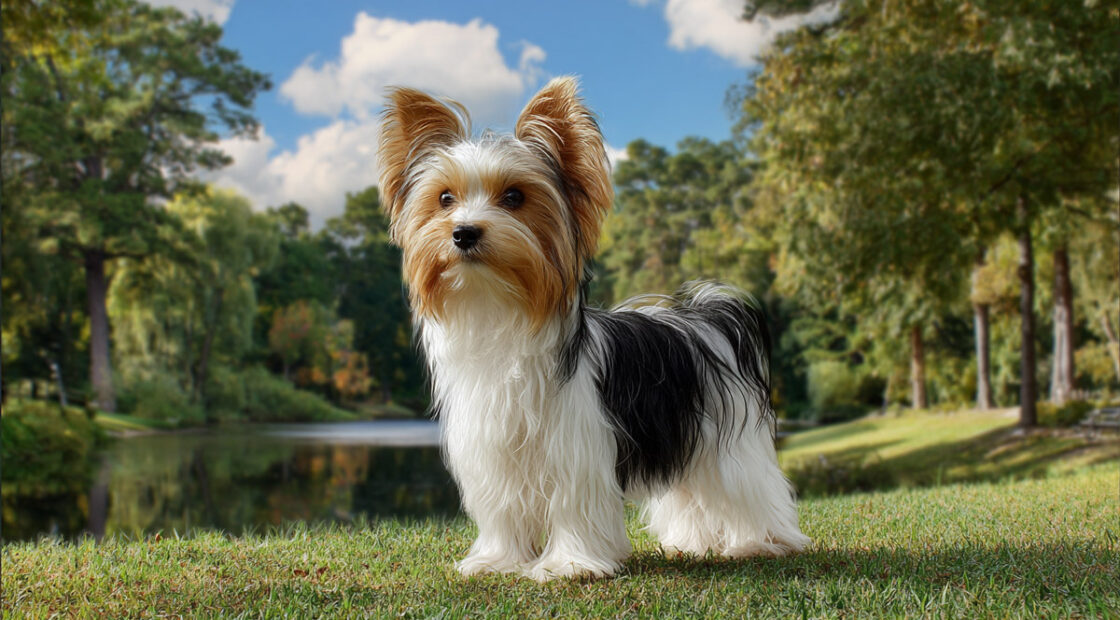
Biewers come in blue or black, white and tan, a coat pattern that comes from a recessive piebald gene the standard Yorkshire Terrier doesn’t show. Werner and Gertrud Biewer began the line in Germany in 1984. The AKC took the breed into its Toy Group in 2021, at 4 to 8 pounds.
Recognition as a separate breed does not settle the genetics.
The UC Davis Veterinary Genetics Laboratory reported in 2019 that some present-day Yorkshire Terriers resemble Biewers on its genetic diversity panel, so the visible pattern and registry papers carry the distinction.
What Is a Biewer Yorkshire Terrier?
Piebald is the whole story with the coat. A recessive gene inherited from Yorkshire Terrier ancestors produces white patches on blue or black and gold, a look the blue and tan Yorkshire Terrier does not show. Beyond that, it’s a long-haired toy terrier.
The AKC, UKC and Canadian Kennel Club standards all say Biewer Terrier. Biewer Yorkie is also in use, and Biewer Yorkshire a la Pom Pon is the original German name.
The AKC places the breed in the Toy Group. Its breed club founders describe it as a lap dog with a terrier’s nerve, which explains the group choice.
The AKC breed standard defines the Biewer by where the tan sits: on the head. A head without tan is a disqualification.
So pattern alone does not make a Biewer. Registered Biewer parentage does.
How the Biewer Yorkshire Terrier Developed and Gained Recognition
The breed starts with one tricolor puppy born in Germany on January 20, 1984. Full AKC recognition came 37 years later, in 2021.

The 1984 Litter in Germany
Werner and Gertrud Biewer bred Yorkshire Terriers under the Friedheck kennel name, using English Yorkshires as foundation stock. One imported sire, Streamglen Richard, appears on both sides of the key pedigree (UC Davis Veterinary Genetics Laboratory, 2019).
- Darling von Friedheck and Fru Fru von Friedheck, two blue and tan Yorkshires, joined the kennel in 1980.
- Their daughter Schneeflockchen von Friedheck was born in 1984, blue, white and gold.
- In 1989 the Allgemeiner Club der Hundefreunde Deutschland recognized the dogs as Biewer Yorkshire a la Pom Pon.
- The first Biewers reached the United States in 2003 (AKC, UKC).
- In December 2007 the Biewer Terrier Club of America limited breeding to Biewer-to-Biewer matings.
The German singer Margot Eskens posed with early Biewers in a promotional flyer, which put the coat in front of the public.
According to the UC Davis history, the Biewers purportedly bred within their own kennel, with no outside introductions, for about five years. The last of their champion dogs went to pet homes when Werner Biewer fell ill in 1992.
Registries and Recognition Dates
The AKC counted the Biewer as its 197th recognized breed in 2021, with 1,424 dogs registered at that point (AKC, 2021).
| Registry | Milestone | Group |
|---|---|---|
| AKC | Foundation Stock Service 2014, Miscellaneous Class July 2019, full recognition January 1, 2021 | Toy Group |
| United Kennel Club | Recognized January 1, 2016 | Companion Dog Group |
| Dogs Australia | Recognized November 3, 2021 | Toy |
| Canadian Kennel Club | Breed standard effective January 2023 | Group V, Toys |
| VDH (Germany) | Recognized nationally in 2024; not recognized by the FCI | Terriers (FCI Group 3 classification) |
Germany came last. The AKC reported in 2021 that the German Kennel Club had not recognized the breed. That has since changed. The VDH, Germany’s national kennel club, accepted the Biewer Terrier in 2024, though the international FCI still does not recognize it.
Is the Biewer Yorkshire Terrier a Separate Breed From the Yorkshire Terrier?
Registries say yes. Geneticists are less sure whether the difference is genetic or only visual.
The AKC, UKC, Dogs Australia and the Canadian Kennel Club each publish a Biewer Terrier standard, so the breed gets its own show ring and its own studbook rules. UC Davis, on the other hand, found that a dog’s identity depends on how a breed is defined, and that some present-day Yorkshire Terriers would be similar to Biewers on its diversity panel.
What the Piebald Gene Does
The piebald (white spotting) gene is recessive. Both parents must carry it for a puppy to show the pattern.
The Biewers claimed they used no outcross, so the likeliest explanation in the UC Davis report is that Schneeflockchen’s parents carried the gene silently. A spontaneous mutation or a cross with another small breed remains unresolved there.
Two Studies, Two Readings
The AKC reports that Mars Veterinary analyzed DNA from 10 Biewers in 2007 and concluded the dogs form a distinct breed. That account names Yorkshire Terrier, Maltese, Havanese and Bichon Frise as contributing breeds.
UC Davis tested 104 Biewers at 33 genetic markers and found its naming varieties (Biewer Yorkshire Terrier, Biewer, Biewer Terrier) statistically identical. Its report did not address the origin of the piebald gene.
The two accounts conflict on ancestry. Mars points to a four-breed mix, while the Biewer breeders and the UC Davis pedigree point to Yorkshire Terriers alone.
For a buyer, the practical test is paperwork. A tricolor dog without registered Biewer parents is a parti-colored dog, not a registered Biewer.
Size, Coat and Color Standards

Height and Weight by Registry
The standards do not agree on height.
- The AKC standard calls for 8 to 10 inches at the withers, and height over 11 inches is a serious fault (approved February 5, 2026, effective April 30, 2026).
- The Canadian Kennel Club allows 7 to 11 inches, or 18 to 28 cm (standard effective January 2023).
- The UKC prefers a weight of 4 to 8 pounds.
- The AKC breed article (2021) also says four to eight pounds.
A 7-inch dog fits the Canadian standard but sits below the AKC’s stated range. Before the 2026 revision, the AKC standard also said 7 to 11 inches and 4 to 8 pounds, which is the wording Dogs Australia and the Canadian standard still follow. Body proportion is close to square in both, slightly longer than tall.
Coat Texture and Color Placement
The coat is long, straight and silky, with no undercoat. The AKC standard has it hanging close to the ground, and the topknot is tied in a single fall with one bow.
Teased or rolled headfalls borrowed from other breeds are an eliminating fault in the AKC ring. The UKC treats curly hair as a fault.
| Feature | AKC standard | UKC standard |
|---|---|---|
| Tan placement | Required on the head | Head and around the anal opening only |
| Body color | Black or blue with white | Black or blue with white, some on the topline |
| White areas | Chest to chin, legs, tail tip | Chest to chin, stomach, legs, tail tip |
Blue eyes or blue flecks in the iris disqualify a dog in the AKC ring. The UKC disqualifies albinism and liver pigment on the nose or eye rims.
What Is the Biewer Yorkshire Terrier’s Temperament Like?

Biewers are affectionate and playful, and they want to be near people. The terrier side shows up as curiosity and nerve.
The AKC standard calls the temperament intelligent, loyal and affectionate, and the UKC adds a fun-loving, child-like attitude. Both read as a companion dog suited to families.
The AKC article quotes the breed club founders describing a dog that carries a toy around the house and runs zoomies when excited. The same article says Biewers adapt to apartment life and to farm life, and they compete in agility, rally, dock diving and obedience.
Training and Barking
Intelligence and a wish to please make training straightforward. Consistency matters more than force with a dog this small.
Neither the AKC standard nor the UKC standard mentions barking, so claims that the breed is quiet are breeder opinion, not published data.
Where the Fit Breaks Down
Households with toddlers who grab or drop dogs are a poor match, because a 4 to 8 pound frame is fragile. The same goes for owners who want a guaranteed quiet dog, and for homes where nobody is around, since the standards describe a dog bred to be with people.
The UKC standard disqualifies viciousness and extreme shyness. Both traits are treated as breeding faults, not as normal variation.
Health Problems, Testing and Lifespan

Few Biewer-specific conditions are documented, but the breed carries the usual toy-dog list, and breeders work from a defined panel of tests for the inherited ones.
Conditions Documented in the Breed
Several complex conditions have been reported in Biewers.
- Tracheal collapse and bronchitis
- Patellar luxation
- Portal-hepatic (liver) shunts
- Legg-Calve-Perthes disease
- Distichiasis, where stray eyelashes irritate the eye
Two single-gene traits are also known. One is a SOD1 mutation that raises the risk of degenerative myelopathy, and the other is a urate transporter mutation behind uric acid bladder stones. Both turn up in other breeds too, according to the UC Davis Veterinary Genetics Laboratory (2019).
The same report found the breed reasonably free of the autoimmune disorders that burden many purebreds.
Teeth are the everyday problem. The breed club’s December 2025 health statement flags retained baby teeth and tartar buildup.
UC Davis adds periodontitis, early tooth loss and puppy hypoglycemia under stress. A sensitive digestive system is also noted, and the club says a good diet controls it.
Tartar control starts with brushing at home. Some owners add natural dental chews sized for a toy breed between brushings.
Tests a Breeder Should Have Done
The Biewer Terrier Club of America sets the panel, as of its December 2025 health statement.
- An ACVO eye exam by a boarded veterinary ophthalmologist comes before breeding begins, with repeat evaluations recommended at 1, 3 and 6 years of age.
- A PRA-prcd DNA test checks for progressive retinal atrophy.
- A PLL DNA test checks for primary lens luxation.
- A veterinary patellar luxation exam, with results registered with OFA, rounds out the panel.
A basic cardiac evaluation is optional. So are a Legg-Calve-Perthes radiograph and a serum bile acid test for liver shunts.
The sources disagree on scope. Paction, a Canadian breeder platform, also lists degenerative myelopathy and hyperuricosuria DNA tests as recommended, and the club statement leaves both out.
UC Davis documents both mutations in the breed, so asking a breeder for those results is a fair request even though the club does not require them.
Lifespan
UC Davis puts the typical Biewer lifespan at 12 to 15 years or more, in line with small dogs generally (Veterinary Genetics Laboratory, 2019).
That is a laboratory estimate, not a longevity survey. No breed-wide survey turned up in the sources reviewed.
How to Groom a Biewer Yorkshire Terrier

A full-length coat needs brushing every day or every other day, and a short puppy cut needs a weekly brushing, according to U.S. breed co-founder Myrna Torres, quoted by the AKC in 2021.
The parent club’s grooming page calls for a pin brush without balls on the tips. It also says to brush only after misting the coat with a light conditioner and water mixture, never when the coat is completely dry.
For a long coat, a basic routine looks like this.
- Mist the coat or apply a conditioner so the hair is never brushed dry.
- Brush in sections with the pin brush, starting at the skin and working outward.
- Part the hair down the middle from nose to tail.
- Tie the headfall in a single topknot with one bow.
- Trim the feet and the hair around the anus, and shave the ear tips, as the AKC standard describes.
- Check the teeth for tartar.
Skip a week and the coat tells you. Silky hair without an undercoat tangles at the elbows, behind the ears and along the tail plume first.
The AKC article also notes that the breed standard carries a strict grooming clause, which is why a show coat takes more daily work than a pet trim.
Breed pages from Dogs NSW call the Biewer hypoallergenic and a good companion for allergy sufferers.
The AKC says no dog is 100% hypoallergenic, and Cleveland Clinic reports that objective studies do not support the idea of a hypoallergenic dog. Low shedding keeps loose hair off the floor but does not remove the proteins in dander and saliva.
Biewer Terrier or Yorkshire Terrier: Which Fits Your Home?
Pick the Biewer if the tricolor coat is the goal. Pick the Yorkshire Terrier if you want a dog that fits the Yorkie standard, because the two standards exclude each other.
| Feature | Biewer Yorkshire Terrier | Yorkshire Terrier |
|---|---|---|
| Color rule | Black or blue and white, tan on the head | Blue and tan only |
| Tricolor | Required | Disqualification (UKC) |
| Weight | 4 to 8 pounds preferred (UKC) | No more than 7 pounds (UKC) |
| Parent club | Biewer Terrier Club of America | Yorkshire Terrier Club of America |
The UKC Yorkshire Terrier standard disqualifies tri-color dogs and any white marking beyond a chest spot of one inch. A tricolor dog entered as a Yorkie would be thrown out of the ring, which is the practical reason the Biewer needed its own standard.
Neither standard gives a measurable temperament difference. Choose on coat rules and grooming goals, not on personality claims from either side.
The upsides of the Biewer are its own show classes and standards at the AKC and UKC, plus a parent-club health panel. The tricolor coat is correct by the standard, not a fault.
Against that, there is limited genetic diversity from a small founder population (UC Davis, 2019) and there are fewer breeders to choose from. The registries also disagree on height.
At home, either breed can wear a short pet trim, so a guide to Yorkshire Terrier haircut styles gives a Biewer owner workable ideas for a pet cut.
Wrong-fit cases are narrow. A buyer who wants a dog under 7 pounds by guarantee should look at the Yorkie cap, and a buyer who wants the dog in a Yorkie show ring needs a Yorkie.
How Much Does a Biewer Yorkshire Terrier Cost?
Puppies from reputable Canadian breeders run CAD 2,000 to 4,300 in 2026, according to Paction.
- In the United States in 2021, the AKC reported $1,000 to $2,500 for a pet puppy and $3,500 to $4,000 for a show or breeding dog.
- First-year total in Canada comes to CAD 3,100 to 6,700 including the puppy (Paction).
- Breeder health screening costs CAD 800 to 2,000 or more per litter (Paction).
The two price sets are not directly comparable. They come from different countries, years and currencies.
What pushes a price up is mostly breeder work: parent health testing, breed club membership, pedigree, coat color and markings, and what the sale includes, such as vaccinations, microchipping and a health guarantee (Paction).
Paction’s first-year table adds supplies, a first vet visit with vaccinations, spay or neuter surgery, and training classes. Those four lines add up to CAD 1,100 to 2,400 on top of the puppy.
A listing far below these ranges skips something. The usual candidates are the health tests, the socialization, or the registration.
How to Choose a Reputable Biewer Breeder

Start with the parent club and work down to paperwork: registration, parent health results, a visit, and a written guarantee.
- Use the parent club first. The Biewer Terrier Club of America is the AKC parent club and runs a breeder directory and a rescue page on its site.
- Ask which registry issues the papers. Listings cite the AKC, the UKC and others, such as the Biewer Terrier Registry of America, which UC Davis reports accepts dogs confirmed by a Mars DNA panel. Verify any registry claim with the named organization.
- Request test certificates for both parents. The AKC Bred with H.E.A.R.T. program requires breeders to certify the screens their parent club recommends and to show proof on request.
- Visit or video call. Meet the dam, see where the puppies are raised, and get the health guarantee in writing.
- Weigh the rescue route. The club’s rescue page covers adult Biewers that need homes.
Walk away if the breeder won’t show health testing or offers no references. Pressure to send a deposit fast is another sign, and so is a story that changes between messages.
The club founders told the AKC in 2021 to be wary of fancy websites and pretty photographs, and of puppy mills selling unsocialized dogs.
No pairing guarantees a litter free of problems, though Paction notes that puppies from health-tested parents are far less likely to develop costly hereditary conditions.
Biewer Yorkshire Terrier FAQ
How do you pronounce Biewer?
Biewer is pronounced like beaver, the animal, according to the AKC and the Canadian Kennel Club.
UC Davis spells it phonetically as “Beeva” in its 2019 breed report.
What does “a la Pom Pon” mean in the breed’s original name?
“A la Pom Pon” translates roughly to “in the pompom style.” Chewy’s breed profile says the singer Margot Eskens suggested it because of the dog’s fluffy tail.
UC Davis confirms only that Eskens promoted the first Biewers and owned one.
Is there a teacup Biewer Yorkshire Terrier?
No registry recognizes one. The AKC and UKC standards describe no teacup or mini class, so those labels are sales terms, not breed categories.
Ask a seller for the parents’ weights and registered papers before trusting a size claim.
What should a Biewer Yorkshire Terrier eat?

No breed-specific feeding standard is published. The breed club’s December 2025 health statement notes a sensitive digestive system that does well on a good diet.
A complete small-breed or toy-breed formula, introduced gradually, is the usual starting point. Ask your vet about meal timing for puppies, because hypoglycemia is a documented risk.
Do Biewer Yorkshire Terriers get along with other pets?
Breed profiles say yes. Basepaws describes the breed as sociable with other animals and people, though neither the AKC nor the UKC standard addresses the point.
Supervise introductions with large dogs, since a 4 to 8 pound frame is easy to hurt in rough play.
Deciding if a Biewer Yorkshire Terrier Fits Your Household

A Biewer Yorkshire Terrier fits a household that can commit to daily coat care and can verify parent health results before paying a deposit.
Over 12 to 15 years, full-coat brushing every other day at the least and daily at the most comes to roughly 2,190 to 5,475 sessions. That range combines the AKC’s 2021 grooming guidance with the UC Davis lifespan estimate, and neither source states it.
Settle the paperwork and test certificates first, since neither can be fixed after purchase. The grooming plan comes next because it is the biggest daily demand, and the budget follows whichever breeder you choose.
A short puppy cut trades coat length for a weekly schedule, about 624 to 780 brushings over the same years.
As of October 2026, the club’s December 2025 health statement is the current test panel, and a revision would change what to request from breeders.