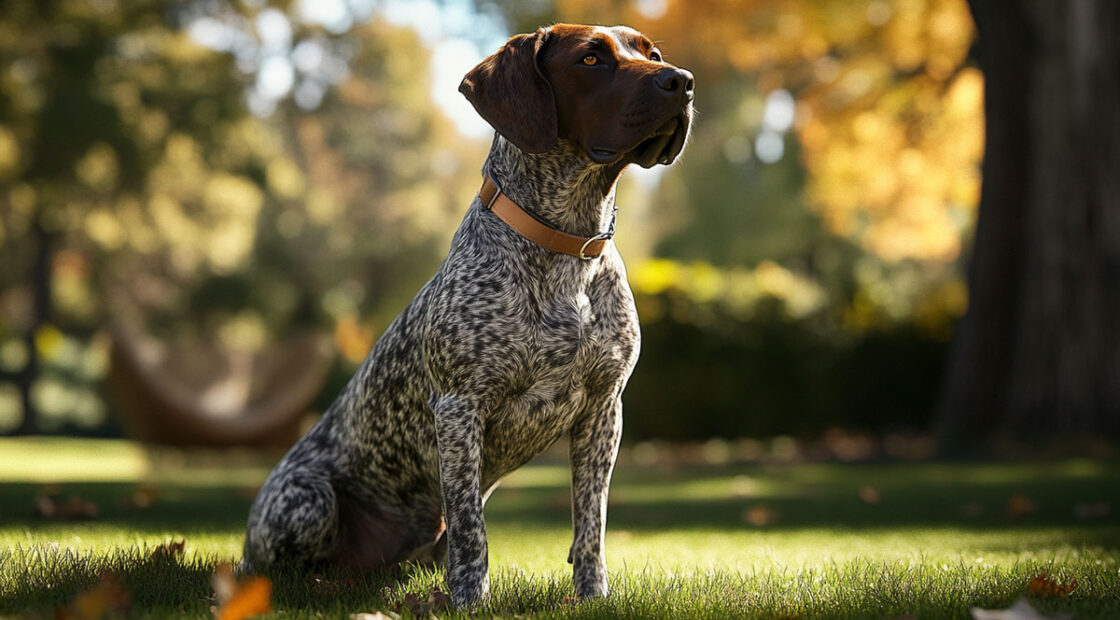
A hunter on foot in 19th century Germany wanted one dog in place of several specialists, and the German Shorthaired Pointer is what breeders gave him. It finds and points game and retrieves from land and water. It also trails wounded animals.
The AKC puts the breed in its Sporting Group. Its 2025 registration rankings landed the dog 9th among 202 breeds (AKC, 2026).
Plenty of older profiles still get coat color wrong. The AKC accepts liver, and liver and white, and it also accepts solid black or any black and white combination (AKC, 2024).
What Is a German Shorthaired Pointer?
Breeders in Germany built it in the 19th century so that a hunter on foot could work one dog in place of separate specialists (Dogs New Zealand).
The word “pointer” describes behavior. When the dog finds game it freezes in a rigid stance, and that pause gives the hunter time to approach (AKC).
In Germany it goes by Deutsch Kurzhaar, literally German Shorthaired. Owners shorten the English name to GSP, and the full formal name is Deutscher Kurzhaariger Vorstehhund.
Each registry files it a little differently. The AKC puts it in the Sporting Group. The FCI lists it as Standard No. 119, Group 7 Pointing Dogs, Section 1.1 Continental Pointing Dogs, Braque type, subject to a working trial, accepted on a definitive basis on 1 January 1954. The UKC uses the Gun Dog Group and recognized the breed in 1948.
Sources give both 1930 and 1935 for AKC recognition. The AKC’s own history page settles it. The breed entered the Stud Book in March 1930 and joined the Sporting Group in 1935.
Registration data for 2025 put the breed 9th among 202 AKC breeds, one place up from 2024 (AKC).

Where Does the German Shorthaired Pointer Come From?
Nobody wrote the exact ancestry down, which WebMD states outright. What is known is that 19th century German breeders blended German pointers with Italian, French and Spanish pointing stock and later the Hannover Hound, a scenthound, aiming for a single dog that could point, retrieve and track (GSPCA).
Breed histories often credit the nobleman Prince Albrecht zu Solms-Braunfels with refining that cross into an all-purpose gundog (Dogs Victoria).
Dogs New Zealand says later crosses to the English Pointer made the dog faster and more energetic.
- In 1879 the first German standard was set, and it removed breeding stock that did not look like the early German pointers (GSPCA).
- The Zuchtbuch Deutsch-Kurzhaar studbook began publication in 1897 (FCI).
- 1907 brought a cross using the black Arkwright pointer bitch Beechgrove Bess, which produced the first black and black and white Shorthairs (GSPCA).
- Dr. Charles R. Thornton of Missoula, Montana, got the first documented US litter in 1925, whelped on July 4 (GSPCA).
- The AKC Stud Book took the breed in 1930, and the Sporting Group followed in 1935.
- The GSPCA became the AKC parent club in 1938, and its first standard was approved in 1946.
Thornton wanted the name German Shorthaired Pointer-Retriever. The AKC required a breed to be either a Pointer or a Retriever, so the name stayed as it is today (GSPCA).
Two world wars thinned the breeding stock in Europe, and the postwar rebuild leaned on the few dogs that survived.
Show Lines and Working Lines
The US standard began as a German one. The GSPCA adopted it and had it approved in 1946, and the current version dates to 1992, with the color section revised effective January 1, 2023 (Showsight Magazine; GSPCA).
Both the AKC and FCI standards tie looks to field function. The AKC text calls symmetry and field quality most important and does not penalize a dog in hard, lean field condition.
The FCI goes further and lists the Deutsch Kurzhaar as subject to a working trial. An AKC history page describes the breed as a link between the field dog and the show dog.
If a breeder points to conformation wins, ask for hunt test or field results too.
German Shorthaired Pointer Size, Coat and Colors
Under the AKC standard, males stand 23 to 25 inches and weigh 55 to 70 pounds. Females stand 21 to 23 inches and weigh 45 to 60 pounds. The coat is short, thick and tough to the touch, in liver, liver and white, or black.
FCI Standard No. 119 gives males as 62 to 66 cm, which converts to roughly 24.4 to 26 inches, so FCI-bred dogs run a little taller than the AKC range. The coat is slightly longer under the tail and on the back edges of the haunches (AKC standard), and the AKC standard has the tail docked to about 40 percent of its length.
The accepted colors are solid liver, liver and white (ticked, roan or patched), and also black or black with white. The standard prefers no particular pattern or head marking (GSPCA).
Many profiles still claim the AKC bars black. The current standard text lists liver or black as the accepted bases and disqualifies other color combinations. The AKC approved the change in October 2022, effective January 1, 2023 (GSPCA).
The confusion has a history. A 1935 AKC-printed standard from the National German Shorthaired Pointer Dog Club listed a black coat as a fault. The 1902 German standard that later US standards used as a reference was written before the first black dogs were produced in Germany (GSPCA).
On docking, the AKC standard requires a docked tail. FCI Standard No. 119 lets the tail stay natural in countries that ban docking, and the UKC does not penalize a full tail.
Webbed feet help the breed swim (Purina).
Coat, Shedding and Brushing
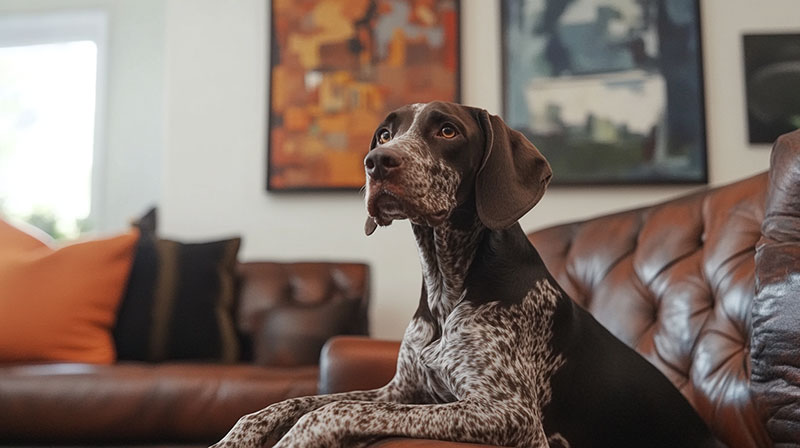
The coat sheds, but it asks very little of its owner.
Brush once or twice a week (PDSA). A hand mitt handles loose hair (Burke’s Backyard). Bathe only when the dog is dirty, and don’t count on the coat being hypoallergenic, because it isn’t (iHeartDogs).
What Is the German Shorthaired Pointer’s Temperament?
Friendly, intelligent and eager to please is how the UKC standard describes the companion dog, and it disqualifies viciousness or extreme shyness. The hunting instinct is the part that shapes how the dog behaves around small animals and young children.
These dogs bond hard. The AKC describes a joyful, highly trainable dog that is deeply attached to its family, and PDSA says the breed needs an owner with plenty of time to give it.
A bored GSP digs up the yard, climbs fences, barks at everything that moves and chases wildlife and pets (Vetstreet).
| Household member | Fit | Note |
|---|---|---|
| Older children and teens | Good | Named the best match by veterinarian Rebecca MacMillan (PetsRadar) |
| Toddlers and small children | Needs supervision | Size and energy are too rambunctious for young children (AKC) |
| Other dogs | Generally good | Accepting and playful with canine friends (PangoVet) |
| Cats and small pets | Risk | Hunting instinct, with sources split on how far training fixes it |
Sources split on cats. Perfect Pets says a trained family dog learns to tell prey from household pets, while Dogster warns the breed may chase cats and smaller dogs and keeps pet birds off limits.
Dogs Victoria advises early socialization with any small animals in the household.
How Much Exercise and Training Does a German Shorthaired Pointer Need?
Plan on one to two hours of hard daily exercise, plus mental work and early training. Published figures run from about 60 minutes to over 2 hours, and age and health move a dog within that range.
PDSA puts the ideal above 2 hours a day, while PangoVet’s veterinary team averages 60 minutes or more, split into two sessions. Veterinarian Rebecca MacMillan caps her guidance at two hours depending on age and health (PetsRadar).
Mental exercise is its own need. Dogs New Zealand warns that a GSP short on physical or mental activity turns frustrated.
Purina lists agility, field trials, hunt tests, obedience and rally obedience, and tracking as breed activities.
Trainability ratings differ. Dogs New Zealand rates the breed moderate, while PDSA and Dogs Victoria call it fairly or relatively easy to train.
The AKC training timeline, built with competitor Belinda Venner, marks the stages that decide how the first years go.
- Bring the puppy home at 8 to 9 weeks and start training right away.
- Teething begins around 4 months.
- Fear stages arrive at 6, 12 and 18 months.
- From 6 months to 3 years, the AKC breed description flags an extremely challenging stretch.
Plan for two hours and you will rarely be short.
What Can a German Shorthaired Pointer Do in the Field?
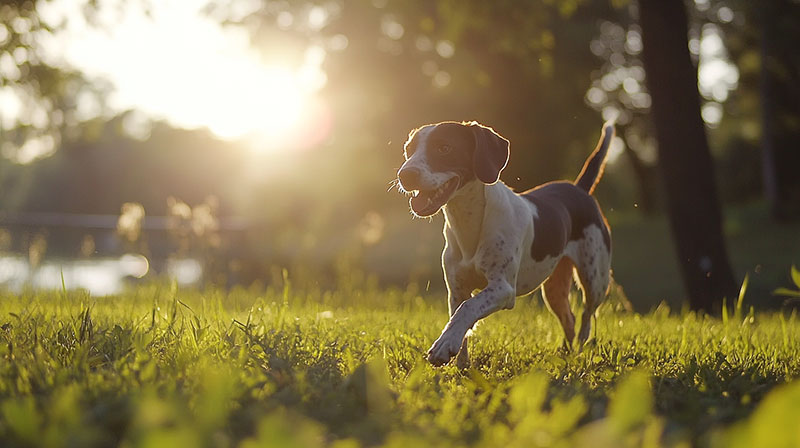
In the field the breed works as a close-ranging bird dog, a water retriever and a trailer of wounded game. The AKC notes it hunts quarry as different as raccoons and deer.
The GSPCA describes what breeders set out to build as a dog that points and retrieves, trails wounded game, hunts large and small game both furred and feathered, and works in low or heavy cover as well as in water. The club adds that breeders wanted these instincts inbred, which cuts down the time spent on force training.
Testing turns those claims into records. Two programs dominate in North America, and they measure different things.
| Feature | AKC pointing breed hunt tests | NAVHDA |
|---|---|---|
| Levels | Junior, Senior, Master | Natural Ability, Utility Preparatory, Utility, Invitational |
| Entry age | 6 months and older | Natural Ability for dogs up to 16 months |
| Result | Pass or fail for each dog | Prize I, II or III from total score |
| Top honor | Master title | Versatile Champion |
AKC hunt tests are pass or fail. A dog needs at least 5 in every scored category and a 7.0 average to qualify, and Advanced titles require an 8.0 average (AKC score sheet).
The Junior level scores four categories and skips retrieving and honoring, so a Junior Hunter title says nothing about retrieving. The very first Junior title went to a GSP, Russo’s Timberdoodle Jake (AKC).
NAVHDA surprises hunters who expect an upland-only test. Its director of promotions, Andy Doak, says there is as much water work as field work, and more at the Invitational (Ducks Unlimited, 2022).
A Prize I in the Utility Test qualifies a dog for the Invitational, where passing earns the Versatile Champion title. The Invitational water work includes a double marked retrieve and a blind retrieve of more than 100 yards, and the dog also has to honor another dog’s retrieve.
German Shorthaired Pointer Health, Lifespan and Screening
Hips, elbows, heart and eyes make up the breed club’s screening list, and bloat is the emergency to plan for. UK records put median longevity near 13 years, above the 10 to 12 many breed guides print.
Common Conditions
The parent club’s test list shows where the risk sits.
Hip and elbow dysplasia come first. The GSPCA says elbow dysplasia is rising in all sporting breeds, GSPs included, and veterinarian Rebecca MacMillan says GSPs can be prone to hip dysplasia like many large pedigree dogs (PetsRadar).
Congenital heart problems are screened by echocardiogram or cardiologist exam, and cone degeneration in the eyes by DNA test. Then there is bloat, a twisting-stomach emergency in deep-chested dogs. A genetic lupus called ECLE (Wikipedia) turns up too, along with epilepsy and von Willebrand disease (Working Dog breed profile).
The AKC standard asks for a deep chest, and a high chest depth to width ratio correlates with bloat risk across breeds (UFAW). In Glickman’s Purdue study of large and giant breeds, risk rose 20 percent each year after age 5 in large breeds and after age 3 in giant breeds (Veterinary Information Network).
Feeding habits matter too. That study’s risk list includes eating quickly and one large daily meal, so a slow feeder bowl and two smaller meals address both.
Surgery is the other route. Prophylactic gastropexy prevents torsion but, in theory, not dilatation (Veterinary Practice News).
Two points stay contested. Veterinary Practice News lists no heavy exercise for an hour before and two hours after meals as a common recommendation, while a Spokesman-Review summary of Glickman’s study says exercise timing did not hold up as a risk factor.
The same study found lean dogs at higher risk than overweight ones. That sits awkwardly with the usual advice to keep sporting dogs trim, so a vet should weigh joint risk against bloat risk.
CHIC and OFA Testing
A CHIC number only shows the required tests were performed, not passed (GSPCA).
The club’s CHIC page sets these requirements.
- Hips need an OFA or PennHIP evaluation at 24 months or older.
- Elbows get an OFA evaluation, also at 24 months or older.
- A board-certified cardiologist examines the heart at 24 months or older.
- An ACVO ophthalmologist examines the eyes every year until age 6.
- Cone degeneration is checked with a DNA test through UC Davis, and the results are registered with OFA.
Those five areas match the list from a PureDogTalk roundtable of national specialty breeders: hips, hearts, eyes, elbows and cone degeneration.
Watch the cardiac age. OFA’s basic form accepts 12 months, but a heart exam before 24 months does not count toward a CHIC number.
Older guides list fewer tests. Vetstreet’s 2011 profile calls the elbow evaluation optional, so check OFA’s current GSP page before relying on any list, this one included.
How Long They Live
A 2024 Scientific Reports study of 584,734 UK dogs found a median survival of 12.5 years for all dogs and 11.9 years for large purebreds (McMillan and colleagues).
| Source | Lifespan | Basis |
|---|---|---|
| Dogs Victoria, WebMD | 10 to 12 years | Average in breed guides |
| Dogs New Zealand | 12 to 14 years | Breed council profile |
| Scientific Reports, 2024 (as summarized on Wikipedia) | 13.4 years median | UK registry, veterinary and insurance records |
Method explains part of the gap. Guide ranges are rules of thumb, while the study counts deaths and live dogs from records, and its authors say the results represent the UK only.
For a US buyer the honest answer is a spread of roughly 10 to 14 years, with UK records at the top.
Ear, Nail and Teeth Care
Ears need the most attention, because this breed swims and retrieves.
Check them weekly. Long, hanging ears trap moisture and dirt, and the AKC explains that water in the canal feeds bacterial and yeast overgrowth.
Clean with a vet-recommended cleaner on a cotton ball or soft cloth, or reach for ear wipes made for dogs if that is easier. The AKC also suggests cotton balls in the ears during baths.
Trim nails every 3 to 4 weeks with clippers or a grinder, and brush teeth several times a week with dog toothpaste (iHeartDogs).
Who Should Not Get a German Shorthaired Pointer?
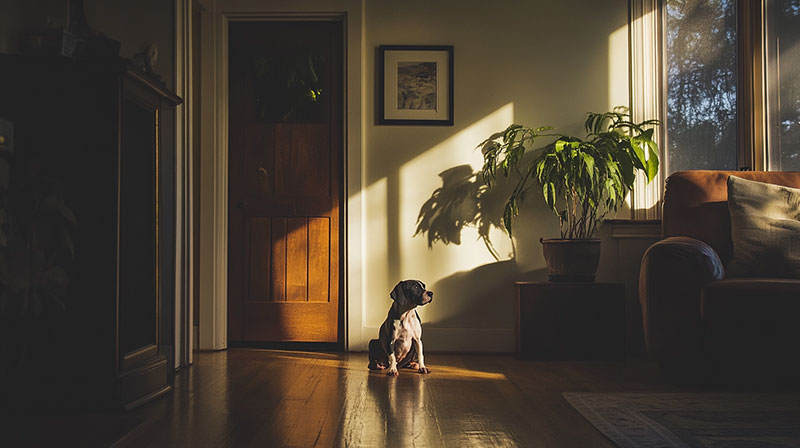
Skip the breed if your days are sedentary, your plan is an outdoor kennel, or your home has no safe outdoor space. The AKC says a GSP probably is not the right fit for anyone without an active lifestyle.
GSP Rescue PA applies the same filter to adopters. It requires proper containment, rejects tie-outs and outdoor kennels as living arrangements, and matches dogs to homes instead of placing them first come, first served.
A kennel or tie-out plan is a poor fit, since the breed can live outside in mild weather but does best in a large house with yard access (Working Dog). With no outdoor space you fall outside Wahl’s description of the fit, which is active families with plenty of space outdoors. A thin health-care budget counts against you as well, because breeders surveyed by the AKC named the financial means to meet a dog’s health care needs as their most critical buyer requirement.
The calm-at-home reputation is conditional. The AKC describes GSPs as quiet and relaxed indoors, and Wahl adds the condition that this holds when the dog gets enough activity to wear itself out.
Calm comes from exercise. It isn’t a default setting.
If you cannot guarantee the exercise, pick another breed.
German Shorthaired Pointer vs Vizsla, German Wirehaired Pointer and English Pointer
The German Wirehaired Pointer is the closest alternative, the Vizsla is the lighter-framed one, and the English Pointer is the upland specialist. Each gives up some of the GSP’s all-round range for a narrower strength.
| Breed | Size against the GSP | Coat | Field strength |
|---|---|---|---|
| GSP | Baseline | Short, thick, tough | Land and water, all-round |
| German Wirehaired Pointer | Slightly taller, similar weight: 24 to 26 in males, 50 to 70 lb | Double, harsh, wiry, water-repellent | Cold, harsh water and land |
| Vizsla | Lighter: 21 to 24 in, 44 to 60 lb | Short, smooth, occasional brushing | Pointing and retrieving |
| English Pointer | Larger: 25 to 28 in, 55 to 75 lb males | Short, dense, single smooth coat | Upland game birds, not waterfowl |
Sizes come from the AKC for the German Wirehaired Pointer and English Pointer, and from Britannica for the Vizsla.
The AKC calls the German Wirehaired Pointer bolder and more intense than the GSP, and aloof with strangers. Its coat suits cold water but adds work, since Orvis notes the double coat needs stripping twice a year.
A Vizsla suits owners who want a lighter dog with a smooth coat. Britannica calls it fairly easy to train but sometimes stubborn, and sources disagree on size, with Wikipedia giving males 22 to 25 inches in its summary box and 23 to 27 inches in its text.
The English Pointer was not bred to hunt waterfowl, according to the American Pointer Club’s Danny Seymour in the AKC piece. A hunter who wants a duck dog loses the main reason to pick it over a GSP, and Hill’s adds that working lines can be too high-strung for family life.
For mostly upland birds with the occasional duck, the GSP’s range beats all three. Hunting cold water often? Then the German Wirehaired Pointer earns its coat.
How to Find a German Shorthaired Pointer Puppy and What It Costs

Start with breeders who follow the GSPCA’s responsible breeder guidelines, check both parents’ health records yourself, and compare written contracts before you pay a deposit. Price follows lineage and testing, not coat color.
- Find breeders through the parent club. Breeders listed by the GSPCA agree not to sell to pet shops or brokers and to provide a pedigree, AKC registration application, and medical and immunization records.
- Match the line to your use. AKC field trial judge Bob Straight advises buyers to ask the right questions to get the type of hunting dog they want (PureDogTalk), so ask for the parents’ hunt test results.
- Look up both parents’ OFA results. The GSPCA says first-time buyers should always ask about the health clearances of sire and dam.
- Visit the breeder in person. The Humane Society of the United States guide says a responsible breeder lets you see every area where puppies and breeding dogs live.
- Read the contract before anything else is signed. GSPCA guidelines call for a written contract offering a refund or replacement, with pet-quality puppies sold on limited registration or spay/neuter contracts, and the AKC advises checking with your vet before agreeing to a spay/neuter timetable.
The sticker price is the smaller part of the bill, because a dog is expensive across its whole life.
Puppy price guides come from pet sites and listing marketplaces, not from the breed club, and their ranges vary widely. Ask several GSPCA-listed breeders for current litter prices, and pay for testing and titles rather than for a color some guides treat as a price factor.
Rescue is the other route. California GSP Rescue vets applications with an interview and lists adoption fees of $250 to $400 (Chewy listing). NorCal GSP Rescue fosters its dogs in volunteer homes before placing them.
German Shorthaired Pointer FAQ
Did a German Shorthaired Pointer ever win Best in Show at Westminster?
CJ, a three-year-old GSP, took Best in Show at the 140th Westminster Kennel Club Dog Show in 2016 (Wikipedia).
Is the breed a good watchdog?
Dogs New Zealand rates its watchdog ability very high and its protection ability moderate.
Burke’s Backyard adds that it alerts owners to a stranger’s approach but should never be aggressive.
Can a GSP compete in dog sports besides hunt tests?
Wikipedia lists AKC agility, dock diving and obedience among its sports.
Some GSPs also work in law enforcement nosework, detecting illicit substances.
Do male and female GSPs differ in temperament?
Slightly, but sources disagree on how. iHeartDogs says males can be more territorial and females often mature faster, while Perfect Pets says females appear more dominant with other dogs.
Meet the parents of each sex before choosing.
What should a GSP eat?
A balanced adult diet, with calories restricted if the dog starts gaining weight, according to VCA Animal Hospitals.
Ask your vet to match the formula and portion to the dog’s age and workload, since a hunting dog burns far more than a house dog.
Choosing a German Shorthaired Pointer Litter Worth the Wait
Parents’ records decide a German Shorthaired Pointer litter’s quality, not the puppies’ looks. Both parents should be at least 24 months old, with hip, elbow and heart results on file at OFA.
Parents under 24 months leave a gap. NAVHDA’s Natural Ability test closes at 16 months, so a dog can hold a hunt prize months before any health result qualifies for a CHIC number.
- Verify the parents’ ages and OFA records.
- Confirm daily exercise and a secure yard, then read the contract and budget for vet care.
Health records come first because they are the only item that cannot be corrected after pickup.
The trade-off is time. One owner profiled by the AKC waited more than a year for each of two puppies from health-tested breeders.
This was last checked in October 2026. A change to the GSPCA’s CHIC page would change the ages above, so recheck OFA before paying a deposit.