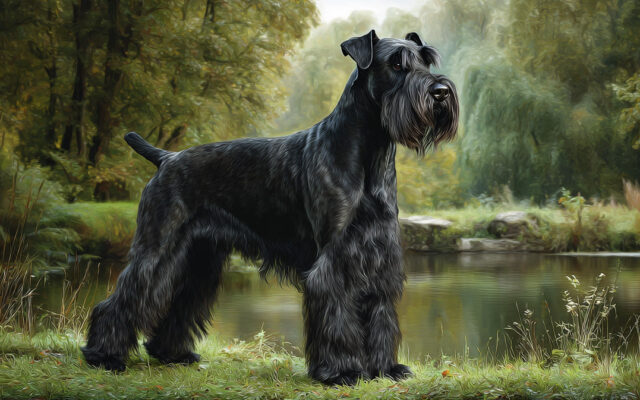
Soviet military kennels developed the Black Russian Terrier in the late 1940s and early 1950s, and the result is a large working breed with a coarse, all-black double coat. The FCI now lists its uses as working dog, guard dog, sport dog and companion.
Registries don’t agree on how tall the dog should stand. The AKC standard, effective 2009, caps males at 30 inches and treats any height deviation as a serious fault. The UKC standard, revised 2017, lets males reach 31 inches.
What Is the Black Russian Terrier?
Guarding is the job. The AKC describes a powerful worker of heavy bone that is naturally aloof with strangers.
Registries file it in different places. The AKC and The Kennel Club place it in the Working Group, the FCI puts it in Group 2, Section 1.4, Pinscher and Schnauzer type (standard 327), and the UKC uses its Guardian Dog Group. Owners also call it the BRT, the Black Pearl of Russia, the Russian Black Terrier or Russkiy Tchiorny Terrier.
The name misleads, because Airedale Terrier ancestry is the only terrier input the standards list. They name the Giant Schnauzer as the main ancestor, and the FCI files the breed with the pinschers and schnauzers.
So it’s a guardian breed with a misleading label.
Black Russian Terrier Size Under the AKC, FCI and UKC Standards
Under the AKC standard, mature males stand 27 to 30 inches at the withers and mature females 26 to 29 inches. Maturity counts from 18 months.
The other two major standards give different numbers, and the gap sits at the top of the range.
| Standard | Males | Females | Weight |
|---|---|---|---|
| AKC (effective 2009) | 27 to 30 in, desired 27 to 29 | 26 to 29 in, desired 26 to 28 | Not stated |
| FCI 327 (in force since 2010) | 72 to 76 cm (28.3 to 29.9 in) | 68 to 72 cm (26.8 to 28.3 in) | Males 50 to 60 kg, females 45 to 50 kg |
| UKC (revised 2017) | 28 to 30 in, limits 27 to 31 | 26 to 28 in, limits 25 to 29 | Males 110 to 132 lb, females 99 to 110 lb |
The AKC treats a male over 30 inches as a serious fault. The UKC allows males up to 31 inches, and the FCI allows up to 78 cm, about 30.7 inches.

The AKC standard states no weight at all. The FCI gives 50 to 60 kg for males and 45 to 50 kg for females, and the UKC’s pound figures convert to the same ranges.
Consumer profiles that list up to 145 pounds exceed the 132 pounds the FCI and UKC allow for males.
On proportions the standards match. The body runs slightly longer than tall, and the AKC puts the height to length ratio at about 9.5 to 10. Chest depth should be at least half the height at the withers, with head length at least 40 percent of it.
The AKC says general balance outranks absolute size.
IPFD goes further and warns breeders against selecting for the top of the range, which produces oversized dogs with poor proportions and a heavy, coarse build (IPFD, 2021). Its health profile also points out that none of the standards calls the breed a giant breed.
Buy for balance, not for the biggest male in the litter.
Coat, Shedding and Grooming Needs of the Black Russian Terrier
Coat type and color
The coat is a rough, thick double coat, with a coarse, slightly wavy outer layer over a soft, dense undercoat. The AKC adds that the outer hair is neither wiry nor curly.
Natural, untrimmed length runs 1.5 to 6 inches under the AKC standard and 2 to 6 inches under the UKC’s, while the FCI gives 5 to 15 cm. Head furnishings fall over the eyes and form the moustache and beard, and the legs carry long, dense hair.
Solid black, or black with scattered gray hairs, is the only acceptable color under the AKC standard. The FCI and the UKC cap gray at a third of the body, and the UKC also permits black and tan.
Non-black puppies still turn up. The Black Russian Terrier Club of America requires K locus and A locus color DNA tests for CHIC testing, and it says non-black dogs can be registered and compete in companion sports but not in AKC conformation (BRTCA article in Showsight, 2021).
Shedding and allergies
Low shedding doesn’t make a dog hypoallergenic.
Breed profiles call the coat low-shedding, Purina lists the breed as non-hypoallergenic, and none of the three standards makes an allergy claim. Hair length does not decide allergen load. Dander and saliva do.
The dense coat also hides skin trouble. The breed club lists ear infections, hot spots, and environmental and food allergies among the breed’s problems, as in other breeds (BRTCA, 2021).
Grooming schedule and clipping
IPFD lists regular weekly grooming as a requirement of ownership (2021) and advises grooming by a professional at six-week intervals. The AKC standard says trimming of the natural coat is needed for shape and upkeep.
Consumer profiles quote anything from a few brushing sessions a week to daily. The spread comes mostly from coat length, since a shorter trim tangles less than a full-length coat.
In the show ring, the AKC allows trimmed body and leg coat from 0.2 to 6 inches depending on location, with longer fall and muzzle furnishings.
The standards speak of clipping and trimming, never stripping. Hand stripping, the technique used on wire-coated terriers, appears in none of the three.
What Is the Black Russian Terrier’s Temperament Like?
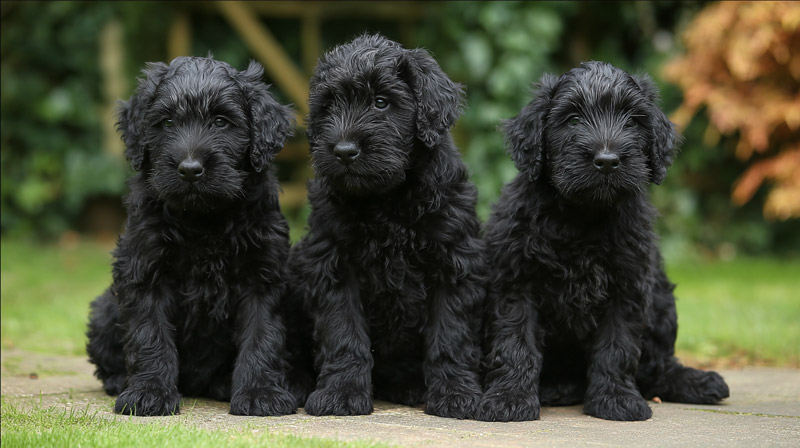
The AKC standard describes a calm, confident, courageous and self-assured dog that is instinctively protective, loyal to its family and aloof with strangers. Shyness or excessive excitability is a serious fault.
The FCI adds that the dog takes an active defensive posture when a threat appears and calms down quickly once it passes. The UKC disqualifies extreme viciousness and extreme shyness.
Family, strangers and other pets
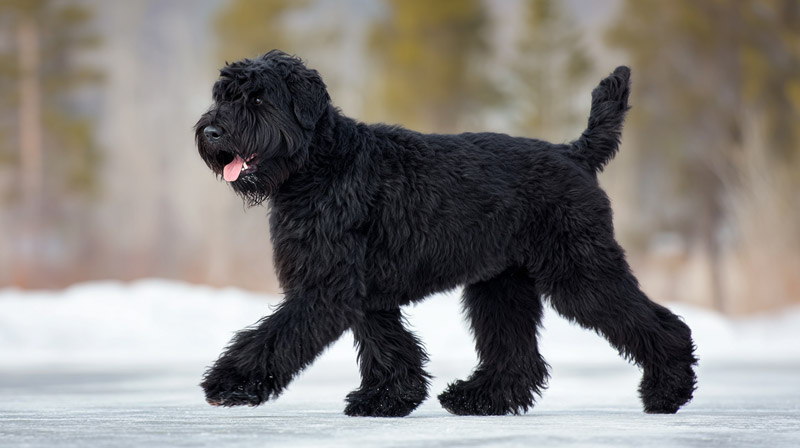
IPFD’s health profile calls the breed reserved and distrustful of strangers, and loving and funny with its own family (IPFD, 2021).
Strangers get a slow warm-up. Children need supervision, because the dogs are very large and play rough, and IPFD says the breed may not be the best fit for toddlers. Some dogs accept other pets, though training doesn’t guarantee it for every dog.
The Westminster Kennel Club rates protectiveness at the top of its scale and tolerance of strangers low, and it calls the breed unsuitable for first-time dog owners (2026).
Training and socialization
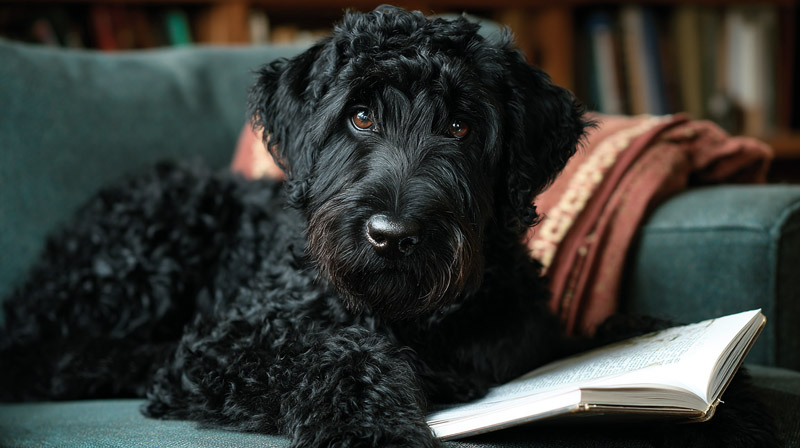
The AKC standard calls the breed highly intelligent and adaptable to training, and the FCI describes it as hard working and reliable.
A WSAVA breed feature written with IPFD notes that behavior problems are not cited for the breed and that early socialization and training are a must (2021). IPFD adds that both continue throughout life, not only in puppyhood.
A dog this size that guards by instinct leaves little room for skipped classes.
Exercise and mental work
None of the three standards sets an exercise target. They stress endurance and a hard-working character instead, and daily targets differ widely between Purina’s and Orvis’s breed pages, so treat any single figure with caution.
The Westminster Kennel Club rates energy level above average (2026). IPFD lists the activities the breed competes in: obedience, tracking, agility, carting, weight pulling, therapy work and herding trials (2021).
IPFD also says dogs should not exercise on a full stomach, a rule that ties directly to the bloat risk covered next.
Give it a daily job, not just a long walk.
Which Health Problems Affect the Black Russian Terrier?
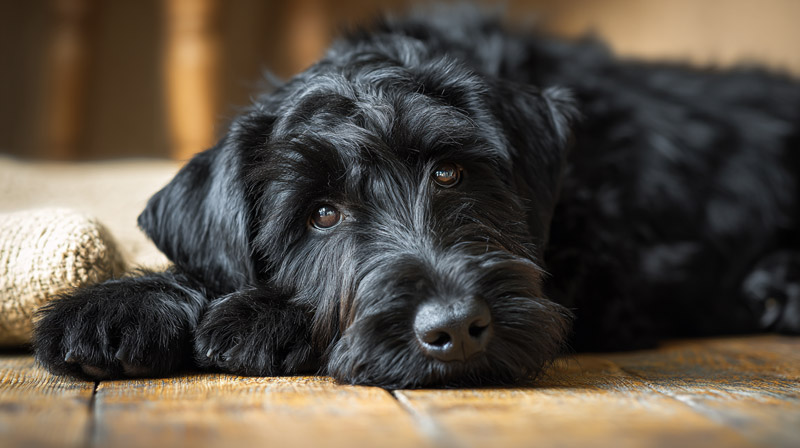
The breed is generally healthy, and its problems cluster in the joints. Hip and elbow dysplasia head IPFD’s list of key health conditions, followed by eye problems and two DNA-testable inherited disorders (IPFD, 2021). The same profile also covers bloat precautions and heart findings.
Hip and elbow dysplasia
More than 41 percent of Black Russian Terriers evaluated by OFA had abnormal hips, and more than 26 percent had abnormal elbows (Black Russian Terrier Club of America health article in Showsight, 2021).
Both figures are floors. Many dogs are X-rayed and never submitted to OFA, and a passing grade at two years does not stop joints from wearing later.
The club adds that most of the dog’s weight rides on its front end, so elbows take heavy wear.
Finland’s breed association shows what a tighter program looks like. It asks that both parents have hip grades A or B and elbow grade 0, that neither parent has more than 20 puppies or 3 litters in Finland, and that inbreeding stays at or below 6.25 percent, the level of a cousin mating (IPFD, 2021).
In the UK, Kennel Club Assured Breeders must use the BVA/KC hip and elbow screening schemes.
Cornell’s College of Veterinary Medicine opened a genetic study of the breed in 2014, aiming at a test that predicts hip and elbow dysplasia risk from birth. Radiographs remain the screening method on the breed club’s recommended list.
Bloat in a deep-chested dog
Of the dogs that went to surgery for gastric dilatation-volvulus in a VetCompass study of UK emergency clinics, 79.3 percent survived to discharge (Royal Veterinary College, 2017).
Speed decides the outcome. In the study’s unadjusted analysis, odds rose with body weight, and dogs of 40 kg or more had the highest odds. Weight data covered under 40 percent of the dogs and dropped out of the final model, which kept breed, age and sex. Odds in that model rose with age up to 12 years and then fell.
The standards require chest depth of at least half the height at the withers, and FCI male weights of 50 to 60 kg put the breed above the 40 kg mark where the study found its highest unadjusted odds.
The breed is not among the study’s five breeds with the highest odds (Great Dane, Akita, Dogue de Bordeaux, Irish Setter and Weimaraner), so its exposure here is inferred from size and chest shape.
- Unproductive retching with a swollen belly means an emergency vet visit now.
- Skip hard exercise right after meals, and ask your vet whether a preventive gastropexy fits, since some vets recommend it at spay or neuter for high-risk breeds.
Inherited disorders with a DNA test
JLPP, short for juvenile laryngeal paralysis and polyneuropathy, shows up around 3 months with raspy breathing and respiratory distress, and affected puppies are usually euthanized for welfare reasons (IPFD, 2021, citing Mhlanga-Mutangadura et al., 2016).
HUU, or hyperuricosuria, forms bladder or kidney stones that need surgical removal and are hard to treat.
Both are recessive, so a dog needs two copies of the mutation to be affected. Carriers can still be bred to a clear-tested partner without producing an affected puppy, which is why both parents are tested before mating.
A carrier puppy is fine. The breed club reports that every puppy with two copies of the JLPP gene has died (BRTCA, 2021).
Heart and eye findings
IPFD reports aortic stenosis, mitral valve dysplasia and cardiomyopathy in the breed, and a US CHIC number requires a heart test. The club says OFA’s cardiac database lists every dog as passing, a result that may be inaccurate because dogs with known disease are rarely entered.
Eye findings include cataracts, distichiasis, entropion and ectropion, with PRA rare. Eye exams are good for one year only, so breeders retest.
Screening tests breeders should run
- Hip radiographs after 24 months
- Elbow radiographs after 24 months
- Cardiac evaluation after 12 months
- Eye exam by a veterinary ophthalmologist
- JLPP DNA test
- Color DNA tests (K locus and A locus)
That is the breed club’s list. IPFD adds the HUU DNA test, which UK Kennel Club breeders get through its CombiBreed package.
A CHIC number means results are public, not that every result passed. Read the OFA entry yourself (BRTCA, 2021).
Lifespan reads up to 12 years in Westminster’s profile (2026) and more than 10 and up to 14 years in IPFD’s (2021). On the testing side, more than 41% of OFA-evaluated hips and more than 26% of elbows were abnormal, and nearly 25% of 735 dogs tested through 2020 carried JLPP (BRTCA, 2021).
Where the Black Russian Terrier Came From and When Registries Recognized It
The Red Star Kennel, a Soviet military kennel near Moscow, developed the breed from the working dogs available after World War II. Registries recognized it between 1981 and 2020, and the sources disagree on several dates.
Who built the breed, and when
A government directive in 1949 told the Red Star State Kennel to create a domestic military guard dog for every climate in the USSR. The kennel belonged to the Central State School of Military Service Dog Breeding and Training (Irena Polonsky and Jean Brown, Showsight).
It showed the Black Terrier breed group at the 1955 State Agricultural Exhibition and won a gold medal, per the same history.
The AKC says the breed first bred true in 1956 (AKC press release, 2004). IPFD adds that Red Star kept the breed to itself until 1957 and that dogs reached the United States in the early 1980s (IPFD, 2021).
The start date is disputed. The AKC’s 2004 release says the program began in the 1930s, while the FCI and UKC standards say the late 1940s and early 1950s, which fits the 1949 directive.
Foundation breeds
The standards name four breeds, the Rottweiler, Giant Schnauzer, Airedale Terrier and the Newfoundland dog, with the Giant Schnauzer as main ancestor (FCI, 2010; UKC, 2017).
Breed histories name more. An AKC history counts some 17 breeds, including Caucasian Ovcharkas and Poodles, and a Showsight breed article adds South Russian and Central Asian Ovcharka, Great Dane and the extinct Moscow Diver.
The counts do not conflict. The AKC describes four main breeds inside a total of 17 breeds and crosses.
A Giant Schnauzer named Roy is credited as the foundation sire in that Showsight article.
The ANKC’s annotated version of the standard credits the Giant Schnauzer for intelligence and quick reactions, the Airedale Terrier for leadership, temperament and stamina, and the Rottweiler for firm stature and fearlessness.
Recognition by registry
| Body | Year | Status |
|---|---|---|
| USSR Ministry of Agriculture | 1981 | Official breed status |
| FCI | 1983 or 1984 | Group 2, Section 1.4 |
| UKC | 1995 | Recognized January 1 |
| AKC | 2001 and 2004 | Miscellaneous class, then Working Group |
| Canadian Kennel Club | 2020 | Full recognition, September |
The FCI’s own nomenclature database lists definitive acceptance on 29 September 1983, while the standard’s history paragraph and most breed articles say 1984.
Some profile pages date the Ministry of Agriculture’s recognition to 1958. BRTCA authors and IPFD give 1981, and 1958 is the year of the first written standard in IPFD’s profile.
The first standard has two dates as well. Polonsky and Brown place it in an exhibition catalog in 1956, and Marilyn Powell’s Showsight overview places it in Red Army regulations in 1958, so the dates fit two different documents.
The AKC standard was substantially revised in 2009 to move it closer to the Russian Kennel Federation’s version (Susan Sholar, Black Russian Terrier Club of America, in Showsight).
How the Black Russian Terrier Differs From the Giant Schnauzer and Rottweiler
Under the AKC standards the Black Russian Terrier stands taller than either relative. The Giant Schnauzer runs smaller, wears a wiry coat and is the easier one to train, while the Rottweiler keeps a shorter coat and is shown without trimming.
| Attribute | Black Russian Terrier | Giant Schnauzer | Rottweiler |
|---|---|---|---|
| Male height (AKC) | Tallest of the three | 25.5 to 27.5 in | 24 to 27 in |
| Coat | Wavy double coat | Hard, wiry, very dense | Straight, medium length, lies flat |
| Trimming | Needed for shape | Not addressed | Shown untrimmed |
| AKC standard in force | 2009 | 1983 | 2022 |
The Rottweiler standard treats any trimming that alters coat length as a serious fault and a long coat as a disqualification. On paper, that makes the Rottweiler the lowest-maintenance coat of the three.
The Giant Schnauzer standard warns that oversized dogs lose the agility a working dog needs, which is the opposite of the pull toward size in the other breed.
The AKC’s Black Russian Terrier temperament wording sits close to the Rottweiler’s. The Giant Schnauzer standard adds playful and easily trained to its description of a composed, watchful dog.
Both parent-breed standards tell judges not to treat belligerence toward other dogs as viciousness or as a fault (Giant Schnauzer standard, 1983; Rottweiler standard, 2022). The Black Russian Terrier standards contain no such allowance, and the FCI lists aggressive behavior as a disqualifying fault (FCI, 2010).
Genetic test providers list the same JLPP test for the Black Russian Terrier and the Rottweiler (Wisdom Panel; Paw Print Genetics), so a Rottweiler owner already knows the screening.
By the standards’ wording, the Rottweiler needs the least grooming and the Giant Schnauzer is the most trainable. Anyone who wants the tallest guardian with a trimmed coat is looking at the Black Russian Terrier.
When a Black Russian Terrier Is the Wrong Dog
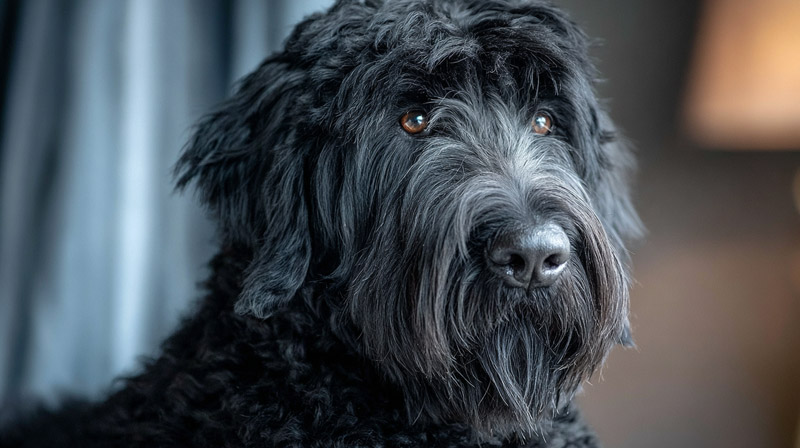
The breed is a poor match for homes that can’t offer company, a cool climate, careful puppy management and a steady budget. None of that is a flaw in the dog.
Long solo days are the first problem. The AKC’s liaison to the breed club called the breed very social and in need of plenty of space and exercise (AKC press release, 2004).
Heat is the second. The design brief required enduring harsh Russian winters (AKC, 2004), so shade, water and a shorter trim are mandatory in warm regions. The standards describe adaptability to many climates, but that is a working record, not a promise about a hot backyard in August.
Slippery floors and stairs matter more than most owners expect. The Black Russian Terrier Club of Canada calls the breed slow to mature and advises no stairs until 4 months, no jumping until 6 months and no slippery surfaces until 18 months (Canadian Kennel Club breed sheet, 2025).
Money is the last one. Large-dog bills arrive in lumps, from bloat surgery to joint care, on top of a grooming cycle that never stops.
If two of those describe your home, pick a different breed.
How Much Does a Black Russian Terrier Cost and Where Do You Find One?
Price depends on health testing, lineage, location and demand, and the published figures for the breed come from listing sites and insurance blogs that disagree with each other. No breed club or registry publishes a price, so ask each breeder for the current figure and what it includes.
What drives the price
Health testing costs the breeder real money. Joint, heart, eye and DNA results for both parents all add up, and the price reflects it.
Supply is thin. In Canada’s first official registration year, 2020, 490 dogs were registered, imports included (IPFD, 2021). European and North American registries bring in dogs from Russia, the Baltic states, Belarus and Ukraine to widen the gene pool (IPFD, 2021).
Inclusions vary too. Registration, microchip, vaccinations and a written contract change from breeder to breeder.
A thin supply means waiting lists, so a short wait for a health-tested litter deserves a second look.
Recurring costs
IPFD puts good-quality food for the breed at $100 or more a month (2021).
The grooming cycle described earlier recurs for the dog’s whole life. Joint care and bloat emergencies sit on top of it.
How to find a breeder
- Start with the Black Russian Terrier Club of America, which the AKC lists as the breed’s parent club and which keeps a breeder referral list.
- Ask for the OFA entries of both parents and the JLPP results for the sire and dam. The breed club says never to buy a puppy without the JLPP results, in any country (BRTCA, 2021).
- Check how closely the parents are related. UK Kennel Club guidance advises breeders to use inbreeding calculators and not to breed a bitch under 2 years old (IPFD, 2021).
- Meet the parents and see where the puppies live, and ask the breeder for written grooming advice, which the Kennel Club also expects.
- Sign a contract that lists the registration number, microchip ID, required health screenings and a return-to-breeder clause, as AKC guidance recommends.
Rescue and adult dogs
Adult dogs needing homes move through breed-club channels. The AKC Rescue Network lists a Black Russian Terrier Club of America rescue program.
Puppy scams
BBB Scam Tracker put the average puppy scam loss at $850 in 2022, up 60 percent since 2017 (Better Business Bureau, 2022).
A Midland, Texas family reported to BBB that it sent $650, shipping included, for a Newfoundland puppy advertised online (BBB Heart of Texas, 2026).
Warning signs include a seller who won’t meet in person or allow pickup, no live video of the puppy, a deep discount on a rare breed, and the same photo appearing on other sites in a reverse image search.
Black Russian Terrier FAQ
Do Black Russian Terriers bark a lot?
Moderately. The Westminster Kennel Club rates barking at 3 on a 5-point scale (2026), which is average for a breed that alerts to strangers.
Teach a quiet cue in puppyhood, before the guarding instinct sharpens.
Do Black Russian Terriers drool?
Little. The AKC standard calls for tight lips without flews, which keeps drool low, though Purina’s breed profile still lists some drool.
The beard holds water after drinking, so expect drips around the bowl.
What should a Black Russian Terrier puppy eat?
A large-breed puppy formula, fed in measured portions. These formulas control calories and calcium to slow growth and protect developing joints, which matters in a joint-prone breed.
Ask your vet when to switch to adult food.
Is there a difference between male and female Black Russian Terriers?
Yes, and the standards want it visible. The FCI requires clearly defined differences between the sexes, and the UKC describes males as larger, stronger and bulkier than bitches.
The AKC adds that withers are more pronounced in males and that females must look feminine without lacking substance.
Are Black Russian Terrier tails docked and ears cropped?
Tails are traditionally docked in the country of origin, but an undocked tail is not penalized under the AKC, FCI or UKC standards. The AKC leaves 3 to 5 vertebrae on a docked tail.
Cropped ears are not acceptable under the AKC standard, and the UKC notes that docking and cropping are banned in some countries.
Does pet insurance cover Black Russian Terrier hip and elbow dysplasia?
It depends on the policy. Some plans cover hereditary conditions, and others exclude anything showing signs before enrollment.
Insure a puppy before symptoms appear, and read the hereditary and pre-existing clauses before you pay.
Who Should Own a Black Russian Terrier?
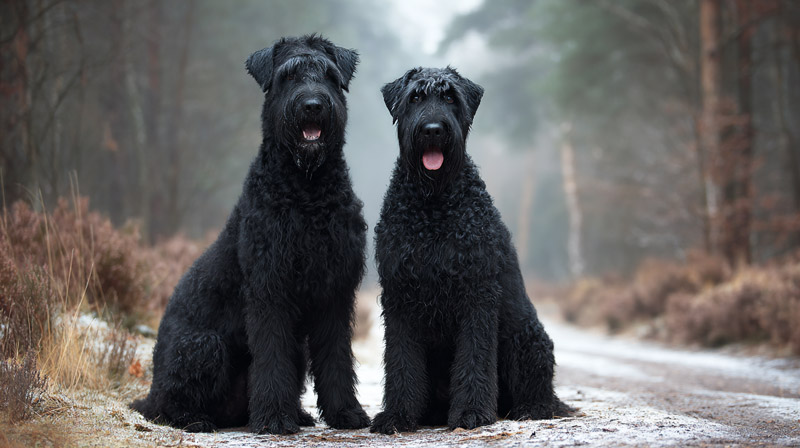
Experienced owners with time, space and a cool home suit the breed. Households missing any of those should choose a different one.
Check the parental health results first, then meet the breeder and both parents, and get grooming, shade and company sorted before the puppy comes home. Health results go first because they screen out a litter before attachment clouds the decision.
Food at the $100 monthly floor (IPFD, 2021) adds up to $12,000 across a 10-year lifespan, before any vet or grooming bill.
The cost that’s easy to forget is time, since a thin supply means waiting for a health-tested litter.
This advice holds as of October 2026 and changes only if the Black Russian Terrier Club of America revises its health testing requirements.