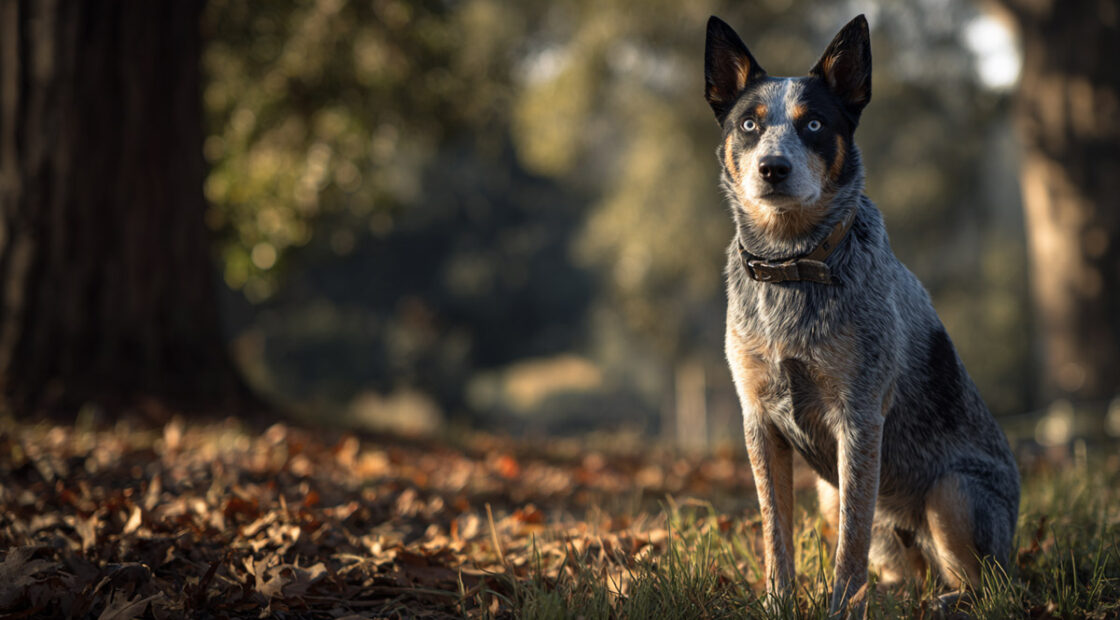
Males stand 46 to 51 cm at the withers and females 43 to 48 cm, which makes the Australian Cattle Dog a medium-sized herder. The coat comes in blue or red speckle. The job is moving cattle by nipping at their heels, and the breed holds up in heat and across long distances of rough terrain.
According to the FCI standard, breeders in 19th-century New South Wales built the type from dingo and blue merle collie crosses, then added Dalmatian and Black and Tan Kelpie blood later on.
If you only remember one health risk, make it inherited deafness. Of 899 dogs tested by BAER, 10.8% were deaf in one or both ears (Sommerlad et al., BMC Veterinary Research, 2012).
What Is an Australian Cattle Dog?
This medium-sized herding breed started out in 19th-century Australia, where cattle were moved by nipping at their heels. The dogs did it over long days in heat and rough country.
Per the FCI standard, the prime function is controlling and moving cattle, in open country or confined areas. The UKC standard goes further and says the breed withstands heat better than any other herding breed.
Cattle Dog and ACD are the short forms. Blue Heeler and Red Heeler describe coat color and the heel-nipping style of work.
Queensland Heeler comes from the Queensland cattle runs where the dogs became hard to do without, according to the ACD Club of America’s breed history. Before Australian Cattle Dog became official, the name in use was Australian Heeler.
The word Australian shows up in both names, but the Australian Shepherd is a separate breed with its own standard.
Each registry files the breed in its own way.

- The FCI lists it in Group 1, Section 2, Cattledogs (Standard No. 287)
- The AKC registered it from May 1, 1980, and has had it in the Herding Group since January 1, 1983 (after a short spell in the Working Group)
- The Canadian Kennel Club recognized it in 1979, in Group VII Herding Dogs
- UKC recognition came in 1985, in the Herding Dog Group
- Dogs NSW puts it in Group 5, Working Dogs
Don’t confuse it with the Australian Stumpy Tail Cattle Dog, which is a different breed. Both descend from Hall’s Heelers, but the Cattle Dog standard calls for a tail reaching about to the hock, and the Canadian standard states the tail is never docked.
Queensland breeders once showed short-tailed and long-tailed dogs as varieties of one breed, which is why the two names still overlap (Wikipedia’s Halls Heeler entry).
Australian Cattle Dog Size and Breed Standard Measurements
The FCI, AKC and UK Kennel Club standards agree on height. Males stand 46 to 51 cm (18 to 20 in) at the withers and females 43 to 48 cm (17 to 19 in).
| Registry | Males (cm) | Females (cm) | Weight in standard |
|---|---|---|---|
| FCI (Standard 287) | 46 to 51 | 43 to 48 | None stated |
| AKC | 46 to 51 | 43 to 48 | None stated |
| The Kennel Club (UK) | 46 to 51 | 43 to 48 | None stated |
| Canadian Kennel Club | 45.75 to 50.75 | 43.25 to 48.25 | 15 to 22.75 kg (33 to 50 lb) |
Weight is where the registries part ways. Only the Canadian Kennel Club and UKC standards print a range, and both land on 33 to 50 lb.
Pet-care pages vary more, from 35 to 45 lb at Purina to 35 to 50 lb at Orvis. The AKC standard itself lists height alone.
Body length runs slightly past height at the withers, a 10 to 9 ratio in the FCI, AKC and Kennel Club standards. The CKC disqualifies dogs over 52 cm or under 44.5 cm, and bitches over 49.5 cm or under 42 cm.
The Kennel Club also notes that an individual dog might be larger or smaller than the printed measurements.
Those cut-offs apply in the show ring. A pet outside them is still an Australian Cattle Dog.
Australian Cattle Dog Coat, Colors and Grooming Needs
Only two colors are recognized, blue and red speckle, carried on a smooth double coat with a short, dense undercoat.
The outer coat is hard and straight, lying flat so rain runs off. Body hair averages 2.5 to 4 cm (1 to 1.5 in) in the FCI and AKC standards.
A blue dog can be blue, blue-mottled or blue speckled, with black, blue or tan markings on the head and tan on the legs, breast and jaws. For red, the standard wants an even red speckle all over, undercoat included, and never white or cream.
Puppies are born white, with only black or red head markings and body patches showing, according to Dogs NSW. The UKC standard calls the white birth coat an oddity inherited from the Dalmatian.
In the FCI and AKC standards, black body markings on a blue dog are not desirable. Red body markings on a red dog are permissible, but not desirable.
Dilute colors such as chocolate or slate are not purebred stock, says the AKC Complete Dog Book.
A white spot on the forehead, called a Bentley mark, is common and draws no fault, though the standard never mentions it (AKC judge Kathryn Hamilton, Showsight, 2018).
Westminster Kennel Club rates shedding at 3 of 5 and grooming needs at 1 of 5. A weekly brushing removes dead hair. The undercoat sheds twice a year, and how active the dog is decides the bathing and nail-care schedule.
That adds up to low upkeep, though not zero.
Where the Australian Cattle Dog Came From
The breed descends from Hall’s Heelers, working dogs bred by the Hunter Valley pastoralist Thomas Simpson Hall (1808 to 1870) and later reshaped by Sydney breeders.
Records are sparse. The FCI standard says early breeders kept very little recorded information, so sources are deeply split on which breeds went in.
Hall’s Heelers and the dingo cross
Droving dogs of the day were commonly Smithfields, which barked at cattle and bit their noses. Hall bred blue-speckled collies with dingoes, and the result worked silently and bit at the heels (Wikipedia’s Halls Heeler entry, citing Eric Rolls).
Monument Australia describes the cross as combining the dingo’s speed and silence with the collie’s intelligent obedience.
Wikipedia’s entry says development probably began at Dartbrook in the 1820s. The 1976 Dartbrook plaque dates Hall’s dingo and blue merle collie experiments to 1840, and the ACD Club of America history credits George Elliott, in Queensland, with dingo and blue merle collie crosses in that same year.
The plaque and the club history agree on the year but name different breeders, so the origin has one date and two claimants.
The Bagust brothers and the first standard
Jack and Harry Bagust of Sydney took the dogs further in the 1880s. According to the ACD Club of America history, they crossed a bitch with a fine imported Dalmatian, which turned the merle coat to red or blue speckle and added a love of horses, though some working ability was lost.
A Black and Tan Kelpie cross followed, and no other infusion worked after that, per the same history. Monument Australia records that by 1890 the blue cattle dog bred true, while the UKC standard dates the breed as pure from 1893.
Robert Kaleski took up blue cattle dogs in 1893 and began showing them in 1897. His first standard, drawn up in 1902, was modeled on the dingo type.
Approval came in 1903, and the breed’s name moved from Australian Heeler to Australian Cattle Dog.
Disputed ancestry
The FCI standard credits the dingo, blue merle smooth-haired collies, the Dalmatian and the Black and Tan Kelpie. It also records a Bull Terrier cross that proved unsuccessful for cattle work.
| Cross | Credited with | Documented in |
|---|---|---|
| Dingo | Silent heel biting, stamina | FCI, CKC, ACD Club history |
| Blue merle collie | Herding sense, obedience, merle coat | FCI, CKC, ACD Club history |
| Dalmatian | Love of horses, loyalty, speckled coat | FCI, ACD Club history, UKC |
| Black and Tan Kelpie | Working ability, compact active build | FCI, ACD Club history |
Dogs NZ tells a different story. It starts with a Smithfield and dingo cross in the 1830s, then adds collie, Dalmatian and Kelpie blood.
Wikipedia’s Halls Heeler entry adds that the claim of Northumberland Blue Merle Drovers Dogs as the imported stock has limited evidence behind it.
Australian Cattle Dog Temperament Around Family, Strangers and Other Pets
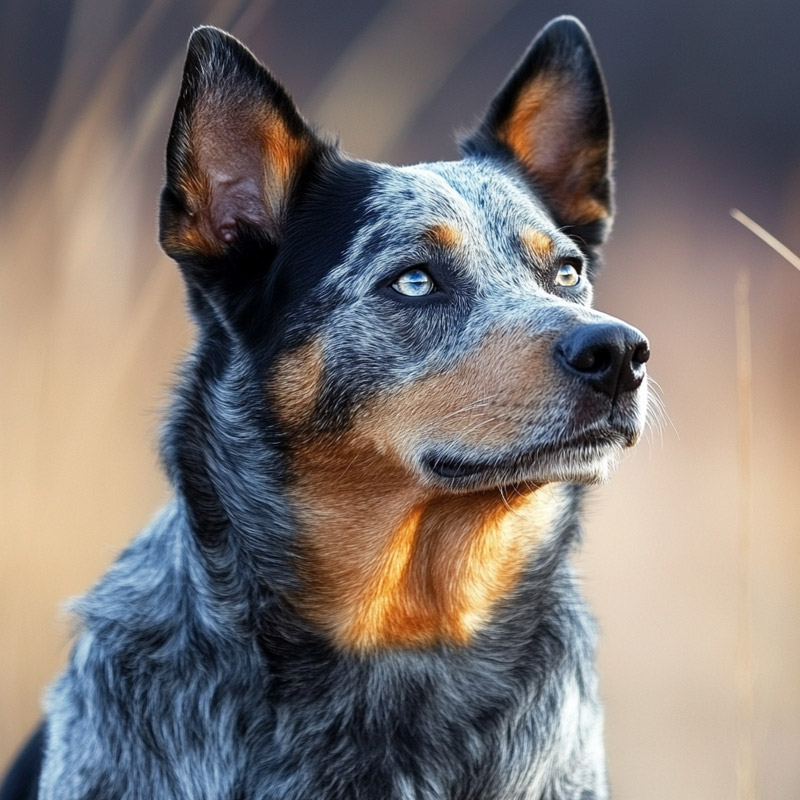
The breed is loyal and alert, protective, and wary of strangers by nature. A working drive shapes how it behaves at home too.
The FCI and AKC standards describe a self-appointed guardian that looks after the stockman and whatever he owns, herd included.
Westminster Kennel Club ratings put protectiveness at 4 of 5. Good with children, good with other dogs and good with strangers each sit at 3 of 5.
With children
Hill’s Pet says the breed may show dominance and herding behavior toward children. Gaye Lynn Grant, a past president of the Australian Cattle Dog Club of America, writes in Showsight that herding children is rare because the dogs rank children above themselves.
Whichever description fits a given dog, supervision around small children is the sensible default.
With other dogs and pets
Hill’s Pet describes the breed as tending toward aggression with other dogs, and Westminster’s 3 of 5 for other dogs sits mid-scale.
The AKC Complete Dog Book calls early socialization a must.
With strangers
Suspicion is a breed trait, and aggression is a disqualifying fault. The FCI standard calls for a dog that is naturally suspicious of strangers yet amenable to handling, and it disqualifies aggressive or overly shy dogs.
ANKC judges Carol and Steve Beckett tell Showsight that suspicion comes with the guardian job, so a friendly greeting from a stranger is not the benchmark. Dogs NZ describes the breed as sometimes suspicious of people it does not know.
Heel nipping and herding at home
The AKC standard says the dog moves difficult cattle by heeling or biting, which is why sound, strong teeth rate so highly in the ring. The CKC standard lists a strong biting dog as the original requirement for mustering wild cattle.
Grant describes the work as a quick grip, usually at the heels, scaled to the stock. Wild cattle get a firm bite, while a lamb only needs the dog’s presence.
The UKC standard calls the breed a silent heeler. Nipping is working behavior, not a defect in the individual dog.
How Much Exercise Does an Australian Cattle Dog Need?
Plan on more than 2 hours of exercise a day, according to PDSA, with mental work counted alongside physical effort.
Dogs NZ is blunter. A leash walk is not enough, and the breed is happiest with a job, especially herding.
On the physical side that means jogging, herding, agility, dock diving, Fast CAT and flyball. Obedience, rally, tracking and scent work take care of the thinking.
Boredom causes the trouble. Hill’s Pet says the breed tends to turn destructive when bored, and Eukanuba says it is unsettled when left alone without exercise.
The AKC Complete Dog Book presents physical and mental stimulation as the cure for demanding behavior. Gaye Lynn Grant of the ACD Club of America goes further and names loneliness and boredom as the breed’s real enemies.
How to Train and Socialize an Australian Cattle Dog
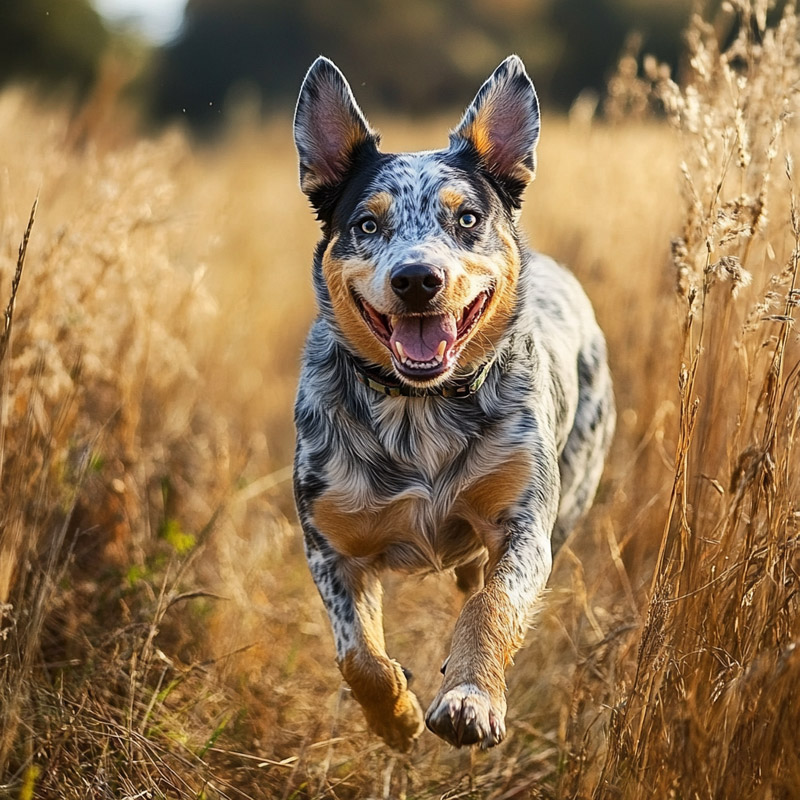
Socialize before the puppy is 12 weeks old, then keep training structured. The AVSAB position statement calls the first three months of life the primary window, and it says puppies can join socialization classes as early as 7 to 8 weeks, before vaccines are complete.
- Introduce the puppy to new people, animals and places without tipping it into fear or withdrawal (AVSAB)
- Enroll in a puppy class at 7 to 8 weeks
- Train with a plan, because Grant says the breed needs an owner with a plan, time and follow-through
- Test the result against the AKC Canine Good Citizen program, which has run since 1989
Skipping the window has a price. AVSAB links incomplete socialization to a higher risk of behavioral problems, aggression included.
Learning speed is not the obstacle. The AKC Complete Dog Book credits a quick, willing mind with making training a pleasure.
Nipping needs its own attention. PDSA warns that the herding instinct can send the dog after the heels of running children, and says early socialization with children and early training can overcome it.
The Canine Good Citizen test has ten items, and three of them hit the breed’s usual friction points: accepting a friendly stranger, reacting to another dog and supervised separation.
Australian Cattle Dog Health Problems and Screening Tests
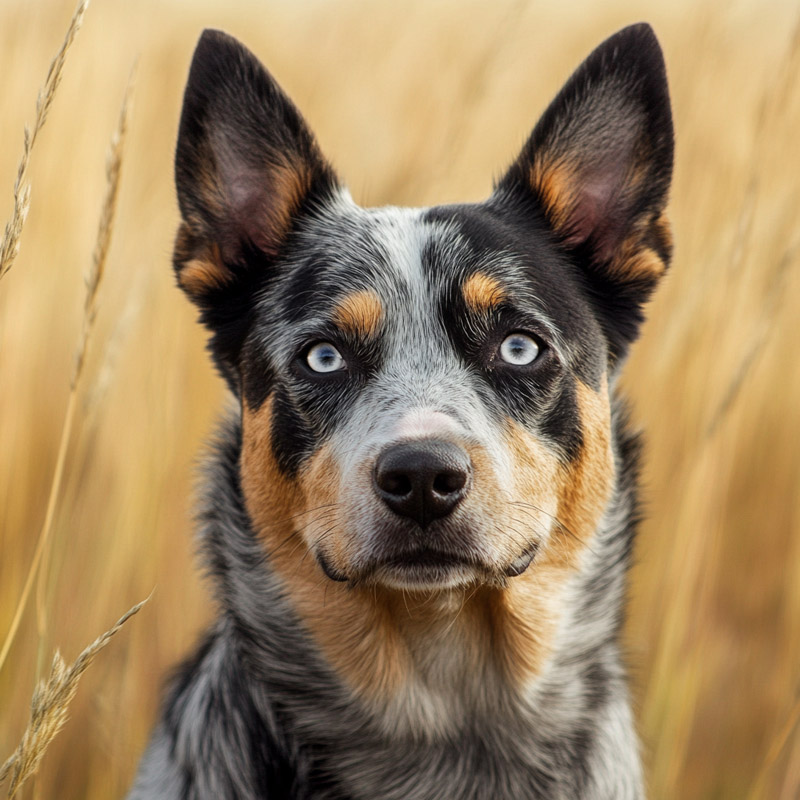
Screening for this breed mostly comes down to progressive retinal atrophy, primary lens luxation, congenital deafness, hip dysplasia and elbow dysplasia.
| Condition | Screening test | Listed by |
|---|---|---|
| Progressive retinal atrophy (prcd-PRA) | DNA test, eye examination | Dogs NSW, Dogs NZ, AKC Complete Dog Book |
| Primary lens luxation | ADAMTS17 DNA test | Dogs NSW, Dogs NZ, UK Kennel Club scheme |
| Congenital deafness | BAER hearing test | Dogs NSW, Dogs NZ (optional), AKC Complete Dog Book |
| Hip dysplasia | Hip X-rays (OFA, PennHIP or BVA/Kennel Club scheme) | Dogs NSW, Dogs NZ, PDSA, AKC Complete Dog Book |
| Elbow dysplasia | Elbow X-rays (OFA or BVA/Kennel Club scheme) | Dogs NSW, Dogs NZ, PDSA, AKC Complete Dog Book |
PDSA’s list for the breed runs longer. It also names eczema (inflamed, itchy skin), portosystemic shunt (blood bypassing the liver), luxating patellas (kneecaps slipping out of place) and urolithiasis (stone formation in the urine).
Eye disease
The prcd-PRA form is an inherited retinal degeneration, and Dogs NSW notes that a DNA test lets breeders avoid affected matings. A late-onset form, rcd4-PRA, shows up on the Dogs NZ list as an optional DNA test.
Primary lens luxation is a painful, potentially blinding disease that typically strikes between 3 and 8 years, according to the test catalogs of CAGT and Labogen.
The mutation is recessive, so carriers can be bred only to dogs tested clear. Gould et al. (Veterinary Ophthalmology, 2011) found the ADAMTS17 mutation in clinically affected dogs of 14 further breeds, the Australian Cattle Dog among them.
Deafness
Of 899 Australian Cattle Dogs tested by BAER, 10.8% were deaf in one or both ears (Sommerlad et al., BMC Veterinary Research, 2012).
A UK study of puppies tested at the Animal Health Trust landed on a similar prevalence. Louisiana State University’s deafness database reports a higher one.
Puppies with a face patch carried a reduced risk in the UK study, and pigmented body spots lowered it in the Australian study. Coat color showed no significant link. Females were at higher risk.
Screening alone has limits. Ten years of BAER testing across 10 breeding kennels produced no substantial drop in prevalence, even in litters whose parents both tested normal (Sommerlad et al., Animal Genetics, 2014).
The authors expect the best long-term gains from breeding only litters whose parents and all four grandparents tested normal. The UK Kennel Club agrees that BAER lowers the risk but does not guarantee hearing in the puppies.
Dogs NZ treats BAER as optional for accredited breeders, while annual eye certificates, hip and elbow scoring, and PLL and PRA DNA tests are among its mandatory tests. Ask for hearing results anyway.
Joint disease
Hip and elbow dysplasia appear on the breed’s main screening lists, though the breed’s own society leans reassuring.
PDSA describes both as poorly developed joints with laxity that eventually leads to arthritis. Dogs NSW calls the breed hardy and healthy, yet says both conditions have been known to appear.
The Orthopedic Foundation for Animals runs a voluntary registry in which boarded radiologists certify hip and elbow conformation. OFA takes final evaluations from 24 months and preliminary readings from 4 months. Its CHIC program, run with the AKC Canine Health Foundation, lets parent breed clubs set required tests.
An OFA and UC Davis analysis of elbow records from 130,117 dogs across 17 breeds found that disease in the left and right elbows tracked closely in most breeds. The exceptions were hybrids, Australian Shepherds and Australian Cattle Dogs, which the authors attribute to low numbers of affected dogs. The same study found that the risk of elbow dysplasia in the offspring rose when one or both parents were affected, though how much it rose varied by breed.
How Long Do Australian Cattle Dogs Live?
The honest answer is a range, and the range depends on who is counting. Dogs NSW leans optimistic, while Dogs NZ and PDSA quote noticeably lower ranges.
The record holder is Bluey of Rochester, Victoria (1910 to 1939), who lived 29 years 5 months and is the oldest verified dog on Guinness World Records. A 100-dog survey published in ACD Spotlight in 2011 found a mean longevity of 13.41 years and called Bluey an uncharacteristic exception. The UK breed club survey by Adams et al. (Journal of Small Animal Practice, 2010) put median age at death at 11 years 8 months.
Bluey regained the record in 2024 after Guinness withdrew the title from the Portuguese dog Bobi (BBC News, ABC News). A Shepparton News interview with her owner’s daughter recalls arthritis late in life as the only real health problem.
The two surveys aren’t measuring the same thing. Adams counts age at death among dogs that died, young deaths included, which pulls a median down. The 100-dog survey is a small owner sample. Both depend on self-reported data, with the UK survey drawn from breed club members and a low response rate.
The two measures bracket a planning figure of 12 to 13 years. Treat anything above that as a bonus, and Bluey as a story.
When an Australian Cattle Dog Is the Wrong Fit
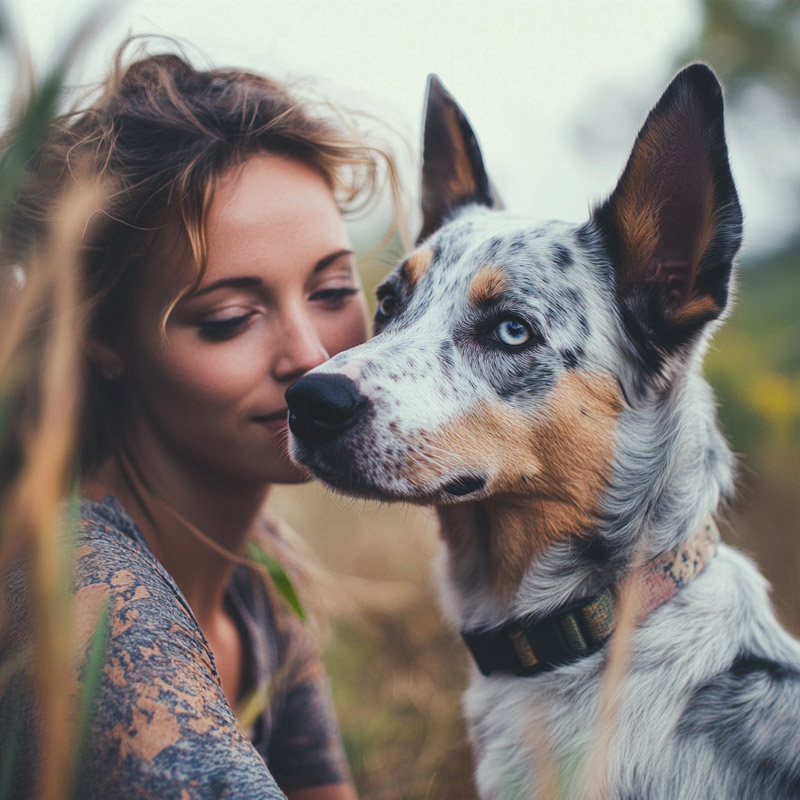
This is the wrong dog for a home that cannot give it a daily job and a plan, or the time to follow through.
Count the red flags before the breed’s looks decide for you.
- Apartment living, which Hill’s Pet and Dogs NZ both rule out
- Novice owners, since Eukanuba does not recommend the breed to first-time owners
- Long absences, because Eukanuba says the dog is unsettled when left alone without exercise
The mismatch is common. Dogs NSW reports that the cattle industry absorbs only a small share of registered Australian Cattle Dogs, and most land in pet homes with no stock and no show ring.
The AKC Complete Dog Book calls the breed a poor choice for owners with little time or low expectations. It says the people happiest with one are active in mind and body.
One or two red flags are workable with planning. Three or more is a mismatch, and a calmer breed will serve better.
Australian Cattle Dog FAQ
Is an Australian Cattle Dog a good guard dog?
Yes. Dogs NZ rates the breed’s watchdog ability very high and its protection ability high.
The same wariness of strangers that makes it alert also raises the stakes on early socialization, since AVSAB links poor socialization to a higher risk of aggression.
Does an Australian Cattle Dog bark a lot?
No. Westminster Kennel Club rates the breed’s barking level at 1 of 5.
Gaye Lynn Grant, a past president of the ACD Club of America, still expects normal barking plus a surprising variety of other sounds, which she credits to the dingo heritage.
How does an Australian Cattle Dog compare with a Border Collie?
According to Orvis, the Australian Cattle Dog moves stock by heeling and the Border Collie works by eye.
Westminster Kennel Club ratings give the Border Collie 5 of 5 for trainability against 4 for the Australian Cattle Dog, and 4 of 5 for barking against 1. Both score 5 of 5 for energy.
Can an Australian Cattle Dog live outside?
Yes, in temperate to cool climates, according to Dogs NZ.
Orvis disagrees and says the dog should live indoors despite its weatherproof coat, while Hill’s Pet calls the breed suited to any climate.
How much should an Australian Cattle Dog eat each day?
Orvis suggests about 1.5 to 2.5 cups of high-quality dry food a day, split into two meals.
The right amount depends on the food’s calorie density and the dog’s workload, so check the bag’s feeding chart and adjust with a vet.
What does it cost to own an Australian Cattle Dog?
PDSA puts the minimum running cost in the UK at 80 pounds a month, before vet bills for illness or injury.
The purchase price comes on top, and the lifetime cost of a dog adds up well beyond the monthly minimum.
Which breeds are mixed with the Australian Cattle Dog?
The best documented is the Texas Heeler, a cross of an Australian Cattle Dog and either an Australian Shepherd or a Border Collie, bred in the United States to work cattle.
Other pairings exist, but no breed standard governs them, so a mix’s size and temperament depend on its other parent.
Choosing a Healthy Australian Cattle Dog Puppy
A healthy puppy arrives with paperwork. That means its own hearing result, and for both parents, DNA clearances and hip and elbow scores.
Ask for the puppy’s BAER result first, then PRA and PLL clearances for both parents, then hip and elbow scores for the breeding pair.
Hearing comes first because BAER can be run on the puppy itself from around five to six weeks of age (Kennel Club and Animal Health Trust), while final hip and elbow results can only come from the parents.
Parent certificates cannot replace the puppy’s own result, since roughly 1 in 9 dogs from BAER-testing kennels was deaf in at least one ear (derived from Sommerlad et al., 2012).
As of October 2026, the Dogs NSW, Dogs NZ and AKC Complete Dog Book screening lists name no DNA test for deafness. A validated one would move parental DNA results ahead of the puppy’s BAER.