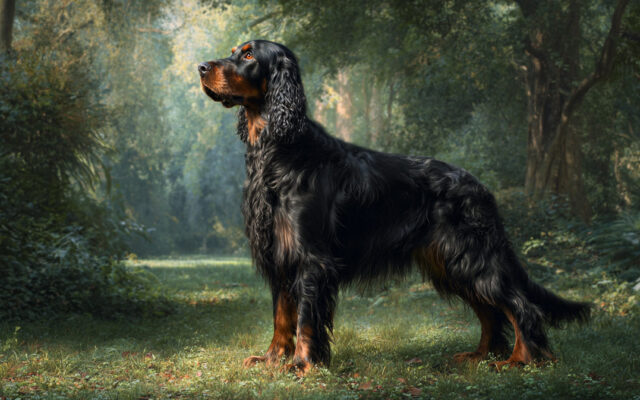
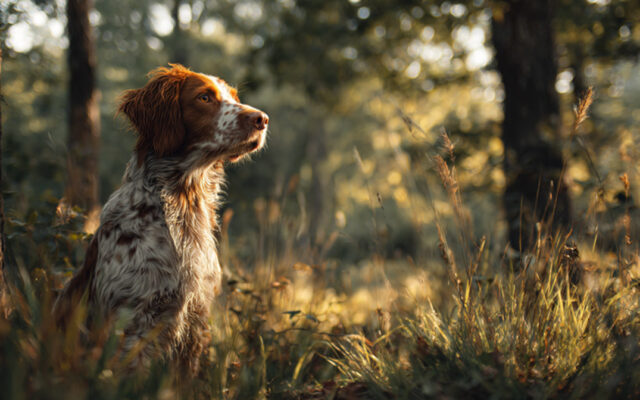
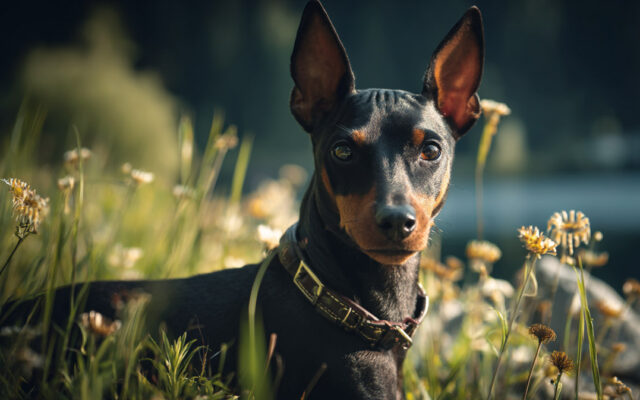
Breed group, adult size, coat, and temperament get locked in long before a puppy’s personality is fully visible. Every puppy type traces back to those four things.
Puppy type classification works off lineage and breed standard, not guesswork about how big or calm a specific dog will turn out.
Kennel clubs sort every recognized breed into an official group, and that placement is what breeders and vets lean on to set expectations for a litter before anyone has really looked closely at the individual puppy.
The Fédération Cynologique Internationale recognizes 356 breeds across ten groups worldwide, a wider net than the narrower system the American Kennel Club uses.
What Are the Official Puppy Breed Groups?
Kennel clubs sort breeds by original function, and the resulting groups are what most people actually mean when they talk about a breed’s “type.”
The American Kennel Club (AKC) currently recognizes 205 breeds, spread across seven official groups: sporting, hound, working, terrier, toy, non-sporting, and herding.
The Danish-Swedish Farmdog became the AKC’s 202nd recognized breed, joining the working group on January 1, 2025 (AKC, 2025). Full recognition followed in 2026 for three more: the Basset Fauve de Bretagne, the Russian Tsvetnaya Bolonka, and the Teddy Roosevelt Terrier, which brought the total to 205.
Other registries carve things up differently. The Fédération Cynologique Internationale (FCI) and The Kennel Club in the UK each run their own group structures, and a breed can land in a slightly different group depending on which one you’re reading.
| Group | Example Breed | Original Job |
|---|---|---|
| Sporting | Labrador Retriever | Retrieving waterfowl and game |
| Working | Bullmastiff | Guarding estates and property |
| Herding | Border Collie | Moving and controlling livestock |
| Terrier | Airedale Terrier | Hunting vermin and small game |
| Hound | Beagle | Trailing scent on foot |
Groups Bred for Function
Function-first groups cover dogs that were originally developed to do a specific job, not to sit on a lap.

- Sporting: retrieving, flushing, and pointing breeds built for fieldwork
- Working: guarding, pulling, and rescue breeds bred for strength and endurance
- Herding: livestock-control breeds with high prey drive and constant motion
- Hound: scent or sight breeds bred to track or chase independently
The Bullmastiff sits inside the working group as an estate guardian. It was bred in nineteenth-century England to track and hold poachers, not maul them.
Hound breeds like the Beagle were bred to trail scent on their own for hours at a stretch, no handler required. That independent streak is a big part of why the hound group tends to score lower on eagerness to please than herding types.
Groups Bred for Companionship
Toy and non-sporting breeds were selected mainly for temperament and size, not for a working task.
Toy breeds were bred purely for companionship, and most stay under 12 pounds as adults. Non-sporting is really more of a catch-all: whatever didn’t fit cleanly into the other six groups lands here, which is how the compact, wrinkled Bulldog and the elegant Poodle end up filed under the same heading.
Group membership predicts behavior more reliably than looks do. Two visually similar puppies from different groups can still grow into very different adult temperaments.
Puppy Size Categories and What They Mean
Weight is what these five tiers track: toy, small, medium, large, giant. Get the tier right and you’ve predicted a dog’s adult footprint well before it finishes growing.
Breeders and vets estimate adult size from paw size, parent weight, and breed-specific growth charts, not from early puppy weight alone.
| Size Tier | Typical Adult Weight | Approx. Time to Maturity | Example Breed |
|---|---|---|---|
| Toy | Under 12 lb | 9 to 10 months | Chihuahua |
| Small | 12 to 25 lb | 10 to 12 months | Shih Tzu |
| Medium | 25 to 50 lb | 12 to 15 months | Border Collie |
| Large | 50 to 90 lb | 15 to 18 months | German Shepherd Dog |
| Giant | Over 90 lb | 18 to 24 months | Great Dane |
Growth plates close earliest in toy and small breeds and latest in giants. That timing is exactly why large-breed puppy food formulas slow down calcium intake, to protect joint development.
Fastest to finish growing is the Chihuahua, usually done by nine months.
A Great Dane puppy is nowhere near finished at nine months. It keeps adding height and bone density until it’s close to two years old, roughly double a toy breed’s growth window.
Owners frequently underestimate this gap. A giant breed puppy that looks proportionally similar to a medium breed at four months can end up twice its adult weight.
Coat Types and Grooming Needs by Puppy Type
Grooming frequency comes down to coat type more than any other single trait. Short, double, curly, wire, hairless, that’s the full spread puppies fall into.
Double coats shed heavily twice a year during seasonal coat blow, releasing a dense undercoat that plain brushing can’t fully remove.
- Short coat: minimal shedding management, occasional brushing
- Double coat: heavy seasonal shedding, needs an undercoat rake
- Curly coat: low shedding, but mats without regular trimming
- Wire coat: needs hand-stripping to keep its harsh texture
- Hairless: no brushing required, but skin needs sun and moisture care
Grooming interval follows coat type directly. Short and double coats can go 6 to 8 weeks between professional grooming, while curly and wire coats often need it every 4 to 6 weeks to prevent matting or pelting.
Owners styling a curly-coated Poodle puppy often work through a rotating set of clip patterns to manage coat length between salon visits.
The Bichon Frise carries a similar curly, non-shedding coat. Most owners keep it trimmed into a short, rounded clip just to cut down on daily upkeep.
Hairless types like the Chinese Crested trade shedding for a different problem: sunburn and skin irritation, since there’s no coat left to buffer the skin.
Temperament, Trainability, and Exercise Needs by Puppy Type
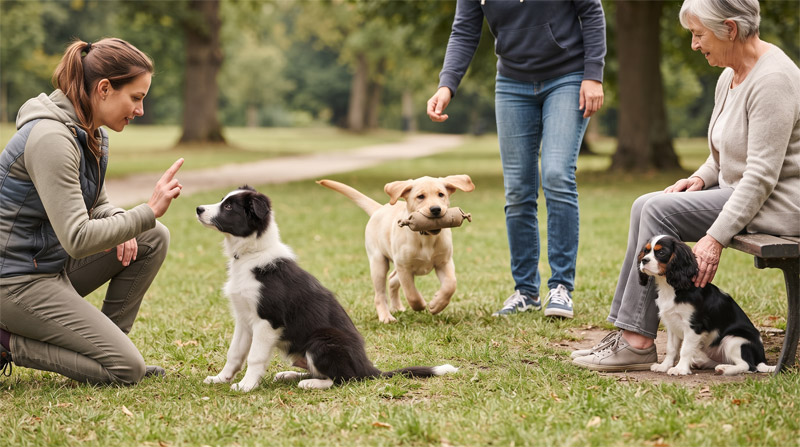
Temperament and exercise tolerance track breed group more closely than they track individual personality, especially in the first two years of a dog’s life.
Herding and sporting types are wired for near-constant activity and quick command response. Toy and companion breeds were selected for close to the opposite: low activity, and a strong pull toward staying physically close to their person.
Temperament and Trainability by Group
High-drive groups, herding, sporting, and some working breeds, show strong prey drive and quick learning, but not much patience for boredom.
The Border Collie is the standard reference point for herding instinct. Without livestock to work, that drive often gets redirected onto joggers, bicycles, or kids.
- High trainability: herding, sporting, and some toy breeds bred to work closely with handlers
- Moderate trainability: many terrier and hound breeds bred to work independently of a handler
- Independent temperament: guardian working breeds bred to make their own decisions
Bite inhibition and early socialization matter across every group, but they matter most in guardian and terrier types, which show naturally lower deference to correction.
A well-bred Bullmastiff typically shows a calm, low-drama temperament at home, and only turns assertive when it perceives an actual threat. That’s a trait shaped directly by its original guarding role.
Exercise Requirements by Group
| Group | Typical Daily Exercise | Risk if Underexercised |
|---|---|---|
| Herding / Sporting | 60 to 90 minutes | Destructive chewing, excess barking |
| Working / Guardian | 30 to 60 minutes | Restlessness, weight gain |
| Toy / Companion | 20 to 30 minutes | Fewer behavior risks, but obesity if sedentary |
Exercise needs shift as a puppy grows. Structured, repetitive exercise before growth plates close can strain developing joints, particularly in large and giant breeds.
A widely used guideline caps structured exercise at five minutes per month of age, twice daily, until a puppy reaches skeletal maturity.
Common Health Predispositions by Puppy Type
Some of these risks show up so consistently in the data that they’re basically baked into certain breeds. A health predisposition is the documented risk a type carries for a specific inherited or structural condition, separate from how any one individual dog actually turns out.
These risks trace back to body structure, breed history, and narrow gene pools. Not bad luck.
- Hip dysplasia in Bulldogs: estimated at around 70% prevalence, among the highest of any breed tracked by the Orthopedic Foundation for Animals (OFA)
- Hip dysplasia in German Shepherd Dogs: approximately 19% prevalence, per OFA records
- Mitral valve disease in Cavalier King Charles Spaniels: roughly 50% affected by age 5, nearly 100% by age 10, according to veterinary cardiology research
- Brachycephalic syndrome: documented in flat-faced breeds including the Bulldog, French Bulldog, and Pug
Large and giant breeds carry most of the documented hip and elbow dysplasia risk. Rapid bone growth under heavy body weight stresses developing joints, according to OFA data.
The Bullmastiff, a large working breed, carries a well-documented risk of hip joint malformation as it matures, which is exactly why responsible breeders screen adult dogs before pairing them.
The Cavalier King Charles Spaniel shows a different kind of risk. It’s a heart-specific issue rather than a structural one, tied to the breed’s narrow historical gene pool.
Reputable breeders screen for these conditions and can produce OFA or cardiology clearances on request. A puppy from unscreened, at-risk parents carries the same statistical odds as the breed average.
Which Puppy Type Is Hypoallergenic or Low-Shedding?
No puppy type is fully hypoallergenic. Low-shedding types simply spread less loose hair, dander, and saliva residue around a home.
Allergic reactions come from a specific protein, Can f 1, found in dog dander, saliva, and urine, not from hair itself.
A 2011 study published in the American Journal of Rhinology and Allergy found detectable Can f 1 in 94.2% of 173 one-dog homes, with no meaningful difference between homes with so-called hypoallergenic breeds and homes without them (Nicholas et al.).
Low-shedding coats still help day to day, mainly by trapping dander in curly hair instead of releasing it into the air and onto furniture.
What low-shedding actually buys you:
- Less visible hair on furniture and clothing
- Dander trapped in the coat rather than airborne
- Require frequent professional grooming to prevent matting
Standard-shedding coats aren’t all downside, either:
- Lower grooming cost and frequency
- More visible shedding, especially during coat blow
- No meaningful difference in raw allergen output
The Poodle remains the standard reference point for low-shedding types, prized for a curly, non-shedding coat that predates the modern designer-dog trend by decades.
Much of that trend exists just to pair the Poodle’s coat with a different breed’s temperament, the Labradoodle being the best-known example.
Allergy sufferers get better results meeting a specific puppy before committing than trusting a breed label. Individual dogs vary more than breeds do.
How to Choose the Right Puppy Type for Your Home
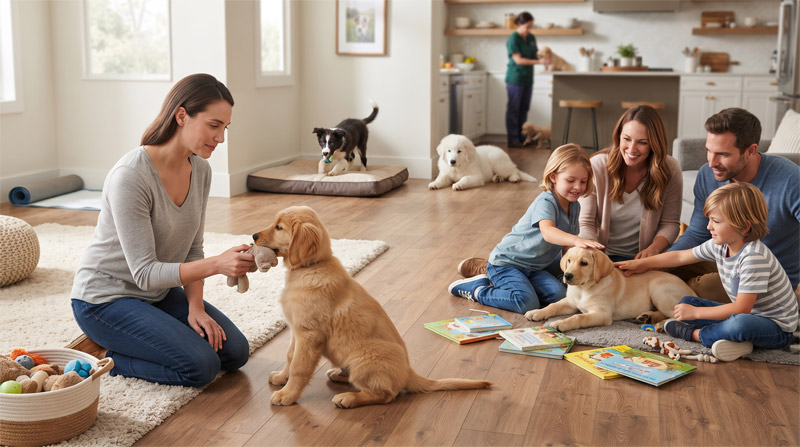
Choosing the right puppy type starts with an honest read of your own schedule and space, not the puppy’s face.
Size, temperament, exercise need, and trainability all get checked against your home before they get checked against a breeder’s list.
First-Time Owners
First-time owners do best with puppy types rated high on trainability and moderate on independence.
A few traits make the difference for a first dog:
- Sporting or companion group breeds with a documented history of easy obedience work
- Moderate exercise needs that fit an average daily routine
- Breeders or rescues that screen for temperament before placement
A couple of profiles are worth steering clear of the first time around:
- High-drive herding types that need a job, not just a walk
- Independent guardian types bred to make their own decisions
A mismatch here is rarely about a bad puppy. It’s almost always a mismatch between drive and daily structure.
Families With Children
Behavior mismatch has a real cost. A widely cited US shelter study found that 40% of owners giving up a dog cited at least one behavior-related reason (Salman et al., 2000, Journal of Applied Animal Welfare Science).
Families weighing a puppy type against young children get more useful information from temperament testing than from breed reputation alone.
- Bite inhibition established early through structured socialization
- Low reactivity to sudden noise, movement, or grabby hands
- A breed history of working closely with a handler rather than independently
Families choosing a working guardian type like the Bullmastiff need to prioritize structured obedience work from an early age. A mature dog of that size and drive is much harder to correct later.
Apartment or Limited-Space Households
Space matters less than energy output. A large, low-drive breed often does better in an apartment than a small, high-drive one.
Large guardian breeds like the Bullmastiff can adapt to indoor apartment life more easily than their size suggests, since their exercise needs run lower than working or herding types.
| Breed Group | Typical Apartment Fit | Main Challenge |
|---|---|---|
| Herding / Sporting | Poor without daily structured exercise | Boredom-driven destruction |
| Working / Guardian | Moderate to good | Size and noise around neighbors |
| Toy / Companion | Good | Separation sensitivity if left alone |
A small apartment does not rule out a large puppy type. It rules out a high-energy one with no plan for daily exercise.
How to Identify a Puppy’s Likely Adult Type
Identifying a mixed or unregistered puppy’s likely adult type takes more than a visual guess.
Skip the guessing and work through this in order for the most reliable read:
- Check the puppy’s pedigree paperwork for registered parents and grandparents
- Run a DNA ancestry panel if the paperwork is missing or the puppy is a known mix
- Track paw size and weight against a breed-specific growth chart every few weeks
- Observe early temperament and body language instead of relying on looks alone
DNA and Genetic Testing
DNA testing has become the fastest way to confirm ancestry when paperwork is missing or incomplete.
Embark Veterinary’s own testing documentation reports 99% breed ancestry accuracy (Embark Veterinary).
That accuracy is built on a database that screens more than 350 breeds and over 250 genetic health conditions, across roughly 230,000 genetic markers.
Results occasionally surprise owners of purebred-registered dogs. A DNA panel can return a mixed Mastiff and Bulldog ancestry reading on a dog registered as a purebred Bullmastiff, since the breed itself was created by crossing those two lines a little over a century ago.
A panel is solid on breed percentages, close relatives, and a handful of inherited health markers. What it can’t tell you is adult temperament, trainability, or how the final coat texture will actually turn out.
Pedigree and Growth Tracking
Pedigree paperwork, registration documents from AKC, UKC, or FCI-affiliated clubs, lists out verified parentage. Growth chart tracking works differently: weekly or monthly weight checks plotted against a known breed growth curve.
A reputable Bullmastiff breeder hands over full pedigree paperwork on request, along with health clearances for the puppy’s parents.
Growth tracking predicts weight and height reasonably well. It says nothing about temperament, which only shows up through direct observation over time.
When a Puppy Type Does Not Match a Household
Puppy type selection fails in the same handful of ways, regardless of how well-bred the individual puppy is.
| Puppy Type | Mismatched Household | Common Outcome |
|---|---|---|
| High-drive herding or sporting | Sedentary or apartment household with no exercise plan | Destructive behavior, escape attempts |
| Brachycephalic (flat-faced) | Hot or high-altitude climate | Heat stress, breathing distress |
| Heavy double-coated | No grooming budget or time | Matting, skin infection |
| Independent guardian | Home with young children and no management plan | Resource guarding, poor supervision outcomes |
Brachycephalic types carry the clearest documented failure point. A Bulldog is 14 times more likely to develop heatstroke than a Labrador Retriever, and flat-faced breeds overall run about twice the heatstroke risk of non-flat-faced breeds (Nottingham Trent University / Royal Veterinary College, 2020).
That risk does not disappear indoors. Warm, humid climates and even moderate summer exercise put a French Bulldog or Pug at risk in conditions a longer-nosed breed would shrug off.
Heavy double coats fail in a different way, through neglect rather than danger. A Great Pyrenees left ungroomed for months develops matting dense enough to trap moisture against the skin and cause infection underneath.
Independent guardian types fail mostly through unmanaged proximity, not aggression by default. A Bullmastiff around small children needs active supervision and early, deliberate aggression prevention work, not the assumption that size alone makes a dog trustworthy.
None of these failure points are permanent. They describe a mismatch in planning, not a flaw in the breed.
FAQ on Types Of Puppies
What is a designer or mixed breed puppy called?
Deliberately cross two purebred parents, like a Labradoodle or Goldendoodle pairing, and you get what’s called a designer dog.
A puppy with unknown or multiple ancestors is usually just called a mixed breed, not a designer dog, since the cross wasn’t planned.
Does a puppy’s type change as it grows?
A puppy’s breed group, coat type, and lineage stay fixed from birth.
Only the visible expression, size, coat length, and behavior, develops over time as growth plates close and temperament matures, typically by 18 to 24 months in giant breeds.
How does puppy type affect the cost of ownership?
Larger types cost more in food, medication dosing, and preventive care than toy types. Coat type adds recurring grooming expense, and screened parents raise the upfront price.
Across a lifetime, an adult dog is expensive to keep, and size drives most of that gap.
What mistakes do people make picking a puppy type by looks alone?
Buyers often match coat color or size to décor or trends, ignoring breed group and original job entirely.
A striking coat on a high-drive herding or working type still needs the exercise and structure that type demands, regardless of appearance.
Does puppy type affect socialization needs?
Guardian and terrier types need earlier, more deliberate socialization than companion breeds, since low deference to correction makes late-stage correction harder.
Herding types need socialization around fast movement specifically, to prevent chasing behavior from becoming fixed by adulthood.
What Should You Check First Before Choosing a Puppy Type?
A puppy type gets checked first on exercise requirement and temperament, not on size or coat, because a household’s daily activity level decides whether a working, herding, or companion type can actually succeed there.
After that first pass, the order goes like this, each step narrowing the field a bit more:
- Exercise requirement and temperament
- Size relative to living space
- Health screening from the breeder
Health screening comes last because it verifies an individual puppy, not a type, and doing it first just wastes time confirming clearances for types that were going to fail on activity level anyway.
Prioritizing exercise fit over appearance means accepting a puppy type that skips the coat color or breed hype originally wanted.
A household that lands on a working guardian type will find the specific daily routine in the Bullmastiff exercise breakdown, which sets exact minutes and intensity by age.