Poodles are usually traced back to Germany, where they retrieved waterfowl, but the FCI lists France as its country of origin and accepted the breed on a definitive basis in 1955 (FCI Standard No. 172).
The AKC has recognized the breed since 1887 and counts three sizes. The FCI adds a fourth, the Medium, between Miniature and Standard.
Whichever size you look at, the coat is dense, curly and low-shedding, and the dog learns fast. These days most Poodles live as companions, with a good number in the show ring or in dog sports.
What Is a Poodle?
Standard, Miniature and Toy Poodles are all judged against the same breed standard. The AKC separates them only by height at the shoulder.
The breed started out as a water retriever. It’s also the base for most “doodle” crosses.
Is there a “French Poodle” breed?
No. The Poodle is France’s national dog, which is where the nickname comes from, but there is no separate French variety.
Which breed group does the Poodle belong to?
It depends on the registry, and they don’t agree with each other.
- The AKC puts the Standard and Miniature in the Non-Sporting Group and the Toy in the Toy Group. It recognized the breed in 1887.
- In the UK, the Kennel Club places all three varieties in the Utility Group.
- The FCI files the breed under Group 9 (Companion and Toy Dogs), Section 2, Standard No. 172.
- The United Kennel Club splits things again, with the Standard Poodle in the Gun Dog Group and the Miniature and Toy in the Companion Group.
According to Purina’s breed profile, the Standard is the only Non-Sporting breed eligible for AKC Retriever Hunting Tests. Honestly, the group label says very little about what the dog can actually do.
Poodle Origin and Original Working Role
Most reference works place the Poodle’s origin in Germany, while the FCI lists France as the country of origin.

Germany or France: where the sources split
Britannica says the breed likely began in medieval Germany as a duck-hunting dog, and that the name comes from the German Pudel, tied to splashing in water.
The FCI names France as country of origin in Standard No. 172 and accepted the breed on a definitive basis on January 1, 1955. In France the dog is the Caniche, a name linked to duck hunting.
The AKC’s history page muddies it further. It says the breed probably arose across Germany, France and Russia, with its roots lost in antiquity.
A workable reading is that Germany supplied the early water dog, and France standardized the breed and made it fashionable at court.
What was the Poodle bred to do?
Retrieve waterfowl from cold water.
VCA Animal Hospitals describes the original working clip as hair cropped close to cut weight and drag, left longer over the head and chest for warmth. The AKC adds that the hair kept on the chest, hips and leg joints protected the dog’s vital areas.
That working clip is the ancestor of the show clip. The retriever side hasn’t disappeared either, since Britannica notes that teams of Standard Poodles have run in the Iditarod.
How did the three sizes develop?
The Standard came first and is the oldest variety, per the AKC. The Miniature was bred down from it, and the Toy followed.
The Miniature was possibly used for truffle hunting. The Toy was bred in the United States in the early 20th century as a city companion, and it turned up in performances and circuses. The Poodle Club of America, founded in 1931, recognized the Toy as the third variety in 1943.
Poodle Sizes Compared
The AKC stops at Standard, Miniature and Toy. The FCI adds the Medium, which makes four.
| Variety | AKC height | FCI height | AKC-listed weight |
|---|---|---|---|
| Standard | Over 15 in | 45 to 62 cm | 40 to 70 lb |
| Medium | Not recognized | 35 to 45 cm | No AKC figure |
| Miniature | Over 10 to 15 in | 28 to 35 cm | 10 to 15 lb |
| Toy | 10 in or under | 24 to 28 cm | 4 to 6 lb |
Height decides the variety. Weight is a typical range, not a rule.
Where the registries draw the lines differently
The AKC caps the smallest variety, the Toy Poodle, at 10 inches. The Kennel Club and the FCI allow up to 28 cm (about 11 inches), which a breeder panel in Showsight describes as an inch above the North American limit.
The Miniature ceiling splits the same way. A dog at 14.5 inches (about 37 cm) is a Miniature under AKC and Kennel Club rules and a Medium under FCI rules.
The Medium itself is recognized by the FCI and most Continental European kennel clubs, not by the AKC.
Is a teacup Poodle a real size?
No. Teacup and similar labels are marketing terms that no major kennel club recognizes.
Embrace Pet Insurance’s breed profile warns that extremely tiny dogs are often plagued with severe health problems and rarely live a normal lifespan.
Poodle Coat Type, Colors and Shedding
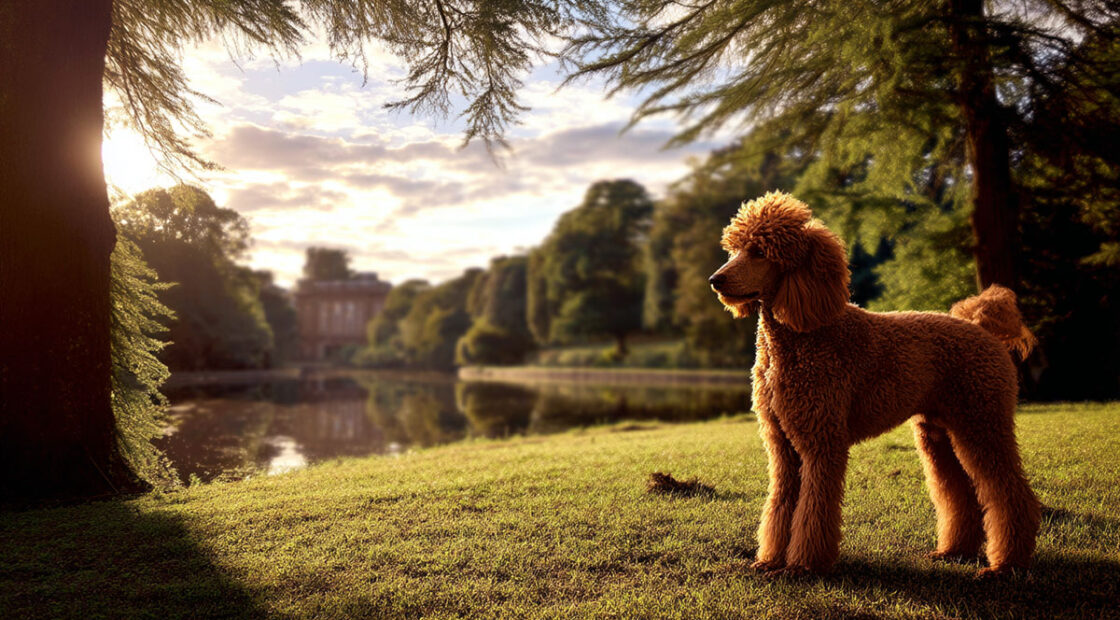
Shedding is minimal. The coat itself is dense, curly and harsh in texture.
What the coat does, and where it fails
In water, it insulates the dog naturally. Left uncut, it forms cords (Purina), and because it grows continually it needs regular clipping either way.
Britannica notes the coat can become matted. Embrace Pet Insurance adds that mats left alone can cause painful skin infections at the roots.
Which colors and patterns are accepted?
Solid colors are the rule. The United Poodle Association’s June 2025 breed document lists black, blue, gray, silver, brown, cafe au lait, silver beige, red, apricot, cream and white.
Multi-colored Poodles (parti, phantom, abstract) are where the registries split.
The AKC lets multi-colored dogs register and title in performance sports, but they are disqualified from conformation. The Poodle Club of America wrote solid colors only into the standard in 1932, and it has not changed.
The UKC is more relaxed, and multi-colored Poodles can compete and title in conformation there.
Do Poodles shed, and are they hypoallergenic?
Poodles shed little, but that does not make them low-allergen. Nicholas and colleagues found detectable Can f 1 in about 94% of 173 homes, with no significant gap between homes with dogs marketed as hypoallergenic and homes with other breeds (American Journal of Rhinology & Allergy, 2011).
A Dutch team measured the allergen on the dogs themselves. Hypoallergenic-labeled dogs, Poodles among them, carried more Can f 1 in hair and coat samples than control breeds, and their homes had no lower airborne levels (Journal of Allergy and Clinical Immunology, 2012).
Only Labradoodles showed lower levels, and only in settled floor dust. Read together, the studies give no reason to expect less allergen exposure from a Poodle household than from any other.
Anyone with a dog allergy should spend time with the specific dog and talk to a board-certified allergist first.
How Often Does a Poodle Need Grooming?
Brush daily and book a professional bath and trim every 4 to 8 weeks, depending on how long the clip is kept (AKC).
The routine in practice
Brushing is a daily job, and it has to go through to the skin, with a slicker brush and a comb. The professional bath and trim fits every 4 to 8 weeks.
In between, Guide Dogs of the Desert’s Poodle grooming sheet lists face, feet and hygiene clips about every 3 weeks.
Which clips can a Poodle wear?
Show rings, including the Westminster Kennel Club Dog Show, accept only the Puppy, Continental and English Saddle clips, plus the Sporting clip in Stud Dog and Brood Bitch classes. The AKC standard disqualifies any other clip.
The FCI standard, as reproduced in the Kennel Club’s version, treats other fancy clips as eliminatory.
Pet owners have far more freedom. Burke’s Backyard notes that most simply have the dog clipped uniformly all over, which gives a lamb-like look, and there are plenty of Poodle haircut styles to choose from once the show ring is off the table.
What does professional grooming cost?
The Daily Groomer’s 2024 pricing roundup puts the national average for a full-service Poodle groom at $112, within a range of $80 to $150.
At one visit every six weeks, that is about nine visits a year, or roughly $1,000 at the average price. Size, coat condition and region move the number.
Skipping the brushing costs more in the end. Whole Dog Journal says there is no simple way to remove mats and tangles without shaving the dog, though some can be picked apart by a groomer.
Poodle Temperament, Intelligence and Exercise Needs
All three sizes share one temperament. Poodles are energetic and sociable, and they like having a job to do.
What is a Poodle like to live with?

The AKC calls every variety very active, in need of plenty of stimulation, and happy to swim, play fetch and compete in dog sports. Orvis describes a highly social breed that wants time with its family. Rover’s breed guide points to a sensitive streak sitting behind the showy exterior.
Petplan’s breed profile sums up the everyday result as friendly and playful, and responsive too.
How smart is a Poodle?
Stanley Coren’s survey of 199 obedience judges ranked the Poodle second among the 133 breeds that drew enough ratings, behind the Border Collie and ahead of the German Shepherd Dog (Coren, Psychology Today, 2009).
The ranking measures a single thing, how readily a breed learns and obeys commands. It rests on judges’ impressions rather than controlled tests, and Coren notes that every breed has exceptions and that training counts for a lot.
How much exercise does a Poodle need?
Plan on about an hour a day for a Miniature or Standard and somewhat less for a Toy, according to Dogster and Orvis.
The Standard needs the most, ideally with room to run or swim. A Miniature does fine on a brisk hour of walking and play. Toys get by with shorter walks and some indoor games.
Physical exercise alone doesn’t cover it. Petplan warns that a bored Poodle can turn destructive, so training and sports such as agility matter as much as the walk.
Which Poodle Size Fits Your Home?
Active households with space suit a Standard. Small homes suit a Toy, and the Miniature sits in between. Grooming and mental needs stay the same in kind across all three.
| Variety | Pros | Cons |
|---|---|---|
| Standard | Athletic, hardier in cold, suits retrieving and dog sports | Most space and exercise, shortest lifespan, bloat and Addison’s risk |
| Miniature | Middle size, adapts to apartments with daily walks | Eye disease and patellar luxation risk, feels the cold |
| Toy | Fits small homes, longest-lived, lighter exercise | Patellar luxation and eye disease risk, feels the cold |
Cold tolerance is the detail most buyers miss. Orvis notes that Miniature and Toy Poodles can struggle in cold weather, while the Standard is hardier.
Can a Poodle live in an apartment?
Yes, and the smaller varieties adapt most easily. iHeartDogs says a Standard can manage too, provided it gets enough exercise and mental stimulation.
When is a Poodle the wrong fit?
Poodles tend to go badly in homes like these.
- You cannot commit to regular professional grooming
- The dog would be alone most of the day, and Poodles are highly social
- Daily training and mental work don’t fit your schedule
- You live somewhere cold and expect a Toy or Miniature to spend long stretches outdoors
How Long Do Poodles Live?
Most Poodles live about 12 to 15 years, with the Standard at the short end and the Toy at the long end.
The median ages at death come from the UK Kennel Club and BSAVA owner survey (2004). Standards reached 12 years, Miniatures 13 years 11 months, and Toys 14 years 8 months. The AKC quotes a wider range for the whole breed, 10 to 18 years.
Why do the figures disagree?
The AKC’s 10 to 18 year range marks the extremes. The survey numbers are medians, so half of the dogs lived longer than shown.
Medians have limits too. A veterinary clinic’s review of the UK longevity studies notes that they include dogs that died young, and that they draw on dogs that died before recent advances in veterinary care.
Insurance data from Japan points higher for Toys. Anicom’s figures, published by Nippon.com in 2020, place Toy Poodles among the longest-lived of Japan’s most popular breeds, though life expectancy at birth and median age at death are different measures.
Why does size set the ceiling?
Smaller dogs outlive larger ones across breeds. A life-table study of insured dogs in Japan (Inoue et al., Preventive Veterinary Medicine, 2015) found the death risk in giant breeds far higher than in small ones at the same age.
Common Poodle Health Conditions and Recommended Tests

Health risks split by variety. Standards face Addison’s disease, bloat, sebaceous adenitis and hip dysplasia, while Toys and Miniatures face progressive retinal atrophy and orthopedic problems such as luxating patellas.
Standard Poodle conditions
Addison’s disease is the immune-mediated destruction of the adrenal glands. Famula and colleagues found it in 8.6% of 1,722 surveyed Standards (reported by UFAW).
Bloat (gastric dilatation-volvulus) is an emergency, and Cornell lists the Standard among the deep-chested breeds at higher risk. Gastropexy greatly reduces the risk of the stomach twisting but does not prevent bloat itself (Washington State University).
Sebaceous adenitis is a hereditary skin disease of the oil glands, thought to be immune-mediated. dvm360 lists the Standard Poodle among the predisposed breeds, and a skin biopsy is the only screen.
Hip dysplasia gets screened by OFA or PennHIP evaluation.
Addison’s is not unique to Standards. The University of Minnesota’s genetics study enrolls both Standard Poodles and Portuguese Water Dogs because both breeds carry an unusually high rate.
No genetic test exists for it, and the Minnesota team is still mapping risk genes.
Toy and Miniature conditions
The smaller varieties follow the small-dog pattern.
- Progressive retinal atrophy (prcd), screened by DNA test
- Patellar luxation, where the kneecap slips out of place
- Legg-Calve-Perthes disease, which is more likely in Toys and Miniatures than in Standards (Purina)
- Miniature dwarfism, which the PCA Foundation’s 2016 screening guide strongly recommends testing for, because the mutation is not limited to a few bloodlines
Which tests should breeders run?
The Poodle Club of America’s December 2024 health statement sets minimum screening per variety. A dog that completes it can earn a CHIC number through the OFA.
For Toys, the minimum is the PRA-prcd DNA test, an annual ACVO eye exam from age 1, and a patellar luxation evaluation from age 1.
Miniatures need the same three tests plus a hip evaluation by OFA or PennHIP.
Standards get a different set. They need a hip evaluation by OFA or PennHIP, an ACVO eye exam, an autoimmune thyroiditis evaluation, and DNA tests for neonatal encephalopathy with seizures and von Willebrand disease I (or clear by parentage).
Cardiac evaluation and a sebaceous adenitis biopsy are listed as optional extras.
Testing lowers risk without removing it. Addison’s has no screening test, and the United Poodle Association warns that the sebaceous adenitis biopsy produces a high rate of false negatives.
Poodle Cost and How to Choose a Healthy Puppy
A Poodle puppy from a health-testing breeder typically costs between $1,200 and $4,000, depending on the variety (Petful, 2026).
What does a puppy cost by variety?
Toys run $1,200 to $3,000 and Miniatures $1,500 to $3,500. Standards come in at $1,500 to $4,000.
Sources disagree on which size costs most. Petful’s ranges, which draw on PetMD, Dogster and Spot Pet Insurance figures, put Standards highest, while Dogster’s own cost guide calls the Standard the cheapest size. Check whether a price covers pet-quality or show-quality stock, and whether the parents were health tested.
What does it cost to keep a Poodle?
Yearly costs after the first year run from $1,790 to $3,720 for a Toy up to $2,550 to $5,140 for a Standard, by Petful’s estimates.
Food, gear and vet bills drive the gap far more than the purchase price. A bloat emergency in a Standard can add thousands of dollars in surgery, which is why Petful points owners toward insurance or an emergency fund.
Owning a dog is expensive over its whole life, and a Poodle that lives 12 to 15 years stretches the total.
How do you find a healthy Poodle puppy?
- Pick the variety first, because each one carries different required tests.
- Ask the breeder for both parents’ results for that variety, using the screening list above, and for CHIC numbers where they exist.
- Verify the results yourself in the OFA database, which can be searched by dog name or AKC registration number (United Poodle Association guide).
- Meet the parents and measure the breeder against the Poodle Club of America’s Code of Ethics. Skip pet-store and puppy-mill sources, which Dogster says commonly supply Toys and Miniatures.
- Consider an adult from a breed rescue, since Embrace notes that many Poodle health and behavior problems do not show in puppyhood.
Breed rescues list adoptable Poodles on Petfinder, and their fees typically cover spay or neuter and vaccines, plus a microchip.
Poodle FAQ
How do you train a Poodle?
Start early, because Poodles are among the easiest dogs to train, per VCA Animal Hospitals. Keep sessions varied, since Dogs Victoria notes the breed’s intelligence needs regular challenge to prevent boredom.
Agility and similar sports add mental work, according to Dogster.
Do Poodles get separation anxiety?
Some do. Orvis describes the breed as highly social and happiest with plenty of time with its family, so long solitary days raise the risk.
Build up alone time in short steps instead of leaving a young dog for hours at once.
Is a Poodle the same as a Goldendoodle?

No. A Goldendoodle is a cross between a Golden Retriever and a Poodle, while the Poodle is a purebred with one breed standard for all sizes.
Rover notes that appearance, coat type and temperament vary widely among Doodles.
Which breeds are crossed with Poodles most often?
Britannica lists the Labradoodle (Labrador Retriever) and the Schnoodle (Schnauzer), along with the Pekepoo (Pekingese).
Breeders also pair Poodles with Golden Retrievers, Cocker Spaniels and Maltese, which produces the Goldendoodle, Cockapoo and Maltipoo.
Can You Keep Up With a Poodle for 12 Years?
Yes, for owners who can fund professional grooming and daily coat care for 12 to 15 years. A Poodle suits a household that settles those commitments before the puppy arrives.
The lifetime grooming bill is the number most buyers never calculate. At the $112 average price and nine visits a year, grooming alone costs roughly $12,000 across a Standard’s 12-year median life and about $14,800 across a Toy’s 14 years 8 months.
The smaller variety lives longer, so it carries the larger grooming bill.
Sequence matters, because costs and test results can be checked before purchase while habits only form afterward. Price a groomer and set the budget first. Then pick the variety and a health-tested breeder. Daily brushing and training start in week one.
The trade-off is plain. A low-shedding coat swaps hair on the floor for a standing appointment. Breeder screening requirements follow the Poodle Club of America’s December 2024 statement, verified October 2026, so a revised statement would change which results to request.