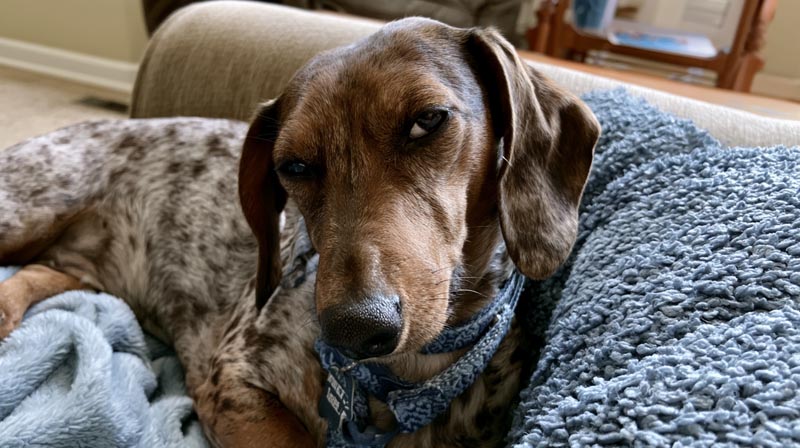
Nobody warns you about the fur until you’re pulling clumps of undercoat off your couch every spring.
Medium fluffy dogs sit in a sweet spot most owners love: big enough to feel substantial, small enough to live comfortably in most homes.
But fluffy coats come with real trade-offs. Shedding patterns, grooming costs, and exercise needs vary dramatically across double-coated breeds like the Bearded Collie, the Soft Coated Wheaten Terrier, and the Finnish Spitz.
This guide covers what actually defines the category, which breeds belong in it, and what daily life with one looks like, from coat care to family compatibility to lifetime cost.
What Are Medium Fluffy Dogs?
Medium fluffy dogs are breeds that fall between 25 and 65 pounds, stand roughly 15 to 22 inches at the shoulder, and carry either a dense double coat or a long, plush outer coat that creates that signature puffed-out look.
The “fluffy” part is almost always coat structure, not just length. A dog with a thick double coat has 2 distinct layers: a soft, insulating undercoat and a longer, weather-resistant guard coat on top. Both layers together create the fluffy silhouette that draws most people to these breeds in the first place.
Why does the size-plus-coat combination matter so much? Because it directly shapes daily life with the dog. A medium double-coated breed sheds more, needs more grooming time, and runs warmer than a similarly sized short-coated breed.
According to the APPA 2024-2025 National Pet Owners Survey, 44% of U.S. households own at least one dog. Among buyers choosing specific breed types, grooming cost ranks as the top concern for 26% of people reconsidering their breed choice (Rover, 2024).
| Trait | Medium Fluffy Dog | Medium Short-Coated Dog |
|---|---|---|
| Weight range | 25-65 lbs | 25-65 lbs |
| Coat layers | Usually double-coated (guard hairs plus undercoat) | Typically single-coated or has a minimal undercoat |
| Shedding pattern | Seasonal coat blowouts plus year-round shedding | More consistent, generally lower-volume shedding |
| Professional grooming cost | Approximately $70-$140 per session | Approximately $35-$70 per session |
Double Coat vs. Single Coat
Double coat: Two layers that serve different jobs. The undercoat traps body heat in winter and releases it in spring via a process called “coat blowing.” The guard hair repels moisture and dirt at the surface level.
Single coat: One layer only. Sheds at a steadier, lower rate year-round. Less insulation, less protection from elements, but considerably less fur on the couch.
Most medium fluffy breeds carry double coats. The Soft Coated Wheaten Terrier is one of the rare exceptions in this size range. It has a single silky coat that sheds less than the average fluffy breed.
What Weight and Height Define “Medium”
The AKC defines medium breeds as those generally between 20 and 60 pounds, though practical usage stretches this to around 65 pounds before a dog reads as large.
Height matters too. 15 to 22 inches at the shoulder covers most medium fluffy breeds. Dogs in this range are big enough to handle active households but small enough to fit comfortably in standard-size living spaces without constant spatial negotiation.
A few breeds sit right on the medium-large boundary. The Australian Shepherd, for instance, can reach 65 pounds at the top of the male range, which some classify as large. Most owners and breeders treat it as a medium breed in practice.
What Medium Fluffy Dog Breeds Are There?
There are roughly 12 well-established medium fluffy dog breeds recognized by the AKC or FCI. They split into 3 main groups based on working origin: herding breeds, spitz-type breeds, and companion breeds that happen to carry fluffy coats.
Herding Breeds With Fluffy Coats
The Border Collie stands 18 to 22 inches and weighs 30 to 55 pounds. It carries a rough or smooth double coat, with the rough variety producing the classic fluffy appearance. The breed ranks as the most widely used herding dog in the world (iHeartDogs, 2024), which tells you everything about its work drive and energy needs.
The Australian Shepherd runs slightly heavier at 40 to 65 pounds and stands 18 to 23 inches. It has a medium-length double coat that always comes in merle or solid patterns with white markings. Aussies are the more socially outgoing of the 2 herding breeds here. Border Collies can be standoffish with strangers; Aussies generally are not.
The Shetland Sheepdog (Sheltie) is smaller at 15 to 25 pounds but carries an exceptionally dense double coat with a prominent mane. It originated on Scotland’s Shetland Islands and was bred to herd the compact native sheep there.
The Bearded Collie weighs 45 to 55 pounds and has one of the longest, most flowing double coats in the medium herding group. Daily brushing is non-negotiable with this breed.
| Breed | Weight | Coat Type | Energy Level |
|---|---|---|---|
| Border Collie | 30-55 lbs | Rough or smooth double coat | Very high |
| Australian Shepherd | 40-65 lbs | Medium-length double coat | Very high |
| Shetland Sheepdog | 15-25 lbs | Dense double coat with a pronounced mane | Moderate to high |
| Bearded Collie | 45-55 lbs | Long, flowing double coat | High |
Spitz-Type Medium Fluffy Breeds
The Keeshond is probably the most purely “fluffy” breed in this category. It weighs 35 to 45 pounds, carries a spectacular double coat with a lion-like mane, and has the distinctive spectacle markings around the eyes unique to the breed. Originally a Dutch barge dog, it adapted well to small spaces.
The Finnish Spitz weighs 20 to 35 pounds and has a standout red-gold double coat. It ranks at No. 194 on the AKC’s 2024 popularity list, making it rare to find outside Finland and dedicated breed circles. It was bred to hunt birds and has an unusually vocal, bark-heavy personality for a medium dog.
The Icelandic Sheepdog sits at 25 to 30 pounds with a thick double coat in either short or long variety. It is Iceland’s only native breed, recognized by the AKC in 2010.
What unites spitz breeds: pointed muzzles, erect ears, tightly curled or bushy tails, and dense double coats built for cold-climate work. They tend to be alert, independent thinkers compared to herding breeds.
Companion and Water Breeds With Fluffy Coats
The Soft Coated Wheaten Terrier weighs 30 to 45 pounds and is one of the few medium fluffy breeds with a single silky coat. It sheds less than double-coated breeds, making it a popular choice for owners with mild sensitivities. Irish farm origin; the coat was bred to withstand wet Atlantic weather.
The Portuguese Water Dog runs 35 to 60 pounds with a wavy or curly single-layer coat that repels water rather than insulating against cold. It does not blow coat seasonally. The Obama family’s choice of this breed in 2009 pushed it from obscurity into mainstream visibility almost overnight.
The Tibetan Terrier weighs 18 to 30 pounds despite the name. It is not technically a terrier but a herding and companion breed from Tibet. Its double coat grows to floor length when uncut and is one of the more high-maintenance coats in the medium category.
What Is the Coat Structure of Medium Fluffy Dogs?
The coat structure of a medium fluffy dog determines everything downstream: how much it sheds, how often it needs brushing, and how it responds to heat. Most medium fluffy breeds carry a double coat made of 2 functionally distinct layers.
Guard Hair vs. Undercoat Function
Guard hair is the outer, visible layer. It is coarser, longer, and water-resistant. Its job is to deflect moisture, block dirt, and protect skin from UV exposure and minor abrasion.
The undercoat is soft, dense, and insulating. It traps air close to the skin to regulate body temperature in both cold and warm conditions. This is the layer that sheds heavily during coat blowing seasons (typically spring and fall for double-coated breeds).
Shaving a double-coated dog does not reduce shedding. According to the ASPCA, removing the guard coat can interrupt the natural shedding cycle and may lead to increased shedding post-shaving and potential coat texture changes that never fully reverse.
Coat Texture Variations Across Medium Fluffy Breeds
Straight plush: Keeshond, Finnish Spitz. Dense and stand-off from the body. Creates maximum visual fluffiness.
Wavy double coat: Australian Shepherd, Bearded Collie. Slightly textured guard hair with a full undercoat. More prone to matting at the collar, behind ears, and in leg feathering.
Silky single coat: Soft Coated Wheaten Terrier, Portuguese Water Dog. Finer texture, lower shedding, but tangles more readily than rough double coats. Requires regular trimming.
Corded coat: The Puli, at 25 to 35 pounds, develops a naturally corded coat where guard hair and undercoat mat together into rope-like cords with age. Zero brushing once fully corded; the maintenance trade-off is in separating and drying cords after bathing.
How Much Do Medium Fluffy Dogs Shed?
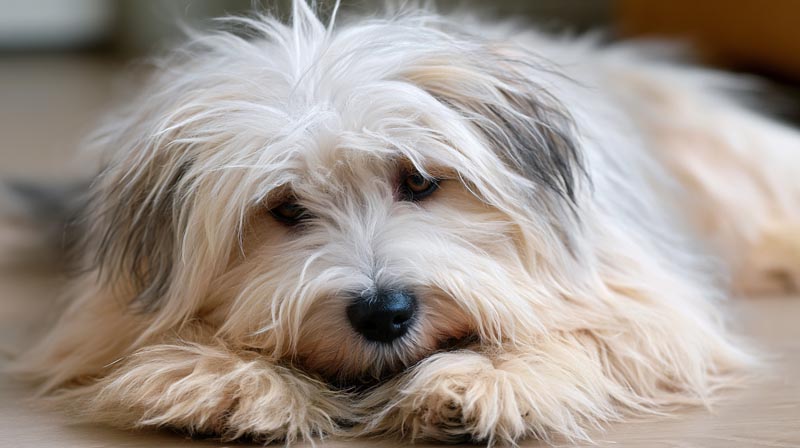
Medium fluffy dogs with double coats are among the heavier-shedding breeds at their size. Double-coated breeds shed year-round with 2 concentrated blowout periods each spring and fall when the undercoat releases in large clumps (Petco, 2024).
Shedding Scale Across Medium Fluffy Breeds
The gap between the heaviest and lightest shedders in this category is significant.
Heavy shedders (daily brushing required during blowouts):
- Border Collie: year-round moderate shedding, heavy twice yearly
- Australian Shepherd: similar pattern to Border Collie, especially heavy in spring
- Keeshond: dense undercoat blows out aggressively twice yearly
- Shetland Sheepdog: fine undercoat hairs are noticeable on dark fabrics
Moderate shedders (2 to 3 times weekly brushing):
- Icelandic Sheepdog
- Finnish Spitz
- Bearded Collie (longer guard hair means less visible individual hairs, but volume is high)
The closest to low-shedding in this category: the Soft Coated Wheaten Terrier and the Portuguese Water Dog. Neither carries a double coat. Both still shed, just at a fraction of the rate. No dog is truly hypoallergenic. People react to proteins in skin cells, saliva, and urine, not fur itself (Wisdom Panel, 2024).
Seasonal Coat Blowing: What It Actually Looks Like
Twice a year, most double-coated medium fluffy dogs go through a 2 to 4 week period where the undercoat releases all at once.
During this time, a Keeshond or Australian Shepherd will shed roughly 10 to 20 times the normal daily amount. Clumps pull loose during brushing. Tumbleweeds of fur collect in corners. Regular daily brushing with an undercoat rake during these periods is the only way to manage volume without professional deshedding treatments.
84% of pet owners reported grooming their dog at least once in the previous 12 months (Dogster, 2024). For double-coated medium breeds, that number should be considerably higher than once per year.
What Are the Grooming Requirements for Medium Fluffy Dogs?
The U.S. pet grooming services market was valued at $2.06 billion in 2024 and is projected to grow at 6.7% annually through 2030 (Grand View Research, 2024). Dogs account for 83.8% of that revenue. Double-coated breeds like the ones in this category are among the biggest drivers of repeat grooming appointments.
Brushing and Dematting Routines
Daily brushing: Required during seasonal coat blowing periods for any double-coated medium breed. Tools needed: undercoat rake for undercoat removal, slicker brush for surface work, dematting comb for tangled sections behind ears and in leg feathering.
3 times weekly brushing: Minimum for maintenance between blowout seasons for heavy-shedding breeds like the Keeshond, Australian Shepherd, and Border Collie.
Weekly brushing: Workable for the Soft Coated Wheaten Terrier and Portuguese Water Dog between professional trims, though these breeds tangle easily and weekly may not be enough if the coat is kept long.
Matting is the main consequence of inconsistent brushing. A severely matted coat can add $50 to $100 to a professional grooming bill (Bark, 2026). The Bearded Collie is particularly prone to mat formation at the collar, armpits, and behind the ears.
Bathing Frequency and Coat Drying
Most medium fluffy breeds do well with bathing every 4 to 6 weeks. More frequent bathing can strip natural oils from the guard hair and dry out the undercoat.
Drying double coats properly takes time. The undercoat traps water effectively. A Keeshond or Sheltie that is not fully blow-dried after bathing can develop hot spots (pyoderma) within 24 to 48 hours in warm, humid weather. Professional force-air drying is genuinely worth the cost for dense breeds.
Professional grooming for a medium double-coated breed costs $70 to $140 per session (Bark, 2026). At 6-week intervals, that is roughly $600 to $1,200 annually for professional sessions alone, before at-home tool purchases.
| Breed | Brushing Frequency | Professional Grooming Interval | Key Tools |
|---|---|---|---|
| Australian Shepherd | 3-4 times per week | Every 8 weeks | Slicker brush, undercoat rake |
| Keeshond | Daily during seasonal coat blowouts; 2-3 times weekly during the off-season | Every 6-8 weeks | Pin brush, undercoat rake, dematting comb |
| Soft Coated Wheaten Terrier | Weekly | Every 6-8 weeks for trimming | Slicker brush, dematting comb |
| Bearded Collie | Daily | Every 6 weeks | Pin brush, wide-tooth comb |
What Are the Exercise Needs of Medium Fluffy Dog Breeds?
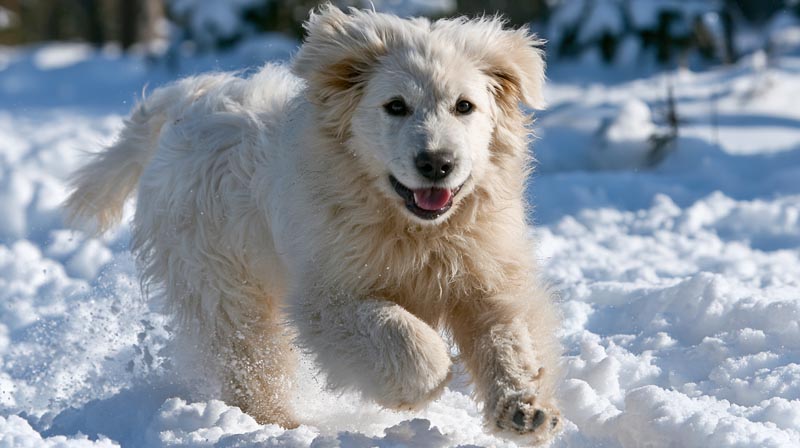
Energy levels across medium fluffy breeds vary more than most people expect. The category runs from the Border Collie, which needs at least 60 minutes of mental and physical activity daily (Brian Kilcommons, Great Pets Resort), to the Keeshond, which manages well with 30 to 45 minutes of moderate daily exercise.
Energy Level Range by Breed Group
Herding breeds are the demanding end of the spectrum. The Australian Shepherd and Border Collie were bred for full workdays on farms. Both need daily running, not just walking, plus mental work like obedience training, agility, or puzzle-based activities. A bored Aussie or Border Collie will redirect that energy destructively.
Spitz breeds sit in the middle. The Keeshond adapts well to urban living with twice-daily walks and play sessions. The Finnish Spitz needs more, partly because of its hunting origin and partly because of its vocal nature. An under-exercised Finnish Spitz barks. A lot.
Companion-origin fluffy breeds like the Tibetan Terrier and Soft Coated Wheaten Terrier need consistent exercise but are more flexible in format. 30 to 45 minutes daily is generally sufficient, and they adjust better to schedule variation than herding breeds do.
Heat Tolerance and Coat Density
Dense double coats insulate effectively in both directions, which creates a real heat management issue in summer.
Medium fluffy breeds overheat faster than short-coated dogs of the same size. Exercise sessions should be scheduled in the early morning or evening during hot months. Pavement temperature is also an issue: asphalt can reach 125 to 145 degrees Fahrenheit on a 90-degree day and will burn paw pads before the dog shows obvious distress.
Never shave a double-coated dog to “keep it cool.” The undercoat provides insulation against heat as well as cold. Shaving removes that regulation and exposes skin to direct UV radiation, increasing the risk of sunburn and heat stress rather than reducing it (ASPCA, 2024).
The Portuguese Water Dog is the heat exception in this category. Its single wavy coat dries fast, and the breed was designed for sustained physical work in warm Atlantic coastal conditions. It handles summer activity better than most fluffy breeds its size.
What Are the Temperament Traits of Medium Fluffy Dogs?
Medium fluffy dogs do not share a single personality. But most of them share 3 baseline traits: alertness, people-orientation, and a tendency toward vocal expression that ranges from mild (Keeshond) to persistent (Finnish Spitz, Shetland Sheepdog).
Herding Breeds vs. Spitz Types vs. Companion Breeds
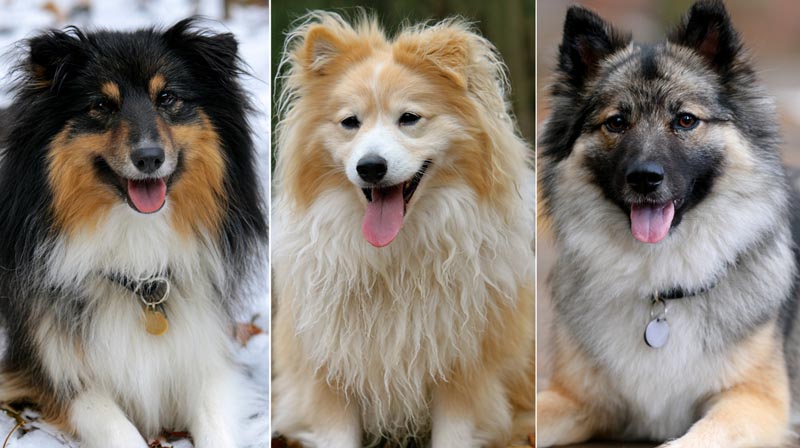
The working origin shapes behavior more than anything else in this category.
Herding breeds (Border Collie, Australian Shepherd, Shetland Sheepdog) are task-driven. They bond closely with their primary person and thrive on having a job. Without structured work or training, they create their own projects, usually in the form of herding children, other pets, or moving objects. The American Kennel Club describes the Border Collie’s herding style as “sweeping outruns, stealthy crouching, and explosive bursts of focused energy.” Living with one is genuinely similar to living with an athlete in constant training mode.
Spitz breeds (Keeshond, Finnish Spitz, Icelandic Sheepdog) are more independent. They were not selectively bred to read human body language the way herding dogs were. They are affectionate with family but can be aloof with strangers and think for themselves more than collies or shepherds do.
Companion-leaning fluffy breeds (Soft Coated Wheaten Terrier, Tibetan Terrier, Portuguese Water Dog) were bred to work alongside people in variable roles. They are sociable, adaptable, and generally more forgiving of schedule irregularity. They handle novel environments better than either herding or spitz breeds typically do.
Family Compatibility
Most medium fluffy breeds do well with children when properly socialized, but with important caveats.
Herding breeds may nip at the heels of small, fast-moving children. This is not aggression; it is instinct. But it can frighten children and needs to be managed through early obedience training. The Australian Shepherd tends to be more tolerant with young children than the Border Collie, which is better suited to households with kids over 8 years old who can participate in training.
The Keeshond is the most consistently family-friendly of the spitz-type medium fluffy breeds. It is patient, playful, and lacks the herding instinct that creates friction with toddlers.
Independence vs. Velcro Tendencies
Some medium fluffy breeds follow their people from room to room. Others do not.
High velcro breeds: Australian Shepherd, Shetland Sheepdog. These dogs are uncomfortable with extended alone time and are prone to separation anxiety if under-socialized.
More independent: Finnish Spitz, Icelandic Sheepdog, Tibetan Terrier. They enjoy company but do not require constant proximity. More suitable for owners who work outside the home part of the day.
The Soft Coated Wheaten Terrier sits in the middle. It is affectionate and social without the anxiety-prone attachment pattern of the herding group. It also has a notably terrier-stubborn streak that makes it more entertaining to train than easy.
What Health Issues Are Common in Medium Fluffy Dog Breeds?
Hip dysplasia is the most common orthopedic condition in medium to large purebred dogs, and several medium fluffy breeds carry above-average risk (FCI, 2023).
Beyond joints, dense double coats create a second category of breed-specific health problems: skin conditions that develop when moisture gets trapped against the skin.
Hip Dysplasia Rates in Medium Fluffy Breeds
Hip dysplasia prevalence varies widely across breeds in this category. A meta-review of OFA data found rates ranging from 3-5% in Siberian Huskies to over 50% in some large working breeds (TopDogTips, 2025).
For medium fluffy breeds specifically:
- Australian Shepherd: moderate risk, OFA health testing recommended before breeding
- Border Collie: lower risk than most herding breeds, but hip and elbow dysplasia screening still standard
- Bearded Collie: moderate hip dysplasia prevalence, higher in working lines
The Orthopedic Foundation for Animals (OFA) maintains the largest canine health database in the world. Buying from a breeder who tests breeding stock through OFA reduces the risk significantly. Ask for OFA hip scores on both parents before purchasing any medium fluffy dog.
Skin and Coat Conditions
Hot spots (pyoderma): Bacterial skin infections that develop when moisture sits under a dense coat. Most common in summer and post-bathing if the undercoat is not fully dried.
Matting-related dermatitis: Tight mats press against skin continuously, causing irritation and creating conditions for infection. The Bearded Collie and Tibetan Terrier are the most prone in this category.
Both conditions are largely preventable with proper drying technique after baths and consistent brushing to prevent mat formation.
Eye Conditions and Lifespan
Progressive Retinal Atrophy (PRA) affects several medium fluffy breeds. Border Collies and Australian Shepherds both carry genetic markers for PRA, with DNA testing available through breed health programs.
Collie Eye Anomaly (CEA) is another inherited condition specific to collie-type breeds. Responsible breeders screen for both CEA and PRA before breeding.
Lifespan across medium fluffy breeds runs 12 to 15 years for most herding and spitz types. The Shetland Sheepdog consistently reaches 12 to 14 years. The Border Collie and Australian Shepherd average 12 to 15 years with proper care.
What Are the Best Medium Fluffy Dogs for Families With Children?
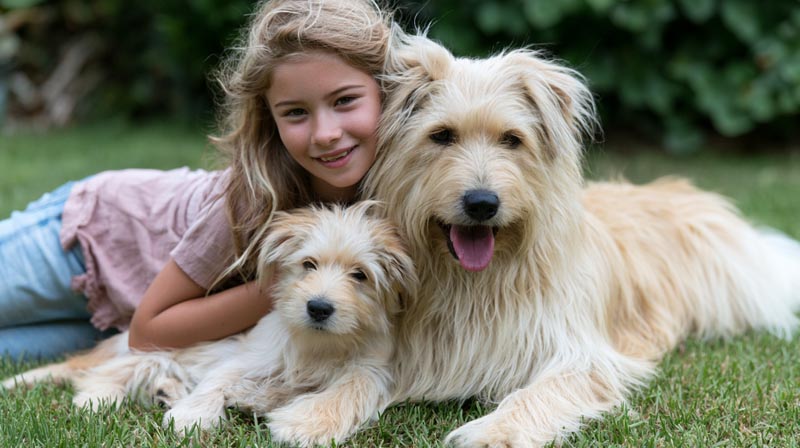
Not every medium fluffy breed belongs in a household with young children. Herding instinct, energy levels, and stranger wariness all affect how a breed interacts with kids day-to-day.
A 2024 Banfield Pet Hospital analysis of veterinary data confirmed the Labrador Retriever holds the highest child-tolerance score of any breed over 50 pounds. Among medium fluffy breeds, the score gap between the most and least child-compatible is significant.
Top Picks for Families
The Keeshond is the standout choice for families with children of mixed ages. It is patient, playful, and lacks the herding instinct that causes friction with toddlers. At 35 to 45 pounds, it is solid enough to handle energetic play without injury to either party.
The Australian Shepherd works well in active households with children over 6 years old who understand boundaries. Aussies form deep bonds with all family members and are generally more tolerant of young kids than Border Collies. Early socialization before 16 weeks reduces adult behavior problems by 35%, per a 2022 Journal of the American Veterinary Medical Association study.
The Soft Coated Wheaten Terrier handles family life well. It is less intense than herding breeds, bonds with children naturally, and has a playful terrier energy that matches active kids without tipping into the anxious, over-stimulated behavior pattern you sometimes see in Border Collies.
Breeds to Approach Carefully With Young Children
The Border Collie is a poor match for households with children under 8. Its herding instinct is strong and constant. It will nip at running children’s heels, which is instinct, not aggression, but it is frightening for young kids and hard to fully train out.
The Shetland Sheepdog is sensitive and can become anxious in loud, chaotic households. Best in calmer family environments with older, quieter children who will not overwhelm the dog with noise and unpredictable movement.
| Breed | Child Suitability | Key Factor | Minimum Age Recommended |
|---|---|---|---|
| Keeshond | Excellent | Typically patient and lacks a strong herding instinct | Any age |
| Australian Shepherd | Good | Often forms strong bonds with the entire family | 6+ years |
| Soft Coated Wheaten Terrier | Good | Playful temperament and generally less prone to anxiety | Any age |
| Border Collie | Limited | Strong herding instinct may lead to chasing or nipping behaviors | 8+ years |
What Are the Best Medium Fluffy Dogs for Apartments?
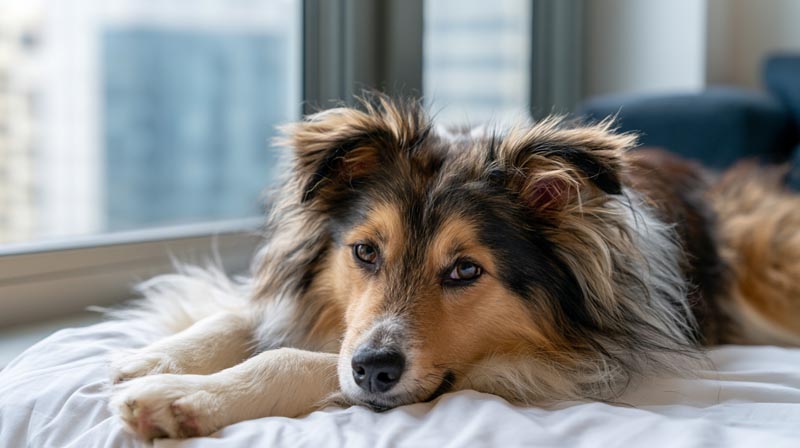
Apartment suitability comes down to 3 factors: daily exercise need, noise tendency, and how the dog handles being alone for chunks of the day. Most medium fluffy herding breeds fail at least 2 of those 3.
The shift toward apartment living is real. The AKC’s 2024 breed rankings reflect a clear trend toward smaller, more apartment-compatible dogs as urban density increases (AKC, 2025).
Best Fits for Apartment Living
Keeshond: 35 to 45 pounds, adapts well to smaller spaces, exercises adequately with twice-daily walks. Alert but not a nuisance barker. The Finnish Spitz, by contrast, is a vocal breed and will stress neighbors in close quarters.
Soft Coated Wheaten Terrier: Moderate energy that is manageable in apartments with consistent daily walks. More flexible about schedule variation than herding breeds. Does not suffer severe separation anxiety if conditioned to alone time from puppyhood.
The Tibetan Terrier is underrated for apartment living. At 18 to 30 pounds, it is the smallest of the medium fluffy group. It was bred as a monastery companion in Tibet and is comfortable in small, contained spaces by disposition.
Breeds That Struggle in Apartments
The Australian Shepherd and Border Collie are poor apartment dogs without exceptional daily exercise commitments. An under-exercised Aussie or Border in a small space will redirect energy into destructive behavior, excessive barking, or anxious pacing.
Noise is a legitimate concern with the Shetland Sheepdog. Shelties bark readily at sounds, movements outside windows, and passing people. In apartments with thin walls, this becomes a real problem.
Exercise Compensation Strategies
Apartment living does not have to mean inadequate exercise. It just requires more deliberate planning.
- 2 structured walks daily (30+ minutes each) minimum for any medium fluffy breed
- Off-leash park time 3 to 4 times per week for herding breeds
- Mental work through training sessions, puzzle feeders, or trick training at home
Training reduces destructive behavior by 68% in dogs that exhibit it, per a 2022 ASPCA behavioral study. For apartment dwellers with medium fluffy dogs, structured training is not optional; it is the difference between a manageable dog and an unmanageable one.
How Much Does a Medium Fluffy Dog Cost?
Breeder price, annual grooming bills, and lifetime vet costs all add up faster with medium fluffy breeds than with short-coated dogs of similar size.
Annual dog ownership costs average $1,200 to $1,500 for moderate care, per the APPA National Pet Owners Survey. For medium fluffy breeds with double coats, grooming alone pushes that baseline up by $600 to $1,200 annually.
Breeder and Adoption Costs by Breed
Reputable breeders charge $800 to $2,000 for an Australian Shepherd puppy, with blue merle or champion bloodline dogs reaching $3,000 (Petscare, 2024).
Border Collies from working-line breeders typically run $700 to $3,000. The average across all sources is roughly $992 (Lancaster Puppies, 2024).
Rescue and shelter adoption fees run $50 to $400 for most breeds, usually including vaccinations, spay/neuter surgery, and microchipping. That bundled veterinary care saves $300 to $800 in first-month costs compared to buying from a breeder (Extravis, 2025).
Annual Ownership Cost Breakdown
Food: $30 to $60 per month for a medium-sized dog on quality dry kibble, per Dogster (2026). That is $360 to $720 annually.
Professional grooming: $70 to $140 per session for double-coated breeds, every 6 to 8 weeks. Annual cost: $600 to $1,200 before tips.
Veterinary care: $200 to $600 annually for routine checkups and preventive medications. Emergency visits are separate. Pet insurance runs $20 to $50 per month depending on coverage level (Dogster, 2026).
| Cost Category | Annual Estimate | Notes |
|---|---|---|
| Food | $360-$720 | Varies based on breed size and diet type |
| Professional grooming | $600-$1,200 | Primarily applicable to double-coated or high-maintenance breeds |
| Routine veterinary care | $200-$600 | Excludes emergency or specialty care |
| Pet insurance | $240-$600 | Optional, but often recommended |
Rescue vs. Breeder: Real Trade-offs
Adoption saves money upfront and often provides a dog with known temperament (adult rescues). The trade-off is less predictability around coat type and breed-specific behavior in mixed-breed rescues.
Breeder purchases give more coat and temperament predictability, with health testing documentation from OFA and breed club programs. The cost is 5 to 10 times higher upfront. Both paths work. The deciding factor is usually how specific you need to be about breed characteristics versus how flexible you can be.
How Do You Train Medium Fluffy Dog Breeds?
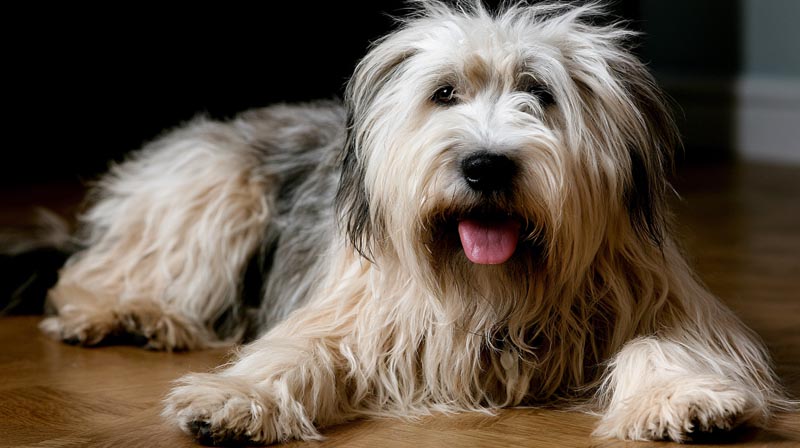
Medium fluffy dogs from herding and spitz backgrounds are among the most trainable dogs at their size. The challenge is not getting them to learn. It is managing drive, energy, and the instincts that come with working-breed genetics.
Positive reinforcement is preferred by 86% of certified trainers according to the Certification Council for Professional Dog Trainers (CCPDT, 2023). For high-drive breeds like the Border Collie and Australian Shepherd, it is particularly effective because both breeds are strongly food and play motivated.
Trainability by Breed Group
Herding breeds rank at the top of canine trainability. The Border Collie is widely cited as the most trainable dog breed in the world, capable of learning complex command sequences. Chaser, a Border Collie at Wofford College, learned the names of 1,000 distinct objects. The Australian Shepherd is close behind, with enthusiastic food motivation that makes it easier to work with for novice trainers than the more intense Border Collie.
Spitz breeds are more independent. The Finnish Spitz and Keeshond train well but make their own decisions more readily than herding breeds. Consistency matters more than intensity with spitz types. Short, frequent sessions beat long, demanding ones.
Terrier-origin fluffy breeds like the Soft Coated Wheaten Terrier are intelligent but selectively compliant. They know what you want. They are just weighing whether it is worth doing. High-value treats close the gap reliably.
Socialization Windows and Herding Instinct
Puppies trained before 16 weeks of age show 35% fewer behavior problems as adults, per a 2022 JAVMA study. Also, 85% of puppies properly socialized by 3 months avoid aggression issues in adulthood (ASPCA, 2021).
For herding breeds, early socialization goes beyond meeting people and other dogs. It means exposing the puppy to fast-moving children, bikes, cars, and other stimuli that trigger chase and nip responses in under-socialized adults.
Common Training Challenges
Herding instinct management: Cannot be fully trained out, but can be redirected. Treibball (pushing large balls into a goal) gives herding breeds a legal outlet for their drive without requiring livestock.
Spitz stubbornness: Finnish Spitz and Icelandic Sheepdog owners regularly report dogs that understand commands perfectly and still decide when to comply. This is breed character, not disobedience. Working with it rather than against it means making training fun and unpredictable rather than repetitive.
Separation anxiety in velcro breeds: Australian Shepherds and Shelties that were not conditioned to alone time during puppyhood can develop destructive separation anxiety. Crate training from 8 weeks, combined with short departure practice sessions, prevents most cases from developing.
Canine Solutions’ 2024 trainer data showed herding breeds made up the largest group seen for behavior issues in that year, with reactivity and nipping in households with children as the top 2 presenting problems. Both are training problems, not temperament failures, and both respond well to structured work with positive reinforcement methods.
FAQ on Medium Fluffy Dogs
What qualifies as a medium fluffy dog?
A medium fluffy dog weighs between 25 and 65 pounds and carries either a dense double coat or a long, plush single coat. The fluffy appearance comes from coat structure, not just length. Both layers together create the characteristic puffed-out silhouette.
Do medium fluffy dogs shed a lot?
Most do. Double-coated breeds like the Australian Shepherd and Keeshond shed year-round, with heavy seasonal blowouts twice yearly. The Soft Coated Wheaten Terrier and Portuguese Water Dog shed considerably less, since neither carries a traditional double coat.
Are medium fluffy dogs good for apartments?
Some are. The Keeshond and Tibetan Terrier adapt well to smaller spaces. Herding breeds like the Border Collie and Australian Shepherd need significant daily exercise and do poorly in apartments without a serious commitment to outdoor activity.
How often do medium fluffy dogs need grooming?
Most need brushing 3 to 4 times weekly, daily during shedding seasons. Professional grooming every 6 to 8 weeks is standard for double-coated breeds, costing $70 to $140 per session. Skipping sessions leads to matting and potential skin infections.
Are medium fluffy dogs good with kids?
It depends on the breed. The Keeshond is patient with children of all ages. Herding breeds like the Border Collie may nip at fast-moving toddlers out of instinct. The Australian Shepherd works well in households with children over 6.
What is the lifespan of medium fluffy dog breeds?
Most live 12 to 15 years. The Shetland Sheepdog and Border Collie regularly reach 14 to 15 years with proper care. Larger breeds within the medium-fluffy category, like the upper end of the Australian Shepherd range, tend toward the shorter end.
What health problems are common in medium fluffy dogs?
Hip dysplasia is the most common orthopedic issue across herding and spitz-type breeds. Skin conditions like hot spots and pyoderma develop when dense undercoat traps moisture. Border Collies and Australian Shepherds also carry genetic risk for Progressive Retinal Atrophy.
How much does a medium fluffy dog cost?
Breeder prices range from $700 to $3,000 depending on breed and bloodline. Rescue adoption fees run $50 to $400. Annual ownership costs average $1,200 to $1,500 for basic care, with grooming adding $600 to $1,200 per year for double-coated breeds.
Are medium fluffy dogs easy to train?
Herding breeds are among the most trainable dogs in the world. The Border Collie and Australian Shepherd respond quickly to positive reinforcement. Spitz types like the Finnish Spitz are intelligent but more independent. Terrier-origin fluffy breeds know what you want; they just decide when to comply.
Which medium fluffy dog sheds the least?
The Soft Coated Wheaten Terrier and Portuguese Water Dog shed the least in this category. Both carry single-layer coats that do not blow seasonally. No medium fluffy dog is truly non-shedding, but these 2 come closest for owners sensitive to dog fur.
Conclusion
This conclusion is for an article presenting medium fluffy dogs as a category worth understanding before you commit to one.
The coat is only part of the picture. Double-coated breeds like the Keeshond and Shetland Sheepdog carry real grooming costs, seasonal shedding cycles, and specific exercise requirements that vary sharply by working origin.
Herding breeds need structured daily activity. Spitz types are more adaptable. Companion-origin fluffy breeds handle apartment life and family chaos better than most people expect.
Hip dysplasia, Progressive Retinal Atrophy, and hot spots are the health risks to screen for. Buying from an OFA-tested breeder or adopting from a breed-specific rescue both reduce long-term risk.
Pick the breed that matches your actual daily life, not the one with the best coat.