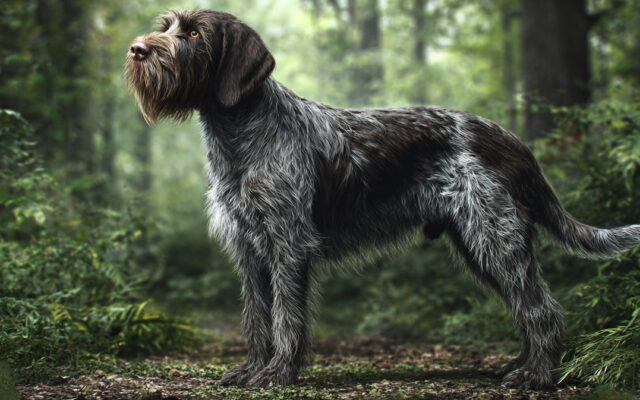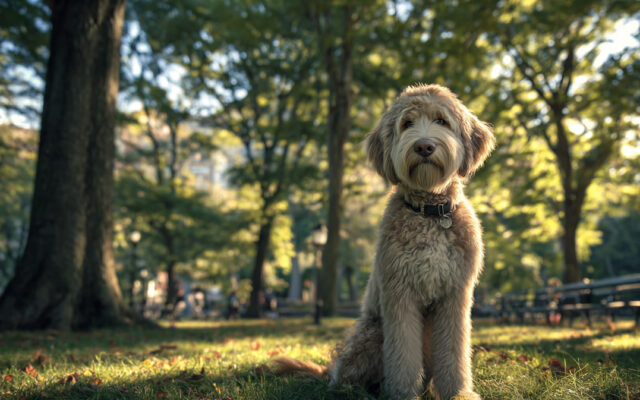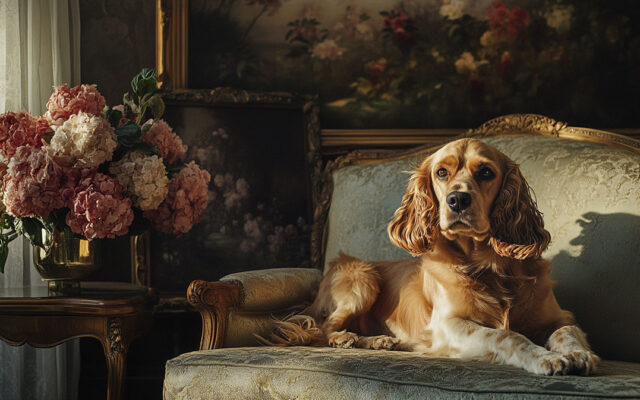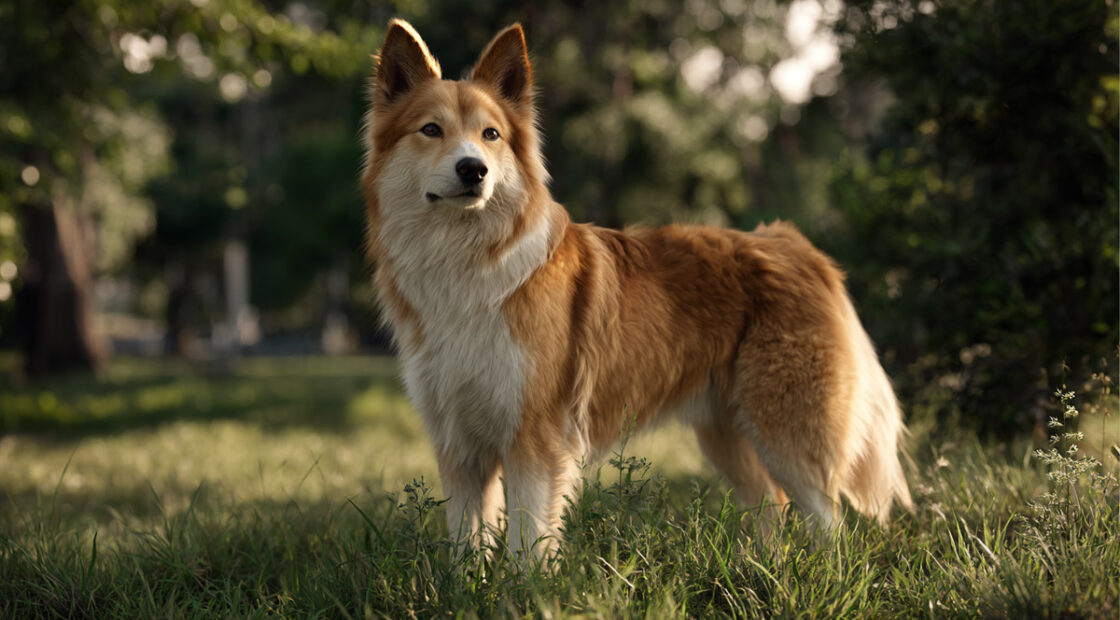
The Icelandic Sheepdog is a Nordic spitz-type herder and Iceland’s only native breed. Farmers bred it to gather sheep and horses, and cattle as well, and to bark when something was wrong.
Farmers kept it for centuries. These days it also lives as a family companion in Europe and North America.
The ancestry goes back a long way, but the living population doesn’t. A 2009 pedigree study in Genetics Selection Evolution traced the studied population of 2,554 dogs to 36 founders, which left genetic diversity equal to only 2.2 equally contributing founders.
What Is the Icelandic Sheepdog?
Its ancestors came over with the first Norse settlers, and it has been the only dog breed native to Iceland ever since. Farmers kept it to gather sheep and horses, and cattle as well.
The bark is part of the job. Breed standards describe a dog that drives stock and finds strays on mountain slopes, then warns the household when something is off.
It also goes by Icelandic Spitz or Iceland Dog. The official name in FCI Standard 289 is Islenskur fjarhundur, and owners usually just say Icie.
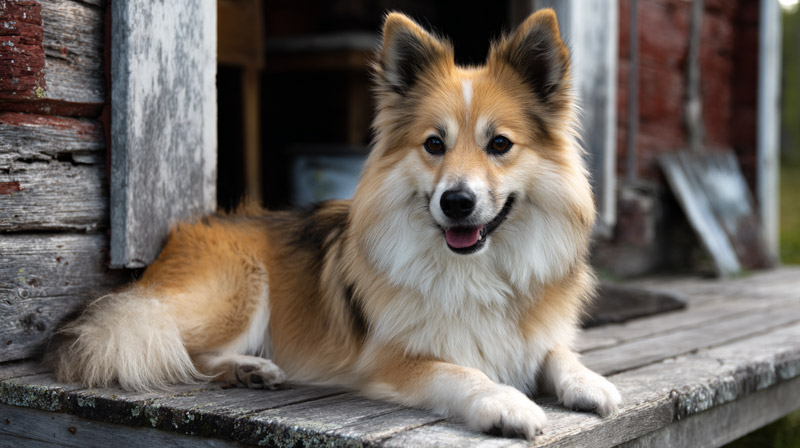
The word “sheepdog” misleads people. This is a small to medium dog with a fox-like face and a bushy tail curled over the back, nothing like a large, shaggy Old English Sheepdog.
Registries don’t agree on where to file it, either. The FCI places it in Group 5, Section 3 (Nordic Watchdogs and Herders), used as a herding dog. The AKC puts it in the Herding Group and The Royal Kennel Club (UK) in the Pastoral Group, while Dogs New Zealand and Dogs Victoria go with the Working Group.
Among other breeds, its nearest relative is usually named as the Norwegian Buhund, another Nordic herder with prick ears and a curled tail.

How Big Is an Icelandic Sheepdog, and What Does the Coat Look Like?
A full-grown male stands about 46 cm (18 in) at the withers and a female about 42 cm (16.5 in) (FCI Standard 289, 2018). That puts the breed at the small end of medium.
The outline is rectangular, with body length from shoulder to buttock greater than height at the withers (FCI Standard 289, 2018). The coat is double and comes in a short-haired and a long-haired variant (FCI Standard 289, 2018).
Size and Weight
Weight is where sources differ most, since no major standard fixes a number. The UKC breed standard (revised 2017) only asks that weight stay proportionate to height.
Showsight Magazine puts males near 30 pounds and females near 25, which matches what most breed profiles repeat.
Anything much wider than that is a pet-site estimate. Judge a dog by height and condition, not by a scale target.
Chest depth matches the length of the foreleg. The muzzle is slightly shorter than the skull, and males look broader through the frame than females.
Coat Types and Colors
Both variants carry a thick, weatherproof double coat, and the FCI standard treats them as equally correct. The short coat has coarser outer hair over a thick, soft undercoat. The long coat has longer outer hair over the same dense undercoat.
Colors run from tan (cream through reddish brown) to chocolate brown, grey and black, with one color predominant. White shows up on every color, though it must not dominate. Black tricolors carry tan on the cheeks, eyebrows and legs.
A solid black saddle on a tan dog counts as a fault under the UKC standard.
Prick ears that move with the dog’s mood, a tail curled over the back and double dewclaws on the hind legs finish the picture.
What Is the Temperament of an Icelandic Sheepdog, and Does It Bark a Lot?
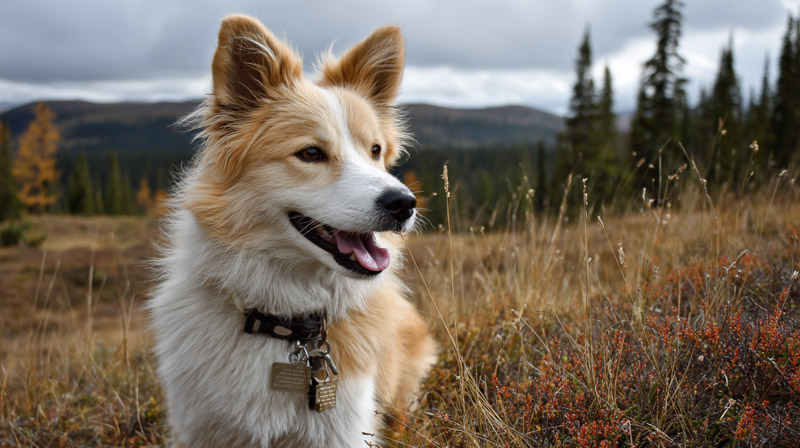
Friendly and alert, and yes, it uses its bark. The breed standard describes a dog that greets visitors enthusiastically without aggression and has weak hunting instincts.
That social streak is the core trait. Icelandics want to be where the people are, and PetMD warns that long stretches alone can turn into anxiety problems.
On the farm the bark drove livestock and found stray sheep. A pet Icelandic keeps the other job, alerting the owner. WebMD describes the breed as vigilant, barking to pull the owner’s attention to whatever it noticed.
Because it gets along with nearly everyone, it makes a poor guard dog. Expect a doorbell announcer, not a deterrent.
WebMD calls the breed patient with small children, and the low hunting drive in the standard helps around other pets.
One caveat. Dogster lists a strong-willed streak next to the charm, which is why consistency matters once training starts.
How Long Does the Icelandic Sheepdog Live, and What Health Problems Does It Have?
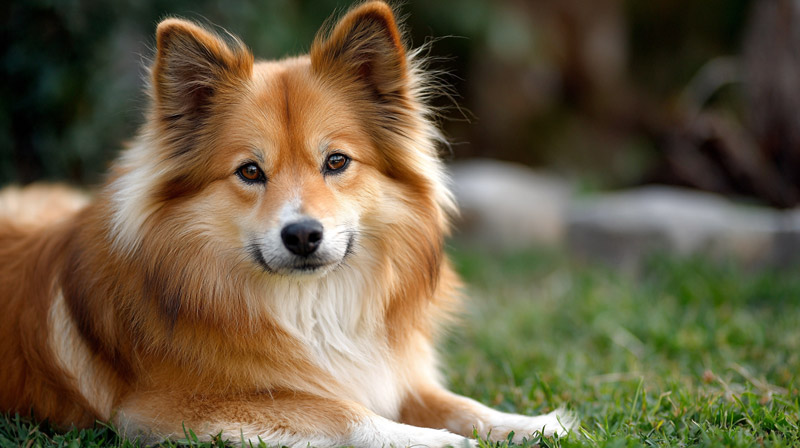
Most live 12 to 14 years. Hip dysplasia and eye conditions are what breeders screen for.
Lifespan
| Source | Stated lifespan |
|---|---|
| The Royal Kennel Club | Over 10 years |
| WebMD | 12 to 14 years |
| Paction | 12 to 15 years |
| PetMD | 12 to 16 years |
The spread comes from the sources, not from different dogs. Plan around 12 to 14 years and count anything beyond that as a bonus.
Documented Conditions
- Hip dysplasia means the ball and socket of the hip fail to fit together, causing pain and gradual loss of joint function (WebMD). Stiffness, a swaying or hopping gait and hind leg lameness are the warning signs.
- Extra eyelashes, called distichiasis, cause no symptoms in mild cases. Severe ones can lead to ulceration.
- Breed guides flag patellar luxation, where the kneecap slips out of place, and breeders screen for it on an optional basis.
- Cataracts, a clouding of the lens, appear on most breed health lists. Guides disagree on how serious they are.
None of this is unusual for a dog this size. The point of screening is to keep these problems out of the next litter.
Health Testing and the Registry Disagreement
Registries don’t agree on what a responsible breeder tests, and the gap is easy to miss.
In the US, the AKC lists hip and ophthalmologist evaluations as the national breed club’s recommended tests. Paction’s breeder checklist adds an ACVO eye exam registered with OFA and participation in the OFA/CHIC DNA repository. Elbow and patella evaluations are optional but recommended.
The Royal Kennel Club (UK) sits at the other end. As of October 2026 it lists no recommended pre-breeding health screening for the breed, and tells breeders and buyers to check back as research develops.
Dogs Victoria sides with the US club, advising that breeding stock be eye tested by an ophthalmologist and hip scored.
Ask for hip and eye results from any breeder, whichever country the puppy comes from. A missing UK scheme does not mean the risk is absent.
How Much Exercise, Grooming and Training Does an Icelandic Sheepdog Need?
Budget up to an hour of exercise a day, brushing at least weekly, and training that starts the day the puppy comes home.
Exercise and Mental Work
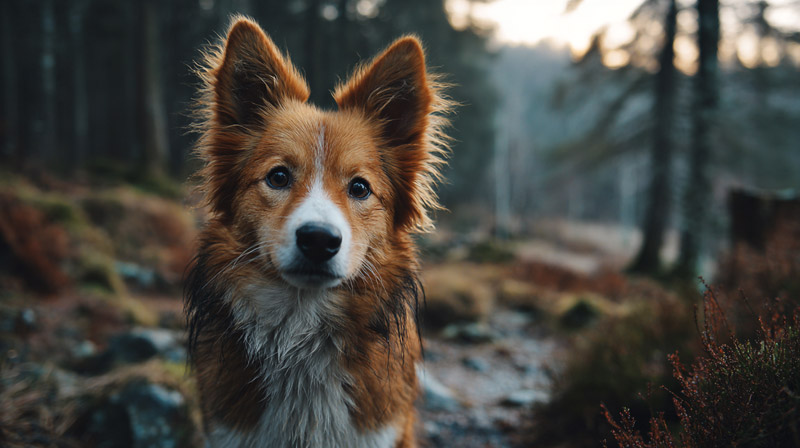
The Royal Kennel Club lists exercise at up to 1 hour per day and rates the breed as fine in a small house, provided that hour actually happens.
Brisk walks and off-lead play in a fenced area cover the physical side. Agility and obedience games help, and puzzle feeders and scent work give the brain something to chew on.
Chewy flags daily mental stimulation as one of the two care standouts, next to the coat. A bored Icelandic finds its own work.
Coat Care and Shedding
Brushing advice varies more than any other care detail. The Royal Kennel Club and Dogs Victoria both say once a week, Paction says two to three times a week, and Wamiz recommends daily.
The Royal Kennel Club also lists the breed as a shedder, and Dogs Victoria notes the coat blows twice a year.
Weekly is the floor. Move to every other day whenever the undercoat starts coming out in clumps. The thicker the coat on the day, the shorter the gap between brushings.
Training
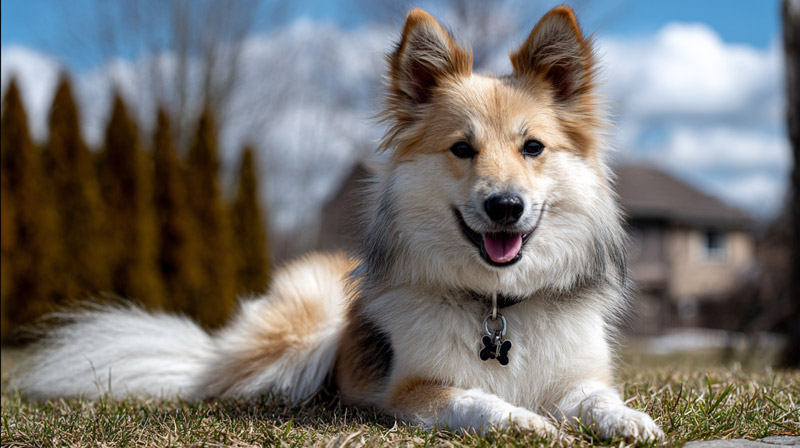
The breed learns quickly, and the habits you set in the first weeks last.
Recall is easy to teach to a puppy, so make it one of the first lessons (Vetstreet). Positive reinforcement works well (WebMD), and small rewards from healthy dog treats keep the calories from piling up.
WebMD says the breed is not trustworthy off the leash, so keep it in a fenced area.
Wamiz notes that training works best with a confident, consistent owner who varies the routine. Harsh methods fail.
Leave an Icelandic alone for too long and the training slips, because separation stress undoes good habits fast.
Is the Icelandic Sheepdog the Right Dog for Your Household?
It fits an active household with someone home most of the day and a high tolerance for noise. It is a poor match for anyone who needs a quiet dog or a puppy on short notice.
What Works in Its Favor
Icelandics are cheerful with family and visitors alike. The Royal Kennel Club’s breed profile says they work in town or country with a small or medium garden, and the hardy double coat was developed for Iceland’s rugged terrain and demanding climate (AKC).
What Counts Against It
The bark is built in, so close neighbors matter. The dog also wants company through the day.
Puppies are scarce and waitlists are normal. A narrow gene pool sits behind every litter, and few registries run breed-specific health schemes.
Who It Suits
Households that want a herding dog’s intelligence without the workload of the most demanding herders tend to land here.
Owners who like dog sports or long walks, and who enjoy a dog that stays close, get the most out of the breed.
Who Should Look Elsewhere
- Anyone who wants a quiet house, since the bark comes with the herding job and training manages it without removing it.
- Households with long working hours, because a dog that wants company and a house that stays empty is a bad pairing.
- Impatient buyers. Dogster warns that rarity puts most buyers on a breeder’s waiting list.
- Anyone who needs tested bloodlines on short notice, since the gene pool is small and the later sections show how small.
Compared With the Border Collie and Norwegian Buhund
| Trait | Icelandic Sheepdog | Border Collie | Norwegian Buhund |
|---|---|---|---|
| Work style | Drives stock by barking, finds strays | Controls stock with eye and crouch | Guard and herding dog |
| Workload | Moderate, company-driven | Very high, needs a real job | Active, strong working instinct |
| Best owner | Social household, no stock | Sport or farm home | Active family wanting a watchdog |
VCA Hospitals describes the Border Collie as needing vigorous daily workouts and real work to do, while the FCI standard (2026 text) calls the Norwegian Buhund mostly a guard and herding dog.
For a pet home without stock or serious sport, the Icelandic Sheepdog is the lower-demand choice. Pick the Buhund when the watchdog streak matters more than sociability.
Where Did the Icelandic Sheepdog Come From, and How Did It Nearly Disappear?
Norse settlers brought spitz-type farm dogs to Iceland, and the breed grew out of those. Disease and dog restrictions later shrank it to a few remote farms, and it was rebuilt from a few dozen founders between 1955 and 1970.
Norse Origins
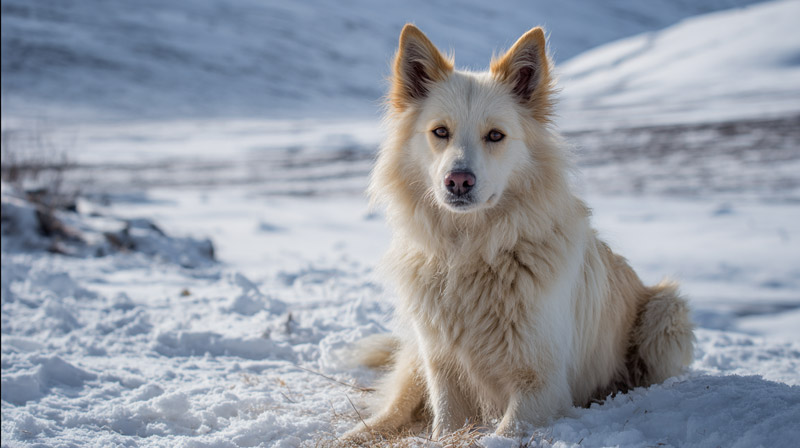
Settlers sailed west across the Norwegian Sea with spitz-type herders, and those dogs became the foundation stock, according to the AKC’s breed history. The Royal Kennel Club adds that the sagas mention the breed.
By the 16th century, European writers described thick-coated Icelandic dogs favored by the Swedish upper class, and John Caius noted in 1570 that British aristocrats liked them too.
Abraham Fleming’s 1576 English translation of Caius’s dog treatise described them as rough-coated curiosities treated as pampered pets. Shakespeare later used the breed’s name as an insult in Henry V, and Buffon published the first known illustration in the mid-1750s (The Royal Kennel Club dates it to 1754, though his fifth volume is usually dated 1755).
At home the job never changed. Guide to Iceland treats rettir, the annual sheep roundup, as the breed’s showcase.
Decline
A tapeworm outbreak pushed the Icelandic government to tax dogs in the mid-19th century (AKC), and distemper and other diseases came on top of the tax (AKC). Farm work then shrank as the 20th century advanced (UKC breed standard).
Sources disagree on when the worst hit. AKC and The Royal Kennel Club center the crash on the 19th century, while WebMD points to pandemics in the early 1900s.
Treat both as waves in one long decline. By 1950 the breed survived mostly in remote regions (AKC).
Abroad, formal status was arriving even as numbers fell. Three dogs were shown at Copenhagen’s Tivoli Gardens in 1897, the breed’s first dog show appearance.
Revival
The population hardly grew until 1967, when it reached about 250 animals, according to a 2009 pedigree study by Oliehoek, Bijma and van der Meijden in Genetics Selection Evolution.
That study counts the first 20 founders as selected from remote Icelandic areas in 1955. AKC’s history dates the breeding program of Pall A. Palsson and Sigridur Petursdottir to the mid-1960s, and says Petursdottir imported two puppies from Mark Watson’s English kennel to widen the gene pool.
Watson also exported dogs to California. WebMD dates that to the 1950s while AKC gives no year, so the sources agree on the sequence but not the exact years.
The Icelandic Kennel Club followed in 1969, founded partly to preserve the breed. ISIC, the international committee, now coordinates breeding data across countries.
The rebuilt population paid for it genetically. The study found 36 founders, with just three of them supplying more than 80% of the alleles in the current population. Diversity came out equal to only 2.2 equally contributing founders, against a maximum attainable 4.7, and the study cites a published recommendation of 20 for adequate variability.
The authors were surprised that no inherited disease had surfaced given the inbreeding they measured, and they noted that a growing population slows genetic drift. The pedigree data stops between 1998 and 2002, so the figures describe the breed as the 1990s left it.
Which Kennel Clubs Recognize the Icelandic Sheepdog?
Recognition came in stages. Denmark went first in 1898, the AKC followed in 2010 and The Royal Kennel Club in the UK from 1 April 2025. The FCI standard, with Iceland named as country of origin, sits underneath all of them.
| Registry | Milestone | Detail |
|---|---|---|
| Danish Kennel Club | 1898 | A year after the Tivoli show (AKC) |
| The Royal Kennel Club (UK) | 1905 registration, 2025 recognition | Imported Breed Register |
| AKC | 2010 | Herding Group, parent club ISAA |
| FCI | Standard 289 | Current text published 15 June 2018 |
The UK club, then known simply as The Kennel Club, registered its first Icelandic Sheepdog, a dog named Chuck, as a foreign dog in 1905. It relaunched as The Royal Kennel Club in November 2025. Full recognition took 120 years from that first registration.
The club’s 21 November 2024 announcement made show eligibility wait for an interim breed standard. A standard page last updated 4 July 2025 now sits on its site.
As of October 2026, The Royal Kennel Club lists the breed in Breed Watch category 1, meaning no points of concern beyond its routine standard, and no extra breed-specific breeding restrictions.
In Iceland, the breed club Deild islenska fjarhundsins, founded in 1979, holds responsibility for safeguarding the breed under the Icelandic Kennel Club. In the US, the Icelandic Sheepdog Association of America plays that role as AKC parent club.
Recognition is a registry status. It says nothing about the health or lineage of any one litter.
How Much Does an Icelandic Sheepdog Puppy Cost, and How Do You Find a Good Breeder?
Expect about 2,500 USD from a US breeder and 600 to 800 GBP in UK estimates, plus a waitlist in either market.
Price Ranges
Eg er Icelandics in Waterloo, New York lists a $300 non-refundable deposit plus $2,200 on final payment, before taxes and fees (Good Dog listing). Over in the UK, Wamiz puts a purebred puppy at 600 to 800 GBP, with care running 130 to 180 GBP a month.
What the price covers varies by breeder. Hjarta Icelandics in California lists AKC registration, deworming, first vaccinations, travel documents and puppy socialization.
One breeder’s listing is not a market average, and the UK figure is a pet-site estimate rather than a breeder survey. Treat both as anchors, then compare real quotes.
The sticker price is the smaller bill, because dogs stay expensive for years after the purchase.
Scarcity drives the wait more than price does. ISIC’s breed database listed 21,531 registered dogs in June 2022, nearly 7,000 of them born since 2000, as quoted by Dog Well Net.
By simple division, that is roughly 300 puppies a year worldwide.
Steps to Find a Breeder
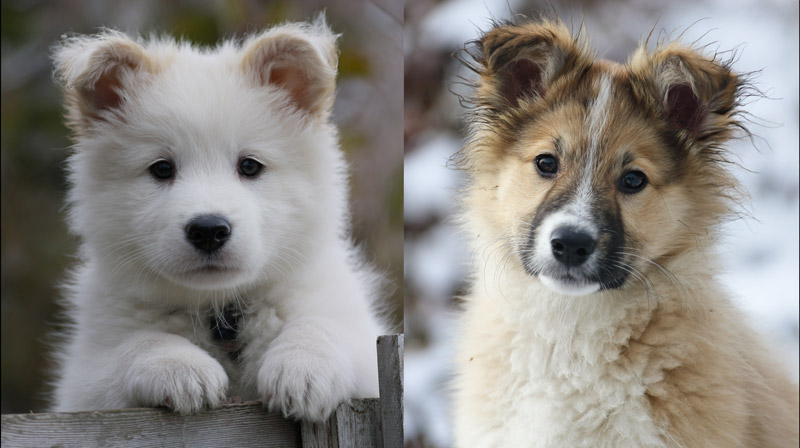
- Start with the national breed club, such as the Icelandic Sheepdog Association of America in the US or The Royal Kennel Club’s Find a Puppy service in the UK, rather than classified ads.
- Apply to several breeders at once, since litters are small and infrequent.
- Look the parents up in the OFA database instead of accepting a verbal health claim. UK buyers can also check the parents’ inbreeding coefficient with The Royal Kennel Club’s calculator.
- Meet the mother and see where the puppies are raised, as Vetstreet and Guide to Iceland both advise.
- Read the contract and health guarantee in writing before paying a deposit.
- Plan pickup early. Good Dog breeders typically offer driving or flying options.
Walk away from any breeder who seems more interested in how fast the puppy leaves than in who it goes to (Vetstreet).
Icelandic Sheepdog FAQ
Can an Icelandic Sheepdog live in an apartment?
Yes, with conditions. The Royal Kennel Club rates the breed as suited to town or country, but a vocal herder behind shared walls needs daily exercise and early noise training.
Without both, the bark becomes the neighbors’ problem.
Is the Icelandic Sheepdog good for first-time owners?
It can be, though sources disagree on trainability. Wamiz calls training challenging and says the breed needs a confident, consistent handler, while Dogster describes an eager-to-please, easygoing dog.
First-timers do best with puppy classes started early.
Does the Icelandic Sheepdog pull sleds?
No. Guide to Iceland states the breed is not used for dog sledding because its build is unsuited to the work.
Its traditional jobs were herding sheep and horses and alerting farmers by barking.
Is the Icelandic Sheepdog hypoallergenic?
No. The Royal Kennel Club lists the breed as a shedder, and the thick double coat drops hair in both coat types.
Allergy sufferers should spend time around an adult dog before committing to a puppy.
Can you adopt a rescue Icelandic Sheepdog?
Rarely, but it happens. Dogster notes that the breed’s rarity makes adoption tricky.
Start with the national breed club, then check rescue listings such as The Royal Kennel Club’s Find a Rescue search in the UK.
When is the Day of the Icelandic Sheepdog?
It falls on July 18, the birthday of Mark Watson, the English breeder who exported dogs and bred them in England while the breed was at its lowest point.
What to Settle First When Buying an Icelandic Sheepdog
Parentage should come first when buying an Icelandic Sheepdog. A narrow gene pool and a small annual puppy output make the breeder a bigger variable than the litter date.
The 2009 diversity findings and ISIC’s puppy counts point the same way. Few litters drawn from closely related parents reward the buyer who checks lineage, not the one who answers the first listing.
Order matters here, because payment and pickup cannot undo a poor pairing. Verify the parents’ results, then go through the written contract, and pay the deposit last.
The trade-off is a longer wait for a litter with documented parents.
While the wait runs, compare puppy food brands so the first week at home has a plan.