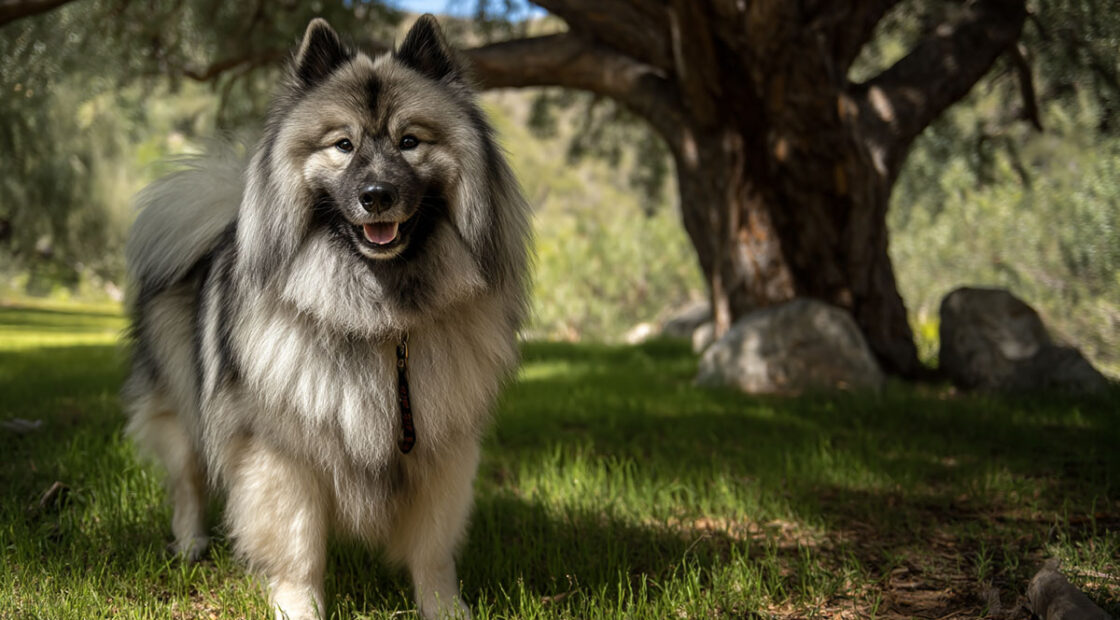
Keeshonden started out guarding Dutch river barges. These days they mostly live with families, and you can still spot one by the thick gray-and-black double coat and the dark “spectacles” markings around the eyes.
Males stand about 18 inches at the withers and females about 17, though the coat makes both look larger. The American Kennel Club files the breed in the Non-Sporting Group, while the Federation Cynologique Internationale treats it as the Wolfsspitz variety of the German Spitz.
The best-documented hereditary risk is primary hyperparathyroidism, which typically appears after age 8. A 2025 Animal Genetics study linked the disorder to a missense variant in the SIRT6 gene.
What Is a Keeshond?
Dutch river barges are where this medium-sized spitz-type dog earned its keep, and it now works mostly as a family companion. Watching the boat and keeping people company was the whole job. Nobody bred it to hunt, retrieve or herd, and the temperament still shows it.
On sight, the giveaways are the plush double coat, a plumed tail that curls over the back and those dark markings around the eyes.
Names, pronunciation and plural
The AKC breed standard gives the pronunciation as KAYZ-hawnd, not “KEES-hond”. The plural is Keeshonden, although plenty of owners just say Keeshonds, and Orvis does the same.
“Kees” is a nickname for Cornelis de Gyselaer, a Dutch Patriot leader, and “hond” is Dutch for dog. Smiling Dutchman and Dutch Barge Dog are the nicknames you hear most, with Wolfspitz turning up now and then.
How the Keeshond differs from the Wolfspitz, German Spitz and Pomeranian
Whether these are three dogs or one depends on the registry.
Federation Cynologique Internationale (FCI) Standard 97 treats the Wolfsspitz and the Keeshond as one variety, filed in Group 5 (Spitz and primitive types) with Germany as the country of origin. The United Kennel Club’s standard points out that the FCI still considers the breed a Wolfspitz.

German Spitz is the FCI umbrella name, and it covers the Wolfsspitz/Keeshond, the Giant, Medium and Miniature Spitz, and the Pomeranian as separate size varieties.
The AKC and The Kennel Club register the Keeshond as a breed in its own right, with a separate standard.
| Dog | Size in the standard | Registry classification |
|---|---|---|
| Keeshond (AKC, The Kennel Club) | 18 in males, 17 in females (ideal height) | AKC Non-Sporting, UK Utility |
| Wolfsspitz/Keeshond (FCI Standard 97) | 49 cm, plus or minus 6 cm | FCI Group 5, European Spitz |
| Pomeranian (AKC) | 3 to 7 lb | AKC Toy Group |
The toy-sized Pomeranian sits at the small end of the same spitz family, at 3 to 7 pounds under the AKC standard.
In the US and UK, you want the Keeshond standard. German-speaking countries call the same FCI variety a Wolfsspitz, and elsewhere in the FCI world it is a Keeshond.
Where the Keeshond came from and how the breed was recognized
The breed began as a watchdog on Dutch and German waterways and became a political symbol in the late 18th century. It nearly vanished after that. Breeders in the Netherlands, England and the United States rebuilt it between 1920 and 1936.
Origins on the barges
Sources do not agree on where the breed started.
The AKC archive’s Keeshond Club of America collection places it in Holland, where the dogs worked as watchdogs in the 17th and 18th centuries. The FCI lists Germany as the country of origin, and the Westminster Kennel Club says Keeshonden are believed to have reached Holland with the Vikings in the 9th century.
The ancestry is easier to pin down. Hill’s Pet Nutrition traces the breed to the same arctic strains that produced the Samoyed, the spitz and the Norwegian Elkhound, and VCA Animal Hospitals calls the Pomeranian and the American Eskimo Dog its closest relatives. Either way, that puts it with the spitz dogs rather than herding or hunting stock.
The name came later. Cornelis (Kees) de Gyselaer led the Patriot faction before the French Revolution, and political cartoons showed him with his barge dog, which became a symbol of the movement.
Then the Patriots lost. Many owners got rid of their dogs, larger barges made the small watchdog less useful, and by the 1900s the breed was rare.
Revival and recognition
The comeback ran through three countries at once, more or less in parallel.
- In 1920, Baroness van Hardenbroek led a revival effort in the Netherlands and helped found the Dutch Keeshond Club.
- Carl Hinderer arrived in America in 1923, and the first two Keeshonden followed in 1926.
- English breeders had their own Keeshond Club by 1925.
- In 1926, The Kennel Club in Britain recognized the Dutch Barge Dog, later renamed Keeshond.
- The AKC recognized the breed in 1930, with Bellon van Trennfeld as the first Keeshond registered.
- The Dutch Kennel Club followed in 1933 and the United Kennel Club in 1936.
Dates come from the AKC archive, VCA Animal Hospitals, The Kennel Club, the United Kennel Club and a 2017 ShowSight primer.
Gwendolen Hamilton Fletcher, a young Englishwoman, bought two barge dog puppies in the early 20th century and brought them home, according to that primer. The Kennel Club’s own breed page credits English breeders with reviving interest in the Keeshond’s home country.
Registries file the breed differently. The AKC and the Canadian Kennel Club both use Non-Sporting (Non-Sporting Dogs, in the Canadian wording), the United Kennel Club puts it in the Northern Breed Group, and The Kennel Club in the UK calls it Utility. The FCI uses Group 5, Section 4 European Spitz.
AKC registration data for 2025 ranks the Keeshond 85th among 202 breeds. The Kennel Club recorded 103 Keeshond registrations in 2023 and 51 in 2024.
So the breed is recognized nearly everywhere and still uncommon.
How big is a Keeshond, and what does the breed standard describe?
Males measure about 18 inches at the withers and females 17, and the heavy coat makes the dog look bigger than it is. The standard asks for a mix of gray, black and cream, a lion-like ruff and the spectacles markings.
Height and weight
The Kennel Club and the Canadian Kennel Club both set the ideal height at 18 inches (46 cm) for males and 17 inches (43 cm) for females. The Canadian standard applies it to fully matured dogs over two years old.
The AKC standard carries no disqualification for size, and a breed judge writing in ShowSight describes a one-inch tolerance either way.
FCI Standard 97 allows 49 cm, plus or minus 6 cm. That band runs from 43 cm to 55 cm (roughly 17 to 21.7 inches), so a 20-inch dog sits outside the AKC’s one-inch tolerance but inside the FCI range.
Weight is where sources split. Purina says about 40 lb for males and 35 lb for females, Hill’s Pet Nutrition gives 36 to 40 lb as ideal, VCA Animal Hospitals says 35 to 45 lb, and the Westminster Kennel Club sets a maximum of 45 lb. I’d plan around 35 to 45 pounds and let your vet judge body condition.
Coat colors and spectacles
The spectacles are a fine black line slanting from the outer corner of each eye toward the lower corner of the ear, plus markings that form short, expressive eyebrows (The Kennel Club standard).
The undercoat should be very pale gray or cream, never tawny. The AKC, Canadian, UK and United Kennel Club standards all say so. Black-tipped hairs on the outer coat create the shading, and the United Kennel Club standard says that shading must be present to some degree.
The dog is shown in a natural state, with no trimming.
Ruff, trousers and tail
The coat is thickest around the neck, shoulders and chest, forming a lion-like ruff that is more profuse in males (AKC standard, as quoted by Canine Chronicle). The rump and hind legs carry “trousers” down to the hocks, while the head, ears and lower legs stay short-haired.
The tail is richly plumed and curls over the back. The standard calls the coat “stand-off,” meaning it stands out from the body instead of lying flat.
That volume accounts for the size illusion. Hill’s notes the Keeshond looks larger than it really is.
What is the Keeshond temperament like?
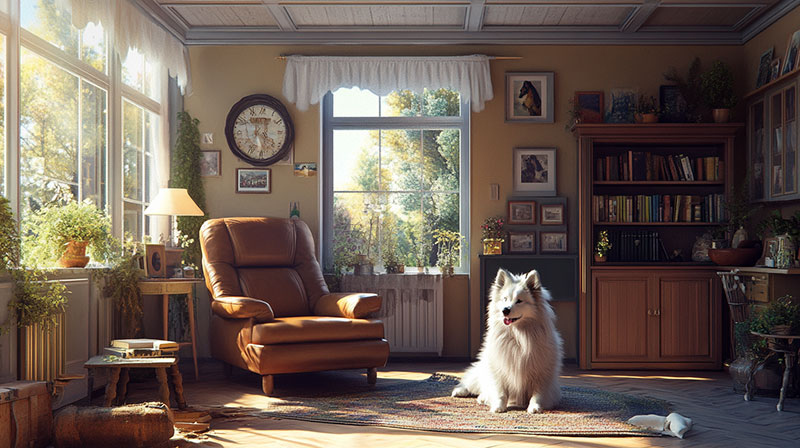
Keeshonden are friendly, and they attach hard to their people. The AKC standard describes a lively, intelligent, alert and affectionate companion, and the FCI standard adds that the dog stays attentive and extraordinarily bound to its owner.
With children, other dogs and strangers
Children get a playful and gentle dog, with one caution from Orvis. Small kids tend to pull the long fur, so supervise rough play.
The Keeshond Club of America, quoted by the AKC, ties the breed’s gentleness with other dogs and pets to the fact that it was never bred to hunt, attack or chase criminals.
Strangers get a bark of announcement, and then the dog accepts anyone the family welcomes, according to Hill’s. Orvis calls the breed respectful toward strangers. The Westminster Kennel Club gives it top marks on its scale for children, other dogs and strangers alike.
Watchdog or guard dog?
Sources split on protectiveness.
The Westminster Kennel Club gives the breed its highest protectiveness rating. Dogs Victoria and Dogs Australia still carry the Kennel Club’s older (1994) wording, which describes a bold, alert and friendly dog with a marked guarding tendency.
The current Kennel Club standard (updated January 2025) is milder. It describes a confident, alert and friendly dog that is always ready to raise the alarm and makes a good watchdog. Orvis says the breed is not considered particularly protective. Hill’s says it needs no special training to act as an alert watchdog and rarely bites.
Hill’s adds that the Keeshond barks a warning when a stranger is near and rarely becomes a nuisance barker. I’d treat it as an alarm and nothing more.
Attachment to people
VCA Animal Hospitals notes that Keeshonden are not one-person dogs. They stay equally devoted to every family member and greet family friends just as warmly.
Tikva, a Keeshond therapy dog, spent two weeks at Ground Zero after the September 11 attacks comforting people at the site. Westminster also calls the breed an excellent therapy dog.
The attachment cuts both ways. Orvis warns that a Keeshond left outside alone for long stretches develops problem behaviors.
How much grooming does a Keeshond coat need?
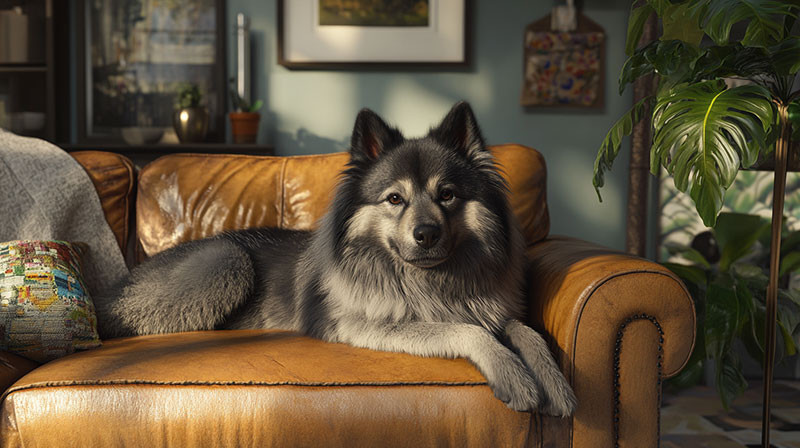
Plan on brushing once or twice a week and a bath every four to six weeks. While the undercoat sheds, brush more often. Weekly brushing is the baseline in most sources, though a few call for daily work.
Brushing frequency and bathing
Published advice runs from weekly to daily, and one publisher contradicts itself.
| Source | Brushing advice |
|---|---|
| AKC, fluffy breeds guide | Once a week |
| AKC, fluffiest breeds guide | Daily |
| Vetstreet | Once or twice a week, more during shedding |
| Orvis | Daily or every other day |
| Hill’s Pet Nutrition | Daily is ideal, once or twice a week keeps the coat clean |
The numbers reconcile once you separate seasons. Weekly brushing covers an indoor dog outside the blow, and daily brushing covers the weeks when loose undercoat packs against the skin and mats.
For baths, the AKC says every four to six weeks with a blow-dry, Orvis says about monthly, and WebMD says every six to eight weeks. A clean coat carries little odor.
Tools
A soft slicker brush handles the cottony puppy coat, and a pin brush takes over once the adult coat comes in. A stainless steel Greyhound comb is worth having, and scissors or shears take care of foot hair.
Vetstreet puts the total at about an hour of coat care per week.
Shedding and coat blowing
Hill’s Pet Nutrition describes two full undercoat blows a year, each lasting up to three weeks.
Orvis rates the breed a heavy shedder and recommends frequent vacuuming. Weekly brushing cuts the loose hair between blows, but it does not stop the blow itself.
Why shaving backfires
Never shave a Keeshond. The undercoat insulates against heat and cold, and Vetstreet’s advice on the point is blunt.
WebMD adds that shaving a Keeshond in summer exposes the skin to sunburn. A regularly brushed coat insulates better, which is the safer way to keep the dog cool.
Heat still matters. Orvis says not to run a Keeshond in hot or humid weather, and Hill’s does not recommend a hot, humid climate for the breed.
Some trimming is fine. Foot hair can be cut with scissors, VCA Animal Hospitals suggests weekly nail trims, and both VCA and Orvis recommend cleaning the ears weekly.
How much exercise and training does a Keeshond need?
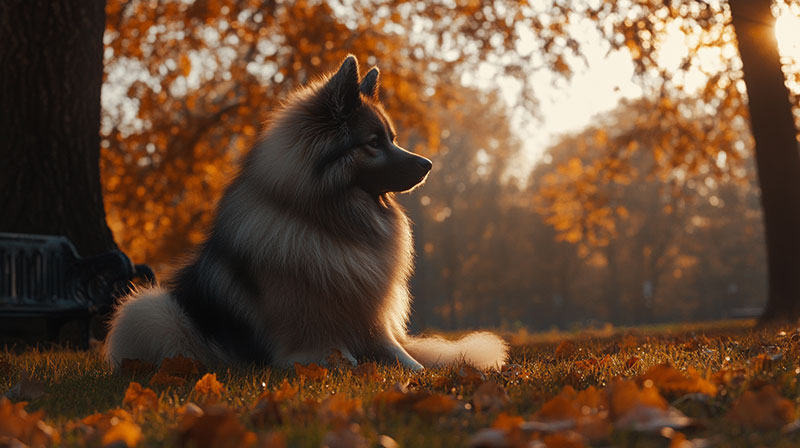
Roughly an hour of activity a day covers it, along with a lot of company. Start training the day the puppy comes home and use rewards, because the breed is sensitive and bores quickly.
Daily exercise
Orvis puts a healthy adult at about an hour a day of walks and play, and Purina UK says the dog is happy with an hour but welcomes more. Orvis also mentions two- to four-mile hikes in mild weather, and longer ones in the cold.
Many Keeshonden enjoy swimming, but the heavy coat weighs them down, so keep sessions brief and watch the dog.
Training and puzzle toys count as exercise too. Purina UK says a bored Keeshond fills the gap with noise.
Vetstreet calls the requirement moderate and lower than the dog’s energy would suggest. Barge life never asked for more.
Training approach
Westminster Kennel Club rates trainability at the top of its scale. Vetstreet adds a catch: the dog bores quickly with repetition, so sessions stay short, and it will put its own spin on commands.
Orvis recommends positive reinforcement, treats and consistency. Vetstreet says to begin at home before puppy vaccines are finished, since many classes require up-to-date shots.
Harsh words or physical corrections backfire, and Omlet says the breed rebels against them.
Timing matters too. Vetstreet warns that waiting until six months produces a more headstrong dog.
The ability is real. Breeder Margaret Bissell told ShowSight that her Keeshond Nikkee was the first of the breed to earn conformation, obedience and agility championship titles (CH OTCH MACH).
Barking, digging and being left alone
Barking is another place where sources disagree.
Hill’s calls nuisance barking rare, while Purina UK describes a potentially loud watchdog and Chewy a high-pitched bark. The split makes sense once you separate two causes.
Alert barking announces strangers and unusual noises. Vetstreet says to teach early when barking is welcome and how to stop it.
Anxiety barking starts when the dog is alone, and Chewy ties the breed’s reputation for barkiness to separation anxiety. Orvis links too little attention and activity to separation anxiety, excessive barking and chewing.
Digging is a separate habit. Vetstreet describes the Keeshond as a digger that hunts mice and moles, and Omlet says digging and chewing need to be stopped quickly.
Omlet’s fix for the alone problem is early practice with short absences. Build the time up slowly instead of testing the dog on day one.
What health problems affect the Keeshond, and how long do Keeshonden live?
Primary hyperparathyroidism (PHPT) is the breed’s best-documented hereditary condition. It is a late-onset parathyroid disorder with a DNA test. Breed-club screening also covers hips, elbows, patellas and eyes.
PHPT typically shows up after age 8, and it is autosomal dominant with high age-related penetrance (Wade et al., Animal Genetics, December 2025). After surgery, recurrence came at a median of 35 months in Keeshonden, according to a University of Cambridge retrospective study.
An earlier estimate said the breed was 50 times more likely than other breeds to develop it (dvm360 report on the Cornell research, which predates the 2025 paper).
On lifespan, a survey median of about 12.2 years for Keeshonden sits against 11 years 3 months across all breeds (Kennel Club 2004 survey, with the breed figure recast by Stanley Coren in 2015).
Primary hyperparathyroidism
PHPT is a disorder of calcium metabolism. Adenomas or hyperplasia of the parathyroid release parathyroid hormone when they should not (Wade et al.).
The Keeshond is the predisposed breed, while other breeds see sporadic cases, according to the Cambridge study.
A 2011 Cornell College of Veterinary Medicine senior seminar case report shows what it looks like in practice. The patient was an eight-year-old castrated male that had tested positive for the PHPT gene. Signs were increased urination and drinking, plus one episode of tremors. Ionized calcium was high, parathyroid hormone sat inside the reference range, and ultrasound showed a mass cranial to the right thyroid.
Surgeons removed a single adenoma. The dog had mild low calcium that cleared within five days, and calcium was normal at seven weeks. The hormone reading looked normal in that case, so the calcium values carried the diagnosis.
Surgery treats PHPT but does not close the file. The Cambridge team recommends lifelong monitoring after curative parathyroidectomy and suggests earlier screening of younger, apparently healthy Keeshonden.
One number needs a flag. Secondary literature cites a 10 percent recurrence rate, and the Cambridge authors say no published primary data backs it.
How PHPT testing developed
As of December 2025, the testing picture looks like this:
| Date | Event | Source |
|---|---|---|
| 2008 | US marker-based PHPT test in use, built on Cornell research funded by an AKC grant (2006 to 2008) | AKC Canine Health Foundation; Wade et al. |
| May 2023 | UK rule requiring PHPT DNA tests on imported Keeshonden before progeny registration put on hold | The Kennel Club |
| March 2025 | SIRT6 variant test launched, and an official Kennel Club PHPT testing scheme approved and listed under the Health Standard’s Best Practice category, with a six-month grace period before formal introduction for Find a Puppy | Canine Genetic Testing; The Kennel Club |
| October to December 2025 | SIRT6 variant paper published online on 24 October and in the December issue of Animal Genetics | Animal Genetics |
The Keeshond Club of America lists two labs, the Cornell University Animal Health Diagnostic Center and Canine Genetic Testing at the University of Cambridge. Before 2025, the Canine Genetics Centre noted that the US test’s underlying research had never appeared in a peer-reviewed journal and that only one lab offered it.
The club says the test can identify affected or at-risk dogs long before clinical signs appear. Ask a breeder which test was run, and on which parent.
Other conditions and screening
The Canine Health Information Center (CHIC) screening list for the Keeshond covers hip dysplasia and elbow dysplasia evaluations through the Orthopedic Foundation for Animals (OFA), a patellar luxation evaluation, and an eye examination by a boarded ACVO ophthalmologist, registered with OFA. PHPT is not on that list.
A CHIC number goes to any dog whose required results are all recorded in the public database, normal or not. The dog must also be microchipped or tattooed.
The Keeshond Club of America lists PHPT, thyroid and cardiac testing as optional additions on OFA.
Beyond those tests, the evidence thins. PDSA names epilepsy, and the club has funded studies of thyroid disease, epilepsy and cancer.
Vetstreet’s longer list adds heart defects (mitral valve defects, tetralogy of Fallot), Addison’s disease and hypothyroidism. A general profile and a breed-club study carry different weight, so treat the lists accordingly.
Lifespan
Breed guides give wide ranges. Westminster Kennel Club gives a maximum of 15 years, and Dogs Victoria quotes 12 to 16.
Survey medians sit near the bottom of those ranges, which is what a median does. It marks the middle dog, not the ceiling.
The Kennel Club’s 2014 survey reported a lower all-breed median (10 years 4 months) than its 2004 survey (11 years 3 months). It also sampled owners of all registered dogs instead of breed club members, so the two do not compare directly.
Vetstreet names one lever owners control. Keeping a Keeshond at an appropriate weight is among the easiest ways to extend its life.
When a Keeshond is the wrong choice
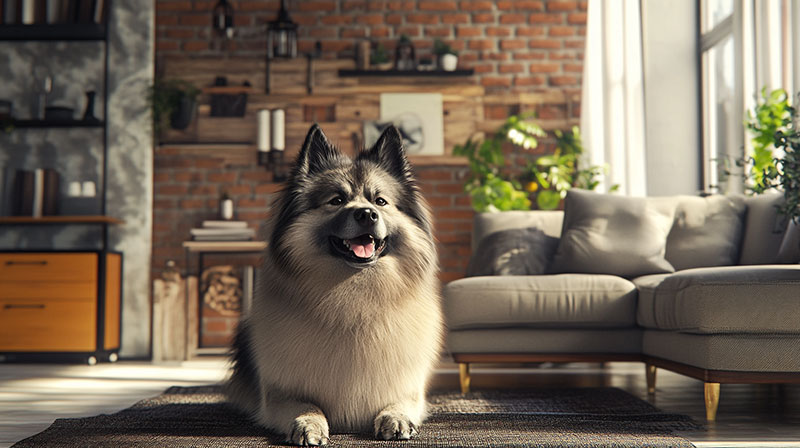
Hot climates without cooling, households that cannot stand a vocal dog and homes that sit empty most of the day all work against this breed. Sources soften each limit, but none of them removes it.
Warm and humid climates
Sources disagree on whether a warm climate rules the breed out.
Orvis says Keeshonden can adjust, because the undercoat thins in hot, humid seasons and the coat gives some cooling insulation. The same page warns that the dense fur risks overheating in direct sunlight and during exercise, which is a softer position than Hill’s advice against a hot, humid climate.
The Keeshond sits with the breeds that handle winter well, which tells you which season needs the planning. In warm weather that means cool water on walks and in the yard, no hard exercise, and a close watch for heat exhaustion.
Noise, babies and empty houses
Purina UK takes the cautious view. It says the breed’s barking makes it a poor match for homes with very young children or babies who need to sleep, and that the dog can be left only occasionally, and only with training.
VCA Animal Hospitals is softer, describing a dog that is playful and careful with children. Omlet says the bark is usually more welcoming than alarming.
The sources that disagree on volume agree on company. The dog wants people around.
The fit is a cool-climate home with someone there most of the day, a tolerance for barking, and a household that accepts the grooming and shedding.
How to find a Keeshond puppy or rescue
In the US, start with the Keeshond Club of America. In the UK, The Kennel Club’s Find a Puppy service lists breeders with puppies available. In both countries the health paperwork matters more than the website.
Buying from a breeder
- Start with a breed club listing. The Keeshond Club of America posts litters from members but says it does not guarantee the health or quality of any dog sold.
- Ask for CHIC numbers or OFA results on both parents, covering hips, elbows, patellas and eyes.
- Ask separately for PHPT results on both parents and which lab ran them, since PHPT sits outside the CHIC requirements.
- Get the documents in writing, along with a health guarantee on the puppy.
- Walk away from a breeder who says the breed has no known problems or keeps puppies isolated from the household, as Vetstreet advises.
- Meet the parents and look for good personalities and early socialization.
- Compare prices last.
Good Dog’s local marketplace pages quote $2,200 to $2,500 for Keeshond puppies in towns such as Logan, Utah and Bell, California, and $2,000 to $3,500 in Laredo, Texas. Those are listing ranges, not survey data, so confirm what a quoted price includes.
Adopting from a rescue
Breed-specific rescue is slow on purpose.
Keeshond Lovers United is a licensed shelter in Kansas and Nebraska where volunteers foster each dog and evaluate health, temperament and socialization. It requires an application, references including your vet, and a home visit.
The Turbo Kees Foundation in Illinois publishes a policy that puts application processing at one to three weeks and rules out shipping dogs sight unseen. Adopters call in two days after the adoption and again one week after.
Keeshond Rescue Ontario is foster-based, and it watches each dog for noise phobias and fear of other dogs. A dog must come back to the rescue if the adoptive home can no longer keep it.
Keeshond Lovers United says it works with other regional Keeshond rescue groups and will point you to the one nearest you first.
Keeshond FAQ
Is a Keeshond hypoallergenic?
No. Orvis reports that the thick coat sheds abundantly and leaves pet dander in the home, and dander causes most pet-related allergies.
Anyone with allergies should spend time with an adult Keeshond before committing.
Can a Keeshond live in an apartment?
Yes. Purina UK notes the breed grew up in the cramped quarters aboard Dutch barges and does not need a large house.
Daily outdoor exercise and a neighbor-friendly approach to barking matter more than square footage.
What should I feed a Keeshond?
Orvis suggests a good-quality dry food, generally 1 to 2 cups a day split into two meals. Purina recommends puppy food through the first year.
Portions shift with age and activity level, so confirm amounts with your vet.
Are there Keeshond mixes?
Yes. Chewy lists Husky, Pomeranian, Poodle, Collie and German Shepherd crosses among the most common.
Size, coat and temperament in a mix depend on the other parent breed, so the Keeshond breed standard does not predict them.
What Does a Keeshond Cost to Keep for Life?
PDSA puts the cost of keeping a Keeshond at 80 pounds a month at minimum, and multiplying that floor by the median lifespan gives roughly 11,700 pounds.
That total is a floor, not a forecast. PDSA’s estimate includes pet insurance but excludes vet fees for illness, so treatment bills sit on top of it.
The order you spend in changes how big the gap gets. Verify parental health clearances first, because they lower the odds of the largest unscheduled bill. Insure while the puppy is healthy, since Embrace Pet Insurance says plans exclude pre-existing conditions, which makes the healthy-puppy window the cheap one. After that, budget the monthly floor plus a vet reserve.
The trade-off is a higher premium, since Embrace reports that Keeshond cover costs more than cover for mixed breeds.
This position was verified in October 2026 and would change if PDSA revises its Keeshond figures. For the wider picture, see how far lifetime dog costs can climb.