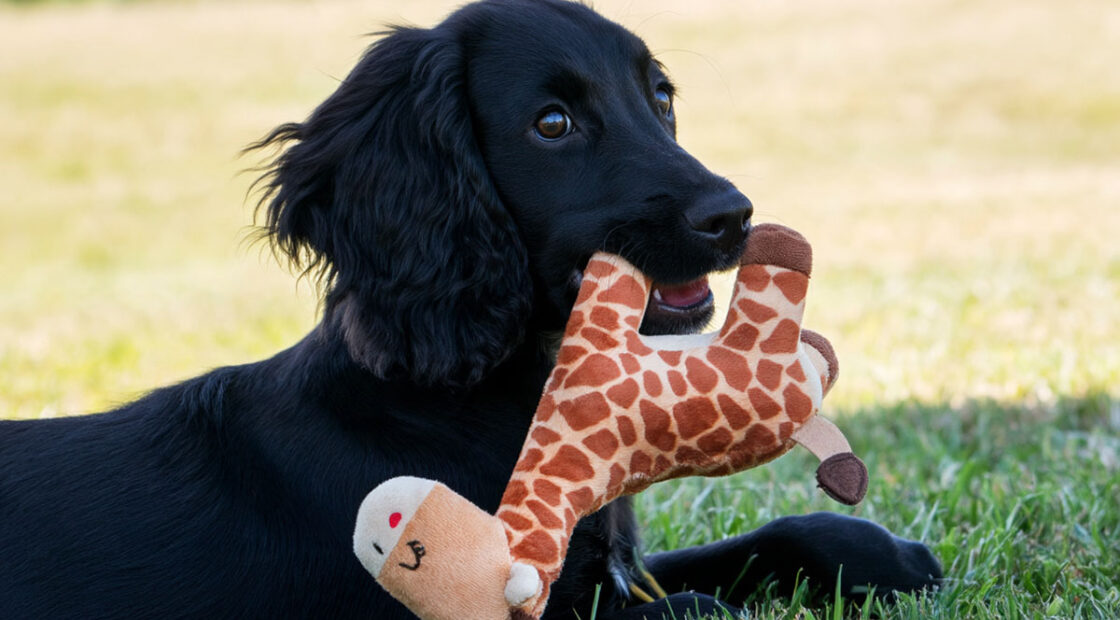
Four legs, one neck, and dogs treat every inch of a giraffe toy differently. The neck gets grabbed and shaken. The legs get chewed down to nothing. That’s basically the whole appeal of the shape: one toy, several jobs.
Brands run this shape through nearly every construction method they’ve got, soft stuffed plush on one end, reinforced-seam builds meant for serious chewers on the other. Wear concentrates at the neck and leg seams no matter which version ends up in your cart.
GoDog tunes the squeaker in its Hear Doggy giraffe to a frequency between 24 and 28 kilohertz. Dogs hear well past 40 kHz, so that range registers clearly for them. Humans standing three feet away hear nothing at all.
What Is a Giraffe Dog Toy?
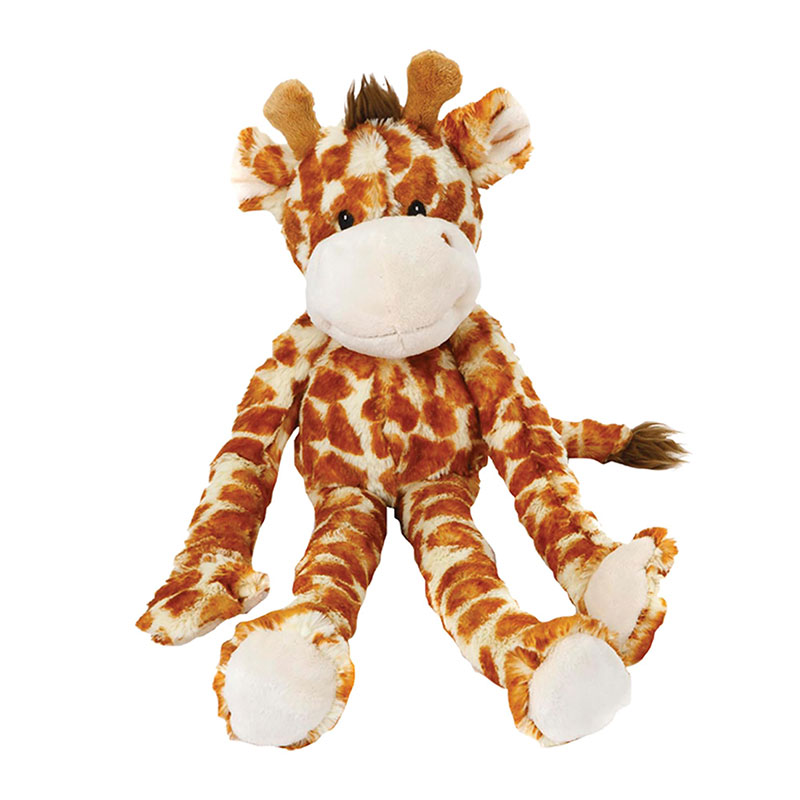
Long neck, four legs, a plush or fabric body. That’s the physical description. What actually separates it from a round or flat toy is how a dog can work different parts of it, not the giraffe shape for its own sake.
It sits in the same broad category as other stuffed animal toys and chew toys, but the long limbs change how a dog actually interacts with it.
The neck works as a tug handle. The legs work as a chew target that stays narrower than the toy’s body, which is part of why the shape keeps showing up across so many brands.
What a dog does with it varies more by mood than owners expect.
- Solo chewing and mouthing, especially on the neck and legs
- Tug of war, using the neck as a handhold
- Fetch and toss, where the long shape makes it easy to grab out of the air
- Comfort carrying, the plush version some dogs treat like a security object
Kong’s WildKnots Giraffe pairs a rope core with a plush outer layer, a build that shows up across the category because it combines chew resistance with a soft feel. It’s one of the smarter compromises out there.
Not every giraffe toy is built the same way, and the differences matter more than the shape does.
Zoom out and the toy itself is a rounding error in a genuinely large industry. The American Pet Products Association tracked $152 billion in total U.S. pet industry sales for 2024, with the wider supplies, live animals, and OTC medicine category that toys sit under reaching $33.3 billion (APPA, 2025 State of the Industry Report).
What Is a Giraffe Dog Toy Made Of?
Most giraffe toys break down into an outer fabric shell, some kind of internal filling or liner, and reinforced seams wherever stress concentrates, usually the neck and the base of each leg.
The outer shell is usually one of a few fabric types.
- Plush fabric is soft and cheap to produce, and it’s also the first thing to give out under sustained chewing.
- Canvas or ballistic nylon uses a tighter weave, and you’ll see it most often on toys marketed specifically at tough chewers.
- Cordura-reinforced fabric adds a heavier textile layered under the outer plush for extra tear resistance.
GoDog builds its plush toys, including its Hear Doggy giraffe design, with what it calls Chew Guard Technology. That’s a heavy-duty inner lining stitched under the visible fabric rather than a straight fabric swap.
Reinforced stitching matters as much as the fabric itself.
Seams on the neck and legs take the most stress, since that’s where a dog gets the best grip. Double or triple stitching in those spots directly affects how long the toy survives first contact with molars.
Stuffed vs No-Stuffing Designs
Traditional giraffe toys use a polyester fiberfill stuffing throughout the body, neck, and legs.
No-stuffing designs replace that filling with a flatter internal liner, sometimes a rope core instead, the same approach ZippyPaws uses across its Skinny Peltz line.
ZippyPaws builds that no-stuffing, multi-squeaker pattern into other animal shapes too, including its raccoon dog toys, so the giraffe version isn’t a design outlier.
Which one wins depends on what you actually want out of it.
- Stuffed toys feel plusher and hold their shape better for cuddling
- No-stuffing toys make less mess if a dog does get through the seams, since there’s no fiberfill to scatter
How Do the Squeaker and Crinkle Features Work?
A squeaker is a small plastic or metal reed housed in its own fabric pocket, usually sewn into the body, neck, or one of the legs.
Pressure from a bite or a paw forces air through the reed. That’s what produces the sound, not the fabric around it.
Crinkle material works on a different principle entirely.
It’s a stiff, layered plastic film sewn into a separate pocket that crackles from friction when it’s squeezed or bitten, adding a texture and sound a squeaker alone can’t produce on its own.
Where the squeakers sit changes how the toy actually plays. A single squeaker in the body gives one consistent sound point. Some toys go further and stitch one squeaker per leg on top of the body squeaker, which rewards a dog for finding and working each spot individually. Crinkle material layered under the plush adds a second, quieter texture running alongside the squeak.
GoDog’s Hear Doggy line, which includes a giraffe design, tunes its squeaker to a frequency in the ultrasonic range, specifically 24 to 28 kHz, audible to dogs but outside typical human hearing.
Neither feature is built to survive direct chewing indefinitely.
A squeaker that gets bitten through stops working, and that’s the point where the ingestion risk covered further down starts to matter.
What Makes a Giraffe Dog Toy Durable?
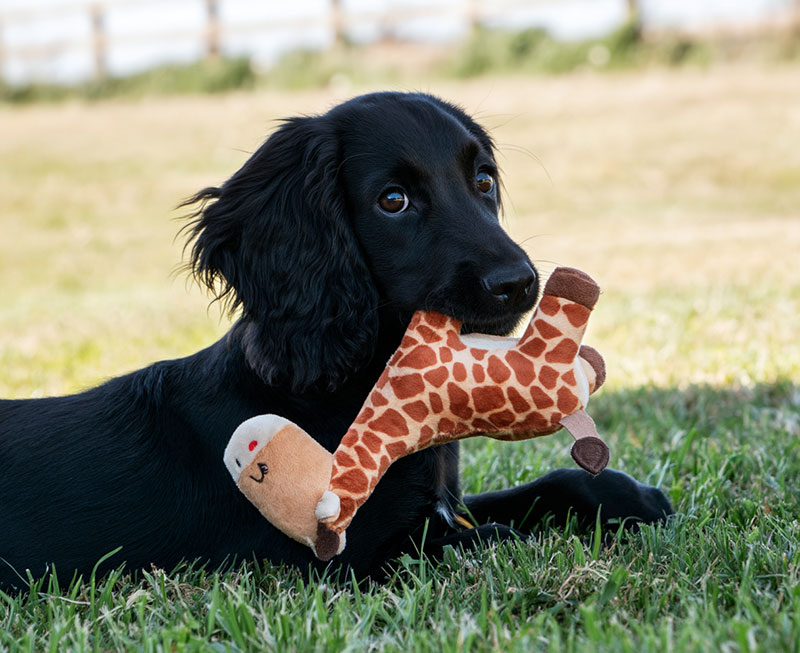
Durability tracks a handful of things: how tight the fabric weave is and how much it weighs, how many stitches sit at the stress points, whether the neck and legs carry internal reinforcement like rope or webbing, and how much bite force the toy was actually built to meet in the first place.
VIP Products (Tuffy’s) rates its toys on a Tuff Scale running from 1 to 10, ten being toughest, a rare case of a brand putting an actual number on how much chewing a toy is meant to take.
GoDog takes a different approach, requiring its plush toys to pass a 15-pound pull test before they ship.
Neither number tells you much about your specific dog. Bite force varies, chewing style varies, and a bored dog treats any toy differently than an engaged one does.
The giraffe shape has one durability quirk worth naming directly.
The neck and legs are narrower than the body, so they take concentrated bite pressure that a rounder toy spreads out more evenly.
That’s why reinforced stitching at the base of the neck matters more on a giraffe toy than it does on, say, a ball or a round plush.
Are Giraffe Dog Toys Safe for Dogs?
Giraffe dog toys are not legally required to meet any specific U.S. safety standard, because pet products fall outside the children’s toy regulations most people assume apply.
ASTM F963, the standard most people picture when they hear “toy safety,” is mandated under 16 CFR Part 1250 (Consumer Product Safety Commission) for toys intended for children 12 years old and under. The standard’s own definition of “toy” is actually broader than that. It covers anything designed, manufactured, or marketed as a plaything for children under 14. That broader definition doesn’t, by itself, trigger the mandatory third-party testing and certification requirement, though.
Pet toys aren’t covered by that rule at all, which means safety testing on a giraffe dog toy is whatever the manufacturer chooses to do voluntarily.
In practice, that split breaks down a specific way.
- Regulatory status. Mandatory ASTM F963 testing and certification under 16 CFR Part 1250 applies to children’s products intended for kids 12 and under, not to pet products.
- Voluntary testing. GoDog states its plush toys are designed to meet child safety standards, even though nothing requires a pet toy maker to do that.
- Real-world risk. In a 2017 to 2019 study of 72 dogs treated for gastrointestinal foreign bodies at three veterinary hospitals, children’s toys were the single most common item recovered, at 14 percent of cases. Worth remembering that a household’s kid-toy bin can pose as much risk to a dog as its own toy box does.
The choking and blockage risk with a giraffe dog toy specifically sits mostly with the squeaker and crinkle insert, not the fabric shell.
Once a squeaker is exposed, a dog that swallows it needs a vet visit. A squeaker that reaches the intestines can cause a blockage, or, if it’s been chewed into sharp pieces, a perforation.
What Size Giraffe Dog Toy Fits Your Dog?
Giraffe dog toys are typically sold in three lengths, and matching size to your dog’s weight matters more than matching it to the breed name printed on the box.
| Size | Typical Length | Best For |
|---|---|---|
| Small | 9 to 11 inches | Dogs under 20 lbs |
| Medium | 13 to 15 inches | Dogs 20 to 50 lbs |
| Large | 18 inches and up | Dogs over 50 lbs |
ZippyPaws lists its large Skinny Peltz shapes at 18 inches, which lines up with the top end of that range.
A toy sized too small for a big dog disappears fast, and that’s a genuine hazard, not just a durability complaint.
Giant breeds close to Bullmastiff size need the large end of that range or nothing at all, since anything mid-sized gets treated like a chew toy the moment the novelty wears off.
For sizing guidance that goes beyond giraffe shapes, the guide to Bullmastiff toys and accessories breaks down what actually holds up for dogs in that weight class.
Puppies deserve their own note here.
Younger dogs under a year old show a higher rate of foreign body ingestion overall. Insurance-claims data out of Japan put that at 4.4 percent for puppies under one year versus 1.7 percent across all ages.
Sizing up rather than down is the safer default for a growing dog.
Best Giraffe Dog Toys for Aggressive Chewers
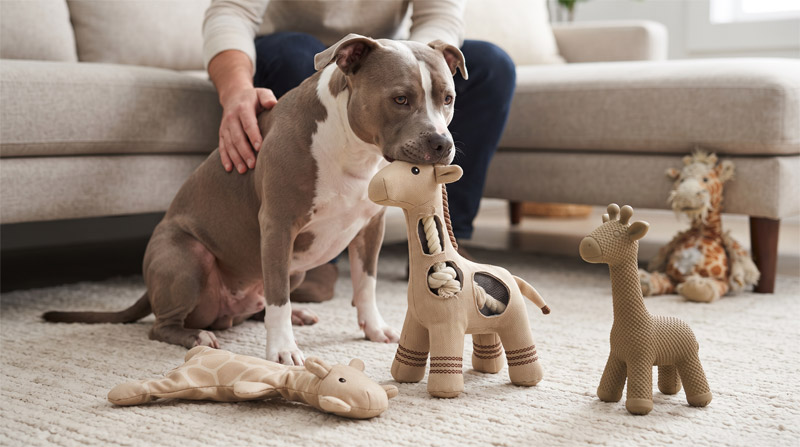
A giraffe toy’s weak points are exactly where an aggressive chewer targets first: the neck and the leg tips.
Reinforced-seam options, like GoDog’s Chew Guard line, tend to outlast standard plush. But “outlast” is relative here, not a guarantee.
Reinforced-seam plush:
- Heavy-duty lining resists punctures better than standard plush
- Squeakers are often sewn into their own protective pocket
- Still fabric-based underneath it all, so a determined chewer eventually gets through
No-stuffing plush:
- Less mess if a dog does breach the seams, since there’s no fiberfill
- Lighter weight, easier for a dog to shake and tug around
- Thinner overall construction than a reinforced-seam design
Non-plush alternatives:
- No fabric shell to tear open in the first place
- Loses the plush texture and cuddle factor entirely
Dogs who reduce a giraffe toy to a pile of fluff within one play session are usually better served by something with no plush shell at all, like a fire hose dog toy, than by a tougher version of the same plush build.
The rope-reinforced neck on a giraffe toy borrows the same armature idea used in yeti dog toys, where a knotted rope core does the tug work while the plush shell just rides along on top.
No plush giraffe toy, reinforced or not, is actually indestructible, and treating one as a substitute for supervision is where most of the swallowed-squeaker stories start.
Giraffe Dog Toy Brands Compared
Four brands dominate the giraffe-shaped toy shelf, and each one solves the durability question a little differently.
| Brand | Construction | Stuffing | Notable Feature |
|---|---|---|---|
| Kong | Plush shell over rope core | Minimal | WildKnots rope skeleton |
| GoDog | Chew Guard lined plush | Under-stuffed | Ultrasonic Hear Doggy squeaker |
| Jolly Pets | Nylon build | Standard | Dual tug handles, floats |
| ZippyPaws | Layered fabric, no rope | None | Multiple squeakers per toy |
Kong’s approach centers on the rope skeleton running through the neck and legs, which is what lets it market the WildKnots line as an interactive toy rather than a straight chew toy.
GoDog leans on its Chew Guard lining plus a flat, under-stuffed build, the same combination behind its Hear Doggy giraffe.
Jolly Pets takes a different path entirely with its Tug-a-Mals Giraffe.
It’s built from non-toxic nylon rather than standard plush, floats for water play, and its easy-grip handle design lets two people, or two dogs, pull at once.
Line the four up side by side and the priorities split pretty cleanly. Kong goes for a soft-but-structured feel. GoDog chases chew resistance at the seams specifically. Jolly Pets is built around tug play and time in the water. ZippyPaws is optimized to make less of a mess if a dog does tear through the shell.
None of them market their giraffe toy as a heavy-duty chew toy, and that omission is deliberate rather than an oversight.
How Much Does a Giraffe Dog Toy Cost?
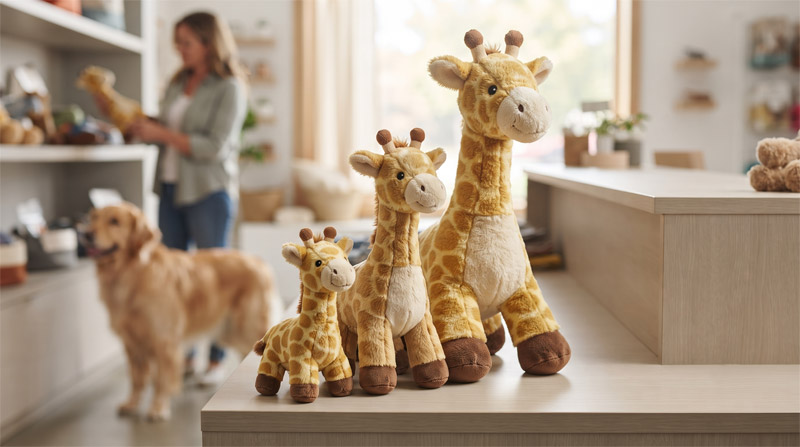
Giraffe dog toys mostly cluster into a narrow band once actual shelf prices replace sale prices.
Real listings from major retailers put the range in view clearly enough:
- Kong WildKnots Giraffe: $11.97 for small/medium, $17.99 for medium/large (Chewy)
- Jolly Pets Tug-a-Mals Giraffe: $12.99 to $18.99 depending on size
- GoDog Hear Doggy Giraffe: $19.99
Size drives most of the price difference within a single brand, not the brand name itself.
A small giraffe toy and a large one from the same company can differ by six to eight dollars just from the extra fabric and stuffing.
None of these prices move the needle much against the overall cost of dog ownership.
A single giraffe toy is a rounding error next to how expensive a dog gets once food, grooming, and vet care are added up over its life.
When a Giraffe Dog Toy Does Not Work
A giraffe toy is the wrong purchase in a few specific situations, not just a bad fit in general.
Kong’s own product guidance for the WildKnots Giraffe states plainly that it’s built for interactive play, not for dogs with strong chewing instincts who destroy toys quickly.
That’s a manufacturer admitting the limit up front, which is rarer than it should be in this category.
A few other situations rule the toy out entirely:
- A dog with a documented history of swallowing fabric or stuffing
- A power chewer who has already destroyed reinforced-seam toys within a day or two
- A young puppy still teething, where a firmer chew toy serves the gums better than soft plush
- A multi-dog household where one dog reacts badly when another approaches its toy
That last point matters more than owners tend to expect.
A five-year study of more than 1,000 shelter dogs found resource guarding present in 15 percent of the population, based on standardized food-bowl and possession tests using food and chew items like rawhide or a pig ear (McGuire, Animals journal, 2019). The study specifically measured food-related guarding and didn’t separately evaluate toy guarding as its own category.
Adding a single giraffe toy to a household with a known guarder doesn’t create a training problem so much as hand a dog a reason to rehearse one.
The fix in that situation isn’t a tougher giraffe toy. It’s separate toys, separate spaces, or professional guidance before the toy comes out at all.
How to Clean and Maintain a Giraffe Dog Toy
Cleaning method depends entirely on construction, and brands are surprisingly specific about their own recommendations.
- Check the care label or product page first, since GoDog recommends only a damp-cloth spot clean for its Chew Guard plush, while ZippyPaws lists its Skinny Peltz line as machine washable on a gentle cycle
- Remove any detachable accessories before washing anything labeled machine washable
- Use a mesh laundry bag if the toy has exposed squeaker pockets, to keep seams from catching on other items in the wash
- Air dry rather than tumble dry, since heat breaks down stitching adhesive faster than normal wear does
- Inspect the neck and leg seams after every wash cycle, since that’s where stitching failure shows up first
Spot cleaning and machine washing aren’t interchangeable across brands.
Checking the specific product matters more than assuming any plush toy is safe for the wash.
Retiring the toy matters as much as cleaning it.
Once a seam opens at the neck or a leg, wash cycles won’t fix the underlying problem. The toy should come out of rotation rather than get handed back to a dog after a repair attempt.
A torn giraffe toy left in the toy bin “just in case” is how a dog ends up chewing through a compromised seam unsupervised, the exact scenario the earlier safety and failure sections already cover.
FAQ on Giraffe Dog Toy
Are giraffe dog toys good for teething puppies?
Soft plush suits gentle mouthing, not aggressive teething.
A puppy losing baby teeth needs firmer chew toys alongside a plush giraffe toy. Use the giraffe shape for cuddling and light tug, not as the only teething outlet.
Can a giraffe dog toy be used for tug of war?
Yes. The long neck works as a built-in handle for tug of war.
Reinforced-seam designs, like GoDog’s Chew Guard line, hold up better under sustained pulling than standard plush. Supervise play so the seams don’t tear mid-tug.
How do you introduce a giraffe dog toy to a puppy?
Let the puppy sniff and mouth the toy before adding motion.
Squeak it once to spark interest, then toss it a short distance. Avoid tug-of-war until the puppy understands “drop it,” so the toy doesn’t turn into a resource-guarding trigger.
What do you do if a giraffe dog toy gets recalled or torn apart?
Pet toys sit outside CPSC recall authority, so there’s no formal recall channel like ASTM F963 provides for children’s products.
If a toy tears, brands including Tuffy’s and GoDog offer replacement guarantees. Otherwise, retire the toy immediately.
Where can you buy a giraffe dog toy?
Major pet retailers, including Chewy, Amazon, Petco, and PetSmart, stock giraffe toys from Kong, GoDog, ZippyPaws, and Jolly Pets.
Prices and available sizes vary by retailer, so checking dimensions against your dog’s weight matters more than picking a specific store.
How long does a giraffe dog toy typically last before it needs replacing?
Lifespan depends on the dog, not a fixed timeline.
A light chewer can keep one for months. A determined chewer can open a seam in one sitting. Inspect weekly and replace at the first sign of exposed stuffing or a loose squeaker.
What Matters Most When Choosing a Giraffe Dog Toy?
A giraffe dog toy earns its price when the size actually matches the dog’s weight, the stitching is reinforced at the neck and legs, and the squeaker sits sealed inside its own protected pocket. Check those in roughly that order, too. Size and seam quality you can verify before you buy. Squeaker protection is usually something you only find out about once the toy’s already in the house.
The age pattern already noted for this category cuts in two directions.
Ingestion risk concentrates in puppies, while resource-guarding risk concentrates in adult and senior dogs, so the same toy carries a different risk profile depending on where the dog is in its life.
Neither risk disappears with a better-made toy. It only shifts as the dog ages.
Dogs who treat every plush shape as demolition work are better matched to a safe dog chew than to another giraffe redesign.