
Enter your dog's weight, age, and activity level to get a daily feeding amount, then check it against the full charts for puppies, adults, and seniors further down the page.
Calories per cup of dry food. Look for it near the guaranteed analysis on the bag. Most kibble sits between 350 and 450 kcal per cup, puppy formulas often run higher.
Feeding amounts are calculated from the resting energy formula (70 times body weight in kilograms to the power of 0.75) published in the National Research Council's Nutrient Requirements of Dogs and Cats, with activity multipliers drawn from the WSAVA Global Nutrition Guidelines. Treat every number on this page as a starting point, not a prescription.
This Border Collie feeding chart turns two facts about your dog, weight and activity level, into a number you can actually measure into a bowl. It runs on the same resting energy formula vets use, not a guess pulled off the side of a bag. Feeding a working breed by eye rarely goes well. Border Collies stay lean, move constantly, and hide weight gain under a thick coat until it's already a problem.
A Border Collie feeding chart is a weight-and-age-based portion reference built for a dog that burns more than a typical medium breed at rest.
It converts a generic dry food label into a daily gram or cup range that accounts for the breed's lean, high-drive build rather than a flat "medium dog" average.
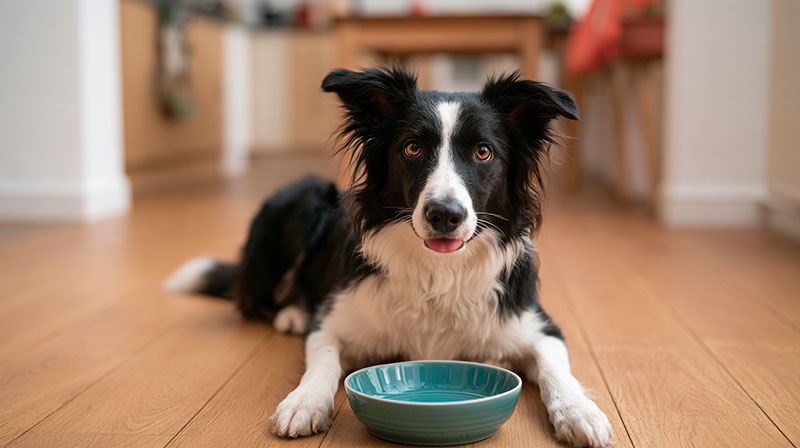
The Border Collie was developed for herding, and that working history is exactly why a standard bag label undershoots or overshoots so often for this breed.
It is worth being clear about what this kind of chart is not, since most owners run into the same three misunderstandings.
Two inputs decide the number on any accurate chart: current body weight and a calculated daily calorie target.
Everything else in this guide (age stage, activity band, body condition) exists to adjust that second number up or down.
Daily portions for a Border Collie fall roughly between 1 3/4 and 3 1/4 cups of dry kibble for most puppies, house pets, and seniors, and climb to about 6 cups for a large working dog, depending on weight, age, and how physically demanding the dog's day is.
The Border Collie Society of America, the breed's official AKC parent club, confirms the written standard sets a height range only: 19 to 22 inches for males and 18 to 21 inches for females at the withers.
It does not fix an official weight, which is why practical weight ranges compiled by breed and veterinary references vary somewhat: adult dogs are commonly reported at roughly 30 to 55 pounds (14 to 25 kg).
| Life stage | Typical weight | Daily amount (dry kibble) | Meals per day |
|---|---|---|---|
| Puppy, 2 to 6 months | 10 to 25 lbs | 1 3/4 to 3 cups | 3 to 4 |
| Puppy, 6 to 12 months | 25 to 40 lbs | 2 1/4 to 3 1/4 cups | 2 to 3 |
| Adult, typical house pet | 30 to 45 lbs | 2 to 2 3/4 cups | 2 |
| Adult, working or competition | 35 to 55 lbs | 4 1/2 to 6 1/4 cups | 2 |
| Senior, 7+ years | 30 to 45 lbs | 1 3/4 to 2 1/4 cups | 2 |
These ranges use the same math as the calculator above: a dry kibble at 375 kcal per cup and resting energy multiplied by 3.0 for puppies under 4 months, 2.5 from 4 to 6 months, 2.0 from 6 to 12 months, 1.6 for a typical adult, 3.0 for a working dog, and 1.3 for a senior. Calorie density changes the cup amount directly, so enter your own food's kcal per cup in the calculator.
A giant breed sits on a completely different curve; a Great Dane feeding chart starts from a much larger frame and a lower calorie need per pound of body weight.
Cross-check any number here against the calorie math in the next section rather than treating the table as the final word.
Daily calorie need starts from resting energy requirement (RER), calculated as 70 multiplied by body weight in kilograms raised to the 0.75 power.
This formula is the standard used in WSAVA-aligned veterinary nutrition guidance and is the same equation applied across dog breeds, not something specific to one size class.
RER only covers the energy needed to breathe, digest, and circulate blood at rest.
Anything the dog does beyond lying still gets layered on top through a maintenance energy requirement (MER) multiplier.
Worked example: a 20 kg (44 lb) moderately active adult has an RER of roughly 660 kcal/day.
Multiplied by 1.6 for a neutered, moderately active dog, that lands near 1,060 kcal/day, the actual daily target before converting to food volume, or about 2 3/4 cups of a 375 kcal-per-cup kibble.
A German Shepherd feeding chart runs through the same RER and MER math, just anchored to a heavier average body weight.
When the formula-based number disagrees with what the bag label suggests, the calculated figure should take priority, then get adjusted against body condition over the following weeks.
Puppy growth splits into four practical stages: weaning, 2 to 6 months, 6 to 12 months, and the approach to adult weight.
Each stage carries a different portion range and meal count, and pushing a puppy through these stages too fast is a documented risk factor for joint problems later on.
| Growth stage | Typical age range | Typical weight | Meals per day | Daily portion |
|---|---|---|---|---|
| Weaning | 3 to 8 weeks | Under 10 lbs | 4 to 5 | Gradual transition to solid food |
| Early growth | 2 to 6 months | 10 to 25 lbs | 3 to 4 | 1 3/4 to 3 cups |
| Mid growth | 6 to 12 months | 25 to 40 lbs | 2 to 3 | 2 1/4 to 3 1/4 cups |
| Approaching adult weight | 12 to 18 months | 30 to 45 lbs | 2 | Transition toward adult portion |
AAFCO's separate growth and reproduction nutrient profile sets a higher floor than adult maintenance food, specifically to support this stage.
Calcium control matters here because uncontrolled bone growth in a large-frame puppy is directly linked to hip dysplasia-type joint disease later in life.
Large-breed puppy formulas from brands such as Hill's Science Diet and Royal Canin manage calcium levels specifically to slow that growth curve.
Weight plateau, not a fixed birthday, is the better signal for switching from puppy to adult formula.
Weaning through 8 weeks: four to five small meals, since a young puppy's stomach cannot hold a full day's calories at once.
2 to 6 months: three to four meals, dropping to three once appetite and energy level stabilize.
6 to 12 months: two to three meals, most owners settling on two by the second half of this stage.
12 months onward: two meals a day, the same frequency that carries through adulthood.
Activity level is the single biggest adjustment on top of the base calorie formula for this breed specifically.
Three practical bands cover most pet dogs, and the gap between the lowest and highest band is wide enough to double a dog's daily portion.
Herding and agility Border Collies tend to sit near the top of their weight-appropriate calorie range even when their body weight looks identical to a sedentary dog's.
Structured exercise routines change day-to-day energy expenditure enough that portion size needs to flex with the training calendar, not stay fixed.
Spay and neuter status adds a separate reduction on top of activity level.
Neutered dogs typically need roughly 20 to 30 percent fewer calories than intact dogs at the same weight and activity band, so portions usually need a downward adjustment in the weeks after the procedure.
The Association for Pet Obesity Prevention's 2022 clinical survey found 59 percent of dogs evaluated at U.S. veterinary clinics were overweight or obese, based on vet-assessed body condition score.
That figure matters here specifically because portion charts only work as a starting point; body condition score is the tool that tells you whether the starting point needs correcting.
The WSAVA Global Nutrition Committee's 9-point scale sets 4 to 5 out of 9 as the ideal target for an adult dog.
Run the rib check monthly rather than relying on the scale alone, since coat length on this breed can hide early weight gain.
Overfeeding shows up gradually, then all at once once the coat starts hiding less.
Underfeeding in a working or high-drive Border Collie looks different from a simple lack of appetite.
Adjust the daily total by roughly 10 percent in either direction, then re-check body condition after two to three weeks rather than making a second change immediately.
Kibble, raw feeding, and grain-free formulas all meet a Border Collie's nutrient needs when they meet AAFCO or FEDIAF minimums, and the real differences come down to protein density, cost, and prep effort.
| Food type | Typical protein | Typical fat | Cost per day | Prep effort |
|---|---|---|---|---|
| Kibble | 22 to 30% | 12 to 18% | Low to moderate | Minimal |
| Raw (BARF-style) | Varies, often 30%+ | Varies widely | High | High, requires planning |
| Grain-free | 24 to 32% | 14 to 18% | Moderate to high | Minimal |
Baseline adequacy:
Downside: cheaper kibble lines often sit close to the AAFCO floor rather than well above it, which matters more for a working dog than a sedentary one.
Raw feeding gives an owner direct control over protein source and ratio, which appeals to owners managing a food sensitivity.
The FDA's December 2022 update on its dilated cardiomyopathy investigation stated that adverse event reports alone "do not supply sufficient data to establish a causal relationship" between grain-free diets and the condition.
That is a narrower conclusion than the early 2018 alarm suggested, and it has not been withdrawn or strengthened since.
Grain-free formulas still need to be checked against the same AAFCO protein and fat floors as any other kibble, since "grain-free" is a marketing description, not a nutrient guarantee.
Feeding decisions intersect with four breed-linked conditions, though the strength of that link varies a lot by condition.
Some are genetic first and diet-adjacent at best; others respond directly to portion control.
| Condition | Primary cause | Diet connection |
|---|---|---|
| Border Collie Collapse | Polygenic, still being mapped | None established; triggered by exertion, not food |
| Hip dysplasia | Genetic, worsened by rapid growth | Growth-stage calcium and calorie control |
| Dilated cardiomyopathy (DCM) | Multifactorial, still under study | Possible link to certain grain-free formulas |
| Collie eye anomaly / PRA | Autosomal recessive genetic mutation | None; diagnosed by genetic test, not diet |
Border Collie Collapse (BCC) is often confused with the Labrador Retriever's exercise-induced collapse (EIC), but the two are genetically distinct.
University of Minnesota researchers, funded by the AKC Canine Health Foundation, found the DNM1 mutation responsible for Labrador EIC in zero of 151 randomly sampled Border Collies and zero of 23 dogs with a collapse history.
The foundation estimates BCC affects roughly 5 to 10 percent of working Border Collies, a separate polygenic condition triggered by strenuous exercise rather than diet.
No feeding adjustment prevents an episode; management is exercise pacing and heat avoidance, not portion size.
Hip dysplasia is the most common inherited orthopedic issue in the breed, and the data shows real improvement over time.
The Border Collie Foundation, citing Orthopedic Foundation for Animals records, puts the dysplastic rate at 10.8 percent across dogs evaluated from 1974 to 2015, falling to 8.4 percent for dogs born between 2011 and 2015.
That decline tracks with wider adoption of controlled-growth puppy feeding, though genetics and breeding selection are doing most of the work.
Dilated cardiomyopathy is the condition where diet has drawn the most scrutiny, and the Border Collie shows up in that data too.
The FDA's own case log lists Border Collie among the breeds with more than one dilated cardiomyopathy report submitted between 2014 and 2019, alongside far more commonly affected breeds like Golden Retrievers and Labradors.
That inclusion does not establish grain-free food as the cause for this breed specifically; it means Border Collie owners feeding a legume-heavy formula should stay alert to the same symptoms any owner should watch for.
Collie eye anomaly and progressive retinal atrophy are both autosomal recessive genetic conditions confirmed by DNA testing, not by anything in the food bowl.
A responsible breeder tests for the NHEJ1 deletion linked to collie eye anomaly before pairing dogs, since no dietary intervention changes the outcome once a puppy inherits two copies.
A sudden switch is the most common cause of short-term digestive upset in dogs changing foods, regardless of breed.
The American Animal Hospital Association's pet nutrition guidance recommends transitioning over seven days, starting by replacing 25 percent of the old food with the new one.
Loose stool in the first few days of a transition is common and usually resolves on its own.
Pause and slow down if diarrhea persists past day three, if vomiting shows up more than once, or if the dog stops eating entirely.
Portion changes need the same gradual approach as food changes, just on a percentage rather than a brand.
Move the daily total up or down by roughly 10 percent, hold that new amount for two to three weeks, then re-check body condition before adjusting again.
Working dogs entering a heavier training block are the exception: increase food a day or two ahead of the added activity rather than waiting for weight loss to show up first.
A weight-and-age chart assumes a healthy, non-reproducing adult dog in a stable routine.
Four situations break that assumption, and each one needs a different starting point than the tables above.
None of these cases are rare edge cases for this breed specifically; working lines and breeding females run into the first and third points regularly.
The chart above is a starting point for a typical companion or moderately active dog, not a ceiling or a floor for every Border Collie in every circumstance.
Bag guidelines are calibrated to the least active dog at a given weight, so they avoid underfeeding across a huge range of dogs.
A personalized chart, built from resting energy requirement and this breed's actual activity level, is usually more accurate.
Yes, and they add up fast on a dog this size.
Treats should stay under 10 percent of daily calories; anything more crowds out balanced nutrition and skews the portion math built around kibble alone.
Free-feeding rarely works well for this breed.
Without portion control, a food-motivated, high-drive dog will often overeat, and body condition score becomes harder to manage over time.
Occasional skipped meals in an otherwise healthy adult usually aren't concerning.
Persistent refusal, especially paired with lethargy or weight loss, warrants a vet visit rather than switching foods repeatedly, which can mask an underlying issue.
Roughly 1 ounce of water per pound of body weight daily is a standard baseline.
Dogs need more on hot days or after strenuous herding or agility work, and dry kibble diets increase water needs compared with wet food.
Two meals a day works well for most adults, and three to four for puppies.
Splitting the day's food lowers the odds of scarfing and helps keep energy steadier through the day for a breed that thrives on routine.
High-drive dogs often beg from habit or boredom rather than true hunger, so check body condition first.
If the dog is already at a healthy weight, the begging is usually a request for more exercise or mental work rather than more food.
Most vets suggest leaving some space around hard exercise as a general precaution.
That means avoiding a full meal right before or right after strenuous activity, regardless of an individual dog's bloat risk.
A performance formula with more fat and protein, and a higher calorie count per cup, keeps portion sizes manageable for a dog burning close to twice a typical pet's calories.
Loop in a vet familiar with sporting or working dogs when building out that diet.
Most reach full adult size by 12 to 15 months, and that is the usual point to switch.
Transition gradually over a week or two by mixing increasing amounts of the new food into the old.
Not automatically, but it is worth a conversation with your vet.
Grain-free diets heavy in peas, lentils, or potatoes have been under FDA review since 2018 over a possible link to heart disease in breeds not normally prone to it, and Border Collies fall into that category.
Quick calculators for the everyday questions every dog owner asks.
Daily portions by age and weight, with a calculator built for each breed.