Some dogs don’t just look grumpy. They look like they’ve seen things.
Dogs that look like old men share a specific set of physical traits: deep facial wrinkles, heavy jowls, droopy deep-set eyes, and scrunched flat faces that compress every feature into one perpetually disapproving expression.
These breeds aren’t accidents. Their saggy skin, loose folds, and furrowed brows came from centuries of selective breeding, genetics, and function.
This guide covers the 12 breeds that nail the old-man look hardest, why they look that way, what it costs to keep them healthy, and how to find one responsibly.
What Makes a Dog Look Like an Old Man?
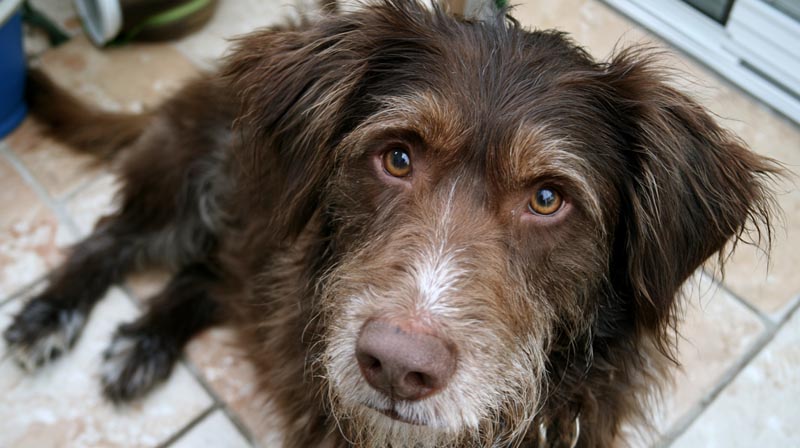
The “old man” look in dogs comes down to 4 specific physical traits working together: deep facial wrinkles, heavy jowls, droopy deep-set eyes, and natural gray or grizzled muzzle coloring.
Not all wrinkled dogs qualify. A dog with body folds but a smooth, alert face won’t have the same effect. The look is driven by the face first.
Facial Wrinkles and Skin Folds
Deep forehead furrows and folds around the muzzle are the primary driver. They compress the face into an expression that reads as concerned, tired, or stern.
Loose, saggy skin bunches at the cheeks and brow. On flat-faced breeds, the compression is even more concentrated since the skull structure pushes everything forward.
Jowls and Droopy Eyelids
Heavy jowls: Excess skin around the muzzle and chin that hangs visibly, similar to human jowl aging.
Droopy eyelids: Visible lower lid sag, sometimes showing the white sclera. Found in Bloodhounds, Basset Hounds, and Neapolitan Mastiffs.
Deep-set eyes: Eyes recessed into folds of skin, creating a tired, world-weary expression common in brachycephalic breeds.
Brachycephalic Skull Structure
Flat-faced dog breeds like the Pug and Bulldog have shortened skulls that compress all facial features into a concentrated area.
This creates a permanently squinted, furrowed look. The shorter the muzzle, the more exaggerated the effect. Brussels Griffons are a perfect example at the small end of the scale.
Gray Muzzle and Wiry Facial Hair
Some breeds are born with naturally grizzled, salt-and-pepper coats around the muzzle and brow. This isn’t age-related graying. It’s a permanent breed trait.
Wiry or bristled facial hair that grows outward around the muzzle creates mustache and beard effects. Scottish Terriers and Bouvier des Flandres are classic examples. The combination of coarse texture and outward growth mimics an old man’s stubble or beard more convincingly than any other feature.
| Trait | What It Creates | Primary Breeds |
|---|---|---|
| Deep facial wrinkles | Furrowed, concerned expression | Shar-Pei, Neapolitan Mastiff |
| Heavy jowls | Sagging cheeks and chin skin | Bloodhound, Dogue de Bordeaux |
| Droopy eyelids | Tired, droopy-eyed stare | Basset Hound, Bloodhound |
| Wiry muzzle hair | Natural mustache and beard effect | Scottish Terrier, Bouvier |
| Flat brachycephalic face | Compressed scowling look | Pug, Bulldog, Brussels Griffon |
Which Dog Breeds Look the Most Like Old Men?
These 12 breeds score highest on the combination of wrinkles, jowls, droopy eyes, and grizzled facial features that produce the old-man look. Each breed gets there through a different physical route.
Shar-Pei
The Chinese Shar-Pei is the most wrinkled dog alive. Skin folds cover the entire face, neck, and body in puppies, with adults retaining dense folds across the head and muzzle.
A 2011 study by Olsson et al. in PLoS Genetics linked the wrinkling to a duplicated DNA segment upstream of the HAS2 gene, which drives overproduction of hyaluronic acid in the skin. Heavily wrinkled “meatmouth” Shar-Pei had 2 to 5 times higher blood levels of hyaluronic acid than other breeds.
Shar-Pei were close to extinction by the early 1970s. In 1978 the Guinness Book of World Records listed the Shar-Pei as the world’s rarest dog breed (Shar Pei Club of Great Britain). The modern Shar-Pei’s deep folds are more pronounced than those of its ancient Chinese ancestors.
Bloodhound

The Bloodhound combines 3 old-man features simultaneously: deep forehead skin folds, pendulous droopy ears, and visible lower eyelid sag (ectropion).
Its wrinkled skin around the head and neck serves a functional purpose. When tracking with its nose to the ground, the loose folds trap scent particles close to the face, improving tracking accuracy.
Bloodhounds have about 300 million scent receptors, more than any other breed, compared with roughly 5 million in humans. According to the AKC’s Bloodhound history, the breed’s ancestors were developed by monks at the Saint Hubert Monastery in what is now Belgium during the 8th and 9th centuries, where careful selective breeding refined its tracking ability.
Basset Hound

Long droopy ears, deep-set sorrowful eyes, and loose facial skin that hangs in visible folds give the Basset Hound a permanently mournful old-man expression.
Their short legs keep a heavy, long body low to the ground, which exaggerates the sagging skin effect. The combination of ectropion (drooping lower eyelids) and prominent jowls creates a look that reads as perpetually exhausted.
Neapolitan Mastiff

The Neapolitan Mastiff wears more loose skin than any other breed. Deep hanging folds frame the entire face, drape down the neck, and cover the chest and shoulders.
Males weigh around 150 pounds and females around 110 pounds, according to the AKC breed profile. Their ancestry traces back to depictions from around 3000 BC, and the United States Neapolitan Mastiff Club credits Alexander the Great with crossing giant Macedonian war dogs with shorthaired Indian dogs in the 4th century BC to create the Molossus, the forefather of today’s Neo.
Several Neapolitan Mastiffs played Hagrid’s dog Fang across the Harry Potter film series, which tells you everything about how intimidating this breed looks in person.
English Bulldog
The English Bulldog has a brachycephalic skull, prominent jowls, and forehead wrinkles stacked above a flattened pushed-in nose. The underbite frequently causes lower teeth or canines to protrude visibly.
In Finnish Kennel Club breeding tests run from 2017 to 2022, 28% of English Bulldogs showed moderate to severe BOAS signs (Lilja-Maula et al., 2024). The breed’s standard underbite and jowl structure are the two features that most directly drive the grumpy-old-man facial reading.
Pug
The Pug packs the maximum number of old-man features into the smallest package. Deep forehead wrinkles, bulging dark eyes, a flat compressed face, and prominent facial folds around the nose create an expression that looks equal parts worried and disapproving.
Pugs have been bred as companions for roughly 2,000 years, originally kept by Chinese emperors who valued flat-faced breeds. They were such a closely held treasure that outsiders could acquire one only as a gift (AKC).
In the same Finnish Kennel Club testing data (2017 to 2022), 71% of Pugs had moderate to severe nostril stenosis (narrowing), the highest rate among the breeds tested.
Chow Chow
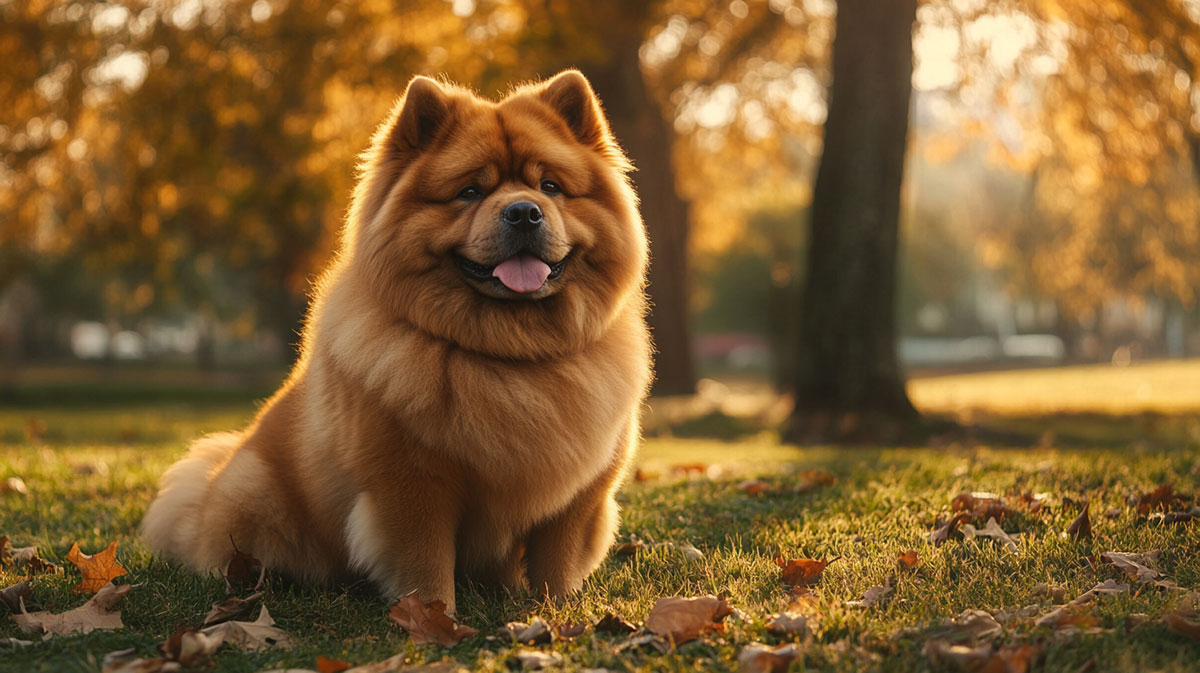
The Chow Chow‘s old-man look comes from a different angle. Not sagging skin, but a marked brow with a padded button of skin above the inner corner of each eye, which the AKC breed standard credits for the breed’s “essentially scowling” expression. The Kennel Club breed standard calls it a “peculiar characteristic scowling expression.”
Deep-set eyes recessed into the furrowed face intensify the look. The thick lion-like mane framing the face adds the effect of wild, overgrown eyebrows and beard that you would associate with a grumpy old professor.
An emperor of the Tang Dynasty was said to have kept some 5,000 Chow Chows in his kennel around the 8th century (AKC). That level of ownership makes sense once you’ve met one. They choose their people and that’s it. They’re not interested in anyone else.
Dogue de Bordeaux

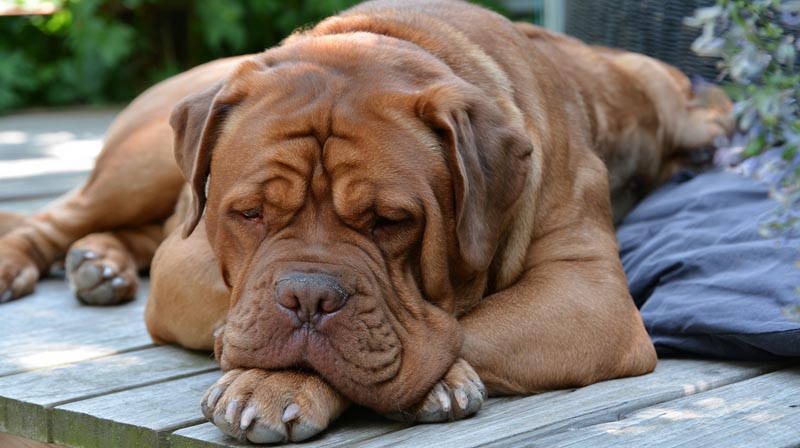
The most jowl-heavy breed on this list. The Dogue de Bordeaux has a massive, wrinkled head covered in deep folds, with jowls that droop well below the jawline and a flattened muzzle that concentrates all that loose skin into a dense, expressive face.
The dog who starred opposite Tom Hanks in the 1989 film Turner and Hooch was a Dogue de Bordeaux, a casting choice that worked entirely because of how expressive and almost human that face reads on screen. The AKC notes the breed was virtually unknown outside France until that film.
Scottish Terrier

The Scottish Terrier achieves the old-man look through wiry facial hair rather than wrinkles. Bushy eyebrows, a full bristled beard, and a mustache that grows outward around the muzzle create the most convincing imitation of an elderly gentleman’s face of any small breed.
Add deep-set dark eyes and the naturally serious, somewhat suspicious expression built into the breed’s temperament, and you have a dog that genuinely looks like it is judging your life choices.
Petit Basset Griffon Vendeen
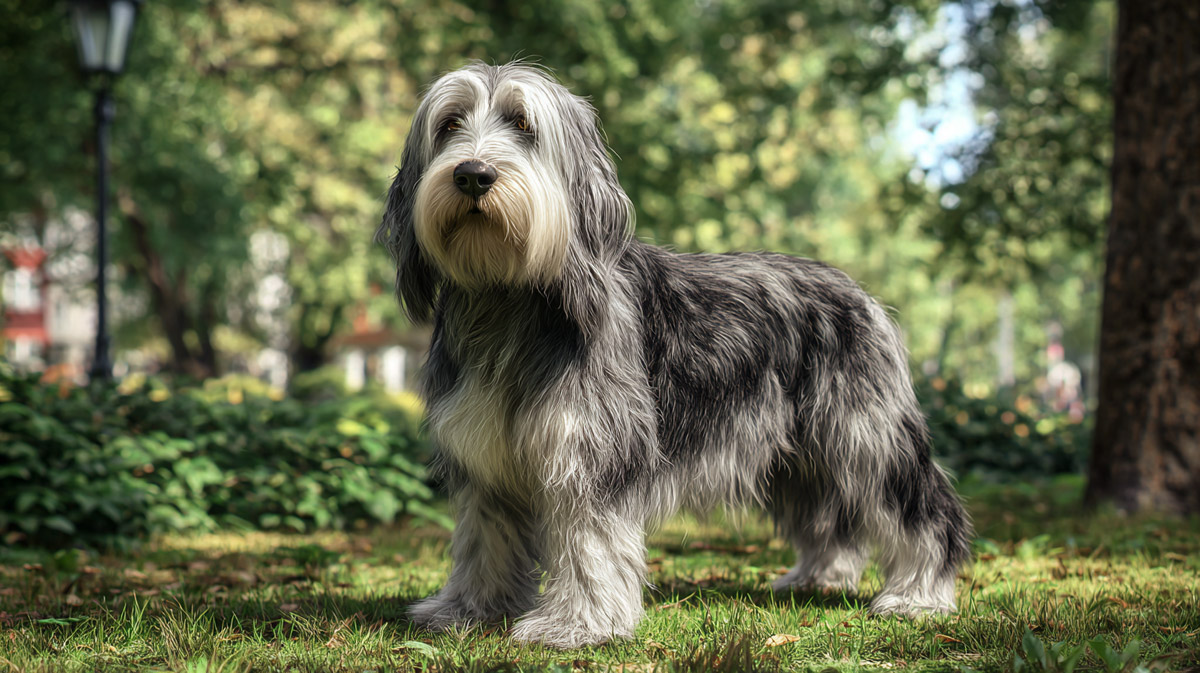
The Petit Basset Griffon Vendeen combines wiry, rough coat texture with naturally bushy eyebrows, a full beard, and the droopy hound eyes of its scenthound lineage. The rough coat grows outward and slightly upward around the face.
Despite looking like the world’s most skeptical elderly man, this breed is actually one of the most cheerful and energetic on this entire list. The face lies completely.
Brussels Griffon

The Brussels Griffon has the most human-like face of any small breed. A brachycephalic skull compresses the face, large prominent eyes dominate, and in rough-coated varieties, wiry facial hair creates a full beard and mustache effect at toy-dog scale.
The rough-coated Griffon Bruxellois is the stronger old-man look. The smooth-coated variety is adorable but loses the beard effect entirely. If the old-man aesthetic is what you are after in a small apartment dog, the rough coat is the one.
Bouvier des Flandres
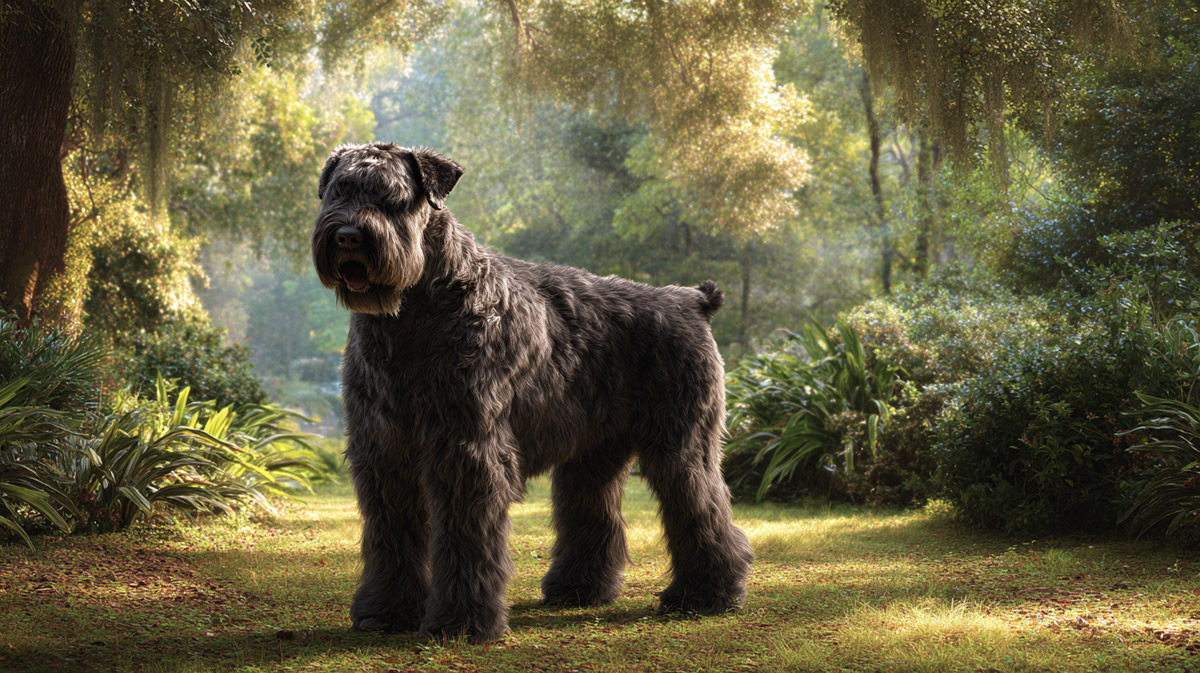
The Bouvier des Flandres is the large-breed version of the Scottish Terrier approach. A thick, rough double coat, prominent mustache, and full beard combine with a serious, focused expression to create the effect of a large, weathered working man.
This is a working herding breed from Belgium originally used for cattle driving, cart pulling, and farm work. The serious expression is not an act. These dogs are actually that serious.
| Breed | Primary Old-Man Trait | Size |
|---|---|---|
| Shar-Pei | Full-body deep wrinkles (HAS2 gene) | Medium |
| Bloodhound | Head folds + droopy eyelids + jowls | Large |
| Neapolitan Mastiff | Massive hanging skin folds everywhere | Giant |
| Pug | Compressed brachycephalic face + wrinkles | Small |
| Chow Chow | Deep-set eyes + padded furrowed brow | Medium |
| Scottish Terrier | Wiry beard, mustache, and eyebrows | Small |
| Brussels Griffon | Human-like brachycephalic face + beard | Toy |
Why Do Some Dogs Naturally Have Wrinkles and Saggy Skin?
There are 3 distinct biological causes behind wrinkled, loose skin in dogs: genetic mutation, selective breeding for function, and brachycephalic skull structure. Most old-man breeds have at least 2 of these operating at once.
The HAS2 Gene and Hyaluronic Acid
In Shar-Pei, the cause is a documented genetic mutation. A duplicated DNA segment near the HAS2 gene causes overproduction of hyaluronan (hyaluronic acid), which accumulates in the skin and physically thickens it into folds (Olsson et al., PLoS Genetics, 2011).
Heavily wrinkled Shar-Pei carry 2 to 5 times higher blood levels of hyaluronic acid than other breeds (Olsson et al., 2011). The same mutation that causes wrinkles also predisposes the breed to Familial Shar-Pei Fever, a periodic inflammatory condition. Both traits share the same genetic origin.
This is worth knowing before buying a Shar-Pei. Dogs carrying the most copies of that DNA duplication have the highest risk of recurring fever flares, and a validated copy-number test now lets breeders select away from high-copy dogs (Uppsala University).
Loose Skin as a Working Function
For Bloodhounds and Mastiff-type breeds, loose skin was deliberately selected because it served a working purpose.
In Bloodhounds, the folds around the head trap scent particles close to the nose during tracking, directly improving performance. In historical fight and guard dogs like the ancestors of the Neapolitan Mastiff, loose skin gave opponents something non-vital to grab, protecting underlying muscle and bone.
The AKC notes that the Bloodhound’s long ears, hanging lips, and loose head wrinkles serve a purpose beyond looks, with the skin folds trapping and intensifying scent during a trail. The old-man look was a performance feature first.
Brachycephalic Skull Structure
Flat-faced breeds have a shortened skull that compresses the same amount of facial skin into less horizontal space.
The result is piling and folding, particularly around the nose, forehead, and eyes. In extreme cases, nasal folds form a separate skin roll directly above the nose. Dogs with nasal folds are nearly 5 times more likely to develop corneal ulcers than dogs without them (Packer et al., 2015).
Brachycephalic dogs were also almost twice as likely to suffer skin allergies as non-flat-faced breeds, with a 19.4% vs 10.4% prevalence respectively, in 2024 claims data from Australian pet insurer PetSure. That excess skin creates the old-man look. It also creates a maintenance commitment.
What Health Issues Come With Old-Man Dog Features?
The physical traits that make these breeds look like old men are the same traits that drive their most common health problems. There is no version of an English Bulldog or Pug where the face is both maximally wrinkled and fully healthy. The two things trade off directly.
Skin Fold Care
Warm, dark, moist folds create ideal conditions for yeast and bacterial growth. Left uncleaned, fold dermatitis develops fast, causing redness, odor, and ulceration.
A 2022 VetCompass study of UK dogs found that, compared with crossbreeds, English Bulldogs had 49 times the odds of skin fold dermatitis, Pugs 16 times, Basset Hounds nearly 11 times, and Shar-Pei about 5 times (O’Neill et al., 2022). Ask your vet which antiseptic wipes suit your dog’s skin and how often to use them.
- Wipe inside each fold with a damp cloth or dog-safe antiseptic wipe several times per week
- Dry thoroughly after every cleaning (moisture is the actual problem, not just dirt)
- Check Bloodhound facial folds daily since their nose-to-ground tracking posture collects debris fast
Eye and Eyelid Conditions
Entropion (inward-rolling eyelid) and ectropion (outward-drooping eyelid) are both linked to excess skin around the eye socket. VCA Animal Hospitals lists the Bloodhound, Shar-Pei, Chow Chow, English Bulldog, and Neapolitan Mastiff among breeds prone to entropion.
In the same study of 700 dogs, brachycephalic dogs were 20 times more likely to develop corneal ulcers than non-brachycephalic dogs. Dogs with visible sclera (white of the eye showing) had nearly 3 times the risk of corneal ulcers (Packer et al., 2015).
Cherry eye, a prolapsed third eyelid gland, is common in Bloodhounds, English Bulldogs, Neapolitan Mastiffs, and Pugs, breeds in which the gland’s anchoring tissue is thought to be weak (VCA).
Breathing Issues in Flat-Faced Breeds
Brachycephalic obstructive airway syndrome (BOAS) affects Pugs, Bulldogs, and any breed with a compressed skull. In PetSure’s 2024 Australian claims data, the average cost to treat BOAS was A$3,174, with a maximum claim of A$29,775.
Brachycephalic breeds represented 93% of all BOAS insurance claims PetSure assessed in 2024. Moderate to severe BOAS signs appear in 28% of tested English Bulldogs and 30% of Pugs (Finnish Kennel Club, 2017-2022 testing data).
In a 2019 survey, nearly 40% of brachycephalic dogs had owner-reported signs of clinically relevant airway obstruction, yet only 17.9% of owners said their dog had a breathing problem, a normalization effect where the signs are accepted as typical for the breed (Packer et al., 2019). That normalization problem is real. I’ve met Bulldog owners who thought the constant snoring and labored breathing after a walk was just personality.
How Do You Groom a Dog With Heavy Wrinkles and Facial Folds?
Grooming wrinkled dogs is less about the coat and more about the skin underneath it. The folds require more daily attention than the fur in most cases.
Daily Fold Cleaning Routine
This is non-negotiable for Shar-Pei, Neapolitan Mastiffs, Bulldogs, and Pugs. Skip it for a week and you will know.
- Use chlorhexidine-based dog wipes or sterile gauze with diluted veterinary antiseptic solution
- Clean every fold including nasal folds, lip folds, and neck folds
- Dry completely after cleaning. A fold that stays damp after wiping will develop dermatitis faster than one that wasn’t cleaned at all
- Check ears at the same time, especially in Bloodhounds and Basset Hounds where long folded ears trap heat and bacteria
Bathing frequency ranges from every 3 to 6 weeks depending on the breed’s skin oiliness. Ask your vet about your specific dog’s needs since stripping essential oils with over-bathing creates its own problems.
Coat Grooming by Type
Short-coated wrinkled breeds (Shar-Pei, Neapolitan Mastiff, Bulldog, Pug, Bloodhound) need minimal coat work. A rubber brush removes loose dead hair. The skin maintenance is the real job.
Wiry and rough-coated old-man breeds need a completely different approach.
Scottish Terriers are ideally hand-stripped (pulling dead coat by hand rather than cutting) to maintain proper coat texture. Clipping a wire coat lets the soft undercoat take over and the correct harsh texture is eventually lost, though clipped coats can be kept up on a 6 to 8 week schedule (AKC). Petit Basset Griffon Vendeens need a full brush-out at least weekly with minimal trimming, and Bouvier des Flandres need brushing once or twice a week. The Scottish Terrier‘s beard specifically needs regular cleaning after meals, because it functions exactly like a human beard and collects food.
Eye Care for Droopy-Eyed Breeds
Tear staining and discharge buildup sit in the folds below the inner corner of the eye in most wrinkled breeds. Wipe gently with a soft dry cloth daily. Always wipe away from the eye, not toward it.
Bloodhounds and Basset Hounds are especially prone to this. The combination of droopy lower eyelids, heavy head folds, and pendulous ears makes thorough daily eye maintenance part of the routine from day one.
What Is the Temperament of Old-Man-Looking Dog Breeds?
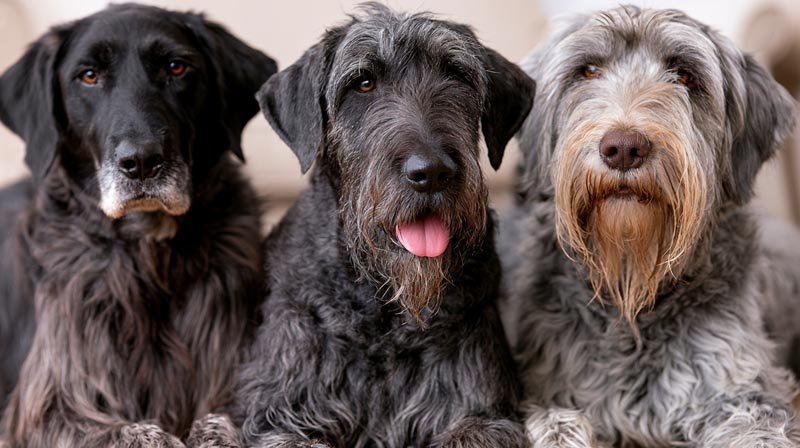
The grumpy-looking face is often completely misleading. Most of these breeds are calm, loyal, and affectionate with their families. The expression and the personality are separate things.
Calm and Low-Energy Large Breeds
The heaviest, most wrinkled breeds on this list tend toward the same temperament profile: calm, loyal, protective, and not especially interested in strangers.
Neapolitan Mastiffs need only 15 to 30 minutes of daily exercise. The Dogue de Bordeaux and Bloodhound share a similar low-energy default at rest, despite the Bloodhound’s endurance capacity when tracking.
The Chow Chow is the outlier. Aloof and independent, the Kennel Club breed standard describes their scowling expression as a defining characteristic, and unlike the Neapolitan Mastiff whose intimidating appearance hides a soft-tempered dog, the Chow Chow actually is somewhat reserved and standoffish by nature. Cat-like is the term breeders use most often.
Stubborn Streaks in Flat-Faced Small Breeds
Pugs are affectionate and people-oriented. Bulldogs are famously stubborn but calm. The Brussels Griffon bonds intensely with one person and is considerably more alert and watchful than its small wrinkled face suggests.
The old-man expression often directly contradicts the breed’s actual energy level. Scottish Terriers look like retired professors but have a true terrier drive. They were bred to hunt independently. The serious face is not a personality guarantee.
The Gap Between Expression and Reality
Seven Neapolitan Mastiffs played Fang in the Harry Potter films. Hagrid’s intimidating companion. In real life, Neos are often described as giant lapdogs by their owners.
The Bloodhound is stereotyped as a lazy porch dog. That is accurate only when they are not tracking. Give a Bloodhound a scent trail and you will be reminded fast that this is a dog that tracked a man for 7 miles through a crowd and located him in an upstairs boarding room (reported by chemist Robert Boyle in the 1600s, per the AKC).
The face tells you very little about the energy or affection level. Do the breed research separately from the look.
Which Old-Man Dog Breeds Are Best for Apartment Living?
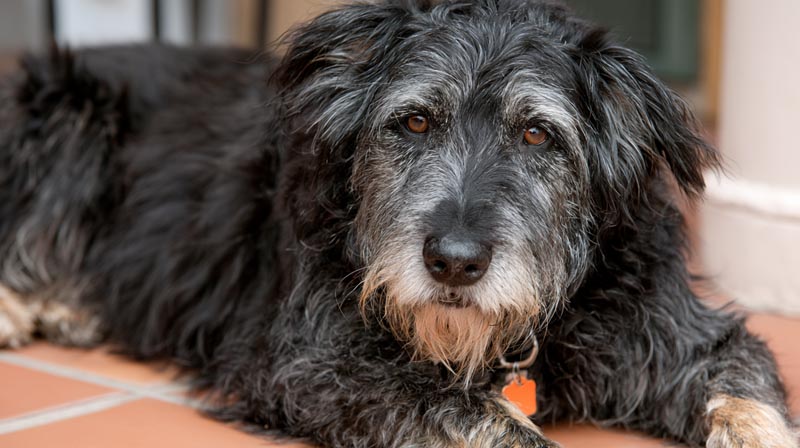
Good news: several of the best old-man dog breeds actually do well in apartments. Low exercise needs, calm temperament, and moderate noise levels are what matter in a small space, and multiple wrinkled breeds tick all three.
Best Apartment Fits
Pug: 20 to 30 minutes of daily low-intensity exercise. Naturally calm. Gets along with most people and pets. Heat sensitivity is the main issue in apartments without good climate control, since brachycephalic breeds struggle with temperature extremes.
English Bulldog: Minimal exercise needs. Content to lounge. The constant snoring is the real apartment consideration. Your neighbors will hear it through the walls.
Brussels Griffon: The best small-apartment old-man breed. 20 to 30 minutes of daily activity is sufficient. Alert but not yappy. Bonds tightly with one person. Rough-coated variety maintains the full old-man beard and brow look.
Large Wrinkled Breeds That Can Adapt
The Neapolitan Mastiff and Chow Chow both adapt to apartment living despite their size, primarily because their exercise needs are lower than their size suggests.
A Chow Chow needs 20 to 30 minutes of walking per day and is explicitly described as apartment-suitable by multiple breed sources, largely because the breed does not have high social or stimulation needs. They are content to be left to themselves.
Neapolitan Mastiffs need enough floor space to stretch out comfortably. A studio won’t work. A one-bedroom with a larger living area can. The drooling is the practical consideration nobody mentions until you are sitting on a couch that’s been Neo-ed.
Breeds That Need More Space
Bloodhounds and Bouvier des Flandres are not apartment dogs.
Bloodhounds need at least an hour of daily exercise and will follow a scent trail directly into traffic if off-leash. They also bay loudly, which is not a sound that goes unnoticed in an apartment building.
The Bouvier des Flandres is a working herding dog. It needs both physical exercise and mental work to stay stable. Putting one in an apartment without meeting those needs is a setup for behavioral problems. The Bouvier des Flandres temperament page covers this in full detail.
| Breed | Apartment Friendly | Daily Exercise | Noise Level |
|---|---|---|---|
| Brussels Griffon | Yes | 20–30 min | Low |
| Pug | Yes (with A/C) | 20–30 min | Snores loudly |
| English Bulldog | Yes | 20–30 min | Snores loudly |
| Chow Chow | Yes (with space) | 20–30 min | Low |
| Neapolitan Mastiff | With larger floor area | 15–30 min | Moderate |
| Bloodhound | No | 60+ min | Bays loudly |
| Bouvier des Flandres | No | 60+ min | Moderate |
How Long Do Dogs That Look Like Old Men Live?
Lifespan varies dramatically across this group, and the same physical traits that create the old-man look are often the ones that shorten life.
Flat-faced breeds have the shortest lifespans. A 2024 Dogs Trust-led study in Scientific Reports examining 584,734 UK dogs found that brachycephalic (flat-faced) purebreds had a median lifespan of 11.2 years, compared with 12.8 years for breeds with medium-length muzzles (McMillan et al., 2024). To see how your own dog’s age translates, try our dog age calculator.
Lifespan by Breed
| Breed | Median Lifespan | Primary Lifespan Risk |
|---|---|---|
| Neapolitan Mastiff | 9.3 years | Giant size, joint issues |
| Bloodhound | 9.3 years | Large size, bloat risk |
| English Bulldog | 9.8 years | BOAS, heat sensitivity |
| Chinese Shar-Pei | 10.6 years | Skin conditions, Shar-Pei fever |
| Scottish Terrier | 12.7 years | Cancer susceptibility |
| Petit Basset Griffon Vendeen | 13.7 years | Generally robust |
Median lifespans from the breed table in McMillan et al. (2024), Scientific Reports.
Why Flat-Faced Breeds Die Younger
BOAS causes chronic oxygen restriction, putting long-term stress on the heart and respiratory system.
Bulldogs sit near the bottom of the lifespan range for old-man breeds at a median of 9.8 years, the same as the French Bulldog. Pugs fare better at 11.6 years, but in both breeds brachycephalic airway issues reduce quality of life across the entire lifespan, not just at the end of it.
The Shar-Pei’s 10.6-year median masks the impact of Shar-Pei autoinflammatory disease (SPAID), which causes recurring fever episodes and is linked to arthritis, ear inflammation, and amyloidosis in affected individuals (Uppsala University).
Health Management and Longevity
Responsible breeding decisions directly affect how long these dogs live.
The Respiratory Function Grading Scheme (RFGS) was developed at the University of Cambridge, and the OFA licensed it for the US and Canada after the Bulldog Club of America, French Bull Dog Club of America, and Pug Dog Club of America pushed for screening (AVMA News). It grades BOAS on a 0 to 3 scale. Only Grade 0 and Grade I dogs are considered clinically unaffected and receive an OFA certification number.
- Ask breeders for OFA RFGS results on both parents of flat-faced breeds
- Request SPAID copy-number (CNV) test results for Shar-Pei
- Verify hip and elbow OFA certifications for large wrinkled breeds
Skin fold management affects longevity too. Chronic fold dermatitis that goes untreated can develop into deep skin infections requiring surgery. It adds up over a 10-year lifespan.
What Did Old-Man Dog Breeds Originally Look Like Before Selective Breeding?
The old-man look in most of these breeds was amplified, not invented, by selective breeding. The original working versions were less extreme. More athletic. And in some cases, considerably healthier.
The Shar-Pei: Less Wrinkled, More Functional
Han Dynasty artifacts from around 200 BC depict dogs with the same square build, scowling expression, and curled tail as today’s Shar-Pei. But they show far fewer wrinkles.
The traditional “bone-mouth” Shar-Pei, still common in China, is considered the ancestral type: tighter skin, less pronounced folds, a more moderate muzzle. The heavily wrinkled “meat-mouth” version is the product of strong selection for wrinkled skin and a padded muzzle, and it is the type most commonly seen in the Western world (Olsson et al., 2011).
Some breed histories also claim that breeders crossed Shar-Pei with other breeds during the mid-20th century, adding to the extreme fold depth now associated with the breed in Western markets. The ancient working dog was not built like that.
The English Bulldog: A Completely Different Animal
The modern Bulldog is, physiologically, barely recognizable as a descendant of the bull-baiting dog it replaced.
Bull-baiting Bulldogs from before 1835 were athletic, longer-legged, and capable of sustained physical activity. The sport was outlawed under the Cruelty to Animals Act of 1835, after which breeders shifted to producing a companion dog for the conformation show ring (AKC).
The UK Kennel Club revised its breed standards, including the Bulldog’s, in 2009 in response to criticism. The current Kennel Club Bulldog standard says an over-nose wrinkle must never obscure the eyes or nose, and treats pinched nostrils and a heavy over-nose roll as unacceptable. The Netherlands went further. A 2014 change to the Dutch Animal Keepers Decree banned breeding that harms the health of offspring, and enforcement criteria published in 2019 rule out breeding dogs whose muzzle is 0.3 or less of skull length, roughly under one-third (Utrecht University expertise centre report). Some breeders have argued the modern Bulldog has drifted so far from its origins that it constitutes a separate animal from its 19th-century ancestor.
The Bloodhound: Intentionally Built, Not Accidentally Changed
The Bloodhound is one of the few old-man breeds where the facial features were deliberately selected for functional reasons from the start, not added or exaggerated through show-ring breeding.
Monks at the Saint Hubert Monastery in what is now Belgium refined the breed’s tracking skills, and the AKC credits them with shaping a medium-sized, long, low hound into the breed known today. The loose head skin, pendulous ears, and facial folds all support scent work, with the skin folds trapping and intensifying scent during trailing.
The modern Bloodhound’s head, ears, and folds still match the scent-tracking job they were bred for. That consistency is unusual in this group. Most old-man breeds got significantly more exaggerated over the past 150 years. The Bloodhound is one of the rare exceptions where the look was functional, stayed functional, and didn’t drift toward extremes.
The Neapolitan Mastiff: Rediscovered After Near Extinction
The Neapolitan Mastiff came close to disappearing after World War II. Only a small number survived in rural southern Italy near Naples.
In 1946 the first post-war exhibition was held in Naples with just 6 dogs presented. Dr. Piero Scanziani wrote the first formal breed standard in 1948. The FCI recognized the breed in 1949 (United States Neapolitan Mastiff Club). The wrinkled, loose-skinned dog that exists today was effectively reconstructed from that small pool.
The AKC did not recognize the breed until 2004, and the extreme loose skin depth seen in modern show-ring Neapolitans reflects decades of breeding for the most dramatic appearance. The working guard dog version maintained in rural Italy carries less exaggerated folds than many show dogs today.
How Do You Find a Reputable Breeder for Old-Man Dog Breeds?
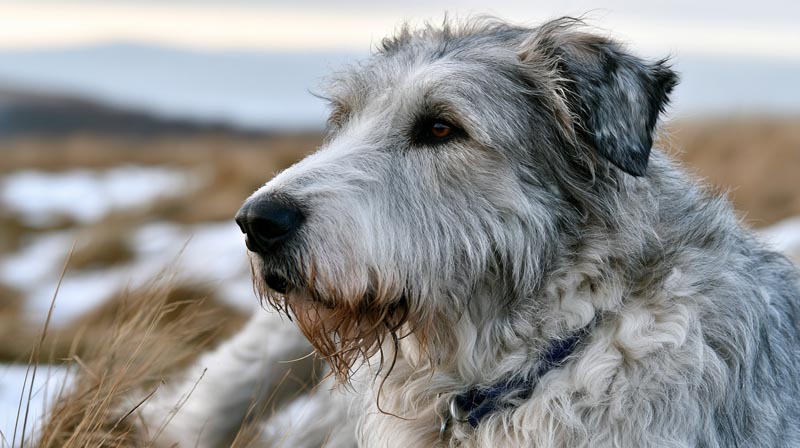
The health problems built into these breeds make breeder selection more consequential than it would be for most other dogs. A badly bred Bulldog or Shar-Pei costs far more in vet bills over its lifetime than the price difference between a reputable breeder and a cheap one.
Health Testing Requirements by Breed Type
Flat-faced breeds (Pug, Bulldog, Brussels Griffon):
- OFA Respiratory Function Grading Scheme (RFGS) score of 0 or 1 for both parents
- OFA eye certification from a board-certified veterinary ophthalmologist (annual)
- MRI screening for Chiari-like malformation and syringomyelia in Brussels Griffons, a breed in which both conditions are common (Rusbridge et al., 2009)
Large wrinkled breeds (Bloodhound, Neapolitan Mastiff, Basset Hound): OFA hip and elbow certifications, cardiac screening for the Mastiff family, eye OFA CAER certification.
The OFA maintains a public database where buyers can look up a health-tested dog by name or registration number before committing to a purchase. Reputable breeders expect you to check it.
Red Flags to Watch For
These are specific to old-man breeds and go beyond general bad-breeder warning signs.
- A Shar-Pei breeder who prioritizes extreme wrinkling depth without SPAID copy-number testing
- A Bulldog breeder who cannot produce RFGS scores for parent dogs
- Any brachycephalic breeder who describes labored breathing as “normal for the breed”
- Puppies available immediately with no waiting list (reputable breeders of these breeds have waitlists)
The World Small Animal Veterinary Association issued a warning in 2023 about an emerging “canine welfare crisis” caused by the popularity of short-nosed breeds. That context matters when evaluating any flat-faced breed source.
Breed-Specific Clubs and Directories
Every major breed on this list has a national parent club that maintains a breeder directory and health testing requirements.
Bulldog: Bulldog Club of America (bulldogclubofamerica.org). Shar-Pei: Chinese Shar-Pei Club of America (cspca.com). Bloodhound: American Bloodhound Club (americanbloodhoundclub.org). Neapolitan Mastiff: United States Neapolitan Mastiff Club (neapolitan.org). Pug: Pug Dog Club of America (pugs.org).
Parent club breeders have agreed to a code of ethics and are more accountable than independent breeders with no club affiliation.
Rescue as an Alternative
Old-man breeds have dedicated rescue organizations, and there are real advantages to adopting an adult dog from rescue for these breeds specifically.
An adult dog’s existing skin condition, breathing function, and temperament are visible and assessable. You don’t have to wait to find out if a puppy develops BOAS or chronic fold dermatitis. What you see is what you get. Bulldog rescues, Shar-Pei rescues, and Basset Hound rescues all operate nationally in the US and UK.
The Basset Hound in particular is a breed that shows up frequently in rescue, partly because buyers underestimate the hound vocals and the skin maintenance involved. Rescues for this breed rarely have a shortage of dogs available.
FAQ on Dogs That Look Like Old Men
What dog breed looks the most like an old man?
The Chinese Shar-Pei is the top answer. Deep full-body wrinkles, a furrowed brow, and a permanently scowling expression combine to create the most convincing old-man face of any breed. The Neapolitan Mastiff and Bloodhound are close seconds.
Why do some dogs have wrinkled faces?
Three causes drive it: a genetic mutation near the HAS2 gene (Shar-Pei), selective breeding for loose protective skin (Bloodhound, Mastiff types), and brachycephalic skull structure that compresses facial skin into folds (Pug, Bulldog, Brussels Griffon).
Are wrinkled dog breeds harder to take care of?
Yes. Skin folds need cleaning several times per week to prevent fold dermatitis. Flat-faced breeds require climate control and regular eye care. The grooming commitment is real and ongoing, not occasional.
Do dogs with saggy skin have more health problems?
Generally, yes. Brachycephalic breeds made up 93% of all BOAS insurance claims assessed by Australian insurer PetSure in 2024. Droopy eyelids cause entropion and ectropion. Deep skin folds trap bacteria. The physical traits that create the old-man look drive most of the health risk.
What small dog looks like a grumpy old man?
The Brussels Griffon leads this category. Its brachycephalic face, prominent dark eyes, and wiry beard in the rough-coated variety produce the most human-like old-man expression of any toy breed. Pugs are a close second.
How long do wrinkled dog breeds live?
It depends on size and face shape. English Bulldogs have a median lifespan of 9.8 years. Shar-Pei reach 10.6 years. Wire-coated old-man breeds like the Scottish Terrier reach a median of 12.7 years. The Petit Basset Griffon Vendeen reaches 13.7 years (McMillan et al., 2024).
Can dogs with heavy jowls live in apartments?
Several can. Pugs, English Bulldogs, and Brussels Griffons need only 20 to 30 minutes of daily exercise and adapt well to smaller spaces. Bloodhounds and Bouvier des Flandres are not apartment-suitable due to exercise needs and noise levels.
Are dogs that look like old men good with families?
Most are. Neapolitan Mastiffs, Bloodhounds, and Basset Hounds are gentle with children despite their intimidating or mournful expressions. The Chow Chow is the exception, being naturally reserved and better suited to calmer households without young children.
What causes a dog to have droopy eyes?
Ectropion, the outward droop of the lower eyelid, results from excess loose skin around the eye socket. It is most pronounced in Bloodhounds and Basset Hounds. Entropion, where the eyelid rolls inward, is the opposite problem and is common in the Shar-Pei, Chow Chow, and English Bulldog.
Where can I find a reputable breeder for wrinkled dog breeds?
Start with AKC parent clubs: the Bulldog Club of America, Chinese Shar-Pei Club of America, and Pug Dog Club of America all maintain breeder directories. Always verify OFA health certifications for both parents before committing, especially for flat-faced breeds.
Conclusion
The takeaway on dogs that look like old men is simple: the look comes with real responsibilities.
Whether you are drawn to the Bloodhound’s pendulous droopy ears, the Shar-Pei’s dense skin folds, or the Brussels Griffon’s human-like brachycephalic face, each breed brings specific grooming demands and health considerations that go beyond aesthetics.
Wrinkled dog breeds, heavy-jowl types, and flat-faced dogs all need owners who research before committing.
Check OFA health certifications. Understand the skin fold dermatitis routine. Know the lifespan realities.
The grumpy-looking face is unforgettable. The ownership experience is deeply rewarding when you go in prepared.