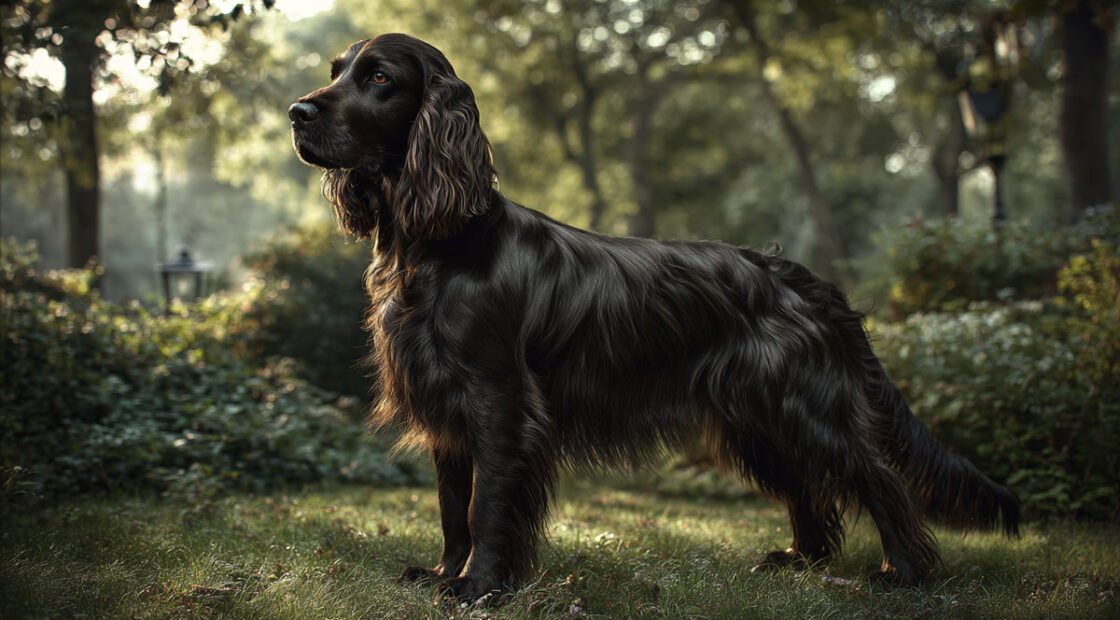
Most people who meet a Field Spaniel guess it’s a big Cocker or a small, dark Springer. Neither is right, but you can see why they’d say it.
It’s a medium-sized flushing and retrieving spaniel from 19th-century England, built long and low, with a silky single coat in black, liver or roan. Expect about 18 inches at the shoulder and 35 to 50 pounds. The AKC puts it in the Sporting Group, and the Kennel Club files it under Gundog.
You probably haven’t met many. The American Kennel Club’s 2025 rankings have it at 148th of 202 breeds, while the English Springer Spaniel sits at 27th and the English Cocker Spaniel at 35th.
What Is a Field Spaniel?

Think of a spaniel bred to find game in cover, push it out, and bring it back once it’s shot, on land or in water. That’s the job. The UKC lists it in the Gun Dog Group, alongside the AKC Sporting and Kennel Club Gundog placements.
The body is longer than it is tall (the AKC standard uses a ratio of about 7:6), and in size it falls between the Cocker and the English Springer. The coat is single and moderately long, in black, liver or roan. Breeders and owners usually just call them “Fields.”
The name itself is a bit of a mess. According to the AKC’s breed history, “field spaniel” was used for centuries to mean any spaniel that worked on land rather than in water.
Dog writer David Hancock argued that “English Land Spaniel” would have avoided the mix-up. I think he’s right, for what it’s worth.
Field Spaniel History From Show-Ring Exaggeration to Revival

Early development and the show-ring era
In the 1800s, English land spaniels were sorted by weight. The UKC standard says a Cocker was shown under 25 pounds and a Field over 25 pounds.

That split was loose for a while. Westminster Kennel Club records show both still sharing one class in 1879, “Cocker or Field Spaniels.” Dogs Victoria’s breed profile notes that the early show type was bred all black.
Then the show ring took over. Breeders kept adding Sussex Spaniel blood, and each generation got longer, heavier in bone and lower to the ground. By the end, according to the UKC standard (revised 2007), you had a dog only 12 inches high that could weigh as much as 40 pounds. Not much use in a hedgerow.
Near extinction and the mid-20th-century revival
The FCI breed standard (effective February 2021) says the breed nearly disappeared twice. Fashion fads wrecked it in the early 1900s. In the 1950s numbers dropped so low that the Kennel Club withdrew championship status, and it wasn’t restored until 1969.
David Hancock counts four bitches left to breed from in 1945, all sired by the same dog.
English Springer Spaniel outcrosses brought back height, a better topline and sounder movement. A breeder quoted in the AKC’s history of the breed names three British Springer outcrosses, in 1928, 1934 and 1957.
Some dates worth keeping straight:
- 1894, AKC recognition
- 1923, the Field Spaniel Society forms in England (Kennel Club)
- 1948, the society is reformed and breeders start removing the exaggerations (UKC)
- 1984, UKC recognition
Field Spaniel Size, Coat and Colors
Under the UKC standard an adult stands about 18 inches at the shoulder and weighs 35 to 50 pounds. The Kennel Club allows up to 55. The AKC standard doesn’t set a weight at all.
Height, weight and proportions
| Standard | Height | Weight |
|---|---|---|
| AKC | 18 in dogs, 17 in bitches (1 in either way acceptable) | Not specified |
| UKC (2007) | About 18 in | 35 to 50 lb |
| Kennel Club (2025) | About 46 cm (18 in) | 18 to 25 kg (40 to 55 lb) |
With body length to height at roughly 7:6 in the AKC standard, the outline reads clearly longer than tall.
The Kennel Club points out that its numbers describe the ideal. Your dog may come out larger or smaller.
Coat texture
There’s no undercoat. A Field Spaniel has a single coat, and that’s the reason it looks lighter than a Cocker standing next to it.
- Moderately long, flat or slightly wavy
- Silky, glossy, dense and water repellent
- Setter-like feathering on the chest, underbody and backs of the legs
- Short, soft hair between the toes
A coat that’s overabundant or cottony gets penalized in the AKC standard, since it would be impractical in the field. Trimming should stay light enough that the dog still looks natural.
Colors and markings
The three registries mostly agree, with one awkward exception.
- The AKC accepts black, liver or golden liver, self-colored or bi-colored. Bi-colored dogs must be roaned or ticked, and tan points are fine.
- For the UKC, it’s black, liver, golden liver or roan, and any of them may have tan markings over the eyes, on the cheeks, feet and pasterns.
- The Kennel Club takes black, liver and the blue roan and liver roan variants, each with or without tan. Golden, orange, red, sable, clear black-and-white and clear liver-and-white are unacceptable.
The exception is golden liver. The AKC and UKC list it, and the Kennel Club standard calls golden unacceptable. If you’re importing or showing across borders, that matters.
Roan versus ticking confuses people too. A Showsight judging article draws the line like this: white and base color mixed evenly is a roan, and base color scattered into white is a bi-color with ticking. In practice the AKC standard treats both the same and disqualifies only sable.
Field Spaniel Temperament Around Family, Strangers and Other Pets

At home they’re gentle and affectionate. With people they don’t know, they hang back. The Kennel Club standard describes the breed as docile, active, sensitive and independent.
With kids, Hill’s Pet rates the breed fine for families whose children are considerate and supervised. Dogs New Zealand says the dog will simply withdraw when play gets rough, which is honestly a better reaction than a lot of breeds have.
Strangers get a cooler welcome. The AKC standard allows for reserve at first meetings, and Hill’s goes a step further and mentions a tendency toward timidity. Orvis notes they’ll bark when visitors show up.
Other dogs are usually no problem, and Dogs New Zealand calls the breed good with other animals in general. Hunting instinct is the catch. Hill’s says it can lead to roaming, so I’d keep an eye on things around birds and small pets.
Long stretches alone don’t go well. Dogs Queensland says a bored Field Spaniel left with nothing to do gets destructive.
One thing doesn’t quite add up on paper. The standard says independent, but Hill’s rates social and attention needs as high. My read is that the dog won’t follow you from room to room, but it does want you in the house.
Purina UK calls it calmer and less busy than the Cocker, and argues that makes it a better family fit than the more popular Cockers and Springers.
How Much Exercise and Training Does a Field Spaniel Need?

The figures range from 40 minutes a day to three hours. That sounds contradictory, but the low number is a minimum and the high ones describe a fit adult that hunts or hikes.
Hill’s Pet lists more than 40 minutes daily, which long leash walks can cover. Purina UK wants two or more hours. Orvis puts a healthy adult at two to three hours.
So a working or hiking dog lives at the top of that range. A companion dog can get by near the bottom if the rest of its day includes something to think about.
The breed profile and Orvis both point to these as good outlets:
- Hunting
- Field trials
- Tracking
- Agility
- Obedience
- Therapy work
- Half-day hikes
Training is where owners tend to mess up. Hill’s says gentle, non-coercive methods are a must for a dog this sensitive. A harsh correction will cost you more than it gets you.
Food and toys work well, according to Purina UK. Dogs NSW describes an intelligent problem-solver that does its best work when it’s properly motivated.
Socialize early, since reserve with strangers is normal for the breed. And use a long leash on walks until recall is solid. A flushing spaniel on a scent is not listening to you.
The more a Field Spaniel gets to work, the happier it is. In a pet home, somebody has to plan that work deliberately, because it won’t happen by accident.
Grooming a Field Spaniel: Brushing, Ear Care and Trimming
For a pet, figure on brushing once or twice a week, and keeping nails, foot-pad hair and inner-ear hair clipped.
The FSSA notes the breed carries less coat than other spaniels, so a companion dog doesn’t need much beyond that.
How often to brush depends on who you ask. Purina’s AKC-based breed card says weekly. Hill’s Pet says once or twice a week, and Purina UK says every other day.
I’d start weekly and add sessions once the feathering on the chest, ears and backs of the legs begins to tangle.
- Brush and comb through the feathering
- Clip hair inside the ears and between the foot pads
- Trim the nails, about monthly according to WebMD
- Bathe only when the dog is muddy or smells, otherwise every few months (Orvis)
The clipping isn’t cosmetic. The FSSA explains that shorter hair dries faster, which helps prevent eczema.
Between trims, a gentle ear wipe made for dogs handles surface dirt on those hairy drop ears.
Show grooming is a different job. Clippers only go on the head and front of the neck. Everything else gets shaped with thinning shears and stripping knives so the dog still looks natural.
Field Spaniel Health Problems, Screening and Lifespan

According to the FSSA, hip dysplasia and low thyroid are the inherited problems you’ll see most. Eye, heart and seizure conditions turn up less often.
Conditions to know
- Hip dysplasia is polygenic, and feeding and exercise during growth play a part.
- Low thyroid (hypothyroidism) shows up as sparse coat and weight gain. A blood test finds it and a daily pill controls it.
- On the eye side, retinal folds, ectropion and entropion lead the list.
- Late-onset seizures have been reported in dogs from seven to over ten years old with no earlier history, and vets disagree on whether it’s true inherited epilepsy.
- If the general vet hears a heart murmur, the next stop is a veterinary cardiologist.
There’s disagreement on one eye disease. The FSSA calls progressive retinal atrophy very rare in Fields, while Burke’s Backyard reports it in the breed overseas.
Ears were the big one in practice. Ear trouble made up 25% of recorded conditions in the FSSA’s 2003 health survey. The club blames the drooping, hairy spaniel ear, and says most cases are treatable and not life-threatening.
Health tests breeders should run
- Hip evaluation, OFA or PennHIP (the Orthopedic Foundation for Animals requires dogs to be at least 24 months old for final hip certification)
- OFA thyroid evaluation
- Eye exam by a veterinary ophthalmologist, yearly for breeding stock
The FSSA takes part in the Canine Health Information Center (CHIC) program, per Embrace Pet Insurance’s breed guide. In the UK, the Kennel Club’s Health Test Results Finder lists screening results for dogs on its breed register.
Don’t read too much into a CHIC certificate. It only requires that results be published, good or bad, so having one doesn’t mean the results were normal. The FSSA also points out that a parent’s test shows that parent’s own status, not the genes it passes on. No breeder can promise a disease-free puppy.
How long Field Spaniels live
The FSSA’s 2003 survey (446 dogs, 184 respondents) found an average age at death of 8.2 years across 71 deceased dogs. Take out accidental and birth-defect deaths and it rises to 8.6.
That number looks bad, but the 366 living dogs in the survey averaged only 5.2 years. The sample was young, so it understates how long these dogs actually live.
Breed profiles go higher. Dogs Victoria says 10 to 14 years, Burke’s Backyard says 10 to 12, PetMD says 12 to 14. None of the pages reviewed cites a breed survey for those numbers.
The best breed-specific figure I found is from a 2024 Scientific Reports study of more than 580,000 UK dogs. It reported a median life expectancy of 13.1 years for the Field Spaniel, against 12.7 years for purebreds overall and 12.0 for crossbreeds.
An older all-breed comparison comes from the Journal of Small Animal Practice’s 2010 UK survey covering 169 breeds, which found a median age at death of 11 years and 3 months across all breeds.
Plan on 12 to 13 years. Fourteen is the top of what the profiles claim, not something to count on.
Field Spaniel vs Cocker Spaniel vs English Springer Spaniel
Size-wise the Field Spaniel lands between its two better-known cousins. It’s also the only one of the three on the UK Kennel Club’s vulnerable breeds list.
A quick note on “Cocker.” In the UK it means the English Cocker. In the US it can mean the American Cocker, and the AKC has registered the English Cocker and the American Cocker as separate breeds since 1946.
| Trait | Field Spaniel | English Cocker Spaniel | English Springer Spaniel |
|---|---|---|---|
| Height (dogs) | 18 in | 16 to 17 in | 20 in |
| Weight (dogs) | 35 to 50 lb | 28 to 34 lb | About 50 lb |
| Availability | Rare, UK vulnerable breed | AKC top 40 | AKC top 30 |
The English Cocker Spaniel is the light one, topping out near 34 pounds, and AKC breed data rates it somewhat active.
Heavier and busier, the English Springer Spaniel runs to about 50 pounds, and the same AKC data calls it very active.
If you want the smallest dog and the easiest puppy search, go English Cocker. If you want the most drive, get a Springer. The Field Spaniel makes sense when neither of those quite fits and you’re willing to wait for a litter.
Who Should Not Get a Field Spaniel?
I’d steer you away if you’re in a city flat with no daily access to open ground, if there are toddlers in the house, or if you want a puppy in the next few weeks.
City and flat living
The Kennel Club standard says the breed isn’t suited to city life, and Purina NZ says busy, noisy cities overstimulate it. Burke’s Backyard disagrees, though. Most owners it spoke with found the breed very adaptable.
Really the argument comes down to exercise. A flat can work if the daily exercise actually happens, every day.
Toddlers
Purina NZ recommends the breed for children old enough to behave around dogs, ideally ones who help with training.
Short timelines
Dogster says buyers will likely end up on a waiting list because the breed is so rare.
Homes that tend to work

- Country homes, which is where the Kennel Club says the breed belongs
- Families whose older kids want to get involved
- Hunters looking for a steady flusher
Put simply, a country home and an owner with spare time suit this dog. A busy city life without either does not.
How Rare Is the Field Spaniel, and How Do You Find a Puppy?

Rare enough that the UK Kennel Club (now the Royal Kennel Club) lists it as a Vulnerable Native Breed, and the AKC has it near the bottom of its table.
- AKC rank for 2025 was 148 of 202 breeds, up 12 places from 2024 (AKC)
- UK registrations went from 29 in 2013 to 73 in 2024 (Kennel Club figures)
- A breed counts as vulnerable at 300 or fewer registrations a year (Kennel Club)
- Litters average 6 to 7 puppies, with 4 to 5 weaned at eight weeks (FSSA 2003 survey)
The Clumber Spaniel is on the same vulnerable list, along with the Irish Water Spaniel, the Sussex Spaniel and the Welsh Springer Spaniel.
Buying one works differently because of this. The FSSA says breeders typically keep only the dam, pick a sire and ship semen. So there’s often no litter to go visit and choose from.
- Contact the breed club: the FSSA breeder referral list in the US, or the Field Spaniel Society and the Kennel Club’s Find a Puppy service in the UK
- Ask for hip, thyroid and eye results, then check them in the CHIC database or the Kennel Club’s Health Test Results Finder
- Describe your household so the breeder can match a puppy, since breeders assess each puppy’s temperament and structure
- Join the waitlist
On price, the FSSA says breeder fees cover health checks, stud fees or semen shipping, whelping and vet care, and still usually come in several hundred dollars below pet-store prices. I couldn’t find a breed-club or registry price list in the sources reviewed.
The FSSA also notes that an AKC pedigree only proves the sire and dam are registered. It tells you nothing about health.
Field Spaniel FAQ
Do Field Spaniels shed a lot?
Not much. WebMD describes a single coat with moderate shedding, and Dogster says it peaks in spring and fall.
Are Field Spaniels hypoallergenic?
No. Purina NZ lists the breed as non-hypoallergenic.
If someone at home has allergies, spend time around an adult dog before you commit to a puppy.
Is a Field Spaniel a good guard dog?
No. Purina NZ calls the breed chatty and vocal, and says it isn’t a guard dog.
Orvis mentions it barks when visitors arrive. That makes it a doorbell, not a deterrent.
Can a Field Spaniel swim?
Yes. The AKC standard builds the breed for heavy cover and water, and the dense, water-repellent coat is made for it.
Hill’s Pet says it loves to retrieve and is fond of water.
How much should a Field Spaniel eat?
Orvis puts an adult at about 1 1/2 to 2 cups of good-quality dry food a day, split into two meals.
Measure it. The FSSA lists weight gain as a sign of low thyroid, so a dog that keeps filling out on the same diet should get a blood test.
Do male and female Field Spaniels differ?
Barely. The AKC standard sets 18 inches for dogs and 17 for bitches, and Dogster reports similar temperament in both.
Where can you adopt a Field Spaniel?
The FSSA’s rescue page and questionnaire is the place to start.
Don’t expect many dogs, though. Dogster says rarity pushes most buyers toward breeders.
Planning the First Year With a Field Spaniel

Most of the first year gets decided before the puppy comes home. Supply is so thin that if the match goes wrong, there isn’t another puppy waiting.
Some rough math: take the Kennel Club’s 73 UK registrations for 2024, divide by the FSSA’s 4 to 5 weaned puppies per litter, and Britain is producing roughly 15 to 18 litters a year. That assumes British litters match the FSSA’s 2003 average, which they may not.
Check the parents’ health results before you pay a deposit. In a queue that short, the deposit is your place in line. The downside is you don’t control the timing. The puppy arrives when the breeder’s litter does.
This was verified as of October 2026. Two things would change the advice. If Kennel Club registrations pass 300 a year, the breed comes off the vulnerable list. And if the FSSA’s genome mapping with the University of Missouri turns up a marker for late-onset seizures, screening gets a lot more useful.