Bearded Collies come from Scotland, where they gathered sheep and cattle over rough hill ground. It’s a medium-sized herding breed with a harsh, shaggy double coat and a lean, agile build.
These days most are family companions. Some compete in agility and obedience, and herding too, but the coat hasn’t changed and it still needs brushing every day.
Health data deserves a look before anything else. BeaCon, the breed’s health foundation, records Addison’s disease in 3.1% of the 3,309 dogs in its 2021 open registry. A 1998 breed health survey put the rate for dogs generally at 0.1%.
What Is a Bearded Collie?
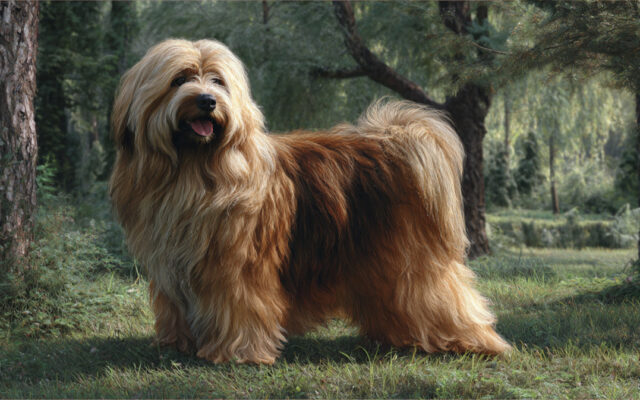
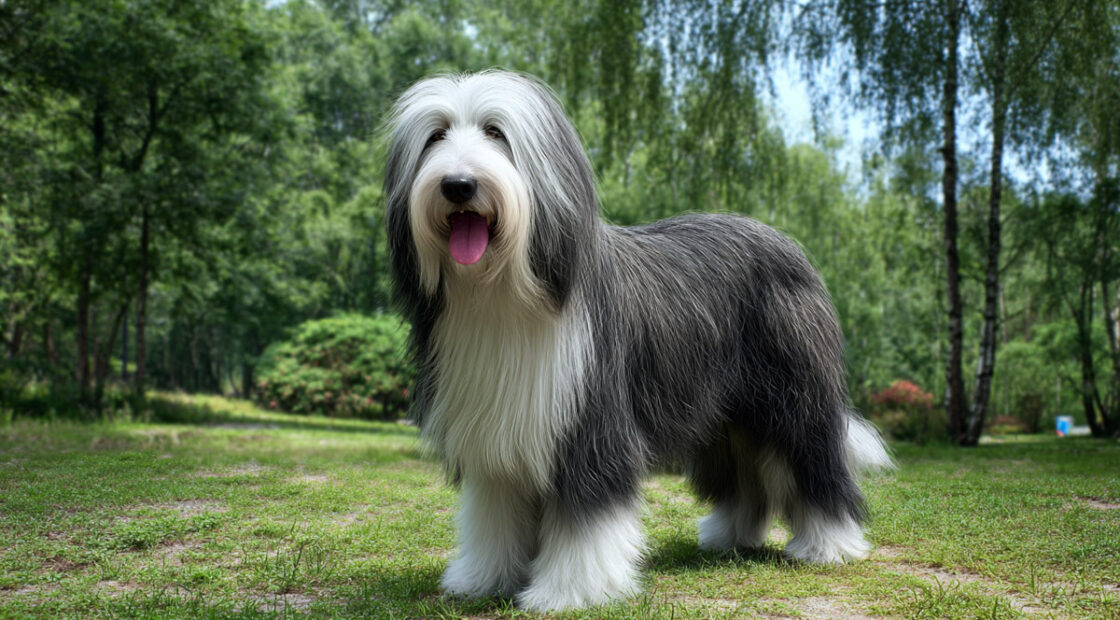
Look at the face first. Longer hair around the muzzle and chin forms the beard, and the rest of the dog is shaggy to match. Underneath it’s a medium-sized Scottish herding breed with a double coat.
The FCI standard lists its use as sheepdog and companion. The AKC calls it a boisterous, charismatic droving dog from Scotland.
Registries file it a little differently. The American Kennel Club puts it in the Herding Group, and The Royal Kennel Club (UK, formerly The Kennel Club) uses the Pastoral Group, per PDSA. The Federation Cynologique Internationale has it in Group 1 (Sheepdogs and Cattle Dogs), Section 1, standard number 271, definitively accepted on 30 August 1967.
The name comes from the coat on the cheeks, lower lips and chin, which gets longer toward the chest and forms the beard (BCCA breed standard).
Beardie is the usual nickname. Older names include Highland Collie and Mountain Collie, plus Hairy Mou’ed Collie.
In deep cover it leaps high to spot stock, a habit known as the Beardie bounce (Hill’s Pet Nutrition).

The coat costs owners the most time. PDSA calls for daily brushing of every layer, not just the top coat.
Bearded Collie Origins and History
Scottish records from around the 16th century describe a dog resembling the Bearded Collie, according to the FCI standard.
The same standard says dogs described as forerunners of the Polish Lowland Sheepdog were left on Scotland’s shores about 500 years ago and bred with local herding dogs.
Purina’s US breed page tells a different story and names the corded Komondor as an ancestor.
The Polish sheepdog account is the one written into the FCI and Royal Kennel Club standards, and neither standard mentions the Komondor. The BCCA and Orvis also name the Komondor as an ancestor, so the two accounts coexist in breed literature.
Modern lines trace to Mrs. G. Olive Willison. The FCI standard dates her acquisition of a puppy named Jeannie to 1940 and credits the Bothkennar kennel with setting today’s type.
| Year | Event | Source |
|---|---|---|
| 1940 | G. Olive Willison acquires Jeannie, foundation of the Bothkennar lines | FCI standard 271 |
| 1967 | FCI accepts the breed on a definitive basis | FCI nomenclature |
| 1969 | Bearded Collie Club of America founded | Vetstreet |
| 1976 | AKC stud book opens to Bearded Collie registrations (1 October); the breed becomes eligible for the Working Group on 1 February 1977 | AKC archives |
| 1989 | A Bearded Collie wins Best in Show at Crufts | Wikipedia |
The breed is still scarce in its home country. The Royal Kennel Club keeps it on the vulnerable native breeds list, which covers breeds with fewer than 300 registrations a year.
In February 2019 the Kennel Club (now the Royal Kennel Club) reported a record low of 274 registrations. When the list began in 2004 the number was almost three times as high.
Size, Coat and Colors
Adults stand 20 to 22 inches at the withers. The double coat comes in black, blue, brown or fawn, usually with white markings.
Height and Weight
The breed standard sets ideal height at 21 to 22 inches for dogs and 20 to 21 inches for bitches. Going over or under the ideal is penalized severely.
The stated reason is to keep the Bearded Collie a medium-sized dog.
| Source | Height | Weight |
|---|---|---|
| BCCA breed standard | 21-22 in (dogs), 20-21 in (bitches) | Not specified |
| PDSA | 51-56 cm | 20-25 kg |
| Purina (US) | 21-22 in (males), 20-21 in (females) | 45-60 lb (males), 35-50 lb (females) |
| Hill’s Pet Nutrition | 20-22 in | 50-60 lb |
The standard sets no weight figure at all. It does fix body proportion, with length exceeding height in a ratio of about five to four.
Only Purina splits weight by sex. Hill’s pairs 50 to 60 lb with 20 to 25 kg, and those two ranges don’t match (20 to 25 kg is roughly 44 to 55 lb).
Some lines mature slowly and reach full size at two or three years, per Hill’s.
Coat Texture and Layers
The outer coat is flat, harsh, strong and shaggy. It shouldn’t be woolly or curly, though a slight wave is allowed. Under it sits a soft, furry, close undercoat.
The beard grows from the cheeks, lower lips and chin and lengthens toward the chest. The coat falls naturally to either side and is never parted artificially.
The standard calls for a medium-length coat that follows the body line and leaves daylight under the body.
Trimming is a serious fault, and so is an excessively long, silky coat.
Hill’s adds a practical warning. A soft coat means a lot more time spent untangling mats.
Colors and Color Change With Age
Every Bearded Collie is born black, blue, brown or fawn, with or without white markings.
The coat lightens with maturity (BCCA breed standard). A born black can turn any shade of gray from black to slate to silver, and a born brown runs from chocolate to sandy.
Blues and fawns also shift from dark to light. Hill’s describes the breed as one of changing colors because many carry a fading gene.
White is allowed on the foreface as a blaze, on the skull, tail tip, chest, legs and feet, and around the neck. It never grows on the body behind the shoulder or around the eyes. Tan is acceptable on the eyebrows, inside the ears, on the cheeks, under the tail root and on the legs.
Pigmentation follows coat color. A born black has black eye rims, nose and lips, a born blue has blue-gray pigment, and a born brown has brown.
Bearded Collie Temperament and Training
The breed standard asks for a stable dog with no signs of shyness or aggression, and most owners describe one that’s friendly, boisterous and sure of itself.
The AKC says the breed was developed to make independent decisions, so it can be willful but is always friendly.
Children and Other Pets
PDSA calls Beardies gentle, lovable, happy dogs that get on well with everyone. Purina describes an affectionate, gentle dog that wants a part in every family activity.
The catch is herding. PDSA says the instinct carries into the home and includes adults and children. Purina notes the breed makes no distinction between livestock and toddlers, and gathers both. Boisterous play around small children adds to it.
Supervise toddlers around a Beardie, and give the herding drive a job elsewhere.
Training and Herding Behavior at Home
Over 2,250 instinct awards have been earned through the BCCA Herding Instinct program since it began (BCCA).
That volume says the drive is common, which fits PDSA’s warning that Beardies try to herd family members at home.
The AKC opens Instinct Tests to dogs from 6 months of age, and no prior training is required to enter.
Purina describes the Beardie as a clever problem solver, though without quite the mental agility of the Border Collie. It responds to reward-based methods, which PDSA also recommends.
Socialize early. Keep sessions short and reward-based, and give the dog a real task such as herding, agility or rally so it stays busy.
How Much Exercise Does a Bearded Collie Need?

Plan on at least 1 hour of exercise a day. PDSA puts the working range at 1 to 2 hours and classes the breed as high energy.
Hill’s links too little exercise to nuisance barking, digging and chewing.
The hour doesn’t have to be a walk. The BCCA runs programs in herding, agility, obedience and rally, scent work, and therapy work and conformation.
PetMD notes that a working dog like this needs to keep mind and body active. A task such as a scent game or a herding class counts alongside the running.
The AKC describes the breed as happy to exercise outdoors in all weather, so rain doesn’t cancel the hour.
How to Groom a Bearded Collie

Brush a Bearded Collie lightly every day and do a full brush-out once a week.
The Royal Kennel Club lists the grooming need as every day. Orvis and the breed guide from clipper maker Wahl describe the same pattern.
One UK grooming school, Four Paws Groom School, treats a weekly brush as enough. Treat that as the floor, not the plan.
Order matters here, so work through it like this.
- Brush the dry coat first to remove dead hair and mats, before any bath.
- Line-brush with a large pin brush. Lift the coat, brush from the skin outward, and work each layer from top to bottom (brushing only the top coat creates frizz and mats, per Wahl).
- Comb the trouble spots with a metal comb: behind the ears, the elbows, the rear end and the base of the tail.
- Run a small slicker between the toes and trim the hair between the pads.
- Bathe about once a month or when dirty, working the shampoo in and leaving the head for last.
- Dry the whole coat, especially around the ears and the base of the tail.
Drop ears hold dirt. Orvis advises cleaning them weekly, and dog-safe ear wipes keep that quick.
Orvis also puts teeth brushing at several days a week and nail trims at roughly monthly.
Extra sessions are needed while the puppy coat sheds, according to Burke’s Backyard.
Bearded Collie Health Problems and Lifespan

Autoimmune disease tops the breed’s health problem list, with symmetrical lupoid onychodystrophy (SLO) and Addison’s disease leading it.
Cancer, behavior problems and endocrine disorders come next, according to BeaCon, the Bearded Collie Foundation for Health.
BeaCon’s March 2021 report found autoimmune disease in 11.0% of the 3,309 dogs in its open registry. Hips came back abnormal in 6.2% of 5,078 Orthopedic Foundation for Animals (OFA) evaluations through December 2020, as reported by BeaCon.
Average age at death across 1,188 registry dogs was 12.2 years, with a range from 1 month to 17.4 years. For screening, a Canine Health Information Center (CHIC) number takes 3 tests, covering hips, eyes and autoimmune thyroiditis.
The registry is voluntary, so its percentages describe enrolled dogs and not every Beardie. BeaCon says the same in its own report.
Addison’s Disease and Autoimmune Conditions
Addison’s disease runs in Bearded Collie families.
PDSA describes it as abnormally low production of hormones such as cortisol by the adrenal glands. The AKC Canine Health Foundation calls it highly heritable in the breed and lists the Bearded Collie among five breeds with unacceptable rates.
Signs are vague, mostly lethargy and a flat mood, so the disease gets mistaken for inflammatory bowel disease, liver disease or kidney failure (Purina Pro Club).
The frequency depends on who counted. BCCA health surveys found Addison’s in 2.2% to 2.7% of dogs in 1992 and 1996, against 0.1% in dogs generally.
BeaCon’s open registry recorded 6.3% in its report year ending February 2006 and 3.1% in 2021. BeaCon says the drop may reflect a real change or a shift in which owners chose to enroll.
Several related conditions travel with it. SLO is a claw disease that tops the registry’s autoimmune list, ahead of Addison’s. Hypothyroidism is the most common endocrine problem in the registry, and some dogs carry it alongside Addison’s.
Vetstreet’s breed profile flags pemphigus foliaceus, an autoimmune skin disease. PDSA lists immune-mediated hemolytic anemia among the breed’s predispositions.
BeaCon adds a practical note on thyroids. Dogs that pull hard against a collar can damage the gland, so a harness suits a puller better.
Joint, Eye and Thyroid Screening
Breeders screen for these conditions through national schemes, and the test lists differ by country.
| Scheme | Tests | Notes |
|---|---|---|
| CHIC (US, BCCA program) | Hip evaluation, eye exam, autoimmune thyroiditis evaluation | Eye and thyroid yearly to age 5, then every 2 years |
| Royal Kennel Club (UK) | BVA/KC hip scheme, BVA/KC elbow scheme, CEA/CH DNA test | Listed on the breed page for breeders |
| Optional (US) | OFA elbow evaluation | Not required for a CHIC number |
Hip dysplasia is the main inherited joint concern. PDSA defines it as hip joint laxity from poor development that eventually leads to arthritis.
Collie eye anomaly/choroidal hypoplasia (CEA/CH) was identified in a Bearded Collie in the UK in 2012, per BeaCon, and the Royal Kennel Club’s breed page now lists a DNA test for it.
For results on a specific dog, BeaCon points owners to the OFA database for US dogs and the BCX database for UK dogs. Its own registry isn’t meant as a source of test results.
How Long Bearded Collies Live
Most sources put the Bearded Collie’s lifespan between 12 and 14 years.
The Royal Kennel Club says over 12 years. Orvis gives 12 to 14 years, and the Westminster Kennel Club gives a maximum of 14.
The data tell a slightly different story. BeaCon’s registry puts the average age at death at the low end of that range, since a registry of deaths also counts dogs lost young. An England-wide longevity analysis summarized by DogWellNet placed the Bearded Collie among the four longest-lived breeds.
Within the registry, autoimmune disease is the leading cause of death before age 7. Cancer leads from 7 to 13, and old age leads after 13.
The two views fit together. Profiles state an expected range, while the registry records what happened to the dogs enrolled, young deaths included.
BeaCon cautions that few necropsies and many unknown causes limit certainty about causes of death.
Bearded Collie vs Border Collie and Old English Sheepdog
The Border Collie learns fastest. The Old English Sheepdog is bigger and calmer, with similar grooming demands. The Bearded Collie sits in between as an outgoing family herding dog.
| Trait | Bearded Collie | Border Collie | Old English Sheepdog |
|---|---|---|---|
| Max weight | 55 lb | 55 lb | 100 lb |
| Max life expectancy | 14 years | 15 years | 12 years |
| Trainability | 3/5 | 5/5 | 4/5 |
| Energy level | 4/5 | 5/5 | 3/5 |
| Grooming needs | 4/5 | 3/5 | 4/5 |
Ratings come from the Westminster Kennel Club’s breed pages, scored out of 5. Westminster caps the Bearded Collie at 55 lb, below the 60 lb Purina gives for males.
Westminster describes the Border Collie as a breed selected for biddable stock sense that can develop unwanted behavior when its intelligence goes unchallenged. The Beardie is the easier house companion, scoring 5/5 for children against 3/5 for the Border Collie.
The Old English Sheepdog matches the Beardie on grooming need and children, but weighs up to 100 lb against 55. Burke’s Backyard says people often mistake one for the other, and Nylabone’s breed guide says the Bearded Collie may have been crossed into the Old English Sheepdog at some point.
If you want a sociable dog and can brush daily, the Bearded Collie is the one to pick.
Want sports or herding work, and able to supply it every day? Border Collie.
And if you have room for 100 lb of coat and prefer a calmer energy level, the Old English Sheepdog makes more sense.
Sources split on the Beardie’s AKC debut because two events are involved. Vetstreet dates recognition to 1976, while Westminster and BeaCon say 1977. AKC archives reconcile the two: the stud book opened to the breed on 1 October 1976, and the breed became eligible for the Working Group on 1 February 1977. Orvis adds that the AKC filed the breed under Working until moving it to Herding in 1983.
When a Bearded Collie Is the Wrong Fit
A Bearded Collie is the wrong fit for homes that are empty most of the day, hot, small or noisy, or short on time for daily grooming.
Orvis says the breed handles solitude poorly, and that crate training buys only a short window before chewing, digging and escape attempts begin. Space matters too. The Royal Kennel Club lists a large house and a large garden, and Burke’s Backyard calls the breed unsuited to inner-city life without committed daily walks.
Hot climates are a problem because BeaCon tracks exercise-induced hyperthermia as a breed issue. Noise is another one, since fear of loud sounds is the most frequently reported behavior problem in BeaCon’s registry.
Heat shows up in the show ring too. At the Midshires Bearded Collie Club championship show on 13 July 2025, judge Ellen Sullivan reported that a few dogs showed signs of being too hot while most coped.
Sources split on children. Westminster rates the breed 5/5 for good with children, while Orvis calls it too rambunctious for homes with small children.
Exercise figures split too. The Royal Kennel Club lists up to 1 hour a day, below the 1 to 2 hours PDSA gives.
The breed fits better where someone is home for most of the day and there’s time for a daily brush and daily activity. The yard should be secure and fenced (the Royal Kennel Club says town or country both work).
How to Find a Healthy Bearded Collie Puppy or Adult
Buy from a responsible breeder who publishes health results for both parents, or adopt through BCCA Rescue or the Royal Kennel Club’s breed rescue network.
Ask for written proof of hip, eye and thyroid testing on both parents. For UK dogs that means BVA/KC hip and elbow scores and the CEA/CH DNA result. Get the inbreeding coefficient of the parents and every term of sale in writing.
Vetstreet is blunt that a vet check is not a substitute for genetic health testing.
The BCCA requires proof of hip, eye and thyroid testing on all sires and dams in its litter listings, regardless of age. A recent litter listing on its breeders page gives CHIC numbers and OFA hip, eye and thyroid results for both parents.
The BCCA treats puppy sales as a private matter between buyer and breeder and offers no warranties, which is why written terms matter. Neither the BCCA listings nor the Royal Kennel Club breed page state a price, so ask each breeder directly.
Going Through a Breeder
- Check the parents in the OFA and CHIC databases rather than relying on the breeder’s summary
- In the UK, use the Royal Kennel Club Health Test Results Finder and its Find a Puppy service
- Ask which breed club the breeder belongs to, and whether they signed its code of ethics
Going Through Rescue
BCCA Rescue has every dog examined by a vet and spayed or neutered before placement. Adopters apply through a regional coordinator and sign a contract to return the dog if they can’t keep it.
The Beardie Connection rehomes Beardies that aren’t formal rescues, and the Royal Kennel Club’s Breed Rescue network covers the UK.
BeaCon’s 2021 report adds a genetic caution. The breed’s average inbreeding is slightly higher than in other breeds, and Dr. Jerold Bell’s analysis of AKC studbook data found enough diversity for the breed to stay viable only if the population recovers.
The Royal Kennel Club lets buyers view the inbreeding coefficient calculation for a puppy’s parents, which makes the question easy to ask.
Bearded Collie FAQ
Do Bearded Collies shed, and are they hypoallergenic?
They shed, and no, they are not hypoallergenic. Orvis says the breed sheds all year and drops extra hair when it blows its coat twice a year.
The Royal Kennel Club also lists it as a shedding breed. Daily brushing keeps loose hair off the furniture.
Do Bearded Collies bark a lot?
Yes. Westminster Kennel Club gives the breed its top barking score, 5 out of 5, and Orvis lists nuisance barking as a specific concern.
Orvis ties problem barking and digging to boredom, so enough exercise and company cuts most of it.
Are Bearded Collies good guard dogs?
No. Orvis describes the breed as watchful and quick to announce visitors, but not aggressive, so guarding isn’t its skill.
Westminster rates protectiveness 3 out of 5. Expect an alarm, not a deterrent.
Can you shave a Bearded Collie?
A pet can be clipped short in an all-over puppy cut, which eases brushing but leaves the dog looking little like the breed, according to Wikipedia.
The breed standard bars trimming, so a clipped dog can’t be shown.
How much should a Bearded Collie eat?

Orvis puts a typical adult at 1.5 to 2 cups of good-quality dry food a day, split into two meals. Age and activity level move that figure.
PetMD says puppies need three or four meals a day. Confirm the amount with your vet.
Is the Bearded Collie a rare breed?
Yes, it’s uncommon. The AKC ranked it 154th of 200 breeds in 2023 and 140th of 201 ranked breeds in 2024, according to its annual popularity lists.
Rankings shift every year, so read both as a rough position and not a fixed rank.
What a Bearded Collie Costs in Money and Time
A Bearded Collie costs at least 15,120 pounds over 12 years and 7 to 14 hours of exercise every week.
That multiplies PDSA’s minimum of 105 pounds a month by the Royal Kennel Club’s 12-plus years, and PDSA’s 1 to 2 hours of daily exercise by seven days.
Settle the hardest-to-reverse decisions first. Start with the parents’ hip, eye and thyroid results, then set a monthly budget at the PDSA minimum, and finish with a two-week trial of the daily brush and walk.
Health testing comes first because a puppy’s inherited risk is fixed at birth, while budget and routine can be adjusted.
Because a dog is expensive over a whole lifetime, check the 15,120 pounds against household income before contacting breeders.
The advice was verified in October 2026 and changes when PDSA reprices its estimates or BeaCon publishes its next registry report.