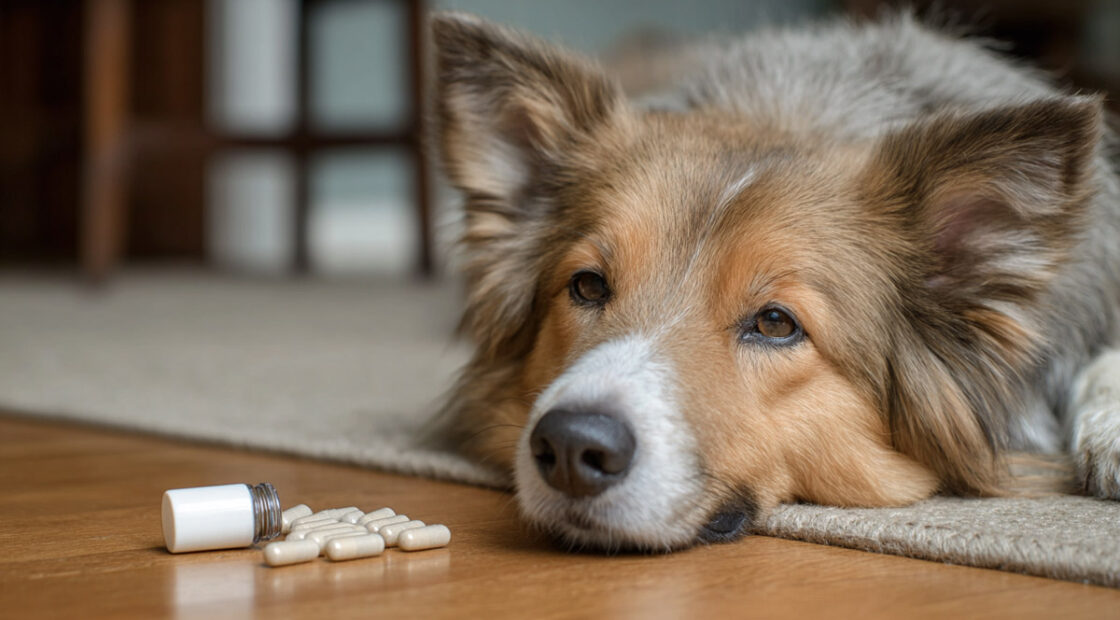
Your dog’s body runs on collagen. It holds their joints together, keeps their skin elastic, and makes up a huge chunk of their connective tissue. But production slows down with age, and that’s when the stiffness, the dull coat, and the reluctance to jump start showing up.
Collagen for dogs has become one of the fastest-growing categories in pet supplements, and for good reason. Clinical research now backs specific forms of collagen supplementation for canine joint health, skin and coat support, and overall mobility.
This guide covers what the science actually says, which types of collagen work best, proper dosing by dog size, safety concerns, and how to pick a supplement that’s worth your money.
What Is Collagen for Dogs
Collagen is the most abundant protein in your dog’s body. It makes up a huge portion of their skin, bones, tendons, ligaments, and cartilage. Think of it as the structural glue that keeps connective tissue intact and functioning.
My older Lab started slowing down around age six. That’s when I first looked into collagen supplements, and honestly, I wish I’d started earlier.
There are three types that matter most for dogs:
| Collagen Type | Where It’s Found | What It Does |
|---|---|---|
| Type I | Skin, tendons, bones, ligaments | Provides structural strength and elasticity |
| Type II | Cartilage (especially in joints) | Cushions joints and absorbs shock |
| Type III | Blood vessels, muscles, organs | Supports smooth muscle and organ structure |
Type I is the most common. You’ll find it almost everywhere in the body. Type II forms the main structure of cartilage tissue, which is why it gets so much attention for joint health. Type III usually appears alongside Type I and helps maintain the extracellular matrix in tissues.
Here’s the part most people miss. Dogs naturally produce collagen on their own. But production starts declining with age, typically between five and seven years depending on breed size. Large breeds tend to lose it faster.
Dataintelo research shows the global collagen pet supplement market hit $758.6 million in 2024, growing at 7.8% annually. Dogs are the primary consumers, mostly because of joint and mobility concerns.
The collagen in a supplement is not the same as what your dog’s body produces internally. Supplemental collagen comes from external sources like bovine hide, chicken sternum cartilage, or fish skin. The body breaks it down into amino acids (glycine, proline, and hydroxyproline are the big three) and uses those as building blocks to repair and maintain connective tissue.

Whether that process actually leads to measurable results depends on the form of collagen, dosage, and your dog’s specific health needs. We’ll get into all of that.
How Collagen Supports Joint Health in Dogs
Joint problems are the number one reason dog owners reach for collagen supplements. And there’s a solid reason for that.
Cartilage sits between bones in every joint. It acts as a cushion, preventing bone-on-bone grinding during movement. Type II collagen is the primary structural component of that cartilage. When it breaks down, you get osteoarthritis.
A 2024 study published in Scientific Reports found that 39.8% of young dogs (aged 8 months to 4 years) already showed radiographic signs of osteoarthritis in at least one joint. That number surprised a lot of people, myself included. We tend to think of OA as an older dog problem, but the data says otherwise.
Osteoarthritis accounts for roughly 80% of all lameness and joint disease cases in companion animals, according to research from Companion Animal Health Publications.
How UC-II Collagen Works in Joints
Undenatured type II collagen (UC-II) works differently from regular hydrolyzed collagen. It doesn’t get broken down into amino acids. Instead, it interacts with immune cells in the gut through a process called oral tolerance.
Small amounts of intact type II collagen pass through the intestinal wall and reach Peyer’s patches. There, they signal the immune system to stop attacking the cartilage in joints. This reduces inflammation at the source.
A PMC review found that UC-II at just 10 mg daily for 150 days significantly improved well-being in moderately arthritic dogs. No important changes in blood chemistry, body weight, or respiration were observed during long-term safety testing.
In a separate randomized study, 60 dogs received either UC-II (40 mg/day) or robenacoxib (a prescription NSAID) for 30 days. Both groups showed similar reductions in the Liverpool Osteoarthritis in Dogs (LOAD) score. UC-II achieved a 32.7% improvement, compared to 31.5% for the drug.
That’s a supplement performing on par with prescription medication. Worth paying attention to.
Collagen vs. Glucosamine for Dogs
Most people default to glucosamine and chondroitin for canine joint health. They’ve been the go-to for decades. But the research on UC-II tells a different story.
Ground force plate testing (the gold standard for measuring joint pain in dogs) showed that dogs on UC-II had a significant increase in peak vertical force within 15 days. Dogs taking glucosamine and chondroitin showed no measurable improvement, even after 150 days.
That doesn’t mean glucosamine is useless. It works through a completely different mechanism, providing raw materials for cartilage repair rather than modulating the immune response. Some vets recommend using both together as part of a multimodal approach.
But if you’re picking one supplement and want the strongest clinical backing for joint support? UC-II has it right now.
Breeds that are especially prone to joint issues, like German Shepherd Dogs, Labrador Retrievers, Golden Retrievers, and Great Danes, may benefit most from early collagen supplementation. Large and giant breeds carry more weight on their joints and tend to develop osteoarthritis sooner than smaller dogs.
Other Benefits of Collagen for Dogs

Joint health gets all the headlines. But collagen does a lot more than that in your dog’s body.
Skin and Coat Health
Type I collagen is the main structural protein in skin. When production drops off, you’ll notice it. Dry, flaky skin. Dull coat. Excessive shedding that doesn’t seem to match the season.
Hydrolyzed collagen peptides provide the amino acids (especially glycine and proline) that skin cells need to regenerate. My dog’s coat changed noticeably after about six weeks on a collagen powder. Shinier, less shedding on the couch. Your mileage may vary, but plenty of other owners report the same thing.
Dogs with chronic skin irritation or breeds prone to coat issues, like the Bulldog or Chinese Shar-Pei, might see the most benefit here.
Gut Lining and Digestive Health
Collagen contains high concentrations of glycine, an amino acid that supports the integrity of the intestinal lining. A compromised gut lining (sometimes called “leaky gut”) can lead to chronic inflammation, food sensitivities, and poor nutrient absorption.
Collagen peptides may help seal and repair the mucosal barrier in the digestive tract. This is still an emerging area of research in veterinary medicine, but the mechanism is well established in human studies. Dogs dealing with persistent digestive upset or sensitive stomachs could see improvements when collagen is added to their daily diet.
Nail and Teeth Strength
Brittle nails that crack or split easily can be a sign of collagen deficiency. The protein matrix in nails and teeth relies on adequate collagen supply to stay strong. Supplementation won’t fix a broken nail overnight, but consistent daily intake supports the underlying structure over time.
Mobility in Senior Dogs
Beyond just cartilage, collagen supports tendons and ligaments, the soft tissues that hold joints together and allow smooth movement. Senior dogs losing mobility often have degradation across multiple connective tissue types, not just in the cartilage itself.
A 2022 exploratory study published in PMC followed 110 dogs with degenerative joint disease over six months of UC-II supplementation. Pain scores dropped significantly after just one month, and the improvement held steady throughout the full study period.
For aging dogs of any breed, from a Dachshund to a Bernese Mountain Dog, collagen supplementation can be one piece of a broader wellness routine.
Types of Collagen Supplements Available for Dogs
Walk into any pet store or scroll through Amazon and you’ll find dozens of collagen products. Not all of them are worth your money. The form of collagen matters just as much as the type.
Powders
Hydrolyzed collagen powder is the most versatile option. You sprinkle it on food, mix it into wet meals, or stir it into bone broth. Most powders use bovine or marine sources and contain Types I and III collagen broken down into peptides for better absorption.
Dosing is flexible with powders. You can adjust the amount based on your dog’s weight, which is tricky with pre-dosed chews or tablets. If you have multiple dogs of different sizes (I do), powder makes life easier.
Chews and Treats
Collagen chews for dogs have become one of the fastest-growing product categories. They’re palatable, easy to give, and most dogs think they’re getting a treat rather than a supplement.
Many chews on the market use UC-II at a standardized 40 mg dose, combined with other joint-supporting ingredients like omega-3 fatty acids or Boswellia serrata. The downside? You can’t easily adjust the dose, and some products pack in fillers or artificial flavors alongside the active ingredients.
Fortune Business Insights data shows the chewable format led the pet supplement market in 2024, driven by convenience and taste preference.
Bone Broth
Bone broth is the original collagen supplement. Simmering bones for extended periods releases collagen, gelatin, glycine, and other beneficial compounds into the liquid. It’s a whole-food source that dogs generally love.
The catch? You can’t standardize dosing with bone broth. The collagen content varies wildly depending on which bones you use, how long you cook them, and at what temperature. It works great as a dietary addition, but it’s hard to rely on as your primary collagen source if you’re targeting specific joint health outcomes.
Hydrolyzed Collagen vs. Whole-Food Collagen Sources
This is where things get a bit technical, but it matters.
Hydrolyzed collagen peptides have been broken down into smaller molecules through enzymatic processing. They’re absorbed quickly through the small intestine and distributed throughout the body. Grand View Research notes the hydrolyzed collagen segment is growing at a CAGR of 11.5%, making it the fastest-growing form in the broader collagen market.
Whole-food sources like bone broth, chicken feet, or beef trachea contain intact collagen that the body must break down on its own. Bioavailability is lower, but you get a broader spectrum of nutrients alongside the collagen, including minerals, glycosaminoglycans, and healthy fats.
| Feature | Hydrolyzed Peptides | Whole-Food Sources |
|---|---|---|
| Absorption rate | High (pre-processed) | Lower (requires digestion) |
| Dosing control | Precise | Variable |
| Additional nutrients | Minimal | Minerals, fats, gelatin |
| Best for | Targeted supplementation | General nutritional support |
Ideally, you’d combine both. Hydrolyzed peptides for consistent daily dosing, and bone broth or collagen-rich healthy dog treats for the added nutritional variety.
How Much Collagen Should a Dog Get
Dosage depends on three things: your dog’s weight, the form of collagen, and what you’re trying to achieve.
There’s no single veterinary consensus on exact numbers, which is frustrating. But the clinical research gives us some solid reference points to work from.
UC-II (Undenatured Type II Collagen) Dosing
Standard dose: 40 mg per day for dogs of most sizes.
That 40 mg figure comes directly from multiple clinical trials. In the PMC study comparing UC-II to robenacoxib, dogs received one 40 mg tablet daily regardless of body weight. The same dosing was used in the 110-dog exploratory study on degenerative joint disease.
UC-II is dose-specific because of how it works. It’s not about flooding the body with collagen building blocks. It’s about delivering enough intact type II collagen to trigger oral tolerance in the gut. More isn’t necessarily better here.
Hydrolyzed Collagen Peptide Dosing
This is where weight matters more:
- Small dogs (under 25 lbs): 1,000 to 2,000 mg daily
- Medium dogs (25 to 50 lbs): 2,000 to 4,000 mg daily
- Large dogs (50 to 90 lbs): 4,000 to 5,000 mg daily
- Giant breeds (90+ lbs): 5,000 to 6,000+ mg daily
These are general ranges based on manufacturer recommendations and veterinary guidance. A Rottweiler or Mastiff will obviously need more than a Chihuahua.
Bone broth dosing is harder to pin down. You’re looking at roughly 1 to 4 ounces per day depending on dog size, but the actual collagen content varies batch to batch.
When to Expect Results
UC-II showed measurable joint improvement in as little as 15 days in force plate studies. Most owners notice behavioral changes (more willingness to walk, less stiffness after rest) within 4 to 8 weeks.
Hydrolyzed peptides for skin and coat benefits typically take 6 to 12 weeks of consistent daily use before visible changes appear. It’s not a fast fix. You have to commit to the routine.
Side Effects and Safety Concerns
Collagen supplements are generally well-tolerated. Took me a while to get comfortable saying that because I’m cautious about anything I give my dogs. But the safety data is pretty reassuring.
Long-term safety testing on UC-II in dogs (150 days) showed no significant changes in blood chemistry, body weight, heart rate, or respiration, according to the PMC review on companion animals. No mutagenic effects were observed either.
Digestive Upset
Some dogs experience mild stomach issues when first starting collagen, especially with hydrolyzed peptides. Loose stool, gas, or temporary appetite changes. This usually resolves within a few days as the gut adjusts.
Starting with half the recommended dose and building up over a week tends to prevent this. Dogs with already sensitive digestive systems should take it slow.
Protein Source Allergies
The collagen source matters if your dog has food allergies.
Bovine collagen won’t work for beef-allergic dogs. Chicken-derived UC-II is off the table for dogs with poultry sensitivities. Marine (fish) collagen is often the safest choice for allergy-prone dogs, but even then, you need to verify the specific fish species used.
Always check the ingredient label beyond just “collagen.” Some products add flavorings, preservatives, or binding agents sourced from common allergens.
Quality Control Issues
The pet supplement industry is less regulated than human supplements. The FDA issued warning letters to multiple companies in 2024 for selling unapproved pet products, and the agency’s Operation Pangea seized over 1,200 shipments of counterfeit pet medications and supplements that same year, according to Mordor Intelligence.
Look for products carrying the NASC (National Animal Supplement Council) quality seal. This means the manufacturer follows good manufacturing practices and undergoes independent facility audits. It’s not a guarantee of effectiveness, but it is a baseline for safety and ingredient accuracy.
When to Avoid Collagen
Dogs with severe kidney disease should consult a vet before adding any protein supplement, collagen included. The additional protein load could strain compromised kidneys.
If your dog is on prescription NSAIDs or other joint medications, talk to your vet before combining them with UC-II. The research on combined therapy (UC-II plus cimicoxib) showed it was safe, but your dog’s specific health situation might be different.
Breeds with known health problems or those already managing conditions like hip dysplasia should always start supplementation under veterinary guidance rather than going it alone.
Signs Your Dog Might Benefit from Collagen

Dogs don’t tell you when their joints hurt. They just… stop doing things. And if you’re not paying attention, you’ll miss it until the problem is already advanced.
A 2022 study in the Journal of Small Animal Practice screened 500 previously undiagnosed dogs and found that 38% had osteoarthritis. Less than half of those dogs had been brought in specifically for stiffness or lameness. The rest? Their owners had no idea.
Physical Warning Signs
Stiffness after rest: Your dog takes longer to get up from a nap, walks slowly for the first few minutes, then loosens up. Classic early joint deterioration.
Reluctance to jump or climb stairs: A dog that used to hop onto the couch without thinking twice now hesitates. Or flat-out refuses.
Limping that comes and goes: Intermittent lameness, especially after exercise, signals that something is breaking down in one or more joints.
Skin and Coat Indicators
Joint problems get noticed first. But collagen deficiency shows up on the outside too.
Persistent dry, flaky skin that doesn’t respond to diet changes or topical treatments can point to declining collagen production. Same with a coat that looks dull or feels rough, even though your dog is eating well and getting proper grooming.
Excessive shedding outside of normal seasonal cycles is another clue. Especially in breeds that don’t typically shed much.
Breed and Age Considerations
Some dogs are more likely candidates than others.
| Risk Factor | Details |
|---|---|
| Large/giant breeds | Newfoundlands, Saint Bernards, Cane Corsos |
| Dogs over age 5–7 | Natural collagen production declines |
| Post-surgery recovery | TPLO, FHO, or other orthopedic procedures |
| Diagnosed OA | Any breed with confirmed osteoarthritis |
Working dogs and highly active breeds like the Australian Shepherd or Belgian Malinois also put enormous repetitive stress on their joints. Starting collagen earlier with these dogs makes sense.
What Veterinary Research Says About Collagen for Dogs
Marketing claims are everywhere. What actually holds up in clinical trials is a shorter list. But the research that does exist is encouraging.
UC-II Clinical Trials
The strongest evidence is for undenatured type II collagen. Multiple peer-reviewed studies back its effectiveness for canine osteoarthritis.
- A 2007 study gave arthritic dogs 40 mg UC-II daily for 90 days and measured significant declines in overall pain, pain during limb manipulation, and post-exercise lameness using objective ground force plate testing
- A 2019 randomized trial in 60 dogs showed UC-II achieved a 32.7% improvement in LOAD mobility scores, matching the prescription NSAID robenacoxib
- A 2022 study comparing UC-II to cimicoxib found both treatments produced significant reductions in clinical signs of OA after just 30 days
UC-II also showed benefits within 15 days in force plate studies, something glucosamine and chondroitin failed to do even after 150 days.
Hydrolyzed Collagen Research
The evidence base for hydrolyzed collagen peptides in dogs is thinner. Most human research on skin and gut benefits hasn’t been replicated in canine-specific trials yet.
A PMC-published study on 23 German Shepherd dogs used 20 grams daily of collagen hydrolysate over 8 weeks and tracked improvements through cartilage markers (MMP-3 and TIMP-1). Lameness in dogs with mild symptoms showed clear improvement.
That’s promising, but it’s one study. Hydrolyzed collagen for dogs needs more clinical validation before it can match UC-II’s evidence base.
What Vets Actually Think
Veterinary consensus on collagen is still forming. Most vets recognize UC-II as a legitimate supplement with solid clinical backing, especially for mild to moderate osteoarthritis.
The gap? Many veterinary schools taught glucosamine and chondroitin as the primary joint supplements for years. UC-II research is newer, and not every practicing vet has reviewed it yet. If your vet isn’t familiar with UC-II, the studies published in journals like Research in Veterinary Science and PLOS ONE provide a good starting point for that conversation.
How to Pick a Collagen Supplement for Your Dog

The pet supplement market hit $2.76 billion in 2025, according to Grand View Research. Dogs account for over 63% of that spending. With that much money flowing, the number of products has exploded.
Not all of them are worth buying.
Certifications That Matter
NASC Quality Seal: This is the baseline. The National Animal Supplement Council requires member companies to pass an independent third-party facility audit every two years. They must maintain standard operating procedures, adverse event reporting systems, and submit to random product testing by independent labs.
PetMD notes that the NASC has been operating since 2001 and provides one of the highest quality standards in the pet supplement industry. If a product doesn’t carry this seal, it doesn’t automatically mean it’s bad. But it means you have to do more homework yourself.
Ingredient Transparency
Read past the front label. Here’s what to check:
- Specific collagen type listed (UC-II, Type I, Type III, hydrolyzed peptides)
- Exact milligram dose per serving, not hidden in a “proprietary blend”
- Source animal (bovine, chicken, marine) clearly stated
- No artificial colors, flavors, or unnecessary fillers
Zesty Paws is one of the larger brands in this space (owned by H&H Group). Nutramax Laboratories, maker of Cosequin and Dasuquin, has been a fixture in veterinary joint care for years. Fera Pets expanded into over 175 Petco stores in 2025 with their vet-formulated line including a Collagen Plus product.
Sourcing and Price
Grass-fed bovine and wild-caught marine collagen sources are generally considered higher quality than conventional alternatives. Grass-fed bovine provides Types I and III. Marine collagen (fish skin) is primarily Type I with smaller peptide size for faster absorption.
Price ranges vary a lot. A month’s supply of a quality collagen powder runs roughly $20 to $45 for a medium-sized dog. UC-II chews with standardized 40 mg dosing typically cost $25 to $50 per month depending on the brand.
Expensive doesn’t always mean better. But suspiciously cheap usually means corners were cut somewhere, whether in sourcing, testing, or active ingredient concentration.
Natural Food Sources of Collagen for Dogs
Supplements work. But they’re not the only way to get collagen into your dog’s diet. Whole-food sources have been around a lot longer than the supplement industry, and some dogs do better with real food than with processed powders.
Bone Broth
The original canine collagen source, and still one of the best for overall nutritional support.
How to make it right:
- Use raw, grass-fed bones with connective tissue attached (beef knuckle bones, marrow bones, chicken feet, turkey necks)
- Add a tablespoon of apple cider vinegar per gallon of water to draw out collagen and minerals
- Simmer on low for 12 to 24 hours in a slow cooker
- Strain all bones and solids (never feed cooked bones)
Good bone broth gels when refrigerated. That gel is gelatin, and gelatin is loaded with collagen, glycine, proline, and glucosamine.
What to avoid: Never add onions, excessive garlic, salt, or seasoning. These are fine for human broth but can be toxic or irritating to dogs. Store in the fridge for up to 5 days or freeze in ice cube trays for easy portioning.
Collagen-Rich Treats and Chews
Whole-food chews made from animal parts naturally high in collagen serve double duty. They satisfy the urge to chew while delivering connective tissue protein.
Chicken feet: One of the most concentrated natural sources of Type II collagen. Dehydrated or raw, they’re a favorite among raw feeding enthusiasts.
Beef trachea: Rich in chondroitin and collagen. Also a softer chew option for senior dogs or puppies compared to something like antlers.
Eggshell membrane: The thin layer between the shell and the egg white contains collagen, hyaluronic acid, glucosamine, and chondroitin in a single natural package. Some supplement brands now use eggshell membrane as their collagen source.
If your dog enjoys safe chews, working collagen-rich options into the rotation alongside something like bully sticks or Himalayan yak chews gives them variety and joint support at the same time.
Combining Food Sources with Supplements
The best approach for most dogs? Both.
Use a standardized UC-II supplement (40 mg daily) for targeted joint support. Then add bone broth as a meal topper and rotate collagen-rich treats throughout the week for additional amino acid variety.
This covers the immune-modulating benefits of UC-II, the broad-spectrum amino acid support from hydrolyzed peptides or broth, and the added minerals from whole-food sources. It’s the same approach a lot of raw feeders and integrative vets recommend.
Owning a dog, especially one that’s getting older, means constantly weighing costs. Between vet visits, quality feeding, and the general reality that a dog is expensive, every supplement needs to earn its place. Collagen, based on the research and my own experience, does.
FAQ on Collagen For Dogs
Is collagen safe for dogs?
Yes. Long-term safety studies on UC-II showed no adverse changes in blood chemistry, body weight, or respiration over 150 days. Most dogs tolerate both hydrolyzed collagen peptides and undenatured type II collagen without issues.
What type of collagen is best for dogs?
UC-II (undenatured type II collagen) has the strongest clinical backing for joint health. For skin, coat, and gut support, hydrolyzed Types I and III collagen peptides from bovine or marine sources are the better choice.
How much collagen should I give my dog daily?
UC-II dosing is typically 40 mg per day regardless of size. Hydrolyzed collagen peptides range from 1,000 mg for small dogs to 5,000 mg or more for large and giant breeds.
How long does collagen take to work in dogs?
UC-II showed measurable joint improvement in force plate studies within 15 days. Most owners notice behavioral changes like increased willingness to walk or play within 4 to 8 weeks of consistent daily supplementation.
Can puppies take collagen supplements?
Most collagen supplements are formulated for adult dogs. Puppies still produce collagen efficiently on their own. Check with your vet before supplementing any dog under one year, especially during active growth phases.
Is collagen better than glucosamine for dogs?
UC-II outperformed the glucosamine and chondroitin combination in ground force plate testing. Dogs on UC-II improved within 15 days. Dogs on glucosamine showed no measurable improvement after 150 days in the same study.
Can I give my dog bone broth instead of collagen supplements?
Bone broth is a good whole-food collagen source rich in glycine, gelatin, and minerals. But you can’t standardize the dose. For targeted joint health support, a measured supplement is more reliable.
Are there side effects of collagen for dogs?
Some dogs experience mild digestive upset when first starting, especially with hydrolyzed peptides. Starting at half dose for a week usually prevents this. Allergies to the protein source (beef, chicken, fish) are the main concern.
What should I look for on a collagen supplement label?
Look for the NASC Quality Seal, specific collagen type and milligram dose per serving, clearly stated source animal, and no proprietary blends hiding actual ingredient amounts.
Which dog breeds benefit most from collagen?
Large and giant breeds prone to joint issues benefit most, including German Shepherds, Labrador Retrievers, Golden Retrievers, and Great Danes. Senior dogs of any breed with declining mobility are also strong candidates.
Conclusion
Collagen for dogs isn’t a trend. It’s a protein supplement backed by real veterinary research, particularly UC-II for canine osteoarthritis and joint inflammation.
The clinical data is clear. Undenatured type II collagen performs on par with prescription NSAIDs in reducing pain and improving mobility, without the side effects of long-term drug use.
Whether you go with hydrolyzed collagen peptides for skin and coat, bone broth for broad nutritional support, or a standardized UC-II chew for targeted cartilage repair, the key is consistency. Daily intake matters more than the format you choose.
Start with a quality product carrying the NASC seal. Give it 4 to 8 weeks. Watch how your dog moves.
You’ll likely notice the difference before your vet does.