Shar-Pei folds look like a grooming decision, but they come from a DNA quirk that also leaves the breed prone to recurring fever syndrome. Olsson et al. (PLoS Genetics, 2011) found two overlapping duplications, 14.3 kb and 16.1 kb long, upstream of the HAS2 gene, and they showed up only in this breed. Dogs with a high copy number of the 16.1 kb duplication had higher HAS2 expression and were more likely to have the fever syndrome (p < 0.0001).
The Chinese Shar-Pei is a medium-sized dog from southern China. Farmers kept it for guarding and herding, with some hunting on the side, and the American Kennel Club placed it in the Non-Sporting Group in 1992. If you’re thinking of buying one, fold depth is a health variable, not only a matter of looks.
What Is the Chinese Shar-Pei?
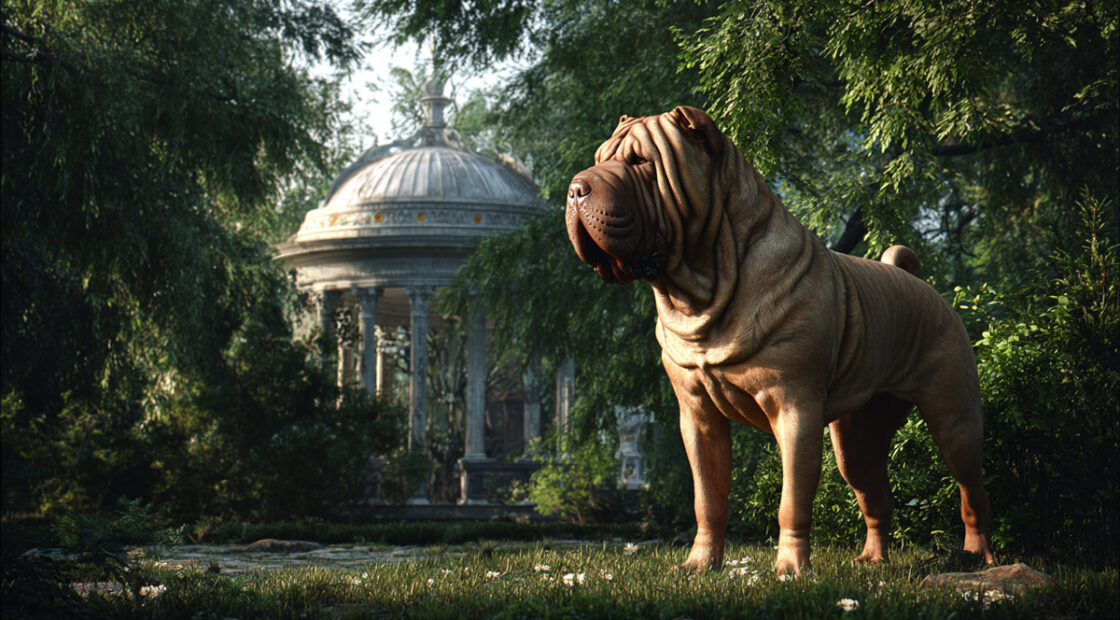
You can pick this southern Chinese breed out of a lineup by its deep skin folds, hippopotamus-shaped muzzle, blue-black tongue and harsh, bristly coat.
The American Kennel Club (AKC) registers it in the Non-Sporting Group, while the United Kennel Club files it under the Northern Breed Group.
Chinese farmers developed it as an all-purpose working dog. It guarded and herded livestock, and it hunted too.
According to the AKC standard, the look comes from a short, harsh coat, loose skin over the head and body, small ears, a hippopotamus muzzle and a high-set tail.
The name Shar-Pei means “sand skin” and refers to the rough coat, not the wrinkles (Britannica).
The Chinese Shar-Pei Club of America uses Shar-Pei for one dog or several, so the plural takes no extra s.
Origin and Recognition History of the Chinese Shar-Pei
The breed nearly disappeared in the mid-20th century and came back because of a 1973 appeal from Hong Kong breeder Matgo Law. Major kennel clubs recognized it between 1985 and 1992.

Origin and original working roles
Britannica dates the breed to about 200 BCE, and the Canadian Kennel Club says it is generally accepted that it arose in the Han dynasty (202 BC to 220 AD).
That makes it one of the oldest dog breeds still around, although its exact lineage is unsettled.
Farmers used it as an all-purpose farm dog (Westminster Kennel Club). Fighting was part of its past too, but the AKC archives say larger mastiff-type dogs outmatched it in the ring, and that sent it back to guarding and farm work.
Near extinction and the Matgo Law revival
Heavy dog taxes in the late 1940s, followed by a breeding ban, pushed the breed close to extinction in China. Hong Kong breeders kept lines going, per Britannica.
Matgo Law of Down-Homes Kennel published his plea in the April 1973 issue of DOGS Magazine. It drew more than 200 inquiries, according to Dr. Jeff Vidt’s breed history, and LIFE magazine put a Shar-Pei on its cover in 1979.
Guinness named it the rarest breed in the world, but accounts date that listing differently. Mental Floss places it between the late 1960s and mid 1970s, and other accounts give 1978.
The name changed along the way. The breed traveled as the Chinese Fighting Dog until early US fanciers switched to Chinese Shar-Pei because of the bad publicity around dog fighting, as Vidt recounts in ShowSight.
Registry recognition
- First Shar-Pei imported into the United States in 1966 (UKC breed standard)
- United Kennel Club recognition in 1985
- AKC Miscellaneous Class in January 1988
- Canadian Kennel Club recognition in 1991
- AKC Non-Sporting Group in 1992
It took the AKC four years to move the breed from the Miscellaneous Class into a full group.
Chinese Shar-Pei Size, Head Features and Coat Types
According to Britannica, an adult stands 18 to 20 inches at the withers and weighs 45 to 60 pounds. The show ring caps coat length at 1 inch.
Size and head features
Pet dogs sit inside that range. UK primary-care records put the average adult bodyweight at 22.26 kg, about 49 pounds (O’Neill et al., Canine Medicine and Genetics, 2023).
The AKC standard calls the broad, full muzzle one of the breed’s distinctive features. Westminster adds small ears, deep-set eyes and a rising topline.
The Chow Chow has a blue-black tongue too, though Britannica says it is unclear whether the two breeds are related.
Coat types

Two coat types are accepted in the ring. A third exists outside it.
| Coat type | Length | AKC standard status |
|---|---|---|
| Horse | Extremely short, harsh | Accepted |
| Brush | Up to 1 inch at the withers | Accepted |
| Bear | Over 1 inch, often soft | Major fault |
Some profile sites call the bear coat a disqualification, which isn’t what the standard says. The standard text treats a soft, wavy or over-length coat as a major fault. Its disqualifications are pricked ears, a solid pink tongue, the absence of a complete tail and a coat that is not a solid color.
A trimmed coat is also a major fault, since the breed is shown in its natural state.
Accepted colors
The AKC and United Kennel Club standards accept any solid color or sable. Shading is allowed as variations of the same body color, with darker hairs throughout the coat.
For the tongue, solid bluish-black is preferred, except in dilute colors, which carry solid lavender. A solid pink tongue is a disqualification.
Profile sites quote different color counts, and the standard text sets none.
Why Does the Chinese Shar-Pei Have Wrinkles?

A duplicated stretch of DNA upstream of the HAS2 gene makes the breed overproduce hyaluronan, a molecule that thickens and folds the skin. Olsson et al. (PLoS Genetics, 2011) found two overlapping duplications, 14.3 kb and 16.1 kb long, that occur only in the Shar-Pei.
Both sit on chromosome 13. HAS2 encodes the rate-limiting enzyme that builds hyaluronan, and higher copy numbers go with higher HAS2 expression, so more hyaluronan piles up in the skin and the skin thickens and folds. When hyaluronan fragments, it acts as an immune trigger and can set off sterile fever and inflammation.
A high copy number of the 16.1 kb duplication tracked with both higher HAS2 expression and the periodic fever syndrome (p < 0.0001).
The authors conclude that breeding for heavy skin enriched a mutation that also predisposes dogs to fever. The paper also reports that the 16.1 kb duplication appeared only in meatmouth dogs, the heavily wrinkled Western type. Dogs of the less wrinkled, ancestral traditional type carried only the shorter 14.3 kb duplication.
A 2013 PLOS ONE follow-up placed the genetic signature separating the breed’s wrinkled extremes next to the main autoinflammatory risk locus on chromosome 13. Read together, the two studies link wrinkle depth to disease risk.
The papers show association, not a safe fold depth.
Health Problems and Lifespan of the Chinese Shar-Pei

Breed profiles quote a lifespan of 8 to 12 years (PetMD), but UK primary-care records put the median age at death at 7.28 years (O’Neill et al., Canine Medicine and Genetics, 2023).
The figures measure different things. The 8 to 12 year range is an expected lifespan, while 7.28 years is the median among 190 Shar-Pei that died during the study period, with ages at death spread from 0.04 to 15.04 years.
Familial Shar-Pei fever and amyloidosis
Vets diagnose familial Shar-Pei fever (FSF) from its signs, which are recurrent fever with swollen ankles or muzzle (Embark). It sits alongside arthritis, vesicular hyaluronosis, otitis and amyloidosis under the label Shar-Pei autoinflammatory disease (SPAID).
Amyloidosis is the dangerous one. Protein deposits build up in the kidneys and can lead to kidney failure.
Anti-inflammatories manage many episodes, though response varies, and vets may recommend colchicine early to protect the kidneys. Severe cases need hospitalization.
Two genetic findings explain part of the picture, HAS2 copy number (Olsson et al., 2011) and an MTBP variant. Metzger et al. (BMC Genomics, 2017) reported that Shar-Pei with one copy of the variant carry a 2.13-fold higher risk of disease, which points to incomplete dominant inheritance.
Testing has limits. Colorado State University’s SHUMI project, named after a Shar-Pei called Shumi, runs copy-number, MTBP and ADAMTS17 (eye disease) tests, and its researchers say a higher count raises risk without guaranteeing disease (Collegian, March 2026).
Eye, skin and ear conditions
Entropion, an eyelid that rolls inward, affects 15.41% of Shar-Pei each year against 0.33% of dogs overall, the highest of any breed in UK VetCompass data (O’Neill et al., PLOS ONE, 2025).
The Chow Chow and the Neapolitan Mastiff rank next. The VetCompass team ties the Shar-Pei’s rate to its thickened, folded skin and bristly hair.
Ears give trouble too. Otitis externa ranked second among diagnoses, at 16.36% (2013 records). Dermatological disorders formed the second most common disorder group, behind eye disease, and paws can develop pododermatitis, an infection of the skin between the toes (PetMD).
Health testing before purchase
A breeder who tests hands over paper, not promises.
Bill Lambert of The Kennel Club says buyers should see the puppy’s parents and avoid exaggerated features, because the breed standard’s rejection of excess skin has not removed the problems.
Ask for SPAID copy-number and MTBP results on both parents, plus eye examination reports. OFA database entries or a CHIC number also count, and the program issues a CHIC number only when every required screen is public, whatever the outcome.
A clear MTBP result rules out only that variant. Other causes of similar disease are not excluded, according to the testing lab Animalabs.
How Does the Chinese Shar-Pei Behave With Family, Strangers and Other Pets?
Britannica describes a dog that is devoted and calm with its own family and aloof with strangers. When trouble comes, it usually comes from unfamiliar dogs.
Family and strangers
Independence defines the temperament. Vetstreet describes a one-person dog that still extends its protection to the whole family, other pets included.
Vetstreet also says the breed’s reputation for aggression toward people is not acceptable. Vet records put a number on the problem, with aggression among the five most prevalent disorders in UK Shar-Pei at 5.23% (O’Neill et al., Canine Medicine and Genetics, 2023).
Orvis’s breed guide adds that some Shar-Pei guard food, so feed them away from children and other pets.
Children and other pets
Inside the house, Britannica calls the breed generally friendly toward household dogs and pets, and Westminster rates its fit with children and with other dogs in the middle of its five-point scale.
Outside it gets harder. Britannica warns the breed can be aggressive toward strange dogs, and Dr. Jeff Vidt says it has a lower aggression threshold and less tolerance for close contact with other dogs.
Hepper advises supervising every interaction with young children. Keep the leash short around unfamiliar dogs until you see how yours reacts.
Training and socialization

Start early. Purina’s breed profile says the Shar-Pei learns fast and benefits from early training, socialization and daily exercise.
- Enroll in socialization and obedience classes with a certified trainer (PetMD)
- Keep sessions short and fun so the dog doesn’t get bored (Vetstreet)
- Discourage play biting in young dogs (Orvis)
- Reward with food, which Orvis calls a strong motivator
Small, healthy dog treats keep the calorie count low across repeated training rounds.
How to Care for a Chinese Shar-Pei

Daily fold cleaning matters most. Coat, ear and exercise needs are light by comparison.
For the folds, the routine goes like this.
- Look first. Check each fold for redness, discharge or odor before wiping.
- Wipe with a warm, damp washcloth or a baby wipe.
- Dry the fold with a soft, dry cloth, since leftover moisture feeds yeast and bacteria.
- Give the deep folds around the nose and sides of the face extra attention.
- Call the vet if redness, discharge or a persistent smell shows up.
Foul odor or excess moisture can signal skin fold dermatitis, and redness or discharge can signal infection, according to The Honest Kitchen.
PetMD quotes Kate Pierce, DVM, on drying folds with cotton balls to limit yeast and bacteria.
How often is the open question. Hepper says to clean every day, while The Honest Kitchen calls it a daily or weekly routine that depends on how deep the folds run.
Bathe only when the dog is dirty, and use a sensitive-skin shampoo because the skin runs dry (Hepper). Dry the folds completely after any bath (iHeartDogs). A weekly brushing lifts dead hair (VCA Animal Hospitals).
Check the ears for redness and irritation a couple of times a week, and clean them with a vet-approved solution when needed (Hepper). Routine wiping goes faster with ear wipes made for dogs.
Exercise stays modest. Vetstreet says a 20-minute daily walk meets the breed’s needs, while VCA lists a leisurely walk, a short jog or a quick game and warns against overly vigorous exercise.
Heat changes the plan. Vetstreet says the Shar-Pei overheats easily, like other flat-faced breeds, so walks belong in the cooler hours.
Puppies eat a puppy formula, and at age 1 the switch to an adult medium-breed formula happens slowly (PetMD). A roundup of puppy food brands helps narrow the first choice.
VCA says Shar-Pei tend to hold a good weight or run slightly overweight, so measure portions. Ask the vet about fish oil for skin health, as PetMD’s veterinary source suggests.
Itching, ear infections and stomach upset can point to a food allergy, according to iHeartDogs. Vets usually confirm it with an elimination diet trial.
How Much Does a Chinese Shar-Pei Cost?
Published estimates for US owners put a breeder puppy at $750 to $1,800 (SpotPet, 2025, citing Hepper) and adoption at $50 to $500 (same guide). Annual upkeep, excluding purchase, runs $2,660 to $5,540 (iHeartDogs, April 2026). Over a lifetime, the estimate is $8,000 to $25,000, excluding unforeseen accidents and illnesses (SpotPet).
All of those figures come from consumer pet sites rather than audited price data, so treat them as planning ranges.
Purchase and adoption price
Price tracks lineage, breeder reputation, location and whether the puppy is pet or show quality (SpotPet, PetsCare).
A reputable breeder’s price should cover vaccinations, registration paperwork, a health guarantee and a vet check, according to ThePricer. Bear-coat puppies price above the standard range at some breeders.
Dogster warns that a free puppy from a stranger can mean the seller is offloading a dog with behavioral or physical problems.
Yearly ownership cost
The annual and lifetime estimates don’t reconcile cleanly. At the lowest yearly figure of $2,660, the $25,000 lifetime ceiling holds only for a dog that lives less than about nine and a half years.
Plan around the higher figure, because a dog is expensive across its whole life, not only at pickup.
Dr. Jeff Vidt, a veterinarian who writes on the breed, puts the Shar-Pei’s health care expenses toward the high end of the scale.
iHeartDogs calls insurance highly recommended given the breed’s health risks. PetInsuranceQuotes notes that policies exclude pre-existing conditions, so enrollment works best while the dog is young and healthy.
Choosing a breeder or rescue

A good breeder talks about breed health problems freely (Vidt). Look for membership in the Chinese Shar-Pei Club of America and active showing or rescue support, plus a contract with a health guarantee. Skip pet shops and puppy brokers entirely.
Rescue costs less up front, since adoption fees often cover initial vet costs (iHeartDogs). Adult dogs arrive with a known temperament and behavior profile, and breed rescues screen applicants.
The Mid-Atlantic Chinese Shar-Pei Rescue Operation, a 501(c)(3), has its board approve each application and picks the best home rather than the first applicant (Petfinder listing).
A breeder makes sense if you want a puppy with parent records. If a known adult at a lower fee sounds better, go to a rescue.
When the Chinese Shar-Pei Is the Wrong Dog

Skip the breed if any of these describe your household.
- First-time owners, since Vetstreet calls the Shar-Pei a poor choice for a novice
- Multi-dog homes, especially with a second dog of the same sex (Hepper)
- Hot climates, because a dog that overheats easily needs a cool indoor home year round
- Outdoor or isolated living, because Vetstreet says a dog kept away from its family is unhappy
- No time for daily fold care, since damp folds are where skin fold dermatitis starts
Sources split on time alone. Orvis’s breed guide says alone time is not a concern, while Vetstreet says a Shar-Pei cut off from people is unhappy.
The two readings fit together for a dog that lives indoors with company most of the day.
Buy only if someone will clean the folds daily, the home stays cool and indoors, the dog is the only dog or a carefully matched one, and the budget covers vet care at the high end of the scale. The breeder also has to show parent health results and moderate folds.
Chinese Shar-Pei FAQ
Is the Chinese Shar-Pei related to the Chow Chow?
Nobody has settled it. Britannica says it is unclear whether the two breeds are related, while VCA Animal Hospitals says shared origin, ancient age and blue or black tongues make a similar origin probable.
Can a Chinese Shar-Pei live in an apartment?
Yes. Vetstreet says the breed has a low to moderate activity level and does well in any home, including an apartment or condo.
It stays quiet indoors, but it still needs a daily walk and a cool living space.
Does the Chinese Shar-Pei shed a lot?
Moderately. Westminster rates shedding in the middle of its five-point scale, and A-Z Animals reports that horse coats shed least and bear coats most.
Weekly brushing handles it.
Is the Chinese Shar-Pei a barker?
Not usually. Vetstreet calls the breed quiet in the house, and Westminster puts its barking level in the middle of the scale.
Dr. Jeff Vidt notes that many Shar-Pei guard the door, so visitors are the likely trigger.
Do Shar-Pei like water and rain?
Mostly no. Dr. Jeff Vidt says most Shar-Pei dislike water, and many of them, particularly horse coats, avoid going out in the rain.
Dry the folds well after any wet walk or bath, as iHeartDogs advises.
Why does a Shar-Pei fight nail trims?
Dr. Jeff Vidt reports that most Shar-Pei dislike having their feet handled or their nails cut, so the resistance is a common breed trait.
Short, frequent handling sessions from puppyhood make trims easier.
What to Arrange Before a Chinese Shar-Pei Puppy Arrives
Line things up in this order: a vet who treats the breed, a breeder with health records, then a cool indoor space.
The vet comes first. Dr. Jeff Vidt’s buying steps put the question of a Shar-Pei-friendly veterinarian ahead of the breeder search, and that vet gives the buyer a second reader for the parents’ records.
The breeder comes second, so the vet can read the paperwork before any deposit is paid.
The home comes last. Fold cloths, a cool room and puppy pads for house training cost little to change once the puppy is chosen.
The trade-off is cost, since registration, microchipping and health guarantees all push the breeder’s price up (PetsCare).
As of October 2026, the available SPAID tests estimate risk rather than predict disease, so this order holds until a predictive test exists.