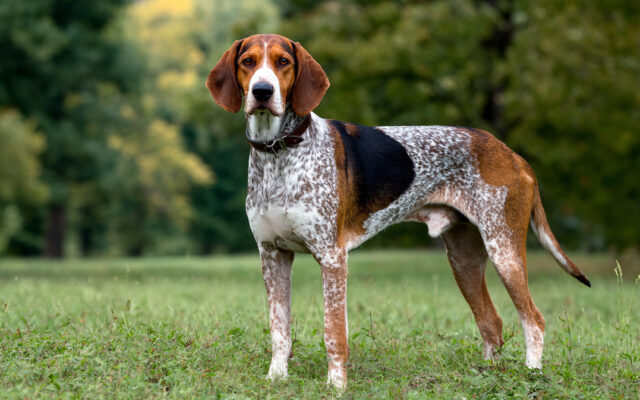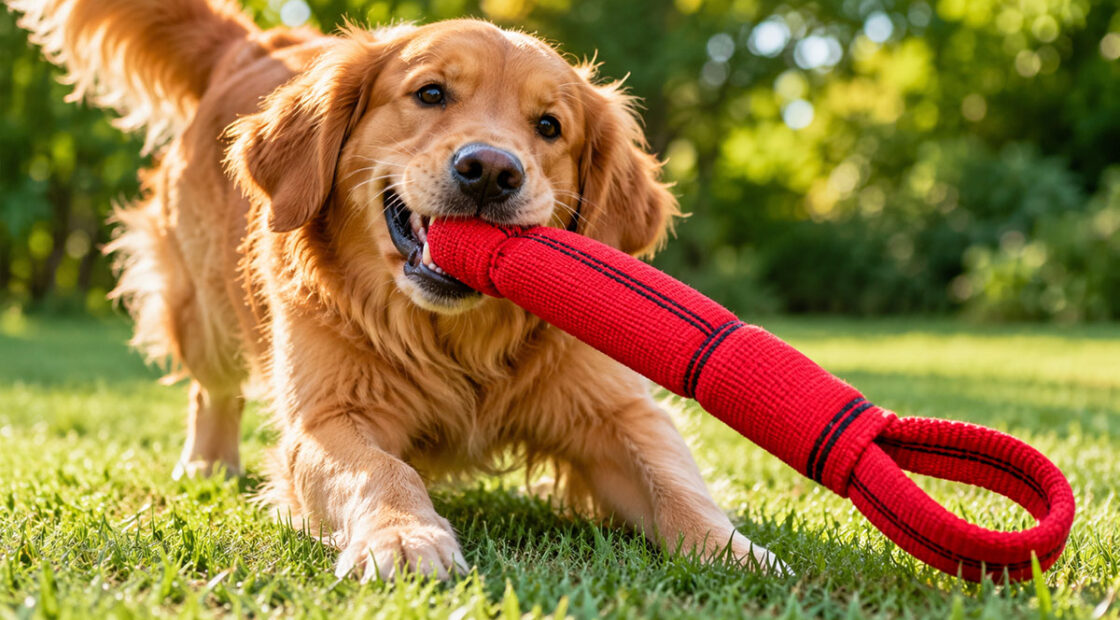
Some dogs go through a plush toy in an afternoon. Fire hose fabric is the fix a handful of firefighter-founded workshops and K9 gear suppliers landed on, and it’s built for exactly that dog: the large or giant breed that treats squeakers and stuffing as a snack.
The material itself is rated for pressure a dog’s jaw will never come close to. NFPA 1961, the National Fire Protection Association’s standard covering fire hose construction, sets the burst threshold above 1,600 psi, or 110 bar (NFPA 1961, current edition 2020).
None of that really speaks to a dog’s chewing power. What it means in practice is that the flat weave of the toy resists tearing far longer than plush does. The seams stitched into it are a different story, and that’s where these toys actually fail.
What Is a Fire Hose Dog Toy?
Firefighters didn’t set out to build a pet product line. The tug and fetch toys came later, made from the same fabric used to move water under pressure: decommissioned hose pulled off a truck, or new webbing woven to match it.
That’s the whole pitch. It’s not a toy meant for a dog left alone with it for six hours, it’s not interchangeable with a rope toy or a rubber one, and the “indestructible” claim on the packaging shouldn’t be taken at face value.
Ray Allen Manufacturing, which supplies gear to K9 trainers, sells its fire hose tugs specifically as a reward tool for working dogs, not as something you toss in a crate and walk away from. That distinction runs through the rest of this guide.
What Is a Fire Hose Dog Toy Made From?
Woven polyester or nylon, doubled up the same way attack hose is built to survive water pressure. Makers stitch the fabric rather than glue it, and most finish the raw edges with mil-spec binding so it doesn’t start fraying in week one.
Recycled Firefighter, for instance, builds its toy line on 1.75-inch diameter polyester fire hose, with a full inch of mil-spec binding stitched around every seam. The specs behind the raw material are stricter than you’d expect for a dog toy: NFPA 1962, the standard covering inspection and service testing of hose already in a truck, requires a minimum service test pressure of 300 psi. NFPA 1961, the separate standard for how new hose gets designed and built, puts burst failure above 1,600 psi, or 110 bar.
Not one of those numbers has anything to do with a dog’s teeth. What they explain is why the fabric itself rarely tears the way a plush seam does after a few sessions.

Decommissioned Fire Hose vs New-Made Fire-Hose-Style Webbing
Decommissioned hose is the real thing: pulled off active duty by a fire department, cleaned up, and never actually exposed to fire despite the name. New-made webbing skips that history and gets woven fresh in the same double-wall pattern, mostly because a manufacturer wants a consistent color and diameter across a whole product line instead of whatever a reclaimed length happens to look like.
Recycled Firefighter actually falls somewhere in between. Its toys come from hose that was factory-fresh but got rejected over small cosmetic flaws or a leak, so technically it was never in service anywhere.
One side effect of using decommissioned hose: no two toys look quite the same. Color and wear marks track back to whatever specific length got pulled that week.
What Types of Fire Hose Dog Toys Are There?
The same fabric gets cut into a handful of different shapes, and which one you end up with says more about how the toy gets used than which brand made it.
| Configuration | Description | Typical Use |
|---|---|---|
| Tug ring | Looped body with a reinforced handle end | Tug-of-war, training reward |
| Fetch stick | Straight-cut length, stuffed or unstuffed | Fetch, water retrieval |
| Plush-filled squeaker | Fire hose shell wrapped around a squeaker core | Interactive play, moderate chewers |
| Frisbee disc | Flat woven disc cut from hose fabric | Outdoor fetch, water play |
Katie’s Bumpers sells its Sqwuggie as a fetch stick with a sewn-in tug loop and a muffled squeaker built into the same piece. Outward Hound takes the opposite approach with its Fire Biterz Lizard, shaping the hose material into a stuffed, squeaky animal instead of a plain stick or ring.
Hands-on buying guides that test multiple fire hose toys side by side tend to land on the same conclusion: configuration matters more than brand for how long any given toy actually lasts.
Why Is Fire Hose Material More Durable Than Standard Dog Toy Fabric?
BARK’s dog toy testing lab has run more than 2.5 million individual chew cycles since it opened in 2022, which works out to roughly 30 days of aggressive chewing per toy. Fire hose held up in that kind of testing, and the reason comes down to how it’s woven rather than any single material in it.
The double wall spreads bite pressure across two layers instead of one, which is the main reason it survives longer than a single-ply plush shell. Stitching is tight and industrial: nothing like the loose threads that shred through plush fabric in minutes. And there’s nothing for a dog to catch and pull loose either, unlike a braided rope toy, where one popped strand can unravel the whole thing.
The flat body of the toy isn’t where these things actually fail, though. It’s the stitched edge. A determined chewer can work a seam loose the same way repeated tugging works a shoelace loose over time. Abrasion resistance and puncture resistance are each doing a different job here, which is part of why two dogs can have wildly different experiences with the identical product off the shelf.
Fire Hose Dog Toy vs Rope, Rubber, and Plush Toys
Survival, feel in the mouth, replacement cost. Every tug and fetch toy on the market is some tradeoff between those, whatever material it’s made from.
| Material | Chew Resistance | Water Use | Typical Price |
|---|---|---|---|
| Fire hose | High for the body, weak at seams | Good, dries fast | $10 to $30 |
| Rope | Moderate, strands fray | Fair, absorbs water | $8 to $20 |
| Rubber | High, resists puncture | Excellent | $10 to $25 |
| Plush | Low, tears easily | Poor | $5 to $15 |
Rubber toys usually win out over fire hose for the truly dedicated power chewer. Makes sense: there’s no stitching anywhere for a determined dog to unravel.
Plush is a different animal entirely. It’s built around comfort and squeaker interaction, not survival, and it shows the first time a dog decides a toy is something to be destroyed rather than played with.
Fire hose sits in between those two extremes. Tougher than plush, gentler on the mouth than rubber, and priced like a mid-range purchase rather than a premium one, it’s the toy you reach for when you want something that survives real play without feeling like a chew block.
Is a Fire Hose Dog Toy Safe for Dogs?
No government agency regulates dog toys the way the Consumer Product Safety Commission regulates children’s toys. That gap in oversight is exactly why the industry ended up building its own reference points instead of waiting on one.
Responsible makers tend to converge on the same handful of choices without being told to: no metal hardware (no rings, clips, or squeaker cases that could crack under pressure), mil-spec binding stitched around every raw edge to slow fraying, and, for the brands that bother testing at all, voluntary checks against ASTM F963, the safety spec written for children’s toys, since nothing dog-toy-specific exists yet.
That’s starting to change. ASTM International’s F15.05 subcommittee, chaired by BARK’s director of safety, held its first meeting on December 6, 2022, to begin work on the first dog-toy-specific safety standard the industry has ever had. As of late 2025, that standard was still in development, past BARK’s earlier goal of publishing it sometime in 2025.
Until it exists, the real risk with a fire hose toy is the same risk attached to almost every dog toy on the market: a piece of it getting swallowed. A peer-reviewed analysis of 72 dogs treated for gastrointestinal foreign bodies found that a child’s toy accounted for 14 percent of the objects removed endoscopically or surgically, with metallic objects, cloth, socks, balls, and plastic material each making up smaller shares. Worth noting: the study didn’t isolate dog toys as their own category, so that figure describes swallowed household and children’s items broadly, not dog toys specifically.
Supervised play beats unsupervised chewing regardless of what a lab test says about the fabric.
Which Dogs Are Fire Hose Dog Toys Best Suited For?
Size and bite habit matter more than breed loyalty here. A moderate chewer, the dog that tugs and fetches but doesn’t sit and gnaw one spot for twenty minutes, is the good match. A dog left alone with the toy for long stretches is the bad one, and that’s exactly the pattern that wears through a seam faster than anything else.
Strong, high-drive dogs that tug hard enough to test a handle do better with shorter sessions under supervision. Gentler tuggers, meanwhile, tend to get a lot more mileage out of the same toy before the stitching finally gives.
Puppies are their own category, and not a good one. Baby teeth are small enough to slip between the fibers of the weave and shred the hose from the inside, which is a completely different failure mode than an adult dog biting through the surface.
When a Fire Hose Dog Toy Does Not Work
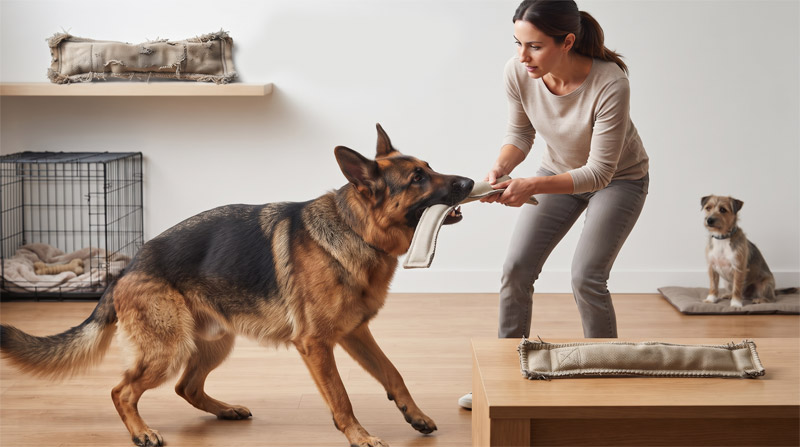
A fire hose toy earns its reputation under fairly specific conditions. Take those away and it fails the same way any other tug toy does. Supervised tug and fetch, moderate chewers, toys rotated out before the stitching wears thin, that’s the version that works. Left overnight with a dedicated chewer, used as a solo crate toy, or kept in rotation long after the binding starts separating, that’s the version that doesn’t.
Breed size raises the stakes more than most owners expect. A large-scale analysis of medical records from nearly 2.4 million dogs seen at Banfield Pet Hospitals found that the rate of gastrointestinal foreign body cases climbs with body size: giant breeds came in highest at 45.9 cases per 10,000 dogs, while toy and small breeds sat lowest at 19 per 10,000. A separate, smaller retrospective study of 208 cases in the Journal of Small Animal Practice (which covered both dogs and cats, not dogs alone) pointed a different direction, finding certain breeds, including Staffordshire bull terriers, English bull terriers, Jack Russell terriers, border collies, and springer spaniels, at significantly higher risk, rather than flagging giant breeds as a class.
That matters here because fire hose toys are marketed almost entirely to large and giant breeds, the exact group the larger Banfield dataset flags as highest risk by size.
If a piece does get swallowed, the bill isn’t small. A CareCredit-sponsored overview of dog intestinal blockage surgery puts basic, uncomplicated blockage removal at roughly $2,000 to $4,000, with more complex surgeries involving resection and extended hospitalization running $4,000 to $8,000 or more.
A torn handle or a frayed seam is the toy telling you it’s done. That’s not a defect to mail back to the manufacturer.
How to Use a Fire Hose Dog Toy for Tug, Fetch, and Training
Playing and training with one start the same way. They just branch off after that.
- Let the dog sniff and mouth the toy once before the first full-strength tug. Stiff fabric can spook a dog that’s used to something softer.
- Keep tug sessions short, thirty seconds to a minute, then release on a verbal cue rather than letting the dog win by force.
- For fetch, throw on grass or in water instead of pavement. The fabric grips looser surfaces better and dries fast once you’re done.
- Swap it in as a training reward between treats, especially for dogs that work harder for play than for food.
- Check the stitched ends after every session, before putting the toy away for next time.
Land, water, snow, it works across all three, which is part of why trainers reach for this material over a tennis ball once the weather turns cold.
Ending the game on your terms rather than the dog’s prevents more damage than any amount of extra stitching ever could.
How to Clean and Maintain a Fire Hose Dog Toy
A 2011 household contamination study by NSF International ranked pet toys among the top 10 germiest items tested, right up there with pet bowls, kitchen sponges, and coffee reservoirs. Fire hose fabric holds onto slobber and dirt the same way any woven textile does, so skipping the wash for months isn’t really an option if you’re using the toy daily.
Machine wash on a normal cycle, skip the fabric softener, and air dry instead of tumble drying on heat, since high heat tends to weaken the stitching over time. Daily-use toys should get washed weekly. Occasional ones, once a month at minimum.
Skip the dishwasher too, and skip the dryer’s heat cycle. Both are fine for a rubber toy. Neither is fine for stitched fabric.
If a toy still smells musty after a wash, it’s probably taken on water inside the weave itself. Treat that as a reason to retire it, not run it through again.
Who Makes Fire Hose Dog Toys and What Do They Cost?
Two pretty different supply chains end up selling more or less the same product.
Small-batch makers usually source from one specific fire department or academy, often with a named founder behind the brand, and price accordingly: generally $10 to $35 a piece depending on size, with each toy looking a little different because the source material varies length to length.
Mass manufacturers skip that variability. They weave fresh to a fixed color and size spec in a factory, sell through big retailers like Chewy alongside dozens of competing toy brands, and turn out units that look identical batch after batch.
Tug And Go makes its repurposed fire hose toys by hand in the USA, built around its founder’s background as a Boston firefighter. Bolder K9 and a few other small makers frame their toys around sourcing hose from local fire departments, leaning into a sustainability story as much as a durability one. Devil Dog Pet Co takes a similar founder-driven approach but builds its identity around the brand itself rather than a fire department partnership.
Recycled Firefighter’s smaller “JR” fetch toy, sized for puppies and small dogs, runs around $9, with larger sizes priced up from there, putting handmade fire hose toys roughly in line with a mid-range rubber toy once size gets factored in.
The price gap between the two supply chains is smaller than the marketing suggests. What actually changes is the story behind the material, not the durability math from earlier in this guide.
FAQ on Fire Hose Dog Toy
Do fire hose dog toys float in water?
Depends on the toy. Unstuffed fire hose fabric is dense enough to sink, but plenty of fire hose toys on the market are built or stuffed specifically to float, and brands commonly market them for water fetch. Check the actual listing rather than assuming either way.
A foam or rubber toy is the safer bet if floating is the main requirement.
Can puppies safely use a fire hose dog toy?
Most makers don’t recommend it while a puppy is still teething. Baby teeth are sharp enough to fray individual threads instead of biting cleanly through the weave.
A dedicated teething chew is the safer pick until the adult teeth finish coming in.
Are fire hose dog toys eco-friendly or sustainable?
Toys built from decommissioned hose divert heavy-duty fabric that would otherwise get scrapped, and that’s the actual sustainability case here, not just a marketing line.
New-made fire-hose-style webbing carries a standard manufacturing footprint like anything else. The eco label really only fits the reclaimed-material toys, not the category as a whole.
How do you know when to retire or replace a fire hose dog toy?
Retire it once the mil-spec binding starts lifting from an edge, threads fray loose at a seam, or a squeaker casing cracks.
Fabric discoloration from washing is just cosmetic, nothing to worry about. A structural gap at any seam is the real signal to stop.
Which firefighters or brands started making fire hose dog toys, and why?
The category grew out of K9 training gear and firefighter side projects rather than one company deciding to launch it. Working firefighters and hobbyists started repurposing surplus or factory-reject hose because it simply outlasted whatever tug toy they’d bought at the store.
Ray Allen Manufacturing later built a dedicated fire hose tug line specifically for professional dog trainers.
What Should You Check Before Buying a Fire Hose Dog Toy?
A fire hose toy is worth buying when the dog fetches and tugs under supervision instead of chewing alone, when someone actually inspects the stitching before each session, and when the size matches the dog rather than the marketing claim of being indestructible.
Match the hose diameter to jaw size first. A mismatch strains gums before the fabric even starts to wear. Check the stitched edge next, since that’s genuinely where failure begins. Save the play mode decision for last: tug for a confident dog, fetch for a cautious one.
Going for the thickest, toughest weight of hose trades easy grip for maximum abrasion resistance, and that tradeoff benefits large and giant breeds far more than it benefits a toy or small dog. Owners of genuinely powerful chewers should be looking for gear sized and rated specifically for large, powerful breeds, not a toy that just happens to be marketed as tough.