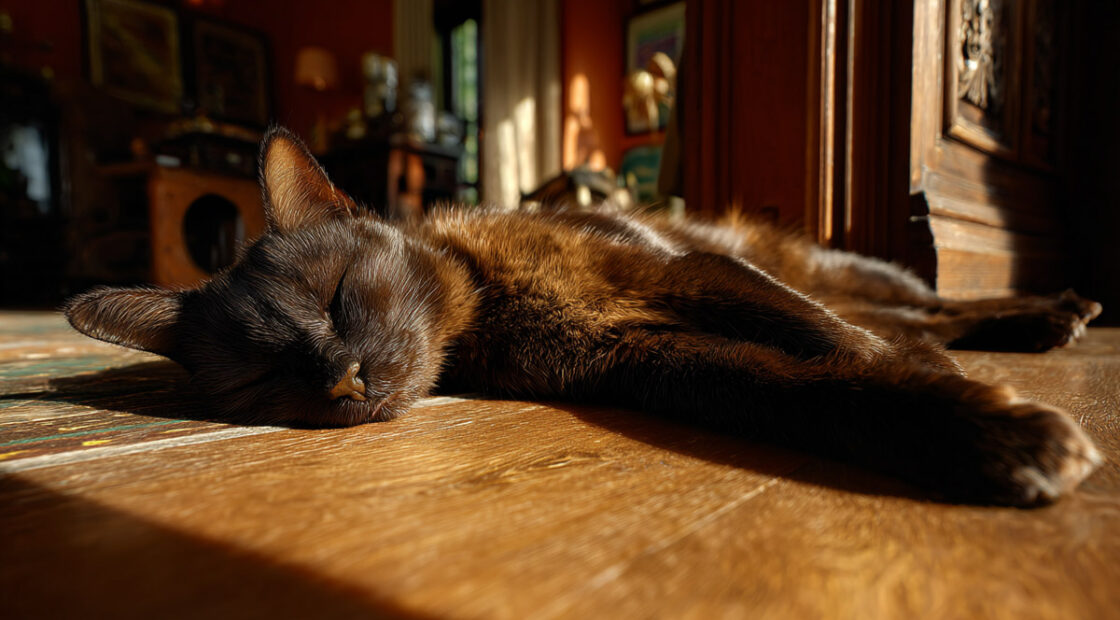
Every Havana Brown in the United States traces back to one cat, Quinn’s Brown Satin of Sidlo, whose parents were both imported from England in the mid-1950s (CFA breed articles, 1991 and 1998). English breeders had built the breed a few years earlier from Siamese and black domestic shorthair crosses. What came out was a solid, warm brown cat with brown whiskers and green eyes.
A founding base that small left a thin gene pool. CFA now offsets it with limited outcrosses to Oriental Shorthairs and Siamese, plus some domestic shorthairs.
What Is a Havana Brown?
Domestic shorthair is the category, but the standard asks for far more than a brown cat. The coat has to be solid, warm brown. Whiskers are brown too, and the eyes are green.
Breeders in England built it in the 1950s by crossing Siamese cats with black domestic shorthairs. CFA and TICA both recognize it, just under different names.
The Havana (TICA and WCF) and the Chestnut Brown Foreign (the original GCCF name) are the main alternatives, and you’ll also see Chestnut Brown Oriental. Breeders usually just say Brownie.
The name doesn’t mean Cuban. The breed comes from England, and “Havana” refers to a color.
It isn’t a Suffolk either, because the Suffolk Chocolate is a separate UK breed with its own standard. And plenty of brown cats don’t qualify. A cat has to meet the written standard, brown whiskers and green eyes included.
Havana Brown Appearance and Breed Standard

CFA’s standard calls for a medium-sized, muscular cat and says outright that it is comparable to no other breed. The head is longer than it is wide, and the coat is an even warm brown.
Coat, Eyes and Whiskers
The coat is short to medium, smooth and lustrous, with no visible undercoat. Any even shade of rich, warm brown (chocolate, bb) is accepted, the same shade down the hair shaft, with no preference for lighter or darker.
Eyes are oval, medium-sized and wide-set, in any vivid, level shade of green (the deeper the better). Whiskers are brown, the nose leather is brown with a rosy flush, and the paw pads are rosy.
Kittens and young adults can show ghost tabby markings, and the standard allows for them. The markings fade as the cat matures.
Whisker color gets unusual treatment. A 1991 CFA breed article calls the Havana Brown the only breed whose standard names a whisker color, and the wrong whisker, nose leather, paw pad or eye color is a disqualification.
Head, Body and Size

The head carries 33 of 100 points on the CFA scale, more than coat color and eyes combined (32), according to the 2025 show standard.
Judges look for a muzzle that narrows to a rounded end with a pronounced break behind the whisker pads, and a distinct stop at the eyes in profile. Breeders describe the shape as “a corncob stuck into an orange.”
Ears are large, round-tipped, wide-set and tilted forward. The body is medium in length, firm and muscular, somewhere between thick-set and svelte. Legs are straight and fairly high with oval, compact paws, and the tail is medium, slender and tapering.
A kinked tail, a locket or button, or the wrong toe count (five in front, four behind) will disqualify a cat.
The standard sets no weight and puts balance ahead of size. Wisdom Panel’s breed profile lists 6 to 10 pounds, and CFA notes that adult males run larger than females.
English Type vs American Type
The English and North American cats no longer look alike.
| Feature | North American type | English type |
|---|---|---|
| Head | Longer than wide, rounded muzzle with whisker break | Long wedge, like a chestnut Oriental Shorthair |
| Profile | Distinct stop at the eyes | Straight nose |
| Build | Moderate, between thick-set and svelte | Oriental, Siamese-influenced |
English breeders kept crossing back to Siamese stock, so the original look faded there, according to CFA’s 1998 breed article. North American breeders preserved the foundation type.
If you’re buying, ask which registry’s standard the breeder shows under. It tells you which of the two types the kitten is likely to resemble.
History of the Havana Brown and the Origin of Its Name

By the early 1950s solid brown cats of Siamese type had dropped out of the English show hall, and a small group of fanciers set out to bring them back.
Self-brown cats of Siamese type had been shown in Europe in the 1890s, one name for them being “Swiss Mountain Cat.” Around 1920 the Siamese Cat Club of Britain declared it would encourage only blue-eyed Siamese, and brown cats lost their class (CFA).
The post-war work came from the Laurentide, Elmtower, Roofspringer, Praha and Crossways catteries. They kept detailed breeding records and studied whatever genetics was available at the time.
Elmtower Bronze Idol came from an accidental mating of a black shorthair, Elmtower Susannah, and a seal point Siamese, Elmtower Tombee. CFA’s breed histories name him the first Havana Brown registered in England. Praha Gypka followed a year later, from a planned cross of a black shorthair and a chocolate point Siamese.
Popular profiles describe the founding as a planned Siamese and black cross. The CFA accounts put an accident first.
Some early crosses reportedly involved a Russian Blue. Pedigree research behind CFA’s 1982 Yearbook article found almost none in the breed’s early parentage.
Elsie Quinn imported the first Havana Brown to North America in the mid-1950s, a female named Roofspringer Mahogany Quinn. CFA accepted the breed for registration in 1959 and granted championship status in 1964.
The GCCF accepted the breed in 1958 as Chestnut Brown Foreign, and a rename followed. Sources disagree on when. Cats.com says 1959, and Petfinder gives 1959 for CFA registration under the Havana Brown name. Wisdom Panel (for the GCCF rename) and Mental Floss say 1970. The gap fits two registries renaming in different years, though neither source says so outright.
The name points to either Havana cigars or the Havana rabbit, since both share the coat color. Nothing documented settles it, and CFA’s 1991 article says most devotees favor the tobacco story.
How Does the Havana Brown Inherit Its Brown Coat?
It’s recessive. A cat shows chocolate only when it carries no B allele at the B locus, which sits in the TYRP1 gene, so it needs two copies of b or one b paired with bl. Both parents must therefore pass on a non-black allele.
Two research teams identified the gene in 2005 (Lyons and colleagues in Mammalian Genome, Schmidt-Kuntzel and colleagues in the Journal of Heredity). The B locus has three known alleles, listed here in order of dominance. B is wild-type black and dominates the other two. Next comes b, chocolate, caused by a splice-site change in TYRP1, and last is bl, cinnamon, caused by a premature stop in TYRP1.
Black is dominant, so a black cat can carry chocolate unseen. That hidden carrying is what made the founding crosses work.
CFA’s breed histories describe the method this way. A black shorthair is crossed with a chocolate-carrying Siamese, and the kittens usually come out black while carrying one b. A black carrier is then bred back to the Siamese parent. Laurentide Areeto Pearl did exactly this, and her litters produced Havana Browns (CFA, 1991). Once brown is bred to brown, no B is left in either parent and every kitten is chocolate.
Bronze Idol was chocolate, so both of his parents carried b. CFA’s pedigrees show a shared source, since each had the seal point Siamese queen Tsiu Chow as dam.
TICA also accepts lilac, the dilute form of chocolate. The current CFA outcross rules exclude cinnamon, fawn, silver and bicolor Orientals and allow only seal point or chocolate point Siamese.
DNA tests for the TYRP1 variants identify carriers. Genetic testing of breeding cats has become central to CFA’s outcross program.
Which Registries Recognize the Havana Brown?
It depends on the name. CFA recognizes the breed as the Havana Brown, TICA and WCF list it as the Havana, and the GCCF recognizes the related Suffolk instead, according to the World Cat Congress breed comparisons.
| Registry | Name used | Status |
|---|---|---|
| CFA | Havana Brown | Full recognition, brown only |
| TICA | Havana | Full recognition, chocolate and lilac |
| WCF | Havana | Accepted |
| GCCF | Suffolk | Full for Suffolk, none for Havana Brown (the GCCF uses “Havana” for a chocolate Oriental Shorthair) |
The outcross rules matter more than the names. In CFA they changed over three decades.
- 1974: CFA closes the breed to outcrosses (CFA breed article, 1998)
- 1990s: breeders report a sharp drop in gene pool diversity, and geneticist Leslie Lyons has a proposal to evaluate the breed’s health accepted by the Winn Feline Foundation
- 1998: the CFA board approves an outcross program, and a 1999 amendment adds chocolate and seal point Siamese (World Cat Congress)
The dates vary by source. CFA’s current breed page, as of October 2026, says a regulated program was put in place in 2019, and Petfinder reports a 1997 vote.
Under the current rules, certain Oriental Shorthair colors, chocolate and seal point Siamese, and unregistered black or blue domestic shorthairs are allowable outcrosses (CFA).
Kittens from those matings are registered as F1, not as Havana Browns. An F1 bred to a Havana Brown produces a litter whose brown kittens register as Havana Browns if they meet the color standard (the World Cat Congress calls them F2), and one parent must always be a full Havana Brown.
TICA lists no allowable outcrosses for the Havana. A CFA pedigree can therefore show outcross generations, and a TICA pedigree should not.
The Suffolk Chocolate is a separate case. The GCCF recognized it in 2014 (Your Cat), CFA, TICA, ACFA and LOOF do not treat it as the same breed, and the World Cat Congress lists CFA or TICA Havana Browns as allowable outcrosses for it.
Havana Brown Temperament and Daily Behavior

Curious and people-oriented, with moderate energy. CFA’s breed profile sums it up in two words, busy and affectionate.
One CFA breed article calls them “the puppies of the cat fancy.” They follow people from room to room and keep playing tag well into adulthood.
They’re smart without being pushy. A Havana Brown tends to wait and watch until a cupboard opens instead of breaking in (CFA). They touch people and new objects with a paw before using the nose, and they like fetch and anything that earns praise.
Chewing is the annoying part. Expect bite marks in paper and cardboard, so documents don’t belong on low tables.
Individual cats vary. CFA notes that some lean shy and attach to one family member, while others want to be everybody’s best friend.
The breed suits homes where someone is around most of the day. It also does well in multi-pet households, and CFA says they pile up to sleep with another cat or even a dog. Children are fine if they play gently, since Catster warns that rough handling can injure a medium-sized cat.
Long stretches alone are a poor fit, because a 1991 CFA article calls human company a necessity for the breed. Anyone who wants a cat that ignores them should look elsewhere. CFA says it can make sense to get two Havana Browns instead of one.
Havana Brown Lifespan, Health and Care
Breed profiles give a Havana Brown lifespan of 8 to 15 years. No breed-specific disease is documented, though the genetic data shows a narrow gene pool, so weight control matters as much as anything.
Lifespan

The range depends on which profile you read. Hill’s Pet says 8 to 13 years, Catster says 10 to 15, and Wisdom Panel says 12 to 15. None of them cites a Havana Brown-specific study.
The Royal Veterinary College’s VetCompass life tables (Journal of Feline Medicine and Surgery, 2024) put overall UK cat life expectancy at birth at 11.74 years, with the Burmese highest of the breeds analyzed at 14.42 (the Birman was a close second at 14.39).
The two sets of numbers measure different things, so the top of the profile range is a best case for a well-kept cat, not an expectation. The same study linked purebred status, and a body weight that was too light or too heavy, to shorter life expectancy.
Health Risks and Genetic Diversity
A 2008 Genomics study of 22 breeds (Lipinski and colleagues, with Leslie Lyons’s lab at UC Davis) measured observed heterozygosity of 0.41 in 11 Havana Browns. The average was 0.51 for purebred cats and 0.65 for random-bred cats.
The Havana Brown landed among the four lowest breeds, alongside the Burmese, Singapura and Sokoke. Eleven cats is a small sample, so read the figure as a direction, not a breed-wide measurement.
Catster, Embrace Pet Insurance and PetMD all report no conditions tied to the breed. An Australian insurer-backed profile (Guild Insurance’s VetsChoice) does list hypertrophic cardiomyopathy and calcium oxalate stones for the Havana, without citing a study.
Both can hold at once. A narrow gene pool raises the odds of inherited problems in general, and none of the profiles reviewed cite a screening study that ties a specific disorder to the breed.
Grooming and Feeding

CFA recommends a daily pass with a soft boar-bristle brush. Two or three times a month, a full-body rubdown with a soft rubber brush, finished with a chamois or silk scarf, brings up the shine. One longtime CFA breeder describes a weekly nail trim and ear wipe as her routine.
Cats.com says a brush once or twice a week is enough, so the daily brushing is optional for a pet. Bathing is rarely needed outside the show ring.
Start tooth brushing in kittenhood with a cat-safe toothpaste, as PetMD advises.
The breed has no special dietary needs, and PetMD suggests a food that meets AAFCO nutritional recommendations for the cat’s life stage.
Speed is the problem. A 1998 CFA article says Havana Browns finish their own food in seconds and go after other cats’ bowls, so multi-cat homes need separate feeding.
Havana Brown vs Oriental Shorthair and Burmese

Choose the Havana Brown for the rounded muzzle and brown-only standard. A chestnut Oriental Shorthair gets you the same color in a sleeker, wedge-headed cat, and a Burmese suits anyone who wants a stockier one with gold eyes.
| Feature | Havana Brown | Oriental Shorthair | Burmese |
|---|---|---|---|
| Head | Longer than wide, rounded muzzle with whisker break | Long tapering wedge, no break at the whiskers | Round, with a short, broad muzzle |
| Eyes | Green, oval | Almond-shaped | Large, round, yellow to gold |
| Coat colors | Brown only in CFA | Every color except colorpoint | Sable and several dilute colors |
| Foundation | Siamese x black shorthair, England | Siamese without the colorpoint gene | Wong Mau, imported to San Francisco in 1930 |
| Prevalence | Rare | Rare | Common |
Head and eye rows follow the CFA standards, the color row follows FIFe for the Oriental, and prevalence comes from Hill’s Pet breed profiles.
The Burmese is the other brown cat that gets mistaken for a Havana Brown, though the two differ in head, eyes and genes.
The browns come from different genes. A sable Burmese is genetically black, softened to brown by the Burmese allele of the albino locus (TYR), while a Havana Brown is chocolate (bb) at the TYRP1 locus (Schmidt-Kuntzel et al., Journal of Heredity, 2005).
The 2008 Genomics study found Havana Browns and Siamese were not genetically differentiated, while the Burmese grouped with the Singapura.
The Havana Brown makes sense if the written head and brown whiskers matter to you, and you should expect a wait. The Oriental Shorthair in chestnut is the better pick when color is the goal, and CFA already allows certain Oriental colors as Havana Brown outcrosses, so it’s the closest relative. A Burmese is rounder and stockier, and it topped the 2024 VetCompass ranking if longevity data counts for you.
If brown is the only requirement, a chestnut Oriental Shorthair meets it. The Havana Brown earns its wait only when the head matters.
How Rare Is the Havana Brown, and What Does a Kitten Cost?

Among the rarest breeds in the cat fancy. Supply stays thin, and kitten prices sit above those of common breeds.
CFA registered 36 Havana Browns in 1997, the smallest number of any breed (CFA breed article, 1998). The same article estimated fewer than 130 unaltered Havana Browns alive in the late 1990s. PetMD puts a kitten from a breeder at $500 to $1,500.
The registration counts are dated, and no current CFA count turned up. CFA’s own breed page warns that a breeder may not be reachable at a show near you and points buyers to its Find-A-Breeder site.
CFA’s 1998 article blames the thin supply on too few breeding lines. New breeders gave up because unrelated breeding stock was so hard to find.
The outcross route adds time. A first-generation (F1) cat has to be bred back to a full Havana Brown before any kitten registers as one, so every outcross litter takes two breedings.
The 2019 date on CFA’s breed page matches its registration rules, revised February 2019, which list the current outcross program as effective that month. The sources do not say which details changed after the original approval.
Other price guides quote higher ranges but do not point to breeder price lists. Price moves with pedigree and show quality, and with whether the kitten is altered, vaccinated and registered (some CFA-listed catteries sell kittens already altered and vaccinated). Deposit and shipping terms matter too.
Vetstreet suggests asking breeders about retired show or breeding cats if a kitten is out of reach.
Havana Brown FAQ
Do Havana Browns shed?
Lightly. CFA says the short, silky coat is not prone to heavy shedding, and PetMD says Havana cats shed very little.
Regular brushing removes loose hair before it reaches the furniture.
Are Havana Browns hypoallergenic?
No. Hill’s Pet lists the breed as not less allergenic, and a short coat does not change that.
Anyone with cat allergies should spend time with the breed before committing.
How vocal is a Havana Brown?

Moderately. CFA describes gently assertive voices, and Cats.com calls the breed fairly quiet despite its Siamese founders.
Zoetis still lists vocal among its top traits, so individual cats differ.
Which is better, a male or female Havana Brown?
Personality varies more by individual than by sex. CFA says breeders typically recommend a female rather than a male when a household keeps only one cat.
Can a Havana Brown be adopted from a shelter or rescue?
Rarely. Shelters seldom receive purebred Havana Browns, and cats listed under the name are usually brown mixes.
A breed rescue or breeder referral is the likelier route, and CFA’s Find-A-Breeder site is the place to start.
How to Reserve a Havana Brown Kitten
Read the pedigree first, get the health terms in writing, and only then pay the deposit. Each of those screens out a breeder before any money changes hands.
Vetstreet warns against breeders who always have kittens available or keep several litters on the premises. Payment by online credit card is another red flag.
CFA’s program aims at greater diversity, so a kitten with an F2 outcross ancestor starts from a wider genetic base than a line bred without outcrosses.
The trade-off is type. Hill’s Pet warns of subtle but important changes in personality, habits and appearance with outcross ancestry.
This advice reflects CFA’s outcross rules as of October 2026. A revised program or a published breed-wide health screen would change it.