Walk through Chewy’s seasonal aisle or scroll Amazon’s holiday pet section anytime after October, and yeti-shaped squeaky toys show up everywhere. Underneath the shaggy white fur, though, it’s the same plush or rubber build every other animal-shaped chew toy uses.
Same stitching approach, same squeaker placement, same durability tradeoffs that show up on a giraffe toy or a raccoon toy. The yeti shape is basically a costume stapled onto hardware that’s been around for decades.
Toys and toy parts aren’t a small slice of what dogs end up swallowing, either. Pumpkin Pet Insurance’s claims data from 2020 to 2025 puts toys or toy parts at 20% of all foreign body ingestion claims recorded across dogs and cats, second only to food and candy.
What Is a Yeti Dog Toy?
Strip away the fur and the seasonal branding and you’re looking at a plush or rubber toy built the same way as any other novelty shape. A squeaker sewn or molded in, stitching along the seams, the same construction choices that show up on a giraffe or a raccoon toy just as often. The yeti part is entirely cosmetic: a shaggy, white, snow-creature silhouette that retailers lean into hard once October rolls around.
Calling it “just another plush shape” undersells the seasonal machine behind it a little, though. Retailers plan inventory specifically around the winter window, roughly late October through January, in a way they don’t for something like a farm-animal toy line that sells steady all year.
It’s also worth saying plainly what a yeti dog toy isn’t. Nobody’s buying one to sit on a shelf and look nice. It shows up outside the holiday window too, just in smaller numbers than during peak season. And durability is all over the map here, since a plush version and a rubber version fail in completely different ways, which is really the subject of the next section.
Frisco’s own take on the category, a three-pack called Holiday Friendly Yetis, sums it up well. Three toys, three different squeaks, ranging from a high-pitched squeal to a low, grunt-like sound. It’s a seasonal spin on an old, pretty ordinary squeaky toy design. Nothing more complicated than that.
What Are Yeti Dog Toys Made From?
Two build types run this category, plush and rubber, and they don’t hold up anything alike once a dog actually gets teeth into one.
Plush and Fabric Versions
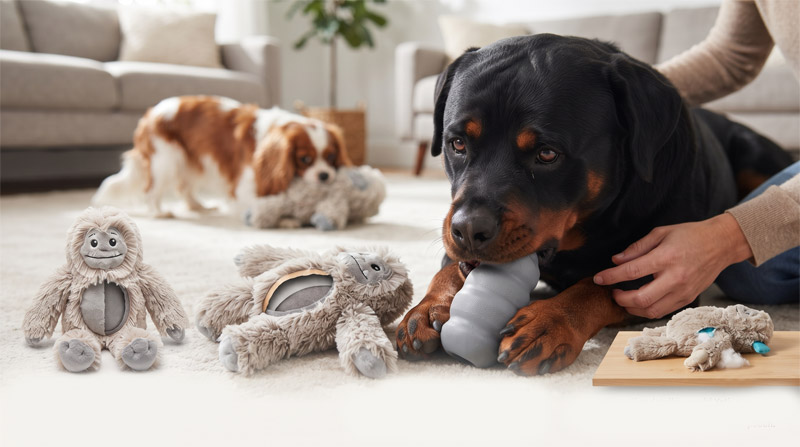

Plush and fabric builds tend to lean on the same handful of materials, though brands mix them in different ratios.
- Polyester plush exterior, usually the long-pile shaggy kind built to mimic fur
- Cordura or mesh fabric reinforcement at stress points
- Minimal or no stuffing in some of the higher-end versions
- An internal squeaker, typically sewn into its own fabric pouch
Tall Tails builds its yeti squeaker toy this way, with the squeaker stitched into a separate pouch and sewn right into the seam instead of left floating loose in the stuffing.
P.L.A.Y.’s Bettie the Yeti goes further on the materials side, using recycled polyester fill made from post-consumer plastic bottles, plus double-stitched, double-layer seams. That recycled-fill approach isn’t unique to yeti toys, by the way. It’s showing up across plush pet toys generally as manufacturers move away from virgin polyester fill.
Rubber and Chew-Focused Versions
Rubber and thermoplastic rubber (TPR) yeti toys exist too, though they make up a smaller slice of the category than plush does.
Food grade rubber and natural rubber chews built into a yeti or snow-creature shape are marketed toward light to moderate chewers, not the power chewers going after a KONG-level rubber toy.
- Rubber builds skip the squeaker-in-fabric setup entirely, often using a hollow cavity instead
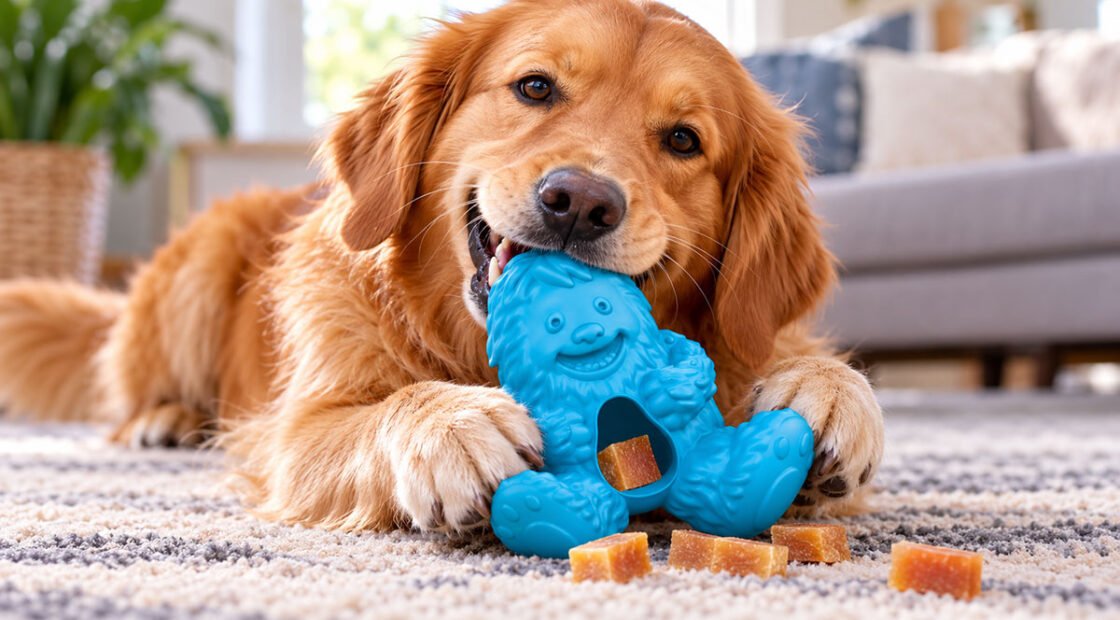
- Some, like puff-and-play style yeti chews, are built to hold a treat insert rather than function as a pure chew toy
- None of the rubber versions in this shape claim to match the toughness of a dedicated rubber chew brand
How Durable Are Yeti Dog Toys?
| Brand or Type | Material | Durability Rating | Best For |
|---|---|---|---|
| Tuffy (VIP Products) | Multi-layer plush, luggage-grade fabric | 7 to 9 out of 10 (Tuff Scale), depending on the specific toy | Tuggers, moderate to strong chewers |
| Frisco (Chewy house brand) | Standard plush | Not rated for heavy chewers | Snugglers, light chewers |
| West Paw / KONG-style rubber | Natural rubber, TPR | High, brand-dependent | Power chewers, unsupervised chew time |
| Standard novelty plush (fabdog, Multipet) | Polyester plush | Low to moderate | Cuddling, gentle fetch |
Tuffy’s own Tuff Scale rates toys from 1 to 10. The brand states plainly that the higher the number, the tougher the toy, which is about as straightforward as durability marketing gets.
Their heavier plush pieces, built with up to four layers of material and up to seven rows of stitching, typically land in the 7 to 9 range on that scale. A small number of designs reach a 10.
Frisco goes the other direction with its labeling. The Holiday Friendly Yetis listing says the toy isn’t meant for heavy chewers and that no toy, full stop, is truly indestructible.
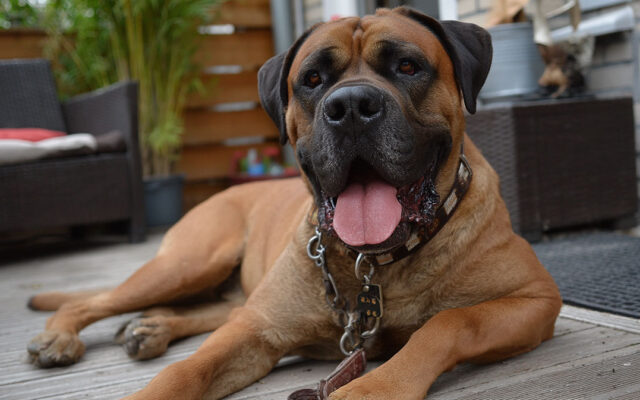
That gap matters more for some households than others. Owners of large, powerful-jawed guarding breeds tend to shop this category differently, and it’s worth checking what actually holds up in Bullmastiff toys and accessories before assuming a standard plush yeti will survive the week.
Rubber-bodied yeti and snow-creature chews sit at the other end of the spectrum, closer to what a dedicated chew-toy brand offers. Even those aren’t sold as truly indestructible, though. Nobody’s is.
What Safety Risks Do Yeti Dog Toys Carry?
Insurance claims data gives a fairly clear picture of where the real risk sits. Trupanion’s 2024 figures show that 7% of its insured dogs have filed a foreign body ingestion claim at some point, and those claims aren’t cheap: the average runs $878, with the single highest recorded claim reaching $27,403. Pumpkin Pet Insurance’s separate dataset, covering 2020 through 2025, puts toys and toy parts at 20% of all foreign body ingestion claims across dogs and cats. Age matters a lot here too. Pets under a year old file 322% more of these claims than adult and senior pets, according to that same 2024 Trupanion data.
The squeaker is usually what causes the worry, and for good reason. Once a dog tears through the fabric pouch it’s sewn into, it turns into a small, hard object that’s easy to swallow and hard to pass.
Frisco’s own product warning tells owners to supervise pets during play, since small parts can cause choking or a blockage, and to stop use the moment the toy starts showing damage.
A few signs mean it’s time to retire the toy, not just wash it.
- Exposed stuffing or a visible tear near a seam
- A squeaker that’s come loose from its pouch
- Chunks missing from a rubber chew version
That age-risk number above isn’t random. Puppies, especially ones actively teething, destroy plush toys faster than adult dogs do, and they’re the group least equipped to pass a swallowed object safely.
What Size Yeti Dog Toy Fits Your Dog?
Size mismatches cause more problems than most owners expect, and they go both directions.
Small breeds do best with something under 10 inches, a smaller squeaker, and lighter fabric that doesn’t outweigh the dog dragging it around the house. Most yeti toys on the market are actually built for the middle of the range, the 10 to 14 inch zone that fits a medium-sized dog’s mouth. Go bigger than that and you’re in reinforced-seam territory, 14 inches and up, thicker construction, sometimes rubber instead of plush entirely.
Multipet’s Yeti Betty runs 10 inches, which tracks with a small to medium dog. Tall Tails’ version runs 14 inches and is marketed specifically for medium and large dogs who like to cuddle.
Sizing up is the riskier mistake more often than people assume. A squeaker built to survive a large dog’s bite force is still just a small, hard object once it’s loose, and in the mouth of something like a Chihuahua it’s proportionally much easier to work free and swallow.
Going too small has its own failure mode. Undersized toys for giant breeds tend to blow out at the seams almost immediately, and a toy scaled for a small dog stands no chance against a Great Dane.
How Much Do Yeti Dog Toys Cost?
Dog owners spent an average of $47 a year on toys, according to the American Pet Products Association’s 2015 to 2016 National Pet Owners Survey. That figure is dated, sure, but it’s still the most commonly cited baseline for toy-specific spending, since APPA’s more recent surveys tend to report total pet spending rather than break out toys separately.
A single yeti toy eats up a meaningful chunk of that budget if it’s on the premium end.
| Toy Type | Typical Price Range | What Drives the Price |
|---|---|---|
| Standard plush (Multipet, fabdog) | $8 to $18 | Single-layer construction, basic squeaker |
| Premium plush (P.L.A.Y., Frisco) | $15 to $25 | Recycled fill, multi-squeaker design, seasonal packaging |
| Heavy-duty plush (Tuffy) | $25 to $35 | Multi-layer fabric, reinforced webbing, higher Tuff Scale rating |
One Tuffy plush toy, for reference, lists at $28.99 through Walmart’s marketplace, which lands right in that heavy-duty bracket.
None of this is a huge expense on its own. It looks even smaller once you set it next to what owning a dog actually costs over a lifetime, once food, grooming, and vet visits are all stacked up.
Where Can You Buy Yeti Dog Toys?
Availability isn’t really the problem with this category. It’s more a matter of which retailer carries the specific brand or durability level you’re after.
Chewy stocks Frisco’s own line alongside fabdog and SNUGAROOZ versions. Amazon carries Multipet, P.L.A.Y., and a long tail of smaller independent sellers listing their own takes. Petco and PetSmart mostly stock the mainstream plush brands, and mainly during the holiday season.
Subscription boxes add another path into the category. BARK’s box has shipped a Sasquatch-themed plush with crinkle material and whip-style arms, which fits the same snow-monster niche even without using the word yeti anywhere on the packaging.
Seasonal stock is worth flagging on its own. Retailers push yeti and other winter-themed toys hardest from late October through January, and selection thins out considerably the rest of the year.
Best Yeti Dog Toys for Aggressive Chewers
Plush and rubber yeti toys aren’t interchangeable once a strong chewer is involved, and pretending otherwise is how you end up buying the same toy twice in one month.
Plush wins on comfort. Softer on gums, easier to cuddle and carry around, and there’s more variety in squeaker sounds and character design if that matters to your dog (or, honestly, to you). The tradeoff shows up eventually no matter how reinforced the seams are. Sustained chewing wins in the end, and once the fabric tears, the stuffing and squeaker both become swallowing risks.
Rubber trades character for longevity. It holds up far longer under repeated biting, most versions are dishwasher safe, and there’s no squeaker pouch to fail in the first place. What you lose is the range of designs. Most rubber yeti chews look more like a generic chew shape than an actual yeti, and the harder material can be rough on dogs with dental issues or a gentler bite.
West Paw says it tracks return rates on its Zogoflex line and sees less than 1% of toys come back for a damage-related replacement or refund. That’s the kind of number that separates an actual track record from a marketing claim.
A few brands split the difference. goDog’s plush line uses what it calls Chew Guard Technology, an internal liner meant to slow down tearing without going full rubber.
Breed matters more here than most owners expect going in. A Rottweiler and a lapdog have almost nothing in common when it comes to bite force, so the “best” toy really just depends on which dog is doing the chewing.
How to Choose the Right Yeti Dog Toy
Skipping steps here is exactly how owners end up back at the store within a week.
- Assess your dog’s chewing style first, not the toy’s appearance
- Match size to breed weight, sizing up rather than down if you’re unsure
- Pick material based on that assessment: plush for light chewers and cuddlers, rubber or reinforced plush for anything stronger
- Set a budget range and expect to pay more for a higher durability rating
- Check retailer return policies before buying, since sizing and durability guesses don’t always land right the first time
Skip step one and everything after it falls apart. Buying based on the cute yeti face instead of your dog’s actual chew strength is the single most common mistake in this category, and it’s an easy one to make.
Comfort-seeking is a real, measurable factor too. APPA data shows 72% of dog-owning Millennials already use some type of calming product for their pets, and calming toys are the single most popular type of calming product among dog owners overall, ahead of treats, supplements, sprays, and wraps.
Fluff & Tuff’s plush line is a decent reference point for what “built well” actually looks like on the shelf: double-stitched reinforced seams and a double mesh interior lining, according to independent editorial testing.
If your dog leans toward novelty shapes generally rather than the yeti specifically, the same sizing and material logic carries straight over to something like raccoon dog toys or any other animal-shaped plush.
How to Clean and Maintain a Yeti Dog Toy
Pet toys aren’t a minor cleaning afterthought. A 2011 NSF International household germ study ranked pet toys among the top 10 germiest items found in an average home, right alongside kitchen sponges, sinks, and coffee reservoirs.
| Toy Type | Cleaning Method | Frequency |
|---|---|---|
| Plush, machine washable | Cold water, gentle cycle, air dry | Weekly with regular use |
| Plush, spot clean only | Damp cloth, mild soap, air dry | Weekly, more if visibly dirty |
| Rubber and TPR | Dish soap and hot water, or top-rack dishwasher | Every few days for chew-heavy use |
General pet hygiene guidance from outdoor gear brands and veterinary sources commonly recommends washing soft toys on a warm cycle at least once a week to keep bacteria in check.
Cleaning only goes so far, though. Some conditions mean a toy needs to go straight in the trash instead of back in the toy bin.
- A squeaker that’s come loose or is sitting outside its fabric pouch
- Any tear big enough to expose stuffing
- A rubber toy with a chunk bitten off, no matter how minor it looks
When a Yeti Dog Toy Is Not the Right Choice
A yeti dog toy isn’t the right pick for every dog, and pretending otherwise is how vet bills happen.
A few situations mean this category of toy just isn’t worth the risk. Dogs with a documented history of swallowing foreign objects, no matter what durability rating the toy carries. Unsupervised access, even to a toy with a high Tuff Scale rating or a manufacturer guarantee behind it. Teething puppies, who tend to destroy plush faster than anyone can realistically monitor. And dogs that specifically target and destuff squeakers rather than just enjoying the sound.
Cost backs this up. Surgery to remove a swallowed foreign object from a dog typically runs anywhere from around $1,600 to more than $12,000, depending on severity and location, according to claims data published by Embrace Pet Insurance. Non-surgical cases (inducing vomiting, monitoring, imaging) run roughly $300 to $1,200. Either way, it’s an expense worth avoiding through prevention rather than treatment after the fact.
There’s also no regulatory floor protecting owners here. The FDA’s Center for Veterinary Medicine has said plainly that neither it nor any other government or non-government body regulates pet accessories like toys, beds, and crates, according to its own statements as reported by Preventive Vet.
That absence of oversight puts the judgment call entirely on the owner, not the packaging.
For dogs that consistently destroy and swallow fabric, plenty of owners just switch away from plush entirely and look into whether antlers are safe for dogs as a longer-lasting, non-fabric alternative.
None of this makes a yeti toy a bad purchase, to be clear. It just means the toy has to match the dog you actually have, not the dog you wish you had.
FAQ on Yeti Dog Toys
Is a yeti dog toy different from a regular plush dog toy?
Construction-wise, not really. A yeti dog toy uses the same squeaker, stuffing, and stitching as any other plush toy on the shelf. The shaggy, snow-creature shape and the holiday-adjacent theme are cosmetic choices, not a different durability standard or material category.
How do you check if a dog toy has been recalled?
No single agency regulates pet toys directly, which surprises a lot of owners the first time they hear it. The Consumer Product Safety Commission publishes general recall notices for consumer products, toys included. Checking a specific brand’s own site or a retailer’s product alerts page usually catches safety notices before a toy ever reaches your cart.
Which size is right for puppies versus adult dogs?
Puppies do better with a smaller, softer build sized for a developing bite, since a full-size squeaker is a real choking risk on smaller jaws. Adult dogs can usually handle the standard medium to large sizing most yeti toys ship in by default.
Are yeti dog toys good holiday gifts?
Yes, within reason. They fit stockings and gift exchanges well, especially the multi-pack sets with varied squeaker sounds. Skip them as the sole gift for a known aggressive chewer, though. Most plush versions just aren’t built for that kind of holiday abuse.
How do you introduce a new toy to a dog safely?
Hand it over during a calm, supervised moment rather than leaving it in the crate unattended. Watch the first three or four play sessions closely, check the seams and squeaker pouch afterward, and only leave the toy unsupervised once it’s proven it can hold up.
Where Do Yeti Dog Toys Break Down First?
Yeti dog toys break down at the seams before anywhere else. Stitching absorbs the repeated tension of tugging and chewing well before the squeaker pouch or the interior stuffing gives way.
That failure runs in a fairly fixed order.
- Seams and stitching
- Squeaker pouch
- Interior stuffing or fill
Pets under a year old already file 322% more foreign body claims than adult and senior pets, and toys drive roughly one-fifth of all such claims industry-wide.
Put those two together and teething puppies come out as the biggest risk group behind yeti toy destruction, even though neither figure states that connection on its own.
Owners whose dogs blow through even a high durability rating typically move next toward a completely different raw material, something like a fire hose dog toy made from repurposed industrial fabric instead of layered plush.