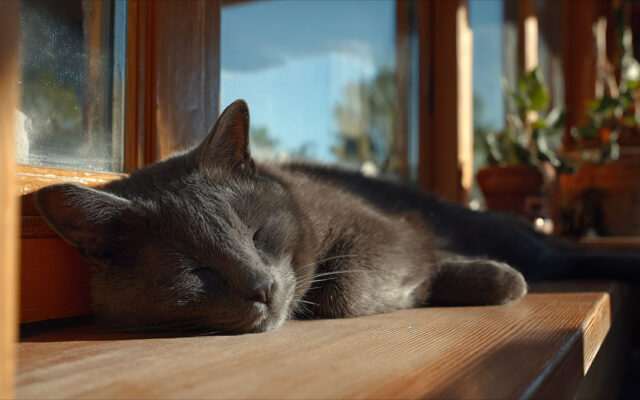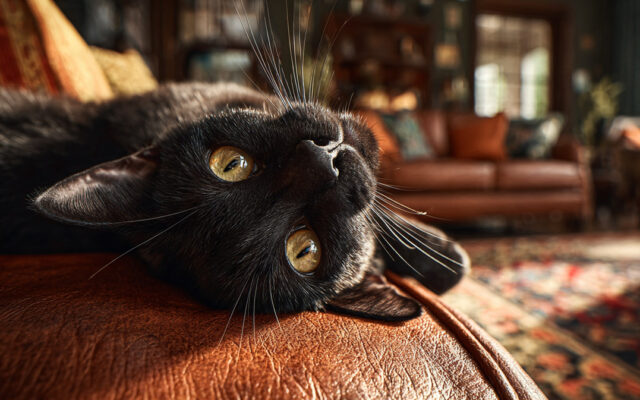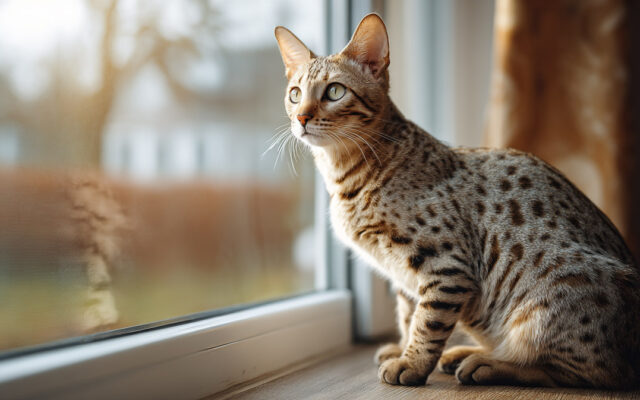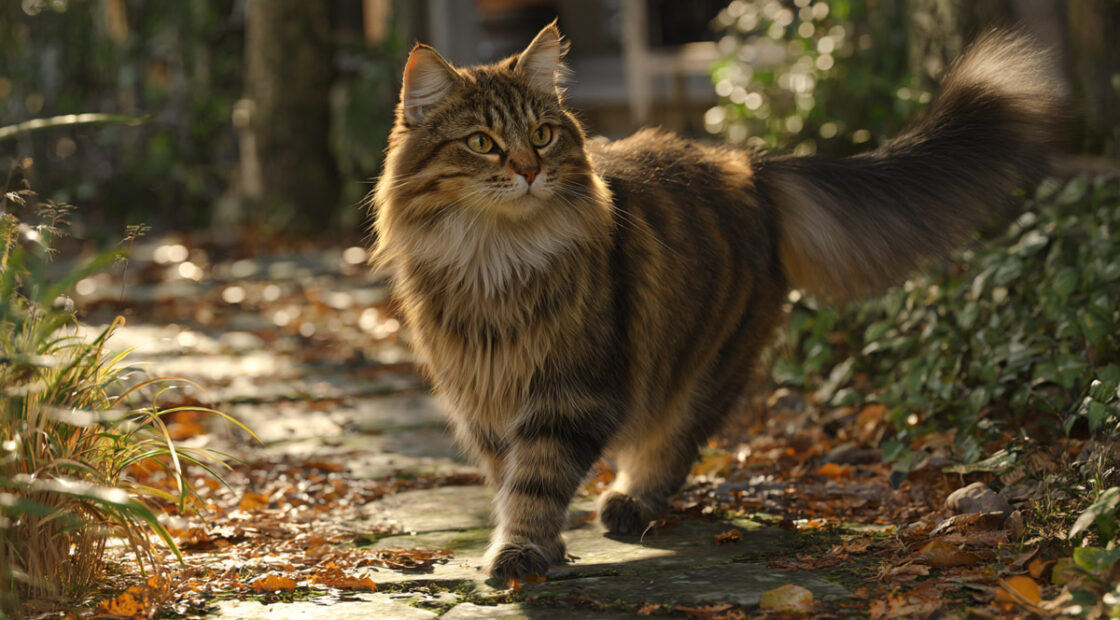
Manx cats come from the Isle of Man, and most of them arrive with no tail or a short stub where one should be. A dominant mutation causes it, and the same mutation disrupts spinal development. Tail length varies inside a single litter, and the kittens with the least tail face the most spinal risk.
Science for Animal Welfare (2026) cites a 1979 breeding study in which 7 of 44 kittens (16%) had severe congenital abnormalities. All seven were rumpies, the completely tailless type.
Registration is a bit of a mess. CFA, TICA, FIFe and the GCCF all register the breed, and they disagree on whether the long-haired form, the Cymric, is a breed of its own or just a coat variety.
What Is a Manx Cat?
Short coat, compact round body, hind legs longer than the forelegs. And a stub or no tail at all, because of a dominant mutation that shortens it from birth.
The tail is the calling card, but it doesn’t define the cat. A stray with a stump isn’t a Manx without the pedigree to match, and other short-tailed breeds exist.
The word also names the Gaelic language and the people of the Isle of Man, which is where the cat got its name.
Manx versus Cymric

Registries can’t agree on the long-haired version. Some list the long-haired Cymric as a breed of its own, others as a coat-length variety.
- CFA files it as Manx Longhair, a division of the Manx breed.
- The GCCF has a Semi-longhair Manx Variant and no separate Cymric recognition.
- FIFe keeps a separate Cymric standard.
- TICA covers both under one Manx breed group standard.
The split shows in the World Cat Congress comparison of member registries. FIFe’s own standard dates the Manx to 1949 and the Cymric to 2006.
Where Does the Manx Cat Come From?

The Isle of Man in the Irish Sea, though nobody has documented when the tailless mutation first showed up. Britannica calls the origin unknown and the island link a matter of tradition.
The GCCF reads the evidence more firmly. It describes an ancient natural breed whose dominant gene spread through the island’s own cats.
Legends about the missing tail
Everyone has heard the one about a cat boarding Noah’s Ark late and losing its tail in the closing door. Another says tailless cats swam ashore from a galleon wrecked off the island during the Spanish Armada in 1588. Then there’s the cat and rabbit cross, an old tale that the island’s own museum collection treats as the silliest of the lot.
None of them holds up. The tail traces to spontaneous mutations in a single gene.
Documented history
A Manx was exhibited at the Crystal Palace in 1871, according to the Harrison Weir Collection reproduced by Cat-o-pedia (2020).
By the 1920s the breed sat in the CFA stud book. The farm and ship’s mouser had become a show cat, and it still appears on Isle of Man coins and stamps.
Manx Cat Size, Body Shape and Coat Colors

A Manx is medium-sized and compact, with a round head, a short back and hind legs longer than the forelegs, which lifts the rump above the shoulders. Adults weigh 8 to 12 pounds, according to VCA Animal Hospitals, and males run slightly larger than females.
The head is round with prominent cheeks and a strong chin, and the wide ears taper to rounded tips. The chest is broad, the flanks are deep, and the back arches from shoulders to rump. Bone is heavy. Forelegs are short, hind legs long and muscular, with five toes in front and four behind. The rump is extremely broad and round.
The CFA standard scores head and ears at 25 points and body at 25, but taillessness at only 5.
So the show ring rewards the round type first. The missing tail is worth no more than eye shape or color.
The longer hind legs also change the walk. The GCCF calls it the Manx strut, and plenty of owners describe it as a rabbit-like hop.
Coat and colors
Manx wear a double coat. The CFA standard calls the shorthair short and dense, and the longhair adds a silky medium-length coat with a neck ruff and fuller breeches.
Color choice is broad. The CFA standard excludes chocolate, lavender and the Himalayan pointed pattern, along with any of those combined with white.
White Manx can be born deaf, as with white cats in general.
Manx Tail Types and What Breed Standards Accept

Tail length runs from nothing to a full tail, and breeders have names for the points along the way. A rumpy has no tail at all. A rumpy riser has a small rise of bone or cartilage where the tail would start. Stumpy means a short tail, and longy means a full or near-full one. Most registries accept the shorter types for championship and sideline the rest.
| Tail type | What it looks like | Show status | Reported spinal risk |
|---|---|---|---|
| Rumpy | No tail, often a dimple | Championship | Highest |
| Rumpy riser | Small rise of bone or cartilage | Championship | Elevated |
| Stumpy | Short tail, 3 cm maximum in FIFe | Own class (ACF), not CFA championship | Reduced |
| Longy | Full or near-full tail | Breeding stock in most registries (CFA’s 2026 standard adds a Tailed variety) | Lowest |
Tail length is random inside a litter. The GCCF notes that breeders have reported every length in a single litter.
How registries handle each type
At CFA, rumpy and rumpy riser have been the championship types, and stumpies are transferred to the AOV class. A rise of bone is allowed unless it stops the judge’s hand. The 2026 revision of the CFA Manx standard adds a separate Tailed variety, so check the current show rules for how fully tailed cats are classed.
The FIFe standard valid from 1 January 2026 limits a stumpy’s tail to 3 cm, straight, with no curve or kink. In Australia the ACF judges rumpy and riser together, gives stumpies their own class and doesn’t show tailed cats.
The World Cat Congress comparison records one hard breeding rule. Manx and Cymric may mate within the breed group, except rumpy to rumpy.
France’s LOOF handles the longy differently. Its 2024 judging reports classify longies as breeding auxiliaries, kept out of championship but used in breeding programs.
UFAW reports rumpies as the cats most often affected by spina bifida, so the tail type that wins shows carries the most spinal risk.
The T-Box Gene Behind Manx Taillessness
Manx taillessness traces to mutations in the T gene (also written TBXT), which encodes Brachyury, a transcription factor that drives notochord and tail development. Buckingham et al. (Mammalian Genome, 2013) found four different T mutations across Manx lineages in the US and on the Isle of Man.
Each is a small deletion or duplication that shifts the reading frame and cuts the protein short.
- c.998delT
- c.998_1014dup17delGCC
- c.1169delC
- c.1199delC
Inheritance and homozygous lethality
The mutation is dominant, so one copy is enough to shorten or remove the tail. In Buckingham’s data, 95% of short-tailed Manx were heterozygous.
No cat in the study carried two mutant copies. The OMIA summary notes that complete loss of Brachyury causes early embryonic death, and three fetuses that died late in gestation were all heterozygous.
The mechanism is haploinsufficiency. One working copy doesn’t make enough Brachyury, and the mutant protein activates its target gene far less than the normal one.
The allele a cat carries doesn’t predict tail length, and mutant alleles are largely lineage-specific. That’s why two tailless parents can still produce a longy.
Other bobtail breeds

The Manx isn’t the only breed with a T mutation. One mutant allele is shared with the American Bobtail and the Pixie-bob, both developed more recently in the US.
The Japanese Bobtail is a different case, because Buckingham’s team found no link between its short tail and the T gene.
A 2016 Scientific Reports study of kinked-tailed cats from southern China traced that trait to HES7, a gene involved in somite segmentation. None of the four Manx mutations showed up in those cats.
Manx Syndrome and Other Health Problems
The spinal cord and vertebral defects that come from the same mutation as the short tail go by the name Manx syndrome. Spina bifida is the most common form.
In a 1979 study by Deforest and Basrur, cited by UFAW (Science for Animal Welfare, updated May 2026), 7 of 44 kittens (16%) were affected, and all seven were rumpies.
What Manx syndrome does to a cat
Severity runs from nothing to fatal. Spina bifida occulta produces no signs, while spina bifida aperta leaves the spinal cord open to the skin and invites deadly infection.
Affected cats often stand with the hock flat on the ground (a plantigrade stance) and have weak control of the hind limbs. Urinary and fecal incontinence shows up too, and the soiling inflames the skin around the perineum. Feeling in the hind legs and around the anus can drop as well.
Signs can appear at birth or build over weeks to months, because the spinal cord can become tethered to the vertebral canal and stretch as the kitten grows. PDSA places the onset before four months of age.
Treatment is rarely effective. Surgery helps in occasional cases, and UFAW notes that breeders often have affected kittens euthanased early, so buyers tend to see only the healthier ones.
Where sources disagree on the Manx hop
Breed guides often present a rabbit-like hop as part of the Manx charm. UFAW lists a hopping gait as a sign of spinal cord abnormality, and the GCCF calls it a product of an over-shortened spine, not an accepted breed feature.
On this one the GCCF and UFAW agree. A Manx that hops needs a vet.
Other conditions in the breed
- Megacolon, where nerve loss weakens the colon and constipation builds. The GCCF profile cites one study in which a sizeable share of Manx had it, nearly all of them rumpies.
- Corneal dystrophy, an eye cloudiness that can start at around four months (PDSA).
- Painful arthritis in the tail joint, seen in stumpies with deformed tail bones (UFAW).
- Rump fold intertrigo, a skin inflammation the GCCF lists.
Screening and diagnosis
A vet exam comes first, since a skin dimple over the lower spine can signal a meningocele underneath. X-rays show the bony defects, and myelography or MRI confirms the type and extent of the cord damage (UFAW).
DNA testing identifies which T variant a cat carries. It can’t predict severity, because the modifying genes behind the variable expression remain unidentified.
Kittens need a full vet exam before purchase. Pedigreed kittens are usually placed at about four months, which leaves time for problems to surface (GCCF), and PDSA advises asking for the medical history of the parents and grandparents.
Is the breed sustainable?
The GCCF says these problems are now rare under good breeding practice. That means at most three generations of tailless-to-tailless mating (two preferably) and fully tailed Manx in the breeding program.
UFAW doesn’t buy it. No program reduces the effect of the mutation, it says, and it found no evidence that informed breeding has cut the problem. It argues the ethics of continuing the breed deserve serious review.
The University of Missouri’s Lyons lab adds that retiring the breed from registries has been considered, and that some registries already refuse the Manx and Cymric.
Manx Cat Lifespan and Daily Care

Sources give the Manx lifespan as anything from 9 to 18 years. UFAW states that life expectancy falls sharply in cats affected by Manx syndrome, which is where much of the spread comes from.
PDSA, the UK charity, says 9 to 13 years. The GCCF breed profile says 12 to 14, and VCA Animal Hospitals says 15 to 18. Stubbs, honorary mayor of Talkeetna, Alaska, from 1997 to 2017, lived past 20 (GCCF), though he’s an outlier.
None of the three pages shows how it arrived at its range. For a kitten from an unscreened line, the low end is the safer planning figure.
Population data points the same way. The Royal Veterinary College’s VetCompass study of English primary-care practices (O’Neill et al., 2015) found crossbred cats outliving purebreds, and heavier adult cats dying younger.
Grooming
The Manx coat is short but double, so it needs regular brushing to clear dead undercoat (PDSA). The GCCF flags the moulting season as the heavy period and notes that older cats can need help to prevent mats.
Longhaired cats need brushing a few times a week, according to VCA Animal Hospitals.
Feeding

Manx are slow to mature, so kitten food should run for at least the first year while bone is still being laid down (GCCF).
Keep adults lean, since extra weight tracks with a shorter life.
Monitoring at home
The litter tray gives the earliest warning of bowel trouble. Straining, small hard stools or soiling all count. Constipation from nerve loss can be treated medically with some success (UFAW).
Movement matters too. A hind foot dragging, a hop or a stiff stance justifies a vet visit, whatever the breed guides call normal.
Manx Cat Temperament and Family Fit

Sociable, playful and intelligent, the Manx bonds closely with its family and gets on with children and other pets, according to the GCCF breed profile. PDSA describes a cat that is playful without being overly active, and happiest following its owner around.
The GCCF and the CFA both call the breed dog-like, for its loyalty and its love of interactive play, fetch included.
Climbing is a mixed picture. PDSA rates the tendency low, while the GCCF calls Manx very impressive jumpers, so expect ability without constant climbing.
On the plus side, the breed isn’t territorial and avoids conflict (GCCF), and it isn’t normally overly vocal, with a quiet voice (PDSA). It’s trainable and happy on a lap.
The downsides are real. The hunting instinct is strong, so outdoor access brings home mice, voles and birds, and the GCCF suggests a catio. Kitten behavior runs through the first year because the breed matures slowly. A Manx is also attached to its people, which suits long solitary days poorly. And a severely affected Manx needs constant nursing care (UFAW).
How Much Does a Manx Cat Cost?

Reputable breeders in the US charge about $500 to $1,500 for a Manx kitten, according to Rover’s breed guide. Price guides disagree on the low end.
Hepper’s guide ends its breeder range where Rover’s begins, so a quote at the bottom of that spread calls for questions about screening.
What drives the price
Pedigree counts, meaning registration with CFA, TICA, FIFe or the GCCF. So does health screening, from vet exams and documented parents to hearing certificates for white kittens. Location and breeder reputation matter as well.
Tail type moves the price too. Rumpies are the most sought after (UFAW), yet they carry the highest spinal risk.
Adoption
Adoption lowers the entry cost. A Pennsylvania rescue listing on Adopt-a-Pet bundles spay or neuter, FIV and FeLV testing, vaccinations and deworming into a single fee.
Lifetime cost
PDSA estimates essentials over a Manx’s life at 10,300 to 14,700 pounds sterling. That covers bed, litter, grooming items, food, preventive treatment, toys, a carrier and insurance.
The figure leaves out the purchase price, non-essential extras and vet treatment for conditions such as Manx syndrome. So the kitten price is the smallest line, and a cheap kitten from an unscreened line pushes cost into vet bills.
How to Choose a Manx Breeder or Kitten

Pick a breeder who documents the line, screens the kittens and keeps them until about four months old.
- Ask for the pedigree. Registration papers from CFA, TICA, FIFe or the GCCF should come with the kitten.
- Ask about tail types in the line. The World Cat Congress comparison records a ban on rumpy-to-rumpy matings, and the GCCF limits tailless-to-tailless pairings to three generations, preferably two.
- Get a vet exam before you buy. UFAW says every new Manx kitten should be fully examined first.
- Wait until four months, since Manx syndrome often shows before that age and corneal dystrophy can appear at around four months (PDSA).
- Watch the kitten move. Walking on the whole hind foot, hopping, a soiled rear end or cloudy eyes all call for a vet check before the sale.
- For white kittens, check hearing. Since 1 June 2016 the GCCF has required a bilateral hearing certificate before a white cat is registered as Active.
A pedigree with an outcross isn’t a red flag. At least one registry in the World Cat Congress comparison lists the British Shorthair, a near cousin in the GCCF’s words, as the permitted outcross.
For a pet home, a longer-tailed kitten from a screened line beats a rumpy. UFAW names the rumpy as the most affected type, so the most desirable tail type is also the riskiest.
Sources split on tailed Manx. Registries accept them as breeding stock, while UFAW says a tailed kitten that didn’t inherit the mutation isn’t a Manx at all. A DNA swab, as in the Lyons lab project, shows which variant a cat carries, so ask whether the parents were tested.
Common Questions About the Manx Cat
Are Manx cats hypoallergenic?
No. A 2024 review found no scientific evidence for a hypoallergenic cat breed, as reported by the University of Southern Queensland in 2025.
The allergen Fel d 1 comes from saliva and skin glands, so coat length doesn’t decide the reaction.
How rare is the Manx cat?
Rare among pedigreed cats. The GCCF classes it as a minority breed, and CFA’s 2018 registration ranking placed it 27th among the breeds it ranked.
Can a Manx cat live indoors only?

Yes. Manx adapt to indoor life, but their hunting instinct makes unsupervised outdoor time risky.
Petfinder’s breed guide recommends a cat-proofed yard for outdoor time, the GCCF suggests a catio, and cat trees indoors suit a breed that jumps well.
How well do Manx cats get along with dogs?
Usually well. VCA Animal Hospitals scores the breed 4 out of 5 for dogs and says it welcomes friendly dogs and other cats.
Royal Canin adds the condition that matters: cats and other pets get on when properly introduced.
Do Manx cats need a tail for balance?
No. VCA Animal Hospitals states that the missing tail doesn’t affect the Manx’s sense of balance.
The GCCF credits the powerful hind legs with fast acceleration, sharp turns and jumps to great heights.
Which UK registry recognizes the Manx cat?
The GCCF does, listing the Manx in Section 3 of its breed register. Its Standard of Points accepts only shorthair, tailless Manx for showing.
One VCA breed page says British show officials still refuse the breed, which conflicts with the GCCF’s own profile.
Should a First-Time Owner Pick a Manx Cat?

A first-time owner can pick a Manx cat when the household accepts the nursing risk and the kitten comes from a screened line with tailed Manx in the pedigree. Without that acceptance, a breed with no spinal mutation is the safer choice.
The order of the decision matters, because only the first step cannot be delegated to a breeder or a vet.
- Whether you have the daily care capacity for an affected kitten.
- Finding a longer-tailed kitten from a screened line, with funds reserved for spinal imaging and specialist treatment.
A household that fails the first test should skip the second. Breeders and vets can lower the risk, but only the owner can absorb what remains.
This position was verified in November 2026. A validated test for severity, or a registry decision to retire the breed, would change it.