Ask three groomers about Great Pyrenees haircut styles and you may get three different answers. Ask them about shaving one and you will get the same answer every time.
The main Great Pyrenees haircut styles are the sanitary trim, paw and hock trim, feathering trim, thin and trim, breed standard trim, and deshedding blowout. Each one is a selective trim that protects the double coat rather than removing it.
This guide covers what each style trims, the blade or snap-on comb used, regroom intervals, salon pricing, and the cuts that trigger post-clipping alopecia.
You will also get the exact wording to hand your groomer at the counter.
What Determines the Best Haircut for a Great Pyrenees?

The best haircut for a Great Pyrenees is decided by coat type first, then climate, matting tendency, and how many minutes a week you will actually spend brushing.
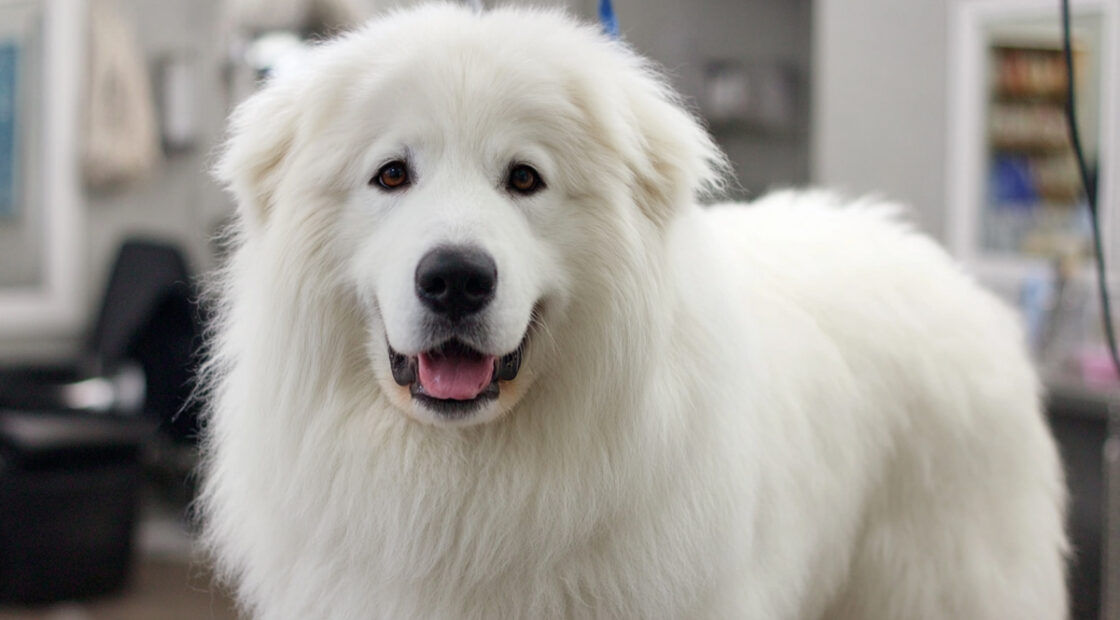
The AKC breed standard describes the coat as a long, flat, coarse outer coat lying over a dense, fine, woolly undercoat.
That structure creates five zones a groomer works with:
- Ruff (mane): heaviest coat, neck and shoulders, more pronounced in males
- Tail plume: long hair forming a flag
- Pantaloons: feathering along the back of the thighs
- Front leg feathering: longer hair down the back of the forelegs
- Face and ears: naturally shorter and finer
The AKC standard also notes that correctness of coat matters more than abundance of coat. Groomers read that as permission to tidy, not to reshape.
Coat type sets the ceiling
Single coats (Poodle, Maltese) keep growing and need clipping. Double coats shed instead, so length regulates itself.

Great Pyrenees fall in the second group, alongside the Samoyed and the Newfoundland.
Climate matters less than owners assume
The undercoat insulates in both directions, trapping air against the skin in winter and blocking radiant heat in summer.
Pyr skin underneath is pale and burns fast, which is why the Great Pyrenees Rescue Society warns against sun exposure on clipped dogs.
Matting decides urgency
Mats form first behind the ears, in the ruff, behind the elbows, in the pantaloons, and around the rear.
The Great Pyrenees Club of America calls the coat tangle resistant with routine grooming. Skip three weeks and that stops being true.
The 6 Most Popular Great Pyrenees Haircut Styles
| Grooming Style | Areas Trimmed | Regroom Schedule |
|---|---|---|
| Sanitary trim | Rear, belly, and inner thighs | Every 4 to 6 weeks |
| Paw and hock trim | Paw pads, foot outline, and hocks | Every 4 to 8 weeks |
| Feathering trim | Ears, chest, legs, and pantaloons | Every 6 to 8 weeks |
| Thin and trim (T&T) | Entire body with bulk reduced | Every 8 to 12 weeks |
| Breed standard trim | Feet, hocks, and whiskers only | Every 6 to 8 weeks |
| Deshedding blowout | No clipping; loose undercoat removed | Every 6 to 8 weeks |
Four of the six leave the guard hairs completely intact. Only the T&T cuts into body length.
The Sanitary Trim
The sanitary trim is a Great Pyrenees cut that clips hair from the rear, belly, and inner thighs while leaving the rest of the coat untouched. It suits working dogs, seniors, and any Pyr with a heavy skirt, and it works year round.
At a glance
- Zones: rear, genital area, belly, inner thighs
- Blade: #10, worked with the grain
- Face & head: untouched
- Ears: untouched
- Tail: base tidied, plume left full
- Maintenance: Low, a 2 minute check weekly
- Regroom every: 4-6 weeks
- Best for: farm dogs, older Pyrs, long skirted coats
Who it suits: Livestock guardian dogs living outdoors full time. Hidden Heights Farm, a working goat operation, uses a sanitary cut plus a light face trim a few times a year and nothing else.
Watch out for: A #10 blade run against the grain leaves clipper tracks that stay visible for months on white coat.
The Paw and Hock Trim
Foot work, nothing more. The paw and hock trim removes hair between the pads, rounds the foot outline, and tidies the hock feathering.
The Great Pyrenees Club of America publishes the exact method: barber’s scissors to level the hair where the foot meets the floor, then thinning shears to shape the sides and top.
Their guide also describes a wide V cut along the heel pad for owners who want to show off strong pasterns.
- Blade: #15 between the pads, blunt tip scissors elsewhere
- Regroom every: 4-8 weeks
- Maintenance: Low
- Best for: hardwood floors, snow country, dogs collecting ice balls
Check the dewclaws while you are down there. Pyrs carry single front dewclaws and double rear ones, and the GPCA notes they curl and grow into the leg when neglected.
Watch out for: Pad hair cut too short costs the dog traction on tile, which matters for a 100 pound dog with hips to protect.
The Feathering Trim
The feathering trim shapes the long fringe on the ears, chest, back of the front legs, pantaloons, and belly. It keeps every guard hair on the body and reads as a tidy version of the natural coat.
At a glance
- Body length: unchanged
- Ears: edges thinned, inner ear fuzz removed for airflow
- Legs: feathering evened, not shortened
- Tail: plume left, tip squared
- Tool: thinning shears, never clippers
- Regroom every: 6-8 weeks
- Maintenance: Medium, 30 minutes of brushing per week
Who it suits: House dogs whose owners want a groomed look without touching coat function. It is the closest thing to a “puppy cut” a Pyr should ever get.
Watch out for: Thinning shears used in one spot too long leave a divot that takes a full growth cycle to fill in.
The Thin and Trim (T&T) Cut
The thin and trim, called the T&T by groomers, reduces overall bulk using a large snap-on comb over clippers, then scissor shapes the body and legs. Rover reports groomers reach for the Andis O, A, C, or E combs, the longest attachments in the set.
National Great Pyrenees Rescue describes the same approach: thin the body with a comb attachment, then sculpt the rest with scissors.
At a glance
- Body: bulk reduced, guard hair length preserved
- Ruff: left heavy for silhouette
- Legs: scissored, cylindrical
- Tail: plume untouched
- Regroom every: 8-12 weeks
- Maintenance: Medium
- Best for: southern climates, dogs with dense undercoat, mat prone coats
Who it suits: Owners in hot regions who have already tried deshedding and still lose the mat battle every August.
Watch out for: This is the only style on the list that shortens body coat, so regrowth texture can shift. Some groomers decline it on principle.
The Breed Standard Show Trim
Conformation cut. Trimming is limited to the feet, the hocks, and the whiskers, with light thinning to clean the outline.
The AKC standard asks for the ruff, the tail plume, the pantaloon effect, and shorter finer hair on the face and ears. Every one of those is left alone.
| Feature | Show Trim Treatment |
|---|---|
| Ruff / mane | Left full and backbrushed |
| Feet | Scissored into a smooth, rounded floor line |
| Hocks | Combed out and trimmed straight |
| Body | Left untouched |
Maintenance: High. Plan on 30 minutes weekly plus a bath and full blow out before each show.
Watch out for: Judges penalize a curly or stand-off coat, and over-thinning the ruff creates exactly that stand-off look.
The Deshedding Blowout
The deshedding blowout is not a haircut. A bath with deshedding shampoo and conditioner is followed by a high velocity dryer that pushes loose undercoat out of the coat, then a rake finishes the job.
Bark Social reports the treatment cuts household shedding by up to 80% for several weeks. K-9 Dryers puts the shed-free window at roughly three weeks.
- Cutting involved: none
- Regroom every: 6-8 weeks, or 2-3 weeks during a coat blow
- Best for: spring and fall shedding season
Groomers often blow out the dry coat first, bathe, then force dry a second time. Two passes pull far more undercoat than one.
Watch out for: A high velocity dryer aimed at a solid mat drives it tighter. Demat first, blow out second.
The Lion Cut, Puppy Cut, and Summer Shave: Styles to Skip
Shaving a Great Pyrenees removes the guard hairs that reflect UV and block radiant heat, and the coat frequently fails to return.
Post-clipping alopecia is the clinical name. Citing the University of Minnesota Small and Large Animal Dermatology Handbook, Scenthound reports follicles that stall past the normal 3 to 4 month regrowth window, with some cases running 12 to 24 months and some dogs never recovering original texture.
The condition shows up most in plush Nordic coats, including the Siberian Husky, the Keeshond, and the Pomeranian, though any double coated dog can develop it.
Three things a shave does not do:
- Reduce shedding (the undercoat still cycles, just shorter)
- Cool the dog (airflow through an intact coat does that)
- Grow back predictably
Owners of other heavy coated breeds run into the same wall, which is why articles on grooming cuts for Golden Retrievers and on trim options for Australian Shepherds land in the same place.
One exception: a veterinarian may clip for surgery, severe pelting, or a skin condition. Medical need overrides coat preservation.
How to Choose the Right Great Pyrenees Haircut

Work through four questions in order.
- Match the trim to the coat, not to the weather forecast.
- Check where mats sit right now, behind the ears and in the pantaloons first.
- Estimate your real weekly brushing time, then pick a style that survives it.
- Factor in age and job. A 10 year old Pyr with arthritis tolerates a shorter table session than a 2 year old.
| Grooming Style | Maintenance | Best Season |
|---|---|---|
| Sanitary trim | Low | Year-round |
| Paw and hock trim | Low | Winter and wet months |
| Feathering trim | Medium | Spring and fall |
| Thin and trim | Medium | Late spring |
| Deshedding blowout | Low | During seasonal coat blow (typically twice a year) |
If you brush under 15 minutes a week
Pick: sanitary trim plus a deshedding blowout every 6 to 8 weeks.
Low commitment, no cutting into the coat, and it handles the two problems owners complain about most: hygiene and hair on the couch.
If your dog works or lives outdoors
Livestock guardians need the coat intact for weather, brush, and predator contact. The Anatolian Shepherd Dog gets the same treatment for the same reason.
Pick: sanitary trim and paw work only.
If you are heading into summer in a hot state
Deshedding beats cutting. A thoroughly raked out Pyr moves more air across the skin than a clipped one.
Pick: deshedding blowout every 6 weeks, T&T only if matting is winning. Cold weather dogs, covered in guides on breeds built for winter, hold their coat for a reason.
How Often Should a Great Pyrenees Be Groomed?
Every 6 to 8 weeks for a professional session, plus 30 minutes of brushing per week at home.
Both the Great Pyrenees Club of America and National Great Pyrenees Rescue land on the same weekly number. Hepper suggests splitting it into three 10 minute sessions.
Bathing runs on a slower clock. Rover puts it at every 3 to 4 months, since the coat sheds dirt on its own once dry.
Factors that shorten the interval:
- Coat blow: twice a year, spring and fall, when the undercoat releases in sheets
- Mud and pasture work: weekly brushing becomes twice weekly
- Age: senior Pyrs groom themselves less and mat faster
- Humidity: damp undercoat felts quickly
Line brushing is the technique that makes 30 minutes count. Part the coat in horizontal sections, brush from the skin outward, then move up an inch.
Great Pyrenees Haircut Grooming Cost and What to Tell Your Groomer
Expect $70 to $180 per session for a Great Pyrenees. Giant breeds sit at the top of every published range because of coat volume and table time.
What the numbers look like
Thumbtack’s 2025 data puts general dog grooming at $79 to $136 per session, with size and temperament moving the figure.
Bark lists giant breeds at $60 to $180. PetsCare reports $70 to $150 and up for the same category, and Dogster notes matted giant coats push past $150.
- Deshedding add-on: $20 to $80 (Bark Social), or $15 to $50 as a line item (Golden Pawps)
- Mobile grooming: roughly $20 to $30 above salon rates (HoundJunkie)
- Dematting: billed hourly, often $40 per extra hour
QC Pet Studies estimates $1,000 to $2,000 a year for a large dog groomed every six weeks. Pyrs land near the upper end. Owners who assumed the breed was cheap to maintain usually learn that the real lifetime cost of a dog runs higher than the purchase price.
What to say at the salon
Use the trim name and the blade number. Groomers price and plan from that.
- “Sanitary trim, #10 blade, with the grain.”
- “Pads cleared with a #15, feet scissored round.”
- “Deshed and blow out, no clipper work on the body.”
- “Thinning shears on the ear edges and pantaloons only.”
- “No shave-down under any circumstance. Call me if you find pelting.”
Ask one question before booking: how many double coated giants does the shop groom per month? A salon that mostly handles doodles may not own a dryer strong enough for a Pyr in full coat.
Doing it at home
Startup kit runs $200 to $500 by QC Pet Studies’ estimate: clippers, snap-on combs, an undercoat rake, thinning shears, blunt tip scissors.
Andis, Wahl, and Oster all make clippers rated for coarse double coats. Keep styptic powder within reach, because the first sanitary trim on a fidgeting 110 pound dog rarely goes cleanly.
FAQ on Great Pyrenees Haircut Styles
Can you shave a Great Pyrenees?
No. Shaving strips the guard hairs that block UV and radiant heat, and the coat often regrows patchy.
Only a veterinarian should clip a Pyr, and only for surgery, pelting, or a skin condition.
Do Great Pyrenees need haircuts?
They need selective trims, not full body cuts. The sanitary area, paw pads, and hock feathering benefit from regular attention.
Body coat regulates its own length through seasonal shedding instead of continuous growth.
What is the best Great Pyrenees haircut for summer?
A deshedding blowout. Removing dead undercoat opens airflow to the skin without cutting the outer coat.
Bark Social reports the treatment cuts household shedding by up to 80% for several weeks.
How often should a Great Pyrenees be groomed?
Professionally every 6 to 8 weeks, plus 30 minutes of brushing weekly at home.
The Great Pyrenees Club of America and National Great Pyrenees Rescue both use that weekly figure. Shedding season shortens the interval.
What clipper blade do groomers use on a Great Pyrenees?
A #10 blade handles sanitary areas and a #15 clears hair between the pads.
Body work, when done at all, uses the longest snap-on combs rather than a bare blade.
How much does a Great Pyrenees haircut cost?
Roughly $70 to $180 per session, since giant breeds sit at the top of every published range.
Bark lists giant breeds at $60 to $180. Deshedding adds $20 to $80.
Will a Great Pyrenees coat grow back after shaving?
Sometimes, and slowly. Post-clipping alopecia stalls follicles well past the normal 3 to 4 month window.
Scenthound, citing University of Minnesota dermatology material, reports cases running 12 to 24 months with some coats never recovering texture.
What is a thin and trim cut on a Great Pyrenees?
The T&T reduces coat bulk with a large snap-on comb, then scissor shapes the body and legs.
Rover notes groomers use Andis O, A, C, or E combs. Regroom every 8 to 12 weeks.
How do you stop mats on a Great Pyrenees?
Line brushing. Part the coat in horizontal sections and brush from the skin outward, one inch at a time.
Mats form first behind the ears, in the ruff, and in the pantaloons.
Can I groom a Great Pyrenees at home?
Yes, with an undercoat rake, slicker brush, thinning shears, and blunt tip scissors.
QC Pet Studies puts a starter kit at $200 to $500. Leave heavy dematting and full blowouts to a groomer.
Conclusion
Every one of the Great Pyrenees haircut styles worth booking follows a single rule: preserve the double coat and trim only what hygiene and comfort require.
The sanitary areas, the pads, and the leg feathering are fair game. The ruff, the tail plume, and the pantaloons stay.
Buy an undercoat rake and a metal slicker brush before you buy clippers. Line brushing prevents more problems than any cut fixes.
Book a deshedding blowout when your Pyrenean Mountain Dog starts blowing coat in spring and fall.
Other double coated breeds, including the Alaskan Malamute, follow the same logic.
Ask your groomer about their experience with giant livestock guardian coats first. That one question saves more coats than any blade chart.