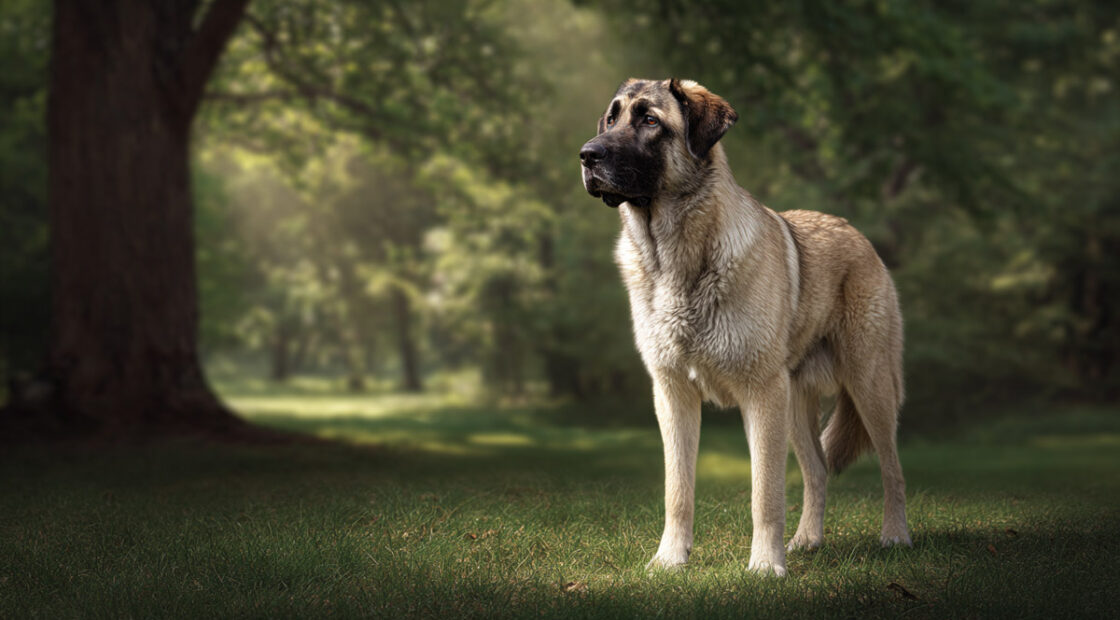
Anatolian Shepherd Dog is a slightly misleading name. The dog comes from Turkey and works with sheep and goats, but it guards them and has no interest in herding. It lives with the flock and deals with wolves and other predators on its own, with no handler giving commands.
Shepherds in Turkey keep these dogs, and so do ranchers in the United States and Namibia. The dog patrols the pasture and barks a warning first. If that doesn’t work, it confronts whatever is there. The American Kennel Club files the breed in the Working Group.
Registries can’t agree on what to call it. In June 2018 the FCI replaced its Anatolian standard No. 331 with the Kangal Shepherd Dog, so the same Turkish guardian type goes by different names depending on the registry (FCI, 2018).
What Is the Anatolian Shepherd Dog?
It lives with the flock and decides for itself when a threat needs a response. Nobody directs it, and that independence is what the breed was built around.
“Shepherd” sounds like a herding dog, which is why people get this wrong. An Anatolian Shepherd Dog Club of America article in Showsight (2021) states plainly that the breed guards and does not herd.
Turkish shepherds call it Coban Kopegi, which means “shepherd’s dog”. Karabash and Turkish Guard Dog are also in use, and the UK registered it as the Anatolian (Karabash) Dog until the 1980s.
Registries file it differently. The AKC puts it in the Working Group and the UKC in its Guardian Dog Group, while The Kennel Club (UK) uses the Pastoral group.
The Kangal Dog complicates the picture. In June 2018 the FCI replaced its Anatolian Shepherd Dog standard No. 331 with the Kangal Shepherd Dog at the Turkish Kennel Club’s request (FCI and KIF documents, 2018), so whether the two are one breed depends on which registry you ask.
Anatolian Shepherd Dog Origin and History
The breed comes from the Anatolian plateau of Turkey, where shepherds kept large guardian dogs with their flocks long before any breed registry existed.

Origin on the Anatolian Plateau
The United Kennel Club standard describes a shepherd’s guard dog of ancient lineage, probably descended from the large hunting dogs of Mesopotamia.
The Showsight article from the Anatolian Shepherd Dog Club of America calls it a Molosser-type breed crossed with sighthound blood. Shepherds kept the dogs that answered a predator’s approach and bred from those.
That puts it among the oldest dog breeds still doing the job it was developed for.
Sources don’t agree on how old it actually is. The Westminster Kennel Club says more than 4,000 years, while Cheetah Conservation Fund cites a 6,000-year pedigree.
Both are estimates. The UKC standard hedges with “probably descended”, and the New Zealand Kennel Club gives the date of origin only as “ancient times”.
Arrival in the United States and Recognition
Ranchers and working-dog enthusiasts imported Anatolian dogs in the 1950s (AKC), after an earlier pair reached the USDA’s Sheep Dog Project in the late 1930s. The modern American breed traces to a pair brought home by Navy Lieutenant Robert Ballard, whose 1970 litter became its foundation stock (Vetstreet).
The Anatolian Shepherd Dog Club of America got going in 1970 (AKC Library). From 1985 to 1997 it presented the breed to the AKC in a long bid for recognition (AKC Library). The UKC recognized the breed on January 1, 1993 (UKC), and the AKC followed in 1999 when it joined the Working Group, according to the AKC’s own article.
Pet-care sites split between 1995 and 1998 for the AKC date. The AKC’s own account says 1999, so that’s the one to trust.
A Documented Case in Namibia
In February 1994, Cheetah Conservation Fund placed four Anatolian Shepherds with sheep and goat herds in Namibia. The question was whether the breed used in Oregon livestock research would also work in Africa.
The program has since placed more than 800 dogs in Namibia, South Africa and Tanzania, according to the organization.
Size, Coat and Colors
Under the AKC standard, males stand at least 29 inches and weigh 110 to 150 pounds, and females stand at least 27 inches and weigh 80 to 120 pounds. The coat is a dense double coat that comes in two lengths. Every color is accepted.
Height and Weight
The Kennel Club (UK) gives dogs 74 to 81 cm (29 to 32 in) and 50 to 64 kg (110 to 141 lb), and bitches 71 to 79 cm (28 to 31 in) and 41 to 59 kg (90 to 130 lb). The UKC lists mature males at 110 to 143 lb (50 to 65 kg). The AKC figures apply to dogs aged 2 years or older.
The registries overlap closely. The AKC treats general balance as more important than absolute size, and a Showsight judge’s guide notes that the standard has no height or weight disqualification.
Puppies fall well short of these numbers. A six-month-old may not meet the standard’s height or weight, because the breed matures slowly.
Coat Types and Shedding
Two varieties exist, short and rough, and both are double coats that need little grooming (Purina).
Shedding gets heavier twice a year, and more frequent brushing clears the loose hair then (Wisdom Panel). The rest of the year, weekly brushing is enough, per the New Zealand Kennel Club.
Accepted Colors
The AKC and UKC standards both accept all colors and markings.
Most dogs seen are fawn with a black mask, though pinto, white and brindle also appear (Purina). Judges are warned that some colors create optical illusions about a dog’s structure (Showsight).
A few things are not negotiable. Blue eyes, or two eyes of different colors, are a disqualification in the AKC standard, and so are overshot, undershot and wry bites (Showsight).
Temperament and Guarding Behavior of the Anatolian Shepherd Dog

It stays calm until something challenges it, then it makes its own call and defends its territory. That makes it an excellent flock guardian and a demanding companion.
Guarding Response
Hampshire College’s ten-year guardian dog study (1988) found that five strains of dogs, Anatolian Shepherds among them, cut predation by an average of 64%, and 53% of reporting producers recorded none in 1986.
Cheetah Conservation Fund reports that most farmers using its dogs see 80 to 100% fewer livestock losses, and a 25-year review of its Namibian placements found reductions reported by 91% of farmers. A 2015 South African study of Anatolian guardian dogs measured farmer-reported losses before and after placement and found no difference by dog sex.
All of these figures rest on producer reports, not controlled counts, so they show direction better than exact size.
The dogs deter mostly through presence and noise. CCF says they bark loudly at a cheetah or other predator and scare it off, and WebMD describes the breed as vocal.
The calm look is deliberate. A Showsight judge’s guide says the breed instinctively conserves energy despite being capable of great speed.
With Family and Children
Sources agree the dog is loyal and devoted to its own people (Wisdom Panel). Children are where they split. Orvis calls it a good companion for older children who can control a large dog, while the UK breed profile in Your Dog advises watching it carefully around children because of its strength, size and guarding instinct.
With Strangers and Other Animals
Expect reserve, not friendliness. The AKC standard accepts reserve outside the dog’s territory, and Westminster says the dog prefers a “formal introduction” to strangers. The New Zealand Kennel Club advises introducing visitors properly.
Unfamiliar dogs can set off aggression if the dog wasn’t socialized early (Orvis). Smaller animals are workable when the dog is socialized young (Embark).
Guarding instinct has a cost. A 2011 master’s thesis on Anatolian and Kangal dogs on Namibian farms, as reported by Farmers Weekly, recorded at least 83 animals caught by the dogs, a count the column describes as an underestimate.
How to Train and Socialize an Anatolian Shepherd Dog

Training starts the day the puppy comes home, and socializing never really ends. The breed decides for itself and takes years to mature.
Training Methods for an Independent Guardian
Vetstreet recommends being firm and confident, and staying consistent. Harshness backfires. Dogsey reports that harsh physical or verbal corrections are met with resentment.
The New Zealand Kennel Club says the breed is not for beginners and needs a firm handler, and Orvis says the owner must set consistent boundaries.
Give it something to do, too. A bored Anatolian Shepherd is a destructive one (Vetstreet).
The Socialization Window
Vetstreet says puppies should go home by 8 weeks so intensive socialization can begin, and that this process continues for life.
For a dog that will guard stock, UC Cooperative Extension says livestock bonding should start by 8 weeks or the dog may not bond properly. Texas A&M AgriLife Extension puts the ideal start between 4 and 8 weeks.
Dog parks help early on, but Vetstreet says the visits should stop once the dog turns one.
Step-by-Step Sequence
- Bring the puppy home by 8 weeks and begin training on the first day.
- Enroll in puppy kindergarten by 10 to 12 weeks (Vetstreet).
- Expose the puppy to people, dogs and new places while it is still small enough to handle.
- Follow with a basic obedience class run by a trainer who understands guardian breeds.
- End dog park visits at one year and keep socializing through outings and visitors.
- Keep training and socializing until the dog reaches full maturity at about 4 years (New Zealand Kennel Club).
Skipping steps rarely ends well with a dog this size.
How Healthy Is the Anatolian Shepherd Dog?

Mostly healthy, going by the sources. The lifespan runs about 11 to 13 years, and the known risks are hip and elbow dysplasia, entropion, hypothyroidism and bloat.
Dogs NSW calls it generally hardy and relatively free of endemic health problems. That makes breeder screening the main lever a buyer controls.
Lifespan
The New Zealand Kennel Club lists 10 to 13 years, while the UK breed profile in Your Dog gives 11 to 15.
The two ranges overlap at 11 to 13 years, which makes that the safest working figure. Chewy’s breed guide lands on the same span.
Common Conditions
Hip dysplasia, where the hip joint fits loosely and wears, costs $1,500 to $6,000 to treat (Embrace). Elbow dysplasia is the same developmental fault in the elbow and runs $1,500 to $4,000 (Embrace).
Entropion rolls the eyelid inward so the lashes rub the eye (Chewy). Hypothyroidism, meaning low thyroid hormone, is flagged by Dogs NSW and Orvis. Embrace also lists osteochondritis dissecans, epilepsy, cardiomyopathy and autoimmune thyroiditis.
PetMD notes that dysplasia is hereditary but gets worse with exercise habits, excess weight and poor nutrition. Dogs NSW says joint care in this fast-growing giant breed comes down to weight, nutrition and exercise.
Bloat is the one that worries people most. MetLife lists gastric dilatation-volvulus among the breed’s predispositions, and VIN clinical references put the lifetime risk for giant breeds at roughly 21 to 22%.
A Purdue University case-control study of 11 large and giant breeds found that a raised food bowl more than doubled the odds of bloat (odds ratio 2.18). That reverses the old habit of elevating bowls.
Health Testing to Ask For
Ask for hip and elbow results on both parents before reserving a puppy.
In a statement dated October 29, 2014, the Anatolian Shepherd Dog Club of America said its code of ethics requires hips certified by the Orthopedic Foundation for Animals or PennHIP, evaluated after age 2. Public elbow results in the CHIC database sat outside the code at that date, so check the club’s current wording.
- OFA or PennHIP hip results for both parents, taken after age 2
- Elbow status for both parents, public in the CHIC database
- A CHIC number, which is issued once every test the breed club requires is complete
- Dogs NSW also tells buyers to look for screening evidence on entropion and hypothyroidism
Space, Exercise and Daily Care

This dog needs rural-scale room and a secure fence it has been trained to respect. Add about an hour of daily activity and large-breed nutrition. Apartments and tight suburban lots are the wrong setting, according to Embark.
Housing and Fencing
The New Zealand Kennel Club says the breed can live outside in temperate to cool climates, and Vetstreet adds that it still needs plenty of family time. Orvis, on the other hand, says it should live inside with its family because of the escape risk outdoors.
That escape risk has research behind it. A US government study in Human-Wildlife Interactions (2011) found that livestock protection dogs roamed and escaped when nobody had trained them to respect electric fencing at an early age.
Dogs trained to respect the fence stayed in their pastures and guarded effectively.
Exercise and Daily Routine
| Need | Guidance | Source |
|---|---|---|
| Exercise | About 1 hour a day | Orvis |
| Puppy diet | Large-breed formula to about 18 months | Healthy Paws |
| Ear care | Weekly wash with a dog-safe cleanser | Orvis |
| Dental care | Home brushing plus professional cleanings | Wisdom Panel |
Exercise advice is not uniform. The UK breed profile in Your Dog says little is needed, while the New Zealand Kennel Club asks for a daily long walk or brisk run.
Weight control matters more than distance. Hill’s Pet notes that extra weight wears the joints of a giant dog, and the breed is built for endurance, not speed.
Is the Anatolian Shepherd Dog the Same Breed as the Kangal?
It depends on the registry. The AKC treats them as one breed, while the UKC, The Kennel Club (UK) and the FCI recognize the Kangal Dog separately, and genetic studies from Turkey support the split.
| Registry | Anatolian Shepherd Dog | Kangal Dog |
|---|---|---|
| AKC | Recognized | Not recognized separately |
| UKC | Recognized | Recognized as a separate breed |
| FCI | No longer an FCI breed name | Recognized (Standard 331) |
| The Kennel Club (UK) | Recognized | Recognized as Turkish Kangal Dog, 2013 |
| ANKC (Australia) | Recognized, UK standard | Recognized, FCI standard |
The UK Kennel Club let owners of dogs registered as Anatolian Shepherd Dogs apply to move them to the new breed, according to VN Online.
Why the Registries Disagree
The FCI accepted Standard 331 definitively in 1989, and until the rename it grouped Kangal and Akbash dogs under one Anatolian Shepherd Dog standard (Altunok et al., 2005).
The Turkish Kennel Club (KIF) takes the position that no breed called Anatolian exists in Turkey, as quoted in Dogs Australia’s 2018 member notice. Its letter of July 30, 2018 let national bodies re-register Anatolians as Kangals only when the dog met the Kangal standard. Dogs that did not meet it kept their papers and were not to be recognized as an FCI breed.
Australia kept both breeds instead of forcing a transfer, assigning the FCI standard to the Kangal and the UK Kennel Club standard to the Anatolian Shepherd Dog (ANKC, 2018).
What the Genetic Studies Show
A microsatellite study in the Bulletin of the Veterinary Institute in Pulawy (Altunok et al., 2005) found Kangal, Akbash, Turkish greyhound and feral dogs genetically distinct. Its authors concluded that Kangal dogs deserve recognition as a breed.
A 2013 study of native Turkish dog breeds (Erdogan et al.) placed Akbash, Kangal and Kars Shepherd dogs in separate clusters. It called the single Anatolian grouping of Turkish shepherd dogs incorrect.
Both abstracts describe Turkish populations, so they say little about where American-registered dogs sit relative to the Kangal.
Which Name to Buy Under
Buy by the registration paper, not the name in the listing. AKC papers name the Anatolian Shepherd Dog, while UKC and FCI papers can name the Kangal.
The FCI standard describes the Kangal as a dark-masked livestock guardian of molossus type, a mask the Anatolian standards do not require. The Akbash, a white Turkish guardian, formed its own cluster in both genetic studies.
Is the Anatolian Shepherd Dog Right for Your Home?

Experienced owners with space, a secure perimeter and ideally livestock to guard get the most from this dog. First-time owners and apartment dwellers should look elsewhere, and so should anyone who wants a casual lap dog.
What It Costs
Chewy’s breed guide puts puppies at $800 to $1,500. That is a retail estimate, not a survey, so breeder quotes will vary.
Insurance costs more than for mixed-breed dogs, and Embrace recommends enrolling while the dog is a healthy puppy. Its breed-specific coverage excludes pre-existing conditions.
When the Breed Does Not Fit
The breed is a poor match for an apartment or a small suburban lot (Embark), and for anyone who has never handled a large, independent dog (New Zealand Kennel Club). People after a cuddly couch companion will be disappointed too, since WebMD notes the breed is not obviously affectionate.
Experienced owners with a secure outdoor space and a quiet, consistent household do best (Hill’s Pet), as do farms that need a flock guardian (Dogs Victoria).
Anatolian Shepherd Dog FAQ
Can an Anatolian Shepherd Dog guard chickens and other poultry?
Yes, in some regions the breed protects fowl as well as sheep and goats (Dogs NSW).
Success depends on early bonding with the birds, the same process extension services describe for sheep and goats.
How is the Anatolian Shepherd Dog different from the Great Pyrenees?
Coat and manner separate them. The Turkish guardian has shorter fur and stays more reserved with strangers.
The Great Pyrenees wears a long white double coat and has a gentler reputation, though both breeds work as independent livestock guardians that US ranchers have relied on.
What are common Anatolian Shepherd mixes, and do they need the same care?
The two most cited crosses are the Anatolian Pyrenees, with the Great Pyrenees, and the German Anatolian Shepherd, with the German Shepherd (MetLife).
The National Anatolian Shepherd Rescue Network says crosses share many of the purebred’s needs, so plan for the same space, fencing and socialization.
Can you adopt an adult Anatolian Shepherd Dog from a rescue?
Yes. The National Anatolian Shepherd Rescue Network, a nonprofit active since 2000, places about 100 dogs a year and applies a no-fence, no-dog policy to every adopter.
An adult also shows its temperament and health history, which a puppy cannot. Embrace notes that many breed health problems stay hidden in puppyhood.
Where to Find a Health-Tested Anatolian Shepherd Dog
Look for a breeder who shows both parents’ hip and elbow results in writing, and start with the parent club’s breeder list.
Embrace and Healthy Paws both direct buyers to the Anatolian Shepherd Dog Club of America for breeder referrals.
The OFA evaluates hips only from 24 months of age, according to a review of its hip database, so a puppy carries no result of its own and only its parents’ records can be checked.
The CHIC database releases results only with the owner’s consent. A missing listing therefore calls for a copy of the certificate, not an assumption.
Get the breeder list from the parent club, then both parents’ records in writing, then a CHIC check or a certificate copy. The deposit comes last. Paying first reserves a place in a litter whose parents may never have been scored.