The AKC breed standard, approved in 1994, describes a working dog that spends the greater part of the year in the open and receives no commands from its master.
The breed developed on the plains of Hungary. Its US parent club reports ranchers using it against coyotes and bobcats.
What Is a Komondor?
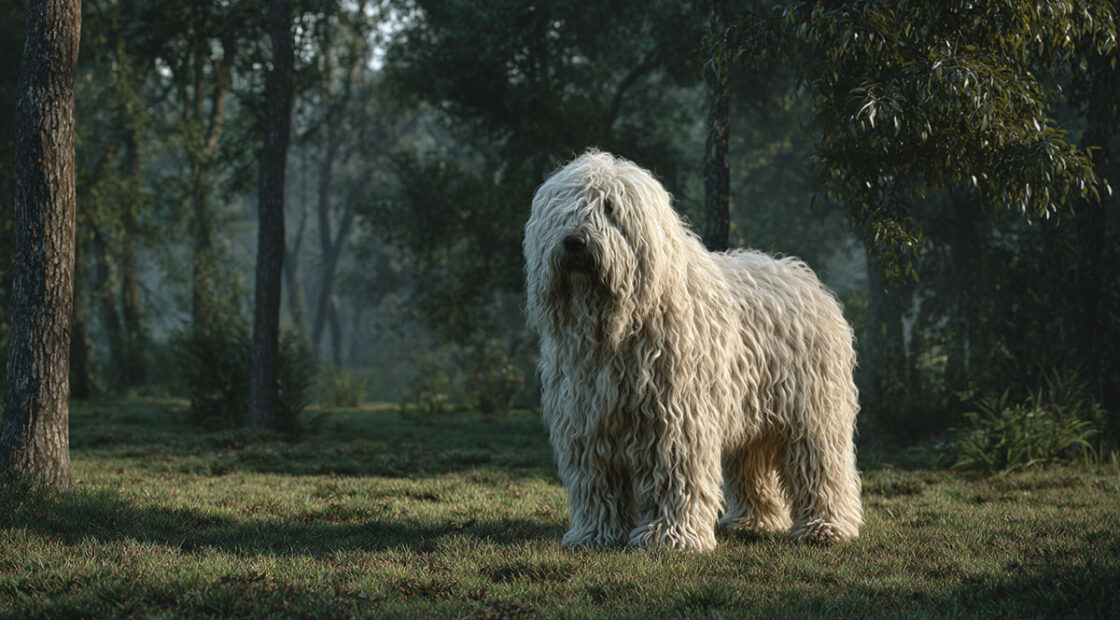
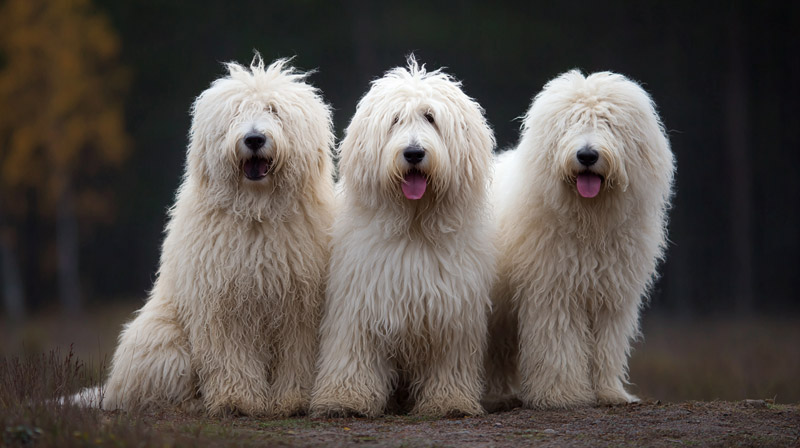
Hungary’s corded white guardian dog protects a flock on its own. The coat does two jobs: among sheep it works as camouflage, and against weather and predators it works as protection.
The AKC breed standard states it plainly: a flock guardian, not a herder, charged with protecting the herd with no assistance and no commands from his master.
Some people call it the mop dog or the Hungarian sheepdog. The Hungarian plural is komondorok. It guards stock and property without handler direction.
Guardians and herders do different jobs. A herding dog moves stock when a handler signals it. A guardian lives with the stock and decides by itself when to act.
Oddly, the FCI still files the breed under Group 1, Sheepdogs, and lists its use as herding dog. That’s a quirk of classification and has little to do with the work.
Don’t confuse it with the smaller Puli. Both are corded Hungarian breeds, but the Puli herds and the Komondor guards.
Where Does the Komondor Come From?

Hungary, specifically the plains of the Carpathian Basin, where the breed developed as a guardian of nomadic and later settled flocks. Which people brought its ancestors there is disputed.
The FCI standard says the original ancestors almost certainly arrived with the migrating Old Magyars. The UKC standard dates this to the 10th century and points to Asian origin, possibly Owtcharka stock.
The AKC goes another way and traces the breed name to a term meaning “dog of the Cumans,” a nomadic people granted asylum in Hungary in 1239.
Both accounts can be true at once. But the written record starts late, and the AKC and the Komondor Club of America (KCA) both place the earliest documents using the word komondor in the 16th century, centuries after either migration.
Hungary’s other white guardian breed, the Kuvasz, ran in parallel. The AKC pairs the Kuvasz with the earlier Magyar clans and the Komondor with the later Cumans, which is exactly where it parts ways with the FCI.
World War II nearly finished the breed off. The KCA reports only a few dozen dogs left in Europe afterward.
Contact between the AKC and the Hungarian Kennel Club (MEOE) resumed in 1962, and imports to the United States followed.
How Big Is a Komondor, and What Do the Breed Standards Say?
A Komondor dog stands at least 65 to 70 cm at the withers depending on the registry, and a bitch at least 60 to 65 cm. None of the four major standards sets a maximum height.
| Registry | Group | Minimum height (dog / bitch) | Weight (dog / bitch) |
|---|---|---|---|
| FCI (Standard No. 53) | Group 1, Sheepdogs | 70 cm / 65 cm | 50-60 kg / 40-50 kg |
| AKC | Working | 27.5 in / 25.5 in | about 100 lb and up / about 80 lb and up |
| UKC | Guardian Dog | 27½ in / 25½ in | about 110-130 lb / 88-110 lb |
| The Royal Kennel Club | Pastoral | 65 cm / 60 cm | 50-61 kg / 36-50 kg |
Weight is where the standards agree. Three of the four put dogs near 50 to 60 kg and bitches near 40 to 50 kg, and the AKC gives only floors.
Height is where they split. Under the FCI, a dog below 70 cm is disqualified. The AKC calls height below the minimum a fault, and the UKC lists adult dogs under minimum height as an eliminating fault.
A 66 cm dog passes the Royal Kennel Club minimum and fails the FCI one. Same dog, different verdicts.
What do the standards measure?
Every standard measures height at the withers and judges proportion against it. The body should be slightly longer than the height at the withers (all four standards agree on that), and the FCI and UKC put the deepest point of the brisket at half the withers height.
The Hungarian standard also sets chest width at 28 percent of withers height, per Showsight Magazine.
The AKC adds a warning: type, movement and ruggedness outrank size, and size is never bought at their expense. The Royal Kennel Club tells puppy buyers that its figures describe the ideal and that an individual dog can come out larger or smaller.
Which registry recognizes the Komondor, and since when?
Four registries publish a Komondor standard that is still in use.
The AKC recognized the breed in 1937 and placed it in the Working Group (KCA). Its current standard was approved June 13, 1994, and the first one drew on the mid-1930s MEOE standard (Showsight Magazine).
The UKC came later, in 1983, with a Guardian Dog Group listing and a standard revised July 1, 2009. The FCI published Standard No. 53 on April 6, 2000, with Hungary as country of origin.
In the UK, The Royal Kennel Club (formerly The Kennel Club) keeps the breed in the Pastoral Group, and its standard was last updated April 1, 2025.
The KCA, organized in 1967 according to Showsight Magazine, serves as the AKC parent club.
How Does the Komondor’s Corded Coat Form?
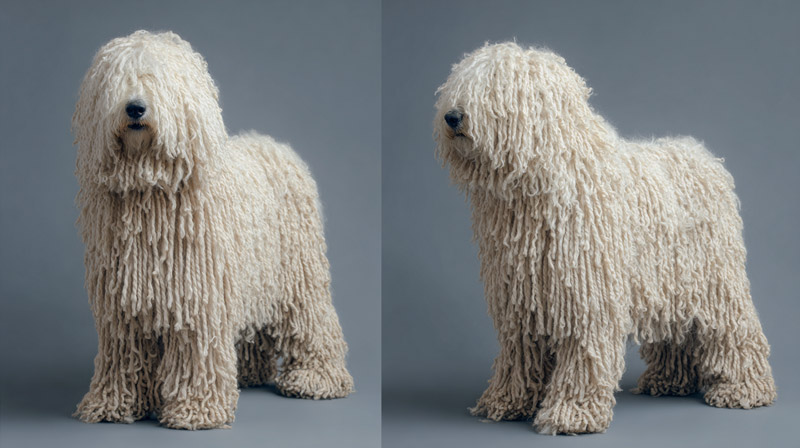
Coarse outer hairs trap the soft, woolly undercoat and mat into permanent, felt-like cords. They form on their own as the dog matures.
The Royal Kennel Club says the adult coat usually starts appearing at 6 to 9 months and may not be fully formed before two years. Purina puts the start of cording at 9 to 12 months.
Both numbers describe the first cords, not a finished coat.
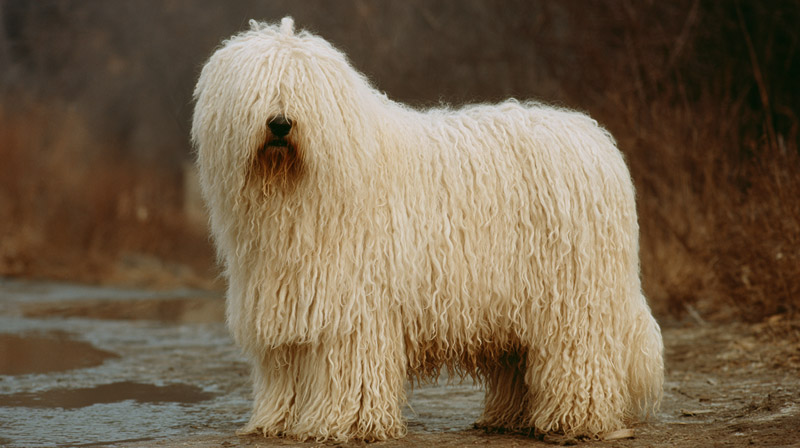
A puppy’s coat is relatively soft and already inclined to fall into cord-like curls. In the intermediate stage the cords are very short against the skin, often hidden under fluff at the outer ends. The mature coat is a dense woolly undercoat plus a wavy or curly outer coat that traps it, and the dog ends up covered in tassel-like cords.
The AKC and UKC both disqualify a dog whose coat has not corded by two years. Neither penalizes a young dog for a shorter coat, since length follows age.
The FCI standard sets the longest coat, on the croup, loin and rear of the thighs, at a minimum of 20 to 27 cm. The lips and lower limbs carry the shortest at 9 to 11 cm.
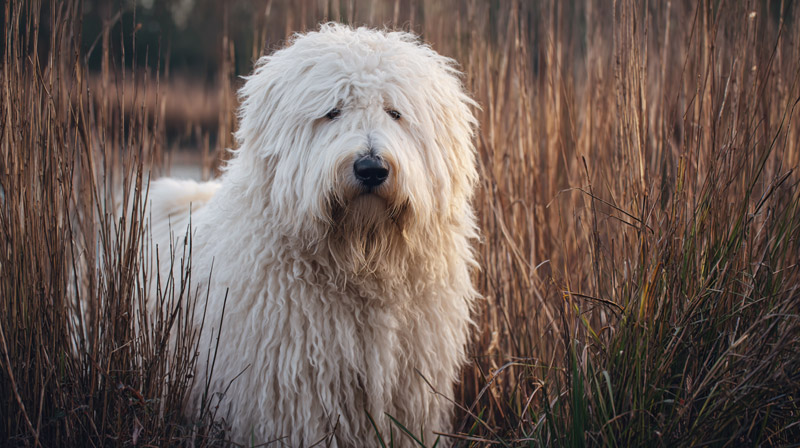
On color, the AKC and The Royal Kennel Club call for white. The AKC allows small cream or buff shading in puppies, and it fades at maturity. The FCI and UKC call for ivory, and the FCI disqualifies a coat that is not ivory or is multicolored.
Skin is ideally gray. The AKC and UKC both fault a straight or silky coat.
The coat has a purpose, and the AKC standard names it: it helps the dog blend in with its flock and protects it from weather extremes and beasts of prey.
Komondor Temperament and Guarding Behavior
Watchful and independent, reserved with strangers, devoted to its own people. It was bred to make decisions without commands, and it behaves that way.
How does a Komondor guard livestock?
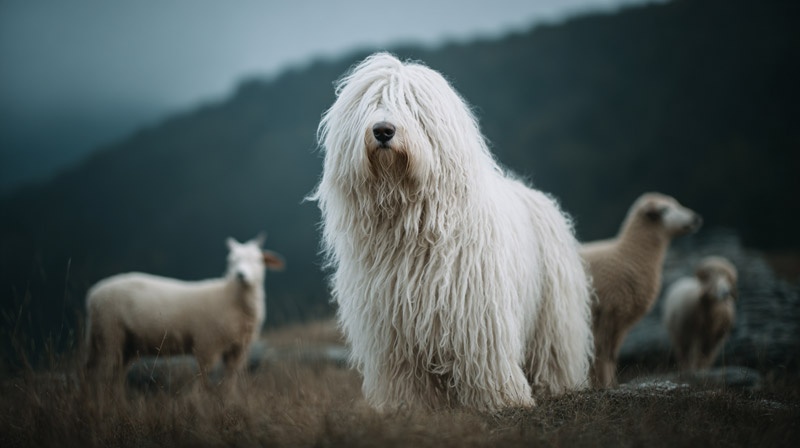
McGrew and Blakesley reported a field trial in the Journal of Range Management (1982). Nine Komondors guarded lambs for 21 days each in two 65-hectare enclosures at the USDA Sheep Experiment Station in Dubois, Idaho.
The lambs learned to run to the dogs or stand with them when attacked, and usually bedded down beside them.
An earlier study by Linhart and colleagues (Journal of Range Management, 1979) reported that Komondors reduced sheep losses to coyotes, and its authors called it a preliminary evaluation.
The FCI standard describes the working temperament in a few blunt lines. The dog attacks silently and treats its territory as its own property, tolerating no other living creature in it. By day it lies in a position that lets it watch its area, and at night it stays on the move.
How does a Komondor behave with family, children and other dogs?
At home, the AKC standard calls the dog reserved with strangers and demonstrative with those it loves. A mature dog stays close to what it guards and is unlikely to be drawn away in a chase.
Children are a gap in the standards, because none of them rates the dog with kids. The Westminster Kennel Club’s breed profile scores it 3 out of 5 for children.
Hepper’s breed guide reports wariness toward unfamiliar dogs and recommends raising a Komondor as the household’s only dog.
The FCI and UKC both disqualify aggression and extreme shyness. The ideal is firm and settled, not hostile.
How to Groom a Komondor
Never brush a Komondor. Separate the cords by hand, bathe only when the coat needs it, and dry every cord all the way through.
The FCI and UKC standards both call a combed coat undesirable. They say the same about a coat left completely neglected.
- Handle the coat daily from puppyhood so the dog accepts it before cords form.
- Split cords by hand at the skin as the coat begins to felt, keeping each cord narrow.
- Bathe only when the coat is dirty, rinse until no shampoo remains, and squeeze each cord out.
- Dry fully in a warm, ventilated space until the center of every cord is dry.
- Part the cords at the underarms, groin and hocks, and check the skin for redness, moisture and odor.
PetMD flags the thin skin of the underarms, hocks and the fold where the rear leg meets the belly as the spots that need the most care.
Neglect is where it goes wrong. Cords left alone fuse into large matted plates, a result the Royal Kennel Club’s standard names directly. Damp cords add skin trouble, and the AKC notes a bath can leave the coat drying for more than two days.
Frequent bathing causes its own problems. The standards set no bathing schedule, and a Burke’s Backyard fact sheet reports that owners skip frequent baths outside the show ring because they weaken the coat.
Shedding is minor, since loose hair stays trapped in the cords and a corded Komondor drops very little. Dogs NSW says heavy shedding happens only in the puppy coat, before the cords form.
The Royal Kennel Club’s breed page lists the Komondor as a non-shedder that still needs grooming more than once a week.
Training, Socialization and Exercise Needs
Start obedience work at 4 to 8 months, socialize the puppy to new people and dogs while it is young, and plan on moderate daily exercise for an adult. The KCA sums up the training challenge in one point: the dog was bred to think for itself.
Repetition bores the breed, so sessions should stay upbeat and varied (KCA). Corrections need to be consistent and humane from the first weeks, because a dog that gets away with hostile behavior once treats it as acceptable (KCA).
Harsh handling backfires, and the AKC standard says heavy-handed training produces a stubborn, unhappy dog.
A Komondor also has to learn to accept handling from strangers. The KCA points out that a dog that guards sheep well can turn out impossible to take to the vet.
Socialization carries the most weight. The KCA says the puppy should meet new situations, people and other dogs, and warns that an unsocialized Komondor can react with excessive aggression to a new situation or person.
A territorial guardian has to learn early what ordinary visitors look like.
On exercise, The Royal Kennel Club says up to 1 hour a day. Hill’s Pet Nutrition (Canada) says 20 to 40 minutes a day at average energy, and Hill’s US profile rates the breed’s exercise needs as moderate.
The standards set no exercise figure, so both numbers are profile estimates. The KCA describes an adult as calm without being sluggish, which makes the demand steady rather than intense.
Komondor Health Problems, Screening and Lifespan
The conditions the KCA documents are hip dysplasia, entropion, juvenile cataracts and bloat. The KCA reports no retinal eye disease or dwarfism in the breed, and no hereditary blood disorders either.
Which conditions does the breed carry?
Hip dysplasia is found by x-ray, and even two cleared parents can produce dysplastic puppies, so a clear certificate lowers the risk without ending it (KCA).
Entropion is an eyelid that rolls inward so the lashes rub the cornea. Surgery corrects it, but the FCI and UKC both disqualify the fault, and the KCA says an affected dog should not be bred.
Juvenile cataracts have been documented in the breed only recently, according to the KCA.
Bloat (gastric dilatation-volvulus) is an emergency. The KCA sees some sign that it is genetic but puts its incidence no higher than in other large breeds.
Then there’s cobalamin (B12) malabsorption, a hereditary condition reported in the breed by Fyfe and colleagues (BMC Veterinary Research, 2018) and linked to a variant in the CUBN gene. Hill’s advises testing breeding dogs, and young dogs with chronic digestive problems.
The heavy coat hides fleas and ticks. The KCA adds that Komondors can be extremely sensitive to some flea and tick products, and that some dips discolor a white coat.
Anesthesia needs a warning too. Like other stock guard dogs, Komondors are usually extremely sensitive to anesthetics, and the KCA says the drugs should be given to effect, never by weight. Tell any new vet before a procedure.
Which health tests should a breeder show?
Ask for hip results for both parents from the Orthopedic Foundation for Animals (OFA) or PennHIP, and an eye examination by a veterinary ophthalmologist for both parents. Get the written terms of the puppy guarantee as well.
The OFA has three independent radiologists grade each submitted film, and it rates hips in seven categories from excellent to severe. The KCA names the Canine Eye Registration Foundation (CERF) for eyes, whose records now sit in the OFA Eye Certification Registry.
If a breeder quotes a Canine Health Information Center (CHIC) number, read it for what it is. As the Samoyed Club of America describes the program, the number shows that a parent club’s required tests were done and made public, not that the results were normal.
In the UK, The Royal Kennel Club’s Health Test Results Finder lists results for any dog on its registers. It offers no breed-specific DNA test package for the Komondor.
Key health figures and lifespan
Lifespan figures split by country, and neither source shows the data behind its number. The Royal Kennel Club says under 10 years. Hill’s Pet Nutrition says 10 to 12 years.
The KCA puts the hip dysplasia rate at about 10% of Komondor hip radiographs submitted to the OFA, though it gives no year for the figure. The earliest OFA certification comes after the dog turns two (KCA), with preliminary evaluations available from 4 to 23 months (OFA).
Under the KCA Code of Ethics, show and breeding puppies are guaranteed free of hip dysplasia to 30 months.
The Royal Kennel Club lists the breed in UK Breed Watch Category 1, meaning no breed-specific points of concern.
Komondor vs Other Livestock Guardian Breeds
The Kuvasz, the Great Pyrenees and the Maremma Sheepdog share the Komondor’s job and its pale coat. Only the Komondor has cords.
| Breed | Dog height at withers | Coat and upkeep | Best fit |
|---|---|---|---|
| Komondor | at least 70 cm (FCI) | Corded, hand-separated, slow to dry | Experienced owner with time for the coat |
| Kuvasz | 71-76 cm (FCI) | Straight to wavy double coat, weekly brushing | Guardian owner who wants a lighter coat load |
| Great Pyrenees | 27.5-31.5 in (UKC) | Double coat, heavy year-round shedding | Owner who accepts hair on everything |
| Maremma Sheepdog | 67-73.5 cm (FCI) | Thick double coat, brushing once or twice a week | Working property with room |
Heights are the Komondor’s minimum and the other breeds’ ranges, taken from FCI Standards No. 53 and No. 54, the current FCI Maremma standard (revised December 16, 2025, with heights unchanged from the 2022 edition), and the UKC Great Pyrenees standard.
The Royal Kennel Club says the Komondor shares common ancestry with the Puli and the Kuvasz, a third reading next to the Magyar and Cuman accounts.
Coat upkeep differs a lot. Dogz Online lists weekly brushing for the Kuvasz, Dogs NZ lists one or two brushings a week for the Maremma, and Purina reports year-round heavy shedding for the Great Pyrenees.
Dogs NSW warns that the traits that make a Maremma a great stock guardian can make it a problem as a backyard pet.
If coat care is the limiting cost, one of the other three fits better. The cords are the reason to pick a Komondor, not a chore to put up with.
When a Komondor Is the Wrong Dog
A small home, a busy social calendar or a first-time owner all argue against it. Most of the limits trace back to the job the breed was built for.
Space comes first. The Royal Kennel Club’s breed profile lists a large house, a large garden and a country setting.
Visitors are the next problem. The KCA calls it a large territorial dog and tells owners to anticipate its behavior whenever friends or relatives enter the house or yard.
Noise is harder to pin down because the sources conflict. Hill’s Canada calls it a loud barker, an issue near neighbors, while the KCA says a pet Komondor stays quiet unless it senses a threat. Hill’s US profile rates barking as quiet.
On experience, the AKC says the independent, protective Kom requires a firm, experienced hand in training.
Heat is unsettled. No standard sets a climate limit. One Canadian profile (Paction) advises avoiding hot, humid climates, while the KCA says the cords let air pass and that dogs seek out moving air.
Maturity is slow, too. Many are not fully mature until nearly three years, and the KCA calls it unreasonable to expect an eight-month-old to behave like an adult.
The KCA adds one more limit. The breed is happiest with something to guard, whether livestock, children or a cat.
Where to Find a Komondor Puppy and What It Costs
Start with the KCA breeder list, because listed breeders have agreed to the club’s Code of Ethics. Expect a search, not a click. Supply is small, and the KCA puts US output at an average of 50 litters a year in the 1980s.
The club secretary can say which breeders have puppies or older dogs (KCA). The interview runs both ways, so the breeder will question you, and you can ask to see the sales contract in advance and request references (KCA).
Skip pet stores. The KCA says the chances of getting a sound, healthy puppy from one are not good.
No registry or breed club sets a price, but the KCA’s FAQ says to expect $1,000 and up for a pet-quality puppy, with show and breeding quality somewhat higher. A 2024 listing from Black Beaver Creek Kennel priced an AKC-registered livestock guardian puppy at $3,000 and states there is no separate pet price because Komondors are working guardian dogs.
Pet-retail sites publish price ranges, but they disagree with one another, so ask breeders directly and compare.
The sticker price is the smaller bill. Owning a dog gets expensive over its whole life, and a corded breed adds grooming time and a long drying routine on top.
For adult and rescue dogs, the KCA runs a rescue referral service, and Komondor Rescue, a nonprofit referral group, places unwanted dogs. It holds that every dog it places should be spayed or neutered.
Adoptable dogs range from several months to several years old. The KCA notes that a five- or six-year-old sometimes lands in a shelter because the family no longer has time for a dog.
In the UK, The Royal Kennel Club runs Find a Puppy and Find a Rescue searches that list Komondor litters and rescue dogs.
Komondor FAQ
How do you pronounce Komondor?
Say KOM-un-dor, with the stress on the first syllable, following Dictionary.com’s transcription.
The Hungarian plural, komondorok, is the form breed clubs and owners use for more than one dog.
Is the Komondor a rare breed?
Yes. Hill’s Pet Nutrition places the largest populations in Hungary and the United States, and the dog remains an unfamiliar sight to most people.
Outside those two countries, expect to search harder for a breeder.
Are Komondors hypoallergenic?
By the club’s account, often a good fit for allergy sufferers. The KCA calls the breed a good choice for people allergic to dog hair and dander, because it does not shed in the usual sense.
Reactions differ from person to person.
How much does a Komondor eat?
Less than its size suggests. The KCA says many adults eat no more than three cups of food a day and stay in excellent condition.
The club adds that portions printed on dog food bags are generally far too generous, and it warns against over-feeding and over-supplementing.
Can you shave a Komondor?
Not as routine care. The KCA describes trimming the hair around the mouth and between the foot pads, and keeping the ear canals clean and free of hair, as the routine upkeep.
The AKC standard also disqualifies a short, smooth coat on both head and legs in the show ring. Ask a vet or groomer before shaving a neglected coat.
Testing Whether a Komondor Fits Your Home
Visiting adult Komondors in their home environment is the most reliable fit test, and the KCA urges every buyer to do it before making a final decision. The club’s secretary can name owners in your area.
Maturity near the three-year mark and a lifespan of 10 to 12 years combine to put a quarter to 30 percent of a Komondor’s life before adult behavior settles. Training and socialization work therefore sits in the first stretch of ownership, not the last.
The order that costs least if the answer is no: visit adult dogs at home, price the coat routine against your week, and contact listed breeders last.
A visit costs an afternoon and can end the search, so it comes before any deposit or breeder commitment.
The trade-off is time. The visit and the long maturing period both delay the day a dog settles in, and no step in this sequence shortens either.