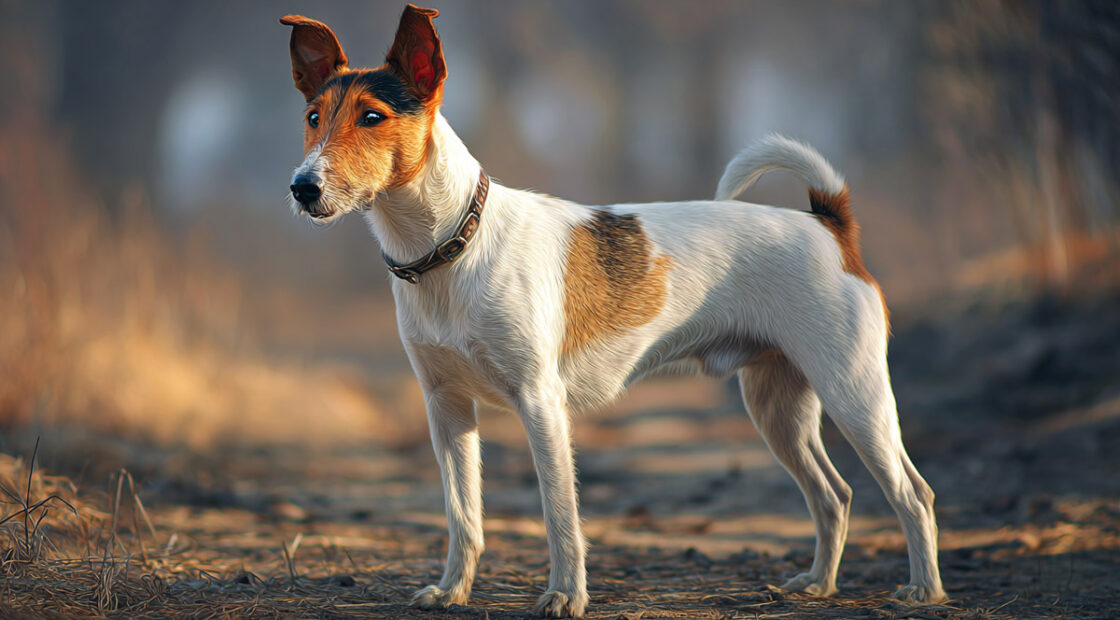
English hunters built the Smooth Fox Terrier to bolt foxes from underground dens, and the dog hasn’t forgotten it. These days it’s kept mostly as a companion and show dog, but the hunting instinct and the energy are still there.
At its peak the breed registered close to 3,000 puppies a year and sat among the ten most popular in the UK, according to The Kennel Club in 2025.
Registrations have fallen far enough since then that the club now classes it as a vulnerable native breed.
What Is a Smooth Fox Terrier?

The American Kennel Club calls it the “gentleman of the terrier world,” which sounds more polite than the dog tends to be.
Foxhound packs needed something small enough to go to ground and bold enough to flush the quarry. Hill’s Pet Nutrition says the breed works mostly as a companion and show dog now.
The AKC files it in the Terrier Group as the Smooth Fox Terrier. The Kennel Club in the UK also uses the Terrier Group but lists it as Fox Terrier (Smooth), the same name the FCI uses, where it sits in Group 3, Section 1 (large and medium-sized terriers) under Standard No. 12. Owners shorten the name to Foxie or SFT.
There are descendants too. The American Toy Fox Terrier is one, though it’s a separate breed and not a size variety.
Smooth Fox Terrier History and Breed Recognition
The first written standard dates to 1876. Dogs NSW records that the Fox Terrier Club formed in the UK that year and issued the standard at once. The breed itself came out of English fox hunting.

Ancestry and Early Use
Nobody documented how the breed was built, and PetMD says so directly. What exists is reconstruction.
VCA Animal Hospitals lists smooth-coated black and tan terriers and Bull Terriers as probable ancestors. The Kennel Club’s standard history says both fox terrier coats probably come from the same types of dog that produced the Bull Terrier and the Black and Tan (now Manchester) Terrier.
Nylabone reads it differently. Its profile traces the Wire to the rough-coated black and tan terrier of Wales, and the Smooth to England’s smooth black and tan.
The hounds are less disputed. PetMD and VCA both list the Beagle and the Greyhound, and so does Nylabone.
Early work meant bolting. The terrier went to ground and drove the fox out, then the hounds took over the chase (Purina).
Recognition by the AKC, The Kennel Club and FCI
Registries recognized the breed in different decades, and they split the Smooth from the Wire on different dates too.
| Registry | Key date | Group |
|---|---|---|
| The Kennel Club (UK) | Fox Terrier standard drawn up 1876 | Terrier |
| AKC | Standard approved 1885; breeds split 1984 or 1985 | Terrier |
| UKC | Recognized 1912; breeds split January 1, 1999 | Terrier |
| FCI | Accepted June 26, 1963 (Standard No. 12) | Group 3, Section 1 |
Sources disagree on the AKC split. Showsight Magazine’s account of the American Fox Terrier Club gives 1984, while Orvis gives 1985.
Show success came early. Ch. Warren Remedy, owned by Winthrop Rutherfurd, took the first Westminster Best in Show in 1907 and won again in 1908 and 1909. Ch. Sabine Rarebit followed in 1910, per the Westminster Kennel Club’s winner records.
Size, Coat and Color Under the Breed Standard

Under the FCI standard a male stands up to 39 cm (just over 15 inches) at the withers and weighs 7.5 to 8 kg. The American standard lands in nearly the same spot at 15.5 inches and 18 pounds.
Females run a little smaller in both documents.
The FCI figures come from Standard No. 12 (2017). Bitches are slightly shorter than dogs and weigh 7 to 7.5 kg. The American Fox Terrier Club standard, effective 2002, caps height at 15.5 inches with back length no more than 12 inches, and asks for 18 pounds in show condition for a dog. A bitch weighs about 2 pounds less, give or take 1 pound.
Profile pages quote softer numbers. Hill’s Pet Nutrition lists 15 inches for males and 14 for females, which describes a typical dog, while the standards set ceilings.
The American standard itself says weight matters less than shape, size and contour, and it calls its height and length figures approximate guides for breeders, not hard rules.
Orvis describes the coat as smooth and dense, flat against the body and hard to the touch. White predominates. As Orvis summarizes the AKC rule, brindle, liver and red markings are out, and the Canadian Kennel Club standard (effective 2004) calls the same three objectionable.
The skull is flat and moderately narrow, with slightly more dip between forehead and muzzle than a Greyhound shows in profile. Ears are small and V-shaped, folded forward against the cheek.
The American standard disqualifies prick, tulip and rose ears. A white, cherry or heavily spotted nose is also a disqualification, since the nose should be black.
The tail is set high and carried gaily. For docking, the American standard calls for leaving about three quarters of the original length.
How Does the Smooth Fox Terrier Differ From the Wire Fox Terrier?
Dogs NSW states that apart from coat and furnishings, the Wire is built the same as the Smooth. Most of the real difference sits in grooming, ancestry and show record.
Where the two fox terriers split
Grooming is where owners notice it first. A Wire Fox Terrier needs its coat stripped out, and Dogs NSW tells owners to ask a breeder or groomer how it’s done. The Smooth just gets a firm brush about once a week (Greencross Vets).
| Feature | Smooth | Wire |
|---|---|---|
| Coat | Short, dense, flat | Wiry |
| Grooming | Weekly firm brushing | Coat stripping |
| Probable ancestry | English smooth black and tan terrier | Welsh rough-coated black and tan terrier |
| Westminster Best in Show titles | 4 | 15 |
| UK Kennel Club registrations, 2024 | 45 | 390 |
For buyers, the registration gap matters most. The UK Kennel Club’s 10-year breed statistics put the Smooth at 45 registrations in 2024 against 390 for the Wire.
At shows, Westminster’s winner list credits the Smooth with four Best in Show titles, all between 1907 and 1910. The Wire has 15, and the latest was King’s win in 2019.
Temperament isn’t a dividing line. The UKC standard calls the two breeds essentially identical apart from coat.
Smooth Fox Terrier vs Parson Russell and Jack Russell Terriers
The Russell terriers look similar because they share a source. The Parson Russell Terrier standard traces that breed to a strain of Fox Terriers bred by the Reverend John Russell, a Victorian hunting parson.
Proportions separate them. The UKC standard describes the Smooth’s body as square, while the UKC’s Parson Russell standard asks for a body slightly longer than the dog is tall.
The Jack Russell Terrier has shorter legs. Britannica notes that the UK Kennel Club and the UKC register it separately from the Parson Russell.
Temperament, Prey Drive and Behavior With Children and Other Pets

Friendly and bold, and quick on its feet. The prey drive causes the trouble, mostly around small pets and on off-leash walks.
The FCI standard calls the breed friendly and outgoing, and fearless on top of that. The American standard asks for a lively, active dog.
The UKC standard adds that the dog is bold but not aggressive with people. It also says the strong prey drive survives even though few work to fox today.
Orvis tells owners to keep a Smooth on leash at all times because it dashes after squirrels and chipmunks. Wisdom Panel adds that early socialization helps temper the drive.
Children are where the sources disagree.
The UKC standard calls the breed affectionate with children but too active for some. The Westminster Kennel Club rates it 3 out of 5 for being good with children, and Greencross Vets says it can be too rough and energetic for younger kids.
Read together, the sources describe a dog for older children who play without grabbing, and a poor match for toddlers.
Other animals are a bigger variable. The Westminster Kennel Club gives the breed 3 out of 5 with other dogs, and Dogster warns that cats and small pets such as gerbils and hamsters are the ones at risk.
Hill’s rates its social and attention needs as high.
How Much Exercise and Training Does a Smooth Fox Terrier Need?
Published exercise figures run from 20 to 40 minutes a day (Hill’s Pet Nutrition) up to one to two hours (Orvis). I’d plan for the higher number, because Orvis links a bored Smooth to digging and escaping, and to nonstop barking.
Daily Exercise and Activities
Healthy adults handle a few miles of running and half-day hikes, according to Orvis, though short legs mean the pace should stay modest.
Orvis also recommends advanced obedience and agility classes, since they tire the brain as well as the body. Other options:
- AKC Earthdog, which the AKC’s eligible breed list (last updated August 2026) includes for the Smooth Fox Terrier
- Trick training, where Hill’s notes a long record in performance troupes and circuses
- Farm Dog certification, which a family from one AKC-profiled breeder’s litters has passed
Earthdog comes closest to the breed’s original work, since dogs find caged rodents underground (Orvis). Entry is open to dogs that are AKC registered (Limited Registration is acceptable) or enrolled in PAL or FSS, and they must be at least six months old. Spayed and neutered dogs may enter, but bitches in season may not.
Yard time without a person doesn’t count as exercise. Orvis warns that a Smooth left alone outside digs, jumps and escapes.
Training and Socialization

Smooth Fox Terriers learn quickly and keep plans of their own. Hill’s calls the breed easily trained but says it needs a firm hand to control the urge to hunt.
Housetraining is slower than average, according to Orvis, so start the routine on day one. Short lessons with plenty of positive reinforcement work best, and small, healthy dog treats keep the rewards from adding weight. That matters here because Dogster flags obesity as a risk in the breed.
Orvis says early exposure to people keeps the breed from turning aggressive with them. Other dogs need separate work, because the same source calls the Smooth quarrelsome with them, a harsher read than the Westminster Kennel Club’s middling rating.
Grooming and Shedding on a Short Coat
A brush once or twice a week, a bath about monthly, plus routine ear, tooth and nail care (Orvis). Hill’s Pet Nutrition sets the bar higher at daily brushing.
Orvis puts nail trims at roughly once a month and tooth brushing at three days a week.
Shedding runs year-round and Orvis rates it moderate. PetMD adds that the Smooth sheds more than the Wire, and Hill’s ties its daily brushing advice to cutting down shed hair around the house.
Ears deserve a weekly wipe with a gentle, vet-approved cleanser. Orvis says built-up dirt and wax can cause infections, and a dog ear wipe makes the clean quick.
Smooth Fox Terrier Health Problems, Screening and Lifespan

Most Smooth Fox Terriers are healthy, but breed profiles do document eye disease, kneecap displacement, a hip condition called Legg-Calve-Perthes disease, deafness and an inherited ataxia.
Conditions and Screening Tests
On the eyes, PetMD and Orvis list lens luxation, cataract and distichiasis. Orvis also names patellar luxation and Legg-Calve-Perthes disease for the joints, and deafness shows up on both Orvis and PetMD.
Then there’s nerves and muscle. Hereditary ataxia is listed, along with myasthenia gravis, which Vetstreet says can be congenital in the breed.
The ataxia is the best documented case. A 2015 study in Acta Veterinaria Scandinavica (Rohdin and colleagues) found that every ataxic Smooth Fox Terrier tested carried two copies of a KCNJ10 variant known from the Parson Russell Terrier and Jack Russell Terrier.
The sample was small, so the study shows the variant exists in the breed without showing how common it is. Profiles that list no major concerns, such as Petfinder’s, leave it out.
The club requirements cover only part of the screening picture, and the DNA tests sit outside them.
| Test | Screens for | Source |
|---|---|---|
| Patella evaluation | Patellar luxation | AKC, American Fox Terrier Club |
| Cardiac exam | Heart disease | AKC, American Fox Terrier Club |
| Eye exam by an ophthalmologist | Cataract, distichiasis, lens luxation | Petfinder profile |
| PLL DNA test | Primary lens luxation | Commercial labs |
| Ataxia DNA test | Hereditary ataxia | Commercial labs |
AKC’s Terrier Group testing page (last modified October 2022) recommends patella and cardiac checks for the Smooth. The American Fox Terrier Club’s breeder rules ask for the same two checks for the Smooth, and add VDEGS (Vanden Ende-Gupta syndrome) testing for the Wire.
Genomia sells a Smooth Fox Terrier panel that bundles primary lens luxation and ataxia testing with a degenerative myelopathy test. Embark lists the breed among those carrying the primary lens luxation variant.
The Orthopedic Foundation for Animals runs the CHIC database behind these lists. It states that results from physical evaluations come with no guarantee.
Lifespan: Why Sources Disagree
Hill’s Pet Nutrition lists 10 to 13 years. Orvis lists 12 to 15.
The independent anchor is the Royal Veterinary College’s VetCompass life tables (2022), which put life expectancy at birth for the Kennel Club terrier group at 12.0 years. Group-level data is the closest independent figure available for the breed.
That number falls inside the overlap of both ranges, so plan for roughly 12 to 13 years and treat 15 as the long tail.
Who Should Not Get a Smooth Fox Terrier?

Skip the breed if the house sits empty most of the day or has no secure fence. First-time owners who want an easy dog should skip it too. A breeder profiled by the AKC puts it plainly and calls the Smooth Fox Terrier “not the dog for everyone.”
A few specific poor fits:
- Households that are empty for long stretches, because Orvis says boredom after a few hours turns into nuisance barking and destructive chewing
- Homes without secure containment, since the same AKC-profiled breeder says these dogs do best with complete containment, ideally a fenced yard
- First-time owners, because Orvis rates the breed suitable for experienced dog owners
- Homes with cats or other small animals, where Orvis goes further than Dogster and says the breed cannot live with them
- Anyone who objects to digging
The good fits are active owners who bring the dog along on runs, hikes and sports, and experienced terrier households with a secure yard. Orvis names active families as the best match, and Hill’s describes the ideal home as a family on the go.
Crate training stretches the tolerable absence to a few hours, per Orvis. A hard exercise session beforehand and a favorite toy add a little more.
Finding a Smooth Fox Terrier: Cost, Breeders and Rescue

Availability depends on where you live. Dogster calls breeders easy to find across the United States, while the UK Kennel Club lists the breed as a vulnerable native breed.
No kennel club publishes a price. Dogz Online, an Australian breeder directory, shows New South Wales breeders asking AUD 2,000 to 3,000 per puppy.
Treat that as the smaller bill, because the real cost of a dog builds over years of food, vet care and training.
Rescue is the other route. The American Fox Terrier Club names breeders and rescue workers as equal options, and the UK Kennel Club’s Breed Rescue network is made up of breed-specific rescue services.
The breeders profiled in the AKC’s spotlight on Taylor Schwartz test each breeding dog for the Fox Terrier CHIC requirements plus OFA hips and BAER. Use that as the benchmark.
- Start with the breed club. The American Fox Terrier Club’s code of ethics commits members to CHIC testing, and the club recommends buying from a member.
- Ask for both parents’ patella and cardiac results and the CHIC number, which the OFA issues only when the owner agrees to public posting of results.
- Ask for an ophthalmologist eye exam and for DNA results on primary lens luxation and ataxia.
- Ask about hearing (BAER) tests, since deafness is on the breed’s problem list.
- Expect questions in return. The AKC-profiled breeder asks buyers why they picked the breed and wants homes with complete containment.
- Meet the litter and choose a puppy that is “neither timid nor a holy terror,” in the American Fox Terrier Club’s words.
Smooth Fox Terrier FAQ
Do Smooth Fox Terriers bark a lot?
Yes. Orvis describes the breed as born to chase, dig and bark, and says consistent training and exercise reduce the noise but never remove it.
Hill’s Pet Nutrition rates barking at the top of its trait scale.
Is a Smooth Fox Terrier hypoallergenic?
No. The short coat sheds year-round and leaves dander in the home, and Orvis notes that no dog is fully hypoallergenic.
Regular brushing controls dander better on a small, moderate shedder like this one, which may ease symptoms for some allergy sufferers.
Can a Smooth Fox Terrier live in an apartment?
It can, but the fit is poor. The breed needs up to two hours of daily activity (Orvis) and a secure outdoor space, and an AKC-profiled breeder recommends complete containment, ideally a fenced yard.
Without that exercise, expect digging, chewing and barking indoors.
How much should a Smooth Fox Terrier eat?

Orvis puts the typical adult at 1.5 to 2 cups of quality dry food a day, split into two meals. Age and activity level shift that amount, so confirm it with a vet.
Dogster warns that obesity builds quickly in under-exercised dogs, so measure portions and count training treats.
Does a Smooth Fox Terrier like to swim?
Some do and some avoid water. Orvis advises introducing it slowly and never forcing it.
Small, lean dogs lose body heat fast in water, so keep swims short and stay close.
What about Smooth Fox Terrier mixes?
Mixes have no breed standard, so size, coat and temperament depend on the other parent. Kennel clubs register purebreds, though the AKC enrolls mixed-breed dogs through its Canine Partners program.
A cross with a Russell-type terrier is worth DNA testing, because researchers found the same KCNJ10 ataxia variant in both groups.
Planning the First Month With a Smooth Fox Terrier Puppy
Start with the yard and the crate. A secure yard comes first because an escape ends the month before training begins.
Next comes a baseline veterinary exam, with the breeder’s test results in hand. Rohdin and colleagues (2015) report that hereditary ataxia in the breed appears between 2 and 6 months of age, so owners should watch for the overreaching, bouncing gait the researchers describe and bring the breeder’s CHIC paperwork to that visit.
Short training and socialization sessions fill the days after that.
The sequence changes if the American Fox Terrier Club adds DNA testing to its protocol, since AKC’s testing page currently lists only patella and cardiac exams (verified October 26, 2026).