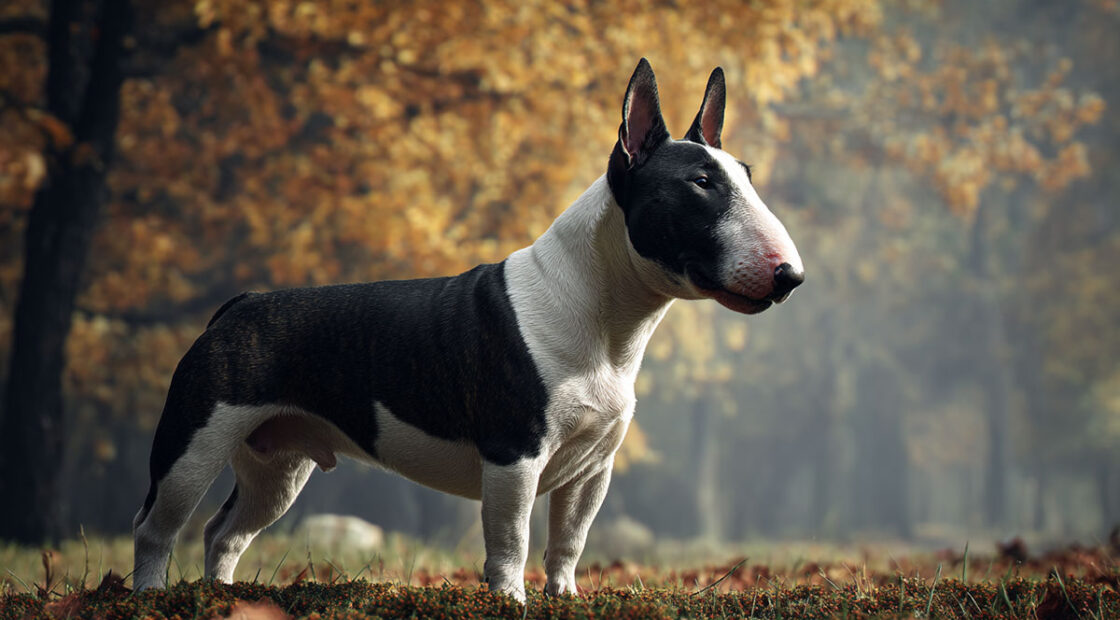
Breeders in England crossed the Bulldog with the White English Terrier and ended up with a muscular companion dog that has an egg-shaped head. Once you’ve seen that head, you won’t confuse the breed with anything else.
Coat color matters more than you’d expect, because it affects hearing. A 2016 BMC Veterinary Research study that tested 1,060 puppies by BAER found congenital deafness predominantly in white dogs, and the breed comes in white and colored varieties.
What Is a Bull Terrier?
Most people spot the head first, then the small triangular eyes and the short, flat coat. The AKC and The Kennel Club (UK) both place the breed in the Terrier Group, and the FCI lists it in Group 3, Section 3 (bull type terriers).
You’ll also see it called the English Bull Terrier, Bully or White Cavalier, and Britannica adds Egghead and Wedgehead.
The name covers a few different dogs. White Bull Terriers are all white, or white with markings on the head. Colored ones can be any color except white, brindle included. The Miniature Bull Terrier is a smaller dog with its own standard, and the FCI lists it separately.
Registries handle the colors differently. The Westminster Kennel Club shows white and colored as two varieties that are identical except for coat and can be born in the same litter, while the UKC shows them as one breed.
It’s a separate breed from the Staffordshire Bull Terrier, even though both descend from the old bull-and-terrier crosses. The head shape alone tells them apart.
Where Did the Bull Terrier Come From?
James Hinks of Birmingham did most of the work in 19th-century England, using the Bulldog, the extinct White English Terrier and Dalmatian blood. The roots go back further, to the bull-and-terrier crosses used for dog fighting in the early 1800s.
Those crosses had no written pedigrees. The AKC points out that the working-class dog dealers of the period rarely documented what they bred.

Hinks was no exception, so the parent list comes from records left by others. His son noted that Dalmatians went in early to produce the all-white coat, and Britannica adds that the Spanish pointer, foxhound and Greyhound may also have contributed.
- Hinks presented his new Bull Terrier at a Birmingham show in May 1862 (AKC).
- Through the late 1800s, breeders moved away from pit fighting and toward a fashionable companion dog (Britannica).
- The colored variety began to develop around 1900 (Westminster Kennel Club).
- In the early 1900s, breeders concentrated on the head (AKC).
Color came back into the breed through crosses to Staffordshire Bull Terriers, which brought in brindle and other markings, according to the AKC.
The start dates in different sources can look like they clash, but they fit together. The UKC standard says Hinks standardized the breed in England in the early 1850s. The FCI standard, reproduced by The Kennel Club, also credits Hinks with standardizing the breed type in the 1850s, and gives 1862 as the year the breed was first shown in its present form at Birmingham. The AKC dates Hinks’s presentation of his New Bull Terrier to the May 1862 Birmingham show.
What Does a Bull Terrier Look Like?
The head identifies the breed fastest. After that you notice the small triangular eyes, the erect ears, the muscular body and the short coat.
Head and body structure
From the front, the skull is filled and egg-shaped. In profile it curves gently downward to the nose, which is why people call the breed downfaced. The eyes are small, triangular and deep-set. Ears are small, set close together and held stiffly erect, per Dogs Queensland.
The body is strongly built and balanced, with a tapering tail. Britannica ranks the breed among the strongest dogs for its weight.
Coat and colors

The coat is short, flat and harsh.
White dogs are pure white or white with head markings, and the FCI standard treats tick markings in a white coat as undesirable. Colored dogs can be any color other than white, brindle included. The Kennel Club (UK) separates breed standard colors from non-standard ones when a puppy is registered.
Care is minimal. Dogs NZ rates coat care as low, and a bath when the dog gets dirty covers most of it.
How Big Does a Bull Terrier Get?
A standard Bull Terrier stands about 21 to 22 inches (53 to 56 cm) tall and weighs 50 to 70 pounds (23 to 32 kg), according to Britannica. Other guides list lighter and heavier ranges, because the standard sets no weight or height limit.
| Source | Height | Weight |
|---|---|---|
| Britannica | 21 to 22 in (53 to 56 cm) | 50 to 70 lb (23 to 32 kg) |
| YourDog UK breed profile | Not listed | 23.5 to 28 kg |
| Dogs Queensland | Not listed | About 30 to 40 kg |
| Westminster Kennel Club | Up to 22 in | Up to 70 lb |
The standard asks for the impression of maximum substance for the dog’s size and sex (Dogs NZ publishes the text). It gives no figure, so the ranges differ by source, and Dogs Queensland’s runs highest.
Plan crates and food around the upper end.
Miniature Bull Terrier size
The Miniature Bull Terrier is bred to the same standard as the standard dog, apart from size.
Britannica lists 10 to 14 inches (25 to 35 cm) and 24 to 33 pounds (11 to 15 kg), and the Dogs NSW standard caps height at 35.5 cm (14 in).
The Kennel Club (UK) allows a Miniature and a standard Bull Terrier to be bred together to produce Miniature puppies, but approval must be sought before mating. A separate guide to the Miniature Bull Terrier covers the smaller variety in full.
What Is a Bull Terrier’s Temperament?
Expect a playful dog with a stubborn streak that bonds hard with its family. The breed standard asks for an even temperament that responds to discipline, and Britannica describes the dog as energetic, exuberant, comical and mischievous.
Britannica also notes the breed was developed as a courageous fighter, not an aggressive fight provoker.
The Westminster Kennel Club rates the breed 4 out of 5 with strangers, 3 with children, 3 for protectiveness and just 1 with other dogs.
With children and family
The Bull Terrier wants to be where its people are. Dogs NZ says it is miserable when shut in a kennel or kept outside away from human company.
Orvis advises keeping children away from the dog while it eats or holds a favorite toy. Supervision matters with small kids, since the breed is strong and exuberant.
With other dogs and pets
Other dogs are the lowest-rated trait, and Dogs NZ says the breed can be aggressive toward them. It extends the same warning to small animals.
Early socialization helps. Orvis says time with people, dogs and small animals while the dog is young teaches it that aggression is unacceptable.
As a guard dog
The sources split on this one.
Orvis calls Bull Terriers excellent guard dogs. Britannica says the breed is a good watchdog but only fair at protection, and Dogs NZ rates both watchdog and protection ability low.
Westminster’s protectiveness score sits in the middle. Treat the breed as an alert companion, not a security dog.
Exercise and Training Needs of a Bull Terrier

Plan on at least an hour of exercise a day, early socialization and firm but fair training. Without them, expect chewing.
Exercise
PDSA guidance sets the minimum at one hour a day. Dogs NZ asks for physical and mental work together, because a bored dog turns its jaws on the house.
Fetch and running in a safe, enclosed area cover the physical side. Puzzle toys and new tricks cover the mental one.
Britannica says the breed needs a secure fenced yard, and Dogs NZ advises running it off lead only where it is safe.
Training and socialization
Start socialization in early puppyhood. Orvis recommends time with people, other dogs and small animals while the dog is young.
Training should be firm but fair, as PDSA puts it. The breed has a stubborn streak, and Westminster rates trainability at 3 out of 5.
Orvis adds that Bull Terriers benefit from learning new skills throughout life, which also covers the mental half of the exercise requirement.
Compulsive spinning and tail chasing
Spinning and tail chasing is the most common compulsive behavior in Bull Terriers, according to an AKC Canine Health Foundation grant description.
The same description reports pedigree data pointing to a heritable component. A Purdue University veterinary review adds that one study found no link between compulsive disorder and lack of training, stimulation or social confinement.
So more exercise is not a reliable cure. A dog that spins often or is hard to interrupt needs a veterinary behaviorist.
Bull Terrier Health Problems, Screening Tests and Lifespan
https://www.youtube.com/watch?v=PrTiQG74Ses&pp=ygUzSGVhbHRoIENvbnNpZGVyYXRpb25zIGFuZCBNZWRpY2FsIENhcmUgYnVsbCB0ZXJyaWVy
The breed is generally hardy, but breeders have to screen for several inherited conditions, and Dogs NZ lists a lifespan of 11 to 14 years.
Hereditary conditions
Deafness
Louisiana State University’s breed deafness table, maintained by Dr. George Strain, records congenital deafness in 20.4% of white Bull Terriers tested, against 1.3% of colored ones.
All four deaf colored dogs in that table were deaf in one ear only. A 2016 BMC Veterinary Research study that tested English Bull Terrier puppies by BAER (brainstem auditory evoked response) reached the same conclusion about color: deafness occurs predominantly in white dogs.
Kidney disease
In polycystic kidney disease, cysts form in the kidneys and gradually reduce their function. Dogs NZ’s breeder scheme requires an ultrasound, and VCA Canada says the only way to prevent it is to avoid breeding affected dogs.
Hereditary nephritis is an inherited form of kidney failure that PetMD, citing the Bull Terrier Club of America, describes as often seen in the breed. Breeders screen with a urine protein-to-creatinine (UPC) test.
Lethal acrodermatitis
This one is recessive, so a puppy needs two copies of the faulty MKLN1 gene variant to be affected.
Signs start in the first weeks of life: skin lesions on the feet and face, diarrhea, pneumonia and stunted growth, according to the veterinary genetics lab Animalabs. Zinc supplements do not help, per a 2018 genetic study of the condition, so DNA testing of breeding dogs is how breeders avoid it.
Heart and joint conditions
Breed summaries name mitral valve dysplasia and aortic stenosis as the forms of heart disease to watch for (Dogzonline). Patella luxation, where the kneecap slips out of place, is the joint issue, and breeders submit an annual patella certificate.
Both sit on Dogs NZ’s list of the breed’s five hereditary diseases.
Screening tests breeders use
The Dogs NZ accredited breeder scheme makes most of its tests mandatory, with hearing as the one optional extra.
- DNA profile (mandatory, lifetime result)
- Cardiac certificate (mandatory, yearly)
- Patella luxation certificate (mandatory, yearly)
- Polycystic kidney disease ultrasound (mandatory, lifetime result)
- Hereditary nephritis UPC test (mandatory, lifetime result)
- BAER hearing test (optional)
The Kennel Club (UK) lists BAER testing, breed club heart testing and breed club kidney testing for the breed. The two schemes agree on heart and kidney, and differ on hearing.
Ask for BAER results either way, especially for white litters. Genomia, a veterinary genetics lab, sells a combined Bull Terrier DNA panel that includes the kidney and acrodermatitis tests.
Lifespan
Dogs NZ puts the breed at 11 to 14 years.
That is a breed-wide range, and dogs with lethal acrodermatitis fall outside it. The Animal Health Trust’s description of the condition, hosted on DogWellNet, says affected puppies have a greatly reduced lifespan.
How Does a Bull Terrier Differ From a Staffordshire Bull Terrier or Pit Bull?
Neither one is the same breed. The Staffordshire Bull Terrier has a distinct stop and fixed size limits, while the American Pit Bull Terrier is registered by the UKC and the American Dog Breeders Association but not by the AKC.
| Breed | Registered by | UK law | Irish law |
|---|---|---|---|
| Bull Terrier | AKC, UKC, The Kennel Club (UK), FCI | Not named in the Dangerous Dogs Act | Restricted |
| Staffordshire Bull Terrier | The Kennel Club (UK), AKC, UKC, FCI | Not named in the Dangerous Dogs Act | Restricted |
| American Pit Bull Terrier | UKC and ADBA | Pit bull terrier type banned | Restricted |
Bull Terrier versus Staffordshire Bull Terrier
The Staffordshire Bull Terrier has a short, deep skull and a distinct stop (FCI Standard 76), where the Bull Terrier’s profile curves down from skull to nose.
Size is another gap. The Kennel Club standard sets the Staffordshire Bull Terrier at 36 to 41 cm and 13 to 17 kg for dogs, and the Bull Terrier standard has no equivalent limits.
On paper, the Staffordshire standard describes a bold, fearless and totally reliable dog with a particular affinity for children.
For the Staffordshire Bull Terrier’s own care and health profile, the Staffordshire Bull Terrier breed guide goes deeper.
Is the Bull Terrier covered by breed-specific legislation?
- In the United Kingdom, the Dangerous Dogs Act 1991 bans the pit bull terrier type, Japanese Tosa, Dogo Argentino and Fila Brasileiro, and England and Wales added the XL Bully type from 2023. The Bull Terrier is not named, but council guidance quoting GOV.UK stresses that a banned type is judged by appearance and characteristics, not by breed name.
- In Ireland, the Control of Dogs Regulations 1998 list the English Bull Terrier. Restricted dogs must be muzzled in public, kept on a short strong lead held by someone over 16, and wear a collar with the owner’s name and address (Mayo County Council).
- In the United States, Orvis says some local ordinances include Bull Terriers in breed bans, restrictions and muzzle requirements.
Orvis describes the Bull Terrier as a variety of pit bull, but the UKC registers the American Pit Bull Terrier and the Bull Terrier as separate breeds.
The grouping only matters where an ordinance defines pit bull by appearance, so read the local wording.
Insurance and housing rules
Insurers and landlords keep their own breed lists, and the published lists disagree.
FindLaw and Openly both name the Bull Terrier among breeds some home insurers restrict, while ValuePenguin and SelectQuote list only pit bull and Staffordshire types. Psychology Today notes that each company draws up its own list.
Get the answer in writing from the insurer and the landlord before the purchase, not after.
How Much Does a Bull Terrier Cost?
A puppy from a US breeder costs about $1,800 to $3,000 (Dogster, 2026). In the UK, PDSA puts running costs at a minimum of 80 pounds a month after setup, and up to 13,000 pounds over the dog’s lifetime.
These are consumer-guide estimates, not registry surveys. Dogzonline lists breeder reputation, lineage, age and the health certification included as the price drivers, and its Australian listings run higher than the US range.
Health testing sits inside that price, because the tests add to the breeder’s costs. A puppy from tested parents costs more up front and carries fewer inherited-disease risks.
Rescue is cheaper. iHeartDogs puts adoption fees well below breeder prices.
Dogster adds that insurance prices are best locked in while the dog is still a puppy.
How to Choose a Healthy Bull Terrier Puppy

Buy from a breeder who can show written test results for both parents, and treat a litter priced well below the going rate as a warning. Rescue is the other route.
- Start with the national breed club or, in the UK, the Kennel Club Assured Breeder scheme. PDSA recommends assured breeders because they carry out extra health tests.
- Ask for written parental results: BAER hearing, heart, kidney and patella. For Miniature Bull Terriers, The Kennel Club lists the DNA test for primary lens luxation (PLL) as a priority test for breeders.
- Ask whether the litter itself has been BAER tested, white puppies first. The test works on puppies, which is how the 2016 BMC Veterinary Research study collected its data.
- Meet the dam and see where the puppies are raised.
- Walk away from an unusually cheap puppy. PDSA warns that low prices can signal a puppy farm.
Adopting a Bull Terrier from a rescue
Rescued dogs arrive without parental test results. Ask the rescue for the dog’s own hearing result and veterinary history.
Bull Terrier Rescue, Inc., founded in 1982 and active in California, Nevada and Oregon, spays or neuters, vaccinates, microchips and temperament tests its fostered dogs before adoption.
Bull Terrier Rescue Mission in New York runs a foster-to-adopt route that includes a written application, a phone interview and reference checks, according to its Petfinder profile.
When Is a Bull Terrier the Wrong Dog?

The sources point away from the breed for households that can’t give it company, time and patience with its quirks, or that can’t absorb its inherited health risks.
- A household that’s empty all day is a poor fit, since Purina UK’s trait scores rank tolerance of being alone low.
- Tight vet budgets are a problem too. VCA Canada says the only way to prevent polycystic kidney disease is to avoid breeding affected dogs, so screening lowers the odds of kidney disease but cannot remove them.
- Owners who aren’t ready for a deaf dog should think twice. Spot Pet Insurance notes deafness is not life-threatening but complicates training, and white litters carry the highest risk.
- If a move abroad is possible, remember that relocating to Ireland, for instance, brings the muzzle and lead rules described above.
One of these is a manageable risk. Several at once are a different matter.
Bull Terrier FAQ
Do Bull Terriers shed a lot?
Seasonally, not constantly. Purina lists the breed as a seasonal shedder, and Dogs Queensland says the short coat needs only basic maintenance.
Brush more often while the coat blows.
How much do Bull Terriers bark?
Moderately. Westminster Kennel Club rates barking at 3 out of 5.
Purina relays the AKC’s advice that a barking Bull Terrier deserves attention, which fits a dog that alerts rather than chatters.
Are Bull Terriers prone to separation anxiety?
Yes. Orvis lists separation anxiety as a breed risk when the dog is left alone.
Build absences up slowly from puppyhood. A bored, anxious dog chews.
Can a Bull Terrier live in an apartment?
Yes, if the daily exercise happens. Westminster Kennel Club notes that an active puppyhood gives way to a dog content to spend its time on the couch, so exercise matters more than floor space.
Check the lease first, since some landlords restrict the breed.
What should a Bull Terrier eat?
A puppy food for the first year, then adult food measured to the label. Purina says Bull Terrier puppies should eat puppy food for their first year, and PetMD advises two meals a day following the label’s measurements.
Dogster flags overfeeding as a cause of obesity in the breed.
Which famous dogs were Bull Terriers?
Spuds MacKenzie, the Bud Light mascot of the late 1980s, and Bullseye, Target’s mascot roughly ten years later, are the best known (Britannica).
Purina adds Theodore Roosevelt’s Pete, General Patton’s Willie and Rufus, the 2006 Westminster winner.
Setting Up a New Bull Terrier in the First Weeks
Book the veterinary check first and take the breeder’s test paperwork with you. The vaccination schedule decides when puppy contact with other dogs can begin, which puts the vet ahead of everything else.
At home, check the fence and chew-proof a space before the puppy settles in. Socialization comes after vaccination, and it should be supervised.
PDSA advises socializing a puppy with other dogs only once fully vaccinated. That costs some time, since Orvis places socialization early in life, so fill the wait with people and new surroundings.
Food is the next decision once that routine holds, and a comparison of puppy food brands narrows the choice.