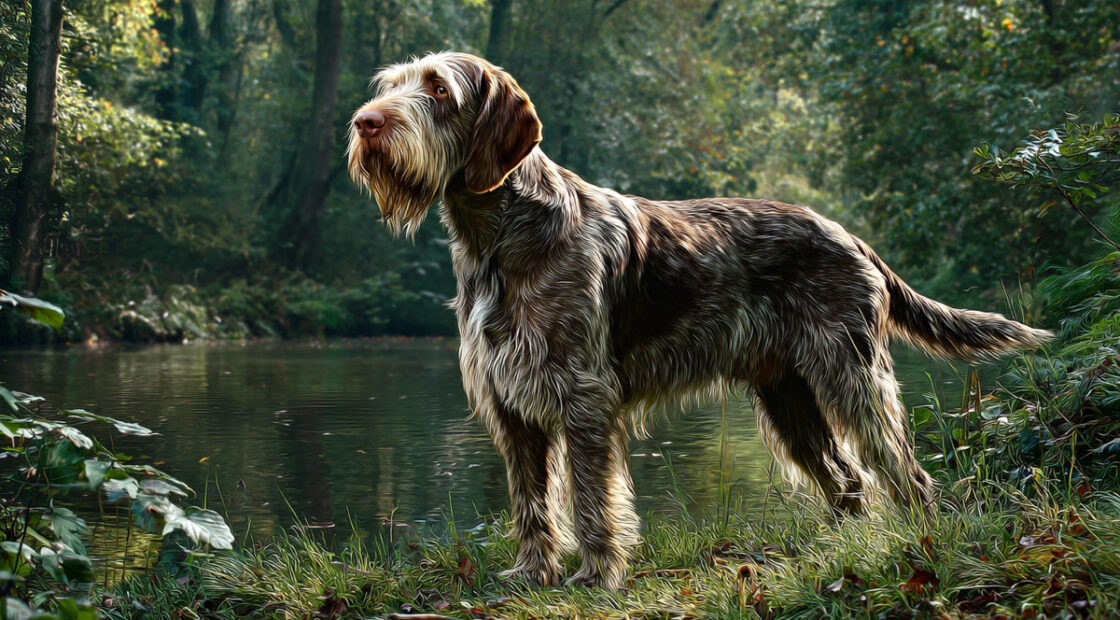
The American Kennel Club’s 2025 registration statistics rank the Spinone Italiano No. 90 of 202 breeds. That’s mid-table, nothing remarkable. The AKC still describes the gene pool as small, though, and that second detail is the one buyers should care about, because it puts breeder health testing first on the list.
The breed comes from Piedmont, Italy. Spinoni are big gundogs with wiry coats and full beards, and they track, point and retrieve through thorny cover and cold water at a steady trot. The temperament is calm and sociable. They suit hunters who work on foot, and households that can supply daily exercise.
What Is the Spinone Italiano?

Thick skin, a wiry coat and a full beard give the breed away at a glance. It’s an Italian gundog that tracks, points and retrieves game, bred for thorny cover and cold water, and it works at a steady trot instead of a gallop.
English-speaking owners also run into Italian Spinone, Italian Griffon and Italian Wirehaired Pointer, plus Italian Coarsehaired Pointer, which is the UKC’s alternate name. Say it Spee-no-nay. The plural is Spinoni Italiani, or just Spinoni (Spee-no-nee), and the AKC lists the breed under its Italian name with the Italian plural.
The Italian Griffon alias trips people up. The Wirehaired Pointing Griffon is a separate breed with its own standard, not a variant of the Spinone.
Nor is the Spinone a hound. Pointing dogs freeze when they locate game and wait for the hunter, and hounds pursue it.
Where Does the Spinone Italiano Come From?
Piedmont, in north-western Italy, is where hunters developed it as an all-terrain gundog. Past that point, the deeper ancestry is unsettled.
Origin and Post-War Revival
A French hunting writer, de Selincourt, said in 1683 that the best griffon dogs came from Italy and Piedmont (cited by the AKC). The UKC standard adds that dogs of this type show up in 15th-century art by well-known painters.
The name traces to Bracco Spinoso, “prickly pointer,” which probably refers to the wiry coat (AKC).

Many breed profiles date the Spinone to around 500 BC. The UK Kennel Club (now the Royal Kennel Club) says the ancestry is mostly speculation, with possible Italian hound, coarse-haired segugio, setter or mastiff input.
Treat the 500 BC figure as folklore. Project Upland points out that a few vague references to hunting dogs in obscure Greek poems do not prove an ancient origin.
World War II cut breed numbers sharply. The AKC’s breed history says a serious revival began in the 1950s, using systematic crossbreeding to restore the Spinone’s historical type and working ability.
Wikipedia’s breed history, citing the Club Italiano Spinoni, dates two Italian breed societies to this period. The Famiglia dello Spinone formed in 1949 and the Club Italiano Spinoni in 1973.
Registry Recognition and Dates

Continental Europe got there first. The North American registries were the last to come around.
| Registry | Group | Milestone |
|---|---|---|
| FCI | Group 7, Pointing Dogs (Standard 165) | Accepted 30 April 1955 |
| The Royal Kennel Club (UK; formerly The Kennel Club) | Gundog | Championship status in 1994 |
| UKC | Gun Dog | Recognized 1 January 1995 |
| AKC | Sporting | Recognized 2000 |
The AKC had shown Spinoni in its Miscellaneous Class since 1932. The UK championship date comes from the Italian Spinone Club of Great Britain.
The current AKC standard was approved on August 14, 2018 and took effect January 1, 2019. The UKC last revised its standard on January 1, 2007.
The FCI’s Standard 165 is dated 13 November 2015, the same date as the Italian text from Italy’s national kennel club, the Ente Nazionale della Cinofilia Italiana (ENCI). In the US, the Spinone Club of America acts as the AKC parent club.
Size, Coat and Colors of the Spinone Italiano
According to the UKC standard, males stand 23.5 to 27.5 inches at the withers and weigh 70 to 81 pounds, and females run smaller. The coat is a harsh, wiry single layer in white, orange or chestnut-brown patterns.
Size and Weight

The body is square, with length close to height at the withers. The standards agree on the shape and differ a little on the numbers.
The UKC puts males at 23.5 to 27.5 inches and females at 23 to 25.5 inches, while the FCI gives 60 to 70 cm for males and 58 to 65 cm for females. On weight, the UKC lists 70 to 81 pounds for males and 62 to 66 pounds for females. Coat length is 1.5 to 2.5 inches according to the AKC.
The FCI sets weight at 32 to 37 kg for males and 28 to 30 kg for females. That is lighter than the 34 to 39 kg and 29 to 34 kg ranges in the Australian standard published by Dogs Australia.
The UK Kennel Club adds a caveat to its own standard. A dog can come out larger or smaller than the stated measurements.
Coat Texture and Accepted Colors
The AKC standard demands a correct, harsh, single coat. Stiff hair frames the eyebrows, cheeks and muzzle, which gives the breed its bearded, almost human expression.
The UK Kennel Club points to thick skin and a coarse coat as what makes the Spinone recognizable on sight.
The UKC accepts pure white, white with orange markings, white speckled with orange, white with brown (chestnut) markings, and roan or roan-brown.
Both the AKC and the UKC disqualify black in the coat, tri-color coats and tan points. Under the UKC standard, the color of the external mucous membranes must match the coat.
What Is the Temperament of a Spinone Italiano?

Friendly and calm, and patient too, the Spinone is gentler than most pointing breeds. The FCI standard describes a dog that keeps working in thorny cover without tiring and stays easy to live with at home.
It’s a sensitive dog. The Spinone Club of America warns that methods that work on other breeds can ruin a Spinone. Maturity is slow, though the same club says the wait is worth it.
There’s a stubborn streak as well, usually showing up as a question about why it should fetch the thing you threw. And don’t buy one for protection, since the AKC says it is not geared to protection work.
Prey drive is real. Orvis’s breed guide says neighborhood cats and wildlife will tempt a Spinone, and without enough attention it will dig under or jump over fences.
With Children and Other Pets
The Westminster Kennel Club rates the breed 3 out of 5 for children and 4 out of 5 for other dogs.
The Spinone Club of America describes an almost magnetic attraction to children, yet advises never leaving small children alone with a Spinone or any other breed. Affection and unsupervised safety are separate questions, and a large, slow-maturing dog needs supervision on both counts.
A Spinone named Drago won the AKC Humane Fund’s 2013 Award for Canine Excellence in the therapy category.
How Much Exercise and Training Does a Spinone Italiano Need?
Plan on 1 to 2 hours of activity a day. UK sources set the bar higher, at more than 2 hours.
Daily Exercise

| Source | Daily exercise |
|---|---|
| The Kennel Club (UK) | More than 2 hours |
| PDSA | Ideally more than 2 hours |
| Spinone Club of America | An hour or two |
No source explains the gap. Start at an hour and add time until the dog settles at home.
The AKC’s breed guidance says a well-exercised Spinone is calm and relaxed indoors. An under-exercised one gets restless, and bored dogs turn destructive.
Mental work counts as much as miles. Retrieves, scent games, agility and obedience all give a working gundog a job.
Training Approach

The AKC’s breed history says gentle training based on positive motivation erases any sign of stubbornness and keeps the dog easygoing. Orvis’s breed guide agrees. The less a lesson feels like training, the better the Spinone cooperates.
Keep lessons short and fold them into walks. Praise and reward, and wait out the slow maturity.
Purina describes a dog that prefers training as you go over training as a hobby. Heavy-handed correction fails here, because a sensitive dog shuts down instead of obeying.
How Does the Spinone Italiano Hunt Compared With Other Pointing Breeds?
It hunts at a methodical trot close to the gun, pointing game, tracking it and retrieving from land and water. What it gives up is the speed of racier pointers, and what it gets back is steadiness in thick cover.
The AKC’s breed history calls it a methodical worker that always gets its bird, built as a trotter rather than a galloper.
Field Roles and Working Style

On point, the dog holds position on scent and waits for the hunter. It also tracks, following game through brush instead of only locating it. Retrieving covers land and water, and Purina’s breed profile notes that rough terrain and thick cover do not put it off.
The UK Kennel Club files the breed in the HPR subgroup of gundogs (hunt, point, retrieve). The Italian Spinone Club of Great Britain runs working tests and field trials under Kennel Club rules.
NAVHDA and Hunt Tests
The North American Versatile Hunting Dog Association (NAVHDA) judges dogs against a standard instead of against each other, and dogs move through the levels in order.
Natural Ability gauges inherited instincts in young dogs, including pointing, tracking and swimming. Next is Utility Preparatory, a mid-level test where training and obedience start to count. Utility is the full day on land and water, and it expects a fully trained dog.
A national-level Invitational Test sits above these, according to Project Upland’s test overviews.
Spinoni were registered with NAVHDA before the AKC accepted the breed, per the Spinone Club of America, and many owners still enter both NAVHDA and AKC events. The two organizations announced a reciprocal registration agreement in July 2007.
Spinone Italiano, Bracco Italiano and German Wirehaired Pointer
Hunters shopping for a pointing breed often end up weighing these against each other, and coat and pace separate them most.
| Breed | Coat | Energy |
|---|---|---|
| Spinone Italiano | Harsh, wiry single coat | Moderate |
| Bracco Italiano | Short, shiny coat | Higher |
| German Wirehaired Pointer | Harsh, wiry double coat | High |
The Bracco Italiano is Italy’s other native pointer. The Westminster Kennel Club rates its energy above the Spinone’s and its grooming needs below them.
The German Wirehaired Pointer offers a similar wire coat with more drive. The AKC calls it highly energetic, and Orvis’s breed guide recommends it for experienced owners with active lifestyles.
If speed is the priority, go with the Bracco. Stamina and drive point to the German Wirehaired Pointer. The Spinone suits a slower pace, and Vetstreet describes it as ideal for the hunter who walks.
How to Groom a Spinone Italiano
Brush the coat at least weekly and pull dead hair by hand when it’s ready to release. The beard, ears and nails go on the same routine. Skip the clippers.
Coat Care and Hand Stripping
Sources disagree on how often to brush. The Italian Spinone Club of Great Britain says ideally every day, especially for soft or thick coats that mat. PDSA suggests two or three times a week plus an occasional professional groom, and Vetstreet’s AKC-based profile says once or twice a week.
Start with a few sessions a week and move toward daily if the coat turns soft or starts to mat.
Hand stripping means pulling dead hair out with your fingers or a stripping tool. No source sets a fixed interval, and the British club says it is a fairly easy job once the coat is ready to come out.
The same club notes that grooming tools now exist that can stand in for hand stripping.
Trimming is the other split. The AKC-based breed guide at Orvis says regular trimming is unnecessary and can change coat texture, while Petfinder suggests an occasional professional groom to trim the face and feet.
If you hire a groomer, ask for stripping on the face and feet and keep clippers off the body.
Beard, Ears and Nails
Brush often around the beard and eyebrows to stop matting, per Showsight’s breed profile. The heavy, hanging ears hold moisture, and VCA calls cleaning them a necessity to avoid odor and infection.
Nails need regular trims too, because long nails split and crack painfully (Orvis).
A gentle dog ear wipe after swims and muddy days covers the routine part. Redness, a sour smell or constant head shaking means a vet visit, not another wipe.
Health Problems, Screening and Lifespan of the Spinone Italiano

The AKC lists hip and elbow dysplasia, cancer, hypothyroidism, epilepsy, cataracts, cerebellar ataxia and bloat as breed concerns. It also describes the Spinone as a rare breed with a small gene pool, which is why screening matters.
Joint Disease
In hip and elbow dysplasia the joint forms abnormally, which causes pain and lameness (WebMD). Both are screened for before breeding.
Hips are checked by OFA radiograph grading or by PennHIP laxity measurement. Elbows get OFA radiograph grading. OFA treats evaluations before age 2 as preliminary.
Cerebellar Ataxia
Ask breeders about this one before anything else. When two carriers mate, 25% of puppies are affected and 50% are carriers, on average, according to the AKC Canine Health Foundation.
Affected puppies are born normal. An unsteady gait, loss of coordination and poor balance usually appear around four months of age.
The disease worsens through the first year, most dogs are euthanized before they reach one, and no treatment exists.
Dogs with two normal copies are clear. They never develop ataxia and never pass it on. A carrier has one mutant copy, stays healthy itself, and passes the mutation to about half its offspring if bred. Two mutant copies means the dog is affected and develops the disease.
A carrier bred to a clear dog produces no affected puppies, so a carrier result alone is not a reason to reject a litter.
Bloat
Bloat is the emergency to plan for.
Gastric dilatation volvulus (GDV) means the stomach fills with gas and twists, and Cornell’s Riney Canine Health Center names large, deep-chested dogs as the most at risk. A swollen abdomen with unproductive retching needs a vet immediately.
Cornell’s list of risk factors includes eating too quickly, one meal a day, a raised bowl, and exercise soon after eating.
One of those is disputed. A 2016 Veterinary Evidence review by Louise Buckley found that most studies show eating speed has no effect on GDV risk, though fast eating was the risk factor wherever an effect appeared.
Both can be true, so the sensible response is cheap and low risk. Feed two meals, skip the raised bowl, keep exercise away from mealtimes, and try a slow feeder bowl for a fast eater.
Prophylactic gastropexy, which tacks the stomach in place, greatly reduces the risk, per Cornell. The Animal Health Trust ran an owner questionnaire on bloat, cancer and epilepsy in Italian Spinones because it lacked a clear picture of how often they occur.
Ear, Eye and Thyroid Conditions
Pendulous ears predispose the breed to otitis externa, which Petfinder rates a minor concern.
Sources split on eyelids. Vetstreet lists entropion (eyelids rolling inward) while Petfinder lists ectropion (drooping outward), and those are opposite problems.
Hypothyroidism is relatively common, with an unkempt coat, weight gain and lethargy as signs, and a vet blood test confirms it (WebMD).
Epilepsy is on the AKC’s list too. Genome-wide studies by the genetics team formerly based at the Animal Health Trust, most recently published in PLOS One in 2025, found no replicable DNA region linked to epilepsy in the Italian Spinone, so breeders have no DNA test to screen for it.
Screening Tests
The AKC’s list for the breed, which comes from the Spinone Club of America, covers hip evaluation, elbow evaluation and an ophthalmologist evaluation.
The UK Kennel Club’s Good Practice list asks for hip and elbow testing under the BVA/KC scheme, and it adds a DNA test for cerebellar ataxia.
The ataxia DNA test sits on the UK list but not the AKC’s. The UK Kennel Club dropped it as an Assured Breeder requirement in September 2020 after the Animal Health Trust’s closure limited which labs could run it, yet it still strongly recommends the test.
From 6 January 2025, the Kennel Club (now the Royal Kennel Club) registers imported Italian Spinones only if they are proven clear or carrier of ataxia, or have hereditary status in place. The Italian Spinone Club of Great Britain says testing is now available through the Canine Genetics team at Cambridge.
A CHIC number shows the required tests were completed, not that the results were normal, according to OFA researchers Keller, Dziuk and Bell. Ask to see the results themselves.
Why Lifespan Figures Disagree
Sources don’t agree on how long a Spinone Italiano lives, and the table shows how far apart they land.
| Source | Year | Reported lifespan |
|---|---|---|
| Dogs Trust-led study, Scientific Reports | 2024 | 11.9 years (median) |
| Westminster Kennel Club breed page | Current | Up to 12 years |
| Petfinder, PetMD and the Orvis (AKC-based) breed guide | Current | 10 to 12 years |
| Royal Canin and Dogs Victoria breed pages | Current | 12 to 14 years |
| UK Kennel Club health survey (Adams et al., 2010) | 2004 | About 9 years (median age at death; an older Wikipedia version cites 8.7) |
The 2024 figure is a median calculated from a UK dataset of 584,734 dogs, 284,734 of them deceased, and it sits close to the all-breed median of 12.5 years. The study covers UK dogs only.
The profile-page ranges state no method. The Kennel Club itself warns that breed-level results from its 2004 survey need cautious reading, since the overall response rate was only 24%.
Plan around the median of 11.9 years and treat 12 to 14 as the best case.
How Much Does a Spinone Italiano Puppy Cost, and How Do You Choose a Breeder?
Budget at least $1,000 for the puppy and plan to wait. PetMD puts the floor at that figure, and the Spinone Club of America says rarity means finding a puppy can take anywhere from a month to a year.
Listing sites publish wider ranges without showing their data. Ask breeders on the club’s referral list for current quotes instead.
Puppy Price and Ownership Costs
The puppy is the smaller bill. PDSA sets the minimum monthly cost of an Italian Spinone at GBP 105 in the UK.
Ownership costs run past the sticker price, and a dog gets expensive over its lifetime even without emergencies. A large, deep-chested breed also adds a bloat risk to the budget.
Read insurance exclusions before you buy. Policies that exclude hereditary conditions leave hip dysplasia and ataxia uncovered.
Choosing a Breeder

- Start with the Spinone Club of America’s breeder referral list. Members follow a code of conduct that prohibits sales to pet stores and wholesalers.
- Ask for hip, elbow and eye results on both parents, and look them up in the OFA public database. In the UK, the Kennel Club’s Health Test Results Finder does the same job.
- Ask for the ataxia DNA status of both parents. A carrier paired with a clear dog is acceptable, and two carriers are not.
- Meet both parents if you can, and check that every dog on the property is well cared for and socialized.
- Expect a waitlist. A seller with Spinone puppies always available on short notice is a warning sign for a breed this rare.
Walk away from any breeder who resists steps 2 and 3.
When Is a Spinone Italiano the Wrong Fit?

Skip the breed if you can’t guarantee daily exercise, someone home most of the day, a house that tolerates mess, and emergency vet access.
Start with exercise. The breed settles indoors only after a real outing, so a plan that falls apart in bad weather fails the dog.
Apartments are a poor match. The AKC-based guide at Orvis calls apartment living not ideal for a hunting breed that needs to run.
Long workdays are less clear-cut. The same guide says a well-exercised dog can manage a working day alone, sometimes with a crate, while Dogs Victoria says the breed dislikes long absences.
Bloat needs immediate surgical care, per Cornell, so living far from an emergency vet is a real problem. And Petfinder’s ideal owner is relaxed about mud, water residue and shedding. If you aren’t, this isn’t your dog.
Sources split on first-time owners. Petfinder and Purina both describe the breed as suited to owners with some experience, while the German magazine zooplus says active beginners can do well.
VCA’s profile adds that owners should be willing to enlist a trainer or mentor. A first-time owner can succeed with a sensitive, slow-maturing dog when gentle methods and a mentor are in place. Without both, choose an easier breed.
Households with small children or frail adults need extra care, since Petfinder says the breed’s size and slow maturity make it a weaker fit for them.
Spinone Italiano FAQ
Does a Spinone Italiano drool?
Yes, some. Purina lists the breed as a light drooler, and Petfinder says the ideal owner stays relaxed about drool, mud and water dripping from the beard.
Sudden, heavy drooling with retching is different. A Cornell emergency-care lecture lists thick, ropey saliva among the signs of bloat.
Is the Spinone Italiano hypoallergenic?
No. The Italian Spinone Club of Great Britain states that a Spinone sheds and is not hypoallergenic, and WebMD rates the shedding as moderate.
Regular brushing and baths reduce loose hair and allergens, but they do not remove them.
How long does a Spinone Italiano take to grow up?
Slowly, in body and mind. Purina calls the breed slow maturing, and Petfinder tells owners to bring patience for the same reason.
The sources that cover it give no single age for full maturity, so keep training short, consistent and positive while the dog catches up.
Can you adopt a Spinone Italiano from a rescue?
Yes, though dogs are rare. The Italian Spinone Club of Great Britain runs a rehoming service, and Healthy Paws points US adopters to a breed rescue group that operates through a private Facebook page.
Ask any rescue for hip, elbow and ataxia history, since an adopted dog may lack screening records.
How should you feed a Spinone Italiano to avoid weight gain?

Measure portions and grow puppies slowly. The Italian Spinone Club of Great Britain warns that puppies convert food energy into fat efficiently, and it says high-protein or giant-breed diets are thought to speed growth and strain joints.
Purina adds that large dogs need a different nutrient balance than small breeds.
Getting a Health-Tested Spinone Italiano Puppy
The order that works is to join a waitlist with a Spinone Club of America referral breeder first, then confirm both parents’ results before paying a deposit.
- Contact referral breeders and join litter waitlists.
- Check both parents’ hip, elbow and eye results in the OFA database.
- Collect written ataxia DNA status for both parents.
The waitlist comes first because waiting is the slowest step, and verification can run alongside it. The deposit comes after verification because payment commits the buyer to that litter.
The cost of this order is patience, since a puppy from a verified litter arrives later than one bought from an open listing.
The sequence changes if the AKC adds the ataxia DNA test to its listed screening for the breed, a step not taken as of October 2026.