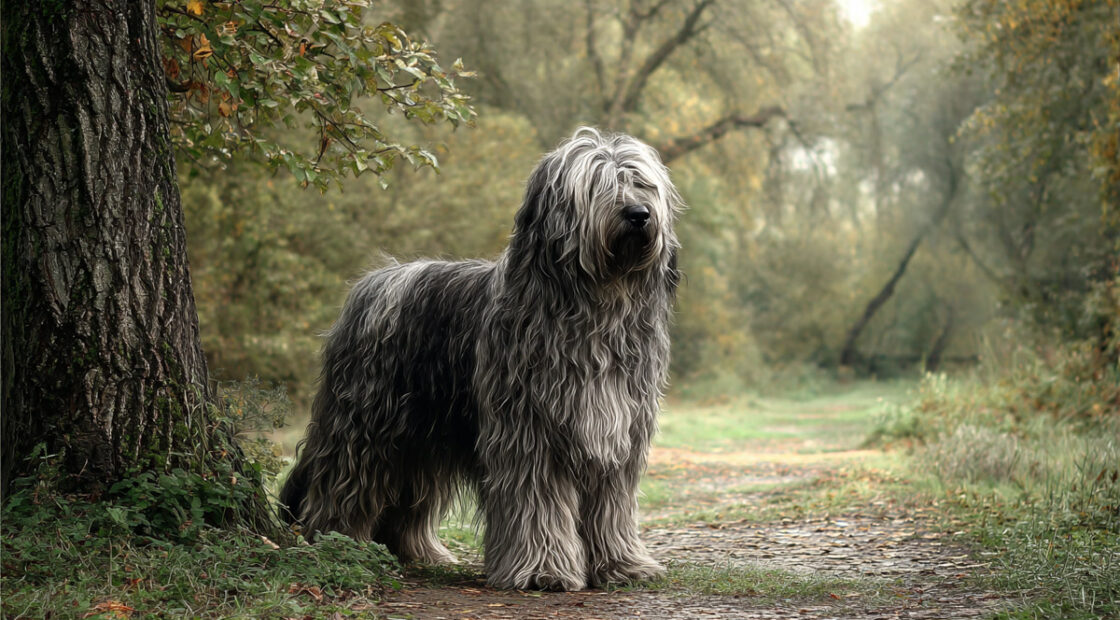
A Bergamasco is hard to mistake for any other dog. This Italian herding and guarding breed grows goat hair, wool and undercoat that felt into flat mats called flocks. The FCI classifies it in Group 1 (Sheepdogs and Cattledogs), and the AKC places it in the Herding Group.
Alpine shepherds used these dogs to drive livestock between mountain pastures and the Po Valley plains. After World War II the population nearly disappeared, and Dr. Maria Andreoli rebuilt it through selective breeding.
The earliest dated evidence in the FCI standard (2020) is a sixteenth-century painting, and the first dogs entered the Italian Stud Book in 1891. Neither standard gives a dated record for the widely repeated 2,000-year figure, which the AKC standard repeats without naming a source.
What is a Bergamasco?
The Alpine and pre-Alpine valleys around Bergamo produced this dog, and that is still where the densest numbers sit. Its coat is the first thing anyone notices. The FCI lists it as the Cane da Pastore Bergamasco (English name: Bergamasco Shepherd Dog), while the AKC registers it as the Bergamasco Sheepdog.
On paper, the FCI puts it in Group 1, Sheepdogs and Cattledogs, Section 1 (Sheepdogs). The AKC files it under the Herding Group.
The FCI standard states the job in one line: drive and guard herds and livestock. One shepherd with a few dogs could tend hundreds of sheep, so the dogs had to decide for themselves, according to the Bergamasco Sheepdog Club of America.
Bergamasco origins and the post-war revival
The breed developed in the Italian Alps, nearly disappeared after World War II, and was rebuilt by Dr. Maria Andreoli. Documented records for the earlier history are thin.
Origin theories and where the sources disagree
The AKC’s breed article traces the dogs to Persia, in what is now Iran, where nomadic shepherds moved with their flocks before some settled in the Italian Alps.
The FCI standard tells it differently. It describes an ancient herding dog already widespread across the Italian Alpine and pre-Alpine regions.

The earliest dated evidence the FCI cites is a sixteenth-century painting, and the first dogs entered the Italian Stud Book in 1891. The AKC standard says the breed’s origins go back almost 2,000 years but names no document.
Breed profiles also argue over the Briard. Some say the French herder descended from Bergamasco stock, and others say the reverse (Wisdom Panel).
My read is that the sixteenth-century painting is the earliest documented anchor. The Persian route and the 2,000-year figure are traditions, and neither standard backs them with a dated record.
Decline after World War II and Maria Andreoli’s work
The breed lost its job before it lost its bloodlines.
- Wool production fell after World War II, so fewer shepherds needed working dogs (AKC).
- Dr. Maria Andreoli, a geneticist, bred over 500 dogs under her Dell’Albera kennel (Bergamasco Sheepdog Club of America).
- She wrote Il Bergamasco, Pastore delle Alpi, and the club says the AKC standard reflects her work.
- Her breeding also brought the breed to the United States (AKC).
Every registered Bergamasco today descends from the stock that survived this period.
Which kennel clubs recognize the Bergamasco?
The FCI, the AKC, The Kennel Club in the UK and Italy’s ENCI are the four registries that matter most.
| Registry | Group | Status |
|---|---|---|
| FCI | Group 1, Section 1 (Sheepdogs), with working trial | Accepted definitively 23 February 1956; standard published 4 September 2020 |
| AKC | Herding Group | Full recognition announced December 2014, effective 1 January 2015; standard effective 4 May 2022 |
| The Kennel Club (UK) | Pastoral Group | Listed as Bergamasco (Imp) |
| ENCI (Italy) | Country-of-origin registry | Publishes the breed description as Cane da Pastore Bergamasco |
The FCI and AKC texts differ on body proportion and on when flocks begin to form.
How big does a Bergamasco get?
Males stand about 60 cm (23.5 in) and females about 56 cm (22 in) at the ideal, and adults weigh 26 to 38 kg (57 to 84 lb).
- Males have an ideal height of 60 cm with a 2 cm tolerance (FCI). The AKC lists 23.5 in as ideal and accepts 21 to 25 in.
- Females have an ideal height of 56 cm with a 2 cm tolerance (FCI), or 22 in ideal with 21 to 25 in accepted (AKC).
- Males weigh 32 to 38 kg (70 to 84 lb) and females 26 to 32 kg (57 to 71 lb).
- Body length equals height under the FCI standard. The AKC wants it 5 to 6 percent longer than tall.
The ideal heights match once units are converted, since 23.5 in is 59.7 cm and 22 in is 55.9 cm. The difference is tolerance. The FCI window is 4 cm wide per sex, while the AKC accepts roughly 53 to 64 cm.
The AKC disqualifies dogs under 21 in once they pass 12 months. It treats anything over 25 in as a fault.
On proportion, the FCI standard describes a square dog and the AKC standard asks for a body slightly longer than tall. That longer outline matches what Andreoli preferred, per the Swedish Kennel Club’s 2023 judges’ compendium.
Both standards call the breed medium-sized. Abundant head hair makes the head look large (FCI), and the full coat adds bulk beyond the figures above.
The FCI also lists lack of sexual dimorphism as a fault, so a visible size gap between males and females is part of the type.
How does the Bergamasco coat form flocks?
Goat hair and woolly hair weave together over a short undercoat, and the mix felts into flat mats that keep growing for years. Those mats are the flocks.
Hair types
The AKC standard (effective 4 May 2022) splits the coat by hair type. Underneath sits a short, dense, fine undercoat that lies against the skin and works as a waterproof layer. On top, goat hair is strong and rough and stays smooth without tufting, while the finer woolly hair grows in tufts and weaves into it to form the flocks.
Distribution is uneven. Goat hair dominates the head, top of the neck and withers, so flocks are fewer and smoother there. Wool is abundant on the rear body and legs, which is where flocks pile up.
The FCI adds that the woolly coat does not moult and traps the undercoat. Traditionally the mats also shielded the dog from wolf bites while it tended sheep in the mountains (AKC).
Flock formation timeline

| Age | Coat stage | Source |
|---|---|---|
| Birth to about 10 to 12 months | Soft, short puppy coat | AKC standard |
| 9 to 10 months (AKC) or 12 to 15 months (FCI) | Goat hair and wool arrive, flocks begin to form | AKC and FCI standards |
| About 3 years | Flocks long enough for the signature look | AKC standard |
| 5 to 6 years | Flocks can reach the ground | AKC standard |
The two standards disagree on the start. The AKC dates new goat hair and wool to 9 to 10 months, while the FCI dates flock formation to 12 to 15 months.
Sources split on the ground-length figure too. VCA Hospitals says about 5 years, Purina says 6, and the AKC standard gives the range.
If you’re planning around this, count on the first separation at 9 to 12 months and the full look around age 3. Young dogs are not penalized in the ring for flocks that have not lengthened yet.
Accepted colors
Puppies are born solid gray or in gradations of gray, including merle, up to solid black (AKC standard).
Most black puppies lighten to gray because of a fading-black gene, though a few stay black. Flocks examined at the roots must be black or gray.
- Tawny or fawn tinges at the flock ends come from sun, water and aging hair, not from the base color.
- Isabella and light fawn tinges are permitted (FCI).
- Solid white is not allowed, and white on more than one-fifth of the body is a disqualification in both standards.
Flocks versus cords: Komondor and Puli
Flocks are somewhat flat, irregular mats that sometimes open in a fan shape at the tip (AKC standard). The AKC’s earlier standard put their width at about 1.5 to 3 inches.
The AKC lists the cord-coated Komondor and the Bergamasco among its corded breeds, but says the Bergamasco’s flocks are a different form of cording.
The Puli differs on one rule. Its standard allows showing the coat brushed out, while the Bergamasco standard says the wool is never brushed out.
How to groom a Bergamasco

The coat gets separated by hand once around the first birthday, then checked weekly for 6 months, then bathed 1 to 3 times a year. Brushing, combing and shaving are out.
- Separate the coat into individual flocks by hand when the goat hair and wool come in, usually around 1 year. Expect several hours.
- Check weekly for the next 6 months so the flocks do not grow back together.
- Leave the flocks unbrushed and pick burrs and debris out by hand.
- Bathe 1 to 3 times a year, and only after the flocks are separated.
- Dry the coat completely with fans.
- Trim nails, check ears, brush teeth.
Timing and bathing frequency come from the AKC and the Bergamasco Sheepdog Club of America.
Ripping the coat
Ripping pulls the felting coat apart into separate flocks so it does not set into one giant mat (VCA Hospitals).
Timing advice varies. The AKC says around 1 year, the AKC standard says human help is usually needed once goat hair and wool start at 9 to 10 months, and the breed club warns against ripping fully too soon.
Skip the separation and the coat felts into one large mat. Rip too early and you get premature setting and weaker flocks in the adult coat (breed club). Leave it unchecked afterward and the flocks grow back together, which is why the AKC recommends weekly checks.
Bathing and drying
The breed club puts bathing at 1 to 3 times a year. Drying is where owners lose the time.
A breeder quoted in Showsight describes needing a hot, dry, windy day or industrial fans so the flocks do not mildew. The same breeder says flocks under the belly and around the rear soak up urine unless trimmed, which means occasional spot baths.
Skip baths while the coat is developing. The club says water can shrink and tighten the young coat, and without full separation air cannot circulate for proper drying.
Never shave. The AKC standard says the coat is never shaven, and the club adds that shaving removes temperature regulation and regrowth turns into a mess of mats.
Hygiene trims and thinning are acceptable when the coat hampers movement, and the club says a trim to 4 to 5 inches keeps the flock structure intact.
Nails and teeth need the usual attention (VCA Hospitals). Ears get a look after every bath, and a gentle ear wipe made for dogs is handy for routine cleaning.
Does the Bergamasco shed, and is it hypoallergenic?
It sheds little, because the woolly coat does not moult and traps loose undercoat. No breed is proven hypoallergenic, though.
Breed sources lean optimistic. Purina calls the coat considerably hypoallergenic, and the breed club says many people allergic to other dogs are not bothered by it.
The research is less friendly. A 2011 study in the American Journal of Rhinology & Allergy compared homes with dogs from breeds listed as hypoallergenic against other homes and found no difference in dog allergen levels (Nicholas et al.). Of the 173 homes in that study, 163 had detectable levels of Can f 1, the major dog allergen.
Allergy response varies by individual dog and person. Spend several hours with the specific dog before committing.
Bergamasco temperament and working traits

This is a calm, watchful guardian that bonds closely with its family and reads strangers before accepting them. It needs a steady daily workload more than a hard one.
Herding and guarding behavior

The AKC standard calls the Bergamasco a drover and a guardian, and moving livestock while protecting it explains most of what owners see at home.
The baseline is a patient, even temperament paired with strong determination (AKC standard). The dog can look aloof while it keeps track of everything around it.
Strangers get a slower welcome. The FCI standard calls a slight natural diffidence typical of some sheepdogs, and Vetstreet says the dog accepts strangers once introduced. Both standards rule out aggression without cause, and fearfulness too.
The same determination shows up as stubbornness. The AKC standard says the breed can display indifference to attempts to engage its attention.
Expect negotiation more than instant compliance.
Exercise and training

Sources disagree on exercise, from none at all to an hour or more.
| Source | Exercise position |
|---|---|
| iDog breed database | Serene and watchful, no special exercise needs |
| Vetstreet | A moderate to long walk or active play daily |
| Pangovet | At least an hour of daily exercise |
The AKC standard points to the answer. It describes a steady, slow trot that the dog holds for long periods without tiring, built for resistance and not for speed.
Plan for long, steady outings. Vetstreet calls the breed a natural at hiking in the mountains.
Training starts the day the puppy comes home (Vetstreet). Socialize widely, because a poorly socialized dog can turn suspicious of anything unfamiliar. Dogsey describes harsh handling as ineffective with this sensitive dog, so kind, firm and consistent methods win.
Omlet advises owners to display authority so the dog does not rank itself above the family. The AKC describes a partner, not a subordinate, and a dog bred to work without commands responds better to motivation than to dominance.
Bergamasco health problems and lifespan
Documented concerns are hip dysplasia, elbow dysplasia and gastric dilatation-volvulus (bloat), and published health data for the breed is thin. The Bergamasco Sheepdog Club of America says no known disease affects the breed as a whole, while a breeder interviewed by Showsight describes ongoing hip problems.
Documented conditions
Hip dysplasia is flagged in Royal Canin’s breed library, and it is the reason the club recommends hip testing before breeding. Royal Canin lists elbow dysplasia next to it, and the AKC’s herding group health list includes an elbow evaluation.
Royal Canin also names bloat (GDV) for the breed, which IVIS describes as sudden, dramatic and often fatal.
Degenerative myelopathy is a smaller story. No breed-wide problem is reported, but the club recommends DNA testing before it becomes one.
The Kennel Club’s 2024 annual hip report lists 27 Bergamascos scored over 15 years, with a mean score of 14.1, a median of 11 and a worst score of 54.
Lower scores are better. The same report shows a mean of 7.2 for the Akita and 9.4 for the Bearded Collie.
Twenty-seven dogs is a small sample, and it describes screened dogs, not the whole population.
FCI describes the chest as broad and deep, reaching the elbows. IVIS names chest conformation as the leading bloat risk factor, and also lists single large meals and raised bowls.
VIN adds rapid eating to that list, so a slow feeder bowl covers the eating-speed factor directly. Ask any breeder about bloat in the lines (Vetstreet).
Screening tests breeders should run
Each organization names its own test list, and none of them matches the others.
| Organization | Hip test | Other tests |
|---|---|---|
| AKC herding group health list | Hip evaluation | Elbow evaluation, DM DNA test |
| Bergamasco Sheepdog Club of America | PennHIP preferred, not before age 2 | DM DNA test |
| NBSA | OFA evaluation on both parents | Recent eye exam by a veterinary ophthalmologist |
The club’s own pages differ too. Its health statement recommends DM testing, while its breeder page calls PennHIP the only recommended test.
The Canine Health Information Center, run by OFA with the AKC Canine Health Foundation, tracks tests that national clubs recommend. Check OFA’s breed list for the Bergamasco’s current status.
Ask for a hip result, a recent eye exam and DM status. A breeder who documents all of them is the safer pick.
How long Bergamascos live
Breed profiles, Wisdom Panel’s among them, give 13 to 15 years without citing a longevity survey. A small population makes any average fragile.
Weight control matters. Vetstreet calls an appropriate weight one of the easiest ways to extend life, and since flocks hide body shape, you have to check the ribs by hand. Bloat is an emergency whenever it happens.
Plan for a dog that stays in the household into its early teens.
Is a Bergamasco the right dog for your household?

It suits a home where someone is around most of the day, the climate is not hot and humid, and children are old enough to be supervised around a herding dog. Long workdays and humid summers are the poor fits.
What works in its favor
- It forms a close bond with its family and is described as protective, tolerant and patient with children (AKC).
- The temperament is calm and even (AKC standard).
- It is not a high-energy breed (Royal Canin).
- Reported lifespan runs long, at 13 to 15 years.
What counts against it
- It does poorly without human company and should not live outdoors (Bergamasco Sheepdog Club of America).
- Very hot, humid climates are a poor fit (club).
- Swimming and frequent wetting work against the coat (club).
- The herding instinct calls for caution around small children and other animals (club).
- Health data is thin, and waiting lists are the norm.
Heat tolerance is a source conflict. The AKC says Bergamascos stay cool in warm summers, while the club says to avoid very hot, humid climates.
Humidity is the condition the club names, so ask a breeder how their dogs cope where you live.
Children are another split. The AKC calls the breed excellent with them, the club advises caution around smaller children, and Petfinder says very small children can be treated as livestock without training and supervision.
Who should not get a Bergamasco
- Households empty most of the day (the club says the dogs do poorly without company, and Omlet calls them unsuitable for long absences)
- Owners in very hot, humid regions
- Anyone who wants a swimming or water-sports dog
- Homes with toddlers and no time to supervise
- Allergy-sensitive households counting on the coat, since the club notes pollen, dander and other environmental allergens can cling to it
Several profiles recommend an experienced owner, Pangovet and Petfinder among them. That advice is sound for a first dog, since an independent herding breed rewards handlers who already know how to train one.
How to find a Bergamasco puppy and vet a breeder
Start with the Bergamasco Sheepdog Club of America’s breeder list and expect a waiting list, since the club says most breeders keep one. Member breeders coordinate and share expected litter information.
Canadian buyers can use the Bergamasco Shepherd Association of Canada, whose breeders post most health scores publicly on the OFA site.
Ask for OFA or PennHIP hip results on both parents, plus grandparents where available (NBSA), and a recent eye exam from a veterinary ophthalmologist (NBSA). Ask about the incidence of bloat in the lines (Vetstreet). The club also wants a written contract with a health guarantee.
Expect questions back. Artos Bergamascos, for one, asks new owners to complete a questionnaire before considering them for a puppy.
Vetstreet says to walk away from any breeder who offers no health guarantee, calls the breed 100 percent healthy, or keeps puppies isolated from the household.
Alp Angel Bergamascos’ Jeanine Dell’Orfano tells buyers to meet the breed in person and ask for proof of health testing before committing (Showsight).
Many problems do not show in puppyhood, so an adult dog rules most of them out (Vetstreet).
The purchase price is the smaller part of the bill, because what a dog costs over its lifetime accumulates across a 13 to 15 year life. Ask each breeder what the price includes, such as health testing, the contract and registration.
Bergamasco FAQ
Is Bergamasco also the name of a town?
Yes. There’s a small comune in Piedmont, in the province of Alessandria, with the same name.
The dog’s name points elsewhere. The FCI says the breed was most common in the valleys of the Bergamo region.
How rare is the Bergamasco in the United States?
Rare. The AKC’s 2025 registration rankings place the Bergamasco Sheepdog at No. 183 of 202 breeds, up 17 spots from No. 200 in 2024.
A low rank reflects few registrations, since the AKC builds the list from registration statistics.
Why does the Bergamasco have such long eyelashes?
They keep forehead hair off the eyes. Both the AKC and FCI standards describe lashes long enough to lift hair falling over them.
Purina adds that the lashes protect against snowblindness, a function the standards do not state.
Do Bergamascos bark a lot?
No, they bark mainly at arrivals. A breeder quoted in Showsight says the dogs bark when someone comes to the door and settle once the family accepts the visitor.
The iDog breed database lists the barking level as barks when necessary.
Can a Bergamasco work as a therapy or search and rescue dog?
Yes. Royal Canin says the breed’s placid manner suits therapy work and its physical power suits search and rescue.
VCA Hospitals calls Bergamascos excellent candidates for therapy training. Programs set their own temperament tests, so check requirements before enrolling.
Planning the First Year With a Bergamasco
The first year goes best in a fixed order. Verify the parents’ health records before you buy, start socializing the day the puppy comes home, and get the coat separated by hand inside a 9 to 15 month window.
Parent records come first because the results exist only before purchase. Socialization follows on arrival, since training starts at home.
The window joins the AKC standard’s 9 to 10 months for new goat hair with the FCI’s 12 to 15 months for flock formation, a range neither states. Separation at 12 months means weekly checks until about 18 months.
The trade-off is a waiting list and an untidy adolescent coat. A Showsight breeder interview mentions club work on the US standard, and the current AKC version took effect 4 May 2022, so recheck coat timing against the current text (this plan matches that version, verified October 2026).
Feeding comes next, and a comparison of puppy food brands covers it.