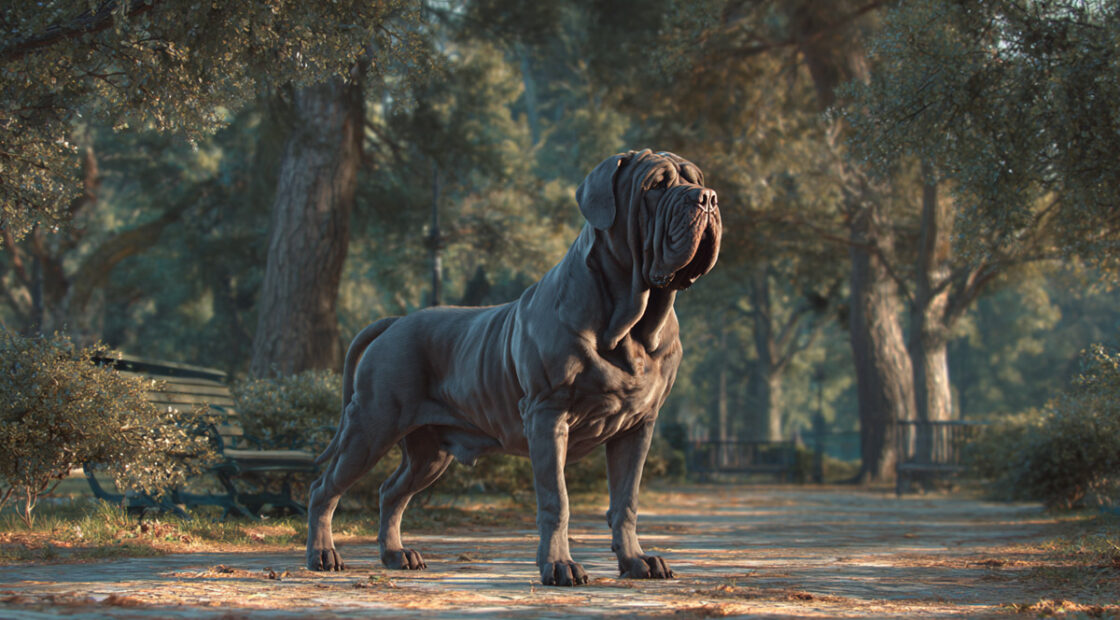
Italy’s Mastino Napoletano is a giant guardian dog of the molosser type. It protects a property with sheer mass and loose, heavily folded skin, and most owners just call it a Neo.
Estate owners around Naples relied on the breed for guard work. The modern line traces to a 1946 Naples show where eight dogs were exhibited, and the AKC admitted the breed to the Working Group in 2004.
Lifespan runs short. The median is 9.3 years, against 12.7 years for purebred dogs overall (McMillan et al., Scientific Reports, 2024).
What Is the Neapolitan Mastiff and Where Does It Come From?
Italy is the country of origin, and the name comes from Naples (AKC breed history).
The FCI lists the breed as Mastino Napoletano, standard number 197, with protection and guard work as its stated use.
Names and Classification
Italians say Mastino Napoletano. Owners and breeders shorten it to Neo, and you will also run into Italian Mastiff. Back in Naples, before the breed had any standard, it went by cane da presa, the “catch dog.”
Registries file it differently. The AKC puts it in the Working Group, the United Kennel Club uses its Guardian Dog Group, and the FCI places it in Group 2, Section 2.1 (molossoid breeds, mastiff type).
Ancestry and the Roman War Dog Claim
The FCI says the dog descends from the great Roman mastiff described by Columella in the first century A.D., spread across Europe by the legions (FCI Standard 197, 2015).
The UKC goes much further back and calls it a direct descendant of the Molossus war dogs of the ancient Middle East, from Sumeria, Assyria, Phoenicia and Babylonia (UKC standard, revised 2017).

The AKC is more careful. Descent from the Roman war dogs is unproven, although for this breed the claim might actually be true (AKC breed history, updated October 2024).
Royal Canin, and an AKC breed-profile article, trace distant ancestors to around 3,000 BC, a date none of the three breed standards repeat.
My read is that the type is old and the registered line is not. Dogs NSW counts it among the oldest recognizable dog breeds, yet documented pedigrees only begin in the 1940s.
Standardization and Kennel Club Recognition
The modern breed starts at one dog show. In 1946, the first postwar show at Castel dell’Ovo in Naples exhibited eight “cani da presa”, and the judges were largely unimpressed (AKC breed history).
The Swiss journalist and fancier Piero Scanziani singled out a blue dog named Guaglione. He became the first registered Neapolitan Mastiff and the first Italian champion, and the first standard was modeled on him.
| Date | Milestone | Source |
|---|---|---|
| 1946 | Naples show exhibits eight dogs, Scanziani picks Guaglione | AKC breed history |
| 1947 | Selective re-breeding begins | FCI Standard 197 |
| 8 March 1956 | FCI accepts the breed on a definitive basis | FCI nomenclature |
| 1 January 1995 | UKC recognition | UKC standard |
| 1 May 2004 | AKC regular status, Working Group competition from 1 July 2004 | AKC press release |
ENCI, the Italian kennel club, publishes the Italian translation of the FCI standard, in force from 1 January 2016.
How Big Does a Neapolitan Mastiff Get?
Males stand 26 to 31 inches at the shoulder and average 150 pounds, while females stand 24 to 29 inches and average 110 pounds, according to the AKC standard (AKC, 2004).
The FCI gives metric ranges. Males run 65 to 75 cm and 60 to 70 kg (about 132 to 154 lb), and females run 60 to 68 cm and 50 to 60 kg (about 110 to 132 lb) (FCI Standard 197, 2015).
Full maturity takes 3 to 4 years (Hill’s Pet Nutrition). Slow growth like that stretches exercise limits well past the first birthday.
The registries disagree on the ceiling. The AKC standard calls weight above the average usual and preferable as long as proportion and function hold, and it penalizes a lack of massiveness severely enough to eliminate a dog from competition.
The FCI caps males at 70 kg (about 154 lb) and treats size outside its limits as a severe fault. The UKC lists the same 132 to 154 lb for males and 111 to 132 lb for females, and it counts overweight as a serious fault. The UK Kennel Club standard runs 110 to 154 lb with some tolerance.
So three of the four standards cited here stop near 154 lb for males. Only the AKC rewards bulk, which is why profiles listing up to 200 lb (Vetstreet) describe a number no other standard uses as a ceiling.
Coat, Colors and Skin Folds
The coat itself is short, dense and flat. Skin is what you notice, loose over the whole body, heavily folded on the head and drawn into a double dewlap under the neck.
The AKC allows hair up to 1 inch, while the FCI (1.5 cm) and the UKC (five-eighths of an inch) hold it near 1.6 cm. None of the three permits fringe.
| Standard | Colors listed | White markings |
|---|---|---|
| AKC (2004) | Gray (blue), black, mahogany, tawny; brindle must be tan (reverse brindle) | Chest, throat, underside, toes, backs of pasterns |
| FCI 197 (2015) | Preferred grey, lead grey, black; also brown, fawn, deep fawn; any may be brindled | Small patch on chest and toe tips |
| UKC (2017) | Gray, lead, black, mahogany, tawny, tawny stag; any may be brindled | Small patches on chest and toe tips |
On folds, the AKC standard names two sets. One runs from the outside margin of the eyelids to the dewlap, the other from under the lower lids to the outer edges of the lips.
The FCI marks the fold from the outer eye corner to the lip corner as the most typical. It also limits the dewlap so it starts at the lower jaw and stops above the middle of the neck.
All three standards disqualify a dog with no wrinkles, folds and dewlap. They also set a limit at the other end. The FCI bars skin so abundant it interferes with health and disqualifies entropion and ectropion, and the UKC wants the eyes free of excess folds.
That limit exists for a reason. Mario Querci, a Tuscan textile maker, used his knowledge of how fabric drapes to fix the facial fold pattern a few years after the first standard, and his Caligola di Ponzano won the 1992 World Dog Show in Valencia over some 6,600 dogs.
AKC’s history says the breed then drifted toward loose, flaccid skin until an international correction pulled it back toward soundness. The Royal Kennel Club (UK) still lists the breed under Breed Watch Category 3, for features that cause trouble when exaggerated.
Ears and tails are where the standards split. The AKC allows cropped or uncropped ears (usually cropped) and a tail docked by one third. The FCI calls the ears natural and disqualifies a missing tail, while the UKC penalizes no dog for natural ears or a full tail.
Upkeep is light on hair and heavier on folds. The Royal Kennel Club lists weekly grooming and notes the breed sheds. Moisture and drool collect in the folds, so they need drying after baths.
Neapolitan Mastiff Temperament With Family, Strangers and Other Animals
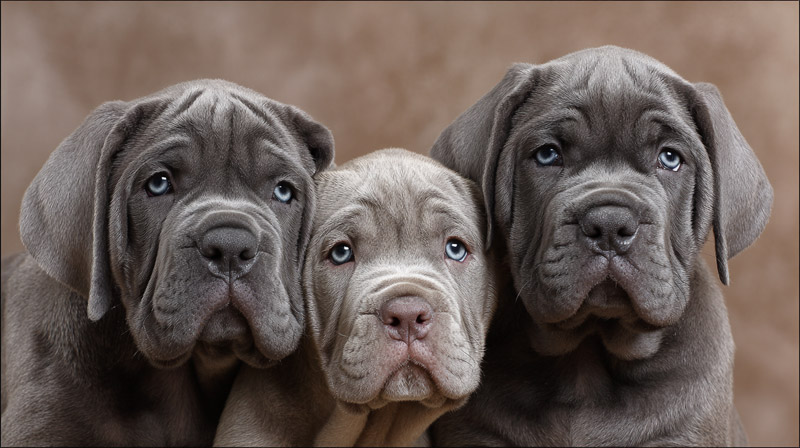
Not aggressive by definition. The FCI standard calls the breed steady and loyal, and it disqualifies aggressive or overly shy dogs.
The AKC standard adds that the dog is not apt to bite without reason, stays watchful, and does not welcome strangers into its personal space. Calm yet wary is the attitude it describes.
Guides split on families and children. Wisdom Panel says the breed is good around children and other pets with proper socialization and training, and Wamiz calls it gentle and safe around children but challenging when provoked. Burke’s Backyard is less relaxed, saying it is not a child’s dog, though fine with families when adults are in charge. Dogster points to low-activity families with older kids.
The disagreement is about size, not mood. A 110 to 150 lb dog can flatten a toddler without any ill intent, so supervision rules apply whatever the temperament.
Behavior with other animals is a gap. Neither the AKC nor the FCI standard says anything about it, so that part of the temperament comes from socialization and the individual dog’s line.
How to Train and Exercise a Neapolitan Mastiff
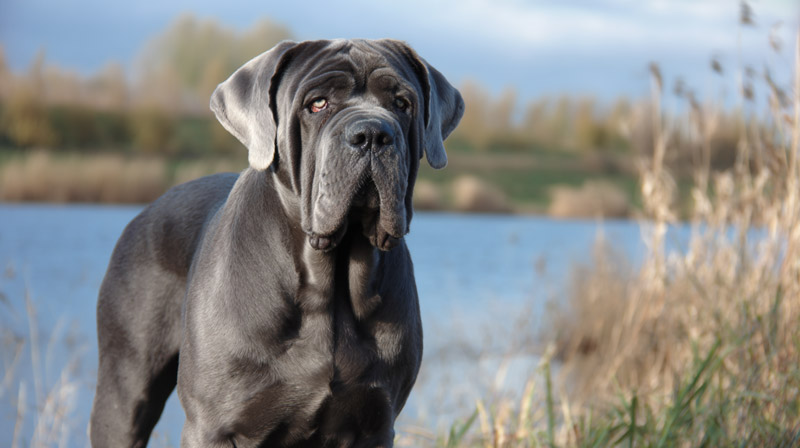
Socialization starts early, at 7 to 8 weeks. Puppy exercise stays short until the growth plates close, and training works best on rewards alone.
AVSAB’s 2008 puppy statement names the first three months as the primary window and supports classes from 7 to 8 weeks, with at least one vaccine set given a week earlier.
A breed whose standard asks for calm but wary behavior around strangers needs that early exposure to many people and places. AVSAB links incomplete socialization to fear, avoidance and aggression later in life. If I had to rank everything in this section, I’d put this window first.
Obedience takes patience. Wisdom Panel describes the breed as stubborn and strong-willed, and AVSAB ties reward-based training to fewer behavior problems than punishment. That matters more with a dog that can outweigh its handler.
Adults need up to 1 hour of exercise per day, according to the Royal Kennel Club. The FCI and UKC standards both note the breed rarely gallops, so this is a walker, not a jogging partner.
For puppies, skip long jogs, hikes and jumping until the growth plates close (VCA Animal Hospitals says giant breeds may wait closer to 1.5 years). A starting ceiling of 5 minutes per month of age, up to twice a day, comes from a UK Kennel Club rule of thumb (per Purdue’s canine welfare center). Let the puppy set the pace.
That rule is a guideline, not a measured limit. A veterinarian writing for Dogster notes no research-backed standard exists by age and breed, so the vet’s read on your own dog outranks the formula.
Boredom has a cost too. Vetstreet warns that a bored Neapolitan Mastiff turns destructive, so pair walks with short training sessions and play.
Neapolitan Mastiff Health Problems and Why Lifespan Figures Differ

The documented problems start with joints and eyelids, then move on to bloat, infections in the skin folds and heart disease. Published lifespan figures for the breed also disagree by several years.
Joint and Eye Conditions
Joints and eyelids are where screening data exists, and it is thin.
In the BVA/Kennel Club Elbow Dysplasia Scheme statistics (2025 edition), 11 of 28 graded Neapolitan Mastiffs scored grade 1 to 3. That is a 39% rate against 23% for the Mastiff. Grade 1 means mild or early osteoarthritis, and grades 2 and 3 mean marked osteoarthritis.
Hips look sparser still. The Kennel Club’s 2024 annual hip report counts 61 Neapolitan Mastiffs scored in 15 years and none in 2024. The 15-year median score is 15 and the five-year median is 6 (lower is better, on a 0 to 106 scale).
Cherry eye, a prolapsed third eyelid gland, is the common eye problem. The United States Neapolitan Mastiff Club’s owner flyer (2018) describes red, inflamed tissue in the eye corner that a minor veterinary procedure fixes.
The AKC parent club’s health statement (March 2020) recommends hip, elbow, cardiac and eye exams.
Twenty-eight elbow grades and 61 hip scores are small samples. Read them as flags, not prevalence, and note that a five-year median can drop for no reason other than who got tested.
Bloat, Heart and Skin Conditions
Bloat is the emergency.
Gastric dilatation volvulus (GDV) is rapid stomach distension that can progress to rotation, and the IVIS Encyclopedia of Canine Clinical Nutrition (2008) calls it sudden and often fatal. Deep-chested conformation is the main risk factor, and the AKC standard for this breed describes a ribcage as deep as half the dog’s height.
Purina UK lists bloating among the breed’s stomach problems. The breed is absent from the large-breed study that set most bloat guidance (Glickman, JAVMA, 2000), so the advice below borrows from other giant breeds.
Two or three small meals a day beat one large one. Raised bowls are worth skipping, since Glickman found higher risk and no study shows a benefit. Fast eaters should be slowed down.
Faster eating raised risk in Glickman’s large-breed dogs, though not in the giant breeds, and the evidence is mixed. A slow feeder bowl is a reasonable precaution, not a proven fix.
Dilated cardiomyopathy appears in published case series and genetics reviews for the breed, and a Cornell case report describes a 4-year-old male with atrial fibrillation and heart failure on both sides. No breed-specific prevalence figure turned up, which is why the national club asks for a cardiac exam before breeding.
The Kennel Club’s Breed Watch tells judges to look for eyelids turned inwards or outwards, excessive skin on the head and body, and dermatitis irritation in skin folds, or hair loss and scarring from earlier dermatitis. It also flags dogs that are too fat or have incorrect hind conformation or poor rear movement.
Wamiz adds demodicosis, a skin disease caused by Demodex mites, to the skin problems it lists for the breed.
Why Sources Disagree on Lifespan
The median Neapolitan Mastiff lived 9.3 years in the largest dataset on record (McMillan et al., Scientific Reports, 2024).
| Source | Lifespan figure | Basis |
|---|---|---|
| McMillan et al., Scientific Reports (2024) | 9.3 years median (95% CI 8.8 to 10.2) | UK records, 367 dogs, 210 deceased |
| Royal Kennel Club breed page | Under 10 years | Breed characteristics listing, no basis stated |
| WebMD | 7 to 9 years | Editorial breed guide, no basis stated |
| Hepper | 8 to 10 years | Editorial breed guide, no basis stated |
The sources bracket the measured median more than they contradict it. The 7 to 9 range sits mostly below the interval (8.8 to 10.2) and touches it near 9, 8 to 10 largely overlaps it, and “under 10” agrees with the median.
What matters is the basis. Only the Scientific Reports figure comes from counted dogs, drawn from 584,734 UK dogs across 155 breeds, so an American owner’s experience may differ.
Cause-of-death data for this breed alone is thin. The closest is a 2021 owner survey in Veterinary and Animal Science covering mastiff-group dogs, which named cancer as the leading cause of death and drew mostly on hobbyist and breeder networks.
What Does a Neapolitan Mastiff Cost to Buy and Keep?
Rescue adoption is the one price that can be verified. Mastino Rescue, Inc. adoption listings show fees of $450 to $750.
No registry or breed club publishes a puppy price. Commercial price guides quote wide, conflicting ranges and none cites sales data, so this article does not repeat one.
When buying, price tracks lineage, health clearances and breeder reputation. A litter priced far below the others usually skipped something, and testing is the usual casualty.
Food adds up fast. An adult eats about 6 to 8 cups of dry food a day, split into more than two meals (Dogster), which doubles as the bloat-prevention schedule.
Vet bills come from screening exams, eye surgery and emergencies. No registry or insurer publishes a verifiable breed-specific annual figure.
Eye surgery is a real line item. Mastino Rescue, Inc. had cherry eye removed from a rescued female named Anita on 13 August 2024, before she was listed for adoption (PetSmart Charities listing).
A dog is expensive over a lifetime even before size enters the math. A giant breed adds food volume and larger surgical bills on top.
Neapolitan Mastiff vs Cane Corso, English Mastiff, Dogue de Bordeaux and Bullmastiff
Only the English Mastiff outweighs the Neapolitan Mastiff, and no other breed in the group carries as much facial wrinkling. The AKC standard names extensive wrinkling as what separates this breed’s head from other mastiff breeds.
| Breed | Origin | Male weight in standard | Role and skin |
|---|---|---|---|
| Neapolitan Mastiff | Italy | 60 to 70 kg (FCI) | Guard of property and inhabitants; heavy folds, double dewlap |
| Cane Corso | Italy | 45 to 50 kg (FCI) | Guardian of property, family and livestock; close-fitting skin |
| English Mastiff | England | None set; 30 in minimum height (AKC) | Large, docile guardian |
| Dogue de Bordeaux | France | At least 50 kg (FCI) | Guard, defence and dissuasion; moderate wrinkles |
| Bullmastiff | Great Britain | 50 to 59 kg (FCI, 2026 revision) | Watchdog; wrinkle only when alert |
The Cane Corso is the Italian cousin built lighter. Its FCI standard names the old Roman Molossian as direct ancestor and asks for close-fitting skin without evident wrinkles on the head.
Lighter does not mean longer-lived. McMillan et al. (2024) put the Cane Corso’s median at 8.1 years and the Mastiff’s at 9.0, against 9.3 for the Neapolitan Mastiff, and all three confidence intervals overlap, so the order is a tendency, not a verdict.
The Bullmastiff and the Dogue de Bordeaux both start at 50 kg for males, but their skin differs. The FCI’s October 2026 Bullmastiff revision keeps flews from hanging below the lower jaw, while the Dogue standard allows moderate wrinkles and a defined dewlap.
Skin also decides who sits on the Kennel Club’s Breed Watch list. In its July 2017 announcement, the Neapolitan Mastiff, Mastiff and Dogue de Bordeaux were among ten Category 3 breeds, and the Cane Corso and Bullmastiff were not.
Health testing lists differ in length. The Cane Corso and Mastiff parent clubs list DNA tests (DSRA and NCL1 for the Cane Corso, four for the Mastiff), while the Neapolitan Mastiff club lists none, so screening for this breed rests on exams (hip, elbow, cardiac, eye).
If you want tighter lips and less skin, look at the Cane Corso or the Bullmastiff. Bulk with a docile temperament points to the English Mastiff. The folds, the dewlap and a wary-but-calm guard only come with the Neapolitan Mastiff, and nothing else in this group matches it.
When a Neapolitan Mastiff Is the Wrong Fit

First-time owners and anyone without a reserve for emergencies should look at a different breed.
The right owner is an experienced one, since Wisdom Panel and Dogster both steer novices away. The Royal Kennel Club wants a large house with a large garden in a country setting, and Dogster points to a low-activity household with older children.
A first dog is a poor match. So is a small flat, or any household that cannot hold a heavy dog back in a crisis. Nothing set aside for a bloat emergency or eye surgery is the other red flag.
Housing is where sources split. The Royal Kennel Club lists a large house and garden, Hepper calls the breed poorly suited to apartments, and Chien.com says the breed is calm enough for one because its exercise needs are limited.
Two of three rule the apartment out, and the reason is mass, not energy. A dog this heavy turns stairs and slick floors into daily problems.
Daily tolerance matters as much as space. The AKC history says the breed produces drool the way some Labradors retrieve tennis balls, and Wamiz warns adopters about frequent flatulence.
The failure mode is documented. Mastino Rescue, Inc. says more Neapolitan Mastiffs are being surrendered or dumped in kill shelters as the breed has grown more popular (GuideStar profile, self-reported).
How to Find a Reputable Breeder or Rescue
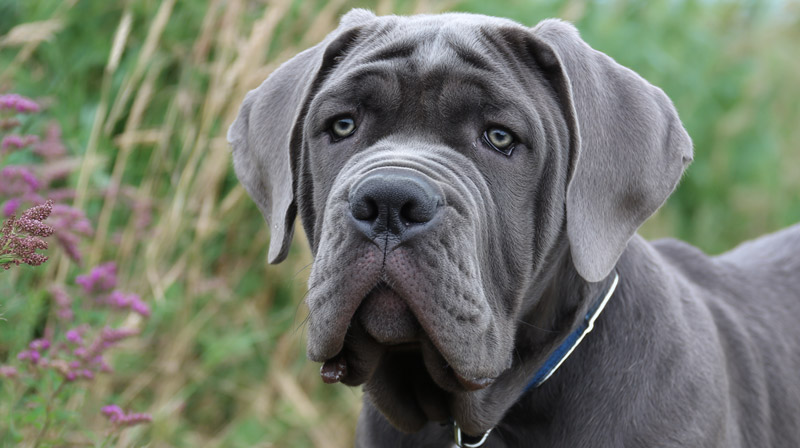
Start with the national breed club. Get test results on both parents in writing, and treat a seller who refuses a visit as a scam until proven otherwise.
- Begin with the club list. The United States Neapolitan Mastiff Club shares a list of breeder members, and in the UK the Royal Kennel Club runs Find a Breeder and Find a Puppy searches. The AKC Marketplace lists AKC-registered breeders nationwide.
- Ask for results in writing. In the US, the OFA database lets you look up individual dogs, and its hip evaluation needs a dog of 24 months or older with three independent board-certified radiologists scoring the film. In the UK, hip and elbow scores can be checked in the Kennel Club’s Health Test Results Finder.
- Compare the scores with the breed median. The BVA advises breeding only from dogs whose total hip score sits below the breed median.
- Find out how the litter was raised. AVSAB says puppies should be handled from birth and exposed to many people, surfaces and situations.
- Meet in person. BBB Scam Tracker reports link higher scam risk to buyers who skip meeting the pet, pay through hard-to-trace apps or accept extra charges such as shipping insurance or special cages.
- Think about an adult from rescue. Mastino Rescue, Inc. runs an application, vet reference check, home visit, introduction to current pets and signed contract, and places dogs through a foster-to-adopt program (GuideStar profile).
A health guarantee that replaces a puppy is not a substitute for test results, as a veterinary article on VIN puts it. Saying the testing was done is not enough, because a breeder who tested has the paperwork.
Neapolitan Mastiff FAQ
Do Neapolitan Mastiffs bark a lot?
No. Hill’s Pet Nutrition rates the breed’s barking as quiet, and it tends to save its deep bark for real threats. Boredom or isolation can still create a barking habit, so daily company and enrichment matter.
Why does a Neapolitan Mastiff smell, and how can owners control it?
Odor usually traces to the skin folds, where drool and moisture collect. Dermatitis in the folds is a Kennel Club Breed Watch concern, so wipe the face and folds regularly and check for redness or hair loss.
Drool also increases in heat, according to the United States Neapolitan Mastiff Club’s owner flyer.
Can a Neapolitan Mastiff live in a hot climate?
Not comfortably. The national club’s owner flyer warns that otherwise healthy dogs die suddenly from heat intolerance every year.
Provide shade, a cool room and plenty of fresh water, and keep walks to mornings and evenings.
Will pet insurance cover a Neapolitan Mastiff’s hereditary conditions?
Usually, but only for signs that appear after the policy starts and its waiting period ends. Healthy Paws treats anything showing before then as pre-existing.
Insurify notes that hip and elbow dysplasia are often excluded in both joints once one side is diagnosed, so enroll before symptoms and read the hereditary clause.
Which breed played Fang in the Harry Potter films?
A Neapolitan Mastiff. The books describe Fang as a boarhound, but the AKC counts seven Neapolitan Mastiffs, stand-ins included, across the film series.
One of them, a dog named Monkey, was an abandoned rescue.
How to Test the Fit Before Committing to a Neapolitan Mastiff
Meet grown Neapolitan Mastiffs in person before reserving a puppy, because an adult shows the finished size, drool and guarded temperament that an eight-week-old cannot. Breed club events and conformation shows put several adults in one place on one day.
Handle adults at a club event or show first. After that, try an adult through a rescue, and only then request the parents’ test paperwork and reserve a puppy.
Paperwork comes last because a clean pedigree cannot repair a mismatch in space, budget or handling skill that one afternoon with an adult would have exposed.
It costs time, though. Club introductions and rescue placements run on the schedule of the breeder or rescue, and a rescued adult arrives with a history that a puppy does not have.