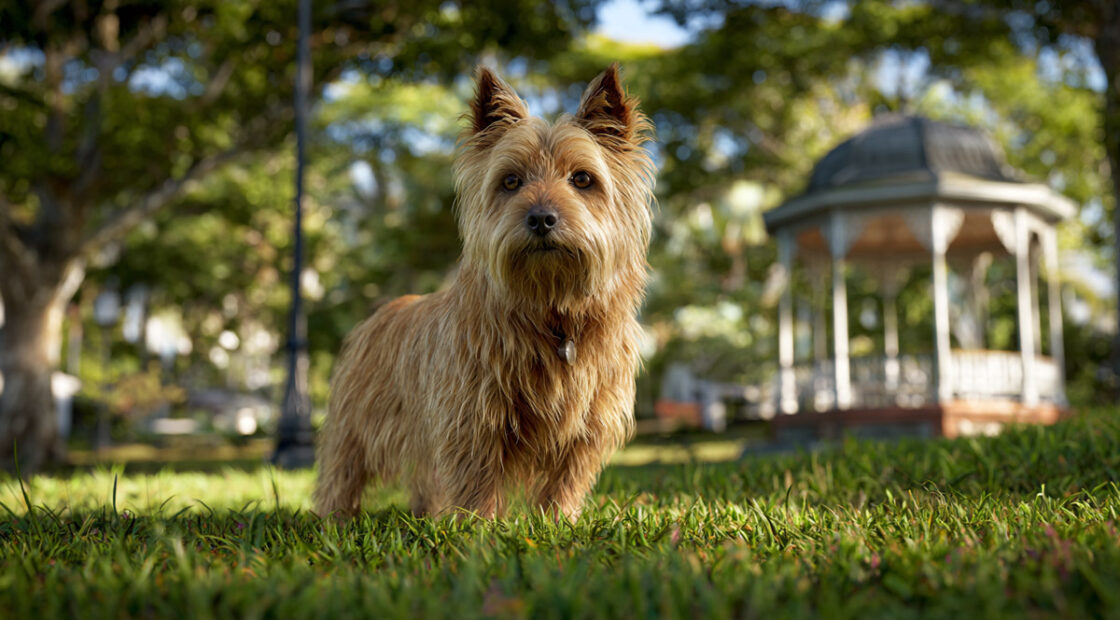
Australian Terriers started out as working dogs in 19th-century Australia, bred to kill vermin and snakes and to guard property. They also turned out to be good company for the family.
Aussies stand 10 to 11 inches at the withers and carry a harsh coat with a topknot and a ruff. The colors are blue and tan, sandy or red.
The breed’s defining health risk is diabetes mellitus. It is 32 times more likely to develop the disease than a mixed-breed dog in the United States (PLOS ONE, 2020).
That puts real weight on parent screening when you’re buying a puppy. The AKC’s terrier group health list names patella, eye (ophthalmologist) and thyroid evaluations for the breed (as of October 2026).
What Is the Australian Terrier?
Developed in Australia, the breed was meant to kill vermin and snakes and guard property, and it doubled as a family companion. The FCI standard (No. 8) puts it among the smallest working terriers and says it’s one of the few terriers developed outside the United Kingdom.
Most people just say Aussie or Aussie Terrier. Older names include Rough Coated Terrier, Broken-Coated Terrier and Blue and Tan Terrier, all early names recorded in breed histories from Showsight and VCA Animal Hospitals.
Which group it lands in depends on the registry. The AKC says Terrier Group. The Australian National Kennel Council (Dogs Australia) uses Group 2 (Terriers), and the FCI files it under Group 3, Section 2 (small-sized terriers).
Don’t confuse it with the Australian Silky Terrier, though the FCI standard says both descend from the same Broken Coated Terrier stock in Tasmania, New South Wales and Victoria. It isn’t a Yorkshire Terrier either, even if the same standard notes that Yorkshire blood was introduced at intervals.
Where Did the Australian Terrier Come From?
Rough-coated British terriers that settlers brought over are the starting point. Breeding took hold in Tasmania, New South Wales and Victoria during the 19th century (FCI Standard No. 8).

The dogs had to earn their keep. According to the head guide by ATCA authors Ida Ellen Weinstock and Jane Tenor in Showsight, early breeders wanted dogs that could hunt vermin (snakes included) and also guard gold mines. Herding sheep and cattle was part of the job too.
Nobody kept pedigrees at that stage, which is why ancestor lists change from source to source.
Which breeds contributed to the Australian Terrier?
The FCI standard names the Skye Terrier, the Scottish Terrier (Aberdeen) and the Dandie Dinmont Terrier, with Yorkshire Terrier blood introduced at intervals. The UKC standard goes with Dandie Dinmont, Skye, Irish Terrier and Manchester Terrier instead, and says the Yorkshire Terrier was used to control size. The ATCA authors in Showsight list the old Scotch Terrier, Skye, Dandie Dinmont, the old Black and Tan Terrier and the Irish Terrier.
The overlap is the useful part. The Dandie Dinmont Terrier appears in all three accounts, and the UKC standard credits it with the breed’s topknot.
One more name sits in every list. The Skye Terrier gets credit from the UKC for the short legs and long body, and for the long coat.
The UKC version also gives the Irish Terrier credit for the red and sandy colors, and the Manchester Terrier for the rich tan on the blue and tans.
Popular breed profiles often add the Cairn and Norwich Terriers. None of the three accounts above names either one.
When was the breed recognized by kennel clubs?
The Kennel Club in the United Kingdom recognized the Australian Terrier in 1933 and the AKC in 1960, according to Showsight’s breed magazine, while the FCI accepted it on a definitive basis on 20 June 1963 (FCI nomenclature).
| Registry | Recognized | Group |
|---|---|---|
| The Kennel Club (UK) | 1933 | Terrier |
| American Kennel Club | 1960 | Terrier Group |
| United Kennel Club | 1969 | Terrier Group |
| Canadian Kennel Club | 1937 | Group IV: Terriers |
| FCI | 1963 | Group 3, Section 2 |
At home, the breed was first shown in Melbourne in 1868 and the first club formed there in 1887. By 1909 every Australian state used the name Australian Terrier (Showsight).
Not every source agrees on the later dates. Purina New Zealand gives 1936 for the UK and 1958 for the AKC.
Showsight notes that nine Australian Terriers were entered in Westminster’s Miscellaneous class in 1958, which may be where the earlier AKC date comes from.
The 1960 admission was the first new terrier breed the AKC accepted in more than 20 years, per Showsight.
What Does an Australian Terrier Look Like?
Expect a low-set dog that’s rather long for its height. The coat is harsh, with a ruff around the neck and a soft topknot, and the standards describe a sturdy dog with a rugged look.
Size and proportions
The standards agree on roughly 10 inches and differ on the upper end.
The ATCA breed standard calls for 10 to 11 inches at the withers. The UKC and the Canadian Kennel Club give a desirable height of about 10 inches (25.5 cm) and a weight of 14 pounds (6.25 kg).
Westminster Kennel Club lists a maximum of 11 inches and 20 pounds. A standard names an ideal and a profile names a ceiling, so the two sets of numbers answer different questions.
Proportion matters as much as height. The body is long in relation to height, and the ATCA illustrated guide treats cobbiness and excess muscle as faults, along with a loin that runs too long.
Coat and colors
The coat is a harsh, straight, dense top coat about 2.5 inches long over a short, soft undercoat. The UKC standard faults a curly or woolly coat.
A ruff runs around the neck to the breastbone, and a soft, silky topknot sits on the skull in a lighter shade than the head. The standards call for the coat to stay untrimmed.
The AKC standard, as printed in Showsight, accepts blue and tan (anywhere from dark blue and steel blue to silver blue, with rich tan that is not red), solid sandy and solid red. White markings on the chest or feet are penalized in any color, and an all-black adult body coat is a fault.
Registries differ on the tan. Australian standards have long asked for rich tan, not sandy, on the blue and tans (the 1962 National Kennel Council of Australia wording, reproduced in Showsight), and the CKC lists sandy markings in place of tan as a fault.
A breed-club contributor writing in Showsight explains that the red and sandy gene is dominant and blue and tan is recessive. Two sandy dogs can still produce blue and tans if both carry the recessive.
How Often Does an Australian Terrier Need Grooming?
Brush or comb the coat once or twice a week and strip out dead hair by hand about twice a year. Sources put the weekly part anywhere from one session to every other day, so treat the schedule below as a baseline.
Dogs NZ says weekly combing plus stripping twice a year. Vets Love Pets wants brushing at least twice a week on top of the same hand stripping. Purina New Zealand is the outlier and suggests grooming every other day.
Stripping is the part that gets skipped. Wire-type coats do not release dead hair on their own, a condition groomers call a blown coat, according to Groomer to Groomer (September 2024).
Shedding is light either way. Westminster Kennel Club rates it 1 on a 5-point scale, though Wamiz calls the breed a moderate shedder.
- Brush or comb the coat once or twice a week with a slicker or pin brush to lift loose hair and stop mats.
- Card or finger-pluck dead hair from the jacket before bath time, because stripping releases dirt and oil (Groomer to Groomer, 2024).
- Hand strip the full jacket a couple of times a year, or book a groomer who knows wire coats.
- Wash the ears weekly with a gentle dog-friendly cleanser (Orvis).
- Trim the nails every four to six weeks (Vets Love Pets).
Between strips, Vets Love Pets suggests tidying the coat with scissors.
What Is the Australian Terrier’s Temperament Like?

Spirited and alert, but it also settles in as a loyal companion. The FCI, ANKC, UKC and CKC standards all describe it as essentially a working terrier whose loyalty and even disposition suit it to family life.
Westminster Kennel Club gives the breed a 5 out of 5 for good with children and a 5 for barking level. Good with other dogs and good with strangers both score 3.
Dogs NZ rates watchdog ability very high and protection ability very low. Next to the barking score, that points to a dog that will announce every visitor and do little else about it.
Westminster adds that the breed is not suited to living outside or alone. It is happiest in close contact with its family, especially children.
The ratting background shows up around small animals. VCA Animal Hospitals describes the breed’s self-appointed job as chasing anything that moves and barking at anything that approaches.
So you get a loud, loyal watchdog in a small body, and the barking and chasing need early, consistent handling.
How Much Exercise and Training Does an Australian Terrier Need?

Plan on 30 minutes to more than an hour of exercise a day, plus short, varied training sessions that start the week the puppy comes home. Sources agree on the direction and split on the numbers.
Daily exercise
Purina New Zealand gives 30 minutes on one breed page and about an hour on another. Orvis puts a healthy adult above an hour of vigorous activity, and Hill’s Pet rates the breed’s exercise needs moderate to high.
Westminster Kennel Club scores energy level 4 out of 5, which fits the upper half of that range.
Walks, hikes, dog sports and indoor fetch all count, according to Orvis.
Training
The sources don’t agree on how hard this breed is to train. Dogs NZ rates trainability easy, and VCA Animal Hospitals says the breed learns quickly.
Vetstreet sees it differently and calls training challenging because of stubbornness and boredom, and VCA adds that endless drilling bores the dog. Both can be true at once.
The workable middle is short sessions with rewards and variety. Hill’s Pet warns that an Aussie without early training may try to boss its owner around.
Vetstreet says to start the day the puppy arrives, and Purina Australia adds early socialization to the list.
Dog sports that use the working instincts
Showsight’s performance guide calls Earthdog the venue most Aussies suit. Following a rat scent down a tunnel can cover much of the exercise the breed needs.
Agility, obedience and rally, tracking and therapy work also fit the breed.
How Long Do Australian Terriers Live, and What Health Problems Do They Have?

Australian Terriers live 11 to 15 years, and most sources center on 12 to 14. Diabetes mellitus is the breed’s defining health risk, followed by patellar luxation and Legg-Calve-Perthes disease.
Lifespan
WebMD and PetMD give 11 to 15 years. Dogs NZ and Wamiz give 12 to 14, and Westminster Kennel Club tops out at 15.
For context, a Kennel Club and BSAVA survey of 169 UK breeds found a median age at death of 11 years 3 months, and noted that smaller breeds tend to live longer (Journal of Small Animal Practice, 2010).
Weight control is the one lever owners hold. Vetstreet calls an appropriate weight one of the easiest ways to extend the dog’s life.
Common conditions
Diabetes mellitus sits at the top of the list, with the breed ranked among the highest-risk in four countries. In the United States the risk runs 32 times the mixed-breed rate (PLOS ONE, 2020).
Patellar luxation means the kneecap slips out of place, usually in a hind leg (Hill’s Pet). Legg-Calve-Perthes disease, a hip joint malformation, shows up early and can be corrected with surgery (WebMD).
Eyes need watching too. Dry eye is common (Hill’s Pet), and Vets Love Pets mentions cataracts and progressive retinal atrophy in older dogs. Embrace Pet Insurance adds allergies, itching and ear infections on the skin and ear side.
The diabetes ranking comes from PLOS ONE (2020) for the United States, Sweden and Australia, Canine Medicine and Genetics (2022) for Norway, and VetCompass Australia (2020). Four national datasets point at the same breed.
Inheritance is polygenic, with no single gene to test for (PLOS ONE, 2020). Heritability comes out at 0.18 (95% confidence interval 0.0 to 0.67), which is a very wide range (PLOS ONE, 2020).
Health screening
In the United States, the AKC’s terrier group health testing list names a patella evaluation, an ophthalmologist (eye) evaluation and a thyroid evaluation for the Australian Terrier, as of October 2026. Results go into the CHIC database run by the Orthopedic Foundation for Animals (OFA).
New Zealand asks for more. Dogs NZ’s accredited breeder scheme requires an annual eye certificate, hip dysplasia, a DNA profile, von Willebrand disease 1, Legg-Calve-Perthes and a patella luxation certificate.
A CHIC number only proves the tests were done. Vetstreet notes that a dog does not need passing scores to earn one, so read the posted results.
Vetstreet’s 2011 profile lists the same CHIC components, patella and thyroid evaluations from the OFA plus eye test results.
How Does the Australian Terrier Compare With the Cairn Terrier, Silky Terrier and Yorkshire Terrier?
The Cairn Terrier is the closest match in size and AKC group. The Silky Terrier is the other native Australian terrier, and the Yorkshire Terrier is smaller than both.
| Breed | AKC group | Height and weight | Coat |
|---|---|---|---|
| Cairn Terrier | Terrier | 10 to 11 in, 13 to 14 lb | Wiry overcoat, soft undercoat |
| Silky Terrier | Toy | 9 to 10 in, 10 lb | Single, flat, silky |
| Yorkshire Terrier | Toy | 7 to 8 in, 7 lb | Long, silky, human-hair texture |
Figures follow the Orvis breed profiles.
Australian Terrier vs Cairn Terrier
Height is nearly identical, and both sit in the AKC Terrier Group. The rest is history and screening.
The Cairn Terrier comes from the Isle of Skye and dates to the 1600s, according to Orvis, and the AKC recognized it in 1913.
The AKC’s health testing list gives the Cairn a patella evaluation and a DNA test for globoid cell leukodystrophy, against patella, eye and thyroid evaluations for the Aussie.
If no health-tested Aussie litter is within reach, the Cairn is the nearest substitute in size and group.
Australian Terrier vs Silky Terrier
Sources disagree on how the two breeds are related.
The FCI standard traces both to the same Broken Coated Terrier stock in Tasmania, New South Wales and Victoria. Hill’s Pet tells it differently and says the Silky was created in the 1800s by crossing the Yorkshire Terrier with the Australian Terrier.
Showsight’s early-history article adds that one litter could produce Silky, Yorkshire and Australian Terrier puppies, depending on type.
The AKC places the Silky in the Toy Group, while the UKC keeps it in the Terrier Group.
Coat is what separates them today. The Silky Terrier carries a single, flat, silky coat that Orvis says needs combing two to three times a week and Hill’s Pet says every other day.
Pick the Silky for a lap-sized dog. Pick the Aussie if you’d rather have a harsher coat that asks for stripping and less frequent combing.
Australian Terrier vs Yorkshire Terrier
The Yorkshire Terrier is the smallest dog here and the most coat-dependent. It sits in the AKC Toy Group at about 7 to 8 inches and 7 pounds (Orvis).
It sheds little, but a long coat takes many grooming hours (Hill’s Pet). VCA Animal Hospitals says the Aussie is frequently mistaken for Yorkies and Cairns.
When Is the Australian Terrier a Poor Fit?

Keen gardeners and homes with a cat will have the hardest time with this breed, and so will owners who are out most of the day. First-time dog owners should think twice, and so should anyone who couldn’t absorb a chronic illness. Each limit traces to a published source.
- Hill’s Pet says the breed loves digging, so a keen gardener may not be a match.
- With a cat or small pets in the house, note that Vetstreet lists terrorizing the family cat among the breed’s favorite hobbies, and Orvis says it will chase every squirrel or bird.
- Long days alone are a problem. Hill’s Pet warns that high energy and intelligence without enough play lead an Aussie to entertain itself in ways owners will not enjoy.
- Purina New Zealand suggests owners with some experience, and Showsight says the breed cannot be pushed around, which makes it a tougher first dog.
- For allergy households, Petstock calls the breed hypoallergenic while Purina New Zealand says it is not, so the label settles nothing.
- Canine diabetes resembles insulin-dependent Type I diabetes in people (AKC Canine Health Foundation), and this breed carries a high risk of it, so a long-term illness is a real possibility.
None of these rules the breed out. If a household ticks two or three, meeting an adult Aussie before committing makes sense.
How Much Does an Australian Terrier Cost, and Where Should You Get One?
A puppy from breeders on Good Dog’s US marketplace runs about $1,900 to $2,350, but quotes elsewhere run far lower. Price tells you little without the test results behind it.
What the price covers
Good Dog’s US breeder listings run $1,900 to $2,350. Burke’s Backyard in Australia gives $350 to $500 on its breed fact sheet, and Wamiz in the United Kingdom quotes GBP 250 to GBP 500, with the higher figure for Kennel Club registered dogs.
The gap is too wide to be a currency effect. Ask whether the price includes registration and parent health testing, and whether there’s a written guarantee. I’d be wary of any cheap listing that can’t answer those questions.
Over 12 or more years, owning a dog is expensive, and an Australian Terrier adds a documented diabetes risk to the budget.
Embrace Pet Insurance says premiums run higher than for mixed breeds and recommends insuring while the puppy is healthy. An insurer profits from that advice, so weigh it accordingly.
Breeder checks
Ask for proof. That means written evidence that both parents cleared the breed’s screening, with results you can look up yourself in the OFA database.
Membership in the ATCA is worth checking as well, since its code of ethics bars sales to pet stores and calls for health clearances before breeding (Vetstreet).
Embrace Pet Insurance says a vet check does not replace genetic testing, and that a breeder claiming clean lines either is lying or does not know the breed.
Puppy scams cost victims an average of $850 in 2022, up 60 percent since 2017, per BBB Scam Tracker.
Rescue and adult adoption
Adult adoption removes guesswork. Embrace Pet Insurance says many of the breed’s health and behavior problems do not show in puppyhood, so an older dog rules most of them out.
Chewy says the breed is relatively rare in North America and hard to find in shelters, so start with the ATCA’s rescue organization (Showsight).
The Australian Terrier Club of South Australia asks owners who cannot keep a dog to contact its breeder first and the club’s rescue service second.
Australian Terrier FAQ
Is an Australian Terrier the same as an Australian Shepherd?
No. The Australian Terrier sits in the AKC Terrier Group, while the Australian Shepherd belongs to the Herding Group.
The shared Aussie nickname causes the mix-up, but the Australian Shepherd is a herding dog and the terrier was built to kill vermin and snakes.
Can an Australian Terrier live in an apartment?
Yes. Hill’s Pet calls the breed an excellent dog for units, and Purina New Zealand says it lives comfortably in the city, country or suburbs.
Exercise matters more than floor space. Petstock says apartment living works as long as the dog gets enough exercise and mental stimulation.
Can an Australian Terrier live outdoors?
Not as a kennel dog. Vetstreet says the breed is not a backyard dog by any means and needs to live indoors as a family member.
Weather is a separate question. Dogs NZ says the breed is physically able to stay outdoors in temperate to warm climates, and Wamiz says the rough coat tolerates cold rather well.
Do Australian Terriers have docked tails?
It depends on the registry. The UKC standard describes a docked tail, while Chewy’s breed profile says the AKC standard allows the tail to be docked or undocked.
An undocked tail is set high and carried erect, at the twelve to one o’clock position (Showsight).
How much should an Australian Terrier eat?
PetMD recommends two measured meals a day for an adult. Measuring matters, because Vetstreet calls an appropriate weight one of the easiest ways to extend the dog’s life.
PetMD adds that a vet may suggest a joint supplement or joint-health diet, since the breed is somewhat prone to joint problems.
Does neutering raise an Australian Terrier’s diabetes risk?
The evidence is mixed, and none of it isolates this breed.
VetCompass Australia (2020) found desexed male dogs at higher risk than entire males and desexed females, while a UK study cited in Canine Medicine and Genetics (2022) found no significant sex predisposition.
Setting Up an Australian Terrier’s First Month
Book the vet exam for the first few days. Short training and socialization sessions start on day one, and brushing and ear checks should become routine before the coat forces the issue.
No screening test closes the diabetes question. The AKC list covers patella, eye and thyroid, and diabetes inheritance is polygenic, so a clean breeder certificate does not clear a puppy of the disease.
Embrace Pet Insurance advises watching for early signs of diabetes and skin problems, ear infections included, from the first visit onward.
This position holds as of October 2026. If a diabetes marker ever gets added to the CHIC list, screening would move ahead of observation.