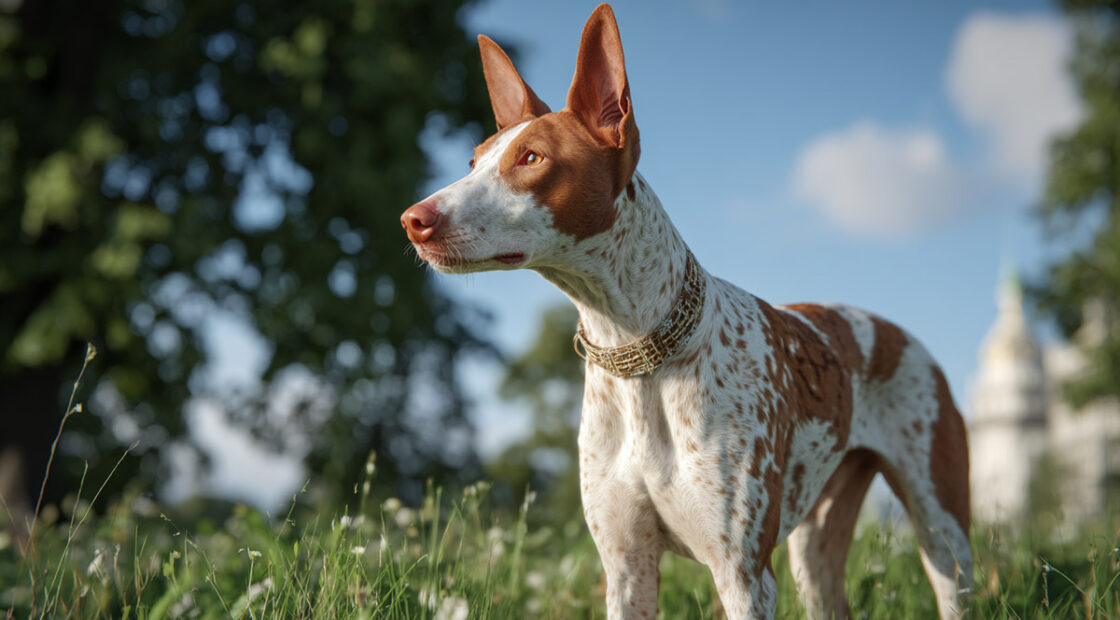
Ibizan Hounds hunt rabbits on the Balearic Islands, and they find them with their noses and ears about as much as with their eyes.
Under the Federation Cynologique Internationale (FCI) standard No. 89, in its 2000 English translation, dogs stand 66 to 72 cm at the withers. The ears are large and upright, the eyes amber and the frame lean.
Registries don’t agree on what category it belongs to. The AKC files it as a hound. The UKC calls it a sighthound and pariah dog, while the FCI treats it as a primitive type.
What Is the Ibizan Hound?
Spain’s Balearic Islands produced this lean hound, and its name comes from Ibiza.
The FCI standard says the dog scents game and uses hearing more than sight. That is why the Canadian Kennel Club (CKC) standard calls it a three-way hunter.
Spanish speakers say Podenco Ibicenco and Catalan speakers say Ca Eivissenc. English has Ibizan Warren Hound, and owners just say “Beezer”.
Each registry files it somewhere different.
- The American Kennel Club (AKC) puts it in the Hound Group.
- The United Kennel Club (UKC) uses the Sighthound and Pariah Dog Group.
- For the CKC it’s Group II, Hounds.
- The FCI has it in Group 5, Spitz and primitive types, Section 7 (primitive type, hunting dogs).
The working method is the same whatever the filing. The UKC standard sums it up as sight, scent and sound used together.
Origin and History of the Ibizan Hound
Nobody agrees on when the breed reached the Balearic Islands, though it was developed there to hunt rabbits.

The FCI standard names Majorca, Ibiza, Minorca and Formentera as the home islands. Related dogs also turn up around Catalonia, Valencia, Roussillon and Provence, where they go by names such as Xarnelo and Charnegue.
VCA Animal Hospitals adds that island farmers could not afford a dog that failed to catch its share of rabbits, so function shaped the breed.
The Egyptian Ancestry Claim and the DNA Evidence
The breed standards tell one story but disagree on the details.
The FCI says tomb illustrations prove the breed existed by 3400 BC, and that Phoenicians, Carthaginians and later Romans probably carried dogs to the islands. The UKC has Phoenicians bringing them around the eighth century, or Carthaginians in the sixth. The CKC goes further back and says the breed evolved from the original dogs of ancient Egypt.
Some breed profiles blur the dates. Purina’s breed page puts the Phoenician voyage itself in 3400 BC, which folds the FCI’s tomb date into the arrival story.
Genetic work doesn’t back the old story. VCA Animal Hospitals reports that recent DNA studies cast doubt on the ancient lineage and suggest a much more recent breed.
Dogsey’s profile credits geneticist Elaine Ostrander of the University of Washington with that line of work. It reads the resemblance to tomb art as a by-product of breeding for function, or a deliberate attempt to recreate the old type.
Malta’s Pharaoh Hound carries the same tomb-art legend. A 2023 survey of eight hound-like Mediterranean breeds (Perini and colleagues, Elsevier) found that none descends directly from Egyptian dogs, though all of them look like the dogs in ancient art.
Treat the Egyptian line as a legend with a real resemblance behind it, not a documented pedigree.
Arrival in the United States
The first Ibizan Hounds reached the US in 1956, brought over by Colonel and Mrs. Consuelo Seoane (Vetstreet).
The AKC recognized the breed in 1979, and the CKC followed in 1985, according to its own standard. PetMD notes the breed never became a popular pet and remains rare.
Size, Coat and Color of the Ibizan Hound by Registry Standard
Every standard describes a tall, light hound, yet the published height ranges don’t match.
| Registry | Height, dogs / bitches | Weight | Accepted colors |
|---|---|---|---|
| AKC (2022) | 23.5-27.5 in / 22.5-26 in | Average 50 lb / 45 lb | White or red, solid or any combination |
| UKC (2008) | 23.5-27.5 in / 22.5-26 in | Average 50 lb / 45 lb | White or red, solid or any combination |
| CKC (2004) | 24-27.5 in / 22.75-26 in | 44-55 lb / 39.75-50.75 lb | Red, lion or white, solid or mixed |
| FCI No. 89 | 66-72 cm / 60-67 cm | Not stated | White and red preferred; fawn tolerated, never in smooth coats |
| The Kennel Club (UK) | 56-74 cm (22-29 in), no sex split | Not stated | White, chestnut or lion, solid or any combination |
The standards carry different dates, which matters when comparing them. The AKC text took effect on May 4, 2022, the UKC text dates from 2008, and the CKC text from January 2004.
The Kennel Club, now branded The Royal Kennel Club, updated its standard on 1 August 2025. The FCI text is a 2000 English translation of a standard first published in 1982.
Height and Weight
FCI dogs top out at 72 cm, about 28.3 inches, nearly an inch above the AKC ceiling of 27.5.
The Kennel Club gives one 56 to 74 cm range with no split by sex, and adds that individual dogs may fall outside the listed measurements.
Every standard tolerates slight variation. The AKC says sizes slightly over or under are not demerits when other qualities are good.
For scale, WebMD places the breed smaller than a full-size Greyhound and larger than a Pharaoh Hound.
Smooth and Wire Coats
Both the smooth and the wire coat are accepted. The AKC, UKC and CKC standards prefer neither, and Dogs Queensland says the smooth type is the more common.
How long the wire coat runs depends on which standard you read.
- The AKC gives 1 to 3 inches, with a possible generous moustache.
- The CKC puts it at roughly 3 to 10 cm (1.25 to 4 in).
- The UKC calls it a rough coat, with the longest hair at least 2 inches and a beard that is highly valued.
- The FCI describes a separate long coat that is softer and at least 5 cm.
The FCI is the odd one out. Its standard text covers smooth, rough and long coats, while its breed record lists only smooth-haired and rough-haired varieties for show awards.
Colors and Coat Care
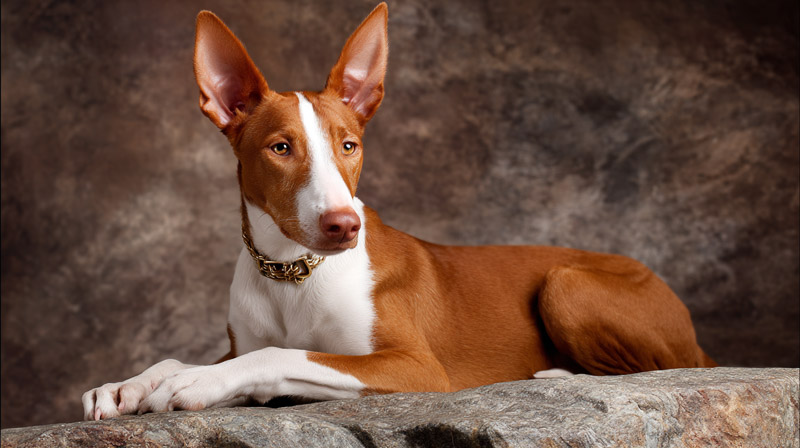
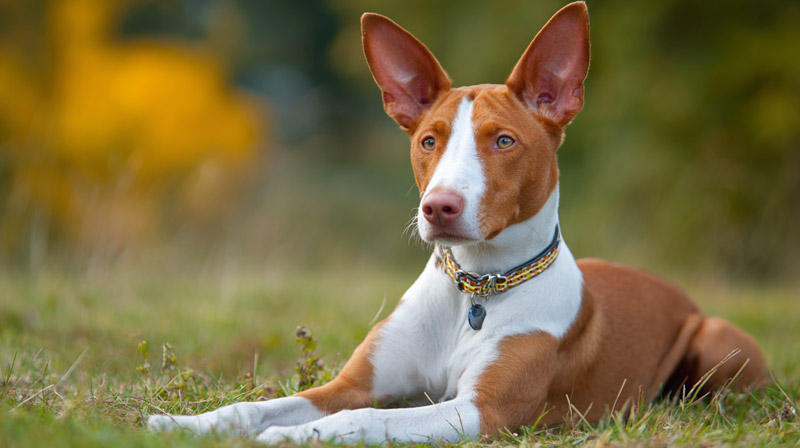
White and red are the accepted colors, solid or in any combination. The AKC defines red as anything from light yellowish-red (lion) to deep red, and it disqualifies any other color. The FCI tolerates fawn in an exceptional dog but never in a smooth coat.
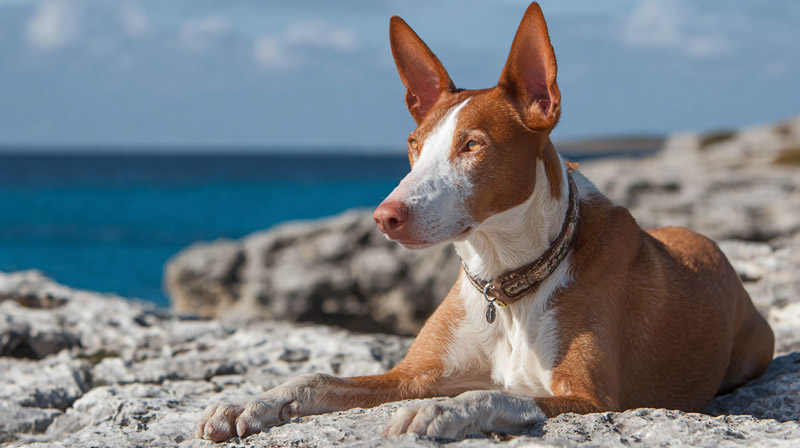
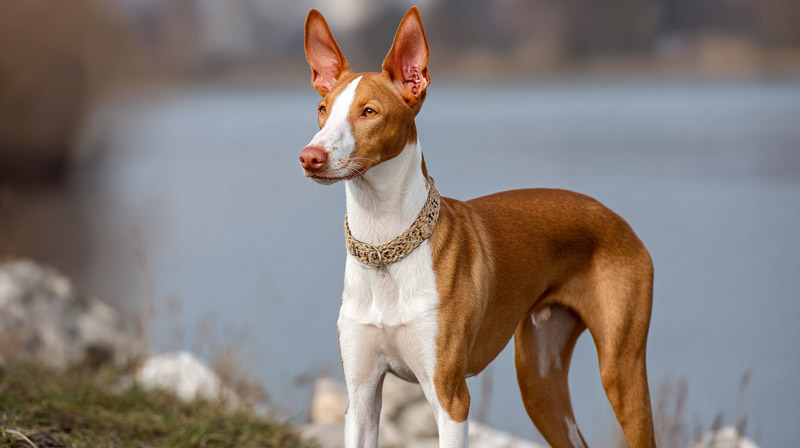
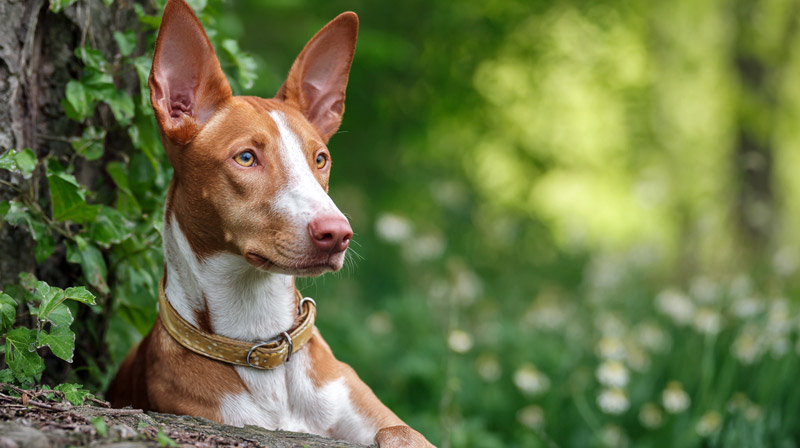
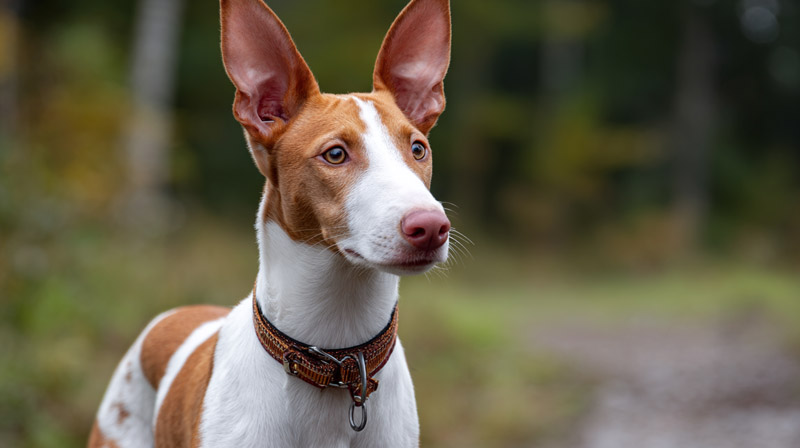
Eyes run clear amber to caramel, and the nose is a rosy flesh color. The AKC standard calls the large pointed ears highly mobile.
A weekly brush covers either coat type. VCA Animal Hospitals adds that the wire coat may benefit from hand stripping twice a year. Low shedding is not zero shedding, since The Kennel Club’s breed page lists the breed as a shedder.
Temperament of the Ibizan Hound: Family, Strangers and Other Pets
At home this is an affectionate dog. Strangers get a more reserved welcome, and out hunting it works on its own judgment.
The AKC, The Kennel Club and the CKC all describe the same dog, with small differences in emphasis.
With Family and Strangers
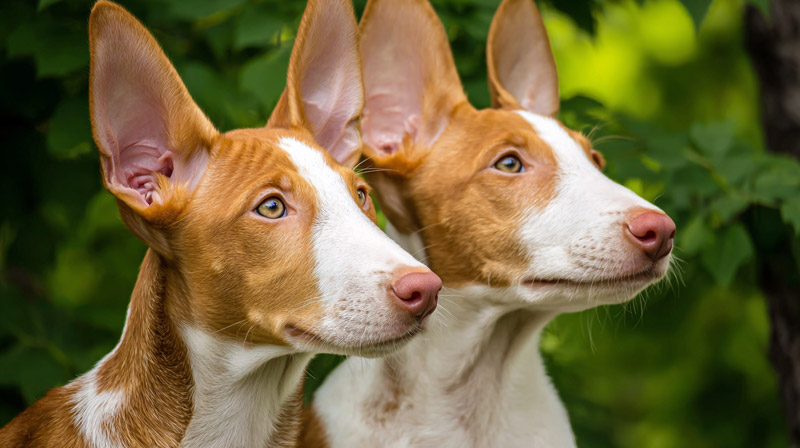
The AKC standard describes an even-tempered, loyal dog that is also affectionate. Embark adds that it is playful, sometimes silly, and not a touchy-feely dog, though it snuggles with family. VCA Animal Hospitals says it gets very attached without fawning over its owner.
With strangers, The Kennel Club standard says reserved, not nervous or aggressive. The CKC standard notes it is sometimes wary of unfamiliar places, and the FCI standard describes an expression that shows intelligence along with some fear and mistrust.
Vetstreet’s buying advice is to check the parents’ personalities and pick a puppy socialized from early on.
Trainability and Barking
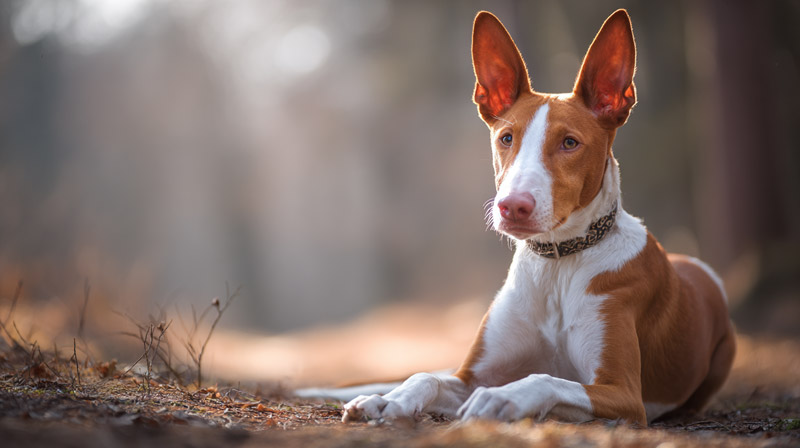
The AKC standard calls the breed extremely versatile and trainable, while The Kennel Club standard lists independent among its traits. Dogs New Zealand rates trainability low.
The CKC standard splits the difference and calls the dog independent yet responsive and readily trainable.
PetMD reads it the same way. The dog learns fast and wants to please, but turns strong-willed without proper training.
Expect food theft, even from spots that look out of reach (Embark, Vetstreet). Recall turns selective once a scent or a rabbit shows up. Barking happens while chasing or playing, which Petfinder calls unusual for a sighthound.
The barking stays tied to the hunt. The FCI standard says working dogs bark only when they see or hear game and have it surrounded.
With Children, Cats and Other Dogs
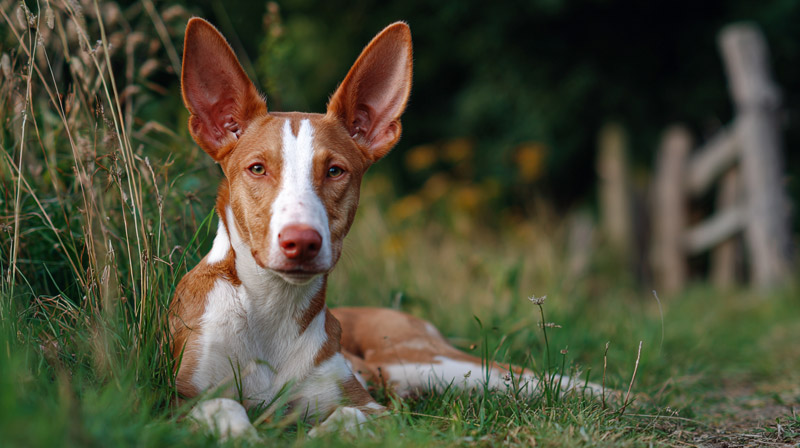
Prey drive sets the limits here, not general friendliness.
PetMD describes a steady companion for children and other pets once socialization starts early. It adds that the breed plays eagerly with active kids and other dogs.
Cats are a supervised introduction at best. Hepper advises early socialization with a family cat and keeping the dog away from small prey animals entirely.
WebMD likewise says households with small pets such as rabbits or guinea pigs may not be a good match, for the same reason.
The FCI standard adds a working detail. Hunters form packs almost entirely from bitches, with at most one male, because males do not work together on a hunt and are quarrelsome.
That describes working packs, not pets, but it flags a pairing to think through before adding a second intact male.
How Much Exercise and Fencing Does an Ibizan Hound Need?
Sources split on how much exercise the dog needs, yet the fence advice is consistent: solid, secure and at least 6 feet high.
Daily Exercise
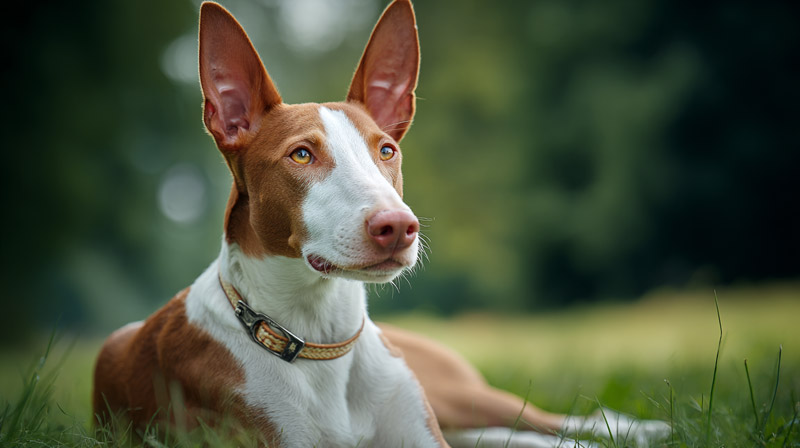
Advice runs from 20 minutes to more than 2 hours a day, depending on who is asked.
Embrace Pet Insurance suggests 20 to 30 minutes daily on leash, plus free play in a fenced yard. Hill’s Pet Nutrition says 40 minutes a day. WebMD wants two or three long walks, and The Kennel Club goes past 2 hours.
None of the four explains how it reached its figure. Start near 40 minutes and adjust to how the dog behaves indoors.
Free running belongs inside a fence. Embark says Ibizan Hounds cannot be trusted off leash outside a fenced yard, and Dogsey notes the breed chases anything that runs from it.
Jumping and Fence Design
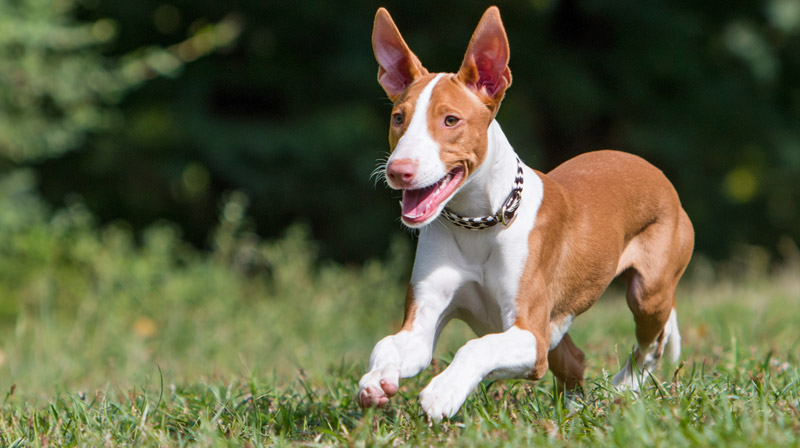
Vetstreet and Dogsey put the standing jump at 5 feet, while WebMD and Purina Canada say 6.
The standards describe the ability without a number. The AKC standard says the dog springs to great heights from a standstill, and The Kennel Club standard credits it with great jumps without a take-off run.
Fence advice is more uniform than the jump claims. Vetstreet, WebMD, PetMD (citing the breed club) and Embark all call for at least 6 feet.
Vetstreet wants solid fencing, not open rails. An underground electronic fence won’t work, since the breed can run straight through one. Royal Canin says to allow for climbing as well as jumping.
Lure Coursing and Other Sports
Lure coursing suits the breed well. The AKC standard also mentions the breed ring, obedience and tracking.
In the US the breed competes in lure coursing through the AKC and the American Sighthound Field Association (ASFA), plus straight-track racing (LGRA) and oval-track racing (NOTRA), per Wikipedia’s breed entry. WebMD lists the AKC Coursing Ability Test, Fast CAT and agility as other events for athletic dogs.
Standards split on speed. The AKC standard puts the breed on par with the top coursing breeds, while the CKC standard says it is not the fastest sighthound but has great endurance.
For exercise planning, the endurance claim matters more than the speed claim, because it points to long sessions rather than short sprints.
Health, Lifespan and Anesthesia Risk in the Ibizan Hound
Most sources call the breed generally healthy, and lifespan estimates run from 10 to 14 years. The one hazard flagged for the breed is sensitivity to certain anesthetics.
Lifespan
Purina UK gives 10 to 12 years. Petfinder and Hill’s say 12 to 14. A 2022 Parasites & Vectors paper, quoting AKC figures, puts mean life expectancy at 11 to 14 years in both sexes. The Kennel Club says over 10 years and leaves it there.
Only 12 years sits inside every one of those ranges.
The UK figure runs lower than the US ones, and The Kennel Club’s breed page avoids a median altogether. Your Dog claims up to 17 years, which reads as an outlier rather than a planning number.
Plan for 12 and treat anything beyond that as a bonus.
Hereditary Conditions and Screening
Sources disagree on how much to worry. Petfinder lists no major concerns, with seizures and allergies as minor and deafness, cataract, axonal dystrophy and retinal dysplasia as occasional.
Vetstreet and PetMD widen the watch list to hip dysplasia, hypothyroidism and eye disorders.
In the United States, the IHCUS (the AKC parent club) tells buyers to ask for proof that sire and dam passed four tests. Hips are checked through an Orthopedic Foundation for Animals (OFA) evaluation or PennHIP, after age two. Eyes get an American College of Veterinary Ophthalmologists (ACVO) exam. Hearing is tested with the brainstem auditory evoked response, or BAER, and autoimmune thyroiditis through an OFA evaluation, again after age two.
Breeders in the Canine Health Information Center (CHIC) program agree to publish every result, positive or negative (Vetstreet).
The UK looks different. The Kennel Club lists no breed-specific health scheme or DNA test, and Breed Watch Category 1 means judges have no points of concern to watch for.
That gap changes what a UK buyer should ask. With no scheme to lean on, request the same four results directly.
One documented advantage sits on the other side of the ledger. A 2022 Parasites & Vectors study (Alvarez and colleagues) notes earlier reports of low leishmaniosis prevalence in the breed and finds a cytokine profile that differs from other canine breeds, though the authors say further work is needed to link the two.
Anesthesia Sensitivity
Veterinarian Marty Greer puts sighthound body fat near 17%, against about 35% in most dogs (Pure Dog Talk).
That gap explains the warning. Court’s 1999 review in Clinical Techniques in Small Animal Practice ties the problem to prolonged recovery from certain intravenous agents, thiopental above all.
Breed profiles carry the warning over to the Ibizan Hound by name. Petfinder and Wikipedia both list sensitivity to barbiturate anesthesia.
The Veterinary Anesthesia and Analgesia Support Group’s sighthound guidance (Stein, 2004) recommends propofol or alfaxalone for induction and isoflurane or sevoflurane for maintenance. Methohexital is the only thiobarbiturate it allows, with thiopental avoided. It also calls for close temperature monitoring, since lean dogs chill under anesthesia and stressed ones run hot.
Tell the vet about the breed before any sedation, and ask which induction agent the clinic plans to use.
Ibizan Hound vs Pharaoh Hound and Related Breeds
FCI Group 5 also holds the Pharaoh Hound, Cirneco dell’Etna and Portuguese Podengo, so these are the breeds people end up comparing. They differ mostly in origin and size, and a little in quarry.
| Breed | Origin | FCI height | Traditional quarry |
|---|---|---|---|
| Ibizan Hound | Spain (Balearic Islands) | 66-72 cm (dogs) | Rabbits, also hare |
| Pharaoh Hound | Malta | 56-63.5 cm (males) | Rabbits (Maltese Rabbit Dog) |
| Cirneco dell’Etna | Italy (Sicily) | 46-50 cm (males) | Wild rabbit |
| Portuguese Podengo | Portugal | 20-70 cm (three sizes) | Rabbits to deer, by size |
Heights follow the FCI standards, with the Cirneco figures as reproduced in the Italian Journal of Animal Science (2021). The Pharaoh Hound row reflects the revised FCI standard whose official valid text is dated 8 September 2026 (English version issued 6 October 2026).
Against the Pharaoh Hound, the FCI height ranges for males do not overlap. Pharaoh Hound males stop at 63.5 cm, and Ibizan dogs start at 66 cm.
Coat separates them too. The FCI describes the Pharaoh Hound only in a short glossy coat with tan and limited white markings, while the Ibizan Hound comes in white and red and in a wire coat.
The Pharaoh Hound’s name is a relabel. Purina notes it was the Maltese Rabbit Dog until breed enthusiasts renamed it in the 1960s for its resemblance to Egyptian art.
For a smaller hound with the same job, Sicily’s Cirneco dell’Etna is the closest match.
The small Portuguese Podengo, the Pequeno, goes smaller still.
Size is the real choice here. The prey drive comes with all four.
How Much Does an Ibizan Hound Puppy Cost, and Where Do You Find One?
Breeder prices vary by country, and Canadian estimates cover a much wider spread than US ones.
Price by Country
Good Dog’s breeder listings put the US range at $1,800 to $2,000 nationally. In Canada, estimates for 2026 run CAD $1,400 to $3,400, which Paction labels a broad industry estimate.
Australia has no dependable published range. Dogz Online carries Ibizan Hound breeder listings, but most do not state a price and some ads on those pages belong to other breeds, so confirm each breeder’s price directly.
Health testing explains part of the spread. Paction estimates the screening costs a breeder $800 to $2,000+ per litter.
Treat a price well under the local range as a question about testing, not a bargain.
Vetting a Breeder
Work through these in order.
- Contact the IHCUS and ask which breeders follow its health statement.
- Ask for documentation that sire and dam passed the hip, eye, hearing and thyroid tests the statement lists.
- Check the results in the OFA and CHIC databases.
- Meet at least one parent, because Vetstreet advises choosing parents with good personalities and a puppy socialized early.
- Read the contract, and ask what the breeder does if a puppy develops a serious genetic condition (a question Paction suggests).
- Ask how the puppies are raised through 8 weeks, including handling and exposure to new things.
A breeder who answers all six without hedging has probably done the work. If the testing questions get dodged, walk away.
Adopting From Rescue
IHCUS Rescue is the only national rescue group dedicated solely to Ibizan Hounds, according to its Petfinder listing. Its dogs live in volunteer foster homes across the US.
The AKC also lists the IHCUS as the breed’s rescue organization. Dogster urges would-be owners to contact rescues before breeders, noting the breed is quite rare in the United States.
Ask a rescue about the dog’s history with small pets and its escape record before you agree to take it home.
When an Ibizan Hound Is the Wrong Fit
A household that can’t give a hunting hound room to run and distance from small animals should skip this breed. Patience with an independent streak matters too.
Anyone shopping for a guard dog should look elsewhere. Dogs New Zealand rates watchdog ability high but protection ability very low, and Your Dog (UK) says the breed is not a good guard dog.
A home without a sighthound-aware vet takes on extra risk, because a clinic unfamiliar with sighthound protocols raises the stakes on routine sedation.
Buyers on a fixed timeline will struggle as well. Litters are scarce in the US, and breeders keep waiting lists.
If the home has small animals or no way to contain a determined jumper, choose a breed without a prey-driven job instead of managing the risk.
Ibizan Hound FAQ
Which pronunciation of Ibizan is correct?
More than one is accepted. Merriam-Webster lists ih-BEE-zun and ih-BEE-thun, and Hill’s Pet Nutrition gives ee-BEE-than.
Use whichever the breeder or breed club uses.
Is the Ibizan Hound hypoallergenic?
No. The AKC states that no dog breed is completely hypoallergenic, because dander rather than hair triggers most pet allergies.
The short coat sheds lightly, which cuts loose hair but not dander. Spend time around an adult before committing.
Will an Ibizan Hound cope in an apartment or alone at home?
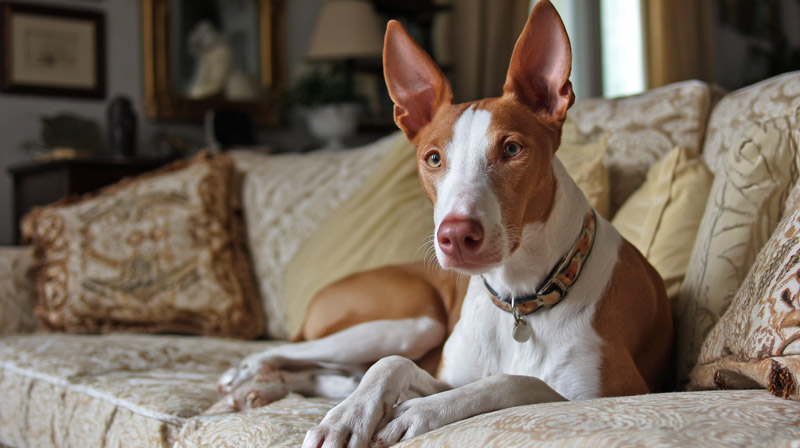
Yes, within limits. Petbarn says a well-exercised dog can adapt to a large apartment, though it does better with yard space.
Purina UK says the breed can be left occasionally with training. That means short absences, not routine full workdays.
How rare is the Ibizan Hound?
Rare. AKC’s 2025 ranking placed it 174th of 202 breeds, down from 152nd in 2018 and 165th in 2017.
AKC publishes a new list every year, so check the latest one for the current position.
Does an Ibizan Hound mix count as a purebred?
No. The FCI standard disqualifies any dog showing evidence of crossing with a Galgo or other sighthound, so a mix cannot be shown as an Ibizan Hound.
The AKC’s Canine Partners program enrolls mixed-breed dogs separately.
Preparing Your Home and Vet Before an Ibizan Hound Arrives
Order matters here. Fence the yard before pickup, since escape risk starts on the first day.
Pick a vet next and flag the anesthesia plan. Anesthesia questions arise with any procedure, so the clinic should know the breed before it is needed. Hearing and eye exams for the puppy get booked after that.
The breed club recommends a BAER hearing test for puppies and an annual eye exam by a board-certified ophthalmologist, according to PetMD. Over a 12-year lifespan, that schedule means about 12 eye exams.
The trade-off is paying for fencing and exams before the dog arrives.
This sequence reflects the IHCUS health statement as retrieved in October 2026, and a revised test list would change the last step.