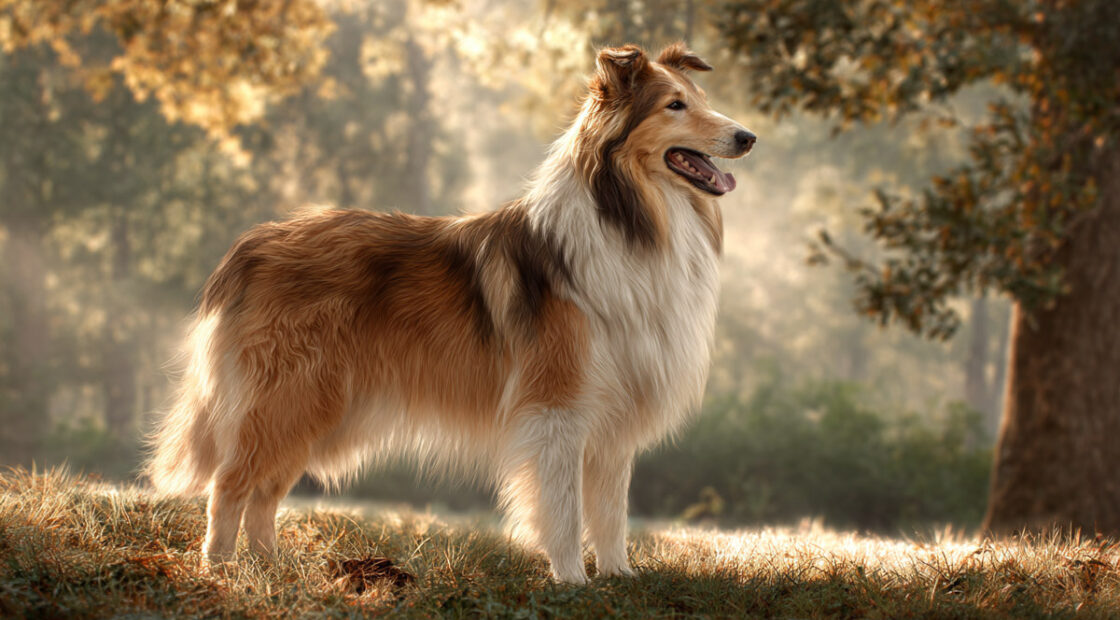
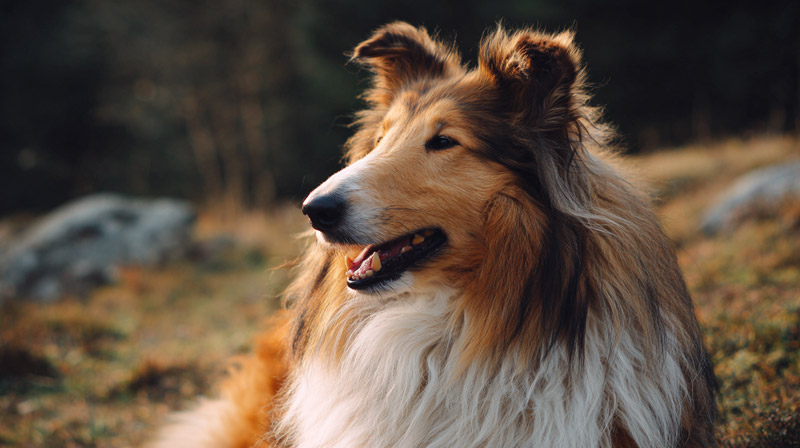
Lassie is how most people first meet the breed. The real Collie is a Scottish herding dog that comes in a long-coated rough variety and a short-coated smooth one, originally bred to gather sheep and cattle. These days it works mostly as a family companion, and owners praise its loyalty and sensitivity, plus how easily it trains.
Some Collies still compete in agility, obedience and herding trials. People also mix the breed up with the Border Collie and the Shetland Sheepdog, which are separate breeds.
Health screening matters more than most breed profiles admit. A 2015 study in Veterinary Medicine: Research and Reports found that 86.4% of 103 Collies tested in Brazil carried at least one copy of the MDR1 mutation.
In affected dogs, the mutation turns normal doses of the antidiarrheal loperamide into a neurologic hazard.
What Is a Collie?
One name covers two coat varieties, the long rough and the short smooth, and both come out of Scottish herding stock that gathered sheep and cattle. Today the breed is known mostly as a family companion, and the traits people mention are loyalty and sensitivity, along with a real willingness to learn.
The word “collie” also names a wider type of Scottish and northern English herding dog, which is why the Border Collie shares the name without being the same breed.
Registries don’t agree on how to file it. The AKC and the Canadian Kennel Club treat it as one breed with two coat varieties, both in the Herding Group. The Kennel Club in the UK splits Rough Collie and Smooth Collie into separate breeds and puts them in the Pastoral Group. The FCI places both in Group 1, Sheepdogs and Cattle Dogs, with Standard N. 156 covering the rough and N. 296 the smooth.
The FCI standard itself says the two derive from the same stock and still share lines.
Collie vs Border Collie
Different breeds, different jobs.

Wikipedia’s collie entry describes the Border Collie as the type most in need of a job, while other collie breeds settle into an active family routine more easily.
On paper the Border Collie is also the smaller dog. Under the Kennel Club standard, Border Collie dogs ideally stand 53 cm (21 in), shorter than the 56-61 cm Collie range. Coats differ too, since Border Collie coats come moderately long or smooth (Kennel Club) while the rough Collie carries a very abundant mane and frill (FCI).
Rough and smooth Collies rate average in trainability within the collie group, which puts them below the Border Collie.
For an owner who wants a family dog rather than a full-time working partner, the Collie is the easier fit.
Collie vs Shetland Sheepdog
The Shetland Sheepdog standard sets height at 13 to 16 inches at the shoulder. Even the smallest UK Collie bitch (20 to 22 inches) tops the tallest Sheltie by 4 inches.
The AKC calls the Shetland Sheepdog a distinct breed, not a miniature Collie, even though Rough Collies appear in its ancestry.
The weight gap is just as wide. A Sheltie runs 15 to 25 lb (Purina) and a Collie 50 to 75 lb (Canadian Kennel Club).
Where Did the Collie Come From?
Scottish Highlands and northern England, where shepherds used the dog to gather and guard sheep and cattle.
The FCI standard traces it further back, to dogs the Romans brought to Scotland that mated with native types. It describes the rough Collie as a refined version of the shepherd’s working collie, selected over at least a hundred years.
Nobody has settled where the name comes from. Breed references offer two theories, a Gaelic word for useful or a black-faced sheep called the colley.
The long nose has its own origin story. Breed profiles credit a cross with the Borzoi, though Wikipedia notes it is not known conclusively whether that cross entered the main breed.
Queen Victoria fell for the breed on a visit to the Scottish Highlands in the 1860s, and Collies turned fashionable (AKC). The Collie Club formed in England in 1881 (Wikipedia), the AKC recognized the Collie in 1885, and the Collie Club of America was founded in 1886 and remains the breed’s parent club.
Collies kept at Balmoral Castle put the breed in front of wealthy owners, according to Purina’s breed profile.
Fiction did the rest. Albert Payson Terhune’s collie stories were very popular in the US in the 1920s and 1930s, then Eric Knight published Lassie in The Saturday Evening Post in December 1938 and as a novel in 1940.
MGM filmed it in 1943 as Lassie Come Home, with a male Rough Collie named Pal in the title role.
The AKC’s 2025 registration ranking lists the Collie at 39th, behind the Border Collie at 26th.
How Big Is a Collie, and What Do Its Coat and Colors Look Like?
Expect a dog between 20 and 26 inches at the shoulder, depending on sex and which breed standard you follow, wearing either a long rough coat or a short smooth one. Accepted colors are sable and white, tricolor and blue merle, and the AKC standard also accepts white.
Size by breed standard
The three major standards disagree, and the gap shows up at the top of the range.
| Standard | Dogs | Bitches | Weight |
|---|---|---|---|
| Canadian Kennel Club | 24-26 in (61-66 cm) | 22-24 in (56-61 cm) | 60-75 lb dogs, 50-65 lb bitches |
| The Kennel Club (UK) | 22-24 in (56-61 cm) | 20-22 in (51-56 cm) | Smooth: 45-65 lb dogs, 40-55 lb bitches |
| FCI Standard N. 156 | 56-61 cm | 51-56 cm | Not stated |
A UK dog tops out at 24 inches, which is where the Canadian male range starts, so a Canadian male can stand 2 inches taller than the UK maximum. The United Kennel Club lists the same heights as the Canadian standard.
The UK smooth weights are as reproduced by the Smooth Collie Club of Great Britain from the Kennel Club standard. The Kennel Club adds that its figures describe an ideal, and individual dogs can run larger or smaller.
Rough and smooth coats
The rough coat has a straight, harsh outer layer over a soft, very close undercoat, plus an abundant mane and frill and feathered legs.
The smooth coat is short, hard, dense and flat (Canadian Kennel Club). It is still a double coat, just with a short outer layer (Orvis).
The FCI standard calls the two varieties the same except for coat length.
Accepted colors
Sable and white covers everything from light gold to rich mahogany. Tricolor dogs are mostly black with rich tan on the legs and head. Then there’s blue merle, a silvery blue splashed with black, and the white Collie that only some standards accept.
All carry white Collie markings to some degree, usually a collar, shirt, legs, feet and tail tip (FCI).
The standards split on white. The AKC accepts a white Collie, while the FCI standard calls all-white or mostly white highly undesirable.
Blue merles often have blue or flecked eyes, which the FCI standard permits. Every other color has dark brown eyes.
Blue merle also carries a breeding rule. The AKC says pairing two merles produces roughly a quarter double-merle puppies, with a higher chance of deafness and eye defects, so responsible breeders avoid it.
Collie Temperament With Children, Strangers and Other Pets
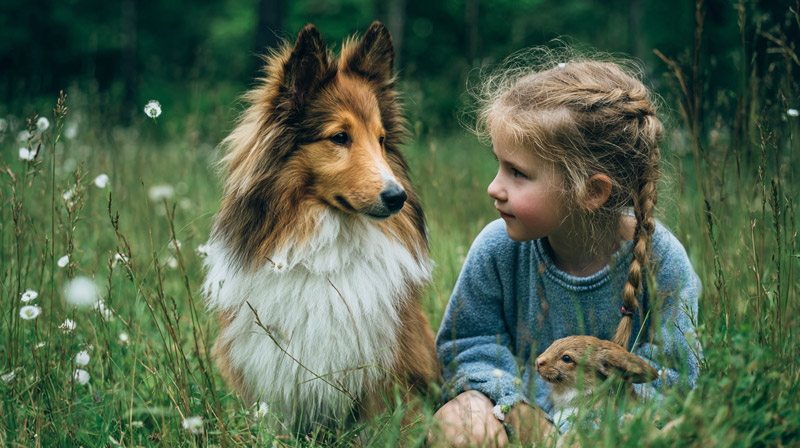
Collies are friendly and gentle with a sensitive streak, and the FCI standard describes them as good with children and other dogs. That same standard lists aggression and extreme shyness as disqualifying faults.
The Collie Club of America’s breed brochure lists loyal, child friendly, protective, sensitive and good with other animals.
With kids, a Collie is gently protective, but the herding instinct can show up as heel nipping or rounding up toddlers, so supervise (Orvis, Vetstreet). Strangers get a bark when they approach the house and a reserved welcome until introduced (Orvis, Dogster). A Collie socialized early is welcoming toward dogs and cats, though standoffish with unfamiliar animals (Orvis).
Collies talk. Collie Life describes a range of barks and grunts, plus the famous Collie singing.
Nervous or aggressive behavior is a fault in this breed, not a personality quirk to accept.
How Much Exercise and Training Does a Collie Need?
Plan on about an hour of daily exercise plus mental work, split into two outings. Published guidance runs from little to a 2-hour minimum, so the number depends on who you ask.
Daily exercise needs
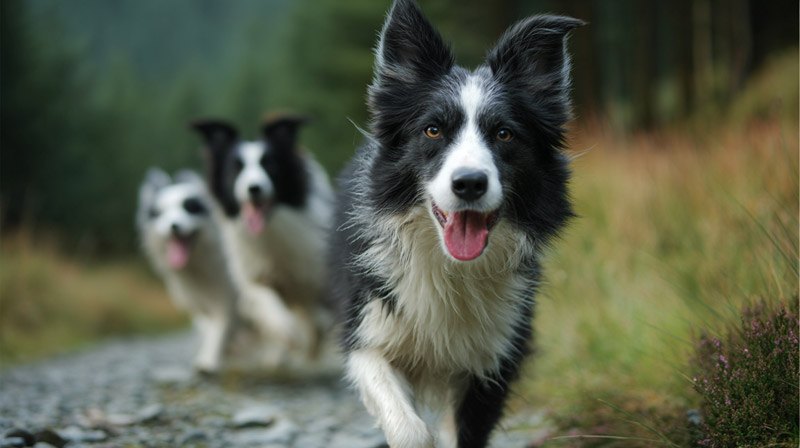
Orvis says about an hour a day, such as two long walks and a game of catch. Vetstreet suggests 30 to 45 minutes of walking or play, twice a day. Dogster wants a minimum of 2 hours, and Your Dog (UK) rates the exercise requirement as little.
None of the four explains the gap. Purina’s breed profile rates energy as medium and calls for moderate exercise, which fits the one-hour figures better than a 2-hour minimum.
I’d treat 2 hours as a ceiling for young, high-drive dogs. Add more if the dog paces, barks at nothing or chews furniture.
Training a sensitive dog
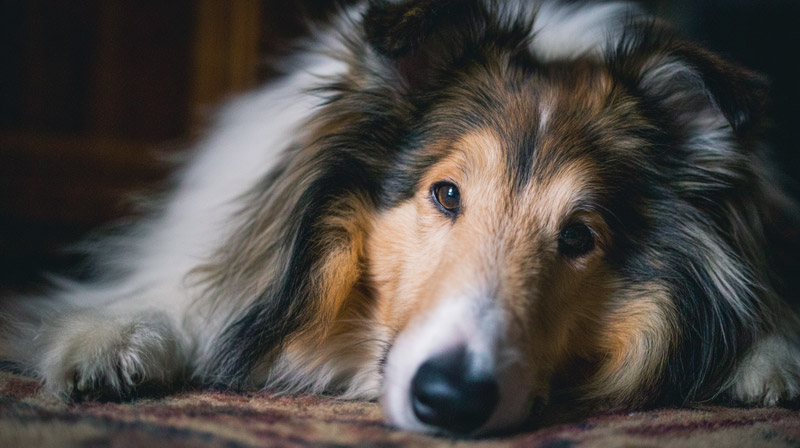
Collies learn fast and housetrain quickly, but they react badly to harsh corrections. Orvis lists sensitivity to harsh reprimands among the breed’s specific concerns.
The Collie Club of America says most Collies are very trainable and do best with positive techniques.
- Stick to reward-based methods
- Start young, so herding instinct lands on acceptable targets (Collie Club of America)
- Crate train for short absences
- Book daycare if your workdays run long
Orvis rates the Collie as a dog that adjusts poorly to alone time, with nuisance barking as the usual result.
Herding instinct and dog sports
AKC Herding Instinct Tests are non-competitive pass/fail tests that need no prior training, and dogs can enter from 6 months.
The Collie Club of America started a regional herding program in 2008, and those events usually offer Collies-only instinct testing. The club also warns against confusing chasing with herding.
Beyond herding, Collies do well in agility, obedience and rally, and tracking.
An unused herding drive ends up aimed at children and other pets.
Collie Grooming and Shedding
A rough Collie needs brushing at least weekly and daily during its twice-yearly coat blow, while a smooth Collie can go a few days between sessions. Both varieties shed all year.
| Task | Rough Collie | Smooth Collie |
|---|---|---|
| Brushing | Regularly, daily during the blow | Every few days |
| Bathing | About once a month | About once a month |
| Nails | Trim every few weeks | Trim every few weeks |
| Ears | Clean weekly with a mild cleanser | Clean weekly with a mild cleanser |
Orvis adds that daily brushing and drying with an absorbent towel keeps tangles from forming in the rough coat.
Why brushing advice varies
The AKC says about once a week, more in shedding season. Hill’s Pet suggests a quick session once or twice a week, Orvis says regular brushing with daily sessions during the blow, and Your Dog (UK) rates grooming as heavy.
The gap closes once you factor in coat state. A dog out of coat needs less, according to Dogz Online’s Australian breed profile, and a dog in full coat or mid-blow needs more.
Shedding and the coat blow
Expect hair either way.
The rough Collie blows its undercoat twice a year, shedding it in bulk, while the smooth Collie sheds at a steady rate instead of blowing, per Orvis.
Despite the volume of hair, the AKC describes Collies as a very clean breed without a doggy odor.
Which Health Problems Affect Collies, and How Long Do They Live?
Orvis’s breed guide gives 12 to 14 years. The problems that matter most are inherited eye, blood and skin disorders, and DNA tests can flag them before breeding.
Inherited conditions to screen for
| Condition | What it is | Test |
|---|---|---|
| Collie eye anomaly | Recessive eye disorder (NHEJ1 deletion), from normal vision to blindness | DNA test, plus eye exam by a board-certified ophthalmologist |
| Gray Collie syndrome (cyclic neutropenia) | Recessive blood disorder (AP3B1 gene), gray puppies with recurring infections | DNA test |
| Dermatomyositis | Immune-mediated disease of skin and muscle blood vessels | DNA test for susceptibility |
| PRA-rcd2 | Rod-cone dysplasia causing progressive retinal atrophy | DNA test |
Severity in collie eye anomaly varies widely, and UC Davis’s Veterinary Genetics Laboratory notes that some affected dogs keep normal vision for life. Most affected dogs still show an underdeveloped vascular layer in the eye.
The same laboratory sells a Collie Health Panel, built with the Collie Health Foundation, that bundles six tests: collie eye anomaly, cyclic neutropenia, dermatomyositis, degenerative myelopathy, MDR1 and rod-cone dysplasia type 2.
Some breed guides add hip dysplasia and epilepsy to the list. The AKC’s herding group testing list, drawn from the national breed club, shows four DNA tests for the Collie (PRA-rcd2, MDR1, DMS and CEA), and no hip evaluation appears among them.
Collie nose and skin problems
A pale, crusty nose is not automatically Collie nose.
Orvis lists nasal solar dermatitis among the breed’s concerns, but the MSD Veterinary Manual (revised 2024) calls true sun-driven nasal dermatitis probably rare and easy to misdiagnose as lupus.
Have a vet examine any crusting or color loss, since a biopsy often settles the diagnosis (Mar Vista Animal Medical Center). Cut sun exposure, and use a dog-safe sunscreen if the vet recommends one. And report skin lesions on a young puppy promptly, because dermatomyositis lesions can appear as early as 12 weeks (UC Davis VGL).
What Does the MDR1 Mutation Mean for a Collie?
MDR1 is a 4-bp deletion in the ABCB1 gene that stops the P-glycoprotein pump from clearing certain drugs out of the brain. Affected Collies can develop neurologic toxicity from medications that other dogs tolerate, according to the Collie Health Foundation.
Three samples show how common it is. A 2002 Washington and Idaho sample of 40 Collies came out 22% normal, 42% carriers and 35% affected (American Journal of Veterinary Research). In Australia in 2005, 33 Collies split 12% normal, 64% carriers and 24% affected (Veterinary Parasitology). The 2015 Brazil study of 103 Collies found 13.6% normal, 50.5% carriers and 35.9% affected, and none of 77 Border Collies carried it (Veterinary Medicine: Research and Reports).
Across those three samples, 78% to 88% of Collies carried at least one mutant copy. Washington State University’s own summary says about three in four US Collies carry it, while Purdue’s canine welfare center puts the figure near 70%.
Every sample is small, which is why an individual test result beats any breed average. The mutation also tracks Collie ancestry rather than the collie name, and Australian Shepherds, Shetland Sheepdogs and other herding breeds with Collie lines carry it too.
Drugs flagged for MDR1 dogs
The list below comes from veterinary summaries of Washington State University research. The WSU Veterinary Clinical Pharmacology Lab keeps the current version.
- Loperamide (Imodium) is the one to avoid outright, since it causes neurologic toxicity at diarrhea doses
- Ivermectin becomes a risk above 50 micrograms per kilogram in affected dogs, though the 6 micrograms per kilogram heartworm-prevention dose is considered safe
- The sedation and pain drugs acepromazine and butorphanol
- Cancer drugs vincristine, vinblastine and doxorubicin, and the antibiotics erythromycin and rifampin
- Milbemycin, moxidectin and selamectin at above-label doses (at the manufacturer’s heartworm-prevention doses these are considered safe)
Testing and telling the vet
- Ask the breeder for both parents’ MDR1 results (Purdue’s canine welfare guidance).
- If the status is unknown, order a cheek-swab test through the WSU Veterinary Clinical Pharmacology Lab.
- Read the genotype. Normal dogs are not expected to react to normal doses, mutant/mutant dogs are expected to react to loperamide and some anticancer drugs, and carriers can react to the same list.
- Give the result to your vet and ask for a check against the WSU drug list before every prescription.
One test result covers the dog for life.
Buying or Adopting a Collie: Cost and Breeder Checks
Rescue adoption fees run from $175 for a senior dog to $600 for a young puppy at the three Collie rescues checked here. Breeder prices are set litter by litter, so the useful comparison is what a price covers.
What rescue adoption costs
| Rescue | Adult | Puppy | Senior |
|---|---|---|---|
| Collie Rescue of Greater Illinois | $375 | $475 (under 1 year) | $175 (8+) |
| Houston Collie Rescue | $500 (ages 1-9) | $600 (under 12 months) | $200 (10+) |
| NorthEast Ohio Collie Rescue | $425 (Collies and Collie mixes) | $475 (up to 1 year) | $350 (8+, and special needs) |
The fee is the smallest line on the bill, since owning a dog is expensive over a decade of food and vet visits, plus grooming.
All three rescues screen adopters with an application and a home visit. Houston Collie Rescue’s application also asks for your vet’s contact details, NorthEast Ohio Collie Rescue runs a vet check after the home visit, and Freedom Collie Rescue, a separate Houston-area rescue, sends adopters a welcome letter with a list of medications Collies are sensitive to.
The Collie Club of America’s breed brochure lists the Collie Rescue Foundation among its recommended websites.
Buying from a breeder
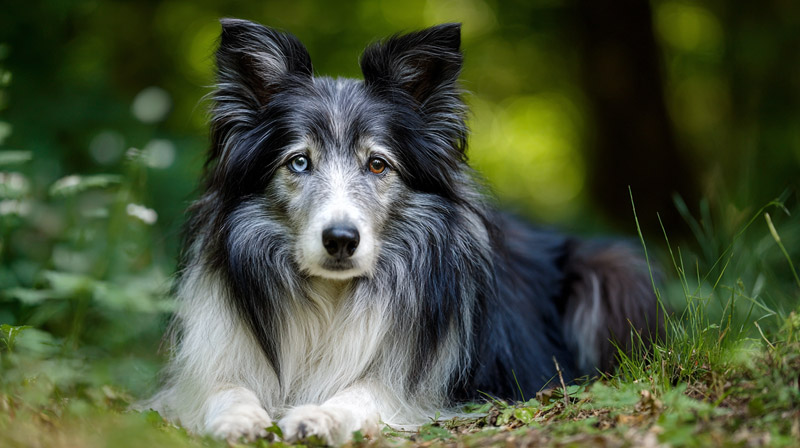
The Collie Club of America’s breeder guidance centers on health proof, a contract and meeting the dogs, not on price.
- Start with a Collie Club of America district contact instead of an online ad.
- Visit the breeder’s home or kennel and ask to meet at least one parent.
- Ask for health results. The club’s health statement names MDR1, PRA-rcd2, DMS and CEA testing, plus an eye exam for the puppies.
- Ask for a written contract, a health guarantee and a microchip or tattoo before the puppy leaves, as the club’s code of conduct specifies.
- Confirm the puppy is at least 8 weeks old. The code of conduct bars release before that age.
A breeder who cannot show results for both parents has not tested. Collie eye anomaly and cyclic neutropenia are both recessive, so two untested carriers can produce affected puppies.
Which Homes Suit a Collie, and Which Do Not?
A Collie suits a household with someone home most of the day, time for coat care and a wish for a dog that bonds with everyone in the family. It fits poorly in apartments with empty days, in homes with allergy sufferers and with owners who dislike dog hair.
The upsides are real. The dog bonds with the whole household, not one person (Vetstreet), and the AKC calls it a clean breed with little doggy odor. Purina notes it is versatile enough for service, guide and search and rescue work, and the smooth variety cuts the grooming load.
The downsides are just as real. Collies are not hypoallergenic and shed abundantly (Orvis), so allergy households are out. Apartments only work if someone is home to give exercise and head off barking (Vetstreet). And owners who skip health screening are asking for trouble, since MDR1 and eye disorders need testing and vet vigilance.
Apartments, yards and first-time owners
Chewy’s breed guide calls the Collie a surprisingly good first dog despite its energy, shedding and barking. Vetstreet says the breed is not a good apartment candidate unless someone is home.
Both hold. A fenced yard helps (Chewy), but Vetstreet is clear that the Collie should live in the house, not out in the backyard.
My rule is simple. Choose a Collie if someone is home most weekdays, you can brush daily through the coat blow, and you will test for MDR1 before any prescription.
Miss one of those, and a smooth Collie or a different breed is the better call.
Collie FAQ
Do Collies bark a lot?
Yes, Collies bark often, and leftover energy makes it worse. Chewy’s breed guide recommends extra walks and games to bring the noise down.
Are Collies good guard dogs?
Better watchdogs than guard dogs. Orvis describes attentive dogs that announce visitors, while Your Dog magazine rates the rough Collie only as a possible guard dog and calls the smooth Collie a companion first.
What is a Collie mix?
Any dog with a Collie parent or ancestor crossed with another breed, so size, coat and temperament vary from dog to dog. Vetstreet’s 2014 MDR1 guide notes that mixes with herding ancestry can carry the mutation even when they do not look like herding dogs, so test the mix too.
How much should a Collie eat?
Most adult Collies eat about 2 to 3 cups of quality dry food a day, split across two meals, according to Orvis. Size, weight and age move that number, so confirm the amount with your vet.
Are Collies still used for herding?
Yes, though the picture differs by country. Wikipedia’s Rough Collie entry says the Border Collie replaced it for serious herding in the UK, while the United States and a number of European countries have seen the Collie return as a working and performance dog.
The Real Cost of Keeping a Collie
A Collie costs more in time than in money. At about an hour of exercise a day, a 12 to 14 year life adds up to roughly 4,400 to 5,100 hours.
Orvis supplies both the exercise guideline and the lifespan figure, and brushing and training hours come on top.
Check weekday time at home before anything else, because it costs nothing to check. Both parents’ test results come next, since they cannot change after purchase, and once the puppy is home the MDR1 genotype goes on file with the vet.
Expect some waiting, since the Collie Club of America tells buyers to be patient when breeders reply slowly. Once a puppy is chosen, comparing puppy food brands is the next purchase decision.
Last verified October 2026. If Washington State University revises its MDR1 problem-drug list, the vet-check step changes with it.