Plenty of puppies handle bully sticks fine, as long as they can chew hard food without gulping it. The stick also has to fit the puppy’s mouth, and someone should be watching until it’s gone or taken away.
Sources disagree on age. Retail and pet-care pages cite either about 12 weeks or about 6 months, and neither camp points to a study that tested age.
Calories are the thing people miss. An average 6-inch stick holds about 88 calories, roughly 30% of a 10-pound dog’s daily requirement (Tufts University, 2013).
Are bully sticks safe for puppies?

Mostly, yes. That holds for puppies that already chew hard food, with a stick sized to them, an adult watching, and a product from a source with clean handling.
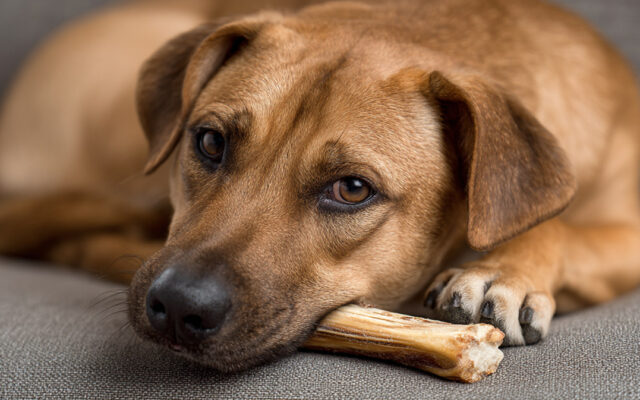
The chew itself is dried beef pizzle (bull penis) with nothing else in it. It breaks down in the stomach, which rawhide doesn’t do.
The American Kennel Club calls bully sticks easily digestible and points out that, unlike bones, they don’t splinter. According to the same source, puppies get the same protein and dental benefits adult dogs do.
Whether one particular stick is safe depends on the puppy’s age, how thick the stick is compared with the puppy’s mouth and weight, whether you’re sitting nearby until it’s finished or taken away, and where it came from. A brand with a clean recall history is worth paying a bit more for.
Cuteness notes that no treat is risk-free for every dog, and bully sticks are no exception. A swallowed piece getting stuck is the risk everyone talks about, but bacteria and calories deserve just as much thought.
Adult dogs run into much the same problems, and there’s a longer write-up on how safe bully sticks are for adult dogs.

What age can puppies start chewing bully sticks?
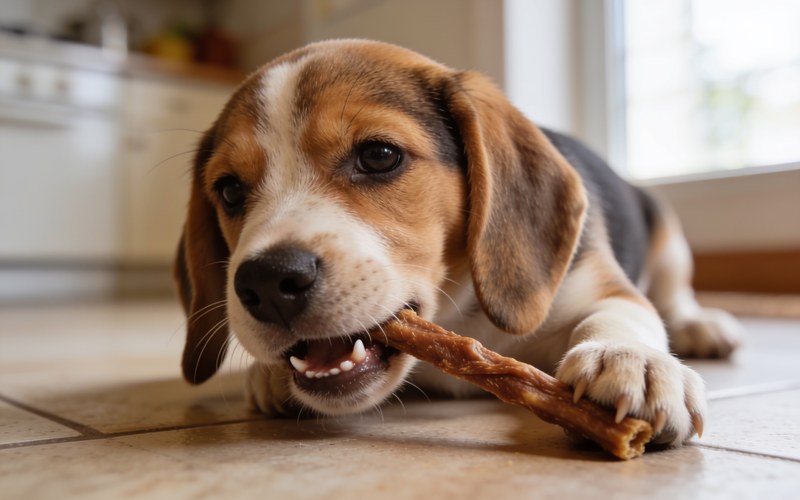
Best Bully Sticks, a retailer, says most veterinarians suggest around 12 weeks, with larger breeds sometimes ready earlier and smaller breeds later. Cadet Pet sets the bar higher. Its line is that bully sticks are safe for puppies over 5 pounds with all their adult teeth, typically by six months (citing VCA). Houndsy recommends around six months too, and so does Pawstruck’s puppy guide.
Since none of the pages behind those numbers cites a study, the practical test is whether the puppy chews hard food without gulping it.
The gap isn’t random. The 12-week figure is really about whether a puppy can chew at all. Six months is when the adult teeth are in.
PetMD says baby teeth begin falling out at roughly 3.5 to 5 months, with most puppies finishing teething by about 6 months. A 12-week puppy still has nearly all of its baby teeth, so a softer, thinner stick makes sense at that age.
Under 12 weeks, or while a puppy is still nursing, I’d skip it altogether. After that and up to about 6 months, a thin, soft stick in a holder is the way to go, and only for a puppy that doesn’t swallow kibble whole. Once the adult teeth are in, a standard stick sized to body weight is fine.
Kinship’s backstop is the obvious one. Run the plan past your vet, especially for toy breeds.
Are bully sticks safe for teething puppies?
Sore gums are the reason most people try it, and a stick does give them something to work on. Hardness is the problem.
Hepper warns that some sticks are too hard for young teeth, and Canine Journal suggests choosing sticks that bend slightly instead of snapping.
If a stick feels like a rock, skip it. Kinship points to soft rubber toys with hidden treats and puppy-safe dental chews, and the best chew bones for puppies list covers more options for this stage.
Choking and blockage risks, and why end pieces matter
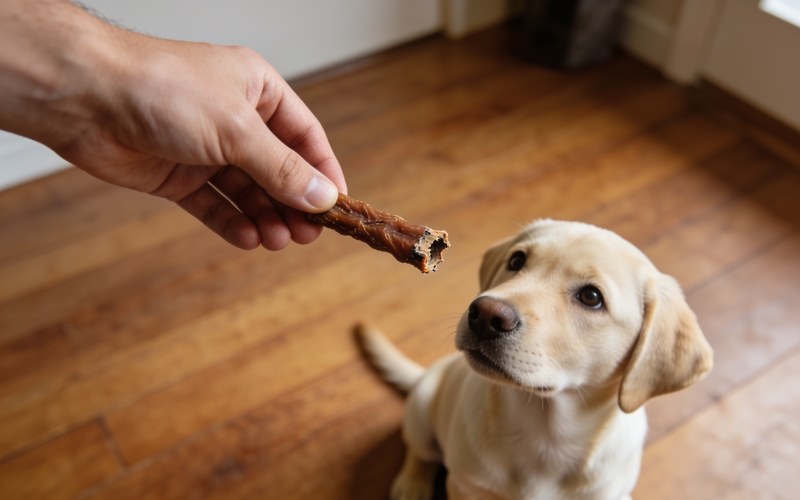
Most of the physical danger sits in the last chunk. Once a bully stick wears down to something swallowable, a puppy can gulp it whole.
Choking is the immediate worry, with the piece lodging in the throat. Chewy’s advice is to throw the stick out once it’s small enough to be a hazard. Blockage is the other one. The piece gets past the throat and stalls further down. AKC calls bully sticks digestible, but Kinship notes that puppies swallowing big chunks can still end up with discomfort or nausea.
A vet quoted by Yahoo (Ahn) describes puppies that don’t realize what they’re holding and swallow a very large piece.
The Merck Veterinary Manual (reviewed August 2025) classes gastrointestinal obstruction as an emergency, with vomiting and loss of appetite among the common signs. It also says young, large-breed dogs are more likely than older animals to present with foreign body obstruction.
People tend to overlook that last part. Big puppies chew harder and swallow bigger pieces.
Take the stick away before the last few inches, not after. It’s the simplest fix, and Kinship makes the same point: pulling it before it’s finished limits how much gets swallowed in one go. For small puppies, Best Bully Sticks recommends a holder or clamp.
Size matters here too. Larger puppies need thicker sticks built for bigger mouths, because a thin one wears down into a swallowable piece quickly.
Can bully sticks carry Salmonella or E. coli?
Yes. Researchers at Tufts University and the University of Guelph tested 26 bully sticks bought in the US and Canada and found E. coli on 7 of them (one tetracycline-resistant), plus Clostridium difficile on one and methicillin-resistant Staphylococcus aureus (MRSA) on another (Freeman et al., Canadian Veterinary Journal, 2013).
The authors flagged limits. The sample was small, and not every strain they found is known to infect people.
Salmonella has a documented bully stick case of its own. On October 3, 2025, Best Buy Bones, Inc. recalled 4 lots of Nature’s Own Pet Chews Bully Bites in 1-pound bags (expiration September 2027) over possible Salmonella, per the FDA announcement.
No dog illness had been reported at that point, according to dvm360. The FDA advised buyers to return the bag or destroy the treats somewhere pets, kids and wildlife can’t get to them.
Freeman’s team described bully sticks as an uncooked, dried product, so seeing single-ingredient treats on the pack says nothing about bacteria.
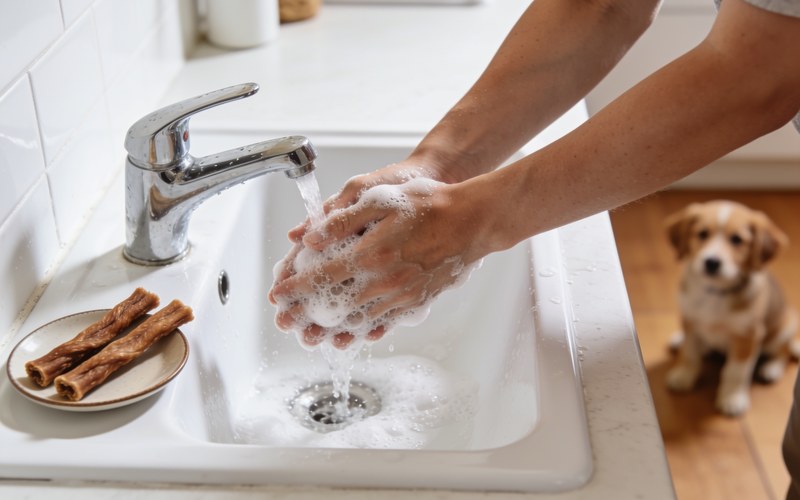
Wash your hands after touching a stick, the way you would after raw meat, and keep very young, elderly, pregnant or immunocompromised people (and pets) away from them, per Tufts and Kinship. Checking the brand against FDA recall notices before buying is worth doing too.
How many calories do bully sticks add to a puppy’s diet?
An average 6-inch stick holds about 88 calories, which is a large share of a small puppy’s day. Owners tend to count the stick as a chew, not as food, and honestly that’s the part I find most annoying about them, because a stick looks like such a small thing.
Freeman et al. measured a random subset of five sticks and got 9 to 22 calories per inch (Freeman et al., 2013). The average 6-inch stick lands at about 88 calories (Tufts University, 2013).
On the other side of the ledger, treats should stay under 10% of daily calories (VCA Animal Hospitals, AKC). AKC’s example is a 5-pound dog eating 182 calories a day, which leaves an 18-calorie treat budget (AKC).
Put those side by side and the gap is wide. One average stick is close to five times the 10% treat budget in AKC’s 5-pound example.
That example uses an adult-sized meal plan, and puppy needs differ. Your vet sets the real figure. After that, VCA’s method is simple enough: 10% of daily calories goes to treats and the rest comes from complete food.
No vet body in the sources sets a weekly count. Eurekapet, a retailer, suggests one to two sticks a week, so treat that as a rule of thumb, not a standard.
Watch the puppy after each new chew. Kinship advises looking for vomiting or diarrhea, and the full picture is in this rundown of bully sticks side effects.
Weight creep is slower to spot. A UK vet quoted by Kinship says to cut calories if body condition changes, and a body condition score chart makes that change easy to see.
Bully sticks vs rawhide, antlers and dental chews
On the chew shelf, bully sticks sit in the middle. They’re more digestible than rawhide and far softer than antlers, though the dental claims rest on general statements, not seal-backed trials.
| Chew | What the sources say | Main puppy concern |
|---|---|---|
| Bully stick | Easily digestible, does not splinter (AKC) | Swallowed end piece, bacteria |
| Rawhide | Take it away once it can be swallowed whole (AKC) | Choking, obstruction |
| Antler | Linked to fractured teeth by veterinary dentists | Tooth fracture |
| VOHC-accepted dental chew | Reviewed against plaque and tartar standards | Size, calories |
The AKC’s line is that bully sticks, unlike rawhide, are easily digestible. Rawhide gets a discard rule from the same source: once a piece is small enough to swallow in one go, it goes in the bin.
If you’re dropping rawhide altogether, the wider list of rawhide alternatives is worth a look before you commit to sticks.
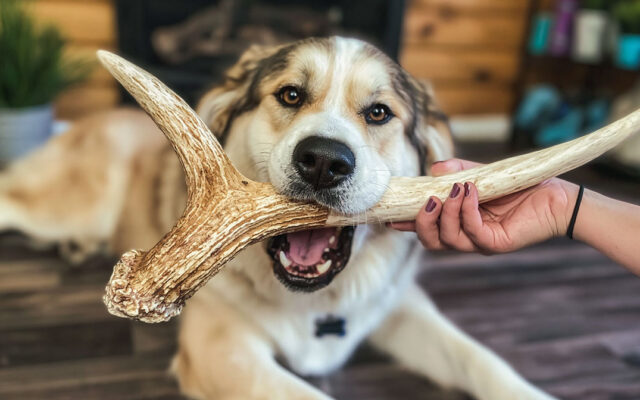
Antlers are the wrong chew for a puppy. Tooth fracture in dogs has a reported prevalence of 20% to 27% (Veterinary Times, 2019), and veterinary dentists have written about rising fractures after antlers and nylon bones.
One vet quoted by PetsRadar says most puppies should skip antler chews until about a year old. The full case is in this breakdown of whether antlers are safe for dogs.
The Veterinary Oral Health Council does not test products itself. It reviews data that makers submit and awards a seal for plaque control, tartar control, or both.
For cleaning teeth, a chew with trial data behind it is the better pick, and the VOHC accepted list is where to check. A bully stick makes more sense as a long, digestible chew while the puppy is teething.
How to choose a bully stick for a puppy
Size and thickness
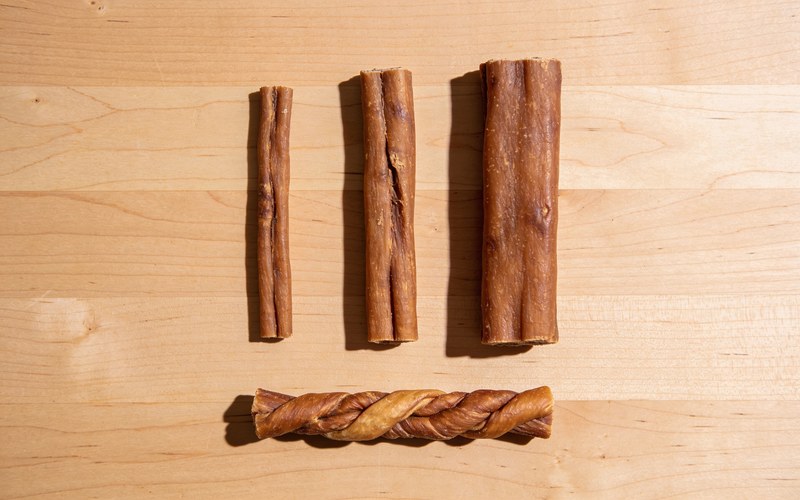
Retailers sort sticks into tiers by dog size, with thin ones for small dogs (Raw Paws) and standard thickness for medium dogs. Thick or jumbo sticks are meant for large dogs and power chewers.
Pawstruck sells braided sticks for stronger chewers and standard ones for medium to large puppies.
A puppy that finishes a stick in minutes has outgrown its bracket. Strong chewers get their own picks in this guide to bully sticks for aggressive chewers.
Processing, origin and labels
Odor-free describes a smell, not a safety result.
Natural Dog Company says the odor comes from blood and urine in the pizzle, and its process bakes sticks hanging vertically so it drains. Bully Bunches says its odor-free sticks are washed twice and cooked longer than regular ones.
That differs from the 2013 description of bully sticks as uncooked and dried (Veterinary Practice News). None of the sources checked compares bacterial counts in baked and air-dried sticks, so “baked” is a manufacturing claim, not a tested safety margin.
On the label, you want beef pizzle as the only ingredient, a country of origin, and a lot number with an expiration date (recalls are announced by lot). A maker that publishes its process is a good sign as well.
Redbarn’s odor-free stick lists its origin as Paraguay, Brazil, Colombia, New Zealand, Peru or Turkey, so the country is worth checking pack by pack.
Natural Dog Company also notes that refrigeration is expensive in Brazil and not every maker pays for it, which is one reason bully stick prices vary so widely.
How to give a puppy a bully stick, step by step
- Wash hands for at least 20 seconds with soap and hot water before and after handling the stick (FDA).
- Keep the first chews to 5 to 10 minutes, then build up if the puppy’s digestion copes (Cadet).
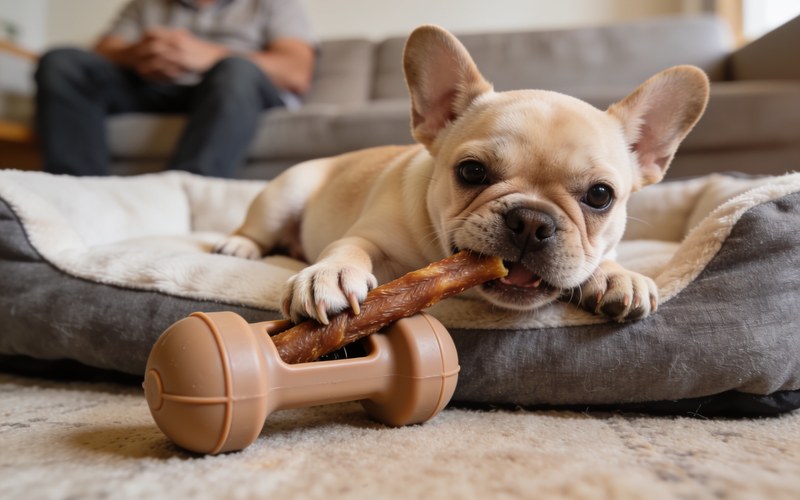
- Fit the stick into a bully stick holder. It grips the stick so the puppy has to chew down to the opening and can’t swallow the end (Bully Bunches).
- Stay in the room until the stick is back in your hand.
- Take the stick back, empty what’s left from the holder, and wash the holder in soapy water between uses (Woof’s instructions).
A holder lowers the swallowing risk. It doesn’t replace watching the puppy.
Chew time depends on the stick and the chewer. Rover puts it between a couple of hours and a few days, and the factors behind how long a stick lasts are worth knowing before you buy in bulk.
When bully sticks are not a good fit
A beef allergy rules them out first. Beef was the most frequently reported allergen, implicated in 34% of the 297 dogs with food reactions reviewed (Mueller et al., BMC Veterinary Research, 2016). Food allergy is uncommon overall, according to Vetster, so most puppies are unaffected.
A puppy on a medical or prescription diet should stick to treats the vet approves for that diet, says VCA Animal Hospitals. Dogster rates bully sticks for dogs that don’t swallow chews in large bites, so a gulper is better off with something else.
Small kids matter too. The AKC Canine Health Foundation says children shouldn’t handle pet food or treats unless an adult supervises hand washing afterward, which is hard to manage in a house with toddlers.
A puppy that fails one of these checks still has options. A list of safe dog chews is a good place to start, and your vet can narrow it down.
When to call the vet after your puppy chews a bully stick
Choking can’t wait. Clear the airway first (per veterinary advice quoted by Yahoo) and get to an emergency clinic. Collapse or weakness gets the same response, and so does abdominal pain with lethargy.
Quieter signs still call for a same-day phone call. Vomiting that runs past 24 hours (Vetster) counts, and so does refusing food or water. Vomiting with no stool is the one PetMD calls a strong sign of blockage, and diarrhea alongside any of these belongs on the list too, since a partial blockage can cause it.
No vomiting doesn’t clear the puppy. The Merck Veterinary Manual says vomiting is less common when the blockage sits further down the small intestine.
Timing matters. PetMD says a vet can sometimes induce vomiting within 30 minutes to 2 hours of swallowing, and by the time symptoms show, that window has usually closed.
Surgery for a blockage runs from $500 to several thousand dollars, depending on location and whether it’s an emergency (PetMD, 2025).
Give the vet the brand and lot number, plus the size of the piece and roughly when it went down.
Bully Sticks FAQ
What are bully sticks made of?
Beef pizzle, which is the penis of a bull or steer, dried until firm. A plain stick is a single ingredient and nothing more.
Many owners don’t know this. In the Tufts and Guelph survey, only 44% of general respondents and 62% of veterinarians identified the source correctly (Canadian Veterinary Journal, 2013).
Can bully sticks give a puppy diarrhea?
In some puppies, yes. Swallowed chunks and frequent sticks are the usual triggers, according to Kinship and Canine Journal.
Introduce new treats slowly and one at a time, as VCA Animal Hospitals advises, and call the vet if vomiting, diarrhea or appetite changes follow.
Do bully sticks clean a puppy’s teeth?
Partly. The AKC says the gnawing scrapes away plaque before it hardens.
Brushing remains the gold standard, per the Veterinary Oral Health Council, and VOHC-accepted chews carry trial data behind their seal.
Can bully sticks cause pancreatitis in puppies?
None of the sources checked link bully sticks to pancreatitis. Fat is the concern.
VCA Animal Hospitals says dogs with chronic pancreatitis on a low-fat diet should avoid high-fat treats, so a puppy with that history needs the vet’s approval first.
How should I store bully sticks?
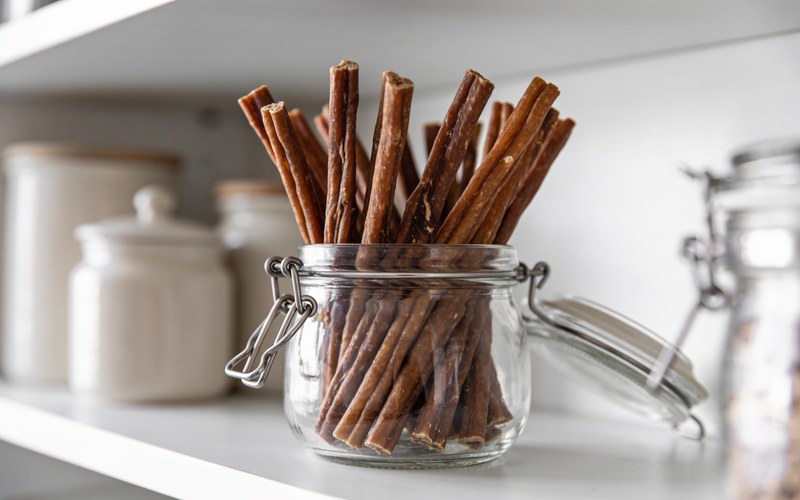
Keep unused sticks in a sealed bag or airtight container in a cool, dry place. Pawstruck says this prevents mold and keeps pests away.
Redbarn lists a 36-month shelf life for its odor-free stick, so check the date printed on your pack.
What to Settle Before a Puppy’s First Bully Stick
Start with the vet. One answer on age or diet can end the plan before any money is spent, so there’s no point shopping first.
Calories come next, because they decide how much stick the puppy can have. One 6-inch stick (88 calories, Tufts University, 2013) fits the 10% treat ceiling from VCA Animal Hospitals only for a puppy eating at least 880 calories a day. A smaller puppy needs a shorter stick or fewer sessions.
Size and holder get picked last. Waiting for adult teeth lowers the risk further, but it gives up the chew during peak teething, and some owners won’t want to make that trade.
This position reflects sources checked in November 2026. A new recall notice or a controlled study on age would change it.