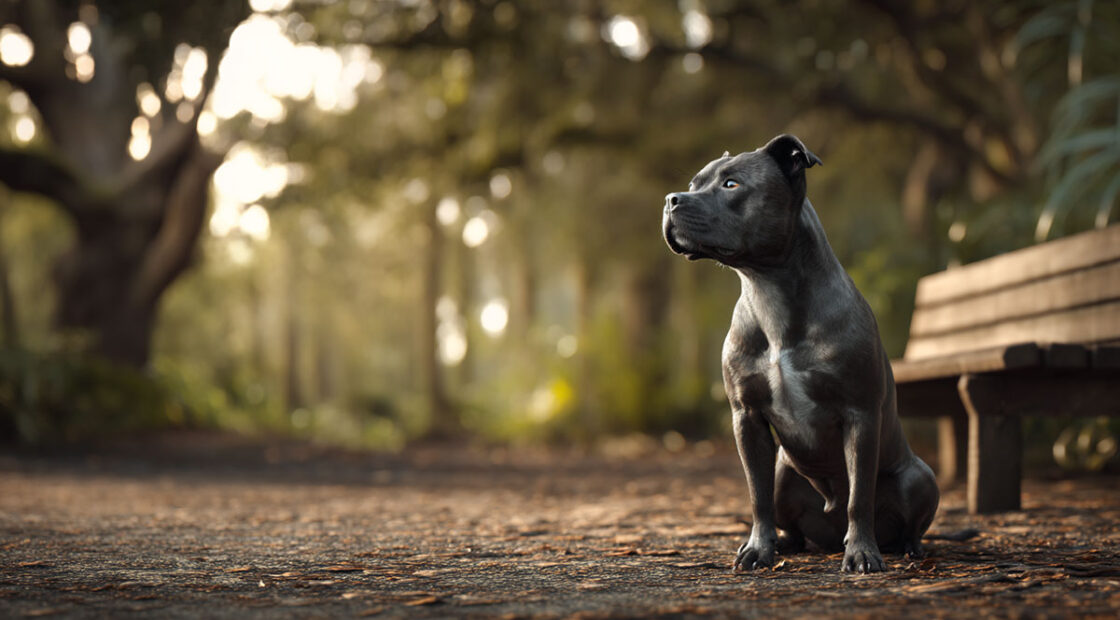
Staffordshire Bull Terriers stand 36 to 41 cm at the withers, and males weigh 13 to 17 kg, according to the Royal Kennel Club breed standard. The breed came out of the 19th-century English Midlands and these days mostly lives as a family companion.
The Royal Veterinary College’s 2020 VetCompass study of the breed describes it as the second most common purebred under UK primary veterinary care in its 2016 data. Registrations tell a smaller story. The Royal Kennel Club recorded only 6,313 registrations in 2023.
What Is a Staffordshire Bull Terrier?
Short smooth coat, a lot of strength packed into a small frame, and a habit of attaching closely to its people. That covers most of what you’d see in one.
Owners say Staffy or Staffie. Britannica adds a few older names, bull and terrier and half-and-half, along with Pit Bull Terrier.
The breed standard asks for a balanced, smooth-coated dog that’s muscular and agile, and active with it.
The Royal Kennel Club (formerly The Kennel Club) and the American Kennel Club (AKC) both file it in the Terrier group. The Federation Cynologique Internationale (FCI) is more specific, listing it as Standard No 76, Group 3 (Terriers), Section 3 (bull type terriers).
It gets mixed up with the American Staffordshire Terrier and the American Pit Bull Terrier all the time. All three trace back to bull and terrier stock, but they sit in separate registries, and that split matters for the law as much as for the show ring.
Where Does the Staffordshire Bull Terrier Come From?
Breeders in the Black Country of Staffordshire and northern Birmingham crossed bulldogs with terriers in 19th-century England, and The Kennel Club recognised the result in 1935.
Those early dogs were bred for fighting other dogs in pits, per Britannica. The Cruelty to Animals Act 1835 made it an offence to keep a pit or other place for fighting or baiting dogs, bulls or bears.

Dogs NSW names the old-fashioned bulldog and the English White Terrier, now extinct, as the foundation stock.
The Royal Kennel Club traces the same ancestry to the 1860s, when James Hinks crossed bulldogs with terriers to build the Bull Terrier line.
Hinks later added breeds that changed the head shape. Fanciers who preferred the older type kept it going, and the modern Staffordshire Bull Terrier comes from those dogs.
Fanciers met at the Cross Guns Hotel in Cradley Heath on 15 June 1935 and adopted the first standard, and The Kennel Club granted the breed club its name that July (The Stafford Knot). The FCI accepted the breed on a definitive basis on 21 October 1954. The AKC admitted it to its stud book in 1974, and the United Kennel Club recognised it in 1975, the same year AKC show competition began.
Sources split on the AKC date. Showsight Magazine puts registration in 1974 with show status the year after, while the Staffordshire Bull Terrier Club of America’s 2026 judges seminar gives 1975.
The club’s own breed history records the first Terrier Group placement on 19 April 1975. That fits the show-status reading.
Staffordshire Bull Terrier Size, Coat and Colours

Height at the withers is 36 to 41 cm (14 to 16 in). Under the Royal Kennel Club standard, dogs weigh 13 to 17 kg and bitches 11 to 15.4 kg.
| Source | Weight | Size label |
|---|---|---|
| Royal Kennel Club (standard and breed profile) | Dogs 13-17 kg, bitches 11-15.4 kg | Small |
| PDSA breed guide | 11-17 kg | Medium |
| RVC VetCompass sample | 20.2 kg median | Not classified |
The median Staffordshire Bull Terrier in the Royal Veterinary College’s VetCompass sample of 1,304 clinic patients weighed 20.2 kg, above the top of both ranges.
The standard describes an ideal, and the Royal Kennel Club tells puppy buyers that a dog can come out larger or smaller than its figures. Height is steadier than weight, since the standard and PDSA agree on 36 to 41 cm.
The coat is short and smooth and lies close to the body. It sheds, and the Royal Kennel Club puts grooming at once a week.
Accepted colours under the standard are white, red, fawn, black and blue, any of those with white, and any shade of brindle with or without white. Black and tan and liver are unacceptable, even though some owner guides list them as normal colours.
Staffordshire Bull Terrier Temperament
The breed standard sums up the temperament as “bold, fearless and totally reliable”. In practice Staffies are affectionate dogs that want to be wherever their people are.
With family members and children

The standard calls the breed highly intelligent and affectionate, especially with children. The AKC’s breed profile lands in the same place and describes a gentle, playful family dog.
That describes the typical dog, not a guarantee. The Royal Kennel Club’s Safe & Sound programme teaches children how to behave around dogs, and it applies here as it does to every breed.
With other dogs and strangers
Wisdom Panel warns that some Staffies react to dogs they do not know, and Sainsbury’s Bank Pet Insurance advises against off-lead walks where strange dogs may appear. Keeping the lead on in open spaces is the simple response.
Aggression and the “nanny dog” label
A 2020 Royal Veterinary College VetCompass study of 1,304 Staffordshire Bull Terriers and 21,029 other dogs found no significant difference in the odds of aggression (odds ratio 1.09, 95% CI 0.75 to 1.58).
Those figures come from aggression recorded in veterinary clinic notes, so they only capture cases that reached a vet.
The FCI standard goes further and lists aggressive or overly shy dogs as disqualifying faults.
The “nanny dog” nickname has less behind it. Agria Pet Insurance’s guide notes that old photos show Staffies with children, but there is no real evidence the breed was ever bred or used to mind them.
Treat it as a nickname, not a safety record.
Staffordshire Bull Terrier Lifespan and Health
On UK data a Staffy lives about 11 to 12 years. Overall health is no worse than other dogs, though there are a few specific weak spots.
How long do they live?
The Royal Kennel Club’s breed profile gives a lifespan of over 12 years.
A 2022 Scientific Reports life-table study of UK dogs under primary veterinary care puts life expectancy at birth at 11.33 years (95% CI 11.19 to 11.48) across 2,364 Staffordshire Bull Terriers.
The two numbers measure different things. Life expectancy at birth counts puppies that die young, so it sits below the typical age at death for dogs that survive puppyhood.
Which health conditions affect the breed?
The most thorough UK comparison is the Royal Veterinary College’s 2020 VetCompass study, which set 36 common disorders in Staffordshire Bull Terriers against the rest of the dog population.
Staffies came out at higher risk for 4 of 36 disorders, led by seizures at 2.06 times the odds, then atopic dermatitis, skin masses and stiffness. They were at lower risk for 5 of 36, led by patellar luxation at 0.15 times the odds. The remaining 27 of 36 disorders (75.0%) showed no difference.
The authors found no evidence that the breed has more health problems overall than other dogs.
Insurer pages still list luxating patella among the breed’s risks (Sainsbury’s Bank Pet Insurance), which is the opposite of what the VetCompass data shows.
Two inherited conditions have DNA tests. One is hereditary cataracts, and the other is L-2-hydroxyglutaric aciduria, a metabolic disorder first identified in the breed according to Wisdom Panel.
The Royal Kennel Club also places the breed in Breed Watch category 2, which flags features that could affect the breed in future if they are exaggerated.
Which health tests apply?
UK and US breed bodies do not test for the same things.
| Test | Royal Kennel Club | OFA CHIC (US) |
|---|---|---|
| Hereditary cataract and L-2-HGA DNA tests | Best Practice | Required |
| Elbow dysplasia scoring | Best Practice | Required |
| Eye examination | Best Practice | Required (ACVO ophthalmologist, from age 1) |
| Hip dysplasia scoring | Not listed | Required (OFA or PennHIP) |
| Patellar luxation and cardiac checks | Not listed | Optional |
The Royal Kennel Club’s breed page lists no hip scheme as of October 2026, while the OFA’s CHIC protocol, in place for the breed since January 2014, requires one.
Neither list tests for seizures or atopic dermatitis, the two disorders VetCompass ranked highest. The Royal Kennel Club’s own health standard states that it leaves out conditions without recognised tests.
Ask any breeder for both parents’ certificates, then check the results in the Royal Kennel Club’s Health Test Results Finder or the OFA CHIC database.
How Much Exercise and Training Does a Staffordshire Bull Terrier Need?

Plan on about an hour of exercise a day, and start reward-based training and socialisation the week the puppy comes home.
The sources disagree on the exercise number. The Royal Kennel Club’s breed profile says up to one hour per day, while PDSA’s vets set one hour as the minimum.
Treat PDSA’s figure as the floor. The same vets describe the breed as boisterous well into adulthood and a known chewer, so a short-changed Staffy finds its own entertainment.
A few separate walks work better than one long one. Add time to run and play off lead in a secure area, scent games or a puzzle toy that ends in a treat, and strong chew toys built for a powerful jaw.
For training, PDSA recommends positive, reward-based methods with firm boundaries, because the breed tests limits. It also advises working on recall early, since an excitable Staffy will chase anything that looks fun.
The research backs that approach. In a 2020 PLOS ONE study of 92 dogs from seven training schools in Portugal, dogs trained with aversive methods showed more stress behaviours and more pessimistic judgements than reward-trained dogs, along with larger cortisol rises after sessions.
Socialisation has a short window for easy gains, and the sources close it at different ages. The AKC puts the end of the critical period between 12 and 14 weeks, while the Royal Kennel Club’s breeder puppy-pack template says it closes at around 14 to 16 weeks.
Plan around the earlier date. PDSA expects a Staffy that meets plenty of people, dogs and situations while young to grow into a confident adult, and it recommends puppy socialisation groups.
Consistency beats intensity.
Staffordshire Bull Terrier vs American Staffordshire Terrier vs Pit Bull
The English Staffordshire Bull Terrier, its larger American counterpart registered by the AKC, and the American Pit Bull Terrier registered by the UKC all share one bull and terrier ancestry.
| Attribute | Staffordshire Bull Terrier | American Staffordshire Terrier | American Pit Bull Terrier |
|---|---|---|---|
| Origin | England | United States | United States |
| Registry history | FCI 1954, AKC 1974 | AKC 1936, as Staffordshire Terrier | UKC 1898, not an AKC breed |
| Height at withers | 36-41 cm | Males 46-48 cm, females 43-46 cm (FCI) | Males about 46-53 cm, females about 43-51 cm (UKC) |
| Aggression in the standard | Disqualifying fault | Disqualifying fault | Some dog aggression called typical |
The larger American Staffordshire Terrier entered the AKC stud book in 1936 under the name Staffordshire Terrier. VCA Animal Hospitals dates the addition of “American” to 1972, two years before the AKC recognised the English breed.
The American Pit Bull Terrier has the earliest registry entry. The UKC says its founder, C. Z. Bennett, gave registration number 1 to his own dog in 1898.
For an owner, what matters day to day is size and what the standard says about temperament. The Staffy stands shorter than either American dog, and its standard treats aggression as a disqualifying fault, where the UKC standard for the pit bull terrier calls some dog aggression characteristic.
Is the Staffordshire Bull Terrier a Banned Breed?

Not in the UK. Ireland does restrict it, though, and a dog that looks like a banned type can be seized in the UK whatever its pedigree.
| Country | Status | What applies |
|---|---|---|
| UK | Not a banned type | Unlimited fine or up to 6 months in prison if any dog is dangerously out of control |
| Ireland | Restricted breed | Muzzle, short strong lead (up to 2 m), handler over 16 |
GOV.UK bans Pit Bull Terrier, Japanese Tosa, Dogo Argentino and Fila Brasileiro types. XL Bully type dogs are also banned in England and Wales, with separate rules in Scotland and Northern Ireland. The Staffy is not on any of these lists.
Parliament tested that in 2018. After PETA UK proposed adding the breed to the Dangerous Dogs Act 1991, an e-petition against the idea collected 186,226 signatures, and MPs debated it in Westminster Hall on 16 July 2018.
Defra’s response on 5 July 2018 said the government had no intention of prohibiting the keeping of Staffordshire Bull Terriers. The Kennel Club (now the Royal Kennel Club), RSPCA, Dogs Trust and Blue Cross had urged MPs to reject the call.
Owners get caught out by the looks test. GOV.UK says a banned type is judged on what the dog looks like, not on its breed or name.
The owner has to prove the dog is not a banned type. A conviction means an unlimited fine or up to 6 months in prison, and the dog is destroyed.
Ireland takes the opposite line. The Control of Dogs Regulations 1998 list the Staffordshire Bull Terrier as a restricted breed, as gov.ie’s dog control page (updated 7 October 2026) confirms.
Check local rules before moving or travelling with one.
When a Staffordshire Bull Terrier Is the Wrong Fit
A Staffy is the wrong dog for a home that stands empty for long stretches, and for anyone unwilling to do the exercise and training. Small pets are a problem too.
PDSA’s vets point first to separation anxiety. The breed chews furniture and even walls when left, and no dog should be left for more than four hours.
A very strong prey drive makes smaller animals a poor match, and a Staffy that grew up with another pet should still never be left alone with it. Young children are a mixed case, since the dog is tolerant and sweet-natured but high energy and unaware of its own strength. Weak fencing is the last problem, because the breed escapes by digging and jumping.
The breed standard praises affection toward children, while PDSA’s vets flag size and exuberance. Both can be true, since temperament and sheer muscle are separate things. PDSA is describing what an excitable dog can do to a small child by accident.
First-time owners are not ruled out. PDSA suggests training classes for people new to the breed, which makes time at home a bigger factor than experience.
Buying or Adopting a Staffordshire Bull Terrier: Breeder, Rescue and Costs
Both routes work. PDSA says adopting an adult from a rescue centre may cost less, and a puppy from a breeder who meets the Royal Kennel Club Health Standard comes with documented parentage and health testing.
Breeder or rescue?
The main advantage of a breeder puppy is that you can check the parents’ health results before you commit. The breeder also controls early socialisation, so ask how it’s done. On the downside, PDSA warns that unusually cheap puppies can come from a puppy farm, and training and socialisation fall on you from the first week.
A rescue dog is often cheaper, and reputable centres frequently vaccinate, with some also neutering before rehoming. You give a home to a dog that has none. History can be patchy, so ask the centre about health and behaviour, and be ready for a rehoming donation at some centres.
Many rehoming centres report seeing more Staffies than any other breed, according to PDSA. Breed-specific rescues exist too, and the charity Staffordshire Bull Terrier Welfare (registered charity 1058627) supports member rescue groups.
What to check before buying
The Royal Kennel Club closed its Assured Breeders scheme on 31 December 2024. Since 15 January 2025 its Health Standard (with Good Practice and Best Practice levels) and Welfare Standard have taken over, alongside a free online puppy pack and a Find a Puppy service that prioritises litters whose parents meet the Health Standard. That gives you a starting filter. Whoever the seller is, these checks apply:
- See the puppies with their mother, and ask where they were bred and raised
- Written health results for both parents (hereditary cataract and L-2-HGA DNA tests, elbow scoring and an eye examination), which you can verify in the Royal Kennel Club’s Health Test Results Finder
- The Royal Kennel Club registration paperwork and pedigree
- Microchip and vaccination records
Dogs Trust adds the puppy’s own health, worming and registration status, and evidence of breed-relevant screening, to the list.
Price and running costs
PDSA puts the minimum cost of keeping a Staffy at 80 pounds a month after purchase and set-up, and over 13,000 pounds across its lifetime.
Sainsbury’s Bank Pet Insurance lists puppy prices of 400 to 1,000 pounds in its breed guide.
Insurance is the cost owners skip. In the Royal Veterinary College’s VetCompass clinic data from 2016, 9.7% of Staffordshire Bull Terriers were insured, against 13.6% of other dogs.
PDSA also lists set-up costs such as vaccines, neutering at around 6 months, and a collar, lead and bed. Training classes add to that, with professional help if behaviour problems develop. You’ll need cover for when you’re out as well, whether that’s boarding for holidays or a dog walker or day care for long absences.
Staffordshire Bull Terrier FAQ
Do Staffies bark a lot?
Not usually. PDSA says Staffies are not really known for barking, though noise levels vary by individual dog.
Owners often report snuffling and pig-like noises at mealtimes instead. If barking turns excessive, PDSA advises seeing an accredited behaviourist.
Can Staffordshire Bull Terriers swim?
Not reliably. The health chair of the Staffordshire Bull Terrier Club of America writes that many Staffords cannot swim well or even stay afloat because of their heavy muscle.
Supervise every dip, and fit a canine buoyancy aid for open water.
Is the Staffy a hypoallergenic dog?
No. A 2012 Utrecht University study in the Journal of Allergy and Clinical Immunology found no evidence for calling any breed hypoallergenic, and allergen levels varied more within a breed than between breeds.
The Royal Kennel Club also lists the Staffy as a shedder, so a short coat does not mean less hair around the house.
Do Staffies cope badly with hot weather?
Yes, more than many owners expect. Royal Veterinary College VetCompass research lists the breed among those at increased risk of heatstroke, and exercise triggers about three-quarters of heat-related illness cases in UK dogs.
Dogs Trust advises walking in the cooler hours of early morning or evening.
What should you feed an adult Staffy?
A complete, balanced dog food, split into two meals a day, with your vet setting the amount. PDSA caps treats at 10% of daily calories, training treats included.
Keep an eye on the kitchen floor too, because Staffies are known for sniffing out dropped scraps.
Are blue Staffies and Irish Staffies separate breeds?
No to both. Blue is a coat colour that the Royal Kennel Club breed standard accepts.
“Irish Staffy” is an informal label for a leggier bull and terrier type, not a breed with its own Royal Kennel Club standard. Ask any seller for pedigree papers before paying a premium for either name.
The First 30 Days With a Staffordshire Bull Terrier
A new Staffy should meet plenty of people and dogs, and get used to everyday noises, before anything else, because socialisation has the shortest window of any early task.
The arithmetic is tight. A puppy collected at 8 weeks is about 12 weeks old by day 30, which is where the AKC places the earliest end of the critical period.
That sets the order of work. Socialise first, while the window is open. Reward-based training and recall come next, with short absences after that to head off separation anxiety. Those last two take repeated practice rather than a deadline, which is why they follow.
Verified on 25 October 2026, this order holds unless the UK banned-dog list changes.