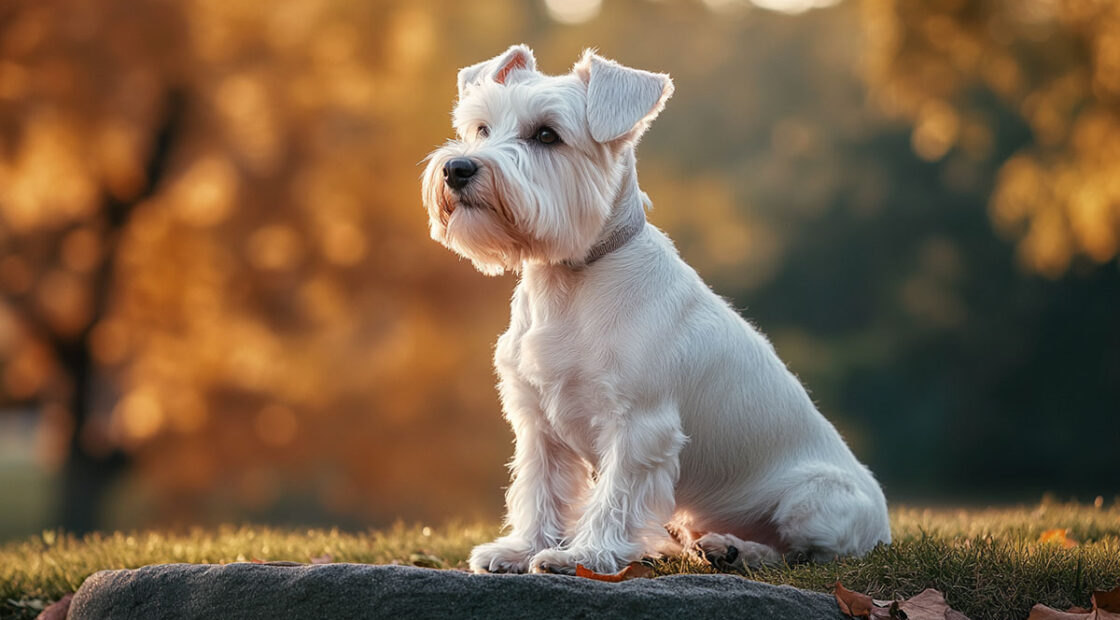
Hardly anyone owns a Sealyham these days. The Royal Kennel Club recorded 111 UK registrations in 2025, far below the 300 a year that defines a vulnerable native breed.
Captain John Owen Edwardes developed this small Welsh terrier in the mid-19th century to go to earth after otter, badger and fox. It sits low on short legs in a hard, wiry white coat, and the outline is oblong rather than square.
Kennel clubs file the breed in the Terrier Group. Its main inherited health risk, primary lens luxation, has a DNA test.
What Is a Sealyham Terrier?
Sealyhams came out of Wales as working terriers, built low so they could work alongside Otterhounds and follow otter, badger and fox underground. The coat is hard, wiry and white, and the outline is oblong rather than a square one.
The Royal Kennel Club (RKC, the UK club that older sources call The Kennel Club), the American Kennel Club and the United Kennel Club all place it in the Terrier Group. The FCI files it under Group 3 Terriers, Section 2 Small-sized Terriers, as Standard No. 74, listed without working trial (origin Great Britain, standard published in 2009). The Canadian Kennel Club puts it in Group IV, Terriers.
Owners shorten the name to Sealy. Older references also list Welsh Border Terrier and Cowley Terrier as earlier names.
Lookalike mix-ups are common. The West Highland White Terrier sits in the Sealyham’s ancestry but has its own standard, and the Welsh Terrier is a different Welsh breed.
Where Does the Sealyham Terrier Come From?
Captain John Owen Edwardes developed the breed in the mid-19th century at Sealyham House (the RKC calls it Sealyham Manor), near Wolfscastle in the Haverfordwest region of Pembrokeshire. The breed takes its name from his estate on the river Seal (RKC and UKC breed pages).
The Founder and the Working Purpose
Selection was blunt.

The RKC breed history records that dogs reluctant to stand their ground or to kill were shot.
Edwardes wanted a terrier to run beside his Otterhounds and go to earth after otter, with badger, fox and polecat as further quarry. Short legs suited the dog to going to earth (Canadian Kennel Club), and the rough coat protected it against attack from the quarry.
The working link is still visible. For its centenary, the parent club held a championship show in the grounds of Sealyham Manor, where Sealyhams gave a demonstration of working in the river Seal with Otterhounds (RKC).
Which Breeds Went Into It
Two authoritative sources give different recipes.
The RKC says white Jack Russell type terriers started it, with West Highland White, Dandie Dinmont and Bull Terrier blood added. Dogs New Zealand gives a longer and messier list: hounds, the Dandie Dinmont, the Basset of Flanders, the Corgi, the West Highland White and the Wirehaired Fox Terrier.
Both lists name the short-legged Dandie Dinmont and the white West Highland White Terrier. Everything else changes from source to source.
Recognition Dates
| Year | Milestone | Source |
|---|---|---|
| 1903 | First shown at a dog show | VCA Canada (LifeLearn) |
| 1908 | First breed club formed | RKC |
| 1911 | Recognized in the UK (AKC recognition by the same year) | RKC, VCA Canada |
| 1919 | Recognized by the United Kennel Club | UKC |
Some profile pages date UK recognition to 1910. The RKC’s own breed page says 1911.
The RKC places the breed’s peak as show dog and companion in the 1930s and 1940s. Popularity has dwindled since.
Sealyham Terrier Size, Coat and Color by Breed Standard

Expect a Sealyham to stand about 10.5 to 12 inches at the shoulder and weigh roughly 18 to 25 pounds, depending on which breed standard applies.
| Standard | Height | Ideal weight | Body marking rule |
|---|---|---|---|
| RKC (UK), updated April 2025 | Maximum 31 cm (12 in) | Dogs about 9 kg (20 lb), bitches about 8 kg (18 lb) | Black patches and heavy ticking undesirable |
| AKC, approved 1974 | About 10.5 in | Dogs 23 to 24 lb, bitches slightly less | Heavy body markings and ticking discouraged |
| Canadian Kennel Club, 2015 | About 26.75 cm (10.5 in) | Dogs 23 to 25 lb, bitches slightly less | Heavy body markings and ticking discouraged |
| UKC, revised 2007 | Maximum 12 in | Males about 20 lb, females about 18 lb | Heavy black markings and body ticking are serious faults |
The UK and UKC figures set a 12 in ceiling with a lighter ideal weight. The AKC and Canadian figures aim for about 10.5 in with a heavier dog. That means an 11.5 in Sealyham is inside the UK limit and an inch over the AKC target.
The FCI standard (31 cm, 9 kg for dogs, 8.2 kg for bitches) follows the UK pattern.
The RKC adds a note for puppy buyers. Its figures describe the ideal, and an individual dog can be larger or smaller.
A breeder-judge interviewed by Showsight argues that 10.5 in exists because the breed was built to go to ground, and that clearly oversized dogs should not win.
Coat
The correct coat is a hard, wiry topcoat over a soft, dense, weather-resistant undercoat. A silky or curly one counts against the dog. The AKC calls it a bad fault, the UKC a serious fault, and the Canadian Kennel Club lists it as a fault.
Breeders say modern coats often miss the standard. Showsight’s breed issue reports that many current coats fail it, and a UK breeder-judge in the same issue says excess coat has gone soft and lost its waterproofing.
Color
All four standards accept an all-white dog, and all four allow markings on the head and ears. Lemon and badger appear in every list.
The RKC and UKC allow lemon, brown, blue or badger. The AKC lists lemon, tan or badger, and the Canadian Kennel Club lemon, tan, badger or blue badger.
The RKC standard says any other colour or combination is unacceptable. Heavy black markings and ticking on the body are the faults every club names in some form.
What Is the Sealyham Terrier’s Temperament?
The breed standards describe a dog that is alert and fearless but friendly, with a working terrier’s nerve. The FCI standard disqualifies aggressive or overly shy dogs, and the UKC standard disqualifies viciousness or extreme shyness.
The AKC calls the breed brave and spirited, but less spiky than the smaller terriers.
With Children
Dogs New Zealand says the breed does best with older children who treat dogs considerately. VCA Canada says it is fine with older kids. Burke’s Backyard calls it suited to families with children, if the owners take a responsible attitude to a dog that thinks for itself.
The two sources that name an age both say older children.
With Other Dogs and Small Animals
Sources split on dog-to-dog behavior.
Dogs New Zealand says the breed can get very dog-aggressive. Burke’s Backyard says owners should watch it around other dogs because it will not back off, and adds that some owners report a cantankerous streak with age.
A judge writing in Showsight says Sealyhams are generally not super aggressive with other dogs, and VCA Canada calls the breed less unwelcoming than most terriers.
The workable reading is a dog that holds its ground. Supervised introductions beat assumptions at the off-leash park.
Small animals are a separate question. Dogs New Zealand says the breed is generally good with other pets and good at catching mice and rats, while VCA Canada notes that a squirrel or rabbit across the road motivates any terrier, this one included.
With Strangers
Dogs New Zealand describes the breed as somewhat reserved with strangers. VCA Canada goes the other way and calls it friendly and fairly outgoing, even with strangers, unless it senses something wrong.
Both descriptions agree on the barking. Dogs New Zealand rates watchdog ability high and protection ability low, and notes that Sealyhams like to bark.
How Much Exercise and Training Does a Sealyham Terrier Need?

Up to an hour of daily walking or play is the top of the range (RKC), paired with short, reward-based training. Obedience is the weak spot, not stamina.
The RKC says up to 1 hour per day. Dogs New Zealand asks for a short to moderate walk or game session daily, and VCA Canada for a short walk or boisterous game. Burke’s Backyard sets the floor lowest, at 30 minutes, a few times a week, to keep weight down.
No source asks for more than an hour. The disagreement is about the minimum, and the 30-minute figure comes with a warning that Sealyhams turn into couch potatoes if allowed.
A daily outing of 30 to 60 minutes covers the whole range.
Containment matters more than distance. Dogs New Zealand says an off-leash Sealyham tends to follow its nose, and VCA Canada warns that it will look for a way under the fence.
On trainability, Dogs New Zealand rates it very hard.
VCA Canada explains why. The breed was developed to think for itself and persist against tough quarry, so it does not check in for directions.
The fix is short, fun sessions with plenty of positive rewards, because the breed is easily distracted and cooperates when the work seems worth its while (VCA Canada).
The ceiling is higher than the rating suggests. Showsight’s breed issue says the general view is that Sealyhams are poor obedience candidates, yet individuals have performed in rally, agility, obedience and earthdog trials, and one veterinarian-breeder in the same issue competes in agility and barn hunt.
Activities built on the breed’s original job, such as earthdog trials, barn hunt and tracking, give it a reason to cooperate.
The usual complaints are barking, which Dogs New Zealand lists as a breed habit, and fence escapes and chasing, per VCA Canada. Independence that reads as stubbornness comes up too.
Which Health Problems Affect the Sealyham Terrier?
Primary lens luxation (PLL) is the breed’s one inherited problem with a DNA test behind it, and both the RKC and the AKC point breeders to that test. Deafness, back problems and allergies appear on profile pages, but neither club lists a test for them.
Primary Lens Luxation
PLL starts when the fibres that hold the lens in place break down and the lens drops into the wrong position (RKC).
It is autosomal recessive, so a dog needs two copies of the abnormal gene to be affected. A carrier shows no signs and can still pass the gene on (RKC).
Signs can be detectable at 20 months, and complete luxation typically arrives between ages 3 and 8. If the lens falls forward, glaucoma and vision loss follow quickly, and the condition is painful (RKC).
The variant behind it is ADAMTS17 c.1473+1G>A, and the Online Mendelian Inheritance in Animals database lists the Sealyham Terrier among the terrier breeds where it is linked to lens luxation.
A red, watery eye needs veterinary attention, according to UC Davis’s Veterinary Genetics Laboratory.
A clear DNA result lowers the risk but does not erase it. In the original ADAMTS17 study, 161 of 196 clinically diagnosed dogs from three breeds (Jack Russell Terrier, Miniature Bull Terrier and Lancashire Heeler) carried two copies of the variant and 12 carried none (UC Davis Veterinary Genetics Laboratory).
The ASTC’s breeding guidelines add that a small percentage of carriers are also at risk of developing PLL.
Testing and Screening
| Test | RKC (UK) | AKC and ASTC (US) |
|---|---|---|
| PLL DNA test | Good Practice, the minimum before breeding | Recommended by the national breed club |
| Eye examination | BVA/KC/ISDS Eye Scheme, listed as Best Practice | Ophthalmologist evaluation, recommended by the breed club |
| Checking results | RKC Health Test Results Finder | ASTC Sealyham Terrier Health Guard database |
The RKC says following Best Practice means completing both categories of tests, so a UK breeder should do the DNA test and the eye scheme.
Other Reported Conditions
Profile pages report deafness (PetMD), retinal dysplasia (VCA Canada, an older PetMD profile), back problems in a long-backed, short-legged dog (Dogzonline), and allergies, which the ASTC has funded research into (Vetstreet).
Only PLL and the eye examination are backed by a club test. The RKC and the AKC list nothing else for this breed.
Retinal dysplasia is where sources split. VCA Canada’s 2014 profile says it occurs at a greater rate than in most breeds, while a US breeder-judge in Showsight believes it has been eliminated over the past 30 years.
Lifespan
The RKC says over 10 years. Dogs New Zealand says 11 to 13 years, and PetMD, VCA Canada and Burke’s Backyard all say 12 to 14 years.
Treat these as club and owner estimates. None of the sources retrieved here cites a Sealyham-specific longevity survey.
How to Groom a Sealyham Terrier
Comb a Sealyham two to three times a week and book coat shaping about every three months (Dogs New Zealand, VCA Canada, Omlet). The RKC lists daily grooming, and Burke’s Backyard lands in between, asking for at least two or three sessions a week, ideally daily, with a daily comb through the fringe.
Shedding and Allergies
Low shedding comes from how the coat works, not from less hair.
The RKC lists the breed as non-shedding, and Burke’s Backyard says the coat does not shed easily. Dead hair stays in the follicle until it is pulled out, which is what hand stripping imitates (AKC).
No club source in this research calls the breed hypoallergenic. Hair on the floor and allergen exposure are separate questions.
Hand Stripping or Clipping
Show dogs are hand stripped to keep the wiry texture (Dogs New Zealand). Pets are usually clipped, often with carding. The AKC article’s groomer source calls a clipper trim with carding the normal route for most pets and says hand stripping is a premium service that costs more than a standard groom.
The trade-off is texture. VCA Canada says clipping is much easier and pet owners usually choose it, though it softens the coat, and the AKC adds that long-term clipping of wire coats risks skin problems.
A veterinarian-breeder in Showsight says a Sealyham clipped by an experienced terrier groomer still keeps a noticeably hard outer coat.
Intervals differ by source. Dogs New Zealand, VCA Canada and Omlet say every three months, while Burke’s Backyard says show coats are stripped twice a year.
For a pet, I’d clip with carding and pick a groomer who knows terriers. Move to stripping if the coat turns soft or the skin gets irritated.
Between Sessions
Comb the fringe daily to prevent matting (Burke’s Backyard). Vetstreet adds nail trims every week or two and frequent tooth brushing with a vet-approved pet toothpaste.
The AKC’s weekly routine for wire coats runs in four passes: pin brush, medium comb, fine comb that reaches the skin, then a slicker brush.
How Rare Is the Sealyham Terrier?
The breed is rare in both countries, though in different ways. It is a vulnerable native breed in the UK and a mid-table rare breed in the US. The RKC puts a breed on its vulnerable list when it records fewer than 300 UK registrations a year.
The UK low was 43 registrations in 2008, reported by Wikipedia and Country Life and in the history note of the 2025 KUSA copy of the FCI standard. The high of the RKC’s 2016 to 2025 table was 184 registrations in 2021, and 2025 came in at 111 (RKC). In the US, the AKC ranked the Sealyham the 40th rarest of the 202 breeds counted in 2025 (AKC, April 2026).
The two countries measure different things. The RKC publishes counts while the AKC article gives a rank, so 111 and 40th cannot be compared directly.
People blame the decline on a few things, and the explanations do not compete as much as they seem to.
Coat upkeep is the first. The RKC suggests it, and an early-1960s Dog World survey recalled in Showsight found breeders, vets and groomers all named maintenance as the major drawback.
The history note in the 2025 KUSA copy of the FCI standard (taken from Wikipedia) blames foreign and designer breeds, and also cites the breed’s lower usefulness as a working dog.
Fashion can swing back. Coat upkeep and the reduced working role are structural, which is why the RKC ties the decline to trimming.
Breeders disagree about whether a rebound is welcome. The RKC urges buyers to consider lesser-known native breeds, while a veterinarian-breeder in Showsight warns that more demand invites commercial breeding, more inherited disease and more dogs in rescue.
A UK breeder-judge in the same issue says puppy farmers are already breeding the vulnerable breed, and a US breeder describes a small gene pool that forces studs to be shipped between breeders.
When a Sealyham Terrier Is the Wrong Dog
A Sealyham is a poor fit for anyone who can’t keep up with the coat or give it experienced, supervised handling.
Coat support is the first snag. A US handler interviewed by Showsight says ordinary pet groomers often do not know the breed’s profile trim, and an owner-handler in the same issue reports experienced terrier specialists calling it the most difficult groom.
VCA Canada’s ideal owner has terrier experience and a patient, consistent training style, with a fenced yard or access to one. The guide calls the breed dominant and in need of a confident owner.
Strong sun matters in hot climates. Burke’s Backyard says pale-coloured dogs should be watched for sunburn, and that gets more relevant with a clipped coat.
Deadlines hurt too. VCA Canada lists availability as rare with a possible waiting list, so buyers on a short timeline are likely to lose out.
My rule is that one limit is manageable and two or more is a mismatch. Coat upkeep alone is the easiest to fix, with a groomer who has terrier experience.
How to Find a Sealyham Terrier Puppy or Rescue
Start with the breed clubs, not a classified listing. The RKC runs Find a Puppy and Find a Rescue services, and the American Sealyham Terrier Club (ASTC) keeps a breeder referral list and points to The Sealyham Forever Foundation.
- Contact a breeder through the RKC’s Find a Puppy service or the ASTC referral list, and ask to join the waiting list.
- Ask for the PLL DNA result of both parents. UK dogs can be checked in the RKC Health Test Results Finder.
- Ask for each parent’s current eye examination (the BVA/KC/ISDS Eye Scheme in the UK, an ophthalmologist evaluation in the US).
- Read the pairing. Clear with clear, or clear with carrier, cannot produce an affected puppy, while two carriers are predicted to produce 25 percent affected puppies (UC Davis Veterinary Genetics Laboratory).
- Meet the mother, see the puppies where they are raised, and get registration and health paperwork in writing.
A carrier puppy is not a sick puppy. The ASTC’s breeding guidelines (George Packard, GDC, revised 2013) keep carriers in breeding programs when they are mated to clear dogs, to protect a small gene pool.
Carriers do turn up in show lines. Embark’s public profile for one Sealyham champion lists a single copy of the PLL variant.
Published prices come from classified and insurance sites rather than surveys, so ask each breeder for the total cost and what it includes. Both Burke’s Backyard and VCA Canada say buyers should expect a waiting list.
Rescue dogs are rare too. In the UK, RKC Breed Rescue brings together breed-specific rescue services, and the Find a Rescue directory lists their co-ordinators.
For an adult dog, ask the rescue for any eye history and consider a PLL DNA cheek swab, because luxation typically appears in adulthood.
Sealyham Terrier FAQ
What is the difference between a Sealyham Terrier and a Westie?
Both are white terriers, and the RKC lists the West Highland White among the Sealyham’s ancestors.
The practical gap is availability. The AKC’s 2025 statistics rank the Westie 158th rarest of 202 breeds and the Sealyham 40th.
Can a Sealyham Terrier live in an apartment?

Yes, if it gets a daily walk and play. Vetstreet calls it the couch potato of the terrier world, and the RKC rates it for a small house.
Barking is the neighbour risk, since Dogs New Zealand rates its watchdog ability high.
How long can a Sealyham Terrier be left alone?
Up to four hours routinely, which is the PDSA’s limit for dogs in general.
Omlet warns that Sealyhams not used to being alone can bark and turn destructive, so build up absences gradually from puppyhood.
Are male or female Sealyham Terriers better?
Neither. Breed standards describe bitches as slightly smaller, and no club source documents a temperament gap.
Profile sites that call males more dominant cite no data, so judge the individual puppy and its parents instead.
Does a Sealyham Terrier need its tail docked?
No, not under most standards. The RKC, FCI and Canadian Kennel Club standards all describe an undocked tail alongside the docked one, and the UKC says no dog is penalized for a full tail.
The AKC standard, unchanged since 1974, still reads docked and carried upright, although a Showsight breed feature says an undocked tail should not be considered a fault.
Why do Sealyham Terriers gain weight so easily?
Breed guides report the tendency mostly in low-activity homes, and the breed needs only modest exercise (Vetstreet), which leaves little room for extra calories.
Measure meals and count treats toward the daily total, as Wisdom Panel advises.
Which Sealyham Terrier Expense Adds Up Fastest?
Coat care adds up fastest, because it repeats on a fixed schedule for the dog’s whole life while the purchase price is paid once.
VCA Canada’s figures show the scale. Shaping every three months across a 12 to 14 year lifespan means 48 to 56 professional sessions, and the AKC says hand stripping runs above a standard groom.
That ordering sets the sequence for budgeting. Start with quotes from groomers who have terrier experience. After that come the PLL and eye results for both parents, and the breeder deposit and waiting list.
Recurring costs come first because they scale with lifespan, while screening and the deposit are paid once and fixed by the breeder.
The trade-off is spending time and money on research before the puppy arrives. As of October 2026, published prices for puppies and hand stripping come from listing sites, so collect two local quotes before committing.