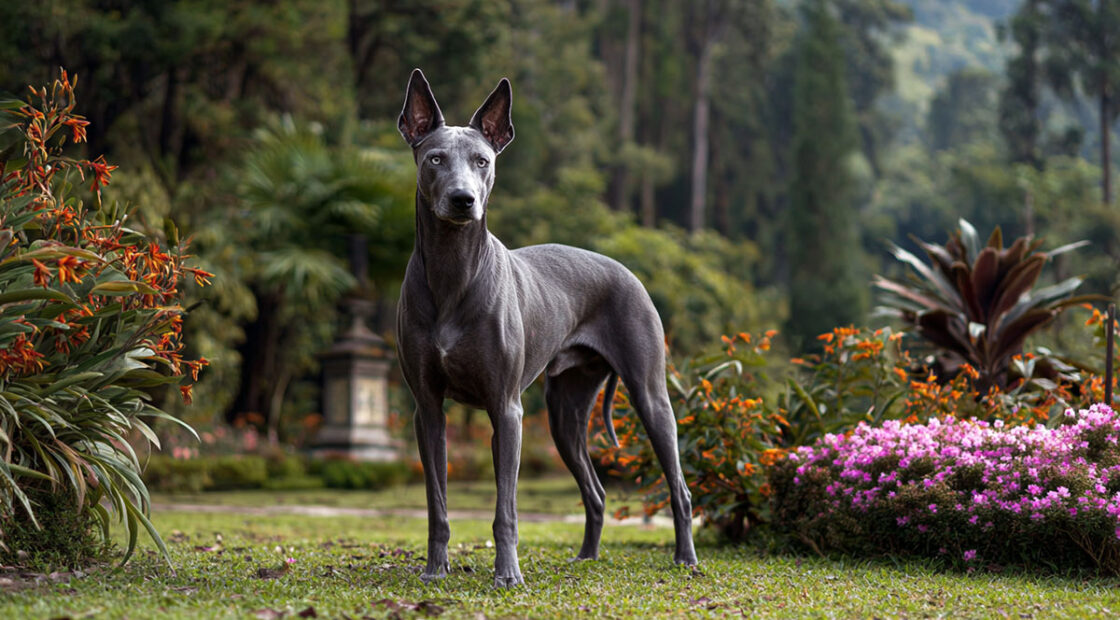
Peruvian Inca Orchids come hairless or coated, and in three sizes. The FCI registers the breed as the Perro sin Pelo del Peru.
Under the UKC standard (2017), heights run from 9.75 to 25.75 inches at the withers. Hairless and coated puppies can be born in the same litter.
The AKC has kept the breed in its Miscellaneous Class since January 1, 2011. A Judging Operations memo dated April 7, 2026 moves it to the Hound Group, and regular breed classes open on January 1, 2027.
What Is the Peruvian Inca Orchid?
A hairless or coated dog from Peru, registered under that name by both the AKC and the UKC.
The FCI lists the same breed as the Perro sin Pelo del Peru (Standard 310, Group 5, Section 6, primitive type). In the US it’s usually shortened to PIO. Peruvian Hairless Dog and Inca Hairless Dog are common in English, and viringo is a local name.
The orchid part comes from the Spanish. The UKC standard says the conquistadors found these dogs in Inca homes among the orchids and called them Perros Flora, flower dogs.
The AKC name differs from the rest of the world because of how the breed got registered. ShowSight magazine reports that it was recorded in what is now the AKC Foundation Stock Service under the Orchid name before the FCI gave it full recognition.
Wikipedia describes the Orchid as a separate type developed by American enthusiasts, but the published standards don’t back that up. The UKC range of 9.75 to 25.75 inches converts to 25 to 65 cm, which is the same span the FCI uses.
Mexico’s hairless breed, the Xoloitzcuintli, is the obvious comparison. ShowSight notes the Peruvian is more slender, and its standard allows a wider spread of sizes and weights.

| Feature | Peruvian Inca Orchid | Xoloitzcuintli |
|---|---|---|
| Origin | Peru | Mexico |
| Size names | Small, medium, large | Toy, miniature, standard |
| Height at withers | 9.75 to 25.75 in (UKC) | 10 to 23 in (AKC) |
| Varieties | Hairless and coated | Hairless and coated |
How Big Does the Peruvian Inca Orchid Get?
Anywhere from 9.75 to 25.75 inches at the withers, depending on which size the dog falls into.
The UKC standard (revised May 1, 2017) sorts every dog by height and gives weight as an approximate range.
- Small dogs stand 9.75 to 15.75 in and weigh roughly 8.8 to 17.6 lb.
- Medium is over 15.75 to 19.75 in, roughly 17.6 to 26.4 lb.
- Large runs over 19.75 to 25.75 in, roughly 26.4 to 55.1 lb.
- The FCI heights, from Standard 310, are 25 to 40 cm, 41 to 50 cm and 51 to 65 cm.
The FCI standard, as translated by the Nordic kennel clubs in 2021, disqualifies any dog over 65 cm or under 25 cm.
Height at the withers decides the size class. Weight follows it loosely, which is why the standards call it approximate.
All three sizes follow the same ideal. The UKC describes a square dog with good leg length, females being slightly longer in body, and ShowSight agrees that actual size is the only difference between them.
Size matters a lot when you’re buying. The lightest small dog and the heaviest large dog sit 46 pounds apart, and nothing else in the standard changes to compensate.
Hairless vs Coated: What Separates the Two Varieties?
The coat, for one, and ear carriage. Teeth too, though that difference is less obvious. The UKC standard calls hairless and coated dogs identical apart from ear carriage, and both can be born in the same litter.
The Hairless Variety
Smooth, elastic skin, with small amounts of hair allowed on the head and legs, and on the tail. The ears stand erect, medium large and broad at the base, and can fold when the dog rests or runs (UKC).
This is the variety most people picture. Embark Veterinary points out that the old claim of a higher body temperature is false. The dog only feels warmer because no coat sits between the hand and the skin.
Upkeep is light, since there’s no coat to brush (Royal Canin). The downsides weigh more. Petfinder says sunscreen is needed for sun exposure, Embark says the dog lives indoors year-round, the set of teeth is incomplete, and the skin takes the hit from rough surfaces.
The Coated Variety
A real coat, and a different set of ears.
The coat is single, moderately coarse, short to medium, straight or slightly wavy, with longer and softer furnishings on the ears and tail. The ears are semi prick, with tips falling forward or out to the side. Full dentition is required.
The coat covers the skin and the mouth is complete, which is the appeal. ShowSight says coated dogs need more grooming than hairless ones, though still little by the standards of coated breeds.
Missing Teeth and Dentition
Drogemuller and colleagues found the same 7-base-pair duplication in the FOXI3 gene in all 140 hairless dogs they tested and in none of 87 coated dogs (Science, 2008).
The mutation turns up in Peruvian and Mexican hairless dogs and in Chinese Crested dogs. Online Mendelian Inheritance in Animals lists it as canine ectodermal dysplasia, defined by hairlessness and missing or misshapen teeth.
Dogs with two copies of the mutation die before birth, so every living hairless dog carries exactly one. Breeding two hairless dogs together can shrink litters for that reason (OMIA).
A coated puppy in a hairless litter is therefore expected, not a defect. It carries no copy of the mutation.
On teeth, the standards say this:
- Missing teeth in hairless dogs are not penalized (UKC).
- Coated dogs need full dentition (UKC).
- An undershot or overshot bite is a disqualification (UKC).
- The FCI standard, in the Swedish translation, says the hairless bite is almost always incomplete.
What Is the Peruvian Inca Orchid’s Temperament Like?

Lively and alert as a young dog, then calm and quiet once mature. The UKC standard adds that the breed is wary of strangers and devoted to its owners.
Family bonds run close, often centered on one or two people in the household (Petfinder). Toward strangers the dog is reserved and cautious without being timid (Embark). The UKC disqualifies both viciousness and extreme shyness, so the standard sets a floor and a ceiling. As a guard and watchdog it rates the breed excellent.
Hunting drive is real. The AKC describes very good hunters that also do well in lure coursing, rally and agility, so a small animal running across the yard is worth planning for.
Training is where sources disagree. Embark calls the breed a quick learner, and Wisdom Panel says it’s difficult to train.
Both can be right. The UKC describes intelligent, independent thinkers, and a dog like that picks up a command fast and still decides whether to follow it.
Petfinder adds that these dogs are sensitive and need patient, gentle handling. Because the hairless variety spends so much time indoors, socialization has to be planned. Friendly people, new surfaces, car rides, everyday noise.
How Do You Care for a Peruvian Inca Orchid?
It depends on the variety. A hairless dog needs protection from sun and cold, plus close attention to its teeth. A coated dog needs weekly brushing. Moderate daily exercise in a fenced space applies to both.
Skin and Temperature Care

The AKC says hairless breeds need protection when they spend long periods outside, and only sunscreen made for dogs is safe. Embark Veterinary adds that the dog should not sit outdoors for long stretches in daylight and should wear dog-safe sunscreen before walks. Vetstreet suggests a doggie T-shirt as an alternative to sunscreen.
Winter calls for a sweater or jacket on outings, which Embark treats as mandatory. The FCI standard explains why. With no coat, body heat leaves the skin directly instead of filtering through hair.
Embark recommends weekly baths for the hairless variety, with moisturizer when the skin dries out.
Bath frequency is where sources split. Wisdom Panel says occasional baths are enough, while Alfredo Jeanneau, president of the Club del Perro sin Pelo del Peru, told RPP in 2024 that regular baths and moisturizers are the main job.
A weekly bath is the safer starting point for a dog that spends time outside. Back off if the skin turns dry or irritated.
Teeth and Health
Published life expectancy runs 10 to 12 years (Wisdom Panel) and 11 to 12 years (Royal Canin), though Petfinder lists 12 to 14 years.
Dental disease is one of the most common conditions in adult dogs, and Wisdom Panel recommends home brushing, professional cleanings and dental chews for this breed. A hairless dog with an incomplete set of teeth should get a vet’s opinion before any hard chew, and softer natural dental chews are the usual place to start.
The AKC warns that sunburn can lead to skin cancer in hairless dogs, so check the skin after long days outdoors. Dental checks should happen every year.
Exercise and Grooming
Moderate, daily and fenced.
Embark suggests a 20 or 30 minute walk or active play in a fenced yard. The AKC adds lure coursing, rally and agility for dogs that want a job.
The fence matters because of the breed’s prey drive. Wisdom Panel advises a leash whenever small animals are nearby.
Hairless dogs need no brushing, just baths as above and sunscreen before sunny walks. Coated dogs get weekly brushing to remove loose hair (Wisdom Panel). Nail trims and ear cleaning are regular jobs for both.
Where Does the Peruvian Inca Orchid Come From?
Pre-Inca Peru. Hairless dogs appear on ceramics from 300 BC to 1460 AD, according to the history written into FCI Standard 310.
The dog shows up in Vicus, Mochica and Chimu pottery, and in Chancay pieces, some with Tiahuanaco influence. On those ceramics the hairless dog sometimes replaces the puma, the snake or the hawk, and the Chancay culture gave it the most prominence.
Peru’s Ministry of Culture points to physical evidence too. A paw print was found in an adobe brick from one construction phase of Huaca Cao Viejo, a sign that dogs walked among the Moche builders.
The dating is not settled. The UKC standard says the breed has existed since A.D. 750, the FCI history starts its record at 300 BC, and Wisdom Panel says 350 BC.
Whichever date holds, the breed counts among the ancient dog breeds in current registries.
Heritage Status in Peru
Peru’s Congress included the hairless dog in the national heritage under Ley 27537 in October 2001 and recognized it as a native breed (Ministry of Culture).
The Ministry’s catalog says site museums keep the dog as a living guardian. The Tucume Site Museum in Lambayeque, for one, houses hairless dogs and maintains a cemetery for them (La Republica, 2023).
The Story in the United States
Breed profiles tell the American arrival two ways. Wisdom Panel credits Jack Walklin with importing dogs in 1966, while Wikipedia traces every recognized dog to an importation in the early 20th century.
The AKC and UKC documents retrieved for this article give neither account.
Is the Peruvian Inca Orchid Recognized by the AKC, UKC and FCI?
Yes, by all three, on different terms. The UKC has recognized it since 1996, the FCI lists it under a Spanish name, and the AKC keeps it in the Miscellaneous Class with a move to the Hound Group set for the end of 2026.
- The UKC places it in the Sighthound and Pariah Dog Group, recognized in 1996 (UKC standard).
- The FCI lists it as Perro sin Pelo del Peru, Standard 310, Group 5, Section 6.
- AKC Miscellaneous Class eligibility began January 1, 2011 (AKC FSS news, May 10, 2010).
- Stud Book acceptance and Hound Group eligibility come on December 30, 2026 (AKC FSS news, January 12, 2026).
- The AKC parent club is the Peruvian Inca Orchid Club of the United States.
As of October 2026 the breed still competes in the Miscellaneous Class.
Where the Sources Disagree
The FCI dates conflict. The preamble of Standard 310 and the Kennel Club Peruano put recognition as a native Peruvian breed at the FCI General Assembly in Amsterdam on June 12, 1985, while the FCI nomenclature page lists definitive acceptance on June 30, 1981.
The documents do not explain the gap.
The AKC gives two dates for its own change. The FSS news entry says Hound Group eligibility starts December 30, 2026, while the Judging Operations memo of April 7, 2026 says the breed competes in regular breed classes on January 1, 2027.
Why the AKC Wait Ran Long
The American English Coonhound holds the AKC’s record for the fastest move from the Miscellaneous Class to full recognition, at 545 days. The Xoloitzcuintli went from Miscellaneous (January 1, 2009) to the Non-Sporting Group (January 1, 2011) in about two years, per AKC FSS news.
The Orchid will have spent almost 16 years in Miscellaneous by the time it reaches the Hound Group.
In October 2024 the parent club’s vice president, Dottie Baker, wrote in ShowSight that the breed was primarily a UKC breed and could earn only Certificates of Merit, not championships, while in the Foundation Stock Service. That limit still applies today, but the January 2026 FSS entry ends it when Hound Group eligibility begins.
Current FSS guidelines (amended August 11, 2025) also require at least 20 litters bred and enrolled within a three-year period while a breed sits in Miscellaneous.
How the Standards Differ
- The FCI shows the three sizes as separate varieties, while the AKC judges all sizes as one breed (ShowSight, 2018).
- FCI Standard 310 prohibits mating two coated dogs, and registers a coated dog only when its parents are registered.
- Merle is a disqualifying color for the coated variety under FCI.
ShowSight also lists differences in ear carriage, coat types and color preference, and says the AKC standard has far fewer disqualifications.
When the Peruvian Inca Orchid Is a Poor Fit
It suits households that can control sun, cold and supervision. It fits badly where the dog would live outdoors, share space with loose small animals, or be the first dog of a busy family.
- Full-time outdoor living is out. Wisdom Panel says the breed isn’t suited to it, and Embark says it should live indoors year-round.
- A hairless dog needs sunscreen in summer and a jacket in winter. Owners who won’t keep up both should look elsewhere.
- Cats and other small pets are a problem, since Wisdom Panel warns that sighthounds with a strong prey drive need supervision and a leash.
- Wisdom Panel says the breed is not the best choice for families with very young, unpredictable children.
- First-time owners struggle. Embark calls the ideal owner someone already experienced with dogs, noting reserve with guests and possessiveness over toys.
The coated variety narrows the weather gap, since it has a coat. It does nothing for the reserved temperament or the prey drive.
If two or more of the situations above describe the household, another breed is the better call.
Peruvian Inca Orchid FAQ
Is the Peruvian Inca Orchid hypoallergenic?
No dog is completely hypoallergenic. Petfinder lists the breed as hypoallergenic, and Ochsner Health includes it among the AKC’s suggested breeds for allergy sufferers, but Ochsner points out that urine, saliva and dander, not hair itself, cause allergic reactions, and the AKC adds that dander causes most pet allergies.
Spend time with an adult dog before committing.
Does the Peruvian Inca Orchid shed?
Only the coated variety does. The hairless variety has almost no hair to lose, and Wisdom Panel advises weekly brushing for coated dogs to remove loose hair.
Can a Peruvian Inca Orchid live in an apartment?
Yes. Embark calls the breed an excellent choice for city dwellers, as long as the dog lives indoors year-round.
Petfinder adds that regular outdoor access helps burn off energy, ideally in a fenced yard, with shade because the skin burns easily.
Is the Peruvian Inca Orchid a good fit for owners who work all day?
Not comfortably. Petfinder says the breed can develop separation anxiety and suits owners who are home most of the time.
Dogs of this breed settle best in a calm, structured environment.
Do Peruvian Inca Orchids bark a lot?
Not usually. Petfinder describes a quiet dog that barks to alert when strangers approach, and the UKC standard calls mature dogs calm and quiet.
How much does a Peruvian Inca Orchid puppy cost?
Good Dog, a breeder marketplace, lists prices of $2,100 to $3,250 across the United States.
Adopting from a shelter or rescue costs less, and Petfinder notes the fee usually covers spay or neuter, vaccines and microchipping.
Where can you find a Peruvian Inca Orchid for sale or adoption?
Start with the website of the Peruvian Inca Orchid Club of the United States, piocus.com, which ShowSight points readers to for breed information.
Adopting this exact breed is typically harder than going through a responsible breeder, according to Good Dog.
What to Settle Before Choosing a Peruvian Inca Orchid
Variety comes first, because the sun and cold routine of the hairless dog decides whether a household can keep one. Size is next, small, medium or large, and registered parents come last.
That order puts the one choice nobody can reverse ahead of the ones a buyer can still adjust. A hairless dog never grows a coat, while a size or a breeder can change before any puppy is reserved.
On paperwork, ask to see both parents’ registrations. Under FCI Standard 310 a coated dog may be mated only to a hairless one, so every FCI-registered litter has at least one hairless parent.
As verified on October 26, 2026, the AKC Stud Book entry takes effect December 30, 2026. After that date, ask for Stud Book numbers. Before it, Foundation Stock Service records are the AKC paperwork.