The Schipperke lands in a different group depending on which registry you check. The AKC lists it as Non-Sporting. The Kennel Club says Utility, and the UKC calls it a Companion Dog. The FCI puts it in Group 1 with the sheepdogs.
Even the name is disputed. The AKC reads it as little captain, but the FCI standard (2010) reads it as little shepherd.
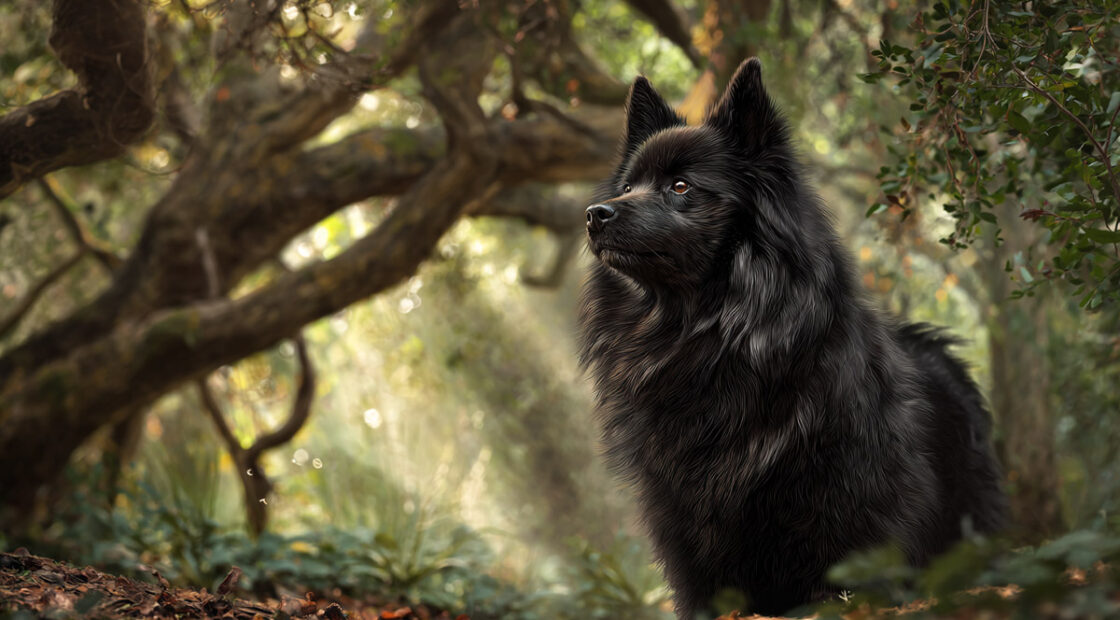
The dog itself is a small Belgian watchdog and vermin hunter with a black double coat, a fox-like face and a thick ruff. It was developed in Flanders, where it worked on canal barges and in Brussels workshops. The Kennel Club breed standard (2025) gives its weight as about 5.5 to 7.5 kg (12 to 16 lb).
What Is a Schipperke?

A small spitz-type breed from Belgium, built compact, with erect pointed ears and a ruff that’s hard to miss. Flanders is where it was developed, as a watchdog and vermin hunter on canal barges and in Brussels workshops.
Many puppies are born tailless or with a short bobtail, which gives the breed its blunt, thickset outline. Add the cobby body and that’s most of the silhouette.
On paper the breed is easy to pin down. Males measure 11 to 13 in and females 10 to 12 in (Hill’s Pet Nutrition), and the weight is 12 to 16 lb (5.5 to 7.5 kg) under the Kennel Club standard (2025). The AKC recognized it in 1904 as a Non-Sporting breed. The FCI lists it as Standard No. 83 in Group 1 (sheepdogs), with the standard dated January 2010.
Size and Weight
A Schipperke stands about a foot tall at the shoulder, and males run slightly taller than females.
The Kennel Club’s standard puts the ideal weight at about 5.5 to 7.5 kg. It also says its measurements are a guide, so a healthy dog can land outside them.
Coat, Ruff and Culottes
The coat is double, with a soft, dense undercoat under a straight, slightly harsh outer coat. The AKC’s official standard (reproduced in Showsight, January 2018) writes a zone-by-zone length pattern into the breed’s identity.

- The ruff starts behind the ears and circles the whole neck.
- Past the ruff there’s a second layer called the cape.
- The jabot runs across the chest and down between the front legs.
- On the back of the thighs, the culottes grow as long as the ruff.
Dense undercoat is what makes the ruff stand out. The standard faults silky coats and very short harsh ones alike, and body coats over three inches get the same treatment. The outer coat has to be black, though the undercoat may run slightly lighter.
Tail
Tail type varies by litter, and the two big standards disagree on what’s acceptable.
The Kennel Club in the UK accepts a naturally tailless dog. It also accepts a full-length undocked tail carried tightly curled over the back, and a partial-length tail as long as it’s fully coated. The club notes that docking was previously customary.
The AKC standard describes a tailless dog, with the tail docked and no tail visually discernible. Orvis reports that a tail is considered a fault, though not a disqualification, and that docking is not required.
The AVMA opposes tail docking done solely for cosmetic reasons and, since its 2008 policy revision, urges breed standards to drop it. Banfield Pet Hospital stopped cosmetic docking in 2009.
The UK bans docking with exceptions for working breeds, and Australia and much of Europe prohibit it (JAVMA News, 2008).
Where Does the Schipperke Come From?
Flanders, in present-day Belgium, where it worked as a ratter and watchdog on canal barges and in guild workshops. The AKC says Brussels shoemakers showed their dogs in 1690, possibly the first specialty dog show ever held. Hill’s Pet Nutrition traces the first written mention to a monk in the 1400s.
Little Captain or Little Shepherd
The AKC derives the name from the Flemish word for boat, which gives little captain and the barge-dog image. The FCI standard text, reprinted by the Kennel Club, reads the same name as little shepherd.
Belgian breed authority Dr. Robert Pollet, cited by Wikipedia, points out that schipper (skipper) and scheper (shepherd) sound alike in the Leuven and Brussels dialect. That makes the two readings easy to mix up, and neither one is settled.
Spitz or Sheepdog
VCA Animal Hospitals reports that Belgian show judges trace both the Schipperke and the Belgian Shepherd to the Leuvenaar, an extinct black sheepdog. VCA Canada quotes an AKC standard passage that rules out spitz descent, but the current AKC standard text contains no such passage.
The Institute of Canine Biology (ICB) reads the genetic data differently. Its breed analysis places the Schipperke closer to spitz-type breeds than to the Belgian Sheepdog.
The ICB haplotype chart shows DNA shared with several toy and spitz-type breeds, among them the Pug, the Brussels Griffon and the Pomeranian.
A Showsight Magazine proposal asks the FCI to revise its standard in line with those genomic findings. On ancestry, I’d give the DNA evidence more weight than show-judge tradition.
Recognition Timeline
Queen Marie-Henriette of Belgium took up the breed in 1885 and made it a fashionable house pet (VCA Animal Hospitals). The first imports to Britain and the United States came in 1887 or 1888, depending on who you ask. The FCI standard text says 1887 for both countries, while the AKC dates the first US import to 1888.
That same year the Belgian breed club, the oldest in Belgium, drafted the first standard. The AKC recognized the breed in 1904. The Schipperke Club of America came along in 1929, after an earlier club lapsed during World War I (Vetstreet).
The founder base is narrow. The ICB’s breed analysis (last updated 2017) puts the effective population size in the UK and Belgium below 50, a range it flags as high risk, with inbreeding rising across generations.
What Is the Schipperke’s Temperament Like?

Big-dog attitude in a small body. The Kennel Club standard (2025) describes an amenable, intelligent dog that is also faithful, and the AKC’s breed profile adds intense but mischievous.
Strangers get a cooler reception. Dogs Victoria describes strong loyalty to family and frequent distrust of outsiders, and Orvis says newcomers meet a polite but standoffish dog.
The breed also wants company. Hill’s says Schipperkes make poor kennel dogs and prefer staying with their owners.
Watchdog Barking
Barking comes with the job.
The AKC describes light sleepers interested in everything around them, and that curiosity produced the vigilant dockyard guard. Purina advises thinking twice before placing one in a busy environment with close neighbours.
Orvis says gentle correction from puppyhood may reduce the habit, but it still calls the breed natural barkers. You can manage the noise. You won’t erase it.
With Children and Other Pets

Published breed guides split on this, and both camps have a case.
Chewy’s breed guide, which credits the Schipperke Club of America’s health chair as a contributor, calls the breed a good fit for homes with cats, dogs and children. Healthy Paws rates it high with kids.
Burke’s Backyard goes the other way, with longtime owners describing an independent dog devoted to one person. Healthy Paws rates it low with other pets, and WebMD says the breed stays wary of strangers and other animals.
The gap most likely comes from early socialization and individual prey drive. The Schipperke Club of America’s new-owner leaflet (2008) notes that some dogs have a well-developed prey drive.
How Much Exercise and Training Does a Schipperke Need?
A lot of exercise every day, and training that stays consistent and positive. The AKC calls the breed active and tireless, and Orvis warns that first-time owners may want to look elsewhere.
Daily Exercise
The AKC frames the need as work, not minutes. Give a Schipperke a job such as agility or obedience and it excels.
Orvis puts the payoff plainly. A tired Schipperke is a better-behaved one, while too little exercise brings destructive habits and extra barking.
The breed is agile, so the AKC stresses a securely fenced yard.
Training Approach

Sources disagree on how hard the breed is to train.
| Source | Trainability verdict |
|---|---|
| WebMD | Challenging, needs patience and persistence |
| Orvis | Demands plenty of dedicated training time |
| Healthy Paws | Medium |
| Dogster | Easy to train |
Intelligence and an independent streak explain the spread. Hill’s notes stubborn tendencies, so a quick learner can still ignore a weak handler.
WebMD’s advice is to stay patient and persistent and keep the training positive.
Apartment Living

An apartment works if exercise and barking are under control. Orvis says the breed adapts to apartments and small houses when it gets enough exercise and outdoor time, and Hill’s notes it does not need a large yard.
When it goes wrong, the usual cause is too little daily exercise, which Orvis links to destructive behavior and barking. Thin walls and close neighbours cause trouble too, since the dog alerts to every passing sound (Purina). Hill’s adds that long stretches alone are hard on a breed with high social needs, so routine counts for more than floor space.
How Often Does a Schipperke Need Grooming?
Weekly brushing covers a Schipperke for most of the year, with extra sessions during the heavy shed. Professional grooming is not required (PetMD).
| Task | Typical frequency | Source |
|---|---|---|
| Regular brushing | Weekly | Purina, PetMD |
| Brushing during a shed | Every second day to daily | Dogs NSW, Wisdom Panel |
| Bathing | Occasional to monthly | Purina, Hill’s |
| Trimming | Only whiskers and hair between the pads may be trimmed | AKC standard |
Guides disagree on shedding. Purina says several times a year, PetMD says twice, in spring and fall, and WebMD puts it at one or two. Count on two heavy sheds and treat anything beyond that as an individual quirk.
The AKC standard even allows for the shed. A transitory reddish cast in the coat is penalized only where it detracts from the overall black.
How Long Do Schipperkes Live, and What Health Problems Affect Them?

Most live 12 to 16 years, and the breed is generally healthy. The one breed-specific threat is MPS IIIB, a fatal inherited brain disease that DNA testing can screen out of a breeding program.
Lifespan
Hill’s Pet Nutrition, Chewy and PetMD all give the same range of 12 to 16 years.
Those are breed-guide expectations, not a firm median. The Kennel Club’s 2004 owner survey put the median age at death across all breeds at 11 years and 3 months (Journal of Small Animal Practice, 2010).
The survey’s authors also found that smaller breeds tend to live longer, which fits a dog this size landing above the all-breed figure. They warn that breed-level results rest on small samples and a low response rate, so treat the range as a planning number and not a promise.
MPS IIIB
MPS IIIB, also called Sanfilippo syndrome type B, is a lysosomal storage disease documented in Schipperkes. An insertion in the NAGLU gene lets heparan sulfate build up inside cells (Scientific Reports, 2020). Inheritance is autosomal recessive, so carriers look completely normal.
Signs start between 2 and 4 years, with tremor, poor balance and trouble on stairs. No effective treatment exists, and most owners choose euthanasia 1 to 2 years after signs appear (AKC Canine Health Foundation).
Early estimates were educated guesses. The AKC Canine Health Foundation text, taken from the University of Pennsylvania, called the carrier rate unknown and said it might reach 15%.
Genotyping later put numbers on it. Of 3,219 Schipperkes tested from 2003 to 2019, 23.6% were carriers and 1.5% were affected (Raj, Ellinwood and Giger, Scientific Reports, 2020).
The same paper shows that the number of carrier and affected dogs found each year fell sharply after the early years, and its authors conclude that genotyping drastically reduced prevalence. The allele frequency in the submitted samples did not fall year over year, though, and carriers and rare affected dogs still appear. The 23.6% is pooled data dominated by early testing, when about a third of all dogs were tested and 21.3% of 1,097 were carriers, and it covers only dogs whose owners chose to submit samples.
These days the risk sits mostly in untested litters.
Other Documented Conditions
- Patellar luxation, where the kneecap slips out of place and makes running or jumping hard (WebMD)
- Legg-Calve-Perthes disease, a breakdown of the femoral head that causes pain and limping, usually before 18 months in this breed (PetMD)
- Hypothyroidism, which bloodwork diagnoses and levothyroxine manages (PetMD)
- Hereditary cataracts, plus progressive retinal atrophy, which has no effective treatment (PetMD)
- Hip dysplasia, which Orvis lists among the concerns
The Schipperke Club of America, working with the CHIC program, also tracks anecdotal reports of epilepsy, autoimmune skin problems, Cushing’s disease, diabetes mellitus and atopy (Embrace Pet Insurance).
Which Health Tests Should a Schipperke Breeder Have Done?
Knees, thyroid and eyes are required for CHIC certification, and a responsible breeder also runs the MPS IIIB DNA test on both parents, even though that one is formally optional.
| Test | CHIC (US) | Dogs NZ accredited breeders |
|---|---|---|
| Patella (knees) | Required, OFA | Mandatory, yearly |
| Thyroid | Required, OFA | Mandatory, lifetime |
| Eye exam | Required, CAER | Mandatory, yearly |
| Hips and heart | Optional | Optional |
| MPS IIIB DNA | Optional | Optional |
The CHIC column follows Vetstreet and Embrace Pet Insurance, which report the Schipperke Club of America’s protocol. The second column comes from Dogs NZ’s own breeder health test list.
Both formal schemes leave MPS IIIB testing optional. The parent club’s 2008 new-owner leaflet calls it a must, and that’s the position to follow.
Legg-Calve-Perthes screening costs little extra. The OFA lists the Schipperke among at-risk breeds, and a normal hip evaluation on a dog over 12 months old qualifies for an LCP number automatically.
In the UK, the Kennel Club approved an MPS IIIB DNA scheme in May 2013. Owners submit results themselves, and the Kennel Club adds them to registration records (Veterinary Nursing Times, 2013).
Checking a breeder comes down to paperwork, and it goes in this order.
- Ask for CHIC numbers and look up each parent in the OFA database, where breeders agree to publish results, positive or negative.
- Ask for the MPS IIIB certificate for both parents. PennGen releases results only to the person who submitted the sample, so the paperwork has to come from the breeder.
- Reject a pairing of two carriers. A carrier bred to a clear dog cannot produce an affected puppy, because the disease needs two copies.
- Check test dates on annual items such as eye exams, and treat “vet checked” as no substitute for genetic testing (Vetstreet).
How Do Kennel Clubs Classify the Schipperke?
The AKC files the Schipperke under Non-Sporting, the Kennel Club under Utility, the UKC under Companion Dog, and the FCI under Group 1 as a sheepdog. The Canadian Kennel Club follows the AKC with its Non-Sporting group.
| Registry | Group | Accepted colors |
|---|---|---|
| AKC | Non-Sporting | Black only, anything else disqualifies |
| Kennel Club (UK) | Utility | Black or cream |
| UKC | Companion Dog | Solid black, blonde or brown |
| FCI | Group 1, Section 1 | Black, other top-coat colors disqualify |
Color is where the standards diverge most. The Kennel Club’s 2009 wording allowed other whole colors, while the version last updated in November 2025 (the club is styled the Royal Kennel Club on its current site) names only black and cream and calls anything else unacceptable.
The UKC standard, revised January 1, 2025, judges black, blonde and brown equally. It disqualifies bi-colors such as black and tan, dilute colors such as gray or blue, and any white markings.
A cream or blonde puppy can therefore win in the UK and under the UKC, yet be disqualified in an AKC or FCI ring.
Tails follow the same split. The UKC treats docked and natural tails as equal and says no dog should be penalized for a full tail, while the FCI accepts tailless, stumpy and curled tails without penalty.
Some secondary breed guides list the Kennel Club group as Pastoral and the UKC group as Northern Breeds. The registries’ own documents say Utility and Companion Dog.
The groups mirror the ancestry argument. The FCI keeps the sheepdog reading, while the UKC’s own history text lists Papillon, Brussels Griffon, Pug, Pomeranian, American Eskimo Dog and Volpino as possible lineage and still files the breed as a companion.
Is a Schipperke the Right Dog for You?
It suits an active owner who wants a small, vocal, independent watchdog and will train it consistently. First-time owners, quiet households and buyers who plan to skip health testing will have a harder time.
AKC breeder Beth Lilly puts it flatly: Schipperke puppies are the best, but they are not for everyone.
The upside is easy to list. It’s compact and an alert, effective watchdog, generally healthy and long-lived, and light on grooming. The AKC adds that it does well at agility and obedience.
The downsides are real, though. Barking comes with the watchdog instincts, and training reduces it more than it removes it. Agility also makes escaping a standing risk, so a secure yard or leash discipline is not optional. And an untested puppy carries MPS IIIB risk that no amount of care can offset.
Burke’s Backyard warns buyers not to expect a lapdog, while Dogster lists the breed as suitable for lap-dog seekers. I’d side with the Burke’s Backyard owners, because they describe the dog’s temperament and not its size.
Someone who has never owned a dog and wants an easy first one should look elsewhere. So should anyone with thin walls and close neighbours, or a home where nobody is around to give it a daily job.
Size is the weakest reason to choose this breed. A dog this small still carries a working dog’s workload, and a buyer who wants low effort will be happier with a different small breed.
Schipperke FAQ
How do you pronounce Schipperke?
Most American sources say SKIP-er-key, and the UKC gives the same rendering. Hill’s Pet Nutrition notes the true Flemish pronunciation sounds closer to “sheep-er-ker”, and some dictionaries also record an sh- opening.
How much does a Schipperke puppy cost?
No registry sets a price, and listed figures vary widely between breeders and regions. Compare what each price includes instead of the number alone.
CHIC numbers and an MPS IIIB DNA result for both parents are worth paying for. A cheaper puppy from untested parents is the costlier gamble.
Are Schipperkes hypoallergenic?
No. The AKC states that no dog breed is 100% hypoallergenic, and WebMD says Schipperkes shed enough to bother people with allergies.
Dander clinging to hair triggers most reactions, not the hair itself, so even well-groomed dogs can still irritate.
Do Schipperkes get separation anxiety?

No documented diagnosis turned up, yet the breed dislikes isolation. Embrace Pet Insurance says a Schipperke banished to the backyard without company will loudly voice its unhappiness.
Orvis sets the limit at five to eight hours alone for a well-exercised adult. Build up to that gradually.
Should I adopt a Schipperke from rescue or buy from a breeder?

Both routes work. A breeder gives you parental health results, while a rescue gives you an adult whose temperament is already visible.
The Schipperke Rescue Network (Lancaster, PA) and the Schipperke Club of America Health and Rescue Foundation support adoption. The MPS IIIB DNA test costs half price for rescued dogs submitted through rescue organizations, according to the AKC Canine Health Foundation.
Planning the First Months With a Schipperke Puppy
Get the parental MPS IIIB results before paying a deposit. Have a secure fence ready before pickup day, and book a puppy class that starts at 7 to 8 weeks.
That order follows what can’t be corrected later. MPS IIIB signs appear at 2 to 4 years, long after the first three months that the American Veterinary Society of Animal Behavior (AVSAB) names as the primary socialization period, so parental DNA results are the only health evidence available at purchase.
The class carries a trade-off. The AVSAB position statement (2008) accepts classes after one vaccine set given 7 days earlier, because behavioral problems, not infectious disease, are the leading cause of death in dogs under 3 years.
Feeding is the next decision, and the range of puppy food brands is where it starts.