Ask how long an Ocicat lives and the usual answer is 15 to 18 years. Purina’s and WebMD’s breed profiles both say so. Nobody measured it, though. The first UK life-table study (Journal of Feline Medicine and Surgery, 2024) analyzed 12 breed groups and left the Ocicat out, so no measured UK average stands behind that range.
The breed itself is easier to pin down than its lifespan. It’s a domestic shorthair that copies the spotted tabby coat of a small wild cat and carries no wild cat genes. Virginia Daly produced the first spotted kitten by accident in Michigan in 1964 from Siamese and Abyssinian stock. The American Shorthair joined the line later, for heavier bone and the silver gene.
What Is an Ocicat?
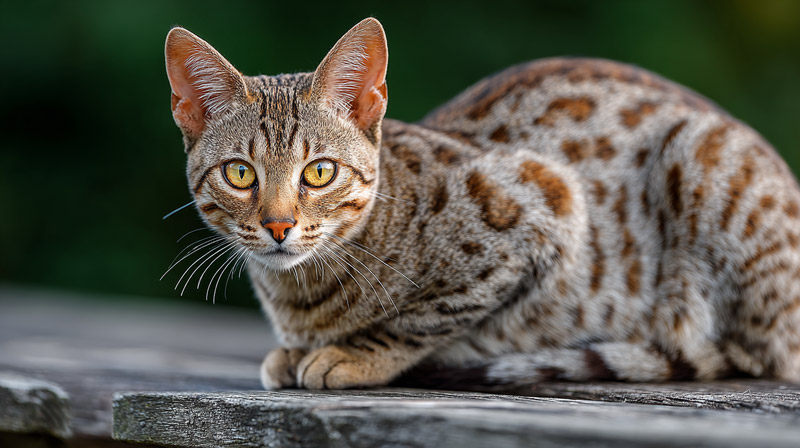
Nothing wild went into this cat, whatever the coat suggests. The spotted tabby pattern copies a small jungle cat, but CFA says the breed descends entirely from pedigreed domestic cats, and its breed page calls the Ocicat a spotted hybrid. That word trips people up. Here it means a cross of three domestic breeds, nothing more.
The name misleads as well, because TICA states flatly that Ocicats are not related to ocelots. Bengals sit in a different category, since they trace back to an Asian leopard cat cross.
The mix started with a Siamese and Abyssinian pairing. Siamese gave the chocolate coloring and the original slim build. The ticked agouti banding and the cinnamon gene arrived through the Abyssinian side. Later the American Shorthair came in and added more body substance and heavier bone, along with the silver gene.
Of everything the Abyssinian passed along, ticking does the most visual work. It’s the raw material that breaks up into spots.
Where Did the Ocicat Come From?
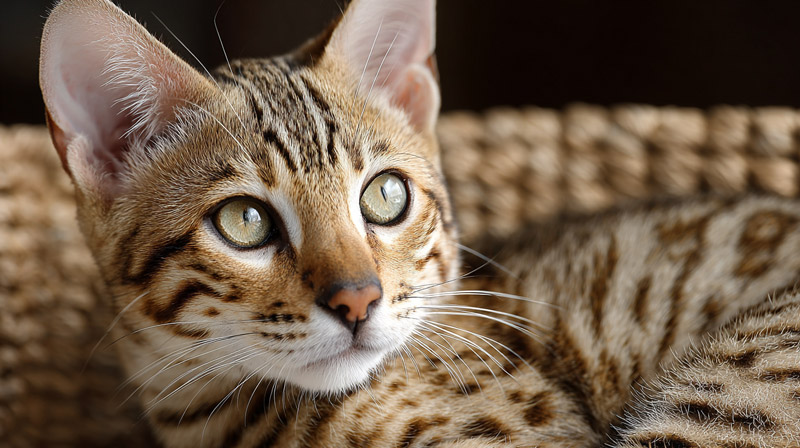
It was an accident. Virginia Daly was trying to produce a Siamese with Abyssinian-style points in Michigan in 1964 when a spotted kitten turned up.
His name was Tonga, and he came from the second litter of an Abyssinian-coated hybrid female and a chocolate point Siamese male. Daly’s daughter said he looked like a baby ocelot, and the name Ocicat followed.
A new breed was never the plan. Daly sold Tonga as a pet for $10 on the condition that he be neutered, according to CFA’s breed history.
Geneticist Clyde Keeler heard about the kitten and wanted a domestic cat resembling the extinct Egyptian Spotted Fishing Cat. Tonga could not be used, so Daly repeated the breeding and produced Dalai Dotson, a tawny spotted male.
Breeders next brought in the American Shorthair for heavier bone and the silver gene. CFA and TICA both present that as a planned step, while Wikipedia, WebMD and the GCCF breeding policy describe a CFA recording error.
- Tonga was born in Michigan in 1964.
- He appeared in a special exhibit of future breeds at a CFA show in Detroit in 1965.
- CFA accepted the first Ocicats for registration in 1966, and Daly paused the program to care for an aunt.
- Breeders restarted the program in the early 1980s, and the Ocicats International breed club formed in 1984.
Only 99 Ocicats were registered with CFA between 1966 and 1980, according to the CFA yearbook history (1996). That slow start explains why championship status did not arrive until the 1980s.
What Does an Ocicat Look Like?
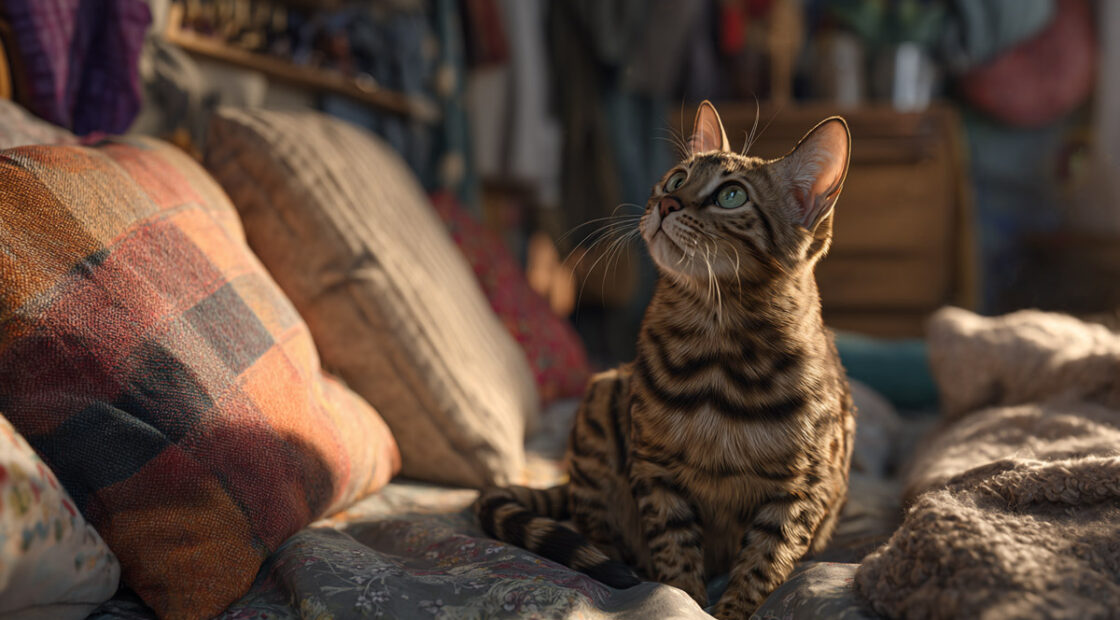
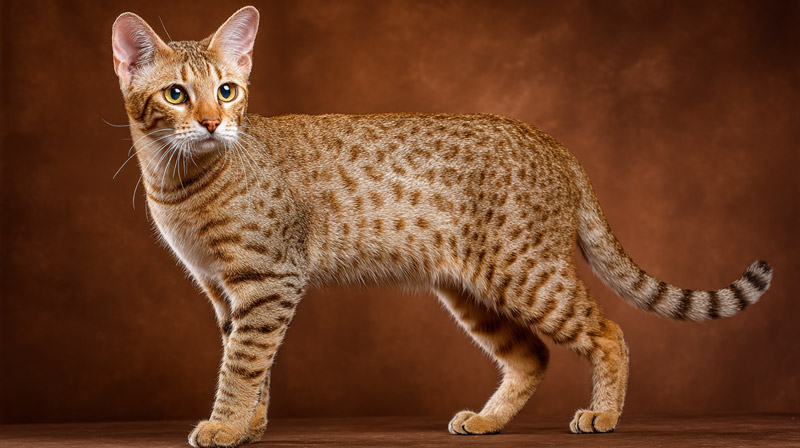
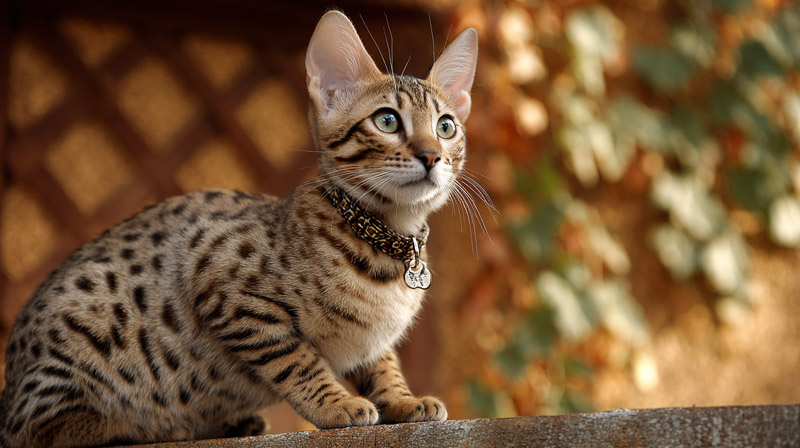
Big thumbprint spots on a banded agouti coat make the look, on a medium to large, muscular shorthair. CFA accepts 12 colors.
Both sexes feel heavier than they look, which is exactly what CFA’s standard asks for. Even the females carry dense muscle.
How Big Does an Ocicat Get?
The head is a modified wedge with a broad, slightly square muzzle. Eyes are large and almond shaped, tilted up toward the ears, and any color is allowed except blue (CFA).
Ears sit at about a 45 degree angle, and ear tufts count as a bonus in the show ring. Mature males can carry jowls, which the standard allows.
TICA gives two sets of adult weights, one in its breed description and a tighter one in its at-a-glance summary. Males run 9 to 14 lb in the breed description and 10 to 12 lb on average in the summary. Females come in at 6 to 9 lb in the breed description and 8 to 10 lb in the summary.
CFA sets no weight numbers at all. Its standard puts overall structure and quality ahead of size.
How Does the Spotted Coat Form?
It comes down to banding. Every hair except those on the tip of the tail carries several bands of color, per CFA, and a thumbprint spot shows up where the dark bands line up.
Hairs inside a marking end in a darker tip, while hairs in the ground color end in a lighter one. That contrast keeps the pattern readable from any angle.
The agouti gene produces the ticking. The silver inhibitor that came through the American Shorthair strips color from the hair shaft, and one copy is enough to show it.
| Base color | Dilute | Silver versions |
|---|---|---|
| Tawny (black spotting) | Blue | Ebony silver, blue silver |
| Chocolate | Lavender | Chocolate silver, lavender silver |
| Cinnamon | Fawn | Cinnamon silver, fawn silver |
Show-quality cats carry a bull’s-eye on each side (a spot circled by spots), an M on the forehead, mascara lines around the eyes, and broken bracelets on the legs. Long streaky spots in a mackerel pattern lose points.
Tawny and chocolate are common, and so is cinnamon, per CFA. When a cat’s color is in doubt, judges read the tail tip.
What Is an Ocicat’s Temperament?
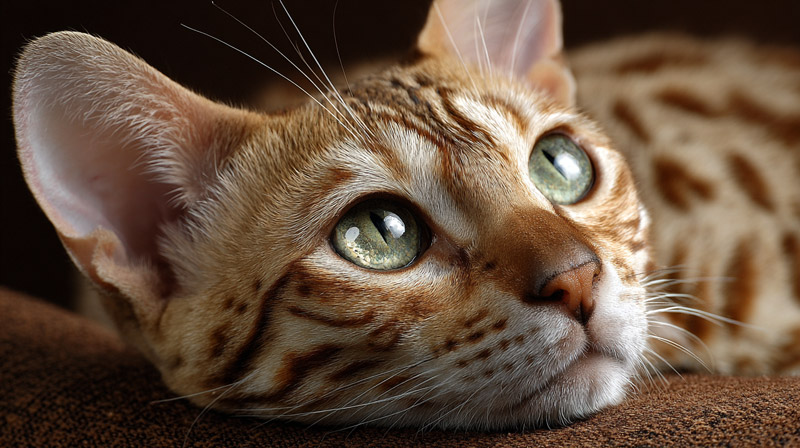
Ocicats act a lot like dogs. They’re social and easy to train, and they attach to their people without getting clingy or demanding.
CFA describes them as natural extroverts that treat strangers as potential playmates. Many will fetch or walk on a leash, and they answer voice commands too.
Energy is high but not frantic. CFA rates their base activity below the Abyssinian and the Siamese, though TICA notes they still leap to high places with ease.
On noise, the sources split. CFA says they speak up now and then without being annoying, although PetsRadar, Purina and Vetstreet call the breed talkative.
TICA warns that they get possessive about toys, guarding favorites and turning a grab into a tug-of-war.
Solitude is the weak point. CFA says they do best in homes with other animals or someone who works from home, and TICA says they are unhappy when left alone for long periods.
When needs go unmet, it shows in behavior. Purina UK’s breed profile lists inappropriate toileting and scent marking among the problems that follow when exercise and company fall short.
Other pets are fine as a rule. TICA reports that Ocicats get along with cats and dogs as long as energy levels and personalities do not clash, and Vetstreet adds children to that list.
How Do You Care for an Ocicat?
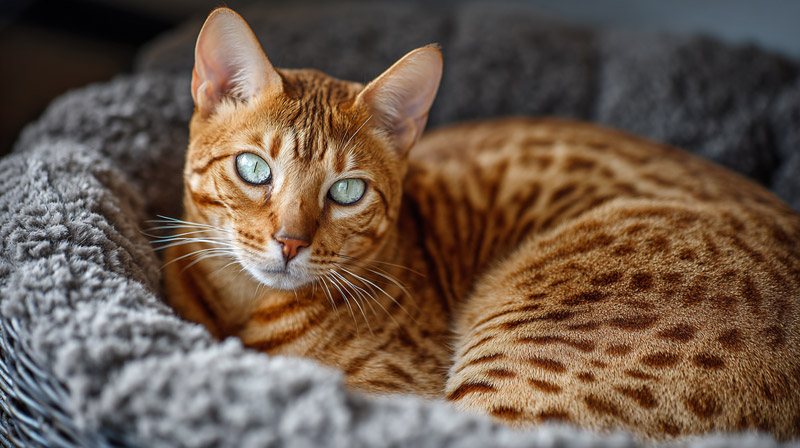
Care is light on grooming and heavier on play. A weekly brush and a regular commercial diet with wet food at least once a day cover the basics, and the cat needs interactive play every day.
Run a rubber brush over the coat once a week to lift dead hair, then polish with a chamois for shine (TICA). Routine baths can be skipped, since CFA says they are only needed for show cats. Clip nails and brush teeth regularly.
CFA says Ocicats are not heavy shedders and need only minimal grooming, so the routine takes minutes.
No special formula is needed, and any balanced commercial food covers the breed’s requirements, per CFA. TICA’s breed committee recommends wet food at least once a day and advises against fish-based food.
Water matters too. TICA passes on a behaviorist tip to set the bowl at least three feet from the food, because strong food smells can put cats off drinking.
Kittens eat kitten food, not the adult formula, according to PetMD.
Cat trees and wall shelves give them somewhere to climb. Wand and chase games that mimic prey count as a high enrichment need for Purina UK, and puzzle feeders turn meals into a task. WebMD says daily play sessions burn off the extra calories some bored Ocicats take in.
Annual vet visits for vaccinations and checkups round out the routine, as TICA recommends.
Which Health Problems Affect Ocicats, and How Long Do They Live?
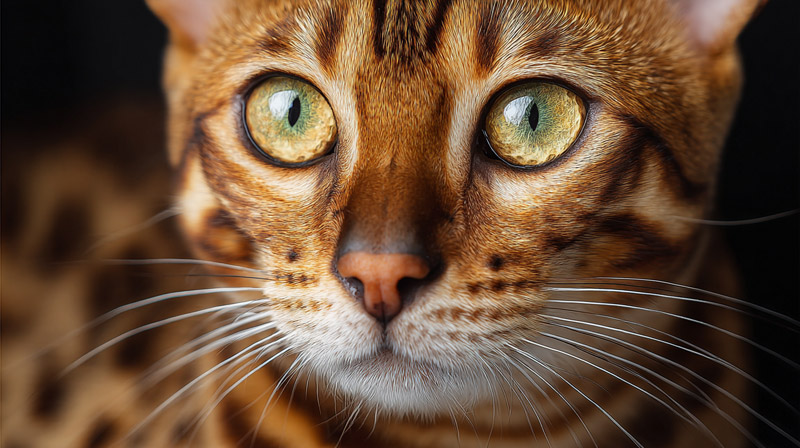
Ocicats are generally healthy. Breeders still screen for inherited problems that trace back to the parent breeds, namely pyruvate kinase deficiency, hypertrophic cardiomyopathy, amyloidosis and progressive retinal atrophy.
CFA credits the three-breed foundation with genetic diversity and says breeders share test results to keep the gene pool healthy.
| Condition | What it affects | How breeders screen |
|---|---|---|
| Pyruvate kinase deficiency | Red blood cells (anemia) | DNA test |
| Hypertrophic cardiomyopathy | Heart muscle | Echocardiogram |
| Amyloidosis | Kidneys or liver | Line history, ask the breeder |
| Progressive retinal atrophy | Retina, leading to blindness | Genetic test |
Pyruvate kinase deficiency (PK deficiency) has been documented in Abyssinian and Somali cats, and PawPeds says Abyssinian-derived breeds such as the Ocicat can be tested too.
The condition is autosomal recessive, so a test sorts each cat into normal, carrier or affected. Signs usually appear between 6 months and 3 years of age, according to the genetics lab Eurovetgene, although other labs report onset as late as 5 years.
Registries disagree on how seriously to treat it. GCCF requires the test for Ocicats imported from another registry (per Langford Vets), while PawPeds calls the risk outside the Abyssinian and Somali unclear, since some affected cats get seriously ill and others never show a problem.
Hypertrophic cardiomyopathy needs an echocardiogram to detect, according to CFA. PawPeds adds that the HCM gene test it describes looks for a single mutation (first linked to Maine Coons), so a clear DNA result alone does not clear a cat.
Ask for scan results on both parents, not just a DNA certificate.
Intact females carry a separate risk. A 2014 Swedish insurance study (Hagman and colleagues, Theriogenology) put the Ocicat among the breeds above 60 pyometra cases per 10,000 cat-years, against about 17 across all cats.
Spaying removes the risk.
On lifespan, Purina and WebMD say 15 to 18 years. PetsRadar (2025) gives 12 to 18, and Catster gives 10 to 15.
None of those figures comes from a breed life table. The first UK life-table study (Teng and colleagues, Journal of Feline Medicine and Surgery, 2024) analyzed 12 breed groups, the Ocicat was not one of them, and overall life expectancy at birth came out at 11.7 years.
The two kinds of number measure different things. Life expectancy at birth counts early deaths, and the study’s authors note that euthanasia pulls estimates down while deaths missed before a first vet visit push them up.
Until an Ocicat-specific table exists, the honest range is the 10 to 18 year spread the sources give.
Which Registries Recognize the Ocicat?
Only SACC holds out. The other eight World Cat Congress members recognize the Ocicat in full, with TICA reaching championship status in 1986, CFA in 1987 and GCCF in 2006.
| Registry | Recognition timeline | Outcross rule |
|---|---|---|
| TICA | Championship August 1986 | Abyssinian, Siamese |
| CFA | Registration 1966, provisional 1986, championship 1987 | Abyssinian, litters born before 12/31/2030 |
| GCCF | Preliminary 1997, provisional 2002, championship 2006 | Abyssinian (excluding Red Series) |
Dates differ across breed guides. Some profiles give 1987 for both CFA and TICA championship, while TICA’s own breed page dates its championship to August 1986.
The outcross window moved as well. CFA’s 1996 breed history said Abyssinian outcrossing would end in 2005, and the current standard page lists the cutoff as litters born before 12/31/2030.
One variant causes most of the confusion. The Aztec, a tabby-patterned relative that turned up in Ocicat litters, received GCCF preliminary recognition in October 2008 as the “Ocicat Classic,” reached full GCCF championship in June 2013 as a separate breed (later named the Aztec), and merged back in 2024 as the Ocicat Classic.
GCCF now lists the Ocicat Classic under breed code OCI 22, with a standard effective 28 June 2025. Other registries treat non-spotted cats differently. CFA runs them, classic tabbies for example, in the AOV class. TICA sees classic tabby kittens in litters but won’t let them compete, and FIFe accepts the spotted pattern only.
Ocicat vs Bengal vs Egyptian Mau: Which Spotted Cat Fits?
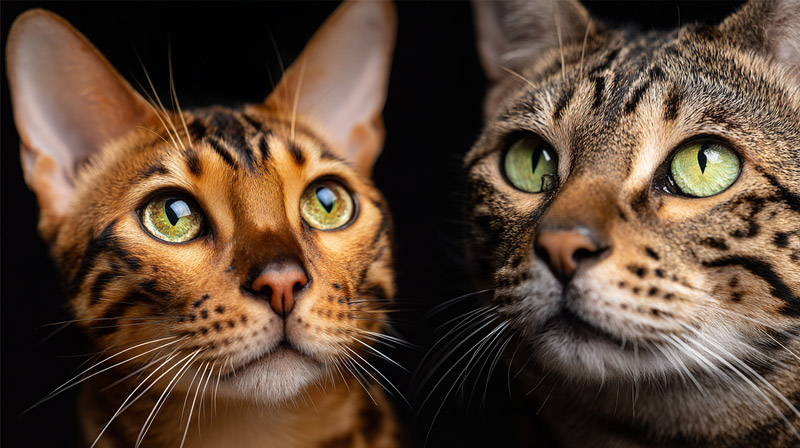
Most homes that want an easy-going, sociable spotted cat will end up happiest with the Ocicat. Owners chasing rosettes and constant activity want a Bengal instead, and the Egyptian Mau only makes sense in a calmer home willing to earn the trust of a reserved, loyal cat.
| Trait | Ocicat | Bengal | Egyptian Mau |
|---|---|---|---|
| Ancestry | All domestic | Asian leopard cat cross | Natural spotted breed |
| Pattern | Thumbprint spots | Rosettes or marble | Random spots |
| CFA championship | 1987 | 2018 | 1977 |
| Temperament | Welcomes strangers | Curious, athletic | Devoted, reserved with visitors |
| UK life-table study (Teng et al., 2024) | Not included | 8.51 years | Not included |
The Bengal is the closest rival on looks. CFA requires five generations of domestic ancestry before it registers the breed, and its standard rewards dark-outlined rosettes that the Ocicat standard never asks for.
The Egyptian Mau is the only natural spotted domestic breed, per CFA, and it shows in just three colors: silver, bronze and smoke. CFA also says there are not enough Mau breeders to meet demand, so expect a wait.
One risk crosses all three breeds. Langford Vets lists the Ocicat (under Aztec/Ocicat), the Bengal and the Egyptian Mau among breeds affected by PK deficiency, so ask for the test result whichever one you pick.
Each breed adds its own. Bengal breeders scan breeding cats for heart disease by echocardiogram (CFA), and the University of Missouri’s Feline Genetics lab reports that Egyptian Maus are significantly predisposed to urate stones.
When an Ocicat Is the Wrong Choice
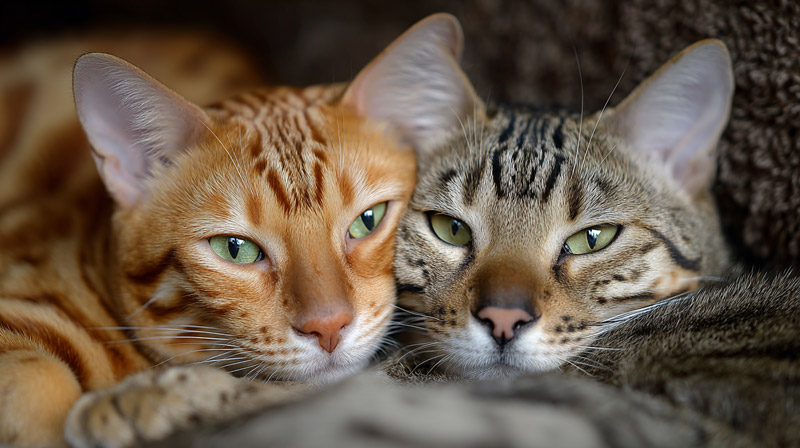
A quiet home is the first problem. The sources split here, with CFA saying the breed is only occasionally vocal and not annoying, while PetsRadar, Purina and Vetstreet call it talkative.
Anyone who wants a one-person cat should look elsewhere too, since Ocicats greet everyone. A rosette or marbled coat only comes from the Bengal. And if you won’t ask for health certificates, skip the breed, because screening only protects you when you request the results.
For most households the Ocicat is the lowest-friction of the three. It’s fully domestic and sociable, and easier to find than a Mau. The Bengal demands more energy than plenty of owners have to spare, and the Mau takes patience.
How Much Does an Ocicat Cost, and How Do You Find One?
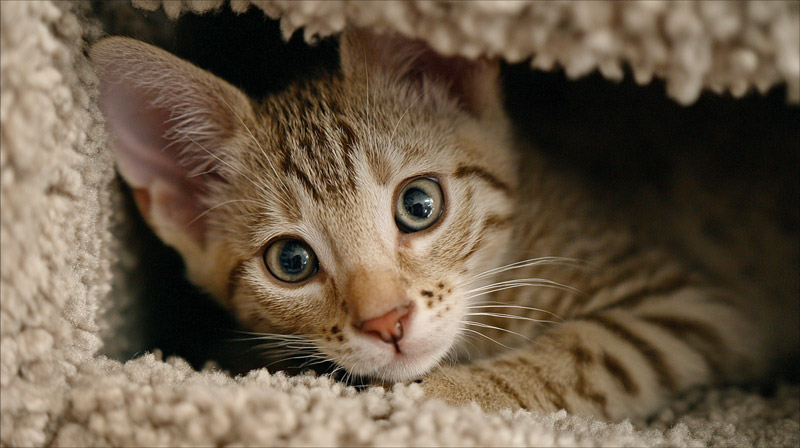
A kitten from a reputable US breeder costs about $800 to $2,500, according to PetsRadar (2025).
Sources disagree on scarcity, which drives that spread. PetsRadar calls the breed relatively rare in the US, while CFA says finding an Ocicat kitten generally is not a challenge and that a CFA show rarely lacks Ocicats.
CFA adds that a particular color or sex can mean a wait. In the UK, GCCF’s breeding policy describes the Ocicat as a fairly small breed.
CFA’s Find-A-Breeder directory is one place to start. TICA’s breeder listings are limited to members who signed its Code of Ethics, and UK buyers can go through GCCF’s breeder scheme.
Vetting a breeder goes roughly like this.
- Meet the breeder at a cat show or the cattery. Kittens at shows are older, so visit the home to see a young kitten and a parent.
- Ask for test results on both parents: the PK deficiency DNA test, the retinal atrophy test and a recent heart scan.
- Get the health guarantee and the return policy in writing.
- Check the vaccination record and the parents’ feline leukemia results.
- Ask for the pedigree and note any recent Abyssinian outcross.
- Expect a spay or neuter clause in the purchase agreement, which CFA says nearly every pedigree breeder requires.
Skip pet stores. CFA says reputable breeders of pedigreed cats do not sell through them.
Adults cost less. One WeRescue listing for an adult Ocicat at All About Animals Rescue in Phoenix carried a $400 adoption fee (the cat has since been adopted), and the UK Ocicat Club’s welfare officer arranges rehoming and foster care for Ocicats in need.
Ocicat FAQ
Are Ocicats hypoallergenic?
No cat breed is fully hypoallergenic, and the Ocicat is no exception. PetsRadar’s consulting vet reports lower Fel d1 output and slightly less shedding in the breed, but sensitive allergy sufferers still react.
Spend time with an adult Ocicat before committing.
Can an Ocicat live outdoors?
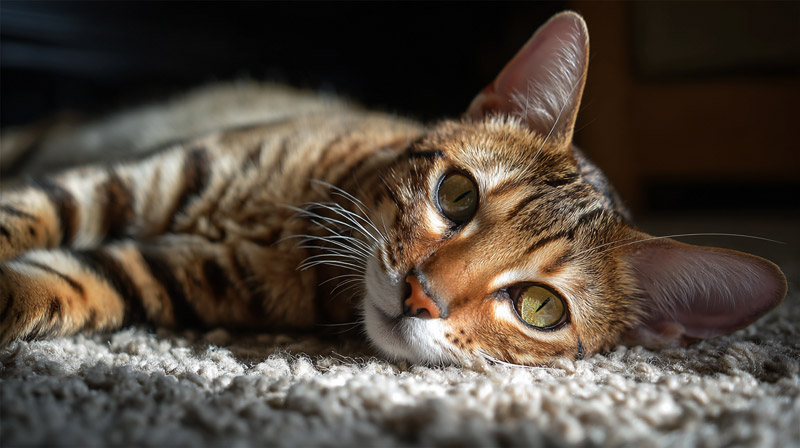
Not as an outdoor-only cat. CFA’s buyer guide says pedigree breeders ask about your attitude toward keeping cats indoors, so expect that question.
CFA also notes that many Ocicats walk on a leash, which makes supervised harness outings the safer route to fresh air.
How can I tell if a shelter cat is an Ocicat?
Only a pedigree proves it. Appearance narrows the guess, with thumbprint spots on banded hairs, a bull’s-eye on each flank, an M on the forehead and a dark tail tip.
GCCF registers lookalikes with other breeds in their pedigree as having no recognised breed.
Do Ocicats like water?
Some do. PetsRadar’s vet-reviewed profile calls the breed a water lover, and Rescue Me’s breed notes say a few Ocicats enjoy swimming.
Let each cat set the pace, since neither source claims every Ocicat takes to it.
What to Settle Before Bringing an Ocicat Home
Before the kitten arrives, work out who keeps it company during the day and get both parents’ health certificates in hand. Book the first vet visit and the spay date too.
Order matters here. A household that leaves the cat alone is the hardest problem to repair, while PK deficiency results and heart scans can only be requested before the kitten changes hands.
The cost is time, since CFA says a particular color or sex can mean a wait.
Verified November 2026, the first UK life-table study (2024) leaves the Ocicat out. A breed-specific table would be the first evidence to revise the 15 to 18 year claims.