A Sphynx has skin oil and nothing to soak it up. Most of the care routine comes from that one fact, which traces back to a recessive KRT71 mutation that took the coat away. Regular baths follow, along with a warmer house than you’re used to and sunscreen for a cat that likes a sunny window.
The breed’s recorded history starts with hairless kittens born in Toronto in 1966 and Minnesota in 1975. The Cat Fanciers’ Association granted championship status in 2002.
Lifespan is the uncomfortable part. UK veterinary records put the breed’s average life expectancy from birth at 6.8 years, the shortest of any breed analyzed and far below the 11.7 years for cats overall (Royal Veterinary College, 2024). Hypertrophic cardiomyopathy (HCM), a heart-muscle disease detected by echocardiogram, is the best-documented breed-specific risk.
What Is a Sphynx Cat?
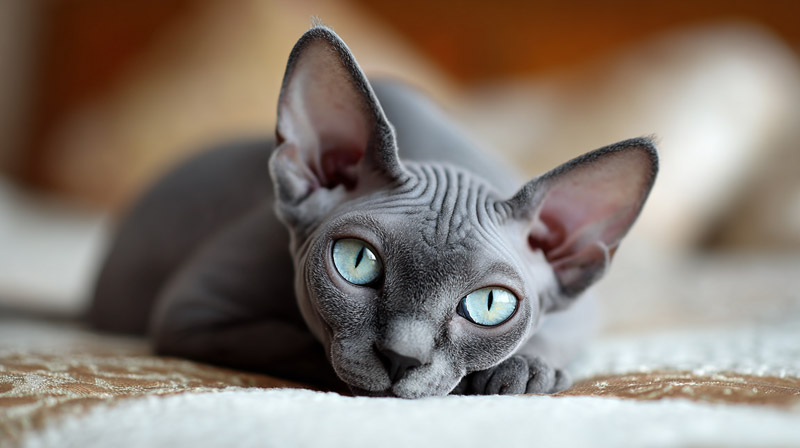
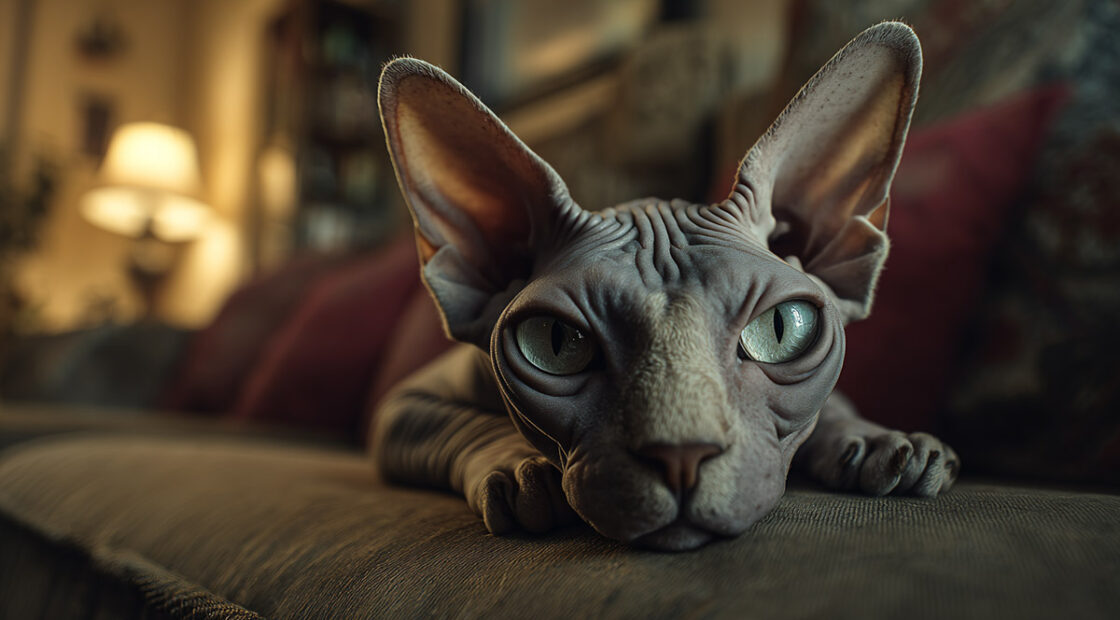
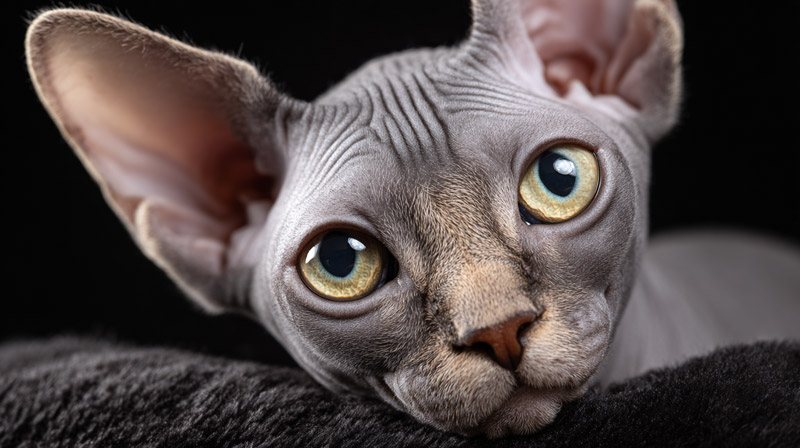
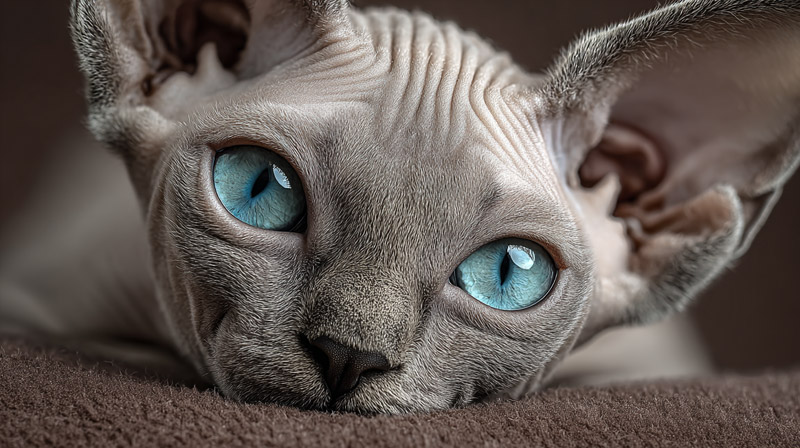
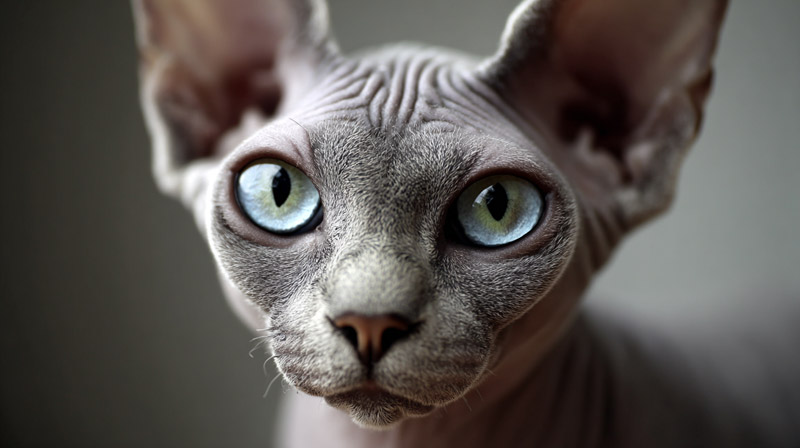
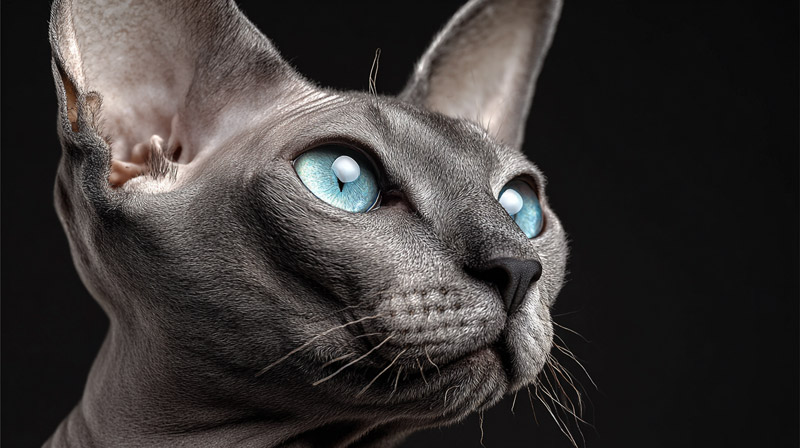
Hairlessness in this breed comes from a recessive mutation in the keratin 71 gene (KRT71), and the cat it produces is medium-sized and muscular. It has oversized ears and wrinkled skin, and it feels noticeably warm to the touch.
Coat and skin
“Hairless” is slightly off. The Australian Cat Federation standard (amended November 2025, built on the TICA standard) says the Sphynx only appears hairless and may carry very fine down, with short soft hair allowed on the ears, muzzle, tail and feet.
Skin texture is chamois-like.
A 2014 histology study in Veterinary Dermatology (Genovese et al.) found Sphynx follicles present at normal density. They are small, curved and kinked, and they produce thin, misshapen shafts that never add up to a coat.
Shedding is minimal because there is little hair to lose. The mess comes from skin oil, which rubs off on blankets, sofas and pillowcases.
Build, ears and size
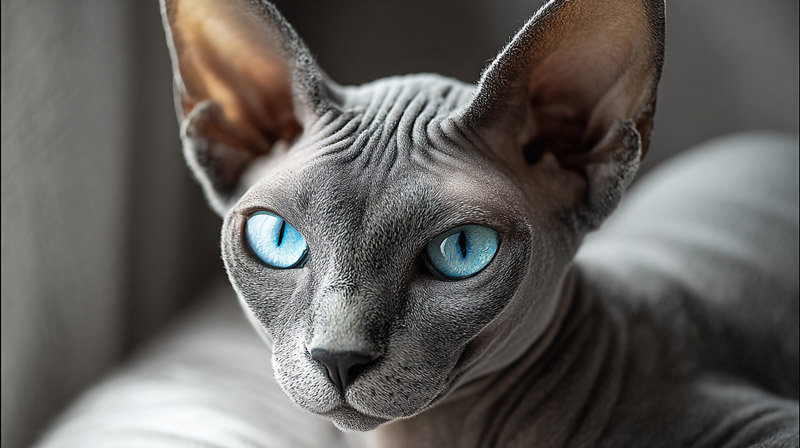
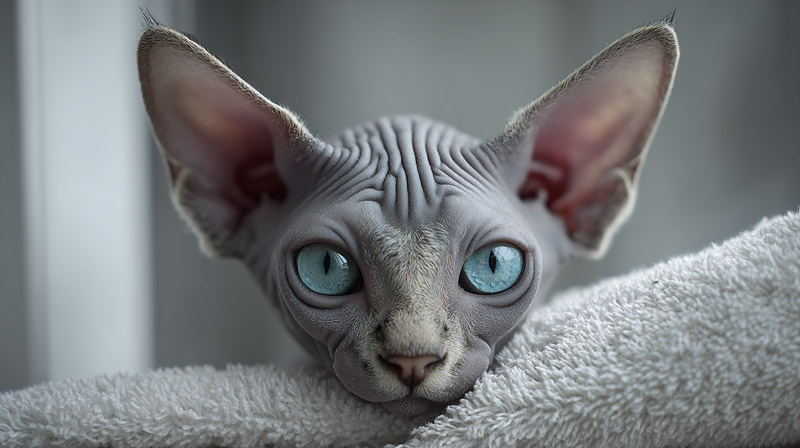
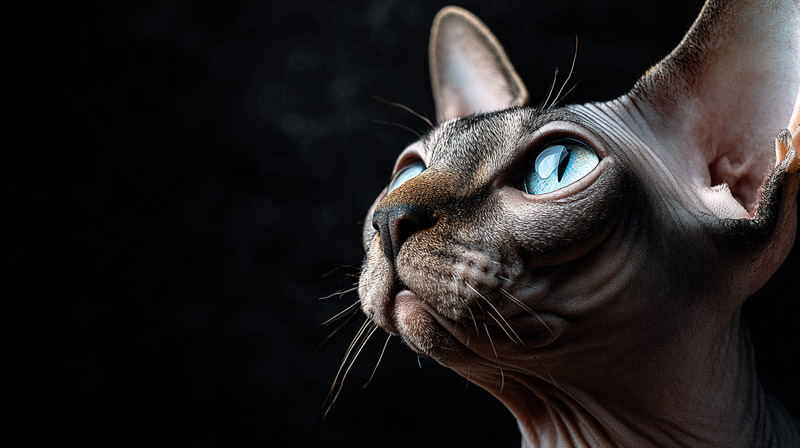
The CFA standard describes a modified wedge head with prominent cheekbones and a distinct whisker break. Eyes are large and lemon-shaped and set wide apart (TICA, WCF and CFA standards). Ears are very large and upright, with a bare inner ear (CCCA standard).
The body is medium in length, hard and muscular, and heavier than it looks. Wrinkles are deepest in kittens and stay on the head in adults, never so deep that they distort the face.
Size is where profiles disagree. Purina lists males at 8 to 12 pounds and females at 6 to 9, while the Cats.com breed guide gives adult weights of 4 to 7 kg (roughly 9 to 15 pounds).
Females run smaller, as the CFA standard says directly. Dense muscle also makes a Sphynx heavier than it looks, so treat any single weight as a rough guide.
Colors and patterns
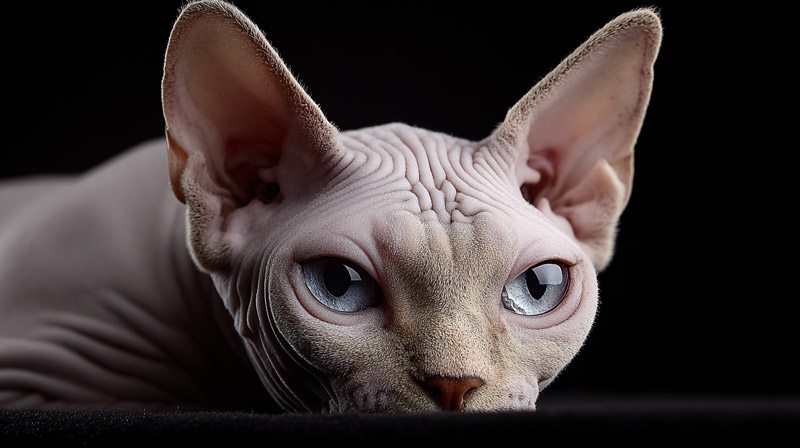
The skin carries the color.
Registries accept the full range of colors and patterns, tabby variants included, and the WCF standard allows any amount of white.
Eye color is where registries split. The CFA accepts every eye color and assigns it no points, while the ACF restricts blue and odd eyes to white cats and cats with white markings.
What Is a Sphynx Cat’s Personality Like?
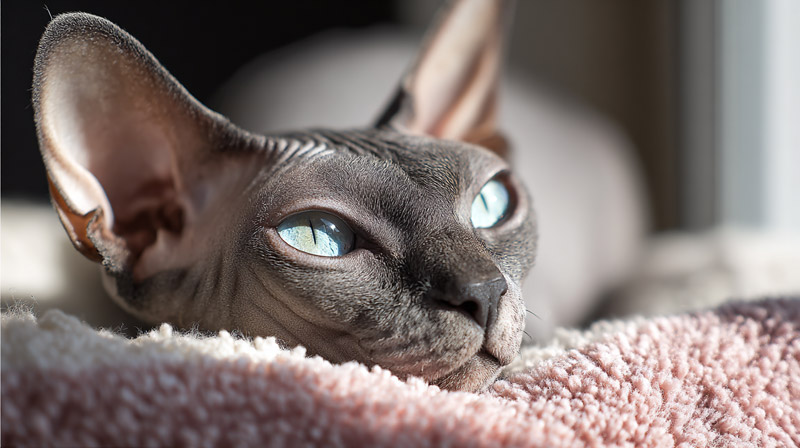
Sphynx cats are extroverted and curious, and they want attention more or less constantly. The FIFe standard calls them sweet-tempered and lively and adds that they are intelligent and strongly attached to their owners, with a big appetite for attention.
They greet visitors and go looking for laps, and the CFA standard calls the breed amenable to handling. PetMD describes a dog-like streak, fetch included. Squeaks and chirps are how they get noticed, and some whine (Pawlicy). Bare skin loses heat, so expect the cat under the covers or on top of you.
Alone time is the weak point. A cat bred to demand attention suits a home where someone is around for most of the day, and a household that is empty from morning to evening should pick a different breed.
WebMD’s breed overview says Sphynx cats get along with children and other pets, dogs included, though introductions to dogs should go slowly.
How to Care for a Sphynx Cat’s Skin and Body Temperature
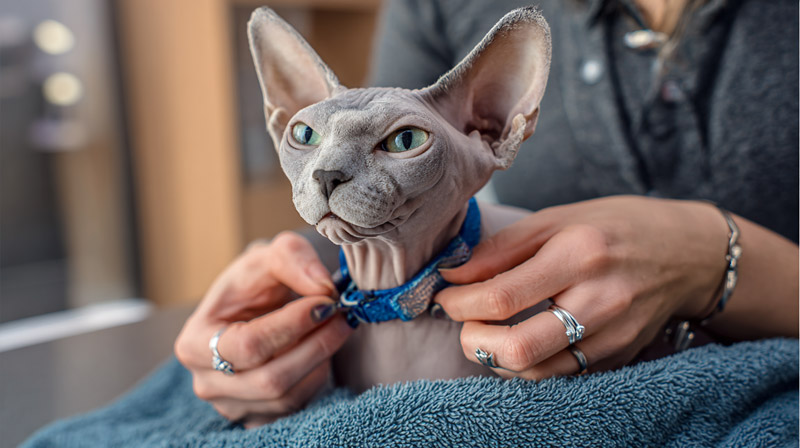
Baths top the list, and once every one to two weeks is the most any cat needs. Wipe ears and nail folds when oil and wax show up. Keep the house warm and cover exposed skin if the cat gets direct sun.
Fur normally absorbs and spreads skin oil. A Sphynx has no coat to do that, so the oil stays on the skin.
Bathing and skin oil
Dr. Alison Diesel of the Texas A&M College of Veterinary Medicine singles out the Sphynx as the cat that does need baths. Routine bathing reduces debris and the chance of secondary skin infection, she says, and rarely needs to exceed once every one to two weeks.
A rusty or brownish tint on the skin or grease on the bedding means a bath is overdue, and so does a bad smell. A bare cat that looks clean can wait.
- Warm the bathroom first, because a wet Sphynx chills fast.
- Fill a sink or basin with lukewarm water to belly height and lower the cat in, back legs first.
- Wash with a cat-safe shampoo, working from neck to tail, and keep water out of the ears and off the face.
- Rinse until no residue is left.
- Wrap the cat in a warm towel, dry it fully and keep the room warm until the skin is dry.
- Finish with a treat. Starting while the cat is young makes every later bath easier (Diesel).
Acne and yeast infections are more common in the breed and often need a medicated shampoo, so ask a vet before choosing a product.
Ears and nail beds
The yeast problem has real numbers behind it. Malassezia yeast grew from 26 of 32 Sphynx cats (81%) and from none of 10 domestic shorthairs (Ahman and Bergstrom, Journal of Feline Medicine and Surgery, 2009).
The yeast settles in skin folds and claw folds, where oil collects. Volk and colleagues (2010) found counts at the claw folds, armpits and groin that exceeded those of healthy coated cats, and armpit counts matched those of seborrhoeic Devon Rex cats.
Brown, waxy debris at the nail base, red folds or constant scratching justify a vet visit. Wipe the nail beds and skin folds during the bath, and clean the outer ear with a cat-safe cleaner when wax shows.
Ear yeast is less settled. One study recovered no Malassezia from Sphynx ear canals, while another found most of one species’ isolates there, so ear checks stay worthwhile without assuming infection.
Cold, heat and sun
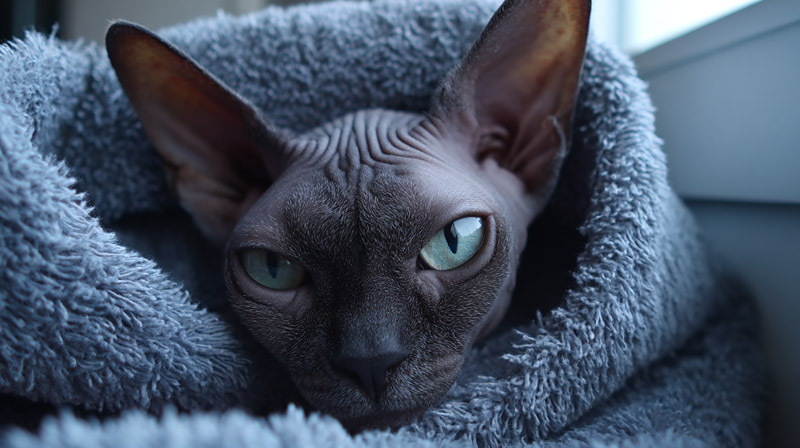
Hairlessness reduces insulation and leaves the cat sensitive to temperature extremes (OMIA). A heated bed and soft blankets help, and so does a sweater on cool days.
Extremes cut both ways. Hot cars and sealed rooms are a bad idea, and so is letting the cat press against a radiator.
Exposed skin burns. A cat that sunbathes at a window needs pet-safe sunscreen on bare areas, according to the Cats.com breed guide.
Feeding a high-metabolism cat
Underfeeding a Sphynx is as risky as overfeeding one.
The cat burns extra energy keeping warm and eats accordingly. Feed a quality adult cat food and adjust portions by body condition, because weight at either extreme shortened life expectancy across UK cats (Royal Veterinary College, 2024).
Cats.com ties lower-quality food to skin problems and excess oil production. Purina points owners of overweight cats to a weight-management formula.
Sphynx Cat Health Problems and Lifespan
Heart disease is the one to worry about first. Hypertrophic cardiomyopathy (HCM), a thickening of the heart muscle, leads the list, with skin yeast overgrowth and a few inherited skin and muscle disorders behind it. UK veterinary records put average life expectancy at 6.8 years, the shortest of the breeds analyzed.
The numbers worth knowing are these:
- About 15% of domestic cats overall have HCM (Seo et al., Animals, 2024).
- In screened Sphynx cats in New Zealand the rate was 40% (20 of 55), at a median age of 5.8 years (Seo et al., 2024).
- 70.9% of those same cats carried an ALMS1 variant, and it showed no link to HCM (Seo et al., 2024).
- Life expectancy from birth is 6.8 years for Sphynx cats against 11.7 across UK cats (Teng et al., Journal of Feline Medicine and Surgery, 2024).
Hypertrophic cardiomyopathy and heart screening
Three of the cats with HCM in the New Zealand study died of congestive heart failure during follow-up. Necropsy found heart attacks (myocardial ischemia or infarction) in all three.
HCM is age-dependent, so a clear scan at breeding age does not clear a cat for life. The authors flag this as a problem for breeding programs that use cats young.
Screening means transthoracic echocardiography performed by a cardiologist, which is how the New Zealand team scanned the cats and then rescanned most of them later.
The sources don’t fully agree on markers. An ALMS1 gene variant was proposed as an HCM marker in Sphynx cats. In the New Zealand cohort most cats carried it and it showed no association with HCM, so the authors say it needs more study before breeders use it for selection.
An earlier French screening reported a lower HCM rate than the New Zealand figure. The New Zealand number is not a random-sample estimate either, since the cats came from breeders and owners who accepted a free screening invitation.
Skin, ear and muscle conditions
Urticaria pigmentosa
Vitale and colleagues (Veterinary Dermatology, 1996) described an itchy, crusted rash with mast cell infiltration in three related Sphynx cats that shared a grandsire, all with juvenile onset. Noli et al. (2004) later reported the same pattern in unrelated Devon Rex cats, so it is not exclusive to the Sphynx.
Ringworm turns up in the breed too. A 2020 case report in Acta Veterinaria followed Microsporum canis ringworm in a two-year-old unneutered female. She was treated successfully with oral itraconazole and a chlorhexidine and miconazole shampoo.
Malassezia dermatitis
Greasy seborrhoea with yeast overgrowth is a recurring skin problem in the breed. Every seborrhoeic cat in the Ahman and Bergstrom study carried Malassezia pachydermatis at several skin sites, which is why the bathing routine above matters.
Congenital myasthenic syndrome
A congenital myasthenic syndrome, also called hereditary myopathy, affects Sphynx and Devon Rex cats. It is autosomal recessive, caused by a COLQ gene variant (c.1190G>A), and a cheek-swab DNA test is available through the UC Davis Veterinary Genetics Laboratory.
Signs can start at 3 weeks of age, with muscle weakness after exertion, stress or excitement. UC Davis says affected cats generally die of choking or aspiration pneumonia by two years of age, while the research literature calls the course variably progressive.
A European panel of Sphynx cats showed a low carrier rate (Abitbol et al., PLOS ONE, 2015).
How long Sphynx cats live
| Source | Figure | Basis |
|---|---|---|
| Hill’s Pet breed profile | 8 to 14 years | Breed guidance |
| VCA Animal Hospitals breed profile | 15 to 20 years | Breed guidance |
| Royal Veterinary College VetCompass (Teng et al., 2024) | 6.8 years from birth | Life table, 7,936 UK cats that died between 2019 and 2021 |
The gap is a difference in method, not only in opinion. Profile ranges are summary guidance with no stated sample, while the RVC figure is an estimate of average remaining life from birth for UK cats under veterinary care.
The study authors attribute short lifespans in several breeds to breed-predisposed diseases. HCM, which turns up at a young median age in screened Sphynx cats, is the best-documented candidate.
Treat 6.8 years as a UK population estimate, not a prediction for one cat. Weight control and heart screening are the levers an owner actually controls.
Are Sphynx Cats Hypoallergenic?
No. Hairlessness removes loose fur, not the main cat allergen, Fel d 1, which cats make mostly in their sebaceous glands. Hill’s Pet lists the Sphynx as not less allergenic than other breeds.
Bonnet and colleagues (Allergy, Asthma and Clinical Immunology, 2018) report that sebaceous glands, not saliva, are the main production site. The protein also sits in skin, fur, saliva and anal glands.
Exposure is not limited to the cat itself. Fel d 1 has been found in classrooms, cars and shopping centers, probably carried on clothing.
Bathing does not fix it. Airborne Fel d 1 recovers within 24 hours of washing a cat (Bonnet et al., 2018), so the regular Sphynx bath protects the cat’s skin, not an allergic housemate.
A 2025 review by Colosimo and colleagues in Clinical and Translational Allergy lists HEPA filtration and neutering among the measures that lower household allergen load. They reduce exposure. They do not remove it.
Allergen output varies between individual cats. A hairless cat is not a safe bet for someone with a diagnosed cat allergy, so spend time with the specific cat before buying.
Sphynx Cat Price and Ongoing Costs
Expect a higher bill than for most breeds, and expect the kitten’s price to be the smaller part of it. The Cat Fanciers’ Association calls the Sphynx one of the higher-priced breeds but gives no figure.
Published ranges come from pet insurers and publishers, not registry data. Read them as asking-price guides.
| Item | Range | Source |
|---|---|---|
| US breeder kitten | $1,500 to $6,000 | SpotPet, 2025 |
| UK breeder kitten | GBP 800 to GBP 2,000 | Catster |
| First-year care in the US (supplies, grooming, blood tests, HCM heart scans) | About $2,000 | Pawlicy |
What moves the price
SpotPet puts the spread down to lineage and breeder reputation, with location mattering too.
The cheapest legitimate route is a coated Sphynx. Because the hairless gene is recessive, coated cats turn up in Sphynx lines, and the CFA says they sell for less and offer the same people-centered personality (they are registered for breeding only).
Vet costs the breed adds
The CFA’s own health list shows where the extra vet bills come from, and the first-year figure above covers only part of it.
HCM screening is the big item, and the CFA says it has helped keep the gene pool healthy and diverse. Periodontal disease shows up as well, along with respiratory problems in kittens that the CFA links to the lack of hair. Sensitive digestive systems can complicate food choices on top of that.
How to Choose a Sphynx Breeder or Adopt One
Ask for dated heart-scan records on both parents first, then check registration and the written contract. A price far under the market range is the clearest warning sign.
- Request each parent’s echocardiogram report from a veterinary cardiologist, with the scan date on it.
- Ask for COLQ DNA results on the parents. A cheek-swab test for the myasthenic syndrome exists.
- Confirm registration with CFA, TICA or FIFe and read the pedigree. Papers show ancestry. They do not replace health records.
- Check the outcross lines. Until December 31, 2033, the CFA allows American Shorthair, Devon Rex and domestic shorthair outcrosses, so a coated ancestor on the pedigree is normal.
- Get a written sales contract with a health guarantee, as PetPlace’s buyer guide advises.
- See the kitten in person, or on a live video call, before any money moves.
The CFA names a cat show as the best place to meet breeders face to face, and its Find-A-Breeder directory lists members.
Adopting from a rescue
A rescue group in northern Alberta charged $600 per cat when it rehomed 20 Sphynx taken from one home (CTV News Calgary), and a New York shelter asked $500 each for five (CBS6 Albany).
In the Alberta case, adoption fees and donations paid for spay or neuter plus medical and dental surgery. Rescue Sphynx tend to come from hoarding cases and breeder closures, like the 19 Sphynx a Sheffield charity rehomed from a single breeder. The Alberta rescuers warned of possible ongoing medical issues, which is the catch.
Ask a vet for a heart assessment before committing to an adult cat, since rescue history rarely includes scans.
Fake Sphynx listings
Hairless kittens can be faked.
In 2016 the Alberta SPCA opened an investigation into allegations that a seller advertising Sphynx kittens at $650 each on Kijiji, less than half the breeder price, had removed the hair and whiskers of ordinary kittens (CBC). One buyer paid $700, and the kitten grew an orange coat within a week.
Hair that grows back means the sale was a fraud. A live video call or a visit would have caught it.
Sphynx Cat Origin and the Gene Behind Hairlessness
The breed’s recorded history starts with hairless kittens born in Toronto in 1966 and on a Minnesota farm in 1975. A recessive splice variant in the KRT71 gene causes the hairlessness.
Founding cats and breed history
- In 1966 a hairless kitten named Prune was born in Toronto and mated back to his mother (CFA, Petfinder).
- The CFA granted provisional status around 1970 to 1971, then withdrew it over health and breeding problems (Petfinder).
- Epidermis and Dermis were born on the Pearson farm in Wadena, Minnesota, in 1975 and 1976, and went to Oregon breeder Kim Mueske (Wikipedia).
- Shirley Smith found three hairless kittens in Toronto in 1978, Bambi, Punkie and Paloma, and two of them were later bred to a Devon Rex in the Netherlands (Wikipedia).
- TICA accepted the breed for championship in 1986, the CFA registered it in 1998 and granted championship in 2002 (Petfinder, CFA).
Sources disagree on which cats founded today’s breed. The CFA starts the story with Prune, while Wikipedia says the current American and European Sphynx descend from the Minnesota and 1978 Toronto lines.
Britannica agrees with the second reading and describes two spontaneous mutations, starting with the 1975 kittens. Prune’s own line had a small gene pool and kittens dying of undiagnosed health problems (Petfinder).
Dates also vary. A few profiles put TICA’s recognition at 2005, but a 1989 Cats Magazine article already called TICA the only US association running Sphynx championship classes.
KRT71 and recessive inheritance
Gandolfi and colleagues (Mammalian Genome, 2010) found a splice-site change in KRT71 in Sphynx cats, which they named the hr allele. The Devon Rex carries a different splice-altering rearrangement in the same gene, the re allele.
The Sphynx variant is a single-base change listed in OMIA as c.816+1G>A, first reported in 2010.
Normal KRT71 is dominant over hr, and hr is dominant over re, so a kitten needs two copies of hr, or one hr and one re, to be hairless.
Most Sphynx in that panel were either hr homozygotes or hr/re compound heterozygotes, which fits the breed’s Devon Rex outcrossing history. Two carried hr without any Devon allele.
Recessive inheritance also explains why coated Sphynx appear in litters, as the CFA notes.
Outcross rules by registry
- The CFA allows American Shorthair, Devon Rex and domestic shorthair outcrosses, and Sphynx born on or after December 31, 2033 may have only Sphynx parents (CFA breed page).
- The ACF has no allowable outcross (standard amended November 2025).
- The GCCF accepts Russian Blue and domestic shorthair (Your Cat breed profile).
Third-party pages quote different CFA cut-off years, including 2015 and 2023, and Wikipedia lists only two CFA outcross breeds. Check the CFA breed page itself.
How Does the Sphynx Compare With the Devon Rex and Other Hairless Breeds?
The Sphynx and Devon Rex are two variants of one gene, KRT71, so they are close genetic relatives, but only the Sphynx is hairless. The Peterbald and Donskoy are hairless for a different reason, a dominant gene.
| Breed | Origin | Genetic basis | Coat |
|---|---|---|---|
| Sphynx | Canada, 1966 | Recessive KRT71 variant (hr) | Hairless to fine down |
| Devon Rex | England, 1960 | Recessive KRT71 variant (re) | Short, wavy, soft |
| Peterbald | Russia, 1994 | Dominant hair-losing gene | Bald to straight, five coat types |
| Donskoy | Russia, 1987 | Dominant hairless mutation | Born hairless or loses coat with age |
Sphynx versus Devon Rex
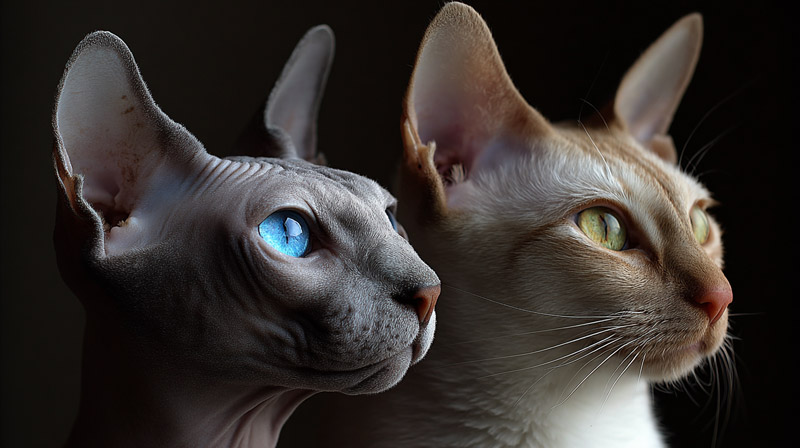
Both carry KRT71 variants, and the CFA standard penalizes a Sphynx that looks like a Devon Rex. Both can also inherit the COLQ myasthenic syndrome, a link researchers tie to repeated Devon Rex use in Sphynx breeding programs (Abitbol et al., PLOS ONE, 2015). Heat appeals to both, and the GCCF describes the Devon Rex basking in windows.
Grooming is where they part ways. Hill’s rates Devon Rex grooming needs as low and warns against brushing the fragile fur. Hill’s also lists the Devon Rex as common and the Sphynx as rare. On health, luxating patella appears more common in the Devon Rex (Your Cat), while heart disease leads the Sphynx list.
Buyers who want the same elfin look and sociable temperament with a coat can look at the curly-coated Devon Rex breed. The skin-care routine is the main thing they would give up.
Peterbald and Donskoy
Elena Kovaleva found the first Donskoy in Rostov-on-Don in 1987. Dominant inheritance means one copy of the gene is enough, so kittens are born hairless or lose their coats as they grow.
Olga Mironova crossed a Donskoy with an Oriental Shorthair in St. Petersburg in 1994 to create the Peterbald, per Petful. The result has a slim Oriental build, and breeding a hairless Peterbald to a coated cat can still produce hairless kittens.
When Is a Sphynx Cat the Wrong Choice?
A Sphynx is the wrong cat for homes that sit empty most of the day, for households expecting a low-allergen pet, and for anyone living where keeping hairless cats is restricted.
Where keeping a Sphynx is restricted
The Netherlands has banned breeding Sphynx cats since 1 July 2014 under Article 3.4 of its Animal Keepers Decree. A ban on keeping hairless and folded-ear cats took effect on 1 January 2026 (Utrecht University, DutchNews).
Owners of existing cats must prove possession from before the ban with official papers or microchip data, and the fine is EUR 1,500 (DutchNews, October 2025).
The authorities and the registries disagree on the welfare question. Utrecht veterinary geneticist Hille Fieten says hairless cats feel the cold, get more skin infections and need sunscreen outdoors.
TICA’s Sphynx breed committee told the Dutch consultation that every TICA breed must meet health standards and that all major registries accept the Sphynx.
Households that struggle with a Sphynx
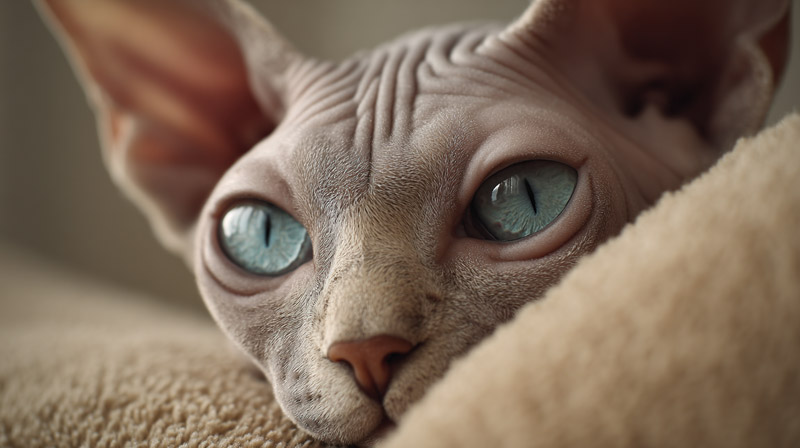
Long absences are the obvious one. The CFA says the breed does not do well alone for long and suggests considering a pair, which doubles the care bill.
Young children are a poor fit as well, since the CFA warns that Sphynx skin is delicate and unsuited to rough play.
Allergy sufferers get mixed messages. The CFA says bathing reduces allergen on the skin but does not make a low-allergen cat, while Bonnet et al. report little lasting benefit from washing, so the sources split on how much bathing helps.
Pros and cons of owning a Sphynx
The good side is a cat that is outgoing, intelligent and strongly people-oriented (CFA). It is sturdy and muscular, not fragile, and it does well with a companion cat. A coated Sphynx gives you the same personality for less money.
The downsides are constant chatter and attention demands, plus skin that rules out rough play. The price band is higher, heart and skin care recur, and there are legal limits in the Netherlands.
What to choose instead
Pick a coated Sphynx if the personality is the draw. Pick a Devon Rex if low grooming matters more than the hairless look.
Sphynx Cat FAQ
How do you pronounce Sphynx, and why is it named after the Sphinx?
Say it “sfinks.” The name nods to the Egyptian sculpture, but the breed began in Toronto, not Egypt, and was first called the Canadian Hairless.
Why do Sphynx cats have few or no whiskers?
Whiskers are hair, and the gene change that thins the coat also affects them. The CFA standard says whiskers are usually absent and, when present, short and sparse, while OMIA describes them as short and curled.
Are male or female Sphynx cats easier to live with?
No source documents a temperament difference between the sexes. The CFA says males are usually larger, and across UK cats overall, females outlived males by 1.33 years (Royal Veterinary College, 2024).
Judge the individual cat, not the sex.
Are Sphynx cats rare?
Yes, the CFA and Hill’s both list the breed as rare. Even so, the CFA calls it unusual to find a show without a Sphynx or two, so rarity shows up mostly in price.
Is pet insurance worth it for a Sphynx?
Usually yes. Heart screening, skin infections and dental disease drive the vet bills, and Hepper lists monthly premiums of $20 to $80.
Enroll before any diagnosis, since insurers generally exclude conditions found before the policy starts.
Budgeting for a Sphynx Cat After the First Year
Keeping a Sphynx runs $1,800 to $5,160 a year, based on SpotPet’s 2025 monthly estimates for food, grooming and veterinary care, which total $150 to $430 a month.
Veterinary care is the largest line at both ends, at $100 to $300 a month against $50 to $130 for food and grooming combined.
Because vet spending varies by $200 a month and food and grooming by $40 each, the budget should be built in that order. Size the veterinary reserve first and price repeat heart scans into it. Food and grooming budgets come last.
Budgeting to the high end costs $3,360 more per year than the low end, and the owner accepts either an idle reserve or the risk of a shortfall.
The figures were verified in November 2026, so replace them with local vet quotes before committing.