Giant Schnauzers started out on Bavarian cattle routes, moving herds to market and guarding the farms they came from. They are the largest of the three Schnauzer breeds.
Police units and search and rescue teams still use them, and some work in therapy programs. The wiry double coat comes in solid black or pepper and salt.
The AKC ranked the breed 52nd of 202 in its 2025 popularity rankings, up from 57th a year earlier. That came after one of its dogs took Best in Show at Westminster in 2025.
What is the Giant Schnauzer?
Southern Germany produced the breed as a working dog, and it is the biggest Schnauzer by a wide margin.
WebMD notes that it isn’t a giant breed in the usual sense. It only looks giant next to its relatives.
The AKC treats the three Schnauzers as separate breeds, not three sizes of one dog, and calls the Standard Schnauzer the oldest of them.
Group placement shows the split. Britannica reports that the AKC puts the Standard and the Giant in the working group, while the Miniature Schnauzer sits with the terriers.
The AKC and Orvis list a few other names. Riesenschnauzer is German for “the giant,” Munchener was the common name for many years, and you’ll also see Munich Schnauzer and Russian Bear Schnauzer.
Droving cattle to market was the first job, with farm guarding added on. Later, butcher shops and stockyards kept the dogs as guards, and so did breweries (AKC history page).

Current work includes police and guard duty and search and rescue, plus therapy (Orvis). In Europe, a Giant Schnauzer still needs a Schutzhund I working title before it can enter conformation classes, according to a breed pamphlet the AKC quotes.
Where does the Giant Schnauzer come from?
Bavaria and Wurttemberg. Cattlemen there wanted a drover’s dog big enough to move cattle, so they started from the medium-sized Schnauzer.
The AKC history page says Bavarian drovers met the medium Schnauzer around Stuttgart and liked its soundness. They didn’t like its size.
A dog that small suited sheepmen but not cattle drovers.
The date is disputed. The UKC standard places the breed’s development in the 1600s, while Royal Canin and WebMD put it in the mid-1800s. The region and the purpose are settled, the century isn’t.
Railroads ended the droving trade, and the dogs moved into guard work. German police schools in Berlin and other cities began training them just before World War I, and police work has been their main occupation since (AKC).
The UKC recognized the breed in 1948 (UKC standard). The Giant Schnauzer Club of America formed in 1962, according to the AKC.
Which breeds went into the Giant Schnauzer?
Steve Fox, a former president of the Giant Schnauzer Club of America, told the AKC that the most widely accepted components are the Standard Schnauzer, the German Mastiff, the Great Dane and a smooth-coated drover such as the Rottweiler.
The UKC standard gives a different list. It names the Standard Schnauzer, the Great Dane and rough-haired sheepdogs, and possibly the Bouvier des Flandres.
Fox says there is no consensus on Bouvier ancestry. The AKC history article adds crossings with rough-haired sheepdogs and, much later, the black Great Dane.
The Standard Schnauzer and the Great Dane show up in every account. The Bouvier is the shaky one.
How do registries classify the breed?
The AKC files it under Working. The UKC moved it to the Guardian Dog Group on May 1, 2008, after years in the Herding Group, so some breed guides still print the old Herding label.
The UK Kennel Club (now The Royal Kennel Club) also says Working. Dogs Victoria and Dogs NZ both use Utility.
Each label follows the job that registry has in mind. The AKC standard in use today was approved on October 11, 1983.
What does a Giant Schnauzer look like?
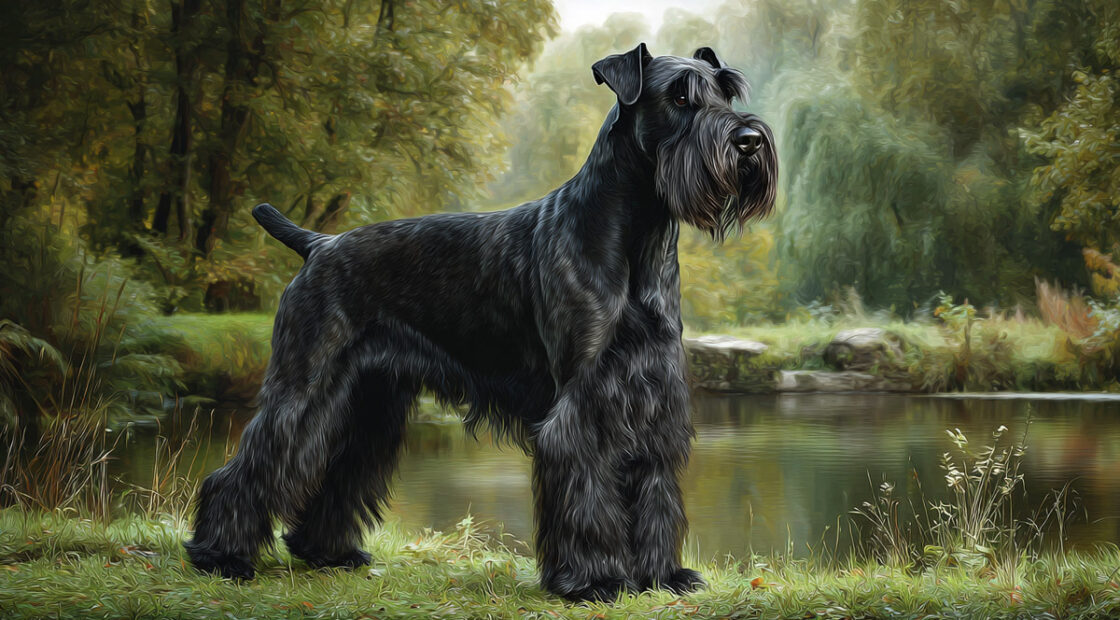
Square and muscular, with a bearded rectangular head, standing 23.5 to 27.5 inches (60 to 70 cm) at the withers. The coat is solid black or pepper and salt.
The AKC standard describes a strongly built dog whose body length matches its height at the withers. A harsh beard and eyebrows are the Schnauzer hallmark.
How big does a Giant Schnauzer get?
Britannica lists the three Schnauzer breeds side by side.
| Breed | Height at withers | Weight | AKC group |
|---|---|---|---|
| Miniature Schnauzer | 12 to 14 in (30 to 36 cm) | 11 to 20 lb (5 to 9 kg) | Terrier |
| Standard Schnauzer | 17.5 to 19.5 in (44 to 50 cm) | 30 to 50 lb (14 to 23 kg) | Working |
| Giant Schnauzer | 23.5 to 27.5 in (60 to 70 cm) | 55 to 85 lb (25 to 39 kg) | Working |
Height is consistent across registries. The AKC sets males at 25.5 to 27.5 inches and females at 23.5 to 25.5, and The Royal Kennel Club puts dogs at 65 to 70 cm and bitches at 60 to 65.
Weight is where the sources split. Britannica says 55 to 85 lb, the AKC breed article says 55 to 95 lb, and the UKC standard says approximately 75 to 100 lb. The FCI standard (2021 version) gives 35 to 47 kg, about 77 to 104 lb.
The AKC standard itself gives no weight at all. Plan for 55 to 100 lb, and ask a breeder for the actual weights of both parents, because no standard predicts a single puppy.
The AKC standard also warns that size never outranks type, balance, soundness and temperament. Dogs that are too small lack power, and dogs that are too large lose agility.
Which colors does the breed standard accept?
The AKC accepts solid black or pepper and salt. A black dog may carry one small white spot on the breast, and any other marking is a disqualifying fault.
The UKC allows pure black or salt and pepper, and lists distinct light markings on the head, chest and legs as undesirable. The Royal Kennel Club, in its April 2026 update, accepts pure black, pepper and salt, and black and silver.
Pepper and salt covers shades from dark iron gray to silver gray, always with a dark facial mask. The AKC wants lighter eyebrows, whiskers, cheeks, throat, chest and legs that still show peppering.
A black and silver dog is a recognized colour in the UK ring. Under the AKC standard, its silver markings disqualify it.
Are the ears cropped and the tail docked?
Only the AKC standard asks for a docked tail.
That standard says the tail should be docked to the second or at most the third joint, roughly 1.5 to 3 inches at maturity. It accepts ears either cropped to pointed tips or left as V-shaped button ears.
The UKC accepts a docked or natural tail and prefers a sickle or saber carriage on a natural one. Its ear description covers both cropped and uncropped ears.
The Royal Kennel Club standard describes V-shaped ears dropping forward to the temple. It notes the tail was previously customarily docked, and it gives an undocked description equal standing.
How do you groom a Giant Schnauzer?
Brush the coat weekly at a minimum, then clip or hand strip on a regular schedule. The dense wiry double coat doesn’t maintain itself.
The AKC standard describes a hard, very dense coat with a soft undercoat and a harsh outer layer that stands slightly off the back. The hair on the head is coarse, and the beard and eyebrows are harsh.
How often depends on the source and on whether the dog is a pet or a show dog. Brushing advice runs from weekly (Purina and the AKC) to daily (the UK charity PDSA).
Pet coats get clipped or stripped about every three months, or roughly four times a year according to Purina UK, while Dogs NZ says two to four times a year. Show coats are hand stripped about once a month (Wahl).
Ear cleaning, nail trims, tooth brushing and baths when the dog is dirty round out the routine, according to Vetstreet.
Hand stripping
Hand stripping pulls dead outer hair out by hand instead of cutting it. The AKC calls it a worthwhile investment in the color, texture and health of a wire coat.
It keeps the harsh texture the standard describes and protects coat color, and it leaves the natural growth cycle alone. The catch is time and skill. The AKC also notes that finding a groomer who offers it can take a while.
Clipping
Clipping a wire coat affects its color, sheen and texture, the AKC says, and clippers or scissors can disrupt how the hair regrows.
On the plus side it’s faster and easier to book, and you can do it at home or with a groomer who knows the breed (Orvis). Clipped looks vary a lot too, and the haircut options for the breed run from close trims to longer furnishings.
The downside is a softer coat, a duller color and a result that no longer matches the breed standard’s description. Vetstreet adds that a good clip takes real clippering and scissoring skill.
Most pet owners will end up clipping, and that’s a reasonable call. For a dog that will be shown, Wahl’s guidance is to hand strip.
Shedding and allergies
Sources differ on shedding.
Purina calls the breed low-shedding, and Orvis says the wiry coat sheds lightly enough to keep dander down, which is why it lists the breed as hypoallergenic. Hill’s rates shedding as moderate, 3 out of 5, and says the breed does not shed excessively.
The AKC lands in between. No big tumbleweeds of hair, but regular brushing still matters.
The hypoallergenic label rests on coat texture and light shedding. None of the three registry standards says anything about allergens.
What is the Giant Schnauzer temperament like?

Loyal with family and wary of strangers, with a strong will of its own. The AKC standard calls for a dog that is composed at rest and commanding when aroused.
The UK standard sums it up as bold, reliable, good natured and composed.
The Westminster Kennel Club’s breed ratings score protectiveness and trainability at 5 out of 5 each, and good with strangers at 3.
With children and strangers
WebMD takes the cautious view. It says the breed isn’t great with small children, because it doesn’t always know how to treat youngsters who are still learning to handle dogs.
Dogs NZ is far warmer. It calls the breed excellent around children, devoted and good natured, and adds that it needs a firm, experienced trainer.
Both are describing the same dog. A 55 to 100 lb guard breed needs supervision around small children whichever view is right.
The AKC calls the breed discerning, suspicious of unfamiliar people and places, and extremely affectionate with its own people. Orvis warns that a dog without early socialization may turn aggressive toward people and dogs it doesn’t know.
As a guard dog
Guarding is the breed’s original job, not a side effect. Dogs NZ rates both watchdog ability and protection ability as very high.
The AKC tells of Bayou, the first Giant Schnauzer to win the AKC National Championship (December 2021), who kept staring at one spot in the ring until his handlers heard a baby crying in the distance. Bayou lives with a young child.
The AKC standard dismisses shy or vicious dogs from the ring but says an aggressive attitude toward other dogs is not viciousness. So dog manners are the owner’s job, not the judge’s.
The guard reputation never turned into a large US police career. Fox told the AKC that the German Shepherd Dog won that work, because a Giant’s hair needs trimming where the shepherd’s fur doesn’t.
How much exercise does a Giant Schnauzer need?
More than 2 hours a day, and not all of it on a leash.
The Royal Kennel Club’s breed page lists more than 2 hours per day, and PDSA gives 2 hours as the minimum.
The AKC says those hours can hold long walks, jogs, runs and hikes, swimming, play in a fenced yard, and work such as carting, herding and agility.
Miles alone don’t finish the job. The AKC says the breed does best with a job to do, so mental stimulation counts as much as the physical load.
Orvis puts the limit on solo time at a few hours. Past that, a bored Giant Schnauzer barks, digs and wrecks things.
Space matters as much as time. The Royal Kennel Club lists a large house and a large garden, Orvis calls apartment living not ideal, and Purina says quiet suburbs or rural homes suit the breed better than a busy town.
How do you train and socialize a Giant Schnauzer?
Start socialization in puppyhood and train with firm, consistent reward methods. The dog also needs regular work to do.
The AKC calls early socialization and puppy classes a must for this breed, because its protective nature needs direction early.
Socialization

The American Veterinary Society of Animal Behavior (AVSAB) set the timeline in its 2008 position statement. A puppy should have one set of vaccines at least 7 days before the first class, plus a first deworming.
Classes can begin from 7 to 8 weeks, with vaccines kept current throughout. The first 3 months are the primary window, when sociability outweighs fear, and exposures should continue into adulthood to keep the dog outgoing.
AVSAB advises staying away from dog parks and other busy areas where the vaccination status of other dogs is unknown.
For a breed that judges newcomers closely, the AKC says early training is what teaches the dog to tell friends from foes.
Obedience and dog sports
These dogs learn fast, and that includes learning which commands they can get away with ignoring.
Hill’s says a Giant Schnauzer will find clever ways around commands it doesn’t respect, and PDSA warns that training may take more effort than with some other breeds. Dogsey’s answer is firm, fair, consistent handling with plenty of food and praise.
Trained well, the dog learns to separate welcome visitors from everyone else, according to the AKC.
- S.T.A.R. Puppy from the AKC is a class of at least 6 weeks, and it’s the usual first step.
- The Canine Good Citizen (CGC) test covers 10 skills and has no age minimum.
- AKC Community Canine takes CGC skills into public settings and earns the CGCA title.
- IGP tests tracking, obedience and protection in three parts.
IGP is the current name of the sport once called Schutzhund, then IPO. The FCI rule changes that took effect in 2019 made the switch.
Giant Schnauzers have also earned AKC titles in tracking, obedience and conformation.
How long do Giant Schnauzers live, and what health problems do they get?

Published lifespans run from 10 to 16 years, and the survey-based median sits at the bottom of that range.
Britannica says 12 to 16 years and WebMD says 12 to 15. Dogs NZ gives 10 to 12, while The Royal Kennel Club and PDSA both say over 12.
The UK Kennel Club health survey (Adams and colleagues, 2010) found a median age at death of 10 years, as tabulated in Psychology Today.
The ranges describe a typical healthy adult. A median built from death records counts every dog that died, young ones included, so it runs lower.
Plan around 10 to 12 years and treat anything beyond that as a bonus.
Common conditions
Source lists overlap on hips, thyroid and bloat, then diverge.
Orvis lists hip dysplasia, hypothyroidism, osteochondritis dissecans and gastric torsion. Purina names hip dysplasia, eye disease and autoimmune thyroiditis. PDSA (UK) adds cardiomyopathy, panosteitis, urinary incontinence and urolithiasis.
Cancer was behind 41.0% of Giant Schnauzer deaths in a UK owner survey cited in a 2024 Animals paper.
One cancer is breed-specific in a way the profiles skip. Black Giant Schnauzers are predisposed to squamous cell carcinoma of the toe, and a 2023 Veterinary Sciences study found higher KITLG gene copy numbers in affected black dogs.
The authors suggest testing could flag individual risk and call for more study. Amputation of the toe is the treatment of choice.
The Kennel Club approved an official DNA test for hyperuricosuria (HUU) in the breed on 19 June 2025. Affected dogs form uric acid crystals that can become urinary stones, which fits PDSA’s listing of urolithiasis.
Bloat and gastropexy
Bloat is the one emergency to plan for before it happens.
PDSA lists gastric dilatation volvulus (GDV) among the breed’s health problems and calls it an emergency needing urgent veterinary attention. Jerold Bell’s 2014 review in Topics in Companion Animal Medicine includes the Giant Schnauzer among the susceptible breeds.
Washington State University lists unproductive retching, a swollen abdomen, restlessness or pacing, and drooling as warning signs. If you see them, drive to an emergency clinic at once.
Feeding advice is less settled than it sounds. WSU says to avoid elevated bowls, and an evidence summary hosted by the University of Edinburgh backs the caution. One study linked raised bowls to more GDV, another found no effect, and none found a benefit.
Floor feeding is the safe call. WSU also advises slowing fast eaters, and a slow feeder bowl is the cheapest way to do it.
The AKC Canine Health Foundation adds that smaller meals and rest after eating don’t always avert GDV.
Gastropexy tacks the stomach to the body wall. It reduces twisting but doesn’t stop bloat itself, WSU says, and it can be done during a spay or neuter.
Without the surgery, up to 80% of dogs that have bloated do so again (WSU, December 2025). Raise gastropexy with your vet before the spay or neuter date.
Health tests a breeder should show you
The national breed club recommends hip, elbow, ophthalmologist and thyroid evaluations, according to the AKC.
The Giant Schnauzer Club of America takes part in the Orthopedic Foundation for Animals (OFA) Canine Health Information Center (CHIC) program, according to Vetstreet.
A CHIC number proves testing, not passing. OFA material presented at the 2011 Tufts conference says the program counts breed-specific testing regardless of results, with abnormal results released to an open database.
Registries also disagree on what is required. Dogs NZ lists the eye certificate as mandatory and the thyroid panel as optional, while the AKC recommends both.
In the UK, the HUU DNA test entered The Kennel Club’s Health Standard under Best Practice in June 2025, with a six-month grace period. UK buyers can look up any registered dog in The Royal Kennel Club’s Health Test Results Finder.
How much does a Giant Schnauzer cost, and where do you find one?

PetMD puts a puppy from a reputable breeder at $1,200 to $3,500, and PDSA puts the minimum monthly cost at GBP 105 in the UK.
PDSA’s lifetime estimate covers purchase, neutering, vaccinations, microchip, food, insurance, grooming and worming. It leaves out vet bills for illness or injury, which shows how quickly a dog gets expensive over its life.
Most people go through a breeder. The AKC Marketplace lists them, and good ones interview you back. Classic Giant Schnauzer breeder Mary Falls told the AKC her favorite question is whether you have ever owned a working dog.
Breed-specific rescues exist too. Valley of the Sun Giant Schnauzer Rescue takes any adopted dog back for life if the adopter can’t keep it (Petfinder listing).
The Royal Kennel Club runs Find a Puppy and Find a Rescue dog searches, and the Giant Schnauzer Club of America is the US parent club.
A few things are worth doing before you put down a deposit.
- Ask for hip, elbow, eye and thyroid results on both parents, then confirm them in the public database.
- Ask whether any close relative has bloated. Bell’s paper for the 2003 Tufts conference reports higher risk in first-degree relatives of dogs that bloated.
- Meet the parents and ask how they behave with strangers and other dogs. Vetstreet says reputable breeders welcome questions about temperament and clearances.
- Expect to be interviewed in return.
When is a Giant Schnauzer the wrong dog?

When the household has no working-dog experience, no daily training time, or small children and cats the dog hasn’t been taught to live with.
The AKC doesn’t recommend the breed to first-time owners, PDSA calls it ideally suited to experienced owners, and Purina UK flags extra training. The AKC also advises against homes with cats.
Small children are murkier. The AKC is cautious and PDSA limits its approval to older children, and of the four sources that address children, only Dogs NZ is unreserved.
The AKC adds that high energy and territorial instincts make the breed a poor match for a casual or new owner.
Here’s a workable test. Choose the breed only if all of these hold.
- You have trained a strong-willed dog before.
- Someone can run the daily exercise and training routine on a bad week, not just a good one.
- The budget can absorb an emergency bloat surgery, which WSU says costs far more than the preventive version.
If you like the look but miss on that test, the Standard Schnauzer is a separate AKC breed with its own standard.
Orvis adds that buyers wanting a large dog with a low-shedding wiry coat often weigh the Giant against the Airedale Terrier, which shares its square body and rectangular head.
Giant Schnauzer FAQ
What should you feed a Giant Schnauzer puppy?
Feed a puppy food labeled for large-size dogs. Since 2016, AAFCO rules require growth foods to say whether they cover dogs of 70 pounds or more as adults (Tufts), though many vets use 50 pounds as the line.
PetMD puts maturity for large breeds (59 to 99 pounds) at 15 to 18 months, and for giant breeds over 100 pounds at 18 to 24 months. Let your vet time the switch to adult food.
Do Giant Schnauzers bark a lot?
Moderately, according to WebMD, though Hill’s rates barking 4 out of 5 and Purina calls the breed chatty and vocal.
The barking has a purpose. Orvis says these dogs bark loudly to alert the household to danger, so expect noise at visitors and odd sounds rather than at nothing.
Do Giant Schnauzers get along with other dogs and small pets?
Not reliably. Britannica says all three Schnauzer breeds can be unwelcoming to strange dogs and may not be trustworthy with smaller pets unless raised with them.
Purina UK adds that a Giant may need extra training to live with other pets.
Can Giant Schnauzers swim?
Yes. The AKC lists swimming among the activities Giants share with active owners, next to running and hiking.
Keep it away from mealtimes. Washington State University advises limiting heavy exercise right before and after meals to reduce bloat risk.
How does a Giant Schnauzer differ from a Bouvier des Flandres?
Mostly in job and origin. The Giant Schnauzer is a German guard dog in the AKC Working Group, while Chewy’s vet-reviewed profile describes the Bouvier des Flandres as a Belgian herding dog with a curly coat.
Both also guard the home.
What to Settle Before Bringing a Giant Schnauzer Home

Settle household fit first, the breeder second and veterinary planning third, since each step costs more to reverse than the one before it.
Fit covers handling experience, daily time and other pets. For the breeder, check parent health results and any bloat history in the line. On the vet side, raise gastropexy and book a puppy class.
The commitment is measurable. At the 2-hour daily minimum, exercise alone fills 7,300 to 8,760 hours across a 10 to 12 year lifespan.
The trade-off is time, since breeders who screen parents and interview buyers plan litters around buyers already waiting.
Position verified October 25, 2026. Revisit the breeder checklist if the Giant Schnauzer Club of America changes its recommended health tests.