Your dog’s side eye is not a performance. It is a real canine stress signal, and most people miss what it actually means.
That sideways glance with the white of the eye showing has a name in veterinary behavior science: whale eye. It sits in the middle of the canine stress ladder, after subtle calming signals and before growling.
Understanding dog side eye body language tells you when your dog is uncomfortable, what triggered it, and how to respond before the situation escalates.
This article covers what the expression physically is, what it means across different contexts, which breeds show it most visibly, and what the research says about how humans read, and misread, canine facial expressions.
What Is Dog Side Eye?
Dog side eye is the expression where a dog turns its head away from a stimulus while keeping its eyes locked sideways on it, exposing the white of the eye (the sclera) in a visible crescent shape.
In veterinary and animal behavior literature, this is called whale eye or half-moon eye. It is not the same as a casual sideways glance. The defining feature is the visible sclera combined with a held, deliberate body posture.
The expression signals an internal conflict state, not random eye movement. The dog wants to monitor the trigger but is also trying to appear non-confrontational by angling the head away.
How Whale Eye Differs from Normal Lateral Glancing
Normal lateral glance: brief, relaxed, no sclera visible, full body stays soft.
Whale eye: head turned away from the trigger, eyes held sideways, sclera exposed as a crescent, body posture typically stiff or frozen.
The difference matters. One is casual observation. The other is the dog communicating discomfort through a deliberate conflict-avoidance posture documented across canine behavioral studies.
Origins in Behavioral Literature
Whale eye appears in ASPCA canine body language assessments as part of a cluster of fear and stress signals that include dilated pupils, pulled-back ears, and tucked tail.
Research from Dr. Juliane Kaminski at the University of Portsmouth confirmed that dog facial expressions, including eye-based signals, are audience-directed, not purely involuntary emotional reactions. Dogs produce more facial expressions specifically when a human is watching them, suggesting these signals function as active communication rather than reflexive states.
What Does Dog Side Eye Actually Mean?
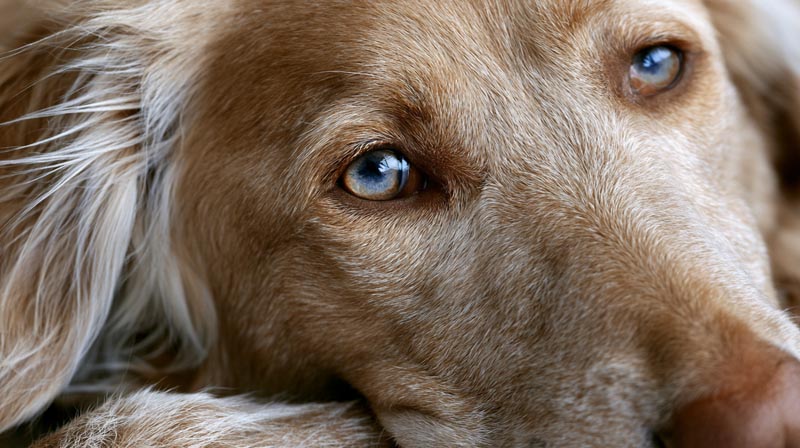
Dog side eye signals that the dog is in a conflict state, most often between wanting to stay near a valued resource or person and wanting to move away from an uncomfortable trigger.
A 2024 Arizona State University study involving nearly 450 participants found that humans frequently misread fear-based dog signals, often confusing fear shown in facial cues with happiness, and fear shown in body language with sadness. Whale eye falls squarely in that misread category.
When Side Eye Signals Stress
Stress-related whale eye shows up when the dog is overwhelmed but not yet ready to escalate. It sits near the beginning of the canine stress response sequence, after subtle calming signals like lip licking and yawning, and before harder warnings like growling or snapping.
Accompanying stress signals to watch for:
- Stiffened body with no movement
- Closed mouth, tight jaw
- Ears pinned back or flattened
- Tail lowered or tucked
- Shallow, fast breathing
When 3 or more of these appear alongside the whale eye, the dog’s stress level is high. That cluster, not any single signal, gives the most accurate read.
When Side Eye Signals a Resource Guard Situation
Resource guarding is one of the most common whale eye triggers. A study of 3,226 dogs found that 41% showed overt behaviors toward humans during resource guarding events (WebMD / published research). Whale eye often precedes those overt behaviors.
The pattern is predictable: dog has a food bowl, toy, or resting spot. A person or another dog approaches. The dog freezes, turns its head slightly away, and holds a hard sideways stare with the sclera visible.
That is the dog saying “I am aware of you and I am not comfortable with what you are doing.” Ignoring it at this stage is how most resource guarding incidents escalate to snapping.
What Are the Physical Signs That Make Up Dog Side Eye?
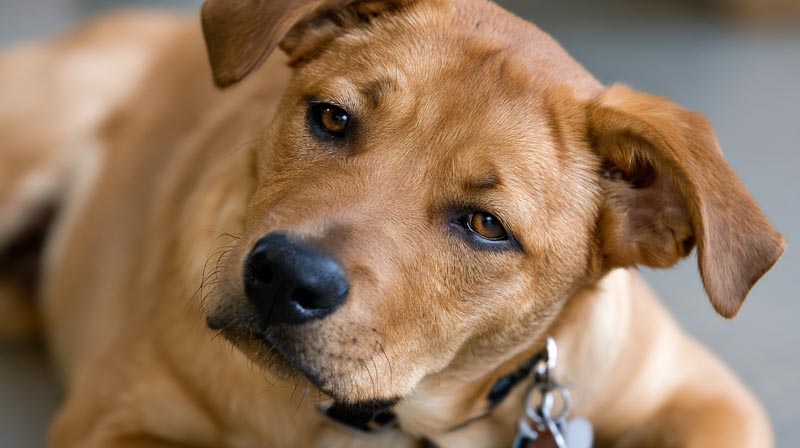
The visible sclera is the non-negotiable marker. Without it, the expression is not whale eye. Everything else is context.
| Physical Component | What to Look For | What It Signals |
|---|---|---|
| Sclera exposure | White crescent visible at the corner or edge of the eye | Defining sign of whale eye |
| Head position | Head turned away from the trigger while the eyes remain fixed on it | Conflict avoidance with continued monitoring |
| Body posture | Stiff, frozen, or leaning away | Elevated stress or resource-guarding state |
| Mouth | Closed mouth with tight lips | Tension rather than relaxation |
| Pupil size | Dilated pupils larger than normal | Heightened arousal or fear response |
Partial vs. Full Whale Eye
Partial whale eye shows a thin crescent of white. The dog is uncomfortable but still processing. Full whale eye shows a wide, obvious white band. The dog is closer to threshold, and the risk of escalation increases significantly.
The amount of sclera visible roughly correlates with intensity. A thin crescent during a mild disruption is worth noting. A wide white band with a frozen body during a high-value resource situation needs an immediate response.
How Lighting and Breed Coat Affect Visibility
Dark facial markings around the eyes, common in breeds like the Rottweiler, can make the sclera harder to spot in low light. On lighter-coated dogs like the Golden Retriever, the white crescent shows clearly even in partial sclera exposure.
Knowing your dog’s eye appearance in a fully relaxed, comfortable state is the baseline. Deviation from that baseline is what signals stress, not the absolute amount of white visible.
Which Dog Breeds Show Side Eye Most Visibly?
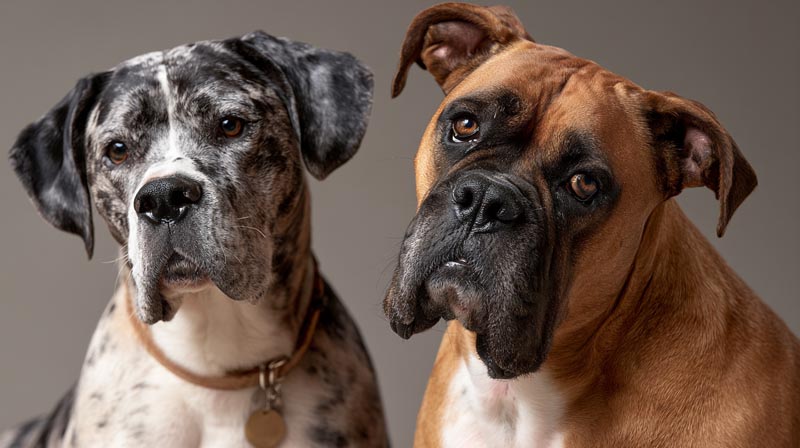
Breed anatomy, specifically skull shape and eye socket depth, determines how much sclera shows during whale eye. Some breeds display it dramatically. Others show a much subtler version of the same emotional state.
Breeds with Naturally Prominent Eyes
Brachycephalic breeds have shallow eye sockets and prominent, forward-facing eyes due to skull foreshortening. Research from the University of Florida Animal Welfare confirmed that breeds like the Pug, Boston Terrier, and French Bulldog have eyes that sit significantly more exposed than the canine average.
The practical problem: these breeds show visible sclera at baseline, even when completely relaxed. This is normal anatomy, not stress. Owners and unfamiliar people often misread it as whale eye when the dog is actually calm.
Other brachycephalic breeds with the same consideration include:
Breeds Where Whale Eye Is Harder to Detect
Deep-set eyes and narrow skulls make whale eye visually subtle. You may only catch it from a specific angle or in direct light.
Chow Chows have deep-set, small eyes with heavy brow folds. Siberian Huskies have almond-shaped eyes that show minimal sclera even under stress. The Chow Chow’s facial structure means you have to watch body posture far more carefully than eye whites to catch early stress signals.
For these breeds, the posture cluster matters more than the eye appearance. Stiffness, head turn, and frozen stance are more reliable indicators than sclera visibility alone.
What Triggers Dog Side Eye?
Whale eye does not appear randomly. There are consistent, well-documented triggers across dog behavioral research and veterinary practice. Understanding the trigger tells you what the dog needs from you.
Resource and Handling Triggers
Food bowl approach: One of the most common. The dog has food, a person walks toward the bowl. Whale eye appears as a first warning before growling or snapping.
Toy or chew possession: A study published in Shelter Dog Adoption research found that 15.3% of dogs evaluated over a 5-year period showed active resource guarding behavior. Whale eye is almost always part of that early signaling sequence.
Direct physical handling: Hugging, reaching over the head, restraint during grooming. All 3 put the dog in a position where escape is difficult. Side eye during handling is a clear signal the dog is tolerating, not comfortable with, the interaction.
Social and Environmental Triggers
Whale eye appears frequently in these 4 social situations:
- A stranger approaching too quickly in a public space
- An unfamiliar dog invading personal space, especially on leash
- A child making direct eye contact or reaching for the dog’s face
- A loud noise or sudden movement nearby while the dog is resting
Children are a particularly common trigger. Kids are more likely to be at face level with dogs, more likely to make direct eye contact, and less likely to read warning signals. More than 50% of dog bite victims are children (American Veterinary Medical Association data), and whale eye often precedes those incidents when reviewed after the fact.
Camera Proximity as a Trigger
Phones held close to a dog’s face for a photo produce a reliable side eye reaction. This is not the dog being “expressive” for the camera. A phone screen is an unfamiliar object moving directly toward the dog’s face. The whale eye in most “funny side eye” photos is a real, low-level discomfort signal.
It is usually mild. The dog is not in crisis. But it is not performance either.
How Does Dog Side Eye Fit Into Canine Body Language?
Dog side eye sits in the middle of the canine stress response sequence. It comes after subtle early signals and before the harder, more obvious warnings most people recognize.
| Stage | Signals | What It Means |
|---|---|---|
| Early (subtle) | Yawning, lip licking, turning away, blinking | The dog is uncomfortable and attempting to communicate peacefully |
| Middle (moderate) | Whale eye, stiff posture, closed mouth, shifting weight backward | Stress is increasing and the dog is in a conflict state |
| Late (overt) | Growling, snarling, snapping, lunging | The dog has crossed its threshold and there is an immediate risk of escalation |
Most bites happen because the early and middle signals were missed or ignored. The dog escalated through the full sequence and the bite looked “sudden” only because the humans present were not reading the earlier stages.
Reading Whale Eye in Context of the Full Body
Whale eye combined with a relaxed tail and soft body is lower concern than whale eye combined with a stiff, lowered tail and frozen posture. Both are worth acting on. The latter is more urgent.
Veterinary behaviorist Patricia McConnell has written extensively on this: stress signals rarely appear alone. Dogs communicate in clusters. A dog showing whale eye plus lip licking plus weight shifting back is giving 3 simultaneous signals that belong to the same cluster.
Read the full body. The eyes are the starting point, not the complete picture.
How Side Eye Connects to the Calming Signals Framework
Norwegian dog trainer and behaviorist Turid Rugaas introduced the term “calming signals” to describe the range of behaviors dogs use to de-escalate tension, including their own. Whale eye is not technically a calming signal since it monitors the trigger rather than redirecting from it. But it often appears alongside them.
A dog giving you whale eye while also turning its head slightly and yawning is running 2 de-escalation behaviors simultaneously. That dog is uncomfortable and is actively trying to communicate that without pushing the situation toward conflict.
Is Dog Side Eye Always a Warning Sign?
No. Context determines what the expression means. Side eye from a dog guarding a raw bone is a different situation from side eye from a dog who just does not want to be moved off the couch.
Low-Stakes Side Eye vs. High-Stakes Side Eye
Low-stakes: The dog is comfortable, loosely relaxed, not guarding anything. Someone sits nearby or shifts position. Dog gives a brief sideways glance with minimal sclera, then goes back to resting. Body stays soft. No escalation.
High-stakes: The dog has a high-value item. A person approaches. Whale eye appears with stiff posture, closed mouth, and a hard, unblinking stare. This is a different situation entirely and needs an immediate behavioral response.
The body does not lie. A relaxed whale eye in a comfortable dog differs visually from a tense whale eye in a guarding dog once you know what to look for.
The “Camera Side Eye” Phenomenon
The viral side eye dog photos flooding social media since at least 2013 capture something real but often mild. Dogs consistently give side eye when cameras or phones are thrust toward their faces.
Research from Dr. Juliane Kaminski at the University of Portsmouth showed dogs are sensitive to human attentional states and produce facial expressions in direct response to being looked at. A camera lens pointed at close range triggers a similar attentional response.
Most of these expressions represent low-level discomfort, not distress. The issue is when owners repeatedly recreate the trigger to get the photo, without removing the cause of the expression. Mild, repeated discomfort is still discomfort.
Individual Baseline Differences
Some dogs show whale eye more habitually than others, not because they are more stressed, but because of individual anatomy or learned patterns. A Labrador Retriever that has always shown prominent eyes when tracking movement is different from one that developed the pattern after a stressful experience.
Knowing your specific dog’s normal is the only reliable calibration tool. Deviation from their personal baseline is the signal, not the absolute expression compared to another dog.
What Should You Do When Your Dog Shows Side Eye?
Stop whatever you are doing. That is the first and most important response.
Whale eye is the dog’s way of communicating discomfort before escalating to harder signals. Pushing past it teaches the dog that its early warnings get ignored, which shortens the warning sequence over time.
Immediate Response Steps
Step 1: Stop the triggering action. Back away, remove your hand, or create distance.
Step 2: Identify the trigger. Food bowl? Approaching stranger? Handling? The trigger tells you what the dog needs from the environment.
Step 3: Give the dog space. Don’t redirect with touch or close-in reassurance. Space is what the dog is asking for.
Never punish whale eye. A systematic review published in Applied Animal Behaviour Science (2024) confirmed that counterconditioning and desensitization are effective for reducing unwanted stress behaviors in dogs, but suppressing warning signals through punishment removes the communication without addressing the cause.
When to Call a Professional
Whale eye that appears frequently, across multiple contexts, or escalates quickly to growling and snapping is beyond basic management.
Credentials to look for: IAABC (International Association of Animal Behavior Consultants) certified consultants and CCPDT (Certification Council for Professional Dog Trainers) credential holders. For cases involving aggression, a veterinary behaviorist (board-certified, DACVB) is the appropriate referral.
Don’t wait for a bite. The side eye is the early warning system. Acting on it before escalation is always the better path.
Threshold Management at Home
Keeping a dog below its stress threshold means arranging the environment so triggers stay at a manageable distance or intensity.
- Feed high-value items in a separate space from foot traffic
- Give the dog a crate or room with access to retreat during visitors
- Teach children a no-approach rule when the dog has food or a chew
Most whale eye situations are manageable with simple environmental changes before any formal training is needed.
How Do You Prevent Situations That Cause Dog Side Eye?
Prevention is more reliable than management. A dog that rarely reaches the whale eye threshold is less stressed overall and safer around people.
Resource Guarding Prevention
Trade-up games are the most consistently recommended tool. The dog has an item, you offer something better, the dog drops the first item, you return both.
Repeated over weeks, this builds the association that a human approaching during possession means good things are coming, not loss. Shelter behavior research (ASPCA) shows that dogs assessed as food aggressive in shelter settings often showed no guarding behavior in adoptive homes after consistent management changes were introduced.
What makes guarding worse:
- Removing the food bowl while the dog is eating
- Reaching over the dog to take items without warning
- Inconsistent rules about furniture or resting spots
Handling Desensitization
Veterinary fear during handling is common. One study found over 50% of dogs showed fear signals while waiting in a vet reception area (published in BMC Veterinary Research).
Handling desensitization means pairing routine touching with rewards, done at low intensity before the dog reaches threshold. Start with brief, non-invasive touches. Build to ear cleaning, nail handling, and full examination-style handling over weeks.
A German Shepherd Dog that tolerates weekly ear checks at home arrives at the vet clinic already conditioned, rather than encountering handling stress for the first time in a clinical setting.
Child and Dog Safety Protocols
Children are involved in more than 50% of all dog bite incidents, according to American Veterinary Medical Association data. Most involve family dogs, not strangers’ dogs.
3 rules that reduce whale eye triggers around children:
- No approaching a dog that is eating, chewing, or sleeping
- No hugging, sitting on, or reaching over a dog’s head
- No direct eye contact when a dog shows visible sclera
Teaching children what whale eye looks like and what it means is one of the simplest, lowest-cost bite prevention tools available.
What Does Research Say About Canine Stress Signals Like Side Eye?
The science behind whale eye and canine stress signals has grown substantially over the past decade. What once was described anecdotally is now documented across multiple peer-reviewed studies.
Research on Human Misreading of Dog Signals
A 2024 Arizona State University study involving nearly 450 participants found that humans regularly misidentify fear-based dog signals, often reading fear in facial cues as happiness, and fear in body posture as sadness.
This misreading has direct safety consequences. Whale eye falls consistently in the misread category, meaning many people see it and either miss it entirely or interpret it as the dog being “funny” or “dramatic.”
Kaminski and Facial Expression Research
Dr. Juliane Kaminski’s research at the University of Portsmouth established that dog facial expressions are audience-directed, not purely reflexive. Dogs produce significantly more facial expressions when a human is watching than when unobserved, as published in Scientific Reports.
This matters for whale eye specifically. The dog is not accidentally showing sclera. The expression is produced in response to perceived social attention and is an active communication signal directed at whoever is present.
ASPCA Behavioral Assessment Data
Whale eye is included in ASPCA canine body language assessment protocols as part of the stress and fear signal cluster, alongside dilated pupils, pulled-back ears, and stiff body posture.
Shelter behavioral evaluations that flag whale eye during resource guarding assessments show a 15% prevalence of guarding behavior across evaluated dog populations, per ASPCA and New York SPCA published shelter data. The expression is taken seriously in professional assessment contexts precisely because it precedes escalation.
Why Do People Find Dog Side Eye Funny?
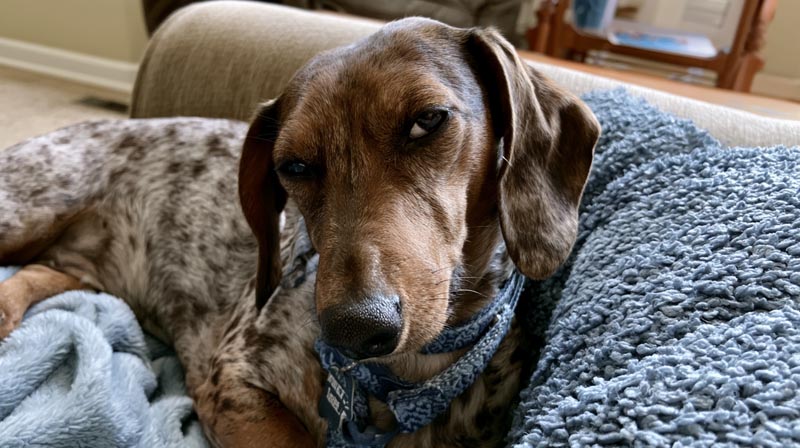
The viral reach of dog side eye content is massive. The dachshund “sus dog” image first appeared on Reddit in April 2015, spent years as a Tumblr reaction image, and exploded on TikTok in early 2023 following the “Bombastic Side Eye” audio trend.
The humor lands because of anthropomorphism. Humans project skepticism, judgment, and disapproval onto the expression, and those are emotions with universal recognition across cultures and ages.
Why the Meme Works
Dog side eye memes work as reaction images because they require no caption to communicate meaning. One glance, and the message is clear.
The relatable factor: The expression mirrors human social body language, specifically the sideways look people give when they cannot believe what they are seeing.
The contrast factor: Dogs are associated with unconditional loyalty. A dog apparently judging you creates comedic tension between expectation and reality.
Breeds like the Dachshund, Shiba Inu, and Chihuahua appear most frequently in these memes because their facial structure makes the expression visually obvious and photogenic.
Where the Humor Creates a Problem
Owners sometimes recreate the triggering condition to capture the photo again. They hold the phone close to the dog’s face repeatedly, or approach the dog during a meal, specifically to get the expression.
Mild, repeated discomfort is still discomfort. A dog that gives whale eye every time a phone appears is telling you something real, not performing for content.
The expression can absolutely be enjoyed without reinforcing the trigger. Recognizing what the dog is actually communicating does not make the photo less funny. It just makes the owner more informed.
How Is Dog Side Eye Different from Other Eye-Based Dog Signals?
Whale eye is one of several distinct eye signals in canine body language. Each has a different meaning and requires a different response.
| Eye Signal | What It Looks Like | What It Means |
|---|---|---|
| Whale eye (side eye) | Head turned with a crescent of sclera visible | Stress, conflict, or discomfort |
| Hard eye | Direct, unblinking stare with round pupils | Challenge, warning, or potential aggression |
| Soft eye | Relaxed, almond-shaped eyes with a slight squint | Calmness, contentment, and trust |
| Squinting (appeasement) | Eyes partially closed with relaxed body language | Peaceful intentions or appeasement signaling |
| Dilated pupils | Enlarged pupils regardless of lighting conditions | High arousal, fear, stress, or pain |
Whale Eye vs. Hard Eye
These two get confused, but the difference is significant. Hard eye is a direct, forward-facing stare with a frozen body and no head turn. It is a challenge or threat signal, not a conflict-avoidance signal.
Key distinction: Whale eye involves turning away while watching. Hard eye involves turning directly toward and locking on. The head position tells you which one you are looking at.
According to veterinary behaviorist Nicholas Dodman of the Center for Canine Behavior Studies, a dog preparing for potential aggression keeps its eyes wide open with retracted lids, not half-closed or angled away.
Squinting vs. Whale Eye
Squinting is almost the behavioral opposite of whale eye. ASPCA canine body language guidelines describe a squinting, almond-shaped eye as a relaxation signal, often paired with a slow blink to indicate trust and comfort.
A dog that squints at you in a warm, low-stimulus environment is communicating contentment. The same dog showing a wide, held, sideways stare with visible sclera in a tense moment is communicating something entirely different.
One-eye squinting that is involuntary, persistent, or accompanied by pawing at the face can indicate pain or a medical issue like corneal ulceration, and warrants a vet check. That is a medical squint, not a behavioral one, and the distinction matters.
Half-Moon Eye in Sleeping Dogs
Some dogs show sclera while sleeping due to partial eyelid closure during REM sleep. This looks like whale eye but has no behavioral meaning.
The difference: a sleeping dog showing sclera will have a fully relaxed body, no stiffness, normal breathing, and will not be tracking any stimulus with its gaze. Context and body state resolve the distinction instantly.
FAQ on Dog Sideeye
What does it mean when a dog gives you side eye?
It means your dog is uncomfortable. The visible sclera and turned head signal a conflict state, where the dog wants to monitor a trigger without confronting it directly. It is canine body language for “I am not okay with this.”
Is dog side eye the same as whale eye?
Yes. Whale eye is the veterinary and animal behavior term for the same expression. Both describe a dog turning its head away while keeping its eyes fixed sideways, exposing a white crescent of sclera in the corner of the eye.
Is dog side eye always a sign of aggression?
No. It signals discomfort or stress, not necessarily aggression. It is a conflict-avoidance posture. The dog is trying to communicate unease without escalating. Aggression risk increases only if the signal is ignored and the trigger persists.
Why does my dog give me side eye when I hug them?
Hugging restricts movement and puts a face directly over the dog’s head. Most dogs find this uncomfortable. The whale eye during a hug is a clear stress signal. Many dogs tolerate it, but tolerance is not the same as comfort.
Which dog breeds show side eye most often?
Brachycephalic breeds like Bull Terriers, Brussels Griffons, and Cavalier King Charles Spaniels show visible sclera most easily due to shallow eye sockets. However, any breed can display whale eye. Anatomy affects visibility, not frequency of the emotional state.
What should I do when my dog shows side eye?
Stop whatever you are doing and give the dog space. Remove or distance the trigger if possible. Never punish the expression. Punishing whale eye removes the early warning without addressing the cause, which shortens the dog’s warning sequence over time.
Can dog side eye be a sign of resource guarding?
Yes, and it is one of the most common triggers. A dog guarding food, a toy, or a resting spot will often show whale eye as a first warning before growling. Research on 3,226 dogs found 41% showed overt behaviors during resource guarding events (WebMD).
Why do dogs give side eye in photos?
A phone or camera held close to a dog’s face is an unfamiliar object moving into their personal space. The canine stress signal you capture is real, not posed. It is typically mild, but recreating the trigger repeatedly for content still causes repeated low-level discomfort.
Is dog side eye the same as the “bombastic side eye” meme?
The meme is based on a real behavioral signal. The dachshund image behind the trend first appeared on Reddit in 2015 and went viral on TikTok in 2023. The expression is genuine canine discomfort, anthropomorphized into humor by human audiences.
How is dog side eye different from a direct stare?
A direct stare is a hard eye signal, forward-facing and unblinking, paired with a frozen body. It signals a challenge or threat. Dog side eye involves turning the head away while watching. One is confrontational. The other is conflict-avoidant.
Conclusion
This conclusion is for an article presenting dog sideeye as a genuine canine stress signal, not a quirk or a pose.
Whale eye sits in a predictable sequence. It follows lip licking and yawning, and it precedes growling and snapping.
Reading it accurately is the difference between preventing escalation and missing the warning entirely.
The sclera visibility, the avoidance posture, the frozen body, none of these signals appear randomly. They are directed communication.
Whether the trigger is resource guarding, physical handling, a stranger approaching, or a phone in the face, the response is the same: give the dog space and remove the cause.
Learn your dog’s baseline. Read the full body, not just the eyes. That is how canine body language actually works.