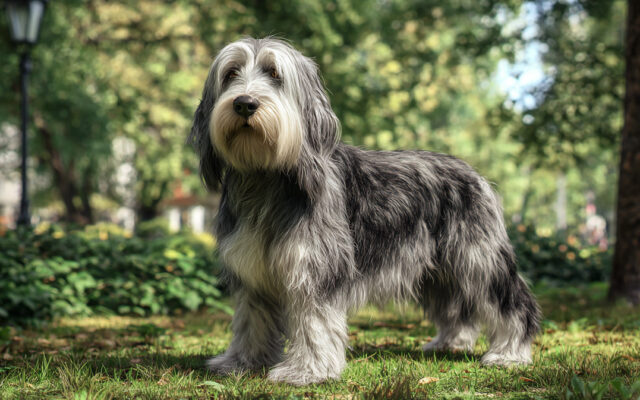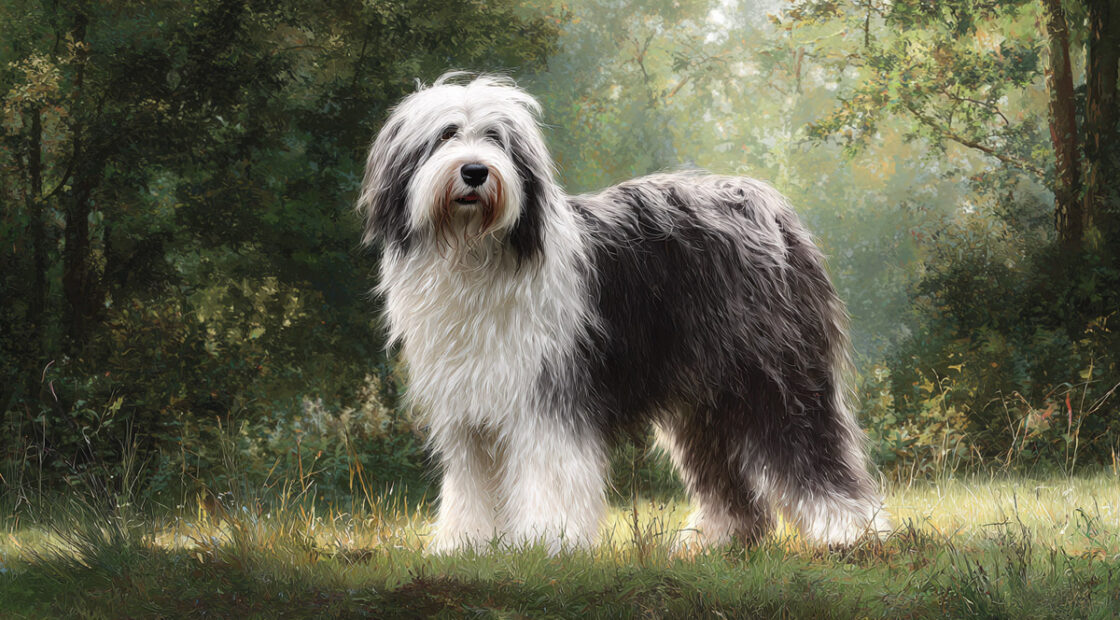
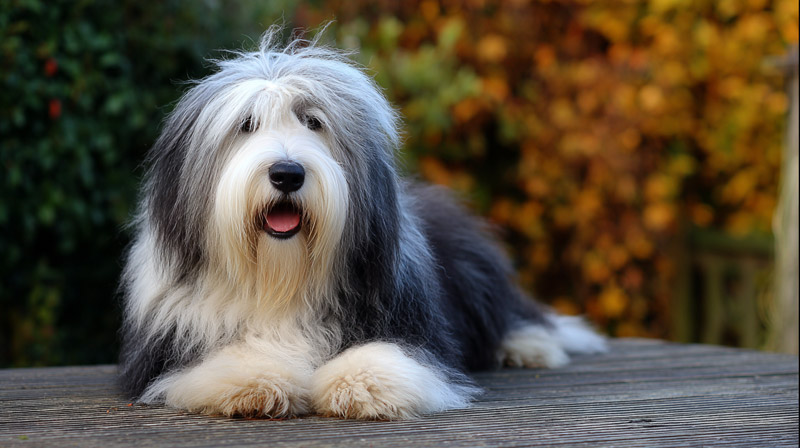
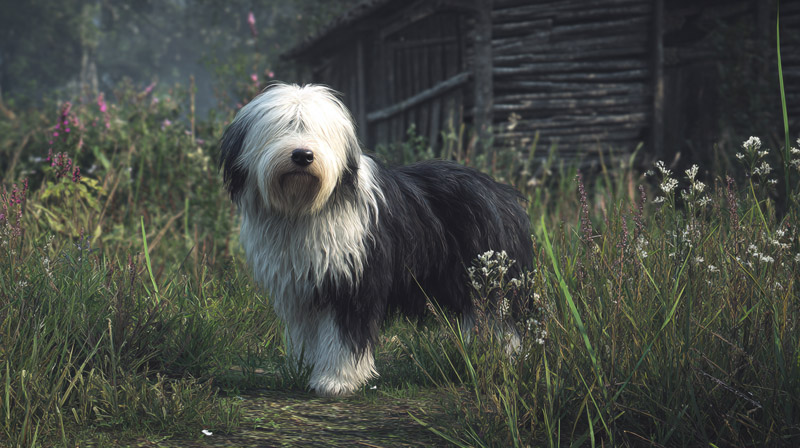
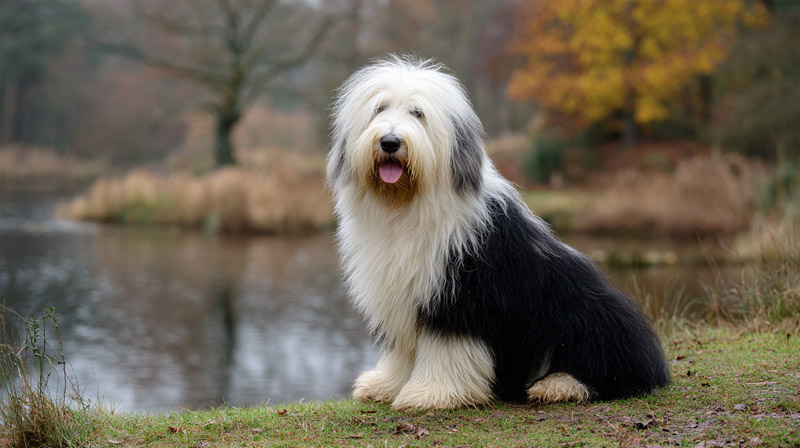
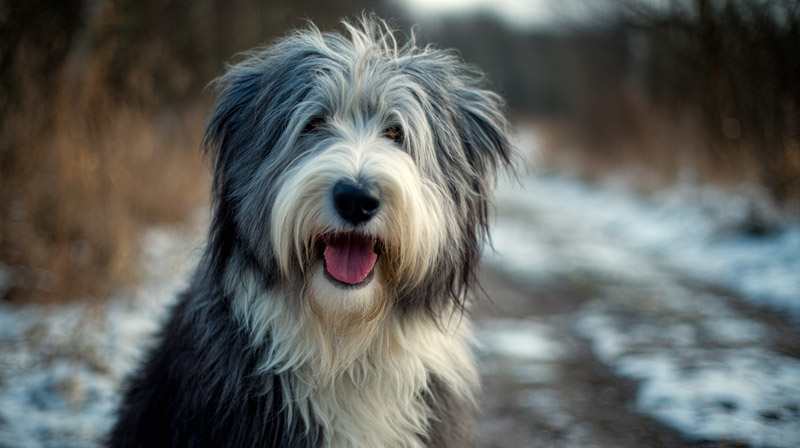
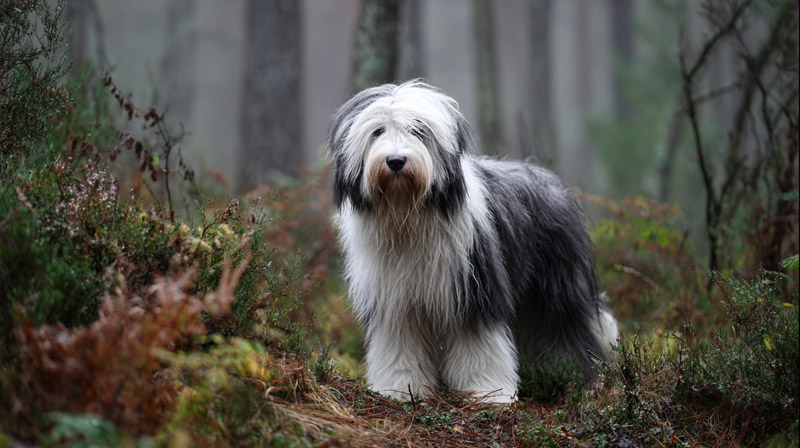
The Polish Lowland Sheepdog, usually shortened to PON, is a medium-sized herding dog from Poland that guarded flocks for centuries and now settles into city homes without much fuss. The coat is coarse and dense, and it falls right over the eyes.
Every modern PON goes back to one stud named Smok. World War II had nearly erased the breed, and when the rebuild started in the 1950s, Smok, owned by veterinarian Danuta Hryniewicz, sired the first ten litters (UC Davis Veterinary Genetics Laboratory, 2024).
What Is the Polish Lowland Sheepdog?
In Poland, and in the FCI standard, the breed goes by Polski Owczarek Nizinny. Owners shorten that to PON. Valee Sheepdog and Nizinny also circulate as names.
FCI Standard No. 251 (1998) files it under Group 1, Section 1 (Sheepdogs) and credits it with working as both sheepdog and guard dog. It also says the breed adapts to city life as a companion.
Among the medium-sized fluffy dogs, the PON stands out for a build that stays compact and muscular under all that hair.
Size and build
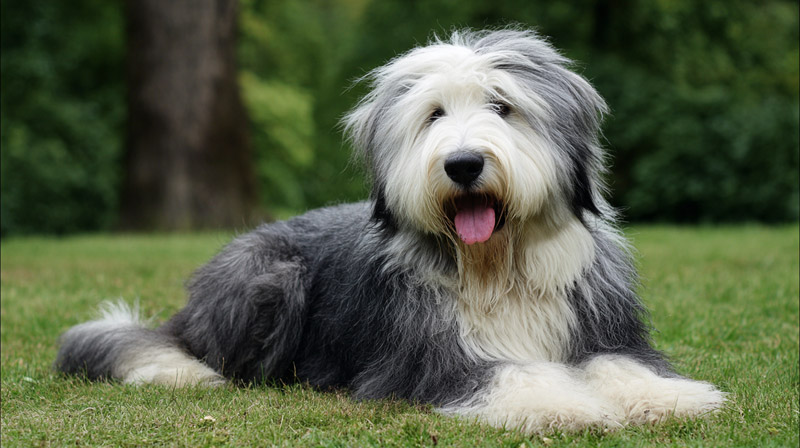
The FCI sets height only. Males run 45 to 50 cm at the withers and females 42 to 47 cm (FCI Standard No. 251, 1998), which is about 18 to 20 inches and 17 to 19 inches.
The outline is rectangular rather than square, with height to body length at 9 to 10. The standard also bars breeding for a smaller, weaker dog, since the PON has to keep the type of a working dog.
Weight has no FCI figure, and the sources don’t agree. The UC Davis Veterinary Genetics Laboratory breed report (2024) gives males 18 to 23 kg (40 to 50 lb) and females 14 to 18 kg (30 to 40 lb). Purina says 30 to 40 lb for the breed as a whole, and Vetstreet says 35 to 55 lb.
The spread comes from sex differences and a standard that never fixes weight. Purina’s single range matches the female figures only.

Coat and colors
Coarse, dense, profuse hair covers the whole body over a soft undercoat. Straight or slightly wavy hair is acceptable, and the standard calls the hair falling from the forehead over the eyes characteristic.
Color is open. The FCI accepts all colors and patches, though white, gray and brown are the most common (UC Davis VGL, 2024).
The same report treats these as coat faults:
- Curly hair
- Short or silky hair
- Lack of undercoat
- A thin, wispy coat
- Sculpted trim
Key figures
- Males stand 45 to 50 cm and females 42 to 47 cm (FCI Standard No. 251, 1998).
- Typical weight is 18 to 23 kg for males and 14 to 18 kg for females (UC Davis VGL, 2024).
- Average lifespan runs 12 to 14 years (UC Davis VGL, 2024).
- The FCI classes it as Group 1, Section 1, Standard No. 251.
- The AKC has had it in the Herding Group since 2001 (American Kennel Club).
Polish Lowland Sheepdog Coat Care and Shedding
A full-length PON coat needs brushing every day. A shortened coat can get by with weekly sessions, but not less than that. Loose hair tends to stay in the double coat instead of landing on the floor, so skipped sessions turn into mats.
Brushing frequency
Advice on brushing varies a lot from source to source, and so does the answer on whether the breed sheds at all.
| Topic | Claim | Source |
|---|---|---|
| Brushing | Every day | The Royal Kennel Club (2026) |
| Brushing | Several times a week | Hundeo |
| Brushing | At least once a week, thoroughly | WebMD |
| Shedding | Sheds | The Royal Kennel Club (2026) |
| Shedding | Does not shed | Wamiz |
The gap tracks coat length. A coat grown to the breed standard needs the daily end, and a shortened pet trim can live on the weekly floor.
Trimming, bathing and drying
Show rules and pet life pull in opposite directions here. The UC Davis report says a show PON appears natural, “unkempt” but clean, and that trimming is severely penalized.
A pet PON still needs some upkeep:
- Trim the hair between the paw pads
- Check the coat for debris after walks
- Dry it thoroughly, right down to the skin
- Brush the areas behind the ears and under the collar first
A neglected coat mats to the skin, and the only fix is a clip-down. That ends any show career, so pet owners lose nothing by choosing a practical trim early.
Shedding and allergy claims
The Royal Kennel Club (2026) lists the breed as a shedder. Wamiz says it does not shed, and yourdog.co.uk rates moulting as low.
The likely reason for the split is hair that stays trapped in the coat until brushing pulls it out. A dog that sheds less onto the floor still puts out the same loose hair.
Pangovet calls the breed hypoallergenic. Neither the FCI standard nor the Royal Kennel Club profile makes that claim, so treat it as unproven and spend time with an adult dog before counting on it.
How Does the Polish Lowland Sheepdog Behave at Home?
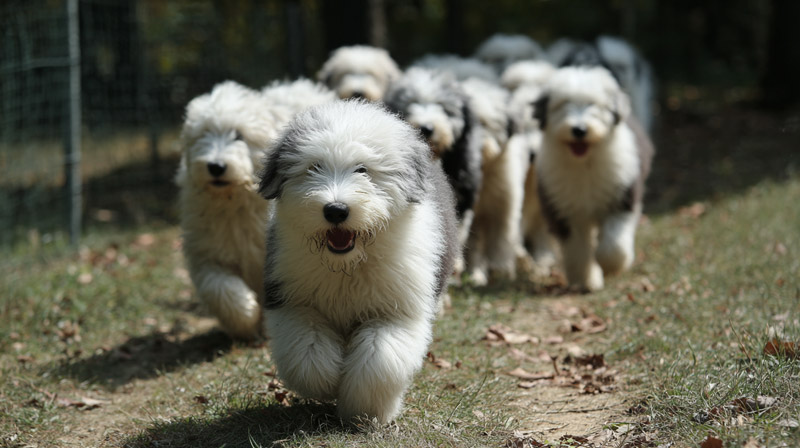
The PON watches everything, keeps some distance from strangers and likes to make its own decisions. The FCI standard describes the temperament as lively but tempered, vigilant, intelligent and perceptive, with a good memory.
Watchfulness and reserve
Suspicion of strangers is among the breed’s basic traits, according to The Official Book of the Polish Lowland Sheepdog, cited in an AKC history article (2021). The same book lists a highly developed sense of territory and strong independence.
The UC Davis report ties territorial behavior and barking to the breed’s value as a watchdog.
The FCI standard disqualifies dogs that are aggressive or overly shy. Reserve is normal in the breed. Aggression and fear are faults.
Children and family life
PONs are described as stable, affectionate, playful and good with children (UC Davis VGL, 2024).
Pangovet adds that children still need to learn how to play with the dog. Wisdom Panel advises introducing puppies early to new people and pets as well as new places, which matters for a breed that starts out reserved.
Trainability: where the sources disagree
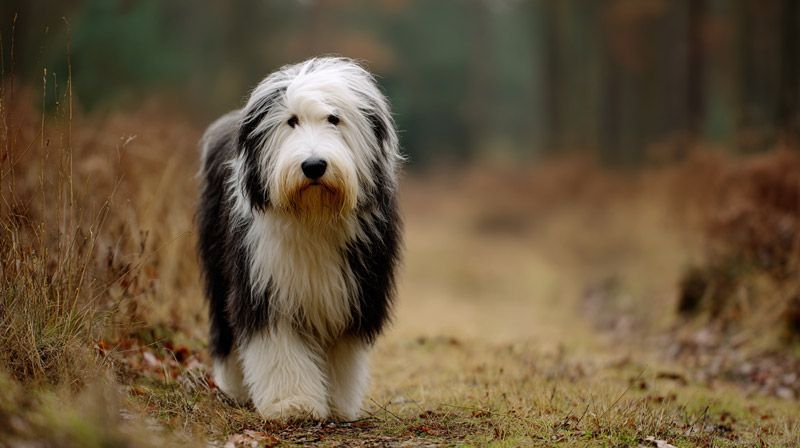
The New Zealand Kennel Club lists trainability as low. Hepper recommends previous training experience because of the breed’s independent streak, and the AKC describes it as clever, confident and a bit stubborn.
Others report the opposite. Royal Canin says PONs are eager to please and tend to enjoy training, and Purina UK calls the breed fun to train with positive reinforcement.
Both sets of reports probably describe the same dog with different handlers. Wamiz notes the breed bores easily with routine, and that fits either camp.
Short, varied sessions with consistent rules work. Heavy repetition does not.
How Much Exercise Does a Polish Lowland Sheepdog Need?
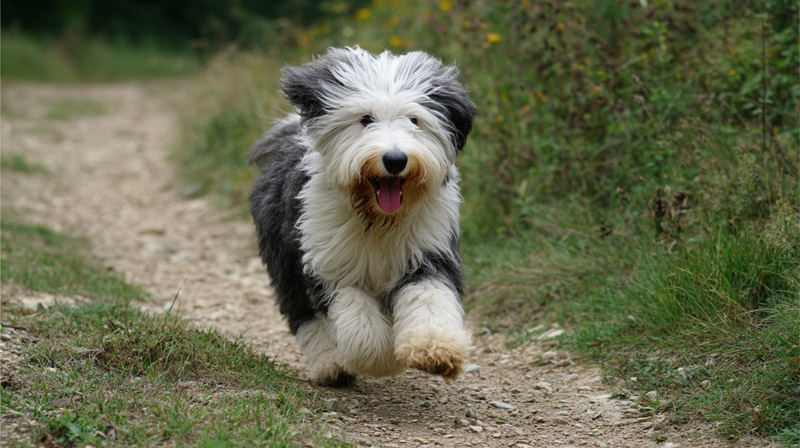
Sources range widely. The Royal Kennel Club (2026) puts it at more than 2 hours a day, while the New Zealand Kennel Club rates the need as medium and the UC Davis report as moderate. Behavior is a better guide than any hour count.
Signs of too little work
The UC Davis report states that bored PONs bark excessively and turn destructive. Watch for barking that doesn’t stop at the door, and for chewing or digging.
Self-destructive habits such as constant licking or chewing at the skin belong on that list too.
Activities that suit the breed
The UC Davis report lists agility, obedience, rally, flyball, tracking and showmanship as options for the breed.
The PON no longer herds sheep for a living, but noncompetitive herding tests measure instinct, and a dog with basic instinct can go on to train for herding trials.
Hundeo says the breed needs mental activity as well as physical activity, so training games count toward the daily total.
After muddy or wet outings, check the coat for debris and dry it thoroughly, as Purina advises. That step feeds straight into the grooming routine above.
Polish Lowland Sheepdog Health Problems and Screening Tests
Breeders screen mainly for hip dysplasia and progressive retinal atrophy (PRA), and either one can stay hidden in a young dog. A clear result isn’t a guarantee, so the breed’s low genetic diversity matters as much as any single disease.
Hip dysplasia
In the OFA Health Survey summarized by the UC Davis Veterinary Genetics Laboratory (2024), 16% of 114 evaluated dogs had dysplastic hips.
The UC Davis report recommends radiographic evaluation by experts once a dog is past one year of age, scored by a recognized method. Left alone, the condition often progresses to degenerative joint disease in older dogs.
Progressive retinal atrophy
Onset is late and slow, with early rod loss by about 4.5 years of age and cone loss later (UC Davis VGL, 2024).
The rcd4 variant in the C2ORF71 gene accounts for the majority of cases tested, though Svensson and colleagues (Veterinary Ophthalmology, 2016) could not rule out other forms. In the OFA survey, 16.7% of 63 dogs were affected and 51% were carriers, as reported by UC Davis.
A clear eye exam in a young adult says little about PRA that starts later. A DNA test for rcd4 covers most of the known risk, not all of it.
Other reported conditions
Hypothyroidism, cataracts, neuronal ceroid lipofuscinosis (NCL) and patent ductus arteriosus (PDA) also turn up in the breed literature.
NCL is the rare, serious one. Narfström and colleagues (Veterinary Ophthalmology, 2007) described nine affected PONs with behavioral changes and movement problems, along with vision loss or blindness.
Pangovet adds ear infections as a minor concern, which fits a breed with hairy, hanging ears.
Which screening tests apply
| Source | Tests listed | Note |
|---|---|---|
| AKC parent club list | Hip evaluation, ophthalmologist evaluation | No DNA test listed as of October 2026 |
| Royal Kennel Club (2026) | BVA/KC hip scheme, BVA/KC/ISDS eye scheme, PRA (rcd4) DNA test | DNA test recognised May 2026, applied from December 2026 |
| UC Davis VGL (2024) | Hip radiographs after age one, PRA (rcd4) DNA test, genetic diversity panel | Diversity panel guides mate selection |
The two registry lists differ by one test. Ask for the DNA result anyway, because the 2016 study found the variant in both Swedish and American dogs.
Lifespan and genetic diversity
Lifespan sources don’t agree either. The New Zealand Kennel Club sits at the long end, up to 15 years, while the Royal Kennel Club only promises over 10.
UC Davis calls the breed reasonably long-lived and of average health compared with other pure breeds, despite diversity among the lowest it has tested. The lab found the breed retains only 26% of the genetic diversity known across canids at its markers.
Put the numbers side by side and a problem shows up. PRA carriers make up about half of tested dogs and diversity is already thin, so excluding every carrier from breeding would shrink the gene pool further. Pairing a carrier with a clear dog avoids affected puppies and keeps the lines, because rcd4 behaves as a recessive variant.
The Royal Kennel Club lists genetic diversity as a Good Practice priority for the breed and offers an inbreeding coefficient calculator. Both bodies point at diversity, not one disease, as the breed’s main health lever.
Polish Lowland Sheepdog History and Kennel Club Recognition
The breed has herded in Poland since at least the 13th century. World War II nearly ended it, and the rebuild in the 1950s centered on a stud named Smok.
Origins and the disputed ancestry
UC Davis VGL (2024) says the breed has existed in its present form in Poland for centuries and traces its roots to Eastern European and Asian breeds. It names the Tibetan Terrier, the Puli and a herding dog that came with the Huns.
The AKC (2021) tells a similar story. Central Asian dogs moved west with Tibetan traders, and sheepdogs resembling the Hungarian herding Puli joined local stock when the Huns crossed Europe.
The Royal Kennel Club (2026) credits the Puli for the breed’s compact build. The accounts stress different ancestors, but the outline matches: Asian herding stock arrived by trade and migration, and nobody can name the exact dogs.
The sheep trade story
In the AKC’s version (2021), a Polish ship sailed from Gdansk to Scotland in 1514 with grain on board. Six PONs came along to move the sheep, and a shepherd paid for two females and one male with a prize horned ram and a ewe.
UC Davis (2024) dates the trade to 1515 and names a merchant, Kazimierz Grabski. Six dogs still change hands, and a ram and two ewes buy one male and two females.
Both versions say the traded dogs fed into the Bearded Collie. UC Davis frames it as a story, and treating it as tradition fits the evidence better than treating it as record.
Near extinction and rebuilding
- In 1924, Countess Maria J. Czentwertynska Grocholska, who had begun selective breeding for type, showed her dogs in Warsaw (AKC, 2021).
- The 1939 invasion of Poland halted dog activity just as the new registry started working.
- The Polish Kennel Club formed in 1948 and searched northern farms for sheepdogs, pre-registering dogs after three generations of known ancestors.
- During the 1950s, Dr. Danuta Hryniewicz’s dog Smok (“Dragon”) sired the first ten litters, and every modern PON traces back to him (UC Davis VGL, 2024).
- The Babia Weis kennel became the first to register PONs in 1957, having bred them since 1946.
- The Polish Kennel Club accepted an official standard in 1959 (AKC, 2021).
- On 10 May 1963 the FCI accepted the breed on a definitive basis (FCI nomenclature). The AKC and UC Davis date FCI acceptance to 1959, but the FCI’s own records show 1963.
The AKC says it took about 15 years after the war to establish several top-quality breeding dogs. The first international show for the breed followed in 1965, at the World Dog Show in Czechoslovakia.
Legend credits a PON bitch named Psyche with warning Warsaw residents before air raids. Treat that one as folklore.
Recognition and breed clubs
The US push came from Betty Augustowski, a Polish-American breeder-judge, who met breeder Moira Morrison, instrumental in getting the Bearded Collie into the AKC in 1977. Augustowski helped form the American Polski Owczarek Nizinny Club (APONC) in 1987 with eight founding members (AKC, 2021).
The FCI accepted the breed on a definitive basis on 10 May 1963, and the current standard, No. 251, was published on 7 August 1998. The AKC places it in the Herding Group with APONC as the parent club.
The UKC published its standard under the name Polish Owczarek Nizinny and last revised it on January 1, 2008. In the UK, the Royal Kennel Club puts the breed in the Pastoral Group. It is not a vulnerable native breed, and it sits in Breed Watch Category 1, meaning no breed-specific points of concern for judges.
The Canadian Kennel Club recognized the breed in 2006 under Group 7 Herding Dogs, with the standard effective January 2007.
Is the Polish Lowland Sheepdog the Right Dog for You?
It depends mostly on grooming time. A household that can keep up with the coat and is willing to wait for a health-tested litter will do well with one, as long as training stays varied. Anyone after a low-effort dog should look elsewhere.
Who the breed suits
Hepper’s suitability summary names farmers, families and individuals, provided they have the space and the time for grooming.
In practice that means active households where grooming is routine, and owners with some training experience. Families who want a medium-sized watchdog with a working temperament fit too.
When the PON does not fit
If daily coat work isn’t realistic, choose a shorter-coated herding breed and save yourself the guilt.
Long empty days are the bigger behavioral risk. A dog with no job and no company is how this breed ends up barking and chewing.
And if you can’t wait for a litter with parental hip, eye and PRA results, skip the breed, because screening is the main defense against late-onset disease.
How the PON compares with look-alike breeds
Most people meet the PON through its resemblance to a bigger shaggy herder. UC Davis notes that the Old English Sheepdog descends from the Bearded Collie yet looks more like the PON.
| Trait | Polish Lowland Sheepdog | Old English Sheepdog | Bearded Collie |
|---|---|---|---|
| Size class | Medium, about half the Old English Sheepdog’s size | Large, up to 100 lb | Medium, up to 55 lb |
| Lineage | Possible ancestor of the Bearded Collie | Descends from the Bearded Collie | Linked to Polish dogs traded in Scotland |
| AKC-listed health tests | Hip, eye | Hip, eye, thyroid, exercise-induced collapse DNA | Hip, elbow, eye, thyroid |
Size figures come from the Westminster Kennel Club breed profiles (the half-size comparison for the PON is from UC Davis), and test lists come from the AKC.
The Bearded Collie is the closer match on size, and its AKC list adds elbow and thyroid evaluations. The AKC says Old English Sheepdog pet owners can use puppy trims but still need regular brushing, the same trade-off a PON owner faces.
If the Old English look at half the size is the goal, the PON delivers it. None of the three is a low-maintenance coat.
How to Find a Polish Lowland Sheepdog Puppy or Rescue
Start with the breed’s parent club, then ask for hip, eye and PRA results on both parents before you reserve a puppy.
Vetting a breeder
- Contact the parent club for referrals: APONC in the US, listed by the AKC, or the Royal Kennel Club’s Find a Puppy and Find a Breeder tools in the UK.
- Ask for hip evaluation and ophthalmologist results on both parents, the tests the AKC parent club list recommends.
- Ask for each parent’s PRA (rcd4) DNA result. UC Davis offers the test, and the Royal Kennel Club recognised it in May 2026.
- Check diversity. Use the Royal Kennel Club’s inbreeding coefficient calculator for a puppy’s parents, or ask US breeders about internal relatedness scores from the UC Davis panel.
- Expect questions back. Vetstreet says good breeders come right back with questions about what you want in a dog.
- Meet the adults at a dog event, as Dogs Victoria suggests, and see the coat they grew.
A breeder who can’t show parental results, or treats testing as optional, is the one to walk away from.
Rescue and adult dogs
The Royal Kennel Club runs a Find a Rescue service. RescueMe’s breed page maps listings by state, and Petfinder lists the breed by location.
Availability varies by state and country. Adult dogs arrive with coat and temperament already visible, though parental health data is usually missing, so ask for the vet’s eye exam and hip history.
Common Questions About the Polish Lowland Sheepdog
How much does a PON puppy cost?
No registry publishes a standard price. According to Paction, cost follows the breeder’s health testing, lineage and breeding rights.
Food and vet bills add up over the dog’s life, and so does grooming, which makes the puppy price the smaller bill.
Can a PON live in an apartment?
Yes, as long as its exercise is covered. The UC Davis Veterinary Genetics Laboratory (2024) reports that the breed is a popular companion for apartment dwellers in Poland.
The Royal Kennel Club (2026) rates a small house as workable and prefers a large garden.
Can a PON be left alone during the day?
Occasionally, with training. Purina UK rates the breed 4 out of 5 for tolerating time alone, yet Dogs Victoria calls it a people dog that dislikes being left in a backyard.
One pet-care reference adds that it copes best after plenty of exercise.
Are PONs prone to weight gain?
They can be. Burke’s Backyard describes a ravenous appetite and a tendency to become overweight, and Omlet says the diet needs watching to prevent obesity.
Unexplained gain alongside low energy or coat changes calls for a thyroid check, because hypothyroidism is among the breed’s reported conditions.
Do PONs have docked tails?
Not always. Some puppies are born with short or no tails, and the FCI standard accepts a short or stumpy tail, a very shortly docked tail and an undocked, long, hairy one.
The UC Davis report says most European countries have banned docking. The Royal Kennel Club has recorded naturally bobbed tails on registration certificates since October 2008, with veterinary certification.
How rare is the PON?
Fairly. The AKC’s 2025 registration rankings place the breed 192nd of 202 breeds (the 2024 UC Davis report cited 181st of 201).
That points to a small pool of breeders, and waitlists that vary with how often litters are planned, as Paction notes.
Weekly Time Commitment of a Polish Lowland Sheepdog
At the upper estimates, a Polish Lowland Sheepdog takes more than 17 hours a week before any training. That is over 14 hours of exercise (Royal Kennel Club, 2026) plus up to 3 hours of coat care (Burke’s Backyard).
The figures come from different places, a UK registry estimate and an Australian pet-guide report of what owners often spend. Read the total as a planning ceiling, not an average.
That ceiling suggests an order for getting ready. Test the hours against your calendar first, then reserve a puppy from health-tested parents, and start socialization and varied training on arrival.
Hours come first because money can’t reduce them. The cost is a wait for the right litter, which at least gives you time to prove the schedule works.