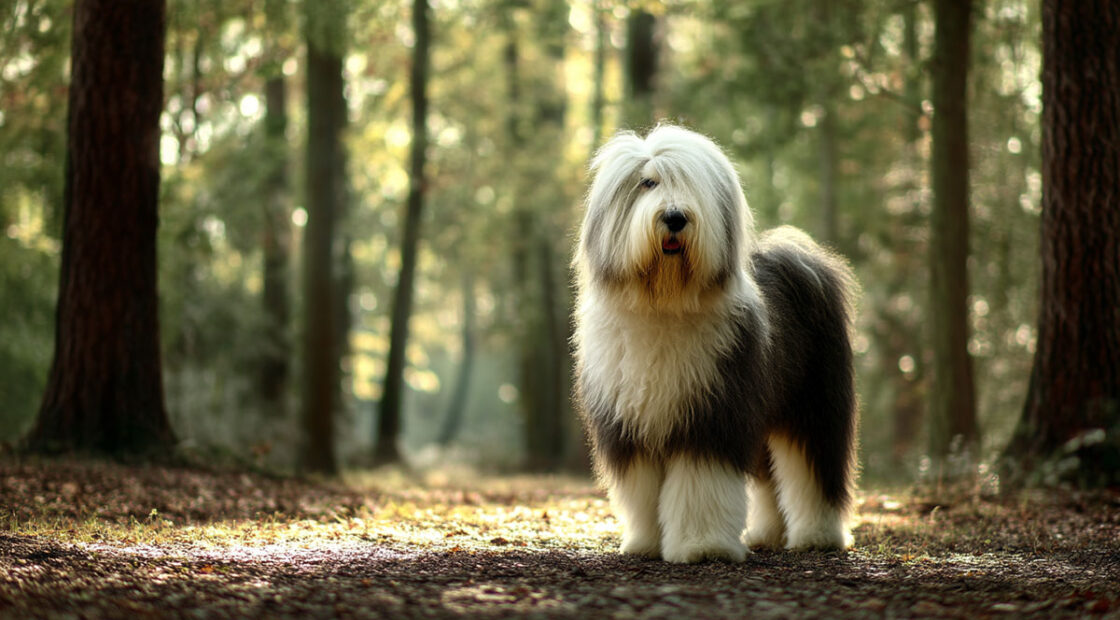
Plenty of people know this dog from paint adverts and not much else.
It’s a large herding breed from western England. Drovers used it to move sheep and cattle to market, and these days it mostly lives as a family companion. A hard, shaggy double coat covers the whole body, face included.
The name sounds ancient and pastoral, but Britannica dates the breed to the 18th century and describes its work as primarily driving sheep and cattle to market. Less romantic than shepherding, honestly.
The AKC placed the breed 87th of 202 in its 2025 registration statistics. That’s mid-table for a dog almost everyone recognizes.
What Is the Old English Sheepdog?
Breed people shorten the name to OES. Outside breed circles the dog picks up a couple of nicknames instead.
- Bobtail comes from the traditionally docked tail, though The Kennel Club says the label no longer fits in the UK now that docking is not allowed.
- Dulux dog comes from the paint brand, which has used the breed as its mascot since its 1961 advertising campaign (Dulux).
The 1959 film The Shaggy Dog and later titles such as The Shaggy D.A. kept the image in front of audiences for decades.
The registries don’t even file the breed in the same group, and the tail wording varies too. Worth knowing if you’re importing a dog or entering a show.
| Registry | Group | Tail in the standard |
|---|---|---|
| AKC | Herding Group | Docked close to the body unless naturally bobtailed |
| The Kennel Club (UK) | Pastoral Group | Docked or undocked described, docking no longer allowed in the UK |
| FCI | Group 1, Section 1 (Sheepdogs) | Docked or natural, undocked tail feathered |
| United Kennel Club (UKC) | Herding Dog Group | Natural bob, docked, or full natural tail |
Tail wording summarized from the AKC, Kennel Club, FCI (Standard 16, 2011) and UKC (2008) breed standards.
And the name oversells the age. The UKC standard calls the Old English Sheepdog a relatively young breed.

Where Did the Old English Sheepdog Come From?
According to Hill’s, the breed reached its modern appearance in Devon and Somerset, in the west of England. Britannica describes the dogs as drovers that moved cattle and sheep to market, with development in the 18th century.
What came before that is disputed, and the registries do not agree.
The FCI standard says the ancestry is probably a cross between British sheepdogs and European shepherd dogs of the Owtcharka and Bergamasco types.
The UKC standard goes by the dog’s herding work and build, and points toward kinship with the Bearded Collie.
Britannica names Scottish and Russian ancestry instead. The Kennel Club’s own breed page calls the origins debated and says little is certain about the early development of any breed.
That’s the honest summary. The earliest picture sometimes cited dates from 1771, but VCA Hospitals notes nobody knows whether the dog in it is an Old English Sheepdog.
The docking story gets repeated everywhere, and the sources hedge it. The UKC standard says the bobbed tail has its roots in the British tradition of docking working dogs’ tails for identification, because working dogs were exempt from tax. The Kennel Club’s breed page calls the reason debated. One account points to hygiene, as with docked sheep, and another to a tax ruse. Treat the tax detail as the usual explanation, not a settled fact.
Recognition dates are messy too. Vetstreet credits Freeman Lloyd with writing a standard in 1885, and the first Old English Sheepdog was registered with the AKC in 1888 (Dutch). The Old English Sheepdog Club of America was founded in 1904 and accepted by the AKC in 1905 (Showsight).
Breed profiles quote 1885, 1888 and 1905 as “the” AKC date, and Showsight dates the first English standard to 1888 and the first US standard to 1904. The sources do not agree on what each year marks, so treat any single date as unconfirmed.
Old English Sheepdog Size, Coat Structure and Colors
Under the AKC standard, males stand at least 22 inches and females at least 21 inches at the withers, with no upper limit, and the thick double coat adds most of the visual bulk. Accepted colors are shades of grey, grizzle and blue, with or without white.
Height and weight
Registries set height as a minimum, and the minimums differ.
The AKC says 22 inches (55.8 cm) and upward for males, 21 inches (53.3 cm) and upward for females. The Kennel Club and FCI ask for more, with males at 61 cm (24 inches) and upward and females at 56 cm (22 inches) and upward. The UKC puts males at 24 inches and upward and females at 22 inches and upward. The Canadian Kennel Club wants dogs at 22 inches (56 cm) and upward, bitches slightly less.
The Kennel Club adds that the measurements in its standard are a guide, and an individual dog can run larger or smaller.
Weight is where the published numbers split. Purina says 60 to 100 pounds. Hill’s says 70 to 90 pounds for males and 60 to 80 for females.
Growth is slow. Hill’s reports adult height at about one year, with full body fill-out taking two to three years.
Under the coat sits a square, muscular dog. The AKC standard describes a typical roll at the amble and the walk, and The Kennel Club describes a bear-like roll from the rear when walking. The UKC standard adds that some dogs may pace at slow speeds.
Double coat
Quality beats quantity. The Kennel Club standard ranks texture and profusion above sheer length.
The outer coat is long, hard and shaggy (VCA Hospitals), the undercoat thick and waterproof. A soft or flat coat counts as a fault under the UKC standard.
The UKC standard also bars changing the natural outline by artificial means, though feet and rear may be trimmed for cleanliness. That rule is why show coats and clipped pet coats look so different.
Accepted colors
Every standard accepts grey, grizzle and blue. The AKC and the Canadian Kennel Club list blue merle as well.
FCI and The Kennel Club describe a solid body and hindquarters, with white on the head, neck, forequarters and underside. The FCI standard discourages white patches inside the solid area.
Browns are a problem. The UKC standard lists any shade of brown as a fault, and the Canadian Kennel Club calls brown or fawn distinctly objectionable.
The AKC list is narrower than people assume. Five combinations carry the standard-color check, all paired with white (blue, blue gray, blue merle, gray and grizzle). Black and white, brown and white, fawn and white and the solid shades are not checked.
Puppies are born black and white, and the grey or blue shows as the puppy coat sheds.
How to Groom an Old English Sheepdog
Line brush the coat down to the skin, section by section, with a pin or slicker brush, then check each section with a metal comb. Do it weekly at the very least, and daily if the coat stays full.
Surface brushing fools everyone. The top layer looks smooth while mats form against the skin.
Full Coat Care
How often is a question the sources can’t agree on, and the gap is wide.
- The Kennel Club rates the grooming need as every day.
- Purina says brush to the skin once a week or more, and more often during heavy shedding.
- Vetstreet suggests budgeting half an hour to an hour a week for a pet dog.
- VCA Hospitals puts brushing and combing at four to six hours or more each week.
The spread comes mostly from coat length. A dog kept in full coat sits at the top of that range, a clipped pet at the bottom.
Dulux dogs show the upper end. Each one spends around four hours in hair and make-up before a big shoot, according to AkzoNobel, the paint brand’s parent company.
Line brushing goes like this.
- Stand the dog on a mat or grooming table and clip the upper layers of coat out of the way.
- Brush the bottom line from the skin outward with a pin or slicker brush.
- Pass a metal comb through the same line. If it snags, brush that line again.
- Release the next line of hair and repeat up the body until the whole coat is done.
- Check the mat-prone spots last (behind the ears, under the legs, around the neck and the rear).
- Trim the hair between the toes and the sanitary area, and wash stained facial hair after meals.
Brush out every tangle before a bath. Water tightens mats.
Skip a few weeks and the mats bond to the skin. Dogs Queensland warns that a matted coat traps dirt and becomes uncomfortably hot in summer, and once mats sit tight against the skin a groomer may have no option but to clip them out.
Shedding follows the brush. The Kennel Club lists the breed as a shedder, yet PDSA says a regularly brushed dog sheds surprisingly little.
Puppy Cut Option
A puppy cut clips the whole coat to a short, even length. Purina suggests puppy clips for pet dogs, and VCA Hospitals notes that many owners have the dog clipped a few times a year or hand the job to a groomer.
Daily grooming gets easier. The cost is regular clipper visits, and a clipped coat does not fit the show standard.
For a dog that never sees a show ring, the puppy cut is the sensible default. Full coat is more of a commitment than a baseline.
Temperament and Herding Instinct in the Old English Sheepdog
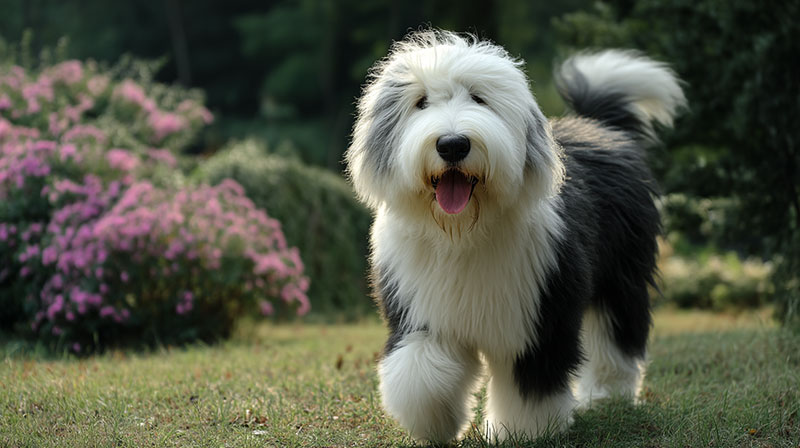
Gentle and playful, and very attached to its people. The herding instinct surfaces as circling, leaning and heel nipping.
The UKC standard describes an adaptable, intelligent breed with an even disposition, and it wants no aggression, shyness or nervousness. Owners report something a little different. Vetstreet calls the dog an independent thinker with its own agenda. Wisdom Panel describes an alert watchdog with a big bark when something seems off. PDSA says it tends to get on well with children.
Herding is the part that surprises people. Wood Green, the UK animal charity, says the dogs can slip into round-up mode around children and small pets, nipping included, and recommends gentle redirection from an early age.
VCA Hospitals says the breed likes to chase other animals and children and may nip at heels. A child running down a hallway is the classic trigger.
Isolation is the failure case. Vetstreet warns that chaining one in the yard with little attention can lead to aggression and destructive behavior, and VCA says time home alone should not be often or for long.
It wants to be wherever its people are.
How Much Exercise and Training Does an Old English Sheepdog Need?
Plan for at least two hours of exercise a day, split across several walks, plus short, consistent training sessions that start in the first weeks at home. Sources agree on the training approach and split on the exercise number.
Daily exercise
PDSA sets a minimum of two hours a day, split into several walks with off-lead time in a secure area. The Kennel Club rates the breed at more than two hours daily. Hill’s lists 20 to 40 minutes a day.
Plan to the UK numbers.
PDSA also warns that herding and prey drive run strong, so keep the lead tight near livestock. It adds that the dogs will try to herd anything that moves, cars included.
Training
The Old English Sheepdog is clever and quick to learn, but strong-willed at times, according to PDSA. Start reward-based training young and keep every session consistent.
VCA Hospitals describes the ideal handler as easygoing but confident, with a firm, positive style. Experience with herding breeds helps.
Dog sports put the herding drive to work. Purina’s breed profile lists agility, obedience, rally and herding trials as typical activities.
Socialization window
Socialization is the one job you cannot do later.
The AVSAB position statement (2008) puts the primary window in the first three months of life and calls socialization before full vaccination the standard of care. Puppy classes can start at 7 to 8 weeks, after one set of vaccines given at least 7 days earlier and a first deworming.
The same statement tells owners to avoid dog parks and other busy areas where dogs of unknown vaccination status gather.
PDSA applies the advice to this breed: expose a puppy to lots of people, experiences and other dogs so an easygoing dog grows into a confident one.
Health Problems and Screening Tests for the Old English Sheepdog
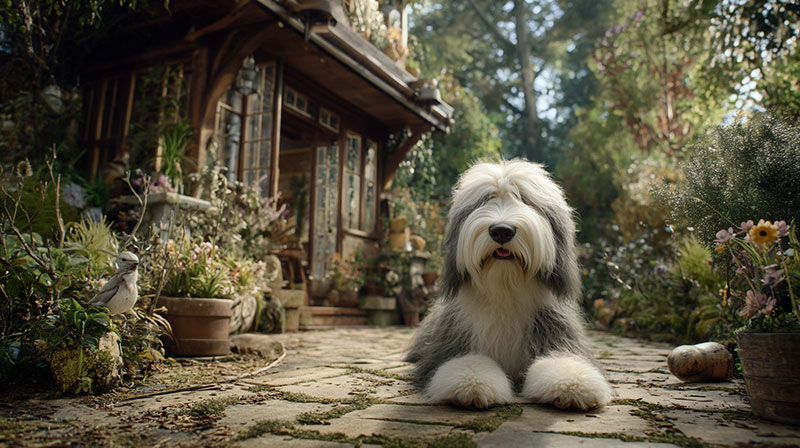
Most of the health advice for this breed comes back to hips, bloat (gastric dilatation-volvulus), hereditary eye disease and MDR1 drug sensitivity. Hips and eyes can be screened, and MDR1 has a DNA test.
Hip dysplasia
Hip dysplasia is a joint that does not fit together properly, and PDSA says it leads to arthritis over time. Screening happens before breeding.
In the UK that means X-ray scoring under the BVA/Kennel Club Hip Dysplasia Scheme. In the US it’s a hip evaluation, which sits on the AKC’s list of tests recommended by the national breed club.
Bloat
Bloat risk is documented in the breed. Bell’s 2014 review in Topics in Companion Animal Medicine lists the Old English Sheepdog among the breeds with raised risk, a pattern tied to large, deep-chested builds.
Cornell University’s emergency and critical care service describes gastric dilatation-volvulus as a condition that needs immediate medical and surgical treatment.
Owners reach for slow feeder bowls first, but the evidence is thin. A 2016 Veterinary Evidence review found that most studies show no effect of eating speed on risk, though Glickman’s 2000 data tied fast eating to bloat in large breeds with a confidence interval that overlapped 1.0.
Purina UK recommends smaller, more frequent meals for the breed, and PDSA splits the daily allowance into two.
Eyes, thyroid and hearing
- Hereditary cataracts and congenital hereditary cataracts both occur, and both are screened through the BVA/Kennel Club/ISDS Eye Scheme (PDSA). Purina’s US profile adds progressive retinal atrophy.
- Autoimmune thyroiditis is covered by the thyroid evaluation on the AKC list (Purina).
- Deafness is possible, and BAER testing can be done from six weeks of age (PDSA).
- Purina lists cardiac anomalies. PDSA lists primary ciliary dyskinesia, a breathing disease where the parents should be DNA tested.
Wisdom Panel’s breed page also names cerebellar ataxia and hemophilia A among the breed’s genetic conditions.
MDR1 drug sensitivity
A mutation in the MDR1 gene makes some dogs react badly to ivermectin, even at prescribed doses. Washington State University’s veterinary hospital lists the Old English Sheepdog among the breeds where the mutation is more common.
The AKC adds that affected dogs also react to loperamide (Imodium), acepromazine and some chemotherapy drugs. A cheek swab sent to a Washington State University lab gives the answer.
There’s a catch. MDR1 is not on the AKC’s club-recommended list for the breed (as listed in October 2026), so a breeder may never have run the test. Ask for it, or run it yourself before any worming or heartworm plan.
The screening lists differ by country.
- As of October 2026 the AKC lists a hip evaluation, eye evaluation, thyroid evaluation and an exercise-induced collapse DNA test, as recommended by the national breed club.
- The Kennel Club points to hip, elbow and eye schemes as good practice, plus a primary ciliary dyskinesia DNA test and, newly recognised in August 2026, a multiocular defect DNA test as best practice.
- PDSA wants hip scoring, the eye scheme, BAER hearing tests from six weeks and a primary ciliary dyskinesia DNA test for the parents.
Older articles name different tests again. Vetstreet’s profile lists hip, thyroid and eye results for a CHIC number, and OFA’s program documentation says breed requirements change as clubs update them.
For reference, the figures behind all of this:
- The bloat odds ratio is 4.8 against mixed-breed dogs (Glickman, JAVMA, 2000).
- Median age at death from bloat was 101 months (8.4 years), against 124 months (10.33 years) for all deaths in the 2014 Kennel Club survey (Lewis et al., 2018, all breeds).
- Four tests sit on the AKC breed-club list (hip, eye, thyroid, exercise-induced collapse DNA).
- A BAER hearing test is possible from 6 weeks of age (PDSA).
How Long Do Old English Sheepdogs Live?
A UK survey of breed club members put the median at 10 years 9 months (Adams et al., Journal of Small Animal Practice, 2010), while most breed profiles quote 10 to 12 years. Plan on 10 to 11 years and treat anything past 12 as a bonus.
| Source | Figure | Basis |
|---|---|---|
| Adams et al., 2010 | Median 10 years 9 months | UK breed club member survey |
| The Kennel Club | Over 10 years | Breed health page |
| Purina | 10 to 12 years | Breed profile range |
| Hill’s | Many live to 12 or 14 years | Breed profile statement |
The gap has a reason. A median counts every dog, including the ones that die young, while a profile range describes a healthy adult.
The 2018 Kennel Club survey (Lewis et al., Canine Genetics and Epidemiology) gave the breed no median of its own, because only breeds with at least 50 reported deaths were analyzed.
That paper also warns that breeds with falling registrations can look longer-lived than they are, since older dogs make up more of the pool. Old English Sheepdog registrations have fallen since 1979, so survey medians may flatter the breed.
A few things move the number.
- Hill’s notes the breed gains weight easily, and VCA Hospitals says to feel the dog at least weekly because the coat hides changes.
- Screening the parents before breeding reduces inherited disease (PDSA).
- PDSA caps treats at 10% of daily calories.
Who Should Not Get an Old English Sheepdog?
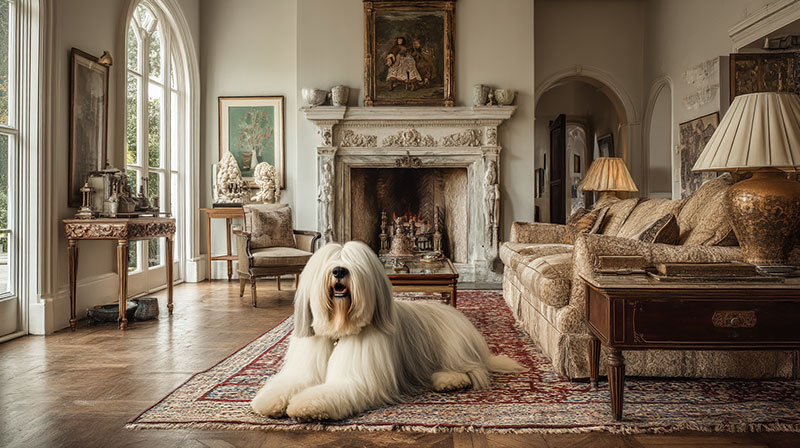
Skip the breed if you cannot commit to daily coat work, two hours of exercise and a home where someone is around most of the day. A puppy cut eases the first demand and leaves the other two untouched.
- The Kennel Club and PDSA both say a large house and a large, secure garden.
- PDSA says the breed can suffer separation anxiety even when left for very short periods.
- PDSA calls the breed better suited to older children, and advises against smaller pets because the hunting instinct runs strong.
Experience matters too. Purina UK lists the breed as suited to experienced owners, and PDSA calls it easy to train only in the right hands.
The space advice splits. Purina’s US, Canadian and New Zealand profiles call the breed equally at home in an apartment or a large house, while The Kennel Club rates it for a large house with a large garden.
Two UK authorities against Purina’s overseas profiles. Go with the UK view.
Registration numbers show how many households reach the same conclusion. The Kennel Club counted 218 registrations in 2025, against a 1979 peak of nearly 6,000.
The breed left the vulnerable list after a 2021 rebound, then fell back under the 300-registration line in 2024 and 2025. Kennel Club spokesperson Bill Lambert blamed lifestyle changes in 2021, pointing to the grooming and exercise demands and the poor fit with smaller living spaces.
The Kennel Club now styles itself The Royal Kennel Club, and its registration table is the source for the recent years.
How to Buy or Adopt an Old English Sheepdog and What It Costs
Buy from a breeder who publishes the parents’ health results, or adopt through a breed rescue, and budget for ongoing costs on top of the purchase price.
If you’re buying from a breeder, the sequence below works.
- Find breeders through the Old English Sheepdog Club of America in the US (the parent club, which takes part in the CHIC health database) or the Kennel Club Assured Breeder Scheme in the UK, which PDSA recommends because those breeders meet extra health requirements.
- Ask for the parents’ test results: hips, eyes, thyroid and the exercise-induced collapse DNA test for US litters, and hip scores, elbow scores, eye certificates and primary ciliary dyskinesia DNA results for UK litters, plus BAER hearing results where the breeder has them.
- Check the results yourself in a public database, the OFA CHIC database in the US or the Kennel Club Health Test Results Finder in the UK.
- Meet the puppies with their dam and ask how the breeder handles early socialization.
- Walk away from unusually cheap litters, which PDSA warns can come from puppy farms.
A CHIC number shows that the required tests were done and made public. It does not show that the dog passed, because a dog need not receive good or even passing scores to get one (Vetstreet), so read the results themselves.
Rescue and adoption
PDSA says an adult from a rescue can cost less than a puppy, and good rescues share the dog’s health and behavior history. Some centres ask for a donation, and some neuter dogs before rehoming.
Breed rescues operate in both countries. Old English Sheepdog Rescue & Welfare is a registered charity rehoming dogs across England and Wales, and Heroes Old English Sheepdog Rehoming covers the UK and Ireland.
In the US, the AKC Rescue Network lists the Old English Sheepdog Club of America as the breed’s rescue contact.
What it costs
PDSA puts the breed at a minimum of 105 pounds a month after purchase and set-up costs, and over 17,000 pounds across a lifetime. The purchase price is the small part, since dogs get expensive over the years.
The ongoing costs break down roughly like this.
- A clipped coat needs a professional trim about every six weeks (PDSA).
- Vaccines, plus neutering at around six months.
- Equipment, grooming brushes included.
- Training classes and boarding.
- A dog walker or day-care if you are out for more than four hours.
- Insurance or a savings buffer for vet bills.
Old English Sheepdog FAQ
Can an Old English Sheepdog have blue eyes?
Yes. The UKC and Kennel Club standards both accept dark eyes, wall eyes (one blue, one dark) and two blue eyes.
Both prefer dark or wall eyes. The UKC lists light amber or yellow eyes as a serious fault, and The Kennel Club calls light eyes undesirable.
Do Old English Sheepdogs bark a lot?
Yes, readily. PDSA describes them as talkative dogs with a loud, deep bark that reports every arrival and departure at home.
Individual temperament and training set the volume, so count close neighbors before buying. PDSA recommends an accredited behaviourist if the barking turns excessive.
Is an Old English Sheepdog the same as a Bearded Collie?
No. The two shaggy herding breeds are separate and often confused.
The Bearded Collie is smaller and reached a median age at death of 12.5 years in the 2018 Kennel Club survey (Lewis et al.). Its breed club also adds an elbow evaluation to the hip, eye and thyroid tests.
How do you keep an Old English Sheepdog cool in summer?
Keep the coat brushed and mat-free, trim it instead of shaving it, and change the schedule. The AKC advises against shaving double-coated dogs, because the undercoat insulates against heat as well as cold and shaving to the skin raises the risk of sunburn and heatstroke.
PDSA lists thick-coated dogs among those at higher risk of heatstroke and suggests asking a vet or groomer about a clip in the warmer months, so move walks to the cooler hours of the day.
How to Test Your Commitment Before Getting a Puppy
A prospective Old English Sheepdog owner can test the commitment in 30 days: brush a long-haired dog to the skin every day and walk two hours daily, ideally by fostering through a breed rescue.
Two hours a day across a median lifespan of 10 years 9 months adds up to more than 7,800 hours of walking. No single source states that total, and it is the real size of the purchase.
Do the decisions in order of how cheaply each one reverses. A trial month costs only time. Checking the parents’ health results costs a few emails. The deposit and the monthly budget are where money actually gets committed.
Judge the trial on its weakest day, such as a wet week or a work deadline. A household that skips the routine then will skip it for a decade.
Position verified October 2026. The breed club’s recommended test list, which clubs revise over time, is the likeliest item to change the second step.