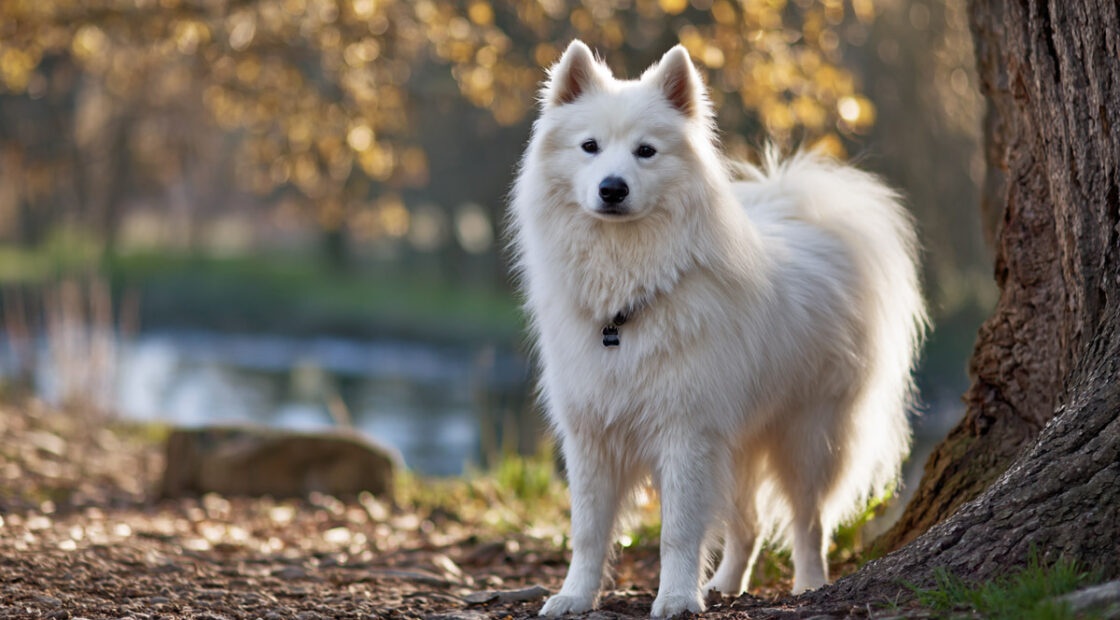
Nobody bred the American Eskimo Dog to pull sleds, and the name has nothing to do with the Inuit. The dogs come from German spitz stock, and they carry a white double coat in three sizes: toy, miniature and standard.
Sources can’t agree on whether the breed reached the AKC in 1994 or 1995, and both years are right. The AKC approved the breed standard on October 11, 1994 and registered the first Eskie in 1995 (AKC breed standard, 1994).
That standard places the breed in the Non-Sporting group and disqualifies any color other than white or biscuit cream.
What Is the American Eskimo Dog?
The AKC classes it as a Nordic-type spitz companion dog with a white double coat and three official size varieties, all in the Non-Sporting group. Its standard describes a small to medium-size dog that is compactly built, alert, and always white or white with biscuit cream.
The ancestry goes back to German spitz dogs, and every size is judged under one standard. Ears are erect and triangular, the lips, nose and eye rims are black, and the richly plumed tail is carried loosely over the back.
The AKC is blunt that Eskies were never bred as sled dogs, and the name has no Inuit link at all.
The Canadian Eskimo Dog is a different animal. Petfinder describes it as a much larger working breed developed by Inuit people, while the American Eskimo Dog is primarily a companion.
Fans call the breed the Eskie, and Westminster Kennel Club uses the nickname “The Dog Beautiful.”
Where Does the American Eskimo Dog Come From?
German immigrants brought the spitz dogs that became the breed, and the name American Eskimo came in 1917 (AKC; United Kennel Club).

German Spitz Ancestry and the Name Change
Before the move, German spitz dogs worked as herders and livestock guards. In America they became farm dogs and watchdogs, per the AKC and VCA Animal Hospitals.
Probable contributors include the Volpino Italiano and the Keeshond, along with the Pomeranian.
VCA Animal Hospitals adds that white Keeshonden and oversize Pomeranians turned away by other breeds probably shaped the early population.
UKC dates the rename to 1917, though VCA says the dogs were still called American Spitz in the 1920s. The AKC traces the “American Eskimo” label to a spitz breeding kennel in Ohio.
Circus Years
The circus is what made the breed famous.
By the AKC’s account, Eskies were popular with traveling circuses from the late 19th century because they trained easily and their white coats looked good under the lights.
The best-known performer was Stout’s Pal Pierre, who walked a tightrope for Barnum and Bailey in the 1930s (WebMD). WebMD adds that the circus sold puppies after each show, and the AKC credits that exposure with turning the breed into a family pet.
Registry Recognition
- The UKC recognized the breed in 1913 (United Kennel Club).
- NAEDA formed in 1970, and the breed got an official UKC standard that year (Hill’s Pet Nutrition).
- The American Eskimo Dog Club of America formed in 1985 to pursue AKC recognition (Vetstreet).
- In 1994, the AKC approved its standard on October 11, effective November 30.
- The first Eskie was registered with the AKC in 1995.
That settles the 1994 versus 1995 split. Recognition and the written standard came in 1994, and the first registration came in 1995 (AKC).
Some encyclopedia entries list UKC recognition as 1919, but the UKC’s own breed page says 1913.
How Big Do the Three American Eskimo Dog Sizes Get?
Height decides the variety. Per the AKC standard, toys measure 9 to 12 inches at the withers, miniatures over 12 to 15, and standards over 15 to 19.
The standard sets no weight, so weight ranges come from breed databases.
| Variety | Height (AKC standard) | Typical weight (Better Bred) |
|---|---|---|
| Toy | 9 to 12 inches | 6 to 10 lb |
| Miniature | Over 12 to 15 inches | 10 to 20 lb |
| Standard | Over 15 to 19 inches | 25 to 35 lb |
Any dog under 9 inches or over 19 inches is disqualified in the AKC ring.
The Poodle uses the same arrangement of three size classes under one standard, as the AKC notes. UKC conformation shows run only two varieties, Miniature and Standard.
Where the Numbers Disagree
The AKC says a standard usually weighs no more than 35 pounds, while Hill’s Pet Nutrition lists male standards up to 40.
Westminster Kennel Club’s breed page goes further, listing a maximum height of 26 inches and a maximum weight of 65 pounds. Both sit well outside the standard, so treat that listing as an outlier.
Which Size Suits Which Home
Pick the size around the household, not the photo.
Standards suit families with young kids best, mostly because PetGuide doesn’t flag that size for extra supervision. Toys fit small living spaces, though PetGuide does advise watching toy and miniature puppies around children.
Miniatures sit in the middle. The breed overall suits people who want an active dog without a large yard (Hill’s Pet Nutrition).
What Does the Coat Look Like, and How Do You Groom It?
Straight, with no curl or wave, and standing off the body. That’s the AKC’s description of the double coat: a dense undercoat with longer guard hair growing through it (AKC standard).
Pure white is preferred, and white with biscuit cream is permitted.
Color, Pigment and Coat Markers
Biscuit cream should never outweigh type, structure or temperament. Skin is pink or gray, and the lips, nose and eye rims should be black, with pink nose or lip pigment counted as a fault.
The coat forms a lion-like ruff on the neck and chest, more noticeable on dogs than bitches, plus thick hair on the rump and hind legs. Disqualifications include any color other than white or biscuit cream, and blue eyes.
How Much Does It Shed?
VCA Animal Hospitals rates shedding above average, while Westminster Kennel Club scores it 3 out of 5.
The pattern is consistent across sources: a heavy coat blow once or twice a year, with lighter loss in between (PetGuide).
Plan for the blow, not the average week.
Grooming Routine, Step by Step
- Brush and comb at least twice a week, per VCA Animal Hospitals. Go daily while the coat blows (Petful).
- Run a line comb through to pull out loose undercoat, a technique the AKC recommends for double-coated breeds.
- Bathe only when the dog is dirty, since PetMD warns that frequent baths strip the coat.
- Dry the coat fully. Groomers use a high-velocity dryer after the bath (AKC).
- Trim nails, clean ears and brush teeth. Scissor only the feet and the backs of the rear pasterns (AKC standard).
Tear staining splits the sources. The standard tolerates it unless severe, Petful says to clean the tear duct area regularly, and PetMD says Eskies need no special eye care in general but suggests a gentle daily eye wash to head off staining.
Should You Shave an American Eskimo Dog?
No.
The AKC says shaving a double coat removes the natural cooling protection and exposes skin to UV rays. The only exceptions it allows are surgery and a coat so matted it cannot be brushed out.
The temptation is real, since VCA Animal Hospitals notes the thick coat can make the breed prone to overheating. The standard also forbids trimming the whiskers or body coat, and show-ring trimming is severely penalized.
What Is the American Eskimo Dog’s Temperament Like?

Intelligent and alert, friendly but slightly conservative, according to the AKC standard.
The standard calls the dog never overly shy nor aggressive and penalizes either extreme in the ring.
Watchdog Instinct and Barking
The standard calls the breed an excellent watchdog that sounds a warning bark at any stranger. It is protective of home and family but does not threaten to bite or attack people.
Hill’s Pet Nutrition says the breed is prone to excessive barking, and Westminster Kennel Club scores barking 3 out of 5. VCA Animal Hospitals adds that the breed once had a reputation for snippiness.
A warning bark is written into the standard, so expect it.
Children, Strangers and Other Dogs
Westminster rates the breed 5 out of 5 with children and 3 out of 5 with other dogs. The AKC calls Eskies great with kids, and Vetstreet advises close supervision around young children and teaching them to pet gently.
Strangers are where sources split.
| Source | Reading on strangers |
|---|---|
| AKC standard | Friendly, slightly conservative |
| VCA Animal Hospitals | Wary |
| Westminster Kennel Club | Good with strangers, 5 out of 5 |
The standard’s word, conservative, is the safer guide. Introduce visitors instead of assuming a welcome.
Company matters too. Vetstreet says a people-loving Eskie belongs inside the house, and Hill’s Pet Nutrition says the breed does not do well left alone for long periods.
How Much Training and Exercise Does the American Eskimo Dog Need?

Training goes best when it starts before 6 months of age, and the exercise and mental work have to be daily.
How Much Exercise Is Enough
Published estimates disagree. Hill’s Pet Nutrition says 20 to 40 minutes a day, while Orvis says at least an hour, since an Eskie can outlast its owner.
Skip the clock and watch behavior. Orvis ties a bored, under-exercised Eskie to destructive habits.
VCA Animal Hospitals says indoor games cover much of a toy’s physical needs, but the dog still needs outdoor walks and sniffing for mental stimulation. Orvis also suggests a food-dispensing puzzle toy to work the brain.
Training Approach
Start early. Vetstreet warns that waiting until 6 months gives you a more headstrong dog.
VCA Animal Hospitals says the breed does best with food or game rewards, and Orvis calls the Eskie a mischief-maker that needs an owner who does not give in.
Barking needs its own attention. Orvis calls it natural for the breed and says exercise and mental work reduce it. Crate training may be needed, and a dog left alone may bark too.
Dog Sports and the Canine Good Citizen Test
Orvis and Wisdom Panel list agility, rally, disc dog and flyball among the sports the breed handles well.
The AKC’s Canine Good Citizen program is a simpler target. It is a ten-item test, and a few of the items hit the breed’s soft spots: accepting a friendly stranger and reacting to another dog, plus supervised separation.
That makes the test a practical training goal, not just a certificate.
Which Health Problems Affect the American Eskimo Dog, and How Long Does It Live?

The breed has a short list of inherited problems, mostly affecting the eyes, joints and blood clotting, and breeders can screen for most of them.
Breed profiles typically give a lifespan of 12 to 15 years (PetGuide), while UK data puts the median life expectancy at 11.3 years, with a 95% interval of 10.0 to 12.0 (Dogs Trust, 2024). CHIC certification rests on 3 tests (hip evaluation, prcd-PRA DNA test, eye exam), and the AKC lists one extra DNA test for the breed, thrombopathia (American Eskimo Dog type).
Why the Lifespan Figures Disagree
The Dogs Trust figure comes from McMillan and colleagues in Scientific Reports, which covered 584,734 UK dogs across 155 breeds. Only 36 American Eskimo Dogs were in the dataset and 22 had died, so the interval is wide.
Lead author Kirsten McMillan told Science News the findings reflect dogs in the United Kingdom only.
Breed profiles give 12 to 15 years without a stated method. Neither figure is settled.
Conditions to Watch
VCA Animal Hospitals says the breed has no overwhelming health concerns, while Nylabone lists seven to watch.
Two involve the eyes: progressive retinal atrophy (inherited retinal degeneration that ends in blindness) and juvenile cataracts (early-onset lens clouding that can be hereditary, per Chewy).
The joint problems are hip dysplasia, patellar luxation (a slipping kneecap) and Legg-Calve-Perthes disease (a hip joint disease of young small dogs). Better Bred flags diabetes as a rising concern, and epilepsy (recurrent seizures) rounds out the list.
Thrombopathia: The Test Most Profiles Skip
Paw Print Genetics describes thrombopathia (American Eskimo Dog type) as an inherited bleeding disorder in which platelets cannot stick together and blood does not clot normally.
Online Mendelian Inheritance in Animals (OMIA) traces it to a c.452dup variant in the RASGRP2 gene, first reported in 2007. A dog needs two copies to develop the disease, while carriers stay healthy and can pass it on (Genomia).
Watch for recurrent nosebleeds and for gum bleeding when the dog is teething or chewing hard objects.
Affected dogs may go unnoticed until surgery or trauma, Paw Print Genetics notes. OMIA adds that platelet counts and clotting screens read normal, so routine bloodwork cannot rule it out.
Only the DNA test settles it, and the AKC lists it among its breed-specific DNA recommendations.
If you’re buying a puppy, ask for the result. Tell the vet before any surgery.
Screening and What a CHIC Number Means
The American Eskimo Dog Club of America takes part in the Canine Health Information Center program, a database sponsored by the AKC Canine Health Foundation and the Orthopedic Foundation for Animals (AKC).
Embrace Pet Insurance says CHIC certification needs an OFA hip evaluation and the OFA DNA test for prcd-PRA, plus an eye exam by a veterinary ophthalmologist.
A CHIC number shows the tests were done, not that the results were good, the AKC points out. Embrace adds that a “vet checked” puppy is no substitute for genetic testing.
Weight Control
Weight is the one lever owners control.
Vetstreet calls keeping an Eskie at an appropriate weight one of the easiest ways to extend its life. Eukanuba says the breed gains weight easily, and VCA Animal Hospitals notes the thick coat hides it, so check by feel and cut calories if the dog starts gaining.
Toy puppies are a separate case. VCA says they need frequent meals to prevent hypoglycemia.
How Does the American Eskimo Dog Compare With the Samoyed, Japanese Spitz and German Spitz?
Size separates the Samoyed from the American Eskimo Dog, while origin and registry status separate the two smaller spitz breeds.
| Breed | Height at withers | Original role | AKC status |
|---|---|---|---|
| American Eskimo Dog | Three size classes | Companion, watchdog | Fully recognized |
| Samoyed | 19 to 23.5 inches | Working dog | Registered since 1906 |
| Japanese Spitz | 12 to 14.5 inches | Companion, then watchdog | Foundation Stock Service |
| German Spitz | 9 to 15 inches | Peasant’s farm dog | Foundation Stock Service |
Samoyed
The AKC standard calls the Samoyed essentially a working dog and sets male height at 21 to 23.5 inches and female height at 19 to 21 (Samoyed Club of America).
That means the largest Eskie class ends where a female Samoyed begins.
The AKC also notes the Samoyed’s undercoat is thick and woolly under a harsh outer coat, and that the breed was built for pulling sleds and guarding in sub-zero cold.
Japanese Spitz
Where it came from depends on who you ask. Dogs Victoria says breeders started with white German Spitz dogs, Dogs New Zealand calls it a miniaturized Samoyed, and The Kennel Club says both are thought to have influenced the breed.
Dogs NSW dates the modern breed to Japan between 1920 and 1950, and The Kennel Club says Japan recognized it in 1948. The AKC added it to the Foundation Stock Service in April 2019, a step before full recognition (Wikipedia).
Dogs NSW sets height at 12 to 14.5 inches.
German Spitz
German breeders recognize five size varieties, but the Toy and Wolfspitz were exported and recognized elsewhere as the Pomeranian and the Keeshond (United Kennel Club standard).
In America only the Mittel (12 to 15 inches) and Klein (9 to 11.5) are registered, and they track the Eskie’s miniature and toy classes closely.
Color is the difference. The UKC standard allows a variety of colors and markings in the German Spitz, while the American Eskimo Dog is white or white with biscuit cream.
Wikipedia adds that the two breeds have diverged and their standards now differ significantly.
When Is the American Eskimo Dog the Wrong Choice?
Homes that sit empty most of the day, tolerate no barking, or cannot give daily exercise and training are the wrong fit.
The breed does well where someone is home for most of the day and tricks, sports or training classes sound like fun. A home that stays cool in summer helps too.
Look elsewhere if any of these sound familiar:
- The dog would be alone for a full workday
- Neighbors share thin walls and complain about noise
- The yard has gaps, since Hill’s Pet Nutrition says the breed can make amazing escapes if not properly confined
- Summers are hot and the home has no air conditioning
- Nobody wants to train or play with the dog daily
Time alone is the gray area. Orvis says an Eskie can be left home for five to eight hours but may turn destructive if bored or under-exercised.
Shaving is off the table in summer (see the AKC guidance above), so cooling has to come from shade, air conditioning and cooler walk times.
If two or more of the “look elsewhere” points apply, pick a different breed, or consider an adult rescue Eskie whose habits are already known.
How Do You Find a Breeder or Rescue, and What Does It Cost?

Start with the American Eskimo Dog Club of America’s breeder list for puppies and the AKC Rescue Network for adult dogs. Expect a rescue fee at the low end and a higher, variable price from breeders.
Finding a Breeder
- Pick breeders who have agreed to the club’s code of ethics, which bars sales to or through pet stores (Vetstreet).
- Walk away from two-tier pricing. Vetstreet calls offering puppies at one price “with papers” and a lower price “without papers” unethical.
- Ask for both parents’ hip, prcd-PRA and eye results, plus the thrombopathia DNA result.
- Check for AKC Bred with H.E.A.R.T. membership. The program requires health testing per the parent club, at least one AKC litter in the past 5 years, and AKC inspections.
- Expect questions back. Vetstreet says good breeders welcome your questions and come back with their own.
Rescue and Adoption
The AKC Rescue Network lists the American Eskimo Dog Club of America under Eskie rescue organizations.
Eskie Rescuers United, a breed-specific nonprofit, shows how a rescue works:
- Adopters apply instead of walking in and buying
- Dogs live in volunteer foster homes
- Every dog is spayed or neutered before placement (GuideStar profile)
- The group takes a dog back if an adopter can no longer keep it
Embrace Pet Insurance points out that an adult rescue can rule out most problems that do not show in puppyhood.
What It Costs
Lemonade’s breed guide lists rescue adoption at $50 to $300 and says it covers basic vet care, spay or neuter, and a temperament evaluation.
Breeder prices are harder to pin down. Published ranges come from pet-content sites, not from registries or breed clubs, so they are not quoted here.
Compare quotes by what they include, meaning health testing, registration paperwork and the contract. Past the purchase price, how expensive a dog gets over its lifetime depends on food, grooming, vet care and training.
American Eskimo Dog FAQ
How popular is the American Eskimo Dog?
It sits in the lower middle of the field. The AKC’s 2025 rarest-breeds list places it at No. 79 of 202 breeds, which makes it the 124th most popular.
The AKC cautions that rank shifts do not always signal gaining or losing fans, since new breeds join the count each year.
Does the American Eskimo Dog get along with cats and other pets?
Often, but not reliably. VCA Animal Hospitals says some Eskies are unfriendly toward other pets, and Hepper says the breed can chase hamsters, guinea pigs and rabbits as prey.
Lemonade rates prey drive low at 2 out of 5, so introduce animals gradually instead of assuming either way.
Is the American Eskimo Dog hypoallergenic?
No. The AKC states that no dog breed is 100% hypoallergenic, and it steers allergy sufferers toward low-shedding breeds with coats that produce less dander.
The Eskie sheds heavily during seasonal coat blows, so spend several hours around an adult before committing.
How much should an American Eskimo Dog eat each day?
Orvis suggests about 1/2 to 2 cups of high-quality dry food daily, depending on weight and activity, so the size variety changes the answer a lot.
Orvis also calls the breed highly food motivated and prone to overeating. Measure meals by the calories printed on the bag, not by eye.
When is an American Eskimo Dog fully grown?
Most reach adult size between 12 and 18 months, according to Healthy Paws Pet Insurance.
The three varieties finish at very different weights, so judge a puppy against its own variety’s adult range, not a single growth chart.
Where a New American Eskimo Dog Owner Should Start
The order that makes sense is health screening first, then training and socialization, then a coat routine. Before the puppy comes home, get the parents’ CHIC results and the thrombopathia DNA status. After that come reward-based training and socialization, followed by coat-blow brushing and regular weight checks.
Screening is the only step that must precede purchase, while habits harden with age and a missed brushing costs the least to recover.
Time is the real cost. Hill’s Pet Nutrition’s 20 minutes a day and Orvis’s one hour, spread across the Dogs Trust median of 11.3 years and the 15-year profile ceiling, add up to 1,375 to 5,475 hours of exercise.
Once the puppy is home, comparing puppy food brands by calories per cup is the next decision.
This order was verified in October 2026, and a new AKC breed-specific DNA recommendation would add a step to the screening.