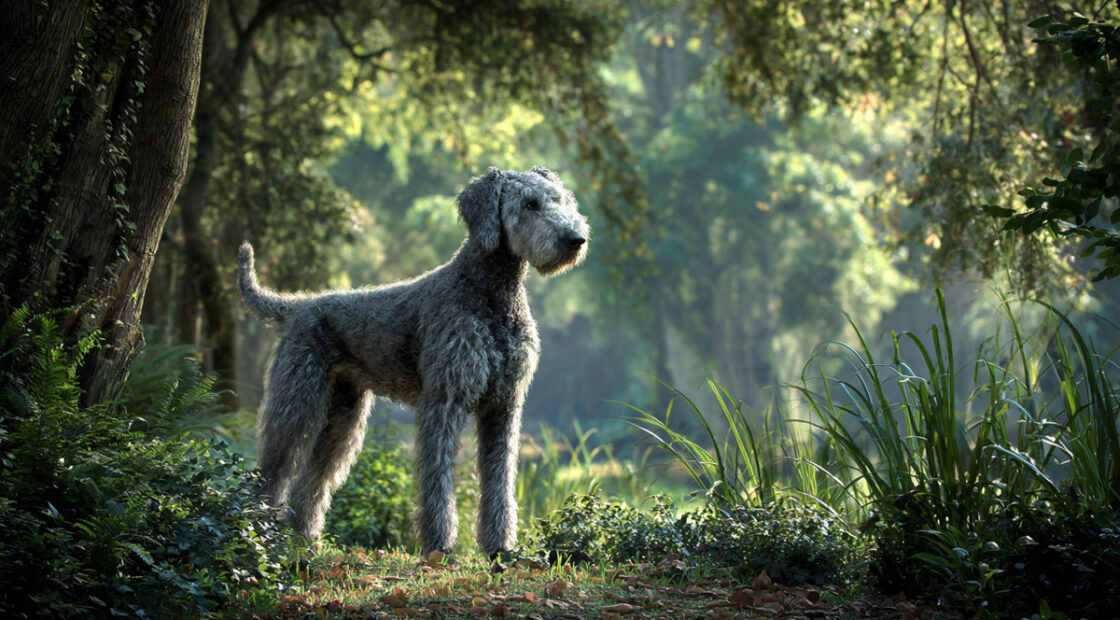
Most people notice the head first. On a Bedlington Terrier it is narrow and rounded, with a pale topknot that gives the dog a lamb-like look. The rest of the animal comes from Northumberland, where the breed was developed to hunt vermin in mining country, and it has the speed and endurance of a sighthound.
These days it mostly works as a low-shedding companion, and some are show dogs.
Before anything else, buyers should know about copper toxicosis, an inherited liver disease. In the 1970s and 1980s it affected 26% to 46% of dogs in different Bedlington populations (Haywood et al., Veterinary Record, 2023, citing Kelly et al., 1984).
The COMMD1 gene deletion behind it is now much rarer in UK dogs, according to the Canine Genetics Centre. But copper toxicosis still turns up in Bedlingtons that lack the deletion, so a clear test result no longer settles the question.
What Is the Bedlington Terrier?
Older books call it the Rothbury Terrier, after the Rothbury area of Northumberland, and Orvis mentions the nickname Rothbury’s Lamb. “Bedlington” is the short form, taken from the mining town of Bedlington.
The soft look misleads people. The UK breed standard warns that it hides a working terrier, and the AKC standard stresses endurance and a fast gallop.
The AKC, The Kennel Club in the UK and the United Kennel Club all place the breed in the Terrier group. The FCI publishes its standard as No. 9.
It is not a toy breed, and it is not a crossbreed. Sighthound blood shaped the build generations ago, but the Bedlington has its own standard at the AKC, The Kennel Club, the UKC and the FCI.
Bedlington Terrier Size and Build
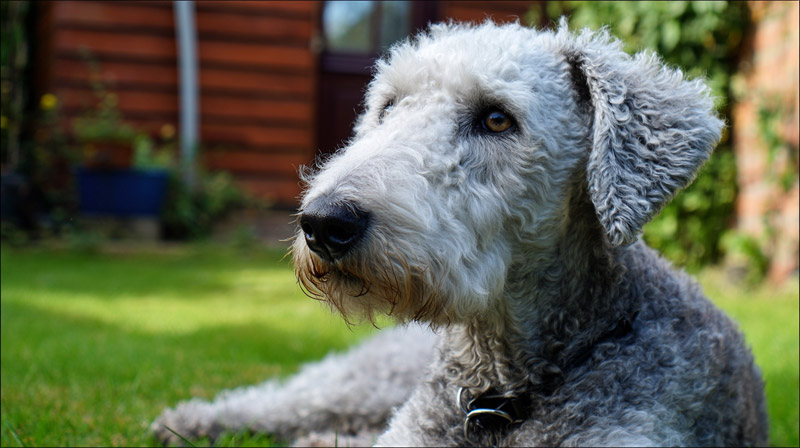

An adult stands about 16 inches at the withers and weighs 17 to 23 pounds. Registries call it a small to medium terrier, and the US and UK standards land within an inch of each other.
The AKC standard (approved 1967) prefers 16.5 inches for dogs and 15.5 inches for bitches, with weight proportionate to height. It treats dogs under 16 or over 17.5 inches as seriously faulty, and bitches under 15 or over 16.5 inches the same way. The UK standard asks for about 41 cm (16 inches) and 8 to 10 kg (18 to 23 pounds), per The Kennel Club’s April 2025 update.
That UK standard also adds a note for puppy buyers. The listed size is the ideal, and an individual dog can come out larger or smaller.
Head, eyes and ears
The head is what the breed is known for. Both standards call for a narrow, deep, rounded skull with no stop, so the line from crown to nose end runs straight and unbroken.
From the front the whole head reads as pear-shaped or wedge-shaped, which accounts for most of the lamb impression.
| Feature | AKC standard | The Kennel Club standard |
|---|---|---|
| Topknot | Lighter than the body color | Silky, nearly white |
| Eyes | Almond-shaped, small, bright | Small, bright, ideal eye looks triangular |
| Ears | Triangular, rounded tips, set low | Filbert-shaped, set low, flat to the cheek |
The wording differs by registry. Check which standard a breeder shows under before comparing dogs.
Body, topline and gait
The AKC standard describes a body slightly longer than it is tall, with a deep chest and a tucked-up underline. The back arches naturally over the loin, which some people call a roached back. Hind legs are longer than the forelegs, and the feet are long hare feet.
The tail is set low, thick at the root and tapering to a point. It is never carried over the back. Gait is light and springy at slow paces, with a slight roll at full stride (UK standard).
That arch and tuck-up trace back to Whippet breeding added for speed, according to WebMD. It is why the dog gallops like a sighthound.
Neither standard tolerates coarseness or weakness. A heavy, stocky Bedlington is off-type.
Bedlington Terrier Coat, Colors and the Hypoallergenic Question
The coat is a crisp mix of hard and soft hair that stands out from the skin, curls or twists, and sheds very little.
The AKC standard calls it crisp to the touch but not wiry. The Kennel Club standard describes it as thick and linty, with a distinct tendency to twist on the head and face.
In show trim, body coat must not exceed 1 inch under the AKC standard, with slightly longer hair on the legs. That short body against a full topknot produces the lamb silhouette.
Accepted colors
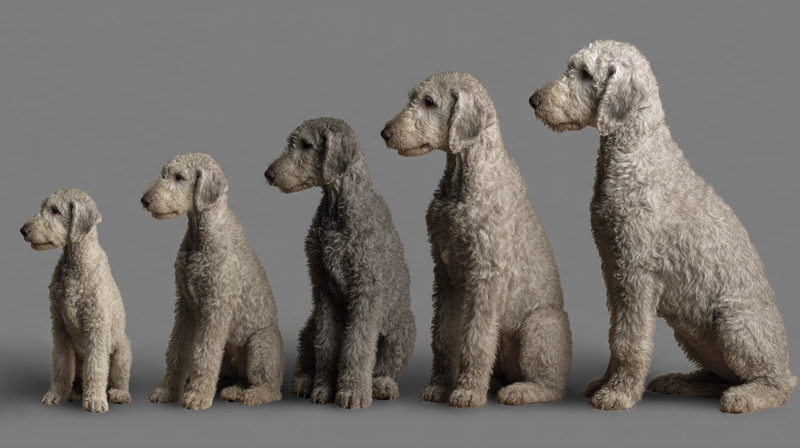
The AKC lists six: blue, sandy and liver, each one with or without tan. The Kennel Club accepts blue, liver or sandy with or without tan, and rejects any other color or combination.
Pigment follows coat color. Blues carry black noses and eye rims, while livers and sandies carry brown, and blues have the darkest eyes.
Puppies are born with deep color, according to Dogs Victoria. Adult topknots must be lighter than the body under the AKC standard.
Is the Bedlington Terrier hypoallergenic?
No breed has been shown to be hypoallergenic, and the Bedlington was not one of the breeds the key study classed as hypoallergenic (Labradoodle, Poodle, Spanish Water Dog and Airedale Terrier).
Researchers compared the main dog allergen, Can f 1, in coat samples and homes, and found no basis for the label (Vredegoor et al., Journal of Allergy and Clinical Immunology, 2012). Dogs sold as hypoallergenic, including Poodles and Airedale Terriers, carried higher levels in their coats than control breeds.
Low shedding is real here, and it does keep loose hair off the furniture. It just doesn’t mean low allergens. The AKC points out that dander and saliva remain, even when the hair does not.
Hill’s Pet and Orvis both describe the Bedlington as hypoallergenic, so the label appears all over breed pages. Anyone buying with allergies in mind should spend time with the specific dog first.
How Does the Bedlington Terrier Behave at Home and With Other Animals?
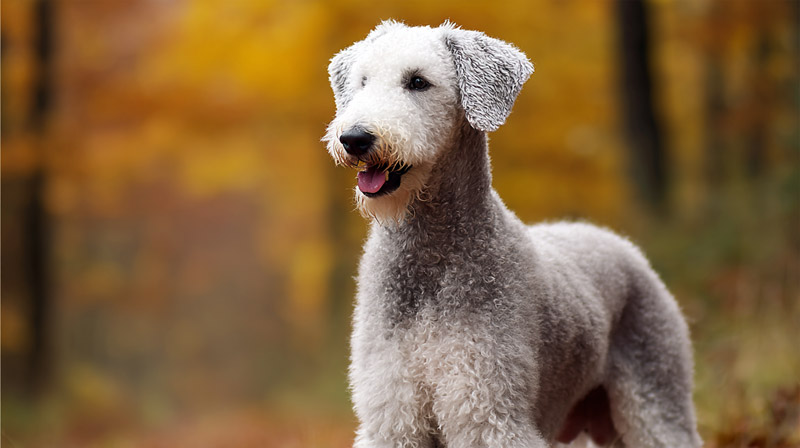
Indoors it is affectionate and fairly quiet, and it will announce visitors at the door. Put another dog or a squirrel in view and the terrier shows up. It suits families with older children and homes without rabbits, hamsters or cats, unless introductions start early.
The Kennel Club standard describes a good-tempered, dignified dog that is never shy or nervous, mild at rest and full of courage when roused. Orvis adds that it greets guests politely and makes an easygoing indoor companion.
With children
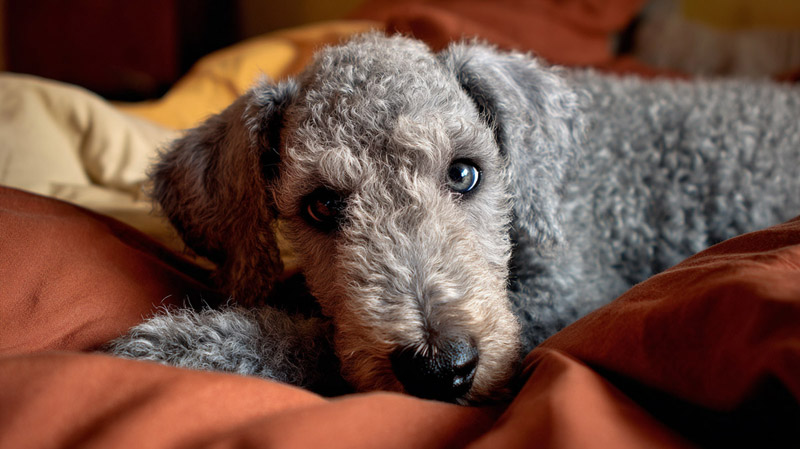
BetterPet calls the breed tolerant of children, including young ones. Purina UK is more cautious and says rough or noisy games over-excite it, so older, sensible children are the better match.
The Westminster Kennel Club rates the breed 3 of 5 for children, which sits between the two.
With other dogs and small pets
Known dogs are usually fine (Purina UK). Unknown dogs can set it off, so early and ongoing socialization matters. New Zealand Kennel Club guidance, cited on Wikipedia, advises against pairing it with a dominant dog.
Small animals such as rabbits and hamsters count as prey, and so do squirrels outdoors. Cats are possible with a lot of time and patience (Purina UK).
Purina UK calls a solid recall the thing to work on, because chasing squirrels and rabbits is where Bedlingtons get into trouble.
Trainability
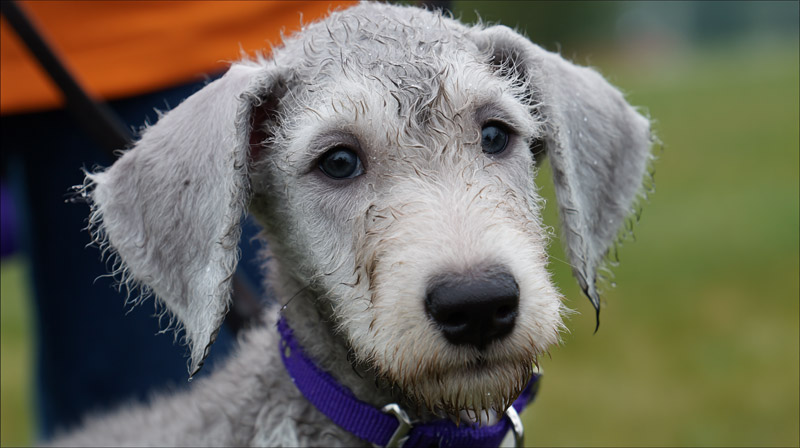
Sources disagree on how trainable the breed is. Dogs NZ rates trainability as hard, the Westminster Kennel Club gives it 3 of 5, and Purina UK calls it surprisingly trainable, especially in sports such as agility.
Orvis lands in the middle. A typical terrier stubborn streak, but easier to manage than most terriers.
Expect a bright dog that needs a job. Agility gives it one.
How Much Exercise Does a Bedlington Terrier Need?
Plan on about an hour a day. Sources set the floor anywhere from 30 minutes to an hour.
Orvis puts the minimum at 30 minutes, either in a fenced yard or on leash. Purina UK says at least an hour and ideally more. The higher figure is the safer plan for a young adult dog.
What a good day looks like
Brisk walks, plus a run in a secure, fenced area, since a loose Bedlington will chase anything that moves. Mental work counts too, such as puzzles and training games (BetterPet). A healthy adult can handle a half-day hike (Orvis).
Bored Bedlingtons dig and make mischief, according to Orvis and Hill’s Pet. More exercise curbs both.
Can a Bedlington Terrier live in an apartment?
Yes, as long as the daily outings happen. Dogs NZ calls it a good apartment dog, and Dogs NSW lists apartment dwellers as suitable owners, along with suburban families and farmers.
An apartment works with daily runs in a safe, open space, and so does a house with a small garden. Full-time outdoor living does not (Orvis), and neither does a backyard with little human company (Vetstreet).
Purina UK notes the breed needs little space but does need access to safe open ground. A people-loving dog belongs in the house.
How to Groom a Bedlington Terrier
Brush and comb the coat once a week with a soft wire slicker and a steel comb, and book a full trim every six to eight weeks.
The interval depends on the source. Hill’s Pet says every six weeks, while Burke’s Backyard says every eight. Start at six and stretch the gap only if the coat stays mat-free.
Effort ratings split too. Dogs NZ rates the grooming load very high, and Certified Master Groomer Suesan Watson of Learn2GroomDogs ranks the coat among the hardest in the trade.
Tools you need
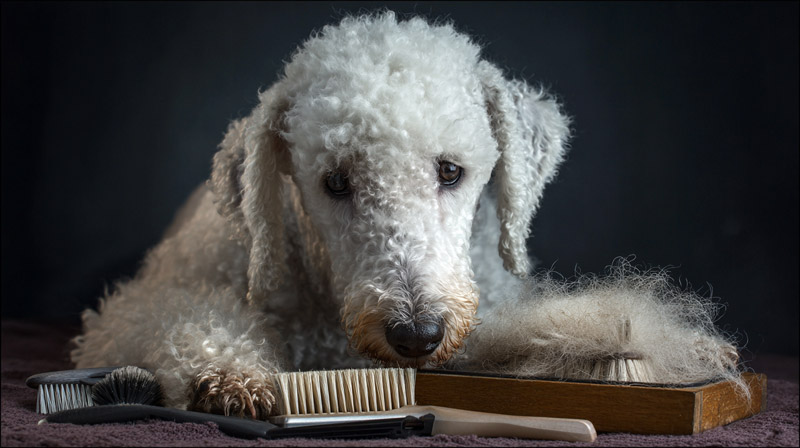
The kit list from Groomer to Groomer is longer than most owners expect.
- Slicker brush and fine comb
- Clippers with #30, #10F and #15 blades
- Long straight scissors
- Curved scissors
- Blenders and thinning shears
The trim, step by step
- Brush and comb the whole coat until no tangles remain.
- Bathe and dry the dog, then comb again.
- Clip the body, using clippers with a short guide comb along the spine between the shoulder blades.
- Clip the ear leather (Groomer to Groomer runs a reversed #30 or #10F blade over two-thirds of it) and trim the tassels into a diamond.
- Scissor the feet first, then the legs into parallel lines.
- Shape the roach with a larger curved scissor, working from the V on the tail up into the top of the roach.
- Finish the head and neck: scissor in line with the bone from eye to ear, then tilt a straight scissor slightly inward to blend the neck.
- Check the profile from the side and blend out any scissor marks.
What goes wrong
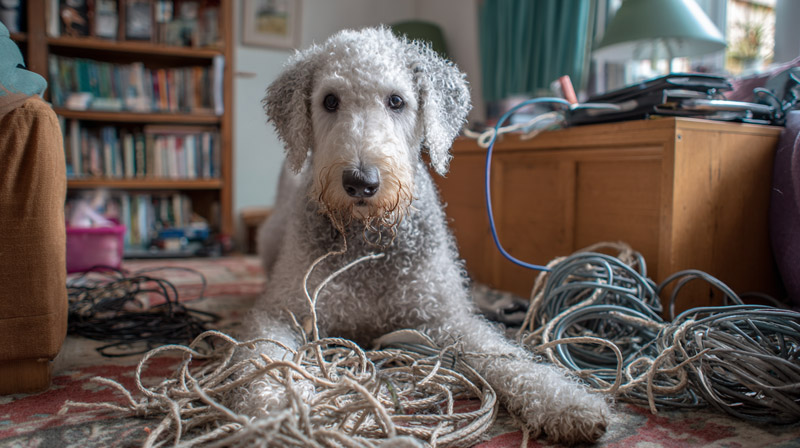
Most grooming failures come from skipped brushing or rushed scissor work.
The soft, curly coat tangles fast when weekly brushing lapses (Hundeo). Hurried finishing leaves visible scissor marks, and Learn2GroomDogs has a full lesson on removing them.
The head has to stay long and narrow. Groomer to Groomer says the eyes should not show from the front, and the UKC standard lists a wide head as a fault.
Groomers borrow the pattern for other curly coats. Groomer to Groomer publishes a “Poodlington” tutorial that puts the Bedlington trim on a miniature Poodle.
Hand the first few trims to a groomer who has done the breed before.
Where the Bedlington Terrier Came From
The Bedlington Terrier developed around Rothbury, Northumberland, in the early 1800s and took its current name in 1825.
The AKC’s history article credits Joseph Aynsley, an early breeder and mason from Rothbury, with first calling his dogs Bedlington Terriers. Other sources spell the name Ainsley. Some pedigrees trace back as far as 1782, according to Wikipedia.
Ancestry and the competing theories
Burke’s Backyard says breeders first crossed Otterhound lines with the Dandie Dinmont, then added Whippet blood in the early 1800s for speed.
Purina UK describes two early types. One used Whippet blood for longer legs and hare coursing, and the other drew on the Dandie Dinmont Terrier for shorter legs and work underground. Today’s dog blends both.
Dogs NSW takes a different line, saying British breed historians there trace the long-legged terrier to the Rough Coated Scotch Terrier.
The sources do not settle the ancestry. They agree on the job, since the UKC standard records a reputation as the gamest terrier and best vermin killer of its early days.
From Rothbury to the show ring
- The earliest pedigrees reach back to 1782.
- In 1825 Aynsley applied the name Bedlington Terrier, and his dog Piper is considered the first true Bedlington (Bedlington Terrier Club of America collection).
- The first show class for the breed was held at Bedlington in 1870.
- The English club was founded in 1875 or 1877, with Orvis giving the first year and Vetstreet the second.
- The AKC registered its first Bedlington in 1886.
- In 1948 Rock Ridge Night Rocket won Best in Show at Westminster, and the UKC recognized the breed.
Piper hunted until he was 14, nearly blind and toothless, according to the AKC. Early show dogs were frequently dyed to improve their coats (Wikipedia).
One date trips up profiles. Hill’s Pet gives 1967 for AKC admission, but AKC-derived profiles say 1886, and 1967 matches the approval date of the current AKC standard (September 12, 1967).
The 1948 win belonged to the Rockefeller family’s Rock Ridge kennel. The AKC’s history calls it the breed’s biggest win on American soil, and LIFE magazine covered the dog that February.
Copper Toxicosis and Other Bedlington Terrier Health Risks
Copper toxicosis is the breed’s main inherited disease. The liver cannot excrete copper into bile, so it builds up in liver cells and leads to hepatitis, cirrhosis and early death (OFA).
Vetstreet and other sources call the same condition copper storage hepatopathy. It is autosomal recessive, so a puppy needs a mutant copy from both parents to be affected.
Copper toxicosis and the COMMD1 test
Signs are easy to miss early. OFA lists lethargy, vomiting, weight loss, excessive thirst, jaundice and dark urine among them.
Diagnosis has relied on a liver biopsy with quantitative copper analysis (Genomia). A marker-based DNA test came first. The COMMD1 gene was identified in 2002, the 39.7 kb deletion was characterized in 2005 (Forman et al., Animal Genetics), and the Animal Health Trust announced the updated direct DNA test in July 2006.
| Result | Gene copies | Breeding implication |
|---|---|---|
| Clear | Two normal | Safe to breed, passes no mutation |
| Carrier | One mutant | Breed only to a clear mate (OFA) |
| Affected | Two mutant | Has the disease, passes mutation on |
What the COMMD1 test does not catch
Copper toxicosis affected 26% to 46% of dogs in different Bedlington populations in the 1970s and 1980s, according to Haywood et al. (Veterinary Record, 2023), citing Kelly et al. (1984).
COMMD1 testing cut that frequency, and OMIA’s summary of the 2023 work says the deletion is no longer the predominant cause.
The gap was visible earlier. An AKC Canine Health Foundation grant led by Andrew Mason at the University of Alberta (2008 to 2013) noted that one third of affected dogs with reliable biopsy data lacked two COMMD1 deletion copies.
Newer work fills in part of the picture. An ATP7B variant, first identified in Labrador Retrievers, is widespread in Bedlingtons with copper toxicosis, and some affected dogs carry no COMMD1 deletion at all (Haywood et al., 2023).
An ATP7B result is a risk marker, not a diagnosis. The UC Davis Veterinary Genetics Laboratory, which offers the test, notes that some Bedlingtons with two copies of the variant had normal copper levels.
A clear COMMD1 result is necessary but no longer sufficient. Ask breeders about ATP7B and about any liver history in the line.
Other health conditions
Copper toxicosis is not the only line on the screening list.
- Patellar luxation, where the kneecap slips out of its groove (Vetstreet)
- Retinal dysplasia and progressive retinal atrophy (PRA)
- Distichiasis, an eyelash disorder
- Renal cortical hypoplasia, underdeveloped kidneys that worsen over time (Omlet)
- Intervertebral disc disease risk, since some European Bedlingtons carry the CDDY variant (Canine Genetics Centre, UK)
How long does a Bedlington Terrier live?
Published lifespans run from 11 to 16 years, depending on the source. WebMD says 11 to 16 years, Dogs NZ says 12 to 14, Burke’s Backyard says 14 to 15, and the Westminster Kennel Club says up to 16.
For scale, The Kennel Club’s 2014 health survey recorded an overall median age at death of 10 years 4 months across 179 breeds (5,663 deaths). Profile ranges are estimates and the survey figure is a measured median, so the two do not compare directly.
WebMD calls the Bedlington long-lived next to similar purebred small dogs. Untreated copper disease is the documented route to an early death.
How to Find a Healthy Bedlington Terrier Puppy
Ask to see written results for both parents before reserving a puppy. That means a copper toxicosis DNA test and a patella evaluation, plus an ACVO eye exam.
The paperwork matters more than the breeder’s reputation or the puppy’s looks.
What the testing programs require
The AKC’s terrier-group testing table lists two CHIC requirements for the breed, a patella evaluation and the copper toxicosis DNA test.
The Bedlington Terrier Club of America’s health statement, reaffirmed January 19, 2026, recommends a further screening, an ACVO eye exam at 12 months or older.
Breeders in the CHIC program agree to publish every result, positive or negative (Vetstreet).
What to ask for
- The copper toxicosis result for both parents, with clear-by-clear the cleanest pairing
- A patella evaluation for both parents
- An ACVO eye exam done at 12 months or older
- An ATP7B result, if the breeder tests for it
- A health guarantee in writing
In the US, Embrace Pet Insurance suggests starting with the parent club’s website. In the UK, The Kennel Club’s Health Test Results Finder shows DNA and screening results for any dog on its register.
Red flags
- No health guarantee on puppies
- A claim that the breed is 100 percent healthy
- Puppies kept away from the main household
- A “vet check” offered in place of genetic testing
Vetstreet’s advice on all four is to walk away.
Is a Bedlington Terrier the Right Dog for You?
A Bedlington Terrier fits owners who want a calm, athletic house dog and will keep up a trim schedule and chase down test paperwork. It does not fit anyone who wants a low-effort, low-paperwork pet.
Pros and cons
On the plus side, it is calm and affectionate indoors, sheds little and lives a long time next to similar small purebreds. It also makes a strong agility prospect, and a DNA test exists for the main inherited disease.
The downsides are practical.
- Regular trims at a groomer who knows the coat
- Terrier prey drive around small animals
- Inherited liver disease that one DNA test no longer fully covers
- Puppies that depend on tested parents
When a Bedlington Terrier does not fit
- A home with rabbits, hamsters or other small pets
- An owner who wants a coat with no appointments
- A buyer who cannot get written parent test results
- Anyone relying on the hypoallergenic label alone to manage allergies
A quick screen. If you can commit to regular trims, a secure place to run and a breeder with parent results, the breed suits you.
Miss one of the three and look at another terrier.
Bedlington Terrier FAQ
How much does a Bedlington Terrier cost?
Budget at least £70 a month and over £12,000 across a lifetime, on top of the purchase price and set-up costs, according to PDSA.
Puppy prices vary by breeder, so ask what health testing the price covers. PDSA warns that unusually cheap puppies can come from puppy farms.
Are there Bedlington Terrier rescues?
Yes. The AKC Rescue Network lists the Bedlington Terrier Club of America and the Bedlington Terrier Wellness & Rescue Association as breed contacts.
PDSA adds that adopting an adult from a rescue centre can cost less than buying a puppy, though some centres ask for a donation.
Are there Bedlington Terrier crossbreeds?
Yes, though few are documented. The best-known pairs a Bedlington with a Whippet, which Wikipedia says produces a Lurcher.
A cross puppy inherits from its Bedlington parent, so ask for that parent’s copper toxicosis result.
Is the Bedlington Terrier a good watchdog, and does it bark a lot?
It works as an alarm dog rather than a guard dog. Dogs NZ rates watchdog ability very high and protection ability low.
PDSA says a Bedlington makes noise like any other dog, so expect ordinary barking.
Can Bedlington Terriers swim?
Yes. Embark lists swimming among the breed’s strengths, and Wikipedia says its speed in the water rivals the Newfoundland’s.
Start with supervised swims in a secure area.
Which dog sports suit the Bedlington Terrier?
Purina’s breed profile lists agility, obedience, rally obedience and conformation. Burke’s Backyard adds terrier racing and lure coursing.
Purina UK says the breed does especially well at agility, which gives a busy mind a job.
The Real Cost of Keeping a Bedlington Terrier
Keeping a Bedlington Terrier means about 80 to 120 professional trims over a 12 to 14 year life. That total comes from combining a trim every six to eight weeks with the Dogs NZ lifespan range, not from either source alone.
Check both parents’ test results before anything else. After that, find a groomer who knows the breed and a safe place to run.
The order follows reversibility. Grooming and exercise arrangements can change after purchase, while a puppy’s copper status cannot.
As of October 2026, the AKC’s CHIC table lists a patella evaluation and a copper toxicosis DNA test without naming ATP7B. A requirement that names it would turn the ATP7B question from an extra ask into a standard check.