Buyers lean hard on the generation label, and it does less than they expect. Shedding is set mainly by two genes, RSPO2 and MC5R (Embark), so a label on a pedigree (F1, F1B, F2 or multigen) raises the odds of a low-shedding coat without deciding it.
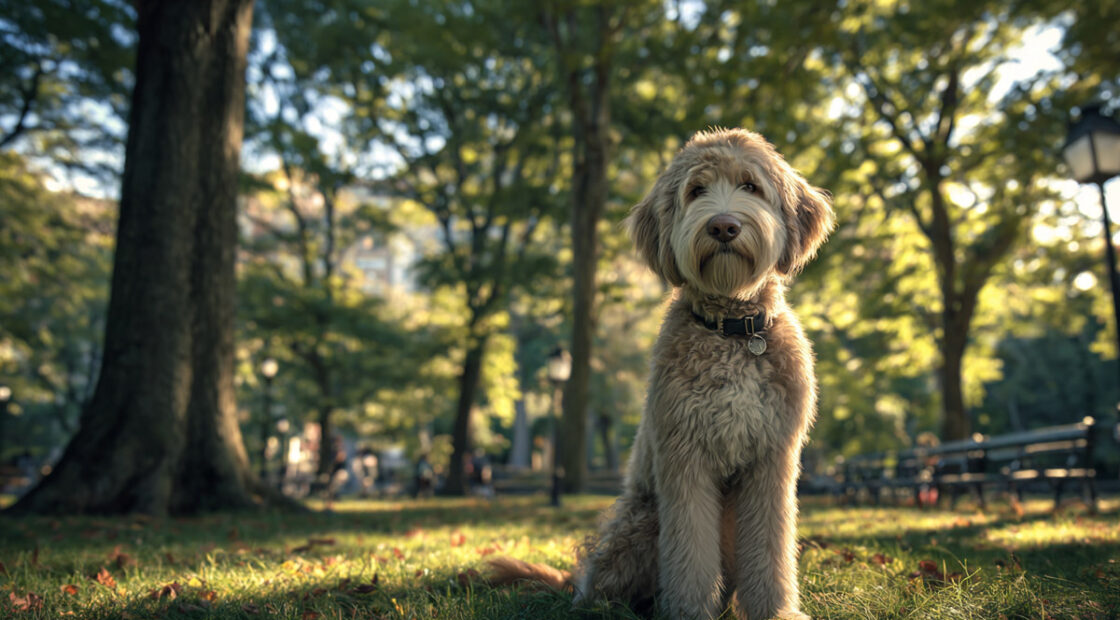
The Goldendoodle crosses a Golden Retriever’s friendly temperament with a Poodle’s curly, low-shedding coat. Size runs from petite dogs under 14 inches to standard dogs over 21 inches at the withers. No major kennel club recognizes the cross, though families and assistance-dog programs both use it.
What Is a Goldendoodle?
Breeders developed it as a family companion and assistance dog. The standard cross uses a Standard Poodle, while Miniature and Toy Poodles produce the smaller sizes.
Hill’s Pet calls it a hybrid rather than a true breed, so how a puppy looks depends on whichever parent’s genes dominate.
Temperament comes mostly from the Golden Retriever side, which breeders chose for a steady, trainable personality. The Poodle side supplies the intelligence and the curl.
It also goes by Doodle or Groodle. Neither the American Kennel Club nor the United Kennel Club recognizes it (Healthy Paws), and the UK Kennel Club doesn’t either (Purina). The Goldendoodle Association of North America (GANA) fills part of that gap by publishing a breed standard and promoting ethical breeding practices.
Where the cross came from is disputed. Wikipedia credits Monica Dickens, a great-granddaughter of Charles Dickens, with crossing the two breeds in 1969, while Purina dates the first intentional breeding to the 1990s.
Wikipedia’s history adds that popularity grew in the 1990s, when designer dog breeders in the United States and Australia began widely crossing Golden Retrievers and Poodles.
The name follows the pattern set by the Labradoodle. Wally Conron produced that Labrador Retriever and Poodle cross as a non-shedding guide dog for a client whose husband was allergic to dog hair (PLOS One, 2024).

Goldendoodle Generations and What Each Cross Produces
Generation labels only record parentage. An F1 is a purebred Golden Retriever crossed with a purebred Poodle. Breed that F1 back to a Poodle and you get an F1B. Two F1s together make an F2, and multigen means the parents are Goldendoodles several crosses deep.
| Label | Parent cross | Golden Retriever / Poodle share |
|---|---|---|
| F1 | Golden Retriever x Poodle | 50% / 50% |
| F1B | F1 x Poodle | 25% / 75% |
| F2 | F1 x F1 | 50% / 50% |
| F2B | F1 x F1B (one common definition) | 37.5% / 62.5% |
| Multigen | Two Goldendoodle parents, at least one F1B or later | Varies |
What each label means
Breeders backcross to raise the Poodle share because buyers ask for low-shedding dogs, according to the breeder guide Doodle Doods. That is why F1B and later labels dominate the low-shedding conversation.
The labels aren’t standardized, and F2B is the messiest. Some breeders use it for an F1 crossed with an F1B (37.5% Golden Retriever), others for an F2 bred back to a Poodle (25% Golden Retriever).
Backcrossing has its own split. Wisdom Panel allows a backcross to a Poodle or a Golden Retriever, while Petful says breeding back to a Golden Retriever is rarely done for pet lines. Multigen drifts as well: breeders following the GANA definition require two Goldendoodle parents with at least one F1B or multigen, and others reserve the word for F3 and later.
A backcross to a Poodle adds Poodle genes. It does not guarantee a coat.
Which generation fits which buyer
Read the parents’ test results before the generation label. I’d do that every time.
An F1 suits buyers who want the steadiest personality. Purina says personality looks more consistent in first crosses, though Petful reports the coat can land anywhere from wavy and low-shedding to straight and moderate-shedding.
F1B and multigen dogs make more sense if a low-shedding coat comes first, provided the parents carry tested furnishings (covered in the coat section below).
The label falls down on furnishings. It’s a dominant trait, so a furnished parent can still carry one non-furnishing copy and pass it to about half its puppies (UC Davis Veterinary Genetics Laboratory). Two such parents, as in an F2 or later cross, can produce a puppy with an improper coat, meaning short hair on the face and legs.
How Big Do Goldendoodles Get?
Adult Goldendoodles run from under 14 inches and about 25 pounds to over 21 inches and 51 pounds or more, and the Poodle parent sets most of that range.
GANA sorts dogs into size bands by height at the withers. The weights here are typical, not limits.
- Petite dogs stand below 14 inches and typically weigh 25 pounds or less.
- Miniature covers anything over 14 and under 17 inches, usually 26 to 35 pounds.
- Over 17 and under 21 inches is medium, typically 36 to 50 pounds.
- Standard starts above 21 inches, and those dogs typically weigh 51 pounds or more.
The Poodle parent explains the spread. The AKC Poodle standard puts Standard Poodles above 15 inches at the shoulder and Miniatures at over 10 up to 15 inches, while a Toy Poodle stands 10 inches or under.
A smaller Poodle parent pulls the cross down a band. Wikipedia lists three Goldendoodle sizes (standard, medium and miniature) and lets a miniature stand up to 20 inches, which overlaps GANA’s medium band.
Labels such as teacup and micro do not appear in GANA’s four bands, so treat them as breeder terms. Personally I’d ignore them.
Size is a prediction, not a measurement. Hill’s Pet advises asking the breeder which type of Poodle the parent was before relying on a size label.
Goldendoodle Coat Types and Shedding
Coats come straight, wavy or curly. Embark says shedding is controlled mainly by two genes, RSPO2 and MC5R, and a higher Poodle share raises the odds of a low-shedding coat without deciding it.
Coat types
Straight coats (flat) sit closest to a Golden Retriever’s, and they’re the type that most often lacks the beard and eyebrows of the Poodle side.
Wavy coats (fleece) have loose, shaggy waves and are the most common among Goldendoodles (Wikipedia). Curly coats (wool) bring thick curls like a Poodle’s, and the heaviest mat risk if brushing slips.
What controls shedding
Cadieu and colleagues mapped furnishings, the beard and eyebrows, to the RSPO2 gene in a 2009 Science paper. They found threefold more RSPO2 transcripts in muzzle skin from dogs with furnishings.
A Goldendoodle without furnishings has an improper coat, with short hair on the head, face and legs and an open face like a Golden Retriever. UC Davis notes that the Goldendoodle breed standard requires furnishings.
The labs don’t fully agree on the second gene. The UC Davis Veterinary Genetics Laboratory says RSPO2 and MC5R act additively, dogs with both low-shedding variants shed least, and the shedding volume of dogs with one copy of each has not been quantified.
Embark says furnished dogs tend to shed lighter whatever their MC5R result.
Both agree furnishings lower shedding. Where they part ways is how much the MC5R result adds once furnishings are in place.
Can you predict the adult coat?
- Look at the parents’ faces and coats, not only their labels.
- Ask for the parents’ RSPO2 (furnishings) and MC5R (shedding) results from a lab such as UC Davis or from an Embark panel.
- If the breeder hasn’t tested the puppy, test it yourself. Wisdom Panel’s July 2026 guide says appearance alone does not always predict shedding, while DNA testing shows a dog’s likelihood of shedding.
- Expect the coat to change. Hill’s Pet notes that puppies pass through different stages before the final coat.
Are Goldendoodles Hypoallergenic?
No. The AKC says no breed or mix is truly hypoallergenic, and studies of Poodle crosses found no reliable drop in household allergen.
The allergen that matters is Can f 1. It comes from saliva and is also found in hair, which is why coat type alone does not settle the question.
Nicholas et al. (American Journal of Rhinology and Allergy, 2011) tested dust from 173 homes with 60 breeds, 11 of them labeled hypoallergenic, and saw no difference in Can f 1. The comparison included mixed-breed dogs with one hypoallergenic parent.
Vredegoor et al. (Journal of Allergy and Clinical Immunology, 2012) looked at hair samples instead. So-called hypoallergenic dogs, including Labradoodles and Poodles, carried more Can f 1 than control dogs (geometric mean 2.26 vs 0.77 micrograms per gram), though airborne levels did not differ between breeds.
The one result that favors the claim is lower settled floor dust in Labradoodle homes. The authors still concluded there is no evidence for classifying any breed as hypoallergenic, and differences between breeds were small next to the variation within a breed.
None of the studies cited here isolates Goldendoodles. The evidence comes from Labradoodles, Poodles and mixed dogs with a hypoallergenic parent.
- Spend time with the specific puppy or its parents before buying
- Ask an allergist first if reactions are severe
The AKC adds that for some allergy sufferers, the reaction to Can f 1 is too strong for any dog.
Goldendoodle Temperament and Working Roles

Goldendoodles are usually friendly, trainable and people-focused, but Purina says a crossbreed’s personality depends on its parents and how it was reared.
Hundeo calls the Goldendoodle an ideal family dog that is never aggressive. The Poodle side makes it quick to learn and in need of mental work, and since both parent breeds are highly active, Purina warns that an untrained or bored Goldendoodle becomes unruly and overly boisterous.
Owner-reported data tells a more mixed story. Among 5,141 owner questionnaires in a 2019 Animals study (Shouldice et al.), 157 of them for Goldendoodles, Goldendoodles showed more problem behavior than their Golden Retriever and Poodle parent breeds, including elevated dog-directed aggression and higher dog-directed and stranger-directed fear.
The data is owner-reported, which limits it. A 2026 PLOS One study from the Royal Veterinary College (Bryson et al.) linked first-time ownership to higher owner-reported problems in Poodle crosses. It covered Cockapoos, Labradoodles and Cavapoos, not Goldendoodles.
Assistance work is where the cross earned its reputation. Purina lists Goldendoodles as guide, service, therapy and sniffer dogs, and GANA describes the breed as capable of therapy and service roles.
Choose a puppy from parents with proven temperaments, and socialize it early. Either parent breed can dominate, so the label alone predicts little.
Goldendoodle Health Problems and Lifespan

Goldendoodles inherit health risks from both parent breeds, and crossbreeding does not reliably reduce them.
Inherited conditions and the tests for each
Screening runs through the Orthopedic Foundation for Animals (OFA), which keeps a public database of certified results. The Goldendoodle Association of North America (GANA) requires hips, elbows, heart, patellas and eyes to be submitted to the OFA.
- Hip and elbow dysplasia are inherited joint disorders, screened by OFA or PennHIP x-rays, with final certification at 24 months (Golden Retriever Club of America).
- Hearts get checked for subaortic stenosis, an inherited defect, by a board-certified veterinary specialist.
- Progressive retinal atrophy, an inherited eye disease, is screened by eye exam and, in Poodles, the prcd-PRA DNA test (Poodle Club of America).
- Slipping kneecaps (patellar luxation) mean patella checks, which GANA requires for Poodles and Goldendoodles of all sizes.
- von Willebrand disease, an inherited bleeding disorder, has a DNA test (Genomia lists vWD type I among its Goldendoodle tests).
- Addison’s disease and thyroid disorders turn up in vet-reviewed breed guides (Dogster) but not on GANA’s required test list.
The Canine Health Information Center (CHIC), a database sponsored by the AKC Canine Health Foundation and the OFA, issues a number when a purebred parent’s required tests are on file. That number shows tests were performed, not passed (German Shorthaired Pointer Club of America).
How long Goldendoodles live
Breed guides quote a Goldendoodle lifespan built from the parent breeds, not measured in Goldendoodles. They give 10 to 15 years, set between the parent ranges (Dogster, 2026).
The measured numbers exist only for the parents. Golden Retrievers had a median survival of 13.2 years in UK veterinary records (McMillan et al., Scientific Reports, 2024), and Poodles 14.0 years in the same study.
Guides give Golden Retrievers 10 to 12 years, below the measured UK median. The 12 to 15 years they give Poodles brackets the 14.0 figure.
The UK study speaks for UK dogs only, according to Science News, so treat the numbers as a range of expectations rather than a prediction.
On hybrid vigor, Wikipedia states the cross can produce a healthier animal than either parent breed.
The Royal Veterinary College’s 2024 study of Cockapoos, Labradoodles and Cavapoos (Bryson et al., PLOS One) found no significant difference from their progenitor breeds in 86.6% of 342 disorder comparisons. The remainder split almost evenly between higher and lower odds.
That study did not include Goldendoodles. The Poodle parent is the shared link.
How to Groom a Goldendoodle
Brush a clipped Goldendoodle once or twice a week and a coat grown out long daily, then book a professional clip every 4 to 8 weeks.
| Task | Interval | Source |
|---|---|---|
| Brushing, short clip | 1 to 2 times a week | Hill’s Pet |
| Brushing, wavy coat grown out | Daily | The Dog Clinic |
| Professional clip | 6 to 8 weeks, or 4 to 6 weeks | Healthy Paws; Woofie’s |
| Bath | Monthly | Healthy Paws |
Clip length is the variable behind those splits. A short, even clip, often called a puppy cut or teddy bear cut, stretches both intervals, and the range of clip styles for a Goldendoodle lets you match the cut to the coat.
Woofie’s, a grooming franchise, pushes the professional visit to every 4 to 6 weeks. Bark and Healthy Paws say 6 to 8.
You’ll need a slicker brush and a comb, the two tools The Dog Clinic ranks first, plus nail trims, ear checks and teeth brushing between clips.
Matting is where grooming goes wrong most often. Heavy matting can force a groomer to shave the whole coat, and over-brushing thin-haired areas causes brush burn, meaning sore, irritated skin (The Dog Clinic).
How Much Does a Goldendoodle Cost?
A reputable breeder charges $2,000 to $5,000 for a Goldendoodle puppy, with an average near $2,500 (Insurify, 2026 cost guide).
The purchase is the smaller number over a decade. Owning a dog is expensive across 10 or more years, and Dogster’s price guide names grooming as the next common expense after the puppy itself.
Smaller dogs usually cost more, and color can raise the price too (Insurify). Breeders who run health checks charge more, and some fold early vet care into the price (Hepper).
Generation is where sources split. Doodle Doods says F1B puppies cost a little more because buyers want low-shedding dogs, while one breeder’s published price list (Best Goldendoodles) puts F1B, F2 and F2B in a single band.
Food follows size too. A feeding chart by weight shows how much each size band eats before you set a budget.
Monthly estimates from Dogster and Hepper differ by several multiples, because insurance, size and groomer rates swing the total. A price far below the range is a warning, since Hepper notes puppy mills price dogs to move quickly.
How to Choose a Goldendoodle Breeder
Choose a breeder who shows OFA results for both parents, lets you meet the dogs before you pay, and puts the health guarantee in writing.
- Search GANA’s breeder directory. Member breeders sit in Bronze, Silver or Gold health-testing tiers, though older breeder pages still cite a Blue Ribbon level.
- Ask for OFA results on both parents. Certificates can be looked up on the OFA website, and the results matter more than a CHIC number.
- Separate “vet checked” from health tested. GANA’s board, quoted by The Doodle Pro, says a vet visit is not OFA testing and a DNA panel alone is not enough.
- See the dogs first. Meet the mother in person or on a live video call, and look at where the puppies are raised.
- Read the contract, especially the length of the health guarantee and the return terms.
- Pay in a way that can be traced. Avoid payment apps and surprise shipping or insurance fees.
Better Business Bureau data logged 1,632 online pet-scam reports through September 2025, with a median loss of $600. The BBB’s guidance is to insist on a live video call or an in-person meeting.
GANA Gold-level breeder Beechwood Goldendoodles publishes a three-business-day general health guarantee and a two-year genetic disease guarantee. Written terms like that give you something to compare across breeders.
When a Goldendoodle Is the Wrong Fit

A Goldendoodle is the wrong fit for buyers who need a guaranteed coat, size or health outcome, or who will not put time into grooming, training and supervision.
In a UK survey of 2019 to 2020 puppy purchases, 47.1% of designer crossbreed owners cited hypoallergenicity as a reason for their choice, against 7.86% of purebred owners (Burnett et al., Canine Medicine and Genetics, 2022).
The Royal Veterinary College notes that allergies rank among the top three reasons dogs are relinquished, often within the first year.
Households with severe allergies should spend time with the actual dog before committing. Owners who won’t keep a grooming schedule shouldn’t bother, since the coat work is recurring, not optional.
A small home is a poor match for a standard-size dog, and Purina calls the Goldendoodle a large, active dog that needs a good-sized living space. And if valuables sit within reach, know that Wikipedia notes strong retriever instincts and an active mouth, and Chewy says the breed is known to grab and eat items like socks and tissue paper.
On the plus side, you get a friendly, family-oriented temperament, a choice of sizes, and a low-shedding coat in tested lines. Against that sit recurring grooming, an unpredictable coat and size, a high purchase price and no kennel-club recognition.
If the cons outweigh the pros for your household, meet the parent breeds first. A visit with a Golden Retriever and a Poodle shows the range of outcomes better than any label.
Goldendoodle FAQ
Can you adopt a Goldendoodle from a rescue?
Yes. IDOG Rescue, a national foster-based group for Doodles, Standard Poodles and Poodle mixes, lists adoption fees of $100 to $750 that cover spay or neuter, core vaccines and microchipping (Petfinder listing).
How much exercise does a Goldendoodle need?

Plan on two hours or more a day. Purina says both parent breeds are highly active and happy with that much, and Hundeo adds scent mats and puzzle toys for mental work.
Do Goldendoodles get separation anxiety?
Some do, though the evidence is thin. In a 2019 owner survey (Shouldice et al., Animals), Goldendoodles scored 0.93 for separation-related problems, near Miniature Poodles (0.94) and above Golden Retrievers (0.51), with no statistically significant gap.
Barking, destruction and house soiling when alone are the signs to watch (Doodle Doods).
Can a Goldendoodle live in an apartment?
The petite and miniature sizes can, while standard-size dogs struggle. Britannica says a Miniature Poodle ideally has a small yard and a Standard Poodle needs a good-sized fenced area, and a Goldendoodle’s size follows its Poodle parent.
What is the difference between a Goldendoodle and a Labradoodle?
It comes down to the retriever parent, a Labrador Retriever instead of a Golden Retriever. In the same 2019 owner survey, Labradoodles differed from a parent breed on one behavior scale (dog rivalry), while Goldendoodles differed on four.
Is a Goldendoodle better than a Golden Retriever?
Neither wins outright. Choose the Goldendoodle for a coat that can shed less and the Golden Retriever for a fixed breed standard.
Hundeo calls low shedding the cross’s big plus, while Hill’s Pet notes a hybrid’s appearance varies widely.
What colors do Goldendoodles come in?
Cream, apricot, red, gold, brown, black and parti-colored are the common ones (Wikipedia). Purina adds white, copper and grey, because either parent breed can supply a color.
What to Settle First When Buying a Goldendoodle
A Goldendoodle buyer should settle size first, the breeder second and coat last, because each choice narrows the next.
Size fixes which Poodle parent the breeder must use, and that breeder’s parent records then show which coat the litter is likely to carry. In practice that means a size band that fits the home first. Then a breeder with OFA results on both parents. Coat type gets confirmed from the parent records at the end.
The trade-off is that coat stays a probability, not a promise, even with tested parents. A household that cannot tolerate any coat surprise should skip the cross.
GANA’s current testing requirements apply to dogs born on or after July 31, 2024, so parents born earlier need their OFA records checked individually.
This order was verified on October 22, 2026, and a change to GANA’s standard would change the advice.