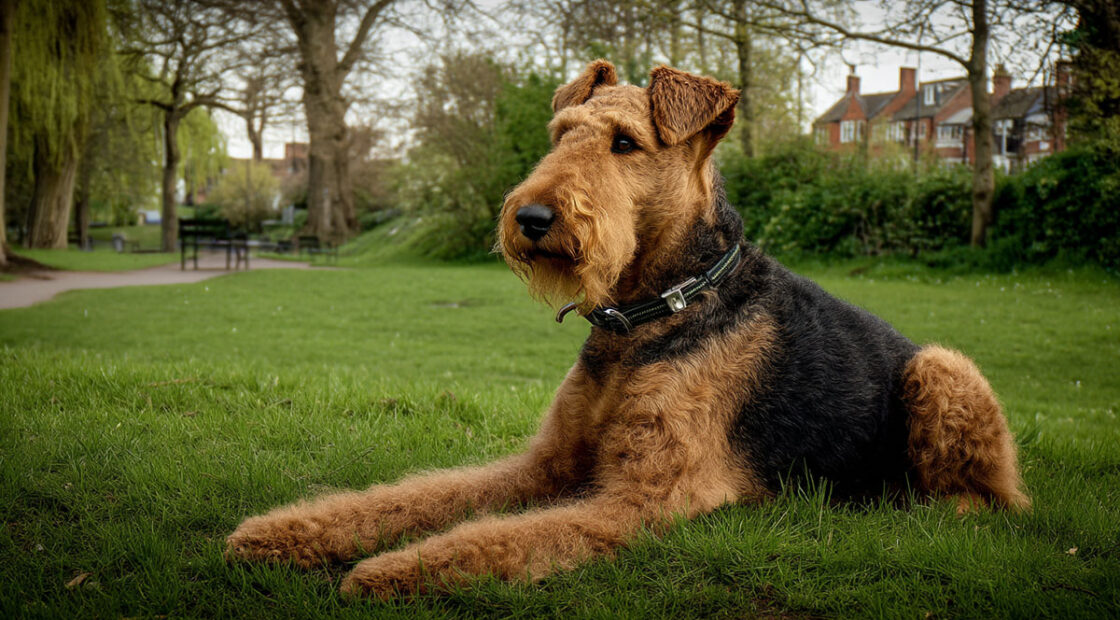
Mill workers in Yorkshire’s Aire Valley developed the Airedale Terrier in the mid-1800s to hunt rats, otters and ducks. The Kennel Club standard (updated April 2025) sets its height at 58 to 61 cm for dogs and 56 to 59 cm for bitches, which makes it the tallest of the terriers.
Size mattered in World War I too. According to the Long Long Trail, intake rules for the British War Dog School allowed no dog smaller than an Airedale.
Great War Dundee says the first two dogs Edwin Richardson and his wife trained to go to war, Prince and Wolf, were terriers of this breed.
What Is the Airedale Terrier?
Mill and factory workers in the Aire Valley of Yorkshire developed it in the mid-1800s, and the job was river work. Rats, otters and ducks.
“King of Terriers” is a nickname about height, not bulk.
Showsight’s breed magazine points out that at the size the standard asks for, the Airedale is already the tallest terrier, and the standard gives no extra credit for going beyond it.
Registries file the breed with the terriers, and the FCI puts it in Group 3, Section 1, for large and medium sized terriers. Before Airedale stuck, the dog also went by Waterside Terrier and Bingley Terrier.
- The Kennel Club standard (updated April 2025) gives 58 to 61 cm for dogs and 56 to 59 cm for bitches.
- The FCI classification is Group 3, Section 1 (FCI Standard No. 7, published July 2021).
- The breed started in the Aire Valley, Yorkshire, in the mid-1800s (United Kennel Club).
- The Canadian Kennel Club recognized it in 1889 and the United Kennel Club in 1914.
- CH Master Briar, who lived from 1897 to 1906, is the patriarch of the breed (United Kennel Club).
Where Did the Airedale Terrier Come From?
Working-class breeders in the valley of the River Aire, Yorkshire, crossed a black and tan terrier with the Otterhound in the mid-1800s.
Aire Valley and the early names
The AKC history notes that Yorkshire shows first listed these dogs as Broken-Haired, Working or Waterside Terriers. One breeder suggested Bingley Terrier, but the name was turned down so the Yorkshire town wouldn’t get undue credit. Airedale won out, after the river and its dale.

The FCI tells it a little differently. In its version the breed reputedly took the name from the Airedale show, which drew a large entry of Waterside Terriers from the Wharfe, Calder and Aire valleys.
Either way, the name leads back to the same valley.
Foundation breeds and where sources disagree
The United Kennel Club and Britannica both name the extinct Old English black and tan terrier and the Otterhound as the parent stock.
Hill’s Pet explains the logic. The terriers lacked scenting skill and swimming ability, so breeders around the River Aire brought in the Otterhound.
Purina’s breed profile adds the Irish Terrier and the Bedlington Terrier to the mix, where the UKC history stops at the first two ancestors.
For breeding records, the UKC names CH Master Briar as the patriarch of the breed. His sons Crompton Marvel and Monarch also made important contributions.
What Work Did the Airedale Terrier Do?
It started out hunting water vermin, then went on to carry messages in war, serve as a police and army dog, and track in Africa, India and Canada.
Britannica places the early work in the mid-1800s, hunting rats, otters and ducks around the Aire. From 1914 to 1918 the breed carried messages and did sentry and guard duty with the British Army. Orvis ties a surge in American popularity in the 1920s to the wartime stories.
The FCI standard adds Red Cross service in wartime and police and armed forces service in both Britain and Russia.
Before 1914, Edwin Richardson, a retired army officer, showed that dogs, Airedales in particular, could be trained to carry messages and find wounded men, per Aberdeenshire Council’s historic environment record.
The British Army used no dogs when the war began. Richardson and his wife trained the first two, Airedales named Prince and Wolf, as messenger dogs (Great War Dundee).
Counts of school dogs differ. The Long Long Trail puts the number trained at about 1,400, while Bryan Cummins, in Colonel Richardson’s Airedales (2003), gives more than 2,000 trained and sent to the front.
Intake rules set an Airedale as the smallest acceptable dog, with no bitches and ages of 18 months to five years (Long Long Trail).
Richardson trained several breeds, but Airedales were his favorite for their intelligence, devotion and coolness under fire, HistoryNet reports.
Laddie Boy then kept the breed in the news. Born July 26, 1920, he reached the White House on March 5, 1921, the day after President Harding’s inauguration, and the breed’s popularity grew during the Harding years (Smithsonian Magazine).
How Big Does an Airedale Terrier Get?

Dogs stand about 23 to 24 inches (58 to 61 cm) at the shoulder, and bitches stand slightly lower.
| Registry | Dogs | Notes |
|---|---|---|
| The Kennel Club (UK) | 58 to 61 cm (23 to 24 in) | Bitches 56 to 59 cm (22 to 23 in) |
| American Kennel Club | About 23 in at the shoulder | Bitches slightly less; much over or under the limit is a fault |
| Canadian Kennel Club | About 23 in at the shoulder | Bitches slightly less; standard effective January 2015 |
| FCI | About 58 to 61 cm | Standard No. 7, published July 2021 |
The registries agree on height. Weight is where sources split.
The UKC standard states only that weight is commensurate with height, so breed profiles fill the gap with their own numbers. Purina says 50 to 70 pounds, while Hill’s Pet says 25 to 35 kg (about 55 to 77 pounds).
The two ranges overlap but don’t match, so height, which every standard in the table specifies, is the more dependable check.
Oversized dogs are a documented exception. According to the kennel’s own magazine, Oorang Comments, Walter Lingo’s Oorang Kennels in LaRue, Ohio, supplied oversized Airedales of 60 to 100 pounds on request, and the strain’s size was never standardized.
The AKC standard lists being much over the size limit as a fault, so extra size is penalized in the ring, not rewarded.
What Does the Airedale Terrier Coat Look Like, and Does It Shed?
The outer coat is hard and wiry over a shorter, softer undercoat, and the usual color is tan with a black or grizzle saddle.
Shedding is light. The hypoallergenic label, on the other hand, isn’t supported by the research.
Coat structure and accepted colors
The Kennel Club standard asks for an outer coat that is hard and wiry, stiff enough to lie straight and close, with a shorter, softer undercoat beneath.
The hardest coats crinkle or wave slightly. A curly or soft coat is highly undesirable.
The AKC lists a soft coat as a fault. The UKC names a soft, curly or ragged outer coat, and also artificial stiffening of the hair.
Color follows a saddle pattern. The AKC standard asks for a tan head with darker tan ears, and Britannica describes the body as rich tan with a black or grizzle saddle.
Grizzle is black mixed with gray and white.
Shedding and the hypoallergenic claim
A 2012 study in the Journal of Allergy and Clinical Immunology tested the claim directly, and the Airedale was one of the breeds it examined.
Vredegoor and colleagues measured Can f 1, the main dog allergen, in coat samples and in home dust. Breeds sold as hypoallergenic, including the Airedale, Poodle and Labradoodle, carried more Can f 1 in their coats than control breeds, yet airborne levels did not differ between breeds.
Settled floor dust was lower only for Labradoodles. The authors found no evidence for classifying any breed as hypoallergenic, and differences between breeds were small next to the variation within a breed.
Orvis calls the Airedale hypoallergenic. Vetstreet says it is not known for extreme shedding but does shed at certain times of year.
Low shedding describes hair on the floor, while hypoallergenic describes allergen exposure, and the two get mixed up constantly. The AKC points out that dander and saliva carry allergen as well as hair.
In an allergic household, meet the specific dog first. The breed label predicts less than the individual animal does.
How Do You Groom an Airedale Terrier?

Brush the coat weekly and book a professional groom, using either hand stripping or clippers. Hand stripping pulls the dead hair out and keeps the harsh coat, while clipping is faster and softens it.
Sources disagree on how often the professional visit should happen.
Vetstreet suggests weekly brushing with professional grooming about every two months. Purina is looser, with weekly brushing and a full groom of bath, brush and clip three to four times a year. Hill’s Pet splits it by coat type, with hand stripping every couple of months to hold a show coat and brushing once or twice a week on a clipped coat.
The gap follows the goal. Show-coat advice wants stripping every couple of months, while pet-coat advice accepts a handful of grooms a year.
Hand stripping keeps coat texture and color sharp, according to Hill’s Pet. It’s skilled work, though, and an older dog may object to it.
Clipping is quick, and a clipped coat gets by on brushing once or twice a week. The catch is that the coat grows back paler and more carpet-like, as a terrier grooming guide from Jane Dogs describes.
A middle route exists. Rolling the coat means hand stripping the body and clipping the tan areas, which the same guide suggests for an older dog that resists full stripping.
Bathing too often softens the coarse coat, Vetstreet warns. Start grooming handling in puppyhood so the independent Airedale Terrier learns to accept it.
My view is simple enough. Strip if coat texture is part of the goal, such as showing, and clip or roll the coat if it isn’t.
What Is the Airedale Terrier’s Temperament, and How Much Training and Exercise Does It Need?
The breed is bold and intelligent, with an independent streak. It needs more than an hour of vigorous exercise a day and training that stays varied, according to Orvis and Vetstreet.
The FCI standard describes an outgoing, confident and friendly dog. Britannica and Dogs New Zealand describe one that is reserved or initially suspicious with strangers.
That split is why socialization starts at once. Vetstreet says to begin training the day the puppy comes home, with family and friends until vaccines are complete.
VCA Animal Hospitals calls the breed highly intelligent and independent, and a challenge to train. Wisdom Panel notes that the terrier ancestors were bred to hunt and kill vermin, so prey drive comes with the package. Orvis says long sessions work as long as the dog stays mentally engaged.
Drill-style repetition fails with this breed. Vetstreet says routine drills bore an Airedale, so sessions must stay interesting and fresh.
VCA’s advice is patience, consistency and a sense of humor, with plenty of shared time in puppyhood. Dogster adds that females tend to be more independent than males.
Exercise ratings differ sharply between sources.
| Source | Exercise | Trainability |
|---|---|---|
| Dogs New Zealand | Moderate | Moderate |
| VCA Animal Hospitals | Very high, vigorous daily workouts | Can be stubborn, needs daily practice |
| Orvis | More than an hour of vigorous exercise daily | Stubborn and independent |
Plan for the high end of the range. Vetstreet warns that an Airedale deprived of exercise and companionship turns to mayhem.
Structured outlets use the energy well. Purina Australia lists obedience, agility, hunting tests and conformation, and notes that Airedales are excellent swimmers.
Which Households Suit an Airedale Terrier, and Which Do Not?

Active households with time for daily training suit the breed. It’s a poor fit for first-time owners who want an easy dog and for homes with cats.
Sources split on children. Orvis says the breed often does well with children when properly socialized, while Dogster lists families with small children among poor fits.
They split on other dogs too. Hill’s Pet and Wisdom Panel report easy relations, but Vetstreet warns of aggression toward other dogs, particularly of the same gender.
The favorable reports come with conditions, namely proper socialization (Orvis) and pets the dog grows up with (Hill’s Pet).
Active owners who plan daily exercise and training into the week do well with one. So do people who are home most of the day, since the Airedale does not relish time alone (Orvis), and anyone who wants an indoor companion with outdoor time built in.
The list of poor fits is longer.
- First-time owners who want an easy dog
- Families with small children and little time for training (Dogster)
- Homes with cats (Vetstreet)
- Owners unwilling to take on a high-maintenance coat (VCA Animal Hospitals)
- Anyone who works long days away from home
Apartment living lands in the middle. It works only if the outdoor hours actually happen, because Orvis says the breed needs a lot of time outside.
If the week has no room for daily exercise and training practice, choose a calmer breed. Vetstreet calls the Airedale “way too much dog” for owners who are not ready for consistent training.
What Health Problems Affect the Airedale Terrier, and How Long Does It Live?

The Airedale Terrier lives a little over a decade, and cancer leads the causes of death in owner surveys. The breed’s other documented problems are hip dysplasia, hypothyroidism and several inherited kidney, brain and lung diseases.
Lifespan and causes of death
Cancer caused 39.5% of Airedale deaths in the 2004 Kennel Club and BSAVA survey of UK dogs, and 38% in the Airedale Terrier Club of America’s 2000 to 2001 survey of US and Canadian dogs.
Two surveys on two continents land close together, which says more than either figure alone.
Both rely on owner reports. The UK survey went to breed club members and, as its authors note, may not represent the wider pedigree population (Journal of Small Animal Practice, 2010).
Second place differs. Old age takes it in the UK survey, urologic disease in the US and Canada survey.
Dogs New Zealand gives a lifespan of 10 to 13 years and Wisdom Panel gives 10 to 14. The ranges differ by a year at the top, so plan around the shared floor of 10 years.
Common conditions
Breed profiles keep returning to the same handful of problems.
- Hip dysplasia is a developmental joint disease, screened with hip radiographs.
- Hypothyroidism, an underactive thyroid, is listed by Purina Australia.
- Bloat is a life-threatening emergency, which is why Pumpkin advises small, frequent meals.
- Juvenile renal disease means abnormal kidney development that ends in kidney failure, with no specific cure (Dogster).
The BVA and Kennel Club hip scheme (2018 statistics) puts the breed’s median hip score at 11, matching the 15-year medians for the Golden Retriever and the German Shepherd Dog. Lower scores mean better hips.
Cerebellar abiotrophy usually shows between 6 weeks and 6 months of age and has no cure (Dogster). Lung developmental disease is present at birth and fatal within days or weeks, and hemophilia B, a clotting disorder that prolongs bleeding after injury or surgery, also turns up in the breed (Wisdom Panel).
A 2020 University of Helsinki study, supported by Wisdom Health, identified the LAMP3 variant behind the lung disease, and a DNA test for the variant is now available.
VCA Animal Hospitals notes the breed is stoic, so owners can miss illness or injury until the signs are severe.
Health tests to ask a breeder about
The Airedale Terrier Club of America takes part in the CHIC program. The AKC’s breed testing list names a hip evaluation, a cardiac exam and kidney disease screening through CHIC. The club’s CHIC list treats the eye examination, the thyroid test and the elbow evaluation as optional.
CHIC requirements change as new tests appear, so check the current list with OFA before buying.
- Ask for OFA or PennHIP hip results on both parents. OFA issues final hip evaluations from 24 months of age.
- Ask for the cardiac exam and the renal disease information.
- Ask for the eye examination results, even though the club lists them as optional.
- Ask for DNA test results. Tests are available for Factor IX deficiency (hemophilia B), Factor VII deficiency, LAMP3 lung disease and protein-losing nephropathy.
- Ask about thyroid results registered with OFA.
- Ask for the health guarantee in writing.
A CHIC number proves the tests were done, not that the results were clean, because OFA certifies a dog once it completes the required testing regardless of results. Ask to see the results themselves.
Walk away from a breeder who calls the breed 100 percent healthy or offers no health guarantee. Vetstreet also advises leaving if puppies are kept apart from the household for health reasons.
Airedale Terrier FAQ
Is there a miniature Airedale Terrier?
No. The Kennel Club, AKC, Canadian Kennel Club and FCI standards describe a single size range.
The dog people mistake for one is the Welsh Terrier, a separate breed about 15 inches tall and 20 to 25 pounds, according to VCA Animal Hospitals.
How does adopting an Airedale Terrier from a rescue work?

Breed rescues screen adopters in steps. Southwest Airedale Terrier Rescue requires an application, a veterinary reference check, an interview and a home visit.
The AKC Rescue Network lists a national committee and regional groups. One of them, Airedale Terrier Rescue and Adoption, reports taking in over 200 Airedales every year.
Do Airedale Terriers bark a lot?
Yes, they bark readily. Orvis calls the breed prone to excessive barking and says it suits apartments poorly because of it.
Vetstreet tells owners to weigh the breed’s inclination toward barking, digging and chasing before choosing one.
Can an Airedale Terrier work as a guard dog?
Yes as a watchdog, with caveats as a guard dog. Vetstreet calls the breed a reliable watchdog.
On guarding, sources split. Orvis rates it an exceptional guard dog, while Hepper says the average Airedale lacks the protective drive of a German Shepherd or Doberman Pinscher.
What should an Airedale Terrier puppy eat?
Puppy food for the first year, according to Purina, followed by a quality adult formula.
Hill’s Pet notes that appetite varies from finicky to obesity-prone, so measure portions and track weight.
What Owning an Airedale Terrier Takes Over a Decade
Owning an Airedale Terrier takes more than 3,650 hours of vigorous exercise over a 10-year lifespan, at Orvis’s guideline of more than an hour a day.
Grooming adds 30 to 40 professional visits at Purina’s three to four a year, or 60 visits at Vetstreet’s one every two months.
Order the decisions by what money can’t buy. Confirm the exercise and training hours fit the week first, then source the dog from health-tested parents or a breed rescue, and start grooming handling in puppyhood.
Grooming and screening are bought once the dog is chosen, while exercise is spent daily, so exercise comes first.