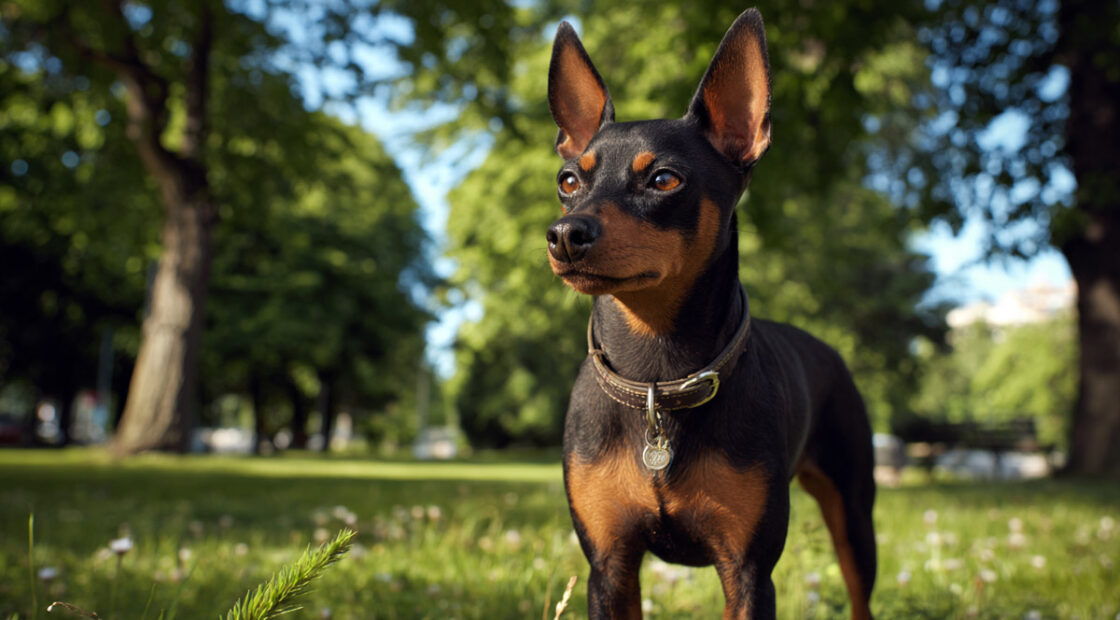
Most people look at a Miniature Pinscher and see a Doberman that stopped growing. The AKC saw it that way too. Its 1935 standard described the dog as “a miniature of the Doberman Pinscher,” according to the breed’s US parent club.
It’s backwards, though. The Min Pin is the older breed, and the Doberman was developed after it.
Germany developed this toy pinscher to clear stables of rats, and it now works as a companion and watchdog. Adults stand 10 to 12.5 inches tall and weigh about 8 to 10 pounds, with a short smooth coat and a high-stepping hackney gait.
What Is a Miniature Pinscher?
Owners say Min Pin and leave it there. The breed came out of Germany to clear stables and barnyards of rats, and these days it works as a companion and watchdog.
It stands 10 to 12.5 inches tall and carries a short smooth coat. The gait gives it away. The front legs lift high, in a hackney gait that resembles a horse’s trot.
The UKC and the Royal Kennel Club (UK, formerly The Kennel Club) standards both treat that gait as a defining trait of the breed. The FCI standard takes the opposite view and lists a hackney gait as a fault.
Min Pin is the everyday name. In Germany it’s the Zwergpinscher, which is also what FCI Standard No. 185 calls it. The US registered it as Pinscher (Toy) until 1972, and an early German name, Reh Pinscher, was linked to a small local deer the dogs resembled.
Show people call it the King of Toys, a nod to the breed’s confident bearing and high-stepping gait.
Registries file the breed under different groups. Every one of them still treats it as a small companion dog.

| Registry | Classification |
|---|---|
| American Kennel Club | Toy Group |
| Federation Cynologique Internationale | Group 2, Section 1.1, Pinscher and Schnauzer type |
| The Royal Kennel Club (UK) | Toy Group |
| United Kennel Club | Companion Dog Group |
In the AKC’s 2025 registration rankings the breed sits 67th out of 202 breeds. That’s the upper third, but small dogs such as the Yorkshire Terrier (13th) and the Chihuahua (24th) rank well above it.
Miniature Pinscher Origin and Ancestry
Germany is home. Small pinscher-type dogs worked as ratters there for centuries before a breed club fixed the type in 1895.
The AKC’s breed history says the earliest dogs may go back to the early 1600s, judging by old paintings and artwork.
Paper records start later. The Canadian Kennel Club standard puts the first written standard in the German Stud Book in 1880, with formal recognition by Germany’s Pinscher-Schnauzer Klub in 1895.
Ancestry: Breed Lore Versus Genetic Data
The breed-club story says the Min Pin came from crossing the German Pinscher with the Dachshund and the Italian Greyhound, as cited from the Miniature Pinscher Club of America.
Genetics tells it differently. A 2017 Cell Reports study led by Heidi Parker found shared ancestry with the Toy Manchester Terrier, a dog the traditional account never mentions.
One parent isn’t in dispute. Purina and WebMD both trace the Min Pin to the German Pinscher, a larger dog with the same build and temperament.
Not a Miniature Doberman
The resemblance doesn’t make it a small Doberman.
The breed is older. According to VCA Animal Hospitals, the Doberman Pinscher was developed after the Min Pin, and the two only overlap in their German pinscher background.
The confusion has an official history. The Miniature Pinscher Club of America notes that the 1929 AKC standard called the breed similar in appearance to the Doberman, and the 1935 version called it a miniature of the Doberman.
Breed profiles also split on the word “related.” Orvis says the two breeds are not related, while Wisdom Panel says they share some common ancestors.
Both statements can hold, as long as “related” means that one breed descends from the other. Neither does.
Breed Recognition Timeline
| Year | Event |
|---|---|
| 1895 | German Pinscher-Schnauzer Klub forms and fixes the pinscher varieties |
| About 1919 to 1925 | Imports reach the US; first dog registered with the AKC as Pinscher (Toy) |
| 1929 | Miniature Pinscher Club of America forms; breed shown in the Terrier Group |
| 1930 | Reclassified to the Toy Group after a petition by the parent club |
| 1972 | Official name changes to Miniature Pinscher |
The first registered dog was a black and rust female named Asta von Sandreuth, brought from Germany by Mrs. Seyschab of Pennsylvania, per the AKC.
Some profiles date AKC recognition to 1929 instead of 1925. The AKC’s own history gives 1925 for the first registration, and 1929 is when the breed club formed and the breed entered the Terrier Group, which explains both dates.
How Big Is a Miniature Pinscher, and What Colors Does It Come In?
The registries don’t measure this breed the same way, but a typical Min Pin stands 10 to 12.5 inches tall and usually weighs 8 to 10 pounds.
- The AKC allows 10 to 12.5 inches and disqualifies dogs under 10 or over 12.5
- The FCI sets height at 25 to 30 cm for dogs and bitches (Standard No. 185, 2007)
- FCI weight runs 4 to 6 kg, which converts to about 8.8 to 13.2 lb
- Pets typically weigh up to 10 lb per the Westminster Kennel Club, and 8 to 10 lb per Purina
- The AKC standard describes the coat as smooth, hard and short, lying close to the body
The standards don’t agree on what to measure. The UKC leaves weight “in proportion to build,” while the FCI fixes it at 4 to 6 kg.
The Royal Kennel Club (UK) adds that its sizes describe an ideal, and a given dog may come out larger or smaller. A pet at 13 lb is out of ring range but not unusual.
For color, the AKC ring accepts solid red or stag red, black with rust markings, and chocolate with rust markings.
The AKC disqualifies any other color. The Royal Kennel Club (UK) lists blue and tan as a breed-standard colour, so a blue Min Pin can win in Britain and not in the US.
White is capped at half an inch in its longest dimension. A scattering of white “frost” on the chest counts as a deviation, not a disqualification, according to the breed club’s illustrated standard.
Temperament of the Miniature Pinscher

A Min Pin will challenge dogs much larger than itself. Fearless and territorial, and always alert.
The AKC standard asks for fearless animation and complete self-possession, plus a spirited presence. The UKC adds proud, vigorous and alert, and disqualifies viciousness or extreme shyness.
Watchdog Instincts and Prey Drive
The Westminster Kennel Club rates energy, barking and protectiveness at 5 out of 5 on its breed page, with trainability at 3.
Those scores describe a dog bred to spot rats and announce anything that moves. The New Zealand Kennel Club rates watchdog ability as very high and protection ability as very low, which sums it up. The Min Pin raises the alarm and does not stop anyone.
Orvis says the ratting energy and prey drive are still intact. A Min Pin will bark at and chase other animals, even bigger ones.
Behavior With Children and Other Pets
Westminster scores the breed 3 out of 5 with children and strangers, and 4 out of 5 with other dogs.
Vetstreet calls the breed wonderful with older children as long as they do not manhandle the dog, which is the real limit with a toy breed.
With other dogs, WebMD warns of aggression, while PangoVet says Min Pins prefer dogs of similar size and energy. Both fit the same pattern: easy with matched playmates, quick to challenge the rest.
Barking and Separation Anxiety
Expect barking.
A 5 out of 5 barking score is the top of Westminster’s scale, and the watchdog job explains it. Orvis adds that a Min Pin without an outlet for its energy turns destructive, barky or snappy.
The breed bonds hard with its family, and breed profiles list separation anxiety as a tendency. PangoVet puts the result plainly: a bored Min Pin is a destructive Min Pin.
Puzzle toys help. So does a walk before any long absence, and a crate or small safe room gives the dog somewhere to settle.
How to Exercise and Train a Miniature Pinscher

Plan on about 30 minutes of exercise a day, the figure both The Royal Kennel Club and PDSA use, and most of it can happen indoors.
That number is a floor for movement, not for mental work. Orvis says much of the exercise can come from play inside, but PangoVet’s warning about boredom means the dog needs a job too.
Short brisk walks and indoor fetch work well. Puzzle toys give it something to think about, and agility or advanced obedience suit the dog that wants more.
Distance running is a poor match. Orvis says the breed is not built for it, and VCA rates it 2 out of 5 as a jogging partner.
Trainability is where the sources disagree. The New Zealand Kennel Club rates it very hard, Westminster gives it 3 out of 5, and WebMD calls it high.
The split makes sense once you see that the dog learns fast and just won’t cooperate without a reason. Vetstreet describes an assertive, proud and stubborn dog and recommends firm, consistent training from puppyhood.
Orvis goes further and calls it a difficult breed for a first-time owner. Treat it as a dog for people who have trained one before.
Orvis also flags the breed as slow to housebreak, so the routine matters more than the dog’s age. A basic housebreaking and crate routine looks like this:
- Pick one outdoor spot and take the puppy there after waking, after meals, after play and before bed.
- Reward within seconds of the puppy finishing outside.
- Choose a crate big enough to stand, turn and lie down in, and introduce it with meals.
- Start with short crate sessions and extend them gradually. The crate is never a punishment.
- Between outdoor trips, supervise the puppy or crate it, and clean accidents with an enzymatic cleaner.
- In winter, keep a jacket handy, since the breed is more sensitive to cold than larger dogs.
Orvis calls the Min Pin an escape artist and puts leash training and a solid recall at the top of the list.
The breed club recommends screens on doors, per PetMD, and Vetstreet says the dog is unlikely to stay in a yard, garage or enclosure. A collar with contact details is cheap insurance.
Miniature Pinscher Health Problems, Screening and Lifespan
Most Min Pins are healthy. The risks that do show up sit in the knees, hips, spine, eyes, brain and heart.
The Miniature Pinscher Club of America calls the breed fairly healthy compared with many others. It lists patellar luxation, cervical (dry) disc disease, Legg-Calve-Perthes disease, epilepsy, thyroid problems, heart defects and eye problems as the major concerns.
Common Conditions

| Condition | What happens | Screening |
|---|---|---|
| Patellar luxation | Kneecap slips out of its groove, causing lameness | OFA patella evaluation by a vet |
| Legg-Calve-Perthes disease | Blood supply to the femoral head fails and the bone breaks down; limping is the usual first sign | OFA radiographic evaluation |
| Mucopolysaccharidosis VI (MPS VI) | Enzyme deficiency causing stunted growth, skeletal deformity and corneal clouding | PennGen DNA test |
| Eye disease | Progressive retinal atrophy, cataracts | ACVO eye exam; BVA/KC/ISDS scheme in the UK |
| Epilepsy | Recurrent seizures, usually starting young | No screening test; a vet rules out other causes |
Surgery is the standard fix for severe Legg-Calve-Perthes, and PetMD reports that small dogs typically recover well and live pain-free afterward.
The kneecap data doesn’t match the reputation. A VetCompass study (Royal Veterinary College, 2016) of 210,824 dogs at 119 English clinics found patellar luxation in 1.3 percent of dogs overall and singled out the Pomeranian, Chihuahua and French Bulldog as the most predisposed.
An earlier analysis of US teaching-hospital records, cited in the same paper, had flagged the Miniature Pinscher as substantially higher risk. The two datasets sample different dogs (referral hospitals versus primary-care clinics), which is the likely reason they disagree.
Health Tests Breeders Should Run
The University of Pennsylvania’s PennGen lab lists the MPS VI DNA test at $75 per sample, with results reported as normal, carrier or affected.
A good breeder will have most of the following on paper.
- Kneecaps get an OFA patellar luxation evaluation, done by a vet
- An OFA radiographic evaluation covers hips and Legg-Calve-Perthes
- Eyes need an ACVO exam registered with OFA, current within the past year
- Both parents should have the PennGen DNA test for MPS VI
- In the UK the BVA/KC/ISDS eye scheme applies, and litter screening is included
The breed club says the Miniature Pinscher participates in the OFA CHIC program. A CHIC number records that the required tests were done and published, abnormal results included, so it does not mean the dog passed.
Carriers of MPS VI are healthy, which is why the test matters. Wisdom Panel notes that a carrier can be bred safely to a clear dog, while carrier-to-carrier matings can produce affected puppies.
A 2020 Animal Genetics paper by Raj and colleagues described the ARSB gene variants in Min Pins and Miniature Schnauzers. The AKC Canine Health Foundation, which funded researchers on that work, notes that affected dogs were often misdiagnosed with hip dysplasia or femoral head necrosis.
The Royal Kennel Club (UK) places the breed in Breed Watch Category 1 at the time of writing (October 2026). Judges have flagged no breed-specific points of concern.
How Long Miniature Pinschers Live
Breed profiles put the lifespan anywhere from 10 to 17 years, and the range depends on who is counting.
Orvis says 10 to 14 years, VCA Animal Hospitals 12 to 14, PetMD 12 to 16 and Omlet 13 to 17.
The only band all four cover is 13 to 14 years, which makes it the defensible planning figure. The Royal Kennel Club (UK) says over 12 years, and Westminster lists 16 as the maximum.
The ranges differ because the studies behind them use different dogs: breed-club questionnaires in one UK survey, vet-clinic records in another, per a summary from Walkerville Veterinary Clinic.
Owners control a little of this. Embrace Pet Insurance says to keep the dog on the lean side, and iHeartDogs links untreated dental disease to heart, liver and kidney problems.
Grooming and Daily Care for a Miniature Pinscher
Grooming takes minutes a week: a soft-brush pass, a bath only when the dog is dirty, and nail trims every two weeks, per Orvis and Dogs NSW.
Shedding is where the sources split. The Royal Kennel Club lists the breed as a shedder, Extreme Dog Fence calls it a moderate shedder, and Hundeo says very little to none.
Ears need routine cleaning, per PetMD’s care guide, and any eye discharge deserves a vet visit. Teeth need regular brushing because dental disease spreads to the organs. Nails, as noted, every two weeks.
A vet-approved dog ear wipe handles the routine ear cleaning.
Indoors, give the dog a blanket to burrow into. PangoVet notes that Min Pins hunt out blankets and warm spots whenever they can.
Weight control is daily care too. Adult Min Pins can finish a day’s food quickly, and PetMD suggests a slow feeder bowl to slow them down.
Home-proofing matters more than most owners expect. The breed club warns that Min Pins investigate any object in reach and any gap they can fit into, so cabinets, appliance gaps and small objects need securing.
Is a Miniature Pinscher the Right Dog for You?

It fits an active owner who’s home a lot and has handled a dog before. Homes with toddlers or long workdays away are a poor fit, and so is anyone expecting off-leash reliability.
Who Suits the Breed and Who Does Not
On the plus side, flats and apartments are fine and a large yard isn’t needed (Royal Kennel Club, Chewy). The grooming load is light, and every visitor gets announced.
The downsides take longer to list.
- It’s territorial with strangers and other dogs, so crowded off-leash parks are a bad idea
- It escapes through gaps, so fencing and door screens matter
- Screening and orthopedic care add vet cost over the dog’s life
- Rough handling goes badly, which rules out most toddler households
First-time owners get conflicting advice. Chewy’s breed guide recommends the Min Pin for first-time pet parents in small urban spaces, while Orvis warns against it.
My rule is to choose it as a first dog only if daily training fits your schedule. The coat is easy to deal with, and the personality is the hard part.
Homes that don’t work include those with eight-hour workdays and nobody home, rabbits, hamsters and other small pets, or owners who want a dog that walks off-leash reliably.
Miniature Pinscher Compared With Similar Toy Breeds
Nearly every comparison lands on the Chihuahua or the Italian Greyhound, and the two pull in opposite directions.
| Breed | Size next to a Min Pin | Energy | Plan around |
|---|---|---|---|
| Chihuahua | Smaller: 5 to 8 inches, up to 6 lb | Medium | High barking level |
| Italian Greyhound | Taller, slimmer: 13 to 15 inches, 7 to 14 lb | Moderate bursts | Cold and fragile legs |
| Miniature Pinscher | Baseline | High | Territorial, escapes |
The Chihuahua is the closest match in attitude but smaller, and Purina’s breed library rates its energy medium. Rover’s guide lists barking as high.
Pick the Chihuahua when exercise time is short.
The Italian Greyhound is the calmer lap dog, with moderate energy in spurts per Lemonade’s breed guide. It is extremely cold-sensitive and needs a coat below 50 degrees Fahrenheit, and Hundeo warns that its slender legs fracture in jumps.
Pick the Min Pin when you want the guard dog of the three.
How Much Does a Miniature Pinscher Cost, and Where Do You Get One?
A puppy from a reputable breeder runs $1,000 to $3,000 in the US per PetMD, and adopting from a rescue runs $150 to $525 across current Petfinder and RescueMe listings.
Puppy Price and Yearly Costs
Prices disagree by source. Chewy puts the typical puppy at $900 or more, while PetMD’s range reaches $3,000.
The gap comes down to breeder reputation, lineage, location and health testing.
The puppy price is the smaller bill. Even a toy breed adds up to a large expense over its life, and vet care for a breed with orthopedic and eye risk is the line most likely to surprise you.
In the UK, PDSA puts the minimum monthly cost at 70 pounds.
Choosing a Responsible Breeder

The breed club’s referral list is a starting point, not an endorsement, so the checking is yours to do.
- Start with the MPCA breeder referral list and the AKC Marketplace, and treat both as leads.
- Ask for OFA patella and hip results and a current eye exam on both parents.
- Ask for the MPS VI result on both parents, and avoid carrier-to-carrier pairings.
- Meet the dam and puppies in person or by video call. AKC lists refusal of phone calls as a scam red flag.
- Get a written contract and a health guarantee, plus the breeder’s commitment to the MPCA Code of Ethics.
- Expect questions back. A good breeder screens buyers too.
Adopting a Miniature Pinscher
An adult from rescue shows you the temperament before you commit, which no puppy can.
The Internet Miniature Pinscher Service, formed in 1998, is the largest single-breed rescue in the US. It waives its adoption donation for dogs 10 years and older.
The top fee, $525 on a March 2026 RescueMe listing, covered spay or neuter, vaccinations, heartworm testing, microchip, health certificate and transport. The $150 listings are the low end.
Miniature Pinscher FAQ
How fast does a Miniature Pinscher puppy grow?
Fast. By 6 months a puppy reaches about half its adult weight, and by its first birthday it is full size, according to Weenect’s breed guide.
Healthy Paws’ growth chart lists 3.9 to 4.8 pounds at 3 months and 8 to 11 pounds at 12 months.
How much should a Miniature Pinscher eat per day?
An adult eats half a cup to one cup of high-quality dry food per day, split into two or three meals, according to Orvis.
Puppies need three or four meals a day, per the breed club as cited by PetMD.
Is a Miniature Pinscher hypoallergenic?
No. Weenect lists the breed as not hypoallergenic, and The Royal Kennel Club records it as a shedder.
A short coat lowers grooming work, but it does not make a dog allergy-safe. Spend time with an adult dog before committing if allergies run in the household.
Are Miniature Pinscher ears cropped and tails docked?
It depends on the registry. Per the breed club’s history, the AKC standard allows cropped or natural erect ears and describes docked tails.
The UKC goes the other way: no dog in any UKC event is penalized for a full tail or natural ears.
What is a Miniature Pinscher mix?
Cross a Min Pin with another breed and you get a mix. Dogster’s roundup of 23 Min Pin mixes includes the Chipin (Chihuahua) and the Doxie-Pin (Dachshund).
Size, temperament and health vary by parent, so the screening questions apply to a mix as well.
Can a Miniature Pinscher be a therapy dog or compete in dog sports?
Yes. Wisdom Panel says properly trained Min Pins make good therapy dogs, and Orvis names agility and advanced obedience as strong fits.
PetMD also lists field trials and dock jumping as activities for the breed.
Does a Miniature Pinscher get along with cats?
Sometimes. WebMD describes the breed as affectionate toward people and cats, while Orvis says its prey drive makes it chase other animals.
Raise them together from puppyhood and supervise early meetings. Give the cat an escape route.
Is pet insurance worth it for a Miniature Pinscher?
Usually yes, because patellar, hip and eye conditions bring large vet bills. Lemonade’s published premiums average $40 to $50 a month for dogs aged 1 to 4 and $70 to $75 at age 7.
Enroll while the dog is young, since policies exclude pre-existing conditions, according to PetInsuranceQuotes.
The First Month With a Miniature Pinscher
Spend the first month on the vet, the door latches and the crate, in that order.
The order follows the cost of a mistake. A vet exam goes in week one, gap and door proofing comes before any free roaming, and the crate routine and puppy introductions start in week two.
A vet who finds a limp can restrict exercise, which changes how much training and play the other steps allow, per PetMD.
It costs some freedom. A supervised first month means no off-leash outings and a crate in the living room, and the payoff is a dog that never practices escaping.
This sequence is verified as of October 2026. A diagnosed orthopedic or eye problem moves the exercise and training plan onto the vet’s schedule.
Food is the next purchase, and a comparison of puppy food brands narrows the field.