Briards have a double dewclaw on each hind leg, and it isn’t optional. FCI Standard No. 113 (2019 edition) disqualifies any Briard with a single dewclaw or none on the hind legs, and the UKC standard sets the same requirement of two per rear leg.
The rest of the dog is a French sheepdog that herds and guards flocks, with a long, coarse, goat-like coat. Breeders and judges measure each one against a breed standard first drawn up in France in 1897.
What Is a Briard?
Its French name is Berger de Brie, and both names point to the same dog. It guards flocks as well as moving them, and the long, coarse coat looks a lot like a goat’s.
FCI Standard No. 113 lists the breed’s use as sheepdog and guard dog. It also records an older name, Chien de Berger francais de Plaine, the French lowlands sheepdog.
Registries don’t agree on which group the breed belongs to, which is why one guide says Herding and another says Pastoral.
| Registry | Group | Name used |
|---|---|---|
| AKC | Herding Group | Briard |
| UKC | Herding Dog Group | Briard |
| The Kennel Club (UK) | Pastoral Group | Briard |
| FCI | Group 1, Sheepdogs and Cattle Dogs | Berger de Brie (Briard) |
When you search a breed club or health database, use the name that registry uses.
Where Does the Briard Come From?
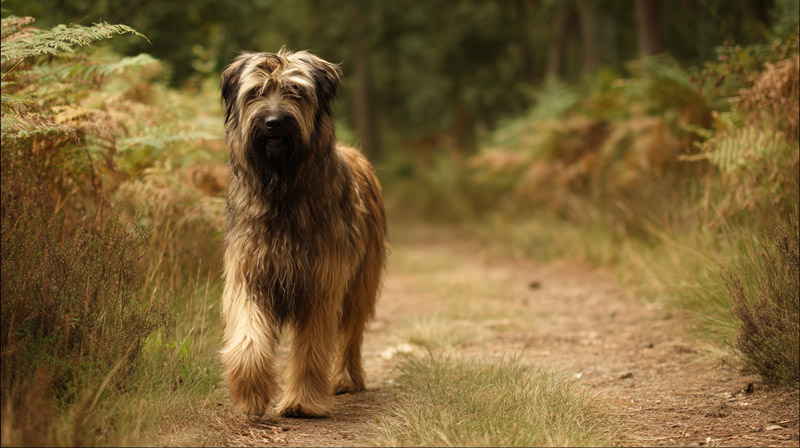
France, and the name comes from the Brie region, though nobody can say for sure how much of the breed was developed there.
Showsight Magazine’s Briard history overview calls the origin obscure. The FCI standard traces the name Chien de Brie to an early agricultural treatise.

The documented timeline starts later. Thomas Jefferson imported a “chienne bergere big with pup” in 1789, believed to be a Briard. Le Club des Chiens de Bergers Francais formed in France in 1896, and France adopted the first Briard standard in 1897. The AKC followed with its first Briard standard in 1928, and the first American Briard champion of record came in 1931.
Dates come from Showsight’s history overview.
Both world wars cut into the breed. The AKC notes that the French used Briards in both wars and once made the breed the army’s official dog.
Jefferson did more than import one dog. He bred Briards at Monticello, and the AKC reports that requests for pups reached him from as far away as Kentucky as wool production grew.
Showsight’s overview puts the Briard and the Beauceron among the oldest French sheepdogs. They were once believed to be close relatives, along with the Berger de Picard and the Berger des Pyrenees.
The post-war years were rougher in the United States. Showsight says the breed was held in little esteem among dog fanciers, and many dogs were unsocialized and unreliable.
Recovery came through coat care and socialization. The same overview credits those two habits for the breed’s later showing in herding, tracking, obedience and agility.
What Does a Briard Look Like?
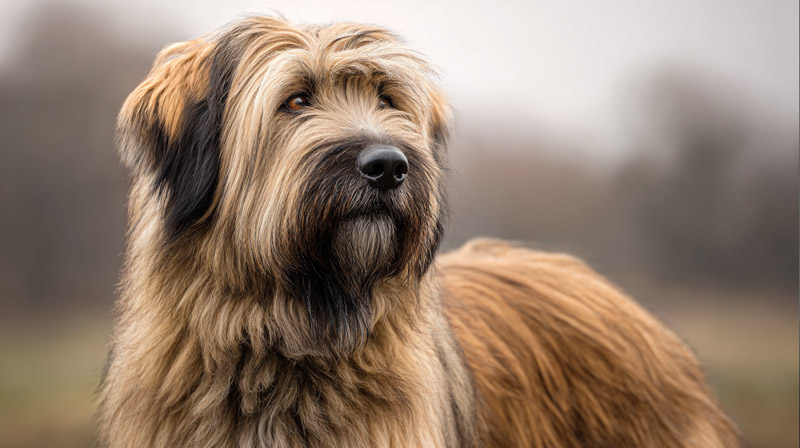
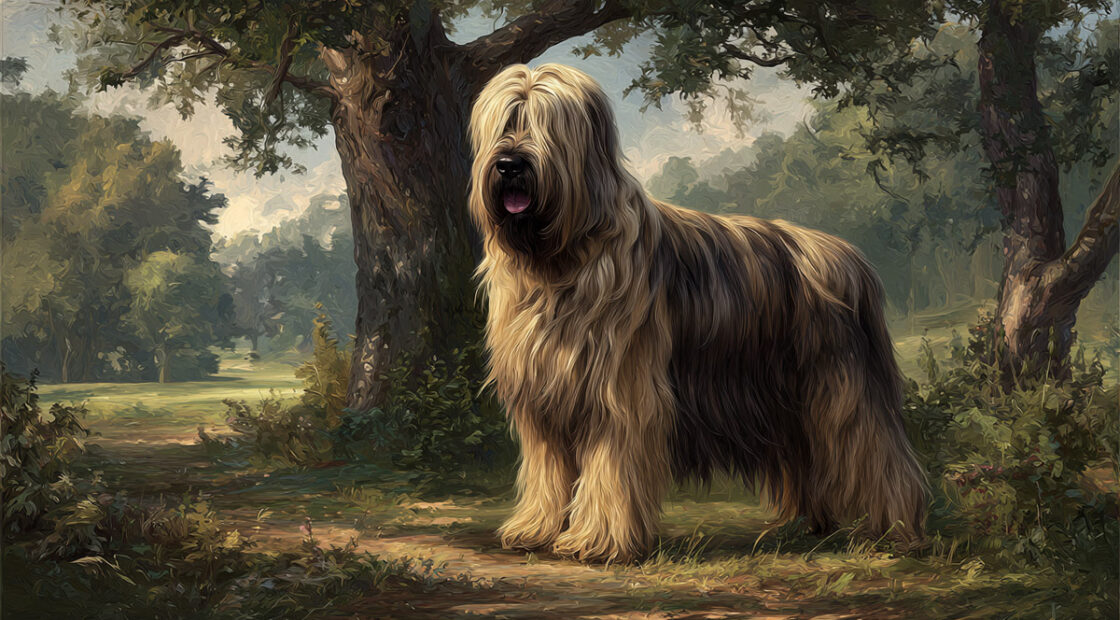
A Briard stands 22 to 27 inches at the withers, wears a long, coarse, slightly wavy coat, and carries two dewclaws on each hind leg.
Size and weight
Height is standardized. Weight is where the guides disagree.
Under the AKC standard, males run 23 to 27 inches and females 22 to 25.5 inches. The FCI standard gives males 62 to 68 cm and females 56 to 64 cm. Any dog or bitch under the AKC minimum is disqualified. On hind dewclaws, the UKC standard (revised 2009) calls for two per rear leg.
Hill’s Pet Nutrition lists 60 to 100 pounds for males and 50 to 80 pounds for females. The AKC’s breed weight chart gives 55 to 100 pounds for both sexes.
Neither range is a standard, so treat weight as a rough guide and judge condition by hand.
Coat texture and accepted colors
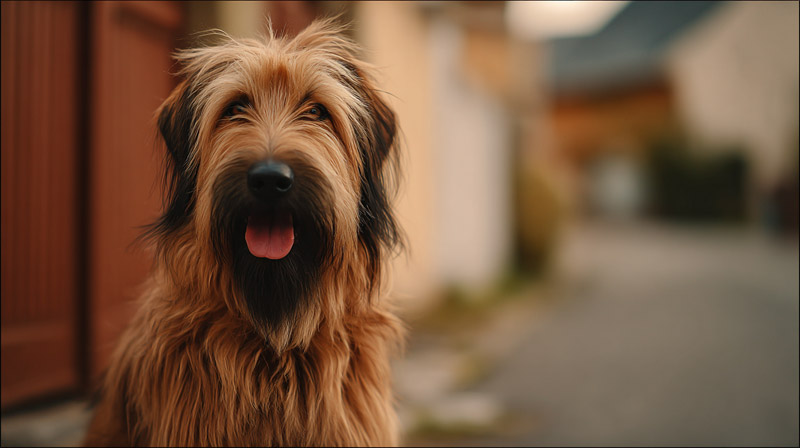
The AKC standard describes the outer coat as coarse, hard and dry, with a rasping sound between the fingers, over a fine, tight undercoat. Accepted colors are uniform black, gray or tawny (called fawn in the FCI and UK standards). The face carries a beard, mustache and eyebrows that partly hide the eyes (FCI standard).
The AKC and UKC standards both disqualify a white coat, a spotted coat and a white chest spot wider than one inch. Some breed profiles list white as a color. The registry standards do not allow it.
The Kennel Club’s UK standard, as reproduced by Dogs NSW, allows dark shading on a fawn coat only when it blends gradually. A visible dividing line makes the dog bicolored, which is not permitted.
The Briard Club of America’s breed education tells judges to put hands on the dog, because the dense coat hides structure and movement.
Double hind dewclaws
Two dewclaws on each hind leg is a requirement of the breed, not an oddity. They should form well-separated thumbs with nails, set close to the foot (FCI, UKC).
The FCI standard disqualifies a single dewclaw or none. The UKC disqualifies a dog with fewer than two on each rear leg.
The FCI says shepherds kept them by tradition. An earlier FCI text adds that the low double dewclaw gives the foot a steadier set.
WebMD notes that the dewclaws may need extra attention. They sit off the ground and do not wear down, so regular nail trims matter.
What Is the Briard Temperament Like?
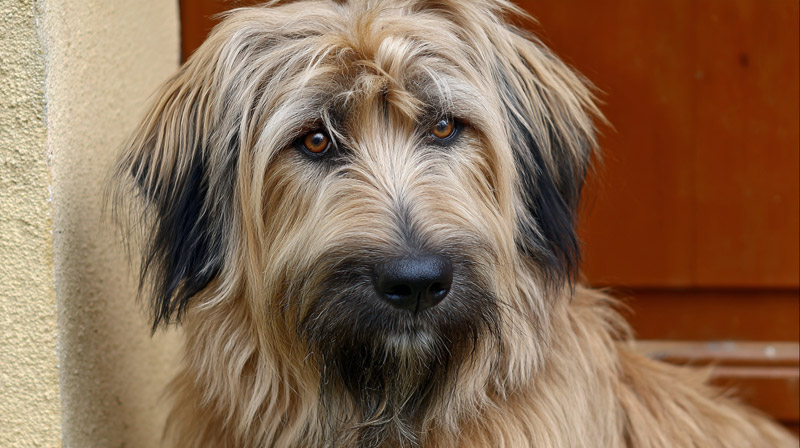
Briards are loyal and protective with their own family and reserved with strangers. The AKC standard names intelligence, faithfulness and gentleness as the breed’s core character.
Orvis ties the independent streak to the breed’s history of herding without human direction.
With strangers, a Briard stays reserved, so introductions go best on the dog’s terms. Children are workable with supervision, and never as a ride-on or climbing dog. Other pets need slow, supervised introductions.
Breed guides split on children. One calls the Briard very good with children of all ages, another says its size makes it a poor fit for small ones.
Orvis lands in the middle: supervise, and never let a child climb or ride on the dog.
Orvis also reports that a Briard’s strong memory makes a frightening experience stick. Showsight’s Briard history overview says coat care and socialization matter even more in this breed than in most.
How Much Exercise and Training Does a Briard Need?
More than 40 minutes of exercise a day, according to Hill’s Pet Nutrition, plus real work for its mind.
Daily exercise
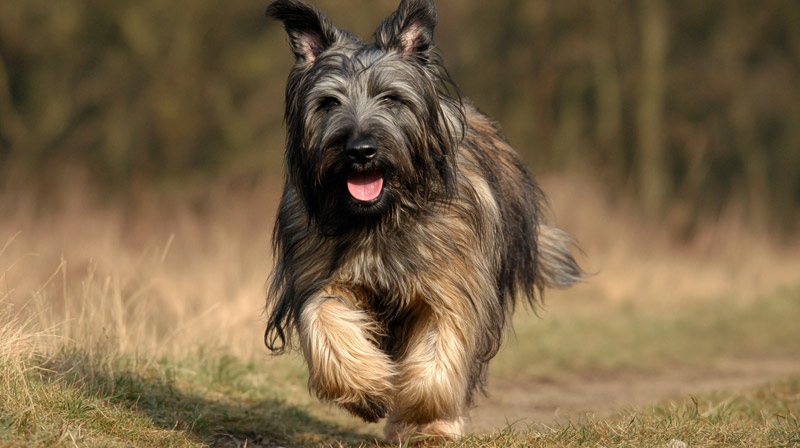
Hiking, jogging and long walks suit the breed, and herding, tracking or obedience work covers the mental side.
Skip the exercise and it shows up as chewing and digging. Hill’s rates the digging tendency high.
Training and herding instinct
Hill’s says you must earn a Briard’s respect through consistent obedience training. Orvis adds that methods that work on a Labrador may not work here, and that the breed wants a confident owner.
Because a Briard holds on to bad experiences, keep corrections calm and reward-based.
Herding tests give the instinct a legal outlet, and the AKC lists the Briard as an eligible breed. The Instinct Test is noncompetitive pass/fail, open to dogs from 6 months old, with no prior training needed. The Herding Test and Pre-Trial come next, with training and livestock exposure expected. Trials are competitive and scored at started, intermediate and advanced levels on courses A, B and C.
The AKC describes the Instinct Test as a gauge of basic instinct and trainability, which makes it a low-cost first check before committing to trial training.
How Do You Groom a Briard?
Brush a Briard through to the skin for at least two hours a week, according to the AKC, and more often after a day in the field.
The payoff is a low-shedding dog. Orvis rates the breed low on shedding despite the length, so the work goes into stopping mats, not vacuuming.
A typical weekly session runs like this:
- Check the coat for burrs, seeds and mud, which it collects fast outdoors (Wamiz)
- Brush in small sections, skin outward, not just across the surface
- Pick any mat apart with fingers and a comb before it tightens
- Comb the beard and wipe the face
- Finish with ears and nails
Skip a couple of weeks and the session grows. Vetstreet notes that a coat left to tangle takes far longer than the usual routine.
Keep baths rare. WebMD advises minimal bathing because even a good dog shampoo changes coat quality, and the breed needs no clipping.
Ears need their own check, since the hair around them traps debris and ear irritation is a common vet visit for the breed. A routine wipe with dog ear wipes keeps buildup down.
How Long Do Briards Live, and Which Health Problems Affect Them?
Briards live about 12 years on the best recent data. Hip dysplasia, bloat, congenital stationary night blindness and hypothyroidism get the most attention.
Lifespan figures and why they differ
A 2024 Scientific Reports study of UK dogs, as summarized in Wikipedia’s Briard entry, gives the breed a median lifespan of 12.6 years, close to the all-dog average.
Other sources run lower. Hill’s Pet Nutrition lists 10 to 12 years, and a Briard health column in Showsight puts the average at 8 to 9 years once accidents and puppy losses count, with 11 to 12 the usual hope for dogs that mature.
The gap comes from what each number counts. An average that includes early deaths sits below the lifespan of dogs that reach adulthood, and the Showsight figure is a breeder’s estimate, not a survey.
Common conditions and the tests for them
Congenital stationary night blindness
Congenital stationary night blindness (CSNB) is an inherited retinal disease tied to a defective RPE65 gene. Breed guides describe it as night vision loss, while the research dogs that carried two defective copies were blind from birth.
A DNA test exists (Showsight), so breeders can screen parents instead of waiting for signs.
In 2001, researchers at Cornell, the University of Pennsylvania and the University of Florida restored vision in affected dogs with gene therapy, reported in Nature Genetics.
The partner press releases don’t agree on the dogs. One says three Briard puppies, another four Briard dogs, and a third Briard-mix dogs.
A later Gene Therapy paper found that a dog treated much later in life did not recover vision, which suggests a treatment window. Lead researcher Gregory Acland also said the therapy was unlikely to become routine for dogs.
Bloat
Bloat, formally gastric dilatation-volvulus, is an emergency in large, deep-chested dogs, and Showsight’s health column names it as a Briard concern.
Watch for restlessness and unproductive retching (Puppilot) and a rapidly swelling abdomen. Pale gums, rapid breathing or collapse are what WebMD treats as a reason to get help immediately.
A vet can relieve the pressure by passing a tube into the stomach, WebMD notes. Ask about prevention at the first checkup, not after the first scare.
Hip dysplasia and hypothyroidism
iDog, a breed disease database, ranks hip dysplasia as the most important condition on the Briard’s list.
Hypothyroidism leaves a dog lethargic and weak when the thyroid underproduces (WebMD), and clinic guides place the signs in middle age.
What a CHIC number does and does not tell you
CHIC, the Canine Health Information Center, is a health database sponsored by the Orthopedic Foundation for Animals (OFA). The parent club picks the required tests, owners opt in, and results go public.
The catch is that a dog earns a CHIC number whether results come back normal or abnormal, as long as every required test is done and published.
So a CHIC number proves testing, not clean results. Read the results, and check the OFA breed page for the current required list.
In the UK, The Kennel Club publishes a breed health and conservation plan and works through breed health coordinators.
Is a Briard the Right Dog for You?

It suits an active owner who is home often and does not mind coat work. It fits poorly in apartments without outdoor access, in hot climates and in households with long solo days.
Briards attach strongly to the family and like having people nearby (Orvis). Indoors they settle, and PetMD says the breed spends most of its time there. They also adapt to outdoor living when needed.
Against that, the people focus makes long absences a poor match, heat tolerance is limited (Wamiz), and crate training may be necessary (Orvis). The breed is also rare, so expect a search and a wait.
Orvis says the breed can adjust to apartment life only when daily romps outdoors are guaranteed.
It mostly comes down to whether someone is home most days, whether there’s a daily outdoor routine, and whether you have time for brushing. Yes to all of those and the Briard fits. Anything less points to a lower-maintenance breed.
How Does the Briard Compare to the Beauceron and Old English Sheepdog?
The Briard sits between its two closest comparisons: more grooming than the Beauceron, less than the Old English Sheepdog.
| Breed | Coat and grooming | Owner profile | Exercise |
|---|---|---|---|
| Briard | Long, coarse coat, weekly deep brushing | Confident owner, independent dog | High, plus mental work |
| Beauceron | Shorter outer coat, low grooming | Experienced, assertive handler | Very high, needs a job |
| Old English Sheepdog | Abundant shaggy coat, brushing every day | Firm handler, independent thinker | High |
Go with the Briard if you want a protective, family-centered dog and will brush weekly.
The Beauceron makes more sense if you want less coat work and have real handling experience. Vetstreet calls it best suited to experienced owners and to families with older children.
The Old English Sheepdog asks for the most coat work, with daily brushing to prevent matting (Orvis). It only wins if you want that look and that routine.
How Do You Find a Briard Puppy or Rescue?
Start with the Briard Club of America, the AKC parent club, because the AKC points the public to the parent club first when looking for a knowledgeable breeder.
Ask any breeder for the parents’ hip and eye results, CSNB DNA status and public OFA records. Paction notes that wait times follow how often a breeder plans litters. For rescue, ask the parent club whether it coordinates placements, since availability is unpredictable for a rare breed.
Registration alone proves little. Paction advises looking at how a breeder plans litters, not just whether the dogs are registered.
Prices vary widely by country and breeder. One Australian breeder listing for a 2024 litter asked AU$4,500, with a deposit due at six weeks (Dogzonline).
Some older fact sheets quote far lower prices, and those no longer match current listings.
The purchase price is the smaller bill, because dog ownership is expensive over a lifetime. Paction makes the same point about ongoing costs, and a large, heavy-coated breed adds grooming and vet bills.
Briard FAQ
How do you pronounce Briard?
The French pronunciation is close to bree-YAR, with the stress on the last syllable.
The full name, Berger de Brie, sounds like behr-ZHAY duh BREE.
Are Briard ears cropped?
Either way is allowed. The AKC and UKC standards accept cropped or natural ears, and judges give neither a preference.
Briards are born with pendant ears, so erect ears come from surgery. The FCI standard permits cropping only where the practice is not forbidden.
Do Briards bark a lot?
No, not excessively. Hill’s Pet Nutrition rates the breed’s barking tendency as moderate.
The bark works as a watchdog alert, a habit that fits the breed’s history of warning when guarding alongside the shepherd (Dogs NSW).
Is a Briard mix a recognized breed?
No. A Briard mix is a crossbreed with no breed standard, so size, coat and temperament depend on the other parent.
The AKC enrolls mixed-breed dogs through its Canine Partners program, while purebred Briards register under the breed itself.
What to Arrange in a Briard’s First Year
Settle health testing first and a bloat plan second. Socialization and coat handling come third.
The order follows reversibility. Congenital stationary night blindness is inherited, so only the choice of parents prevents it, while bloat gives no lead time and fear and mats respond to work done after purchase.
Dogs NSW advises starting grooming practice long before the coat needs it, so the third step can begin in the first week.
The price of that order is time, since a litter with tested parents means a waitlist instead of the first available puppy.
Since 6 January 2025, The Kennel Club has registered imported Briards only when CSNB status is proven clear, carrier or hereditarily clear (position verified October 2026). A revised OFA test list for the breed would replace the first step with the new list.