The AKC let the Beauceron into its Herding Group ring only on 27 June 2007, according to the AKC’s 2007 press release. The FCI had accepted the breed definitively in 1963, so the American side showed up more than four decades late.
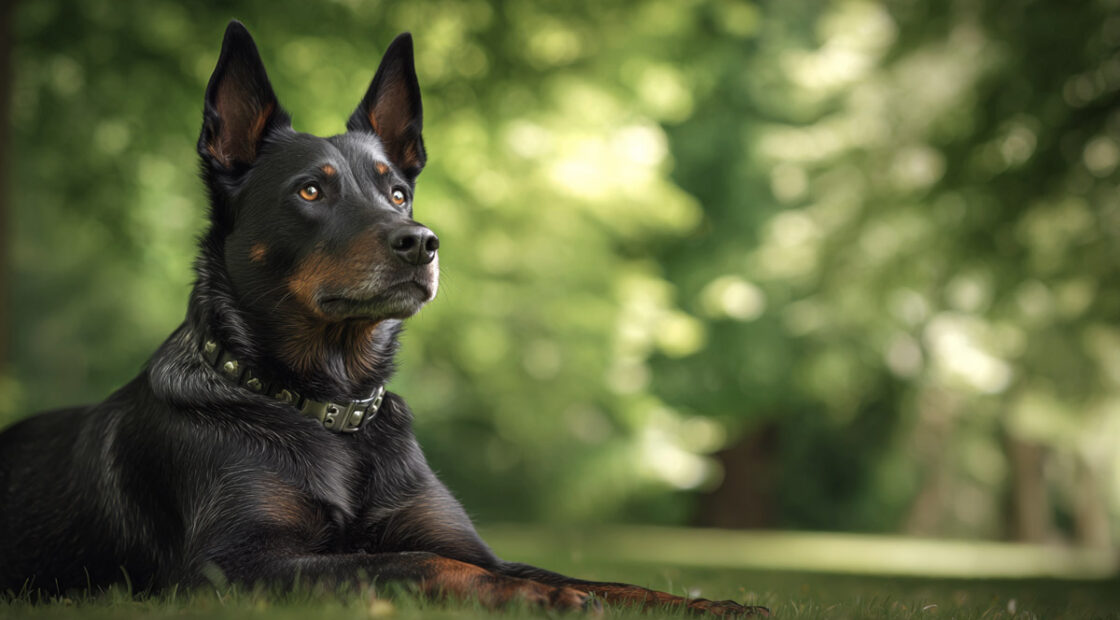
It’s a big French sheepdog from the plains around Beauce, black with tan markings and a pair of dewclaws on each hind leg. French shepherds call it the Berger de Beauce, or bas rouge (red stockings), and the FCI files it in Group 1 with the sheepdogs.
Driving and guarding flocks was the original job.
Police, military and search and rescue units picked the breed up later for messenger, detection and tracking work.
What Is the Beauceron?
Sheep on the plains around Beauce needed a dog that could work them and guard them, and the Beauceron was developed for exactly that. Double dewclaws on each hind leg and tan markings on a black coat are the giveaways.
The Federation Cynologique Internationale files it in Group 1 (sheepdogs and cattle dogs), and the American Kennel Club places it in the Herding Group.
The French name is Berger de Beauce, meaning sheepdog of Beauce. Bas rouge means red stockings and points to the tan on the lower legs. The FCI standard uses Beauce Sheepdog in English, and you will also run into French Short-Haired Shepherd.
The FCI standard dates the nicknames to the end of the 19th century, when breeders settled on Beauce Dog, Beauceron and Red-Stocking for the old plains sheepdogs. Those dogs had smooth hair on the head and a harsh short coat, with tan on the extremities of all four legs.
Coat length is what eventually separated it from the long-haired Briard, a dog from the same plains that was once lumped in with it.

Nobody mixed it with anything, either. The US standard says the breed developed solely in France with no foreign crosses.
Size, Coat and Distinguishing Features of the Beauceron
The build is tall and slightly rectangular, with a short double coat in black and tan or harlequin. The show ring treats the double hind dewclaws as non-negotiable.
Height and weight
Males stand 65 to 70 cm at the withers and females 61 to 68 cm (FCI standard, as published by Les Amis du Beauceron). The same standard asks for a chest girth more than one fifth above the height at the withers.
Weight runs 66 to 85 lb at Hill’s Pet and 70 to 110 lb at Dogster (2026).
The standards disqualify on height. Weight is left to proportion, so published ranges vary by source, and the two above overlap only between 70 and 85 pounds.
I’d treat 70 to 85 pounds as the safe middle for a lean adult, with bigger males drifting toward the top of the Dogster range.
Coat, colors and shedding
The outer coat is coarse and dense over a thick undercoat, and it runs short and fine on the head, ears and lower legs (UKC standard, 2025 update).
Black and tan or harlequin are the options, and the French standard calls the tan squirrel red, according to a ShowSight judging guide. Black and tan dogs have dark brown eyes. Harlequins can have eyes of two colors.
Sources disagree on shedding. WebMD describes heavy shedding through two seasonal blowouts a year, while Yourdog’s breed profile rates moulting as low.
Brushing two or three times a week covers most households (Purina UK), and a bath is only needed after a muddy outing (Dogster).
Double dewclaws, ears and tail
Show-ring eligibility hangs on the double dewclaws.
The standards call for two well separated thumbs with nails on each hind leg, set close to the foot. A dog with fewer is disqualified under the AKC, UKC and FCI texts.
Purina UK credits the extra claws with better traction on rough terrain. WebMD adds the practical note to trim them along with the other nails.
| Trait | What the standards require | Show-ring consequence |
|---|---|---|
| Hind dewclaws | Two per leg, well separated | Fewer than two disqualifies |
| Ears | Set high, cropped or natural | Natural ears upright and rigid disqualify |
| Color | Black and tan, or harlequin | Other colors disqualify |
Ears get the most questions. The AKC and UKC standards allow cropped or natural ears, and the UKC describes cropping in America as a personal choice.
Natural ears sit flat, half pricked or drooping, and stand off the cheeks (AKC standard). The tail is long with a slight hook at the tip (WebMD), carrying a light brush with feathering underneath (ShowSight).
What Is the Beauceron’s Temperament Like?

The FCI standard calls the character gentle and fearless, and the UKC standard adds that the dog must never look mean, timid or worried. Reserved with strangers is the usual description.
Dogster’s breed profile lists the working-dog side as smart, curious, energetic and independent. WebMD notes that the French novelist Colette called the breed a country gentleman, which fits the calm, watchful side.
With family and children
Eukanuba calls the breed great with children when they grow up together. Purina UK is more cautious and says the exercise and training demands rule out very busy families and homes with younger children.
Yourdog’s profile asks for attention around kids even when the dog was raised with them.
Whichever camp you land in, a dog this large needs supervision around small children, however gentle it is.
With strangers and other dogs
Reserved is the standard’s word, and the protective instinct is the reason. Adults are suspicious of strangers (Dimensions), and PangoVet notes the breed can turn territorial.
Other dogs are the harder test. Yourdog’s profile warns that Beaucerons try to dominate other male dogs, so off-lead meetings with unfamiliar males need care.
Eukanuba says early socialization is what keeps the guarding instinct from turning into over-protectiveness.
How Much Exercise, Training and Socialization Does a Beauceron Need?
Adult Beaucerons need about two hours of exercise a day, according to Purina UK and WebMD. Hill’s Pet puts the figure at more than 40 minutes.
That’s a wide gap, but every source describes the same dog, one that only settles after real work. Orvis says the breed rests contentedly at home once the day’s exercise is done.
Exercise and mental work

Walks alone don’t cover it. Purina UK pairs the two hours with extra training and mental stimulation.
Dogster, PangoVet and ShowSight name agility, flyball, obedience, herding, and hiking and jogging as outlets.
Training style

Firmness is the consistent advice.
Animal-World and WebMD both describe a quick learner that responds to firm, consistent handling started early.
Skip that and things go sideways. Omlet’s breed profile warns that an untrained Beauceron takes over the household, and Hill’s Pet says the dog leans dominant and needs a firm hand, which is why Dogster steers the breed toward experienced owners.
Socialization

PangoVet traces the territorial streak to the guarding and herding background, and Eukanuba says early socialization keeps it from becoming over-protectiveness.
WebMD tells owners to begin socialization and training from the very start. In practice that means lots of different people and other dogs, in as many places as you can manage, from the first weeks at home.
Beauceron Health, Screening and Lifespan
Beaucerons live 10 to 12 years according to Dogster (2026) and Chewy (2025). Other sources stretch the range from 9 years (Dimensions) to 13 (Omlet).
Health sources conflict on how much to worry. The Kennel Club’s UK breed page lists no breed-specific points of concern for judges, while US sources name hip dysplasia, bloat, dilated cardiomyopathy and progressive retinal atrophy.
Scope explains most of it. Breed Watch covers conformation points for judges to check, so it says nothing about hidden disease, which is why Purina UK still advises hip scoring and eye testing for breeding dogs.
Hip dysplasia and elbow dysplasia
US sources mention hip dysplasia more than any other condition.
It is inherited, and the loose joint wears over time into arthritis (PetMD). Healthy Paws pet insurance lists elbow dysplasia alongside it.
No DNA test exists, so breeders screen by X-ray, either with Orthopedic Foundation for Animals (OFA) radiographs or PennHIP, which PetMD says allows early detection. Chewy adds the rule that affected dogs should not be bred.
One caveat. The OFA database is voluntary, and a review in VIN (Tufts, 2013) notes that obvious cases are probably never submitted, so published results understate the true rate.
Bloat and gastric dilatation-volvulus
Bloat is the emergency to plan for. The standard asks for a chest girth more than one fifth above withers height, and Chewy’s veterinary team ties the breed’s gastric dilatation-volvulus risk to that deep-chested shape.
VetCompass (Royal Veterinary College, 2017) found the condition most often in large and giant deep-chested breeds. It also found survival with emergency care far better than the condition’s reputation suggests.
Owners control the mealtime routine, and Chewy recommends slow feeder bowls to stretch out how long a Beauceron takes to eat.
- Split the daily ration into two or three small meals (Animal-World).
- Slow the pace of eating.
- Keep hard exercise away from mealtimes in both directions (Chewy, Healthy Paws).
- Go to a vet immediately at any sign of bloat (Chewy).
Some veterinarians recommend a preventive gastropexy at spay or neuter in high-risk breeds, according to VCA Animal Hospitals. It does not stop bloat itself, but it prevents the stomach from twisting in most cases, and whether a Beauceron qualifies is a question for your vet.
Heart and eye conditions
The American Beauceron Club lists dilated cardiomyopathy, a heart muscle disease, among the breed’s concerns.
Progressive retinal atrophy has no treatment, though Chewy notes dogs that lose their sight can still have an excellent quality of life. The club also recommends a yearly eye exam performed by a veterinary eye specialist.
Prevalence data is thin. The club’s health committee said in 2020 that it had not run a formal breed health survey since 2010.
That leaves buyers leaning on the breeder’s own testing records rather than published breed-wide numbers.
Origin, History and Recognition of the Beauceron
Manuscripts from the late 1500s give the first descriptions of this French plains sheepdog. It appeared at the first Paris dog show in 1863 and joined the AKC Herding Group in 2007.
Origins and the split from the Briard
The oldest mention sits in a Renaissance manuscript, dated 1587 on the American Beauceron Club’s history pages and 1578 in the AKC’s 2007 press release quoting the club’s president. Farmers used the dog for everything, from guarding the farm and family to driving sheep and sometimes cattle (VCA Animal Hospitals).
The club and registry histories give a rough timeline from there. In 1783 the priest Abbe Rozier described the French plains herding dogs in his Cours complet d’agriculture, using the terms Berger de Brie and Berger de Beauce (many breed pages print 1809, but Rozier died in 1793).
The breed appeared at the first dog show in Paris in 1863, and in 1888 Megnin used the name Beauceron in a book on war dogs. The first Berger de Beauce entered the Societe Centrale Canine stud book in 1893.
The later dates split. Beauceron Club UK puts the separation of the two coats at 1893 and names the veterinarian Paul Megnin, while the American Beauceron Club credits Pierre Megnin. Other histories place his writing on the two breeds in 1895 and the commission that set separate selection standards in 1896.
The French breed club is no cleaner. The Beauceron Club UK says a separate Beauceron club formed in 1911, while the American Beauceron Club and Purina UK both date the Club des Amis du Beauceron to 1922, and no source reconciles the two.
One more claim circulates in breed circles, that Beauceron stock helped create the Doberman Pinscher. The Beauceron Club UK repeats it, but the AKC’s own Doberman history lists the old shorthaired shepherd, Rottweiler, Black and Tan Terrier and German Pinscher as possible ingredients, with no mention of the Beauceron by name.
Working roles then and now

The Beauceron herded and guarded first, then went to war.
The Beauceron Club UK lists sentry duty, bomb detection, message carrying and prison guard work in the First World War. It adds that the breed served in both wars as a messenger, supply transport, land mine detection and search and rescue dog.
Popularity in France climbed from the 1960s, when breeders set out to preserve native French breeds (VCA Animal Hospitals).
The American Beauceron Club lists herding sheep and cattle, personal protection, tracking, police and military service, and search and rescue as the work it sees today.
A Beauceron named Cara received the AKC’s rare Heroic Service Award for search and rescue work at the World Trade Center in 2001, per VCA Animal Hospitals.
Registry recognition
| Registry | Group | Recognition milestone |
|---|---|---|
| FCI | Group 1, Section 1 (sheepdogs) | Definitive acceptance 25 November 1963 |
| UKC | Herding | Recognized 1 January 1994 |
| AKC | Herding | Registration from 1 March 2007, group ring from 27 June 2007 |
| The Kennel Club (UK) | Pastoral | Moved from the Import Register to the Breed Register on 1 July 2014 |
The AKC took the breed in two stages. VCA Animal Hospitals says the Miscellaneous class opened in 2001, and the AKC’s March 2007 press release set the group debut for that June.
In the UK, Purina UK reports the breed moved off the Import Register and into the Pastoral group in July 2014. The FCI republished standard No. 44 on 19 September 2023 and keeps the working trial requirement.
How Does the Beauceron Compare With Similar Breeds?
People weighing the Beauceron against other dogs usually land on the Briard, Doberman Pinscher, German Shepherd Dog and Belgian Malinois. Coat and country of origin are where they differ most.
| Breed | Coat | Origin and typical work |
|---|---|---|
| Beauceron | Short double coat | France; herding, guarding, police, military |
| Briard | Long, wavy double coat | France; herding, guarding, French Army service |
| Doberman Pinscher | Short, smooth coat | Germany; guarding, police, military |
| German Shepherd Dog | Medium-length double coat | Germany; herding, police, guide and rescue work |
| Belgian Malinois | Short, dense double coat | Belgium; herding, police, military |
The table draws on the Westminster Kennel Club, Orvis, Hill’s Pet and the AKC.
The Briard has the same plains ancestry and the same double hind dewclaws, but its coat costs time. Vetstreet puts grooming at a couple of hours a week, though the coat sheds little.
Dobermans are built square and compact, where the AKC standard has the Beauceron slightly longer than tall. The tax collector Louis Dobermann developed the breed in Germany for protection on his rounds (AKC).
For working versatility, the closest match is the German Shepherd Dog, whose standard is stricter about looks. The GSDCA standard disqualifies cropped or hanging ears and docked tails, where the Beauceron standard accepts cropped ears.
The Belgian Malinois is one of four Belgian sheepdog varieties, and its coat needs brushing a few times a week and a monthly bath (Orvis). Orvis also calls it highly athletic, known for scaling walls and fences in police work.
The Beauceron’s niche is a short coat on a larger frame, with French herding roots behind it. Past that, the four overlap more than they differ.
How Much Does a Beauceron Cost, and How Do You Choose a Breeder?
A Beauceron puppy costs roughly $1,000 to more than $2,000 according to Chewy (January 2025), though Lemonade’s breed guide puts reputable-breeder prices at $1,500 to $4,000.
A real listing gives a sense of the top end. Birdwing Beaucerons charges $2,500 for a registered companion puppy and adds $450 if the buyer wants the ears cropped.
Rescue is far cheaper, and Lemonade lists adoption at $50 to $300. The American Beauceron Club Rescue takes surrendered dogs, and Healthy Paws points to Adopt a Pet and Petfinder as other places to look.
Many of the breed’s health conditions do not show in puppyhood, so an adult from rescue rules most of them out, according to Embrace Pet Insurance.
Food is the recurring cost that puppy buyers underestimate. Healthy Paws says large-breed puppy food runs until around 18 months, so it pays to weigh up puppy food brands before pickup day.
Breeders deserve some questioning before any deposit changes hands.
- Ask for written proof that both parents were cleared of the breed’s health problems (Embrace).
- Ask what testing the sire and dam had, and what health issues appear in the line (American Beauceron Club).
- Ask how the breeder handled past health problems. The club calls that response a more accurate sign of a reputable breeder than a clean record.
- Read the contract for a return clause. Birdwing Beaucerons requires buyers to contact the breeder if they cannot keep the dog.
- Walk away from any seller who offers no health guarantee or says the breed has no known problems (Embrace).
When Is a Beauceron the Wrong Fit?

Novices, people who leave a dog alone for long stretches and households without outdoor space for a very energetic dog should look elsewhere.
The American Beauceron Club says the breed is not for novices, and Chewy says size, intelligence and energy make it a poor first dog. Orvis tells owners who must leave a dog home for hours at a stretch to choose a different breed.
Hill’s Pet suits it to a farm or a home with a large fenced garden. Orvis calls it hardy but says it should live indoors with the family, so outdoor-only living is out. And PangoVet says an extremely active breed is not for people who want a quiet pet.
Experienced handlers with space and a training plan, plus time for dog sports, are the ones who do well with it.
PangoVet makes the same point from the other side. Families too busy to keep a Beauceron active or consistently trained should pick another breed.
Common Questions About the Beauceron
Are Beaucerons aggressive?
Not by temperament today. Animal-World notes the breed began as a highly aggressive herder, and selective breeding has since made it more amicable toward people.
The guarding instinct remains, so socialization decides how it turns out.
Do Beaucerons bark a lot?
Not as a rule. The iDog breed database rates the barking level as barks when necessary, and Hill’s Pet calls the breed a good watchdog, so expect alerts rather than constant noise.
Can a Beauceron handle hot and cold weather?
Animal-World calls the breed hardy and adaptable to a wide variety of climates.
Orvis still says a Beauceron should live indoors with its family.
What should you feed a Beauceron?
A diet matched to life stage (puppy, adult or senior), with portions set by ideal body weight and checked with a vet, according to PetMD.
Healthy Paws also says no free-feeding, and homemade recipes only when a veterinary nutritionist wrote them.
What dogs are commonly crossed with a Beauceron?
Chewy lists German Shepherd Dog, Rottweiler, Doberman Pinscher, Labrador Retriever (the Beaucador) and Border Collie as common crosses.
None is a recognized breed, so no breed standard governs the cross.
Is the Beauceron a rare breed?
By registration numbers, yes. The AKC ranked it 102nd of 202 breeds for 2025, and that ranking counts registered purebreds only.
The Beauceron Club UK also describes the breed as rare in Britain.
How to Test Whether a Beauceron Fits Your Life
Meet adult Beaucerons before choosing a puppy, because an adult shows you the size and guarding behavior a puppy only promises.
The American Beauceron Club lists fostering and transport volunteering among its rescue activities, which puts a prospective owner around working dogs without a purchase.
The order I’d go in: contact the breed club to meet adult dogs, foster or help transport through rescue, and only then approach breeders.
That puts the cheapest evidence first and the largest payment last.
The catch is scope. A foster dog arrives with an unknown line and an adult’s habits, so it proves lifestyle fit but says nothing about a particular breeder’s puppies.
This advice reflects sources reviewed in October 2026, and published results from the club’s breed health survey should change the screening guidance.