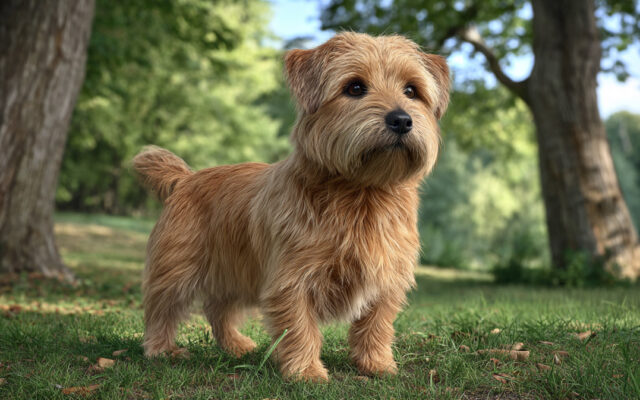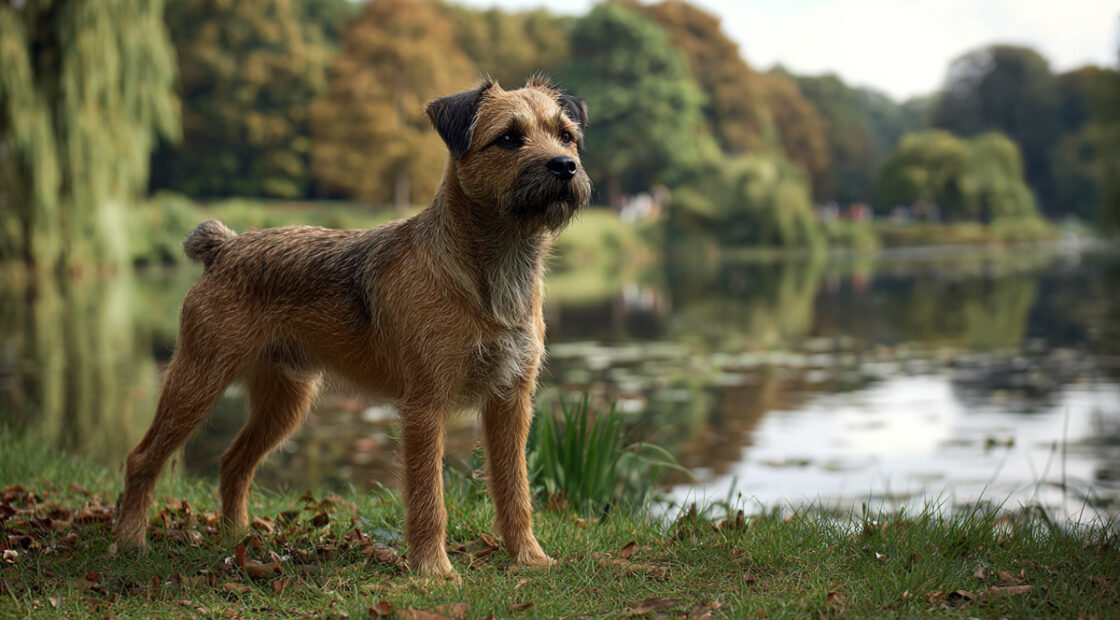
Border Terriers came out of the Cheviot Hills country of Northumberland, where farmers needed a small dog that could keep pace with horses and bolt foxes from their burrows. They have an otter-shaped head and a wiry double coat, and the legs run longer than on many other terriers. The hunting instincts never left.
The breed isn’t rare, either. Kennel Club registration tables list 5,426 UK registrations in 2015 and 3,675 in 2024. That’s a drop, but the 2024 total still exceeds the Cairn Terrier’s 467 and the Lakeland Terrier’s 86 by a wide margin.
What Is a Border Terrier?
Small, rough-coated and part of the Terrier Group, the breed was shaped by its job. The Kennel Club standard (last updated 1 January 2025) asks for a deep, narrow, fairly long chest that two hands can span behind the shoulder.
Origin in the Anglo-Scottish borders
The breed developed in the 18th century in the hill country around the Cheviot Hills, where Northumberland meets Scotland.
Farmers there needed a dog small enough to go to ground and long-legged enough to follow the hunt. Breed histories say the stock most probably matches that of Bedlington Terriers.
The Dandie Dinmont Terrier has the same ancestry, so all three trace back to that stretch of border country.
What the breed was bred to do
The Kennel Club standard describes a terrier capable of following a horse, which explains the legs. The fox work came on top of that. The dog goes to ground and either drives the fox out or barks and holds it in place until it is dug out (Dogs Victoria).
Farm work covered ratting too, and Dogs NZ adds marten, otter and badger to the list.
What came out of all this is a game dog that is not aggressive toward other dogs or people, according to Dogs Victoria.

Names and kennel club recognition
Valley by valley, the same dog was a Coquetdale Terrier, a Redesdale Terrier or a Reedwater Terrier before the name settled.
By the late 1800s it was the Border Terrier, named for its long association with the Border Hunt in Northumberland.
It first appeared on the bench in the 1870s (Dogs NSW). The first Kennel Club registration came in 1913, and full Kennel Club recognition followed in 1920, the same year The Border Terrier Club formed. The American Kennel Club recognized the breed in 1930 and the United Kennel Club in 1948.
Hill’s Pet points out that it never got the show-ring popularity other terriers did, so the form still follows the work.
Border Terrier Size, Coat and Colors
On looks alone, this is a light terrier with an otter-shaped head and a wiry double coat, and the standard allows four colors.
Height and weight
Neither the Kennel Club nor the AKC fixes a height for the breed.
Both set weight instead, and the AKC adds a proportion rule: height at the withers slightly greater than the length from withers to tail.
The Kennel Club standard puts dogs at 6-7 kg (13-15.5 lb) and bitches at 5-6.5 kg (11.5-14 lb). Real-world numbers run heavier. A study of vet clinics in England found a median adult bodyweight of 10.9 kg for males and 9.1 kg for females (O’Neill et al., 2017, Canine Medicine and Genetics).
The AKC states its figures as weights for dogs in hard-working condition, not for the average household pet. The Kennel Club also tells puppy buyers that a dog can come out larger or smaller than the figures given.
Put the two sources side by side and the clinic median lands 3.9 kg over the standard’s ceiling for males and 2.6 kg over it for females. Judge conformation against the standard. Expect the scale to read higher, though.
Coat texture and colors
The coat is double, with a short, dense, soft undercoat beneath a harsh, wiry, weather-resistant outer layer that lies close to the body (Dogs Victoria).
| Feature | Kennel Club standard |
|---|---|
| Coat | Harsh and dense, with a close undercoat |
| Colors | Red, wheaten, grizzle and tan, or blue and tan |
| Head | Otter-like, moderately broad skull, short strong muzzle |
| Ears | Small and V-shaped, dropping forward close to the cheek |
| Eyes | Dark, with a keen expression |
A black nose is preferred. A liver or flesh-colored nose is not a serious fault.
The Kennel Club lists four colors. Some breed profiles, Dogs Victoria among them, add black and tan, so check which standard a breeder follows.
What Is the Border Terrier’s Temperament Like?

Active and game, according to the Kennel Club standard, and with a mind of its own. The AKC standard adds good-tempered, affectionate, obedient and easily trained.
Bred to hold a fox in place without fighting it, the dog came out as a worker that is not aggressive with other dogs or people (Dogs Victoria). Purina New Zealand calls it a softer, less feisty and more social terrier than most.
Owners get a loving companion that wants to be near them (Dogs NZ). It’s robust and active, so family outings suit it, and Purina New Zealand says it settles in town or country provided the exercise happens.
The downsides are the usual terrier ones. Dogs NZ mentions digging and some barking, and PetMD adds escape attempts from fenced yards, so outdoor time needs supervision. A worried or lonely dog left alone gets destructive (PDSA).
With children

Purina New Zealand ranks the Border Terrier among the better terriers with children, because it is robust, active and more patient than many.
PDSA still advises supervising any dog around children and vulnerable adults.
With cats, dogs and small animals
Other dogs are usually fine if the Border Terrier was socialized young (PDSA). Cats are fine if the dog was raised with one, with supervision (PDSA), and Dogs NZ calls the breed generally good with cats. Rodents, birds and small pets are a poor match because of the hunting instinct (Orvis, Dogs NZ).
Purina Australia says the breed lives in harmony with other household pets, yet it also notes the love of chasing rabbits and squirrels.
Read together, the sources describe a dog that tolerates animals it grew up with and treats small unfamiliar ones as quarry.
How Much Exercise and Training Does a Border Terrier Need?

Plan on about an hour a day. Walks and off-lead running cover most of it, and play fills the gaps.
Sources don’t quite agree on the figure. The Kennel Club says up to 1 hour per day, PDSA says a minimum of 1 hour on top of playtime and training sessions, and Dogs NZ simply rates the need as moderate. Both UK sources land on one hour, so an hour is the safe working figure.
Skimping has a documented cost. PDSA warns that a lonely or worried Border Terrier turns destructive indoors, and Orvis says the breed needs mental stimulation as well as exercise to behave in the house.
On trainability, the AKC standard calls the breed easily trained, and Purina New Zealand ranks it among the easier terriers.
Purina Australia names the catch. The dog is independent, so training takes firmness and patience, and it should start early.
Dogs Victoria says to teach walking off lead and recall from the day the puppy arrives. It also notes the breed is very food driven and responds well to treat rewards.
Treat off-lead reliability as conditional anyway. A dog bred to chase and dig will often pick the rabbit over the recall cue.
Earthdog trials test the go-to-ground instinct, and agility and tracking suit the breed too. Care home and hospital visiting is another option (Dogs Victoria).
Do Border Terriers Shed, and How Often Does the Coat Need Hand Stripping?
Shedding is light, but the dead coat stays put until someone strips it out.
Hill’s Pet says the dog sheds minimally and the coat does not shed out completely without help. PDSA goes the other way and says the dog sheds throughout the year.
The Southern Border Terrier Club cautions against the claim that the coat does not molt. Loss rises as stripping time nears and drops right after a strip.
| Source | Suggested stripping interval |
|---|---|
| Hill’s Pet | About twice a year |
| Tesco Bank pet insurance | Every 5 to 6 months |
| Wahl grooming guide | About 4 times a year |
Twice a year is the common answer for pet dogs. Wahl, a clipper maker, says four times a year cuts the loose hair around the house.
Show dogs follow a stricter standard. The AKC wants the coat shown almost natural, with only the head, neck and feet tidied.
Clipping changes the coat. The Southern Border Terrier Club says it turns the coat softer and less waterproof, and warns that groomers often clip areas such as under the neck because it is quicker.
PetMD reports the same softer regrowth after clipping. The club’s advice is to learn the method from the breeder or find a groomer who owns Border Terriers.
Groomer to Groomer magazine describes the technique this way. Pinch and roll the back coat to count the layers before starting. Begin behind the occiput and pull in the direction of growth, straight back, so the hair comes out whole instead of breaking, and hold the skin taut with the other hand.
Between strips, brush weekly (Tesco Bank pet insurance) and clip nails little and often. Bathing is rarely needed, and frequent baths remove the natural oils that keep the coat waterproof (Southern Border Terrier Club).
Handle the paws from puppyhood, since terriers can be touchy about them (Orvis).
Which Health Problems Affect Border Terriers?
The Border Terrier Health group’s reports keep returning to canine epileptoid cramping syndrome, SLEM, gallbladder mucocoele, Cushing’s syndrome and late-onset hereditary cataract.
Both the 2021 and 2023 breed health reports name those. Some breed pages still describe the breed as free of hereditary disease, which the breed’s own health group does not support.
Canine epileptoid cramping syndrome
Spike’s disease is the other name for canine epileptoid cramping syndrome (CECS), an episodic movement disorder that the breed health group files as paroxysmal gluten-sensitive dyskinesia.
Black et al. (2014, Journal of Small Animal Practice) recorded difficulty walking and mild tremor most often during episodes, along with dystonia, with episodes most often involving all four limbs.
Vomiting and diarrhea sometimes come just before or after an episode. A 2017 Journal of Veterinary Internal Medicine study combined owner surveys with EEG recordings and classed the syndrome as paroxysmal dyskinesia, not epilepsy.
Embrace Pet Insurance reports that no genetic screening test exists for CECS. Tested parents therefore do not clear a puppy of it.
Other breed-linked conditions
Gallbladder mucocoele has the clearest risk data and the widest disagreement on its size.
A single-centre hospital study led by Allerton put the odds ratio for Border Terriers at 72. A 2022 multicenter study in the Journal of Veterinary Internal Medicine (Butler et al.) found 11.66.
The designs differ, and the second followed dogs that already had biliary sludge. Both agree on direction. The breed carries a clear excess risk, and the 2023 breed health report adds that many dogs show no signs until a crisis.
SLEM, or shaking puppy syndrome, shows up as tremors from about 2 weeks of age. An official Kennel Club DNA test has existed since November 2017.
Cushing’s syndrome is an endocrine disease that raises mucocoele risk in the breed, and case reports were still rising in 2021.
Late-onset hereditary cataract gets screened by eye test under the BVA/Kennel Club scheme, with results added to the dog’s Kennel Club record.
Luxating patella means the kneecaps slip out of place. A vet checks for it before breeding (PDSA).
Common everyday problems
Dental disease heads the list of disorders recorded in Border Terriers at English vet practices, ahead of overweight and obesity (O’Neill et al., 2017).
The Royal Veterinary College’s summary of that study tells owners to watch diet and dental care. These are the problems an owner controls.
How Long Do Border Terriers Live?
Plan on roughly 12 to 14 years. Measured longevity sits near 12.7 years, and breed profiles quote a little higher.
Median longevity in English vet records is 12.7 years, with an interquartile range of 9.3 to 14.3 (O’Neill et al., 2017, Canine Medicine and Genetics). PDSA’s breed profile says over 12 years and Hill’s Pet says 13 to 14 years.
Insured dogs show a median age at death of 9.6 years against 7.4 for all breeds, with a relative mortality risk of 0.72 (Agria data, summarized by Dogwellnet).
The sources agree on direction and disagree on level. Vet-clinic and insurance data both put the Border Terrier ahead of the all-breed average, yet the insurance median sits about 3 years below the vet-clinic one.
The two sample different dogs (vet-clinic records against an insurer’s customers), and none of the sources reconciles the gap. Treat the profile figures as the optimistic end and plan around the measured median.
The RVC study summary links long life to diet and dental care. A long median is not risk-free, though, because Cushing’s syndrome and gallbladder mucocoele both tend to occur in middle-aged and older dogs (Border Terrier Health, 2023).
What Does a Border Terrier Cost, and How Do You Find a Healthy One?

Judge the source before the price. A puppy from tested parents costs more at the start and leaves fewer unknowns.
PDSA lists no purchase price for the breed, only a warning that unusually cheap puppies can come from puppy farms. It recommends Kennel Club Assured Breeders, who must do extra health tests.
Running costs are easier to pin down than purchase prices. PDSA puts a Border Terrier at a minimum of 70 pounds a month after purchase and set-up, and over 12,000 pounds across a lifetime, which shows how expensive a dog gets over a full life even in a small, healthy breed.
Set-up covers vaccines, neutering at around six months and equipment. After that come food, preventive healthcare and insurance or vet bills, and some owners add training, boarding, day care or a dog walker.
When you contact a breeder, ask for these.
- SLEM DNA results for both parents, searchable in the Kennel Club Health Test Results Finder (breed health advice is that at least one parent of a pair should be clear)
- Cardiac and patella evaluations, the two items the AKC lists for the breed
- Eye test results from the BVA/Kennel Club scheme
- Written documentation, since a “vet checked” statement is not genetic testing (Embrace Pet Insurance)
Sources list the Canine Health Information Center (CHIC) requirements for the breed differently, so ask which results the breeder holds. Read the results themselves. A CHIC number only records that required tests were performed, and it says nothing about whether the dog passed.
In the US, the Border Terrier Club of America bars its member breeders from placing puppies before 12 weeks or selling through pet stores, according to Vetstreet. The club also runs a rescue network.
| Option | Pros | Cons |
|---|---|---|
| Breeder puppy | Parental test results on file; early socialization can be checked | Higher upfront cost; late-onset problems stay hidden in puppyhood |
| Rescue adult | Often cheaper (PDSA); many problems already visible; breed-specific rescues exist | History can be patchy, so ask the centre directly |
Puppy farms aside, an adult rescue carries fewer health unknowns. A puppy from tested parents wins if you want to shape training from day one.
Border Terrier vs Cairn Terrier and Lakeland Terrier: Which Fits Better?
Of the three, the Border Terrier is the safest pick for a first terrier owner.
| Feature | Border Terrier | Cairn Terrier | Lakeland Terrier |
|---|---|---|---|
| Original job | Bolt foxes, follow horses | Hunt otter, fox and vermin along the shoreline | Go to ground and kill fox |
| Standard size | Weight-only standard | 28-31 cm, ideally 6-7.5 kg | 36.8 cm maximum, 7.7 kg average for dogs |
| Coat care | Hand stripping | Hand stripping | Wiry coat, grooming rated high |
| Trainability | Rated easy | Independent but friendly | Rated very hard |
| UK registrations, 2024 | 3,675 | 467 | 86 |
The table draws on the Kennel Club standard for Cairn size, Dogs NZ for Lakeland size and the ratings, UKC for the Cairn’s original job, Orvis for the Lakeland’s, Westminster Kennel Club for the Cairn’s temperament, and Kennel Club registration statistics for the last row.
The Cairn Terrier comes from the short-legged class, according to its AKC standard. A UK breed profile from Your Dog puts its exercise need around 30 minutes a day.
The Lakeland Terrier was used to kill fox, where the Border Terrier only had to bolt it (Orvis). Dogs NZ rates the Lakeland’s trainability very hard and its grooming need high, against easy and moderate for the Border Terrier.
The registration row works as a practical filter. Fewer registered litters mean a longer wait and a smaller pool of tested parents.
For a first terrier, pick the Border Terrier. Someone after shorter legs and a lighter exercise load should look at the Cairn Terrier, and an experienced owner who wants a fox-killing working heritage can go for the Lakeland Terrier.
When Is a Border Terrier the Wrong Dog?

Skip the breed if you want a guard dog or a tidy garden. The same goes for long days away from home.
Dogs NZ rates watchdog ability high and protection ability very low, so the dog raises the alarm and stops there. PDSA says the breed digs well, chews almost anything and is not the best pet if you like a tidy garden. It also says the breed is known for separation anxiety because it bonds closely with its owner.
Free-feeding is out too, since the breed gains weight easily (Hill’s Pet). Hill’s Pet also says no Border-proof toy exists, and that owners unwilling to crate or supply chews may be better off with another breed.
None of this is a defect. It follows from a working terrier’s design.
Before committing, get the SLEM, cardiac and patella results for both parents in writing. Walk the garden and secure the fence bottoms against digging (PDSA). Then look at your week honestly, because the breed needs its exercise and company every day for 12 years or more.
Border Terrier FAQ
Do Border Terriers bark a lot?
No, the breed is not known for being noisy, according to PDSA. It barks to signal unhappiness or to get attention, and how much varies by individual dog.
Can a Border Terrier live in an apartment?
Yes, provided the dog gets enough daily exercise. PDSA says the breed is happy almost anywhere, in a city or the countryside, though a secure garden is ideal.
At what age is a Border Terrier fully grown?
Full size comes by 12 months, according to Sainsbury’s Bank pet insurance.
Body weight keeps shifting after that, depending on diet and exercise.
Why does my Border Terrier smell?
A lasting smell usually points to a bacterial, yeast or skin infection, per Sainsbury’s Bank. Ear infection also ranks among the disorders recorded most often in the breed (O’Neill et al., 2017), so a vet check is the first step.
How much should a Border Terrier eat?
Your vet sets the amount, and PDSA suggests splitting the daily allowance into two meals of complete, balanced dog food.
Keep treats under 10% of daily calories, because the breed gains weight easily.
Should you get two Border Terrier puppies at once?
No. A UK breed profile from Your Dog warns that littermates bond with each other instead of with you, which makes training and recall harder.
What to Check Before Committing to a Border Terrier
Check the parental test results before anything else, since that is the one check nobody can redo after purchase.
- Parental SLEM, cardiac and patella results
- Fence line and garden layout
- Hours at home each week
The budget follows the same logic. Spread across the 12.7-year median life, PDSA’s lifetime total of over 12,000 pounds works out to about 79 pounds a month, roughly 9 above the 70-pound minimum.
Testing parents first narrows the pool of breeders and rules out the cheapest puppies. That trade-off buys a dog whose SLEM status is known, which no later check can supply.